
If your business already has a CDP, why do you still react late, personalize poorly, and argue over which customer record is real?
I'm Samuel Woods. I've been working with machine learning since 2016 and Generative AI since 2019, and I've watched this pattern repeat. Businesses buy data infrastructure expecting a strategic advantage, then discover they bought storage without decision power. That gap is where growth stalls.
The real question is whether your business can sense, decide, and act faster than competitors. More customer data won't answer it. An AI Customer Data Platform matters only if it becomes the nervous system for AI agents, automation, and revenue decisions across your business.
Table of Contents
- Your Customer Data Is Lying to You
- Moving From a Database to a Brain
- The Architecture of an Intelligent System
- Real Business Outcomes and Revenue Growth
- Example AI-Powered Marketing Workflows
- Your Pragmatic Implementation Roadmap
- The Only Moat Left Is Speed
Your Customer Data Is Lying to You
Most CDPs tell a flattering story. They say you have a unified customer view, a modern stack, and the foundation for personalization. Then you open the dashboard, export another list, and launch another campaign based on stale assumptions.
That's a tidier backlog, with no intelligence in it.
The market is moving hard in this direction. The global CDP market is projected to reach USD 11.68 billion in 2026 and USD 96.70 billion by 2034, with an estimated 80% of enterprises adopting a CDP by 2025, according to Polaris Market Research on the customer data platform market. I read that as an infrastructure shift, not a trend.
The lie is in the lag
Your current setup probably answers historical questions well enough. Who opened the email. Who bought last month. Which segment converted last quarter. Useful, but late.
You don't win with cleaner hindsight. You win when your system notices intent while the customer is still deciding.
Your customer data becomes dangerous when it gives you confidence without giving you speed.
If your profiles are incomplete, duplicated, or inconsistent, the AI layer on top won't save you. It will just automate mistakes faster. That's why I push owners to understand data quality for AI models before they chase agentic workflows or flashy personalization.
Organized data still loses to faster rivals
I've seen companies spend heavily on identity stitching, warehouse syncs, and dashboarding, then wonder why growth still feels manual. The answer is simple. Their CDP became a filing cabinet with better search.
If turning data into action still depends on someone pulling a report by hand, your business is slow by design. You can improve that by tightening your marketing data integration strategy, but integration alone won't create competitive speed.
Here's my blunt view:
- If your CDP stores profiles but doesn't drive next actions, it's overhead.
- If you still build static audiences by hand, you're lagging your market.
- If support, sales, and marketing don't share live context, what you have is disconnected memory instead of a customer brain.
That's the tension you need to face. Your customer data has value, but it tells you what happened after the moment that mattered.
Moving From a Database to a Brain
A traditional CDP stores. An AI Customer Data Platform evaluates, predicts, and activates. That difference changes how you compete.
I don't care how polished the demo is. If the platform can't help your business make better decisions in the window when buyers are still persuadable, you're paying software rent.
Why storage is not strategy
According to McKinsey, companies that make intensive use of customer analytics are 2.6 times more likely to outperform competitors in revenue growth, as cited in this summary of customer data platform benefits. That number matters because it points to a business truth. Deep customer understanding compounds when it feeds action, not reporting.
A database is passive. It waits for someone to query it.
A brain is active. It senses signals, attaches context, updates memory, predicts likely outcomes, and chooses an action path.
That's the mental model I want you to use when you evaluate tools.
| System type | What it mainly does | What your team feels |
|---|---|---|
| Traditional CDP | Collects and organizes customer data | Better reporting, slow activation |
| AI Customer Data Platform | Interprets signals and supports decisions in real time | Faster campaigns, sharper prioritization, less manual work |
What a brain does differently
An AI Customer Data Platform should do four things well.
It should ingest live events from tools like Salesforce, HubSpot, Shopify, Klaviyo, Zendesk, Stripe, and your product analytics stack.
It should maintain context around the customer as well as identity. That means recency, sequence, channel preference, support friction, purchase behavior, and likely intent.
It should run reasoning layers on top of that context. Churn prediction. Lifetime value estimation. Affinity scoring. Offer selection. Content generation shaped by profile context.
It should orchestrate action through automations and agents. Email, ads, sales alerts, support prioritization, on-site personalization, renewal intervention.
Here's a practical rule. If your platform can't move from signal to action without a human rebuilding context each time, it's still a database.
Most AI CDP messaging tends to get sloppy. Vendors talk about intelligence, but they often mean a few predictive widgets bolted onto a conventional data model. That's not enough.
A real AI Customer Data Platform becomes a business operating layer. Marketing stops guessing who needs what. Sales stops chasing accounts without current intent. Support stops treating every user with the same urgency. The business gets sharper because the system keeps score continuously.
That's what a brain buys you. Not more records. Better moves.
The Architecture of an Intelligent System
Most owners hear terms like identity resolution, feature store, LLM, orchestration engine, and agent framework, then tune out. That's a mistake. If you don't understand the architecture at a practical level, you'll buy overlapping tools and still end up with a slow system.
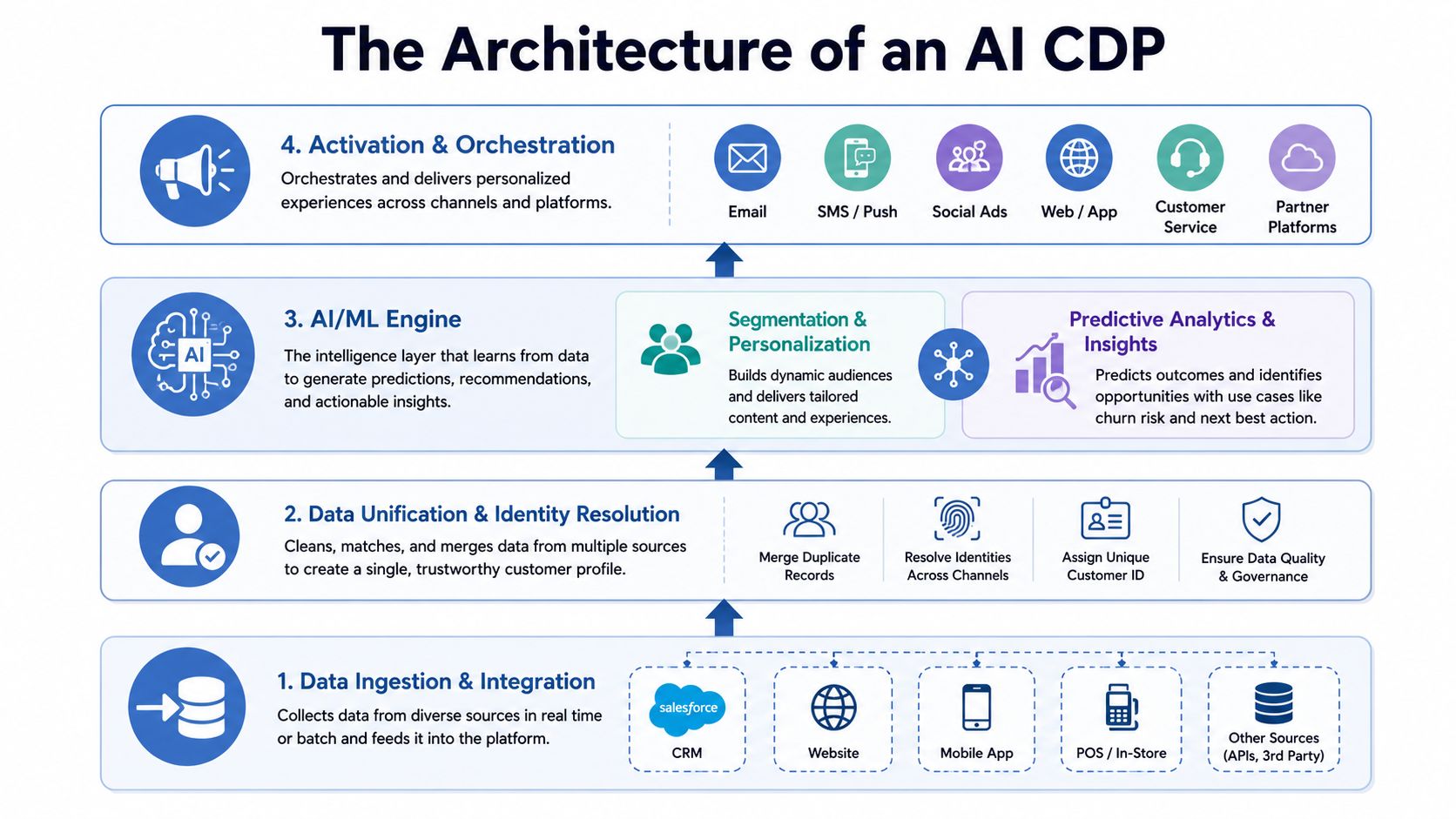
Here's the architecture I trust.
Identity is the foundation
Everything starts with data ingestion and integration. CRM data, website behavior, mobile app events, POS transactions, support tickets, email engagement, subscription data. If those streams don't land cleanly, the rest of the stack is fiction.
Then comes identity resolution. This is the bedrock. If one customer appears as three people across HubSpot, Shopify, and Intercom, your AI will make weak decisions because it's reasoning on broken context.
That means matching records, resolving duplicates, assigning durable IDs, and keeping the unified profile current. Not glamorous. Completely necessary.
A lot of people want to jump straight to prompts, copilots, and agentic campaigns. Bad move. Before you do that, get clear on how to train an AI agent on your company data, because training or grounding an agent on fragmented customer context produces polished nonsense.
The shared memory layer agents need
This is the part most CDP content misses. AI agents need more than data access. They need shared memory, live context, and feedback loops.
CDP.com puts it directly. AI agents require a shared memory layer to operate as one intelligent system, and most guides ignore how real-time API access and feedback loops inside a CDP enable context-aware decisions. That point comes from CDP.com's explanation of why every AI agent needs a CDP.
Without that memory layer, your agents become isolated bots. The marketing agent doesn't know support just logged a negative interaction. The sales agent doesn't know the buyer returned to pricing. The service agent doesn't know this account is in a renewal sequence.
That's where the feature store or real-time serving layer matters. It exposes current traits and signals to models and agents in a format they can use quickly. Think churn propensity, product affinity, engagement recency, likely channel preference, and account health state.
Models reason and agents act
Above the memory layer sits the AI and ML engine.
Some models are predictive. They estimate churn risk, likely conversion, or customer value. Some are generative. They draft personalized content, summarize account context, and shape responses using live profile data. The best systems combine both.
Then you need activation and orchestration. Through them, intelligence becomes money.
A short comparison makes it clearer:
| Layer | Job | Business outcome |
|---|---|---|
| Predictive ML | Scores risk, value, and intent | Better prioritization |
| LLM layer | Generates tailored messaging and summaries | Faster execution with context |
| Agent layer | Executes workflows across tools | Less manual coordination |
| Orchestration layer | Pushes decisions into channels | Faster customer response |
I'm opinionated here. If a vendor talks endlessly about dashboards and audience builders but can't explain how agents access live customer state across systems, they're selling old architecture with new branding.
The point of this stack is operational inference. The system observes, reasons, and acts while the opportunity still exists.
Real Business Outcomes and Revenue Growth
Architecture only matters if it moves revenue, lowers waste, or increases speed. Otherwise it's expensive theater.
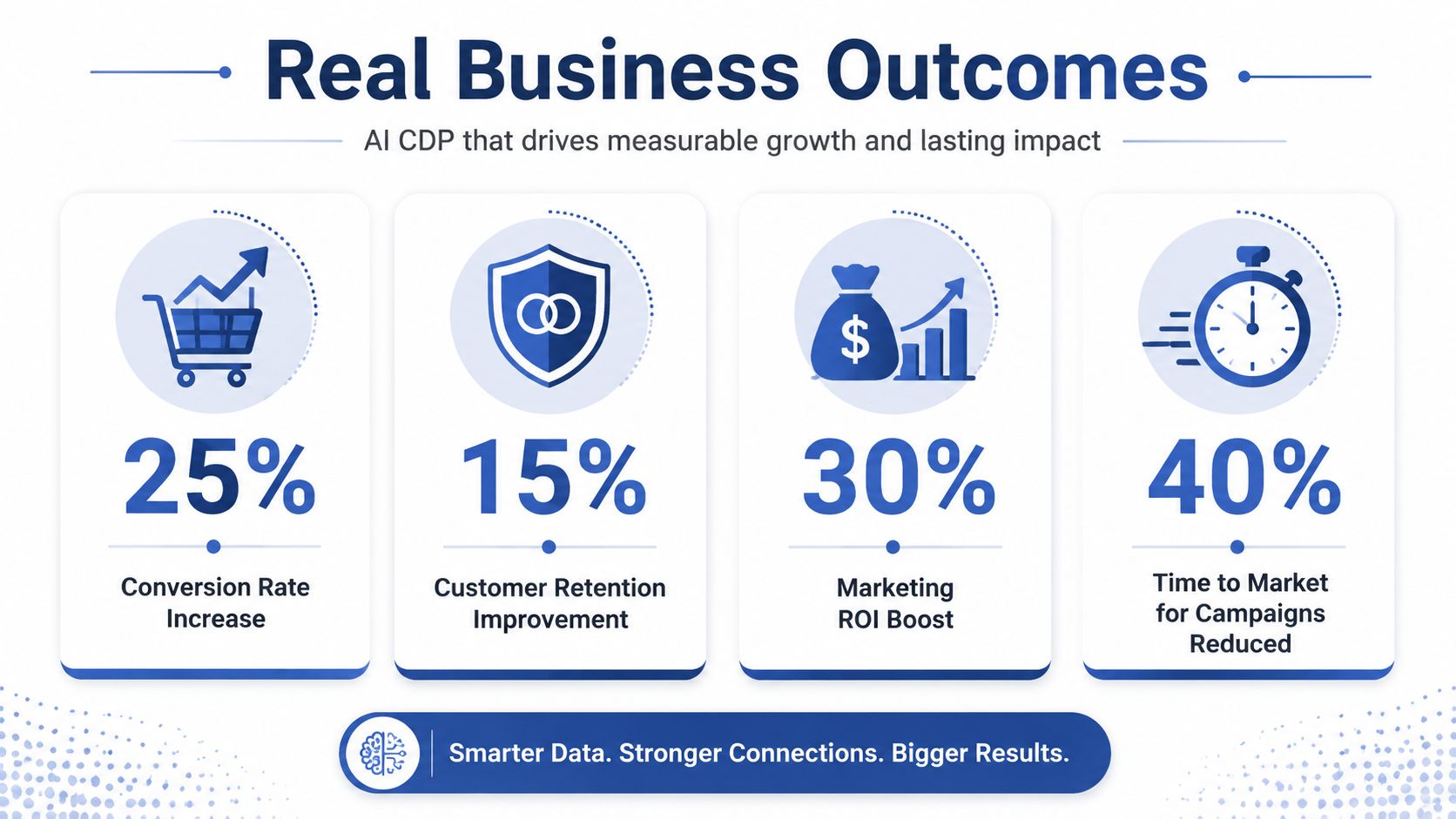
Here's the strongest business case for an AI Customer Data Platform. Companies using a CDP report significant returns: 93% see reduced customer acquisition costs, 90% experience improved customer loyalty, and 89% see an uptick in online sales, according to VWO's roundup of customer data platform statistics.
Early in the section, it helps to look at the outcome visually.
Where the return actually shows up
Most owners ask the wrong question. They ask whether the platform will centralize customer data better. That's an IT question.
The useful question is this. Where does the return hit the P&L first?
Usually in three places:
- Acquisition gets more efficient, because better targeting and suppression reduce wasted spend and lower CAC.
- Retention and loyalty improve, because the system catches risk earlier and personalizes interventions before the relationship decays.
- Sales expand, since cross-sell and upsell become timely when the system sees real intent signals instead of static segments.
That's why I take AI CDPs seriously when they're implemented properly. They tighten the loop between customer behavior and commercial action.
A second data point matters here too. Enterprise customers using CDPs report a 30% lift in customer engagement and a 30% increase in marketing efficiency, according to Coworker.ai on enterprise customer data platforms. That's a real gain: you get more output from the same people and media budget.
Why owners should care about operational lift
The AI CDP is valuable because it compresses time between signal and execution. A shopper views a pricing page, clicks a product email, opens support chat, and revisits your comparison content. In a weak stack, those become isolated facts. In a strong stack, they become one commercial moment.
This short video gives a useful overview of how that translation from data to action plays out in practice.
A good AI CDP improves marketing and also changes how fast the whole business can respond to demand.
That said, not every company should rush in.
If you have low traffic, weak first-party data, a tiny product catalog, or no operational discipline around CRM and lifecycle marketing, you won't get full value yet. In that case, fix instrumentation, event tracking, and channel basics first. AI doesn't rescue sloppy operations. It amplifies them.
But if you already have real customer touchpoints across web, email, product, commerce, and support, then delaying the move has a cost. Your competitors learn faster from each interaction while you still wait on reports.
Example AI-Powered Marketing Workflows
Theory sounds intelligent. Workflows make money.
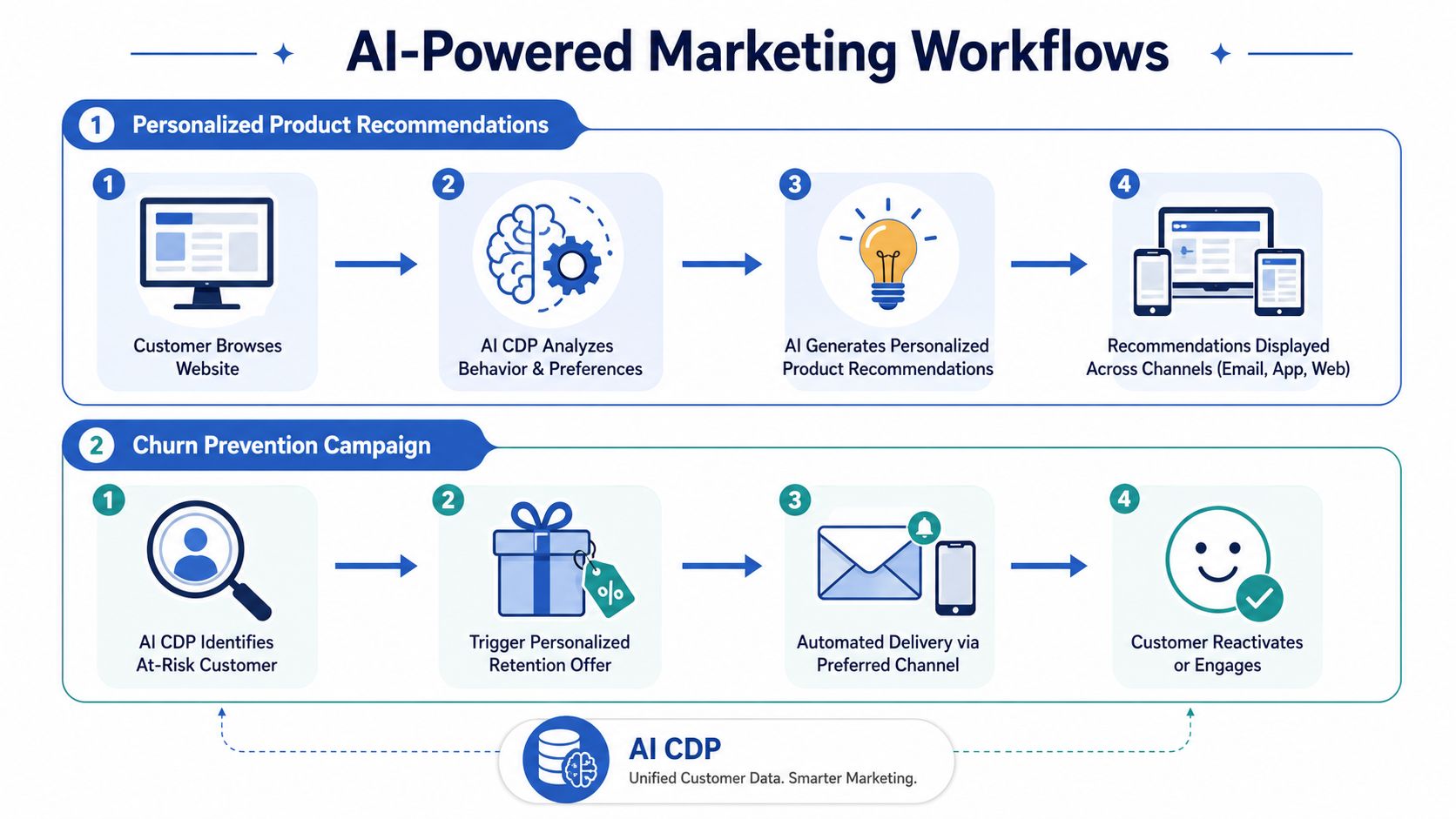
A modern real-time CDP updates customer profiles instantly when new events happen, such as product views or email clicks, which lets brands segment audiences and trigger next-best actions from live behavioral signals rather than delayed history. Adobe explains that clearly in its overview of what a customer data platform is.
That single capability changes how marketing runs.
Workflow one proactive churn prevention
A customer hasn't cancelled. Yet.
But the signals are there. Fewer logins in the product. Slower response to lifecycle emails. A support ticket with negative sentiment. A drop in feature usage tied to activation milestones. In a legacy stack, nobody sees the whole pattern quickly enough.
In an AI Customer Data Platform, the profile updates in real time, the churn score moves, and an agent can trigger the retention workflow before the account goes dark.
Here's how I'd run it:
- Detect the signal. Product activity falls, support friction rises, and email engagement weakens.
- Update the profile. The unified profile changes immediately.
- Run the model. The churn model classifies the account as at risk.
- Let the agent act. An agent drafts a personalized retention message, selects the best channel, and alerts the account owner if human intervention is warranted.
- Close the feedback loop. The system tracks whether the customer re-engages and adjusts future actions.
That's an operating advantage you can measure.
Workflow two dynamic opportunity capture
Now the upside case.
A shopper browses several high-margin products, clicks an email, reads shipping details, then returns to the site from a paid campaign. These actions are often still treated as separate channel events. That's why their offers feel generic.
An AI Customer Data Platform sees one buying pattern. It updates the profile, identifies the likely category interest, and pushes a personalized offer through the right channel while intent is active.
If you want a useful outside perspective on this kind of execution, Refact has a solid pragmatic guide to AI personalization. It's worth reading because many businesses overcomplicate personalization when the primary win comes from acting on a handful of strong signals quickly.
I've built similar logic into marketing automation workflow examples for companies that needed faster campaign response without adding more manual segmentation work.
A simple contrast shows the difference:
| Legacy workflow | AI-powered workflow |
|---|---|
| Weekly segment refresh | Continuous audience updates |
| Static promotional sequence | Offer changes based on live behavior |
| Human reviews edge cases later | Agent handles routine decisions immediately |
| Channel teams work separately | One system coordinates email, site, and sales alerts |
The practical win is a shorter delay between buyer intent and business response. Call it personalization if you like.
These workflows are why I call the AI CDP a nervous system. It remembers, and it reacts.
Your Pragmatic Implementation Roadmap
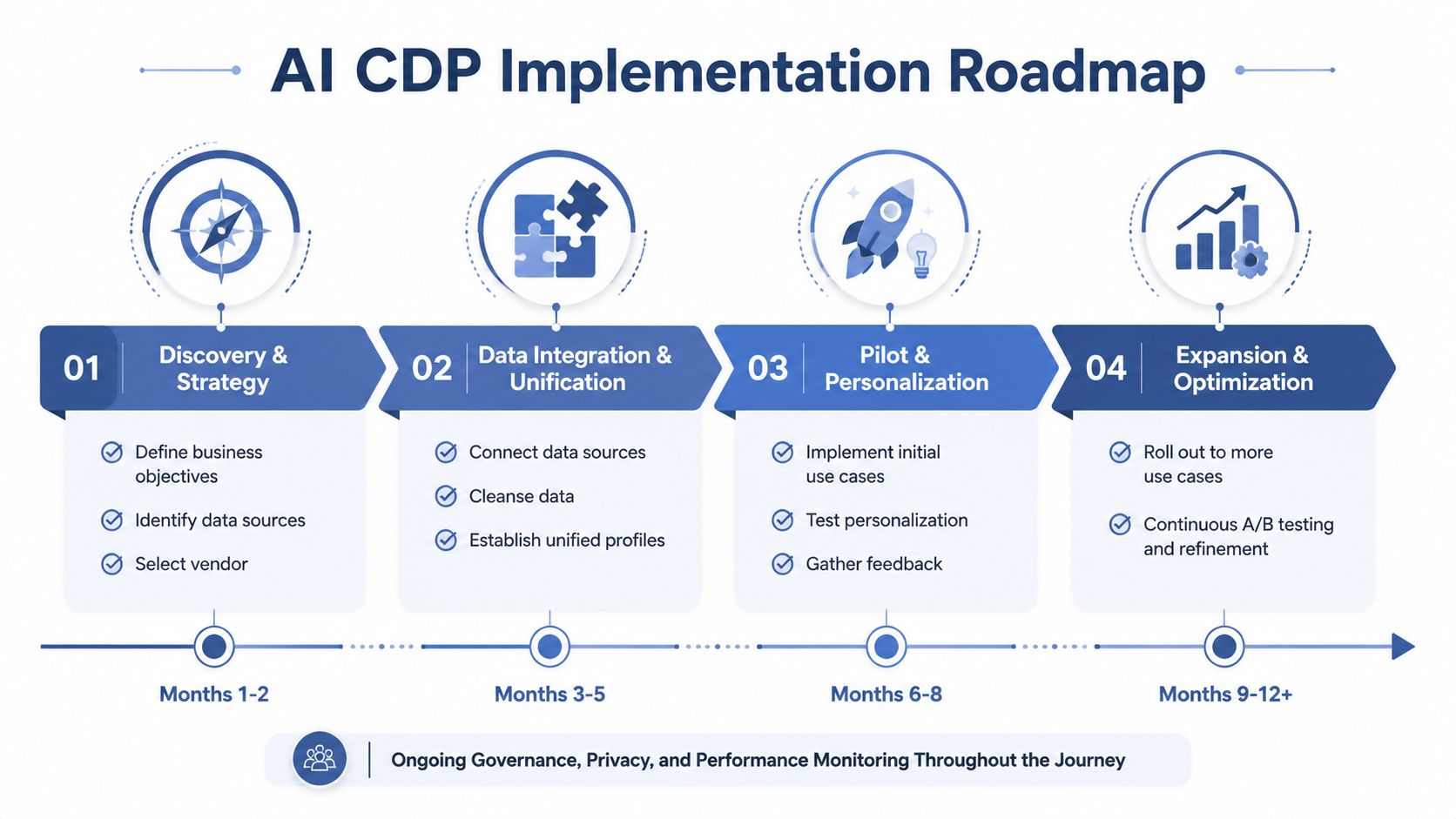
Most AI CDP projects fail because someone buys a platform before defining a use case, a data standard, or an execution model. That's backwards. You don't start with software. You start with one business bottleneck worth fixing.
Also, don't try to operationalize ten GenAI use cases at once. IDC notes that 60% of organizations struggle to define practical GenAI use cases for CDPs, according to IDC's piece on transforming customer experience with CDP and generative AI. That's why narrow focus wins.
Phase one clean the pipes
Start with data hygiene and identity resolution.
Map your core sources. Usually CRM, commerce, product analytics, email platform, support desk, and billing. Standardize event names, reconcile duplicate records, define the customer ID strategy, and lock down consent handling.
If you skip this, every later model and workflow gets worse.
Phase two launch one high-value model
Don't boil the ocean. Pick one problem with direct commercial value.
Good first bets include churn risk for subscriptions, next-best-product scoring for ecommerce, or lead prioritization for sales-assisted funnels. The key is simple. The model must influence an action you can take this quarter.
A practical filter helps:
- Someone clearly owns the result, even if that someone is you.
- The needed data already exists or is easy to instrument.
- You know what to do when the score changes.
Phase three connect the first agent
Companies either become faster or stay theoretical at this point.
Connect one AI agent to one bounded workflow. For example, a retention agent that drafts outreach for at-risk accounts, a sales agent that summarizes account context before calls, or a lifecycle agent that selects content blocks for active buyers.
Don't give the agent broad freedom yet. Give it a tightly scoped role, a clear action space, and visible logs.
The rule I follow: start with one agent whose output you can audit line by line.
Phase four scale what proves itself
Once one workflow is working, expand by adjacency.
If churn prevention works, add renewal prioritization. If product recommendation works, add cross-channel offer sequencing. If support summarization works, feed service signals into lifecycle marketing.
This is the maturity curve I like:
| Phase | What you focus on | What success looks like |
|---|---|---|
| Foundation | Clean data and unified identity | Trusted profiles |
| Intelligence | One predictive or generative use case | A decision improves |
| Activation | One agent in one workflow | Faster execution |
| Expansion | More channels and use cases | Compound learning across teams |
When should you not do this? If your business still lacks basic tracking discipline, if nobody has settled the primary customer journey, or if no one is prepared to own operational change. In those cases, an AI CDP becomes shelfware with a nicer interface.
The roadmap is not complicated. The discipline is.
The Only Moat Left Is Speed
Your competitors can copy features. They can copy pricing. They can copy messaging. They can even copy most of your AI prompts.
What they can't easily copy is a business that observes customer behavior, updates shared context, makes a decision, and acts while everyone else is still stitching together reports.
That's why I don't see the AI Customer Data Platform as another martech purchase. I see it as the central nervous system for AI agents, models, and people that need to move in sync. If it's just a better database, skip it. If it becomes your real-time decision engine, it's one of the few infrastructure bets that can still create distance between you and the market.
In 2026, the winners won't be the companies with the most data.
They'll be the ones that act on it first.