
You publish a strong article. Your team feels good about it. Then the traffic barely moves, the pipeline doesn't react, and the content bears the blame.
That diagnosis is usually wrong.
I'm Samuel Woods, and I've spent years building AI systems that help companies execute faster than competitors. In content, the biggest failure I see isn't weak ideas. It's weak distribution. Companies keep treating distribution like a final checklist item instead of the operating system that turns content into revenue.
If you want a real content distribution strategy, stop thinking in terms of one blog post, one social post, one launch day. Start thinking in systems. A repeatable engine. Preferably one that uses AI to remove manual bottlenecks and gives you a measurable edge in every channel that matters.
Why Your Content Dies Before It Is Even Seen
You publish a strong piece on Tuesday. By Friday, the team has already moved on, sales has not used it, email barely pushed it, social posted it once, and the market never noticed it existed.
That is how good content disappears.
The failure usually happens after approval, not before it. Teams put serious effort into writing, design, editing, and publishing, then treat distribution like a quick handoff. One post goes live. A few snippets get shared. Then everyone starts the next asset.
Creation does not create reach. Distribution does.
Earlier research referenced in this article makes the point clearly: many teams overinvest in production and underinvest in getting assets in front of buyers. The fix is not more content. The fix is a system that adapts, republishes, routes, and measures content across the channels that influence pipeline.
The problem is operational
When I audit a content program, I see the same failure points again and again.
- Publishing is treated as completion. Once the page is live, the team considers the job done.
- No one owns distribution end to end. Content, social, demand gen, sales, and lifecycle each do a small piece. Nobody runs the whole machine.
- Assets are not adapted by channel. The same headline, hook, and CTA get pasted into email, LinkedIn, and every other outlet.
- There is no learning loop. Teams cannot tell whether weak performance came from the topic, the format, the audience, the offer, or the timing.
Practical rule: If an asset gets one launch and one round of posts, you do not have a content distribution strategy. You have a publishing routine.
This is why average competitors keep showing up everywhere while better content stays invisible. They built a repeatable execution layer. Their advantage is not taste. It is output, speed, repetition, and follow-through.
Stop publishing. Start deploying.
Operate like a distributor.
Before a piece is created, decide who needs to see it, what formats it will become, which trigger starts distribution, how often it will be resurfaced, and what signal determines whether it gets expanded or retired. That is the difference between a content team and a content engine.
AI changes the economics here. It can generate channel-specific variants, match angles to audience segments, suggest resend windows, brief sales on follow-up usage, and surface which messages are getting attention across search, social, inbox, and outbound touchpoints. The point is not to automate for its own sake. The point is to out-execute competitors with a system that keeps working after the publish button is clicked.
Email deserves special attention because weak deliverability can kill distribution before the first message lands. If email is part of your owned channel mix, use this email deliverability consultant guide to tighten that layer.
Strong content rarely fails on merit alone. It fails because no operating system exists to carry it through the market.
Find Your Battlefield Through Audience Prioritization
A SaaS team publishes on LinkedIn because the CEO likes LinkedIn, cuts short videos because competitors are doing video, and posts on X because someone on the team says the algorithm is hot again. Six months later, traffic is flat, pipeline impact is unclear, and the team cannot explain which channel influences revenue.
That is what bad prioritization looks like.

Winning distribution starts with concentration. Pick the channels that match buyer behavior, then build a system that keeps showing up there with more speed and relevance than your competitors can manage manually.
Pick channels by buyer behavior
Use a simple filter. Where does your buyer discover the problem, evaluate options, and take action?
Where do they realize they need help?
Search results, niche newsletters, analyst content, LinkedIn feeds, communities, podcasts, referrals.Where do they compare solutions?
Product pages, case studies, review sites, webinars, sales emails, third-party writeups.Where do they convert or start a conversation?
Demo requests, contact forms, reply-driven email, direct outreach, booking pages.
If a channel does not influence one of those moments, cut it from the priority list.
This matters even more once AI enters the workflow. AI makes content output cheaper. It does not make attention easier to win. If you spread AI-generated content across every possible surface, you get more volume and the same weak result. If you focus AI on the few channels that shape buying decisions, you get compounding gains in coverage, testing speed, and message fit. That is the whole point of using AI for content creation systems that support channel-specific execution.
Score channels before you commit
Do not choose channels by habit. Score them.
| Channel | Buyer intent | Format fit | Measurement clarity | Sales impact |
|---|---|---|---|---|
| Organic search | High when buyers already know the problem | Strong for educational and commercial pages | Clear | Strong |
| High for nurture, follow-up, and reactivation | Strong for direct response | Clear | Strong | |
| Strong for B2B visibility and proof | Strong for opinions, clips, and customer stories | Moderate | Strong | |
| YouTube or short video | Strong when the sale needs explanation | Strong for demos and teaching | Moderate | Moderate to strong |
| Communities and partner placements | Strong when trust transfer matters | Depends on audience norms | Moderate | Moderate |
Use this as a decision tool, not a generic ranking.
A channel earns priority when it does three things: reaches the right buyer, fits the message format, and creates a measurable path into pipeline. Anything else is side activity.
Define ownership by segment
One channel rarely serves every audience segment equally well. Your enterprise buyer may discover ideas on LinkedIn, your technical evaluator may search for implementation guidance, and your champion may respond best to email follow-up with proof and examples.
Treat that as an operating constraint. Assign primary channels by segment.
- Category-aware buyers often respond to search and comparison content.
- Problem-aware buyers often respond to social education, founder-led content, and expert commentary.
- Late-stage buyers often respond to email, case studies, demos, and sales-assisted distribution.
At this stage, distribution starts to become a system instead of a checklist. One core idea can be routed to different audiences in different formats, then scheduled and adapted automatically. If you want to streamline content creation workflows, build around audience-channel pairs first, then generate derivatives for each pair.
Define what winning looks like before you publish
"More reach" is not a target. It is a vanity metric with good branding.
Set one primary outcome for each priority channel.
- Search: qualified visits to high-intent pages and conversions from those pages
- Email: replies, clicks into bottom-funnel assets, and reactivation of warm accounts
- LinkedIn: engagement from target roles and movement into owned channels
- Partner placements: referral quality, assisted conversions, and branded search lift
Then give each channel a job inside the larger distribution engine. Discovery channels create demand. Evaluation channels build trust. Conversion channels capture intent. Once those roles are clear, AI can support the execution layer by creating variants, tagging performance patterns, and reallocating effort toward the combinations that produce revenue.
You do not need to be everywhere. You need to dominate the few places that shape buying decisions.
The Content Repurposing Matrix You Can Actually Use
Creating new content for every platform is a terrible operating model. It burns time, drains budget, and usually produces weaker work because the team is constantly starting from zero.
A better system starts with one anchor asset and then breaks it into derivatives.
A practical workflow is to repurpose a single asset into multiple formats, such as turning a blog post into a video, infographic, or social posts, because that reduces production burden while extending reach across channels and audience segments (Mimeo on repurposing for distribution).
Start with one anchor piece
Your anchor piece is the deepest version of the idea. Usually that's a strong blog post, a webinar, a recorded interview, a whiteboard lesson, or a research-backed landing page.
From there, extract components:
- Claims become social posts
- Frameworks become carousels
- Examples become email sequences
- Objections become short videos
- Data or visuals become graphics
- FAQs become answer blocks for search and AI surfaces
If you want to streamline content creation workflows, the key is not just using AI to rewrite content. It's using AI to transform one source asset into channel-native variants with different hooks, lengths, and calls to action.
Content Repurposing Matrix Example
Here's a matrix you can hand to your team.
| Channel | Format | Angle / Hook | Call to Action |
|---|---|---|---|
| Blog | Long-form anchor article | Deep explanation of the core problem and solution | Read the full guide or book a call |
| Opinion post | Strong point of view on why most teams waste content | Comment or visit the article | |
| Carousel | Step-by-step framework pulled from the article | Download, save, or click through | |
| Newsletter intro | What changed, why it matters, what to do next | Read the full article | |
| Nurture sequence | One objection or insight per email | Reply, book a demo, or view case studies | |
| X or Threads | Thread | Breakdown of the argument into quick lessons | Click to the full resource |
| Short-form video | Talking-head script | One tactical insight with a sharp opening | Watch full version or visit landing page |
| YouTube | Explainer video | Expanded walkthrough of the framework | Subscribe or book consultation |
| Sales enablement | One-page summary | Practical takeaways for prospects in evaluation | Share with decision-maker |
| Community post | Discussion starter | Ask a high-value question based on the topic | Join the conversation |
| Infographic | Visual process | Condense the system into a simple visual | Download or share |
| FAQ page | Answer blocks | Direct responses to recurring questions | Move to demo or contact form |
Don't repurpose mechanically
It is a common mistake to confuse repurposing with reposting.
Repurposing means adapting the asset to platform behavior. A blog paragraph pasted into LinkedIn is lazy. A blog argument reframed as a carousel with a contrarian first slide is distribution.
I wrote more about this kind of system design in my guide on AI for content creation. The same principle applies here. AI works best when you give it a clear source asset, a channel-specific goal, and a format constraint.
One good idea should feed your pipeline for weeks, not disappear after launch day.
The teams that win aren't creating more from scratch. They're extracting more value from every strong idea.
Aligning Distribution With Your Sales Funnel
A content distribution strategy that isn't tied to the sales funnel becomes a vanity project fast. You get impressions, likes, maybe some traffic, and still no clear movement toward revenue.
That happens when content is distributed without buyer-stage intent.
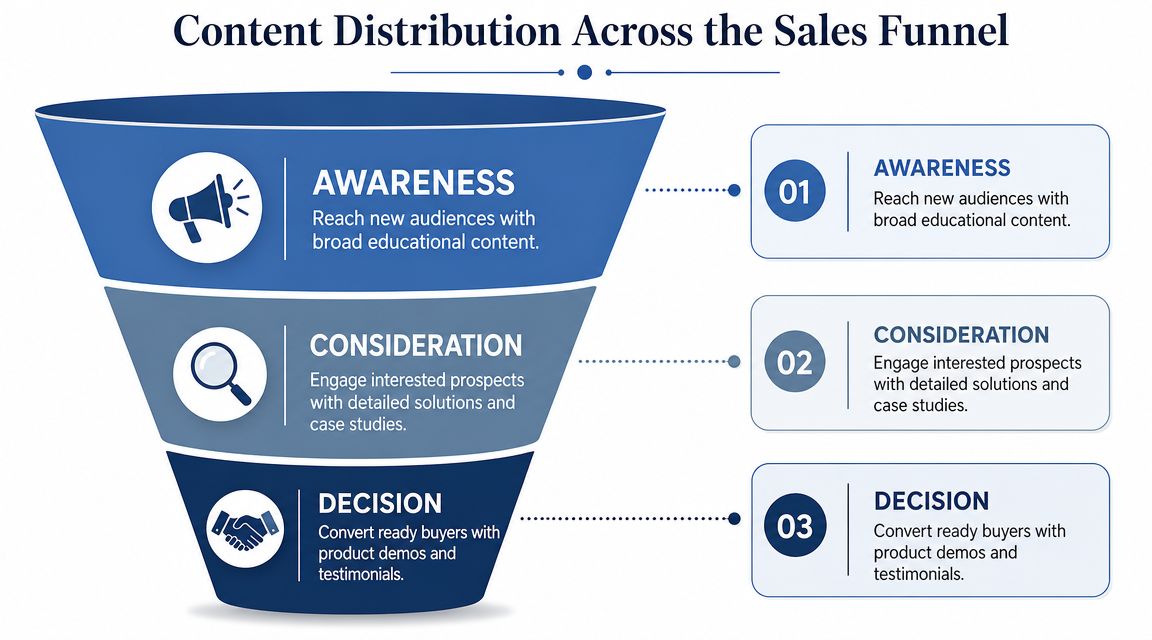
The fix is straightforward. Match asset type, channel, and call to action to the stage of the buying journey. Each stage asks for different proof and different distribution.
Awareness needs breadth and clarity
Top-of-funnel content should help buyers name a problem, understand a shift, or see a risk they hadn't framed correctly.
Good fits here include:
- Thought leadership posts on LinkedIn
- Educational blog articles optimized for discovery
- Short videos that explain a concept quickly
- Guest contributions or earned mentions that introduce your perspective to new audiences
The call to action at this stage should stay light. Read more. Watch the deeper explanation. Join the list. Follow for future insights.
Consideration needs specificity
Middle-of-funnel content should help the buyer compare approaches, understand trade-offs, and see why your method is more effective than the default.
This is where I like:
| Funnel stage | Best-fit content | Strong channels | Practical CTA |
|---|---|---|---|
| Consideration | Framework articles, webinars, deep email nurture, comparison guides | Email, organic search, retargeting, YouTube | View the full method, register, request details |
| Consideration | Case-style proof assets, implementation walkthroughs, FAQs | Email, site content, partner distribution | Talk to sales, evaluate fit |
The mistake here is being too vague. Buyers in consideration don't need more inspiration. They need reduction of uncertainty.
If your distribution sends awareness content to decision-stage buyers, you're making the sales cycle harder for yourself.
Decision needs proof and friction removal
Bottom-of-funnel assets should answer the final commercial questions. Why this solution. Why now. Why this vendor. Why this implementation path.
Use distribution that narrows the audience and raises relevance.
- Segmented email for engaged prospects
- Retargeting ads to commercial pages
- Sales-shared assets like implementation briefs or proof points
- Bottom-funnel landing pages designed for direct action
At this point, your content stops being media and starts functioning like sales infrastructure.
Aira's distribution framework emphasizes extending content through paid social, paid search, republishing partnerships, and influencer collaborations, while measuring outcomes through platforms like Google Analytics and Google Search Console. It also reflects the broader shift toward tracking traffic, conversions, engagement, and search visibility as part of distribution performance (Aira on measurable content distribution).
If your funnel mapping is tight, distribution does more than create visibility. It shortens the path from first touch to buying conversation.
Build Your Automated AI Distribution Engine
Manual distribution breaks at scale. It depends on people remembering tasks, rewriting assets repeatedly, switching between tools, and checking performance after the fact. That works for a while. Then output stalls and competitors who automate start moving faster.
AI becomes useful. Not for gimmicks. For throughput, consistency, and decision support.
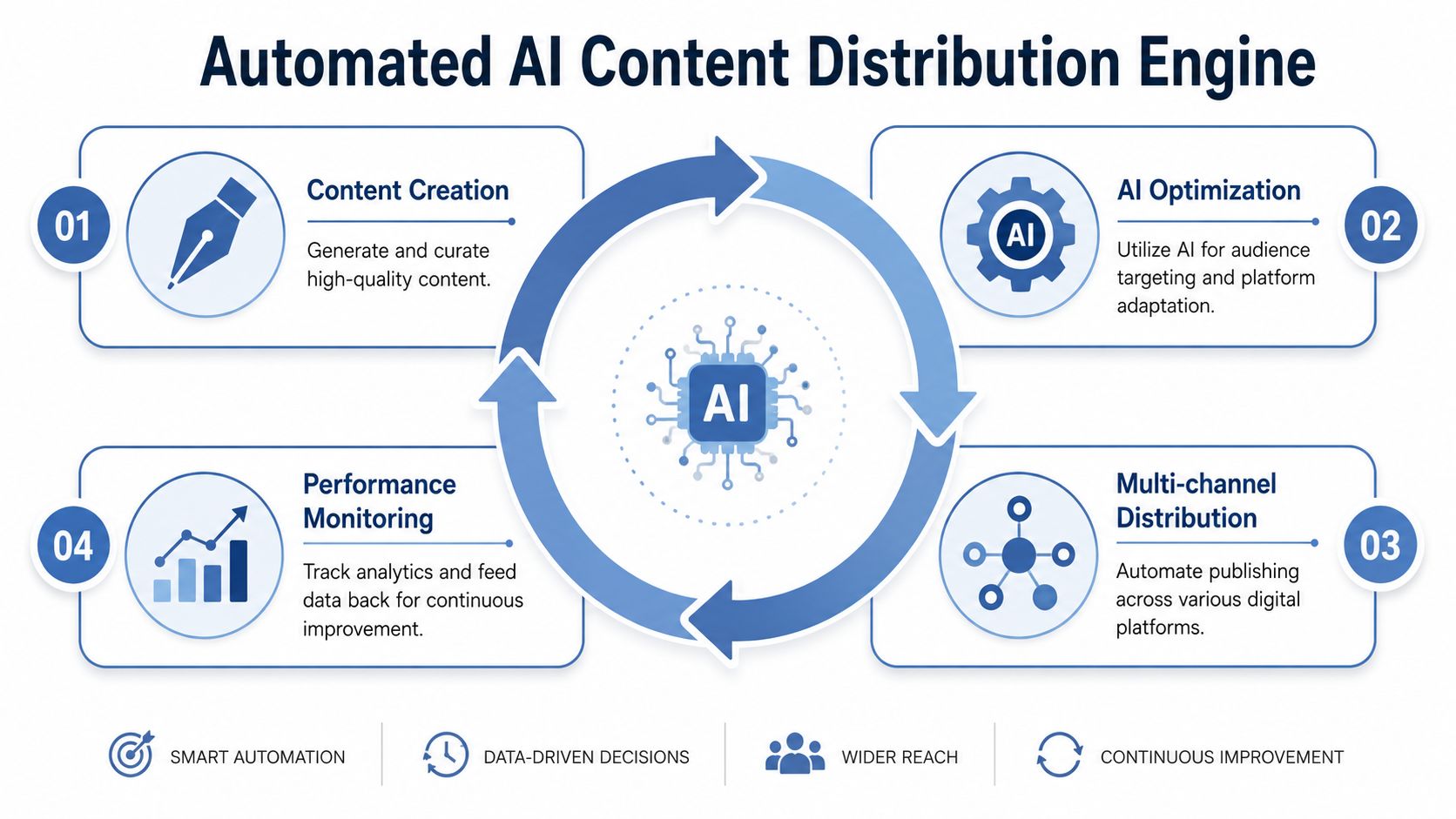
What the engine actually does
A serious AI-powered content distribution strategy should do four jobs well:
Ingest source content
Pull in the anchor asset, transcript, notes, metadata, and target audience context.Transform it into channel-native assets
Generate variants for email, LinkedIn, short video, community posts, paid copy, and internal sales use.Distribute with logic
Push assets to the right channels, at the right cadence, with human review where needed.Collect performance signals
Feed engagement, traffic, conversion, and cost data back into the system so the next round improves.
A practical workflow
Here's a workflow I like for lean teams using tools they can deploy.
| Step | Tool examples | What happens |
|---|---|---|
| Source capture | Notion, Google Docs, CMS, transcript tools | Final article or video transcript enters the workflow |
| AI transformation | ChatGPT, Claude, Gemini, custom prompts | The system creates post variants, email copy, summaries, titles, and answer blocks |
| Automation layer | Zapier, Make, n8n | Assets move to scheduling tools, spreadsheets, CRM, or approval queues |
| Publishing layer | Buffer, Hootsuite, HubSpot, email platform | Approved assets get scheduled and distributed |
| Analytics layer | Google Analytics, Google Search Console, platform analytics | Results are tracked and routed back into reporting |
A simple implementation looks like this. You publish a blog post. Zapier or Make detects it. An AI prompt package generates five LinkedIn variations, an email intro, a short video script, and a community post draft. Those go into an approval board. Once approved, the system schedules them and logs each asset against the source article.
That alone saves real operating time. More important, it creates repeatability.
Build for AI-mediated discovery too
The next frontier is bigger than social scheduling.
A major gap in current strategy is failing to optimize for AI-mediated discovery. The emerging KPI isn't only clicks. It's citation-worthiness and brand attribution within AI assistants and search overviews, which means your content needs to be formatted for extractability (Blumint on AI-mediated content distribution).
That changes how I structure content.
- Use clear headings so models can isolate sections cleanly
- Add concise answer blocks near common questions
- Strengthen factual originality so your content is worth citing
- Make entities explicit by naming products, roles, use cases, and categories clearly
- Keep summaries tight so they can surface cleanly in answer engines
Later in your workflow, AI can also score drafts for extractability before publication.
If you're exploring how agencies are adapting this kind of execution, Mallary.ai's social media AI insights are worth reviewing. The useful lesson isn't the novelty. It's how teams operationalize speed without losing control.
Here's a short walkthrough that complements this approach:
I also cover the infrastructure side in my guide to AI workflow automation tools. If you want one provider option rather than piecing everything together, Samuel Woods offers consulting around AI agents and workflow automation for content distribution systems, alongside other implementation paths like Zapier, Make, or custom internal stacks.
Automation should remove repetitive work, not remove judgment. Keep strategy, approvals, and brand-risk decisions with humans.
Don't automate chaos. Automate a strong process.
Measure What Matters A Closed-Loop Optimization Rhythm
If you can't tell whether a content asset failed because of weak messaging or weak distribution, you'll keep making the same mistake with more confidence.
That's why the last piece is measurement. Not bloated reporting. A closed-loop system that tells you what to amplify, what to rework, and what to kill.

High-performing teams use a closed-loop system to track KPIs like traffic, engagement, and CPA, which helps them separate content quality from distribution efficiency and decide whether an asset needs amplification or rework (Mailchimp on closed-loop content distribution measurement).
The dashboard I want you to build
Keep it simple. One row per asset. One view by channel. One view by funnel stage.
Track these categories:
| KPI area | What to watch | Why it matters |
|---|---|---|
| Traffic | Sessions or visits by channel and asset | Shows whether distribution is getting attention |
| Engagement | On-platform interaction, time on page, email clicks | Tells you whether the message is resonating |
| Conversion | Demo requests, lead captures, replies, qualified actions | Connects content to business outcomes |
| Efficiency | Cost per acquisition where paid is involved | Reveals whether amplification is economically sound |
This is enough to make smart decisions. Often, teams add too many metrics and then avoid acting on any of them.
How to read the signals
The point of the dashboard isn't reporting. It's diagnosis.
Use this logic:
High reach, low conversion
Your distribution worked. The content, offer, or landing experience needs rework.Low reach, high conversion
The asset has commercial value. Push it harder through email, syndication, social reposting, or paid amplification.High engagement, weak downstream action
Good topic. Weak call to action or wrong funnel alignment.Weak reach and weak engagement
Kill it, rewrite the angle, or reposition the asset.
This is what separates disciplined teams from content hobbyists.
Create a monthly operating rhythm
I like a simple cadence.
- Review asset-level performance
- Tag winners by format, channel, and buyer stage
- Refresh underexposed assets with strong conversion signals
- Remove channels or formats that drain effort without movement
- Feed the learnings back into the next creation cycle
If you're trying to connect this with broader marketing accountability, my guide on how to measure marketing effectiveness will help you tighten the reporting layer.
One more thing matters here. Owned, earned, and paid channels should not be judged with the same lens. A practical distribution workflow uses different success metrics by channel type. Owned channels are commonly measured with traffic, time on page, and conversions. Earned channels lean toward referral reach, shares, and brand lift. Paid channels focus on acquisition efficiency and return on ad spend. That channel-by-channel framing is one reason broad "publish everywhere" strategies usually underperform.
The closed loop is what turns content distribution strategy into a compounding asset. You publish. You amplify. You measure. You adapt. Then the next cycle starts from evidence instead of opinion.
Most companies don't need more content. They need a better system for getting their best ideas in front of buyers, repeatedly, across the channels that influence action.
Build the machine. Narrow the battlefield. Repurpose aggressively. Align distribution to the funnel. Automate the repeatable work. Measure what moves revenue.
That's how you stop feeding the content treadmill and start out-executing your market.