
Most advice on AI social media automation is weak. It tells you to schedule faster, post more often, and let a tool “handle your presence.” That's how companies create more content and less pipeline.
I'm Samuel Woods. I've been working with ML since 2016 and Generative AI since 2019, and I can tell you the winners don't build posting machines. They build systems that listen to the market, shape better messages, surface buying signals, and move qualified people into sales workflows.
That's the difference between content automation and commercial advantage. One gives you activity. The other gives you intelligence, speed, and a real shot at winning more of your market.
Table of Contents
- Stop "Automating" and Start Winning
- Design Your Social Intelligence Engine
- Build the AI Agent Workflow
- Select Your Automation Tech Stack
- Measure for Revenue, Not Applause
- The Two Automation Traps That Kill Growth
Stop "Automating" and Start Winning
Many teams using AI social media automation are just scaling noise. They've bought a scheduler with a prompt box, told it to write “thought leadership,” and now they're flooding LinkedIn and Instagram with polished irrelevance.
That approach loses for one reason. Buyers don't reward volume. Buyers respond when your message feels specific to their problem, their frustration, and their current moment in the market.
The market is moving fast. The global AI in social media market is projected to grow from USD 2.45 billion in 2024 to USD 3.34 billion in 2025, reaching approximately USD 54.07 billion by 2034, with a CAGR exceeding 36%, and 61% of organizations are implementing AI to reduce manual workload and improve daily efficiency, according to Electro IQ's AI in social media statistics. Joining the pile won't make your business win. What those numbers tell you is that your competitors are getting faster, and generic output is becoming cheaper by the day.
AI-generated posts often attract zero customers because they lack emotional depth and target everyone instead of a small, highly reactive group.
That's the core mistake. Broad messaging dies. Niche messaging that hits an exposed nerve creates comments, replies, demos, and inbound sales conversations.
The fix is operational. “Better prompting” in isolation won't get you there. You need a system that gives your models real context, strong positioning, and sharp audience boundaries. If you're trying to make your team operate this way, I'd read AY Automate for AI-native teams. It gets into the organizational side that most founders ignore.
Why most automation fails
Teams usually make three bad moves:
- They automate before they decide what matters. They optimize posting frequency before they define audience segments, buying triggers, and revenue goals.
- They ask AI to sound smart instead of useful. The output becomes safe, generic, and interchangeable with every other company in the feed.
- They treat social as branding only. That guarantees weak measurement and a hard time justifying the spend.
I see this constantly. A founder says social “isn't converting,” but their setup can't capture a single buying signal from comments, DMs, or post interactions. They built a calendar and called it a growth engine.
The winning position
Successful engagement comes from telling a model to “think about what this means emotionally” and writing for a niche group that feels strongly about the message, as discussed in this video on emotional depth in AI content. It sounds soft, but it pays off commercially.
If you sell B2B software to finance teams, don't write for “modern businesses.” Write for the controller who's tired of reconciling bad data at month end. If you sell ecommerce services, don't write for “brands.” Write for the operator who's watching margins get chewed up by acquisition costs.
A practical rule: if your post could apply to five industries and ten buyer types, it's too vague to drive revenue.
I've broken down similar operating principles in my guide to marketing automation best practices. The pattern is consistent. The companies that win with AI don't ask, “How do we automate content?” They ask, “How do we use AI to understand the market faster than everyone else and turn that advantage into pipeline?”
That's the shift. Stop automating output. Start automating insight, response, and conversion.
Design Your Social Intelligence Engine
Before you choose tools, build the architecture. If you skip this step, your stack will run your strategy instead of the other way around.
Build around signal, not volume
Your system should do five jobs well. It should listen, analyze, create, engage, and convert. That sequence matters because each stage feeds the next one with context.
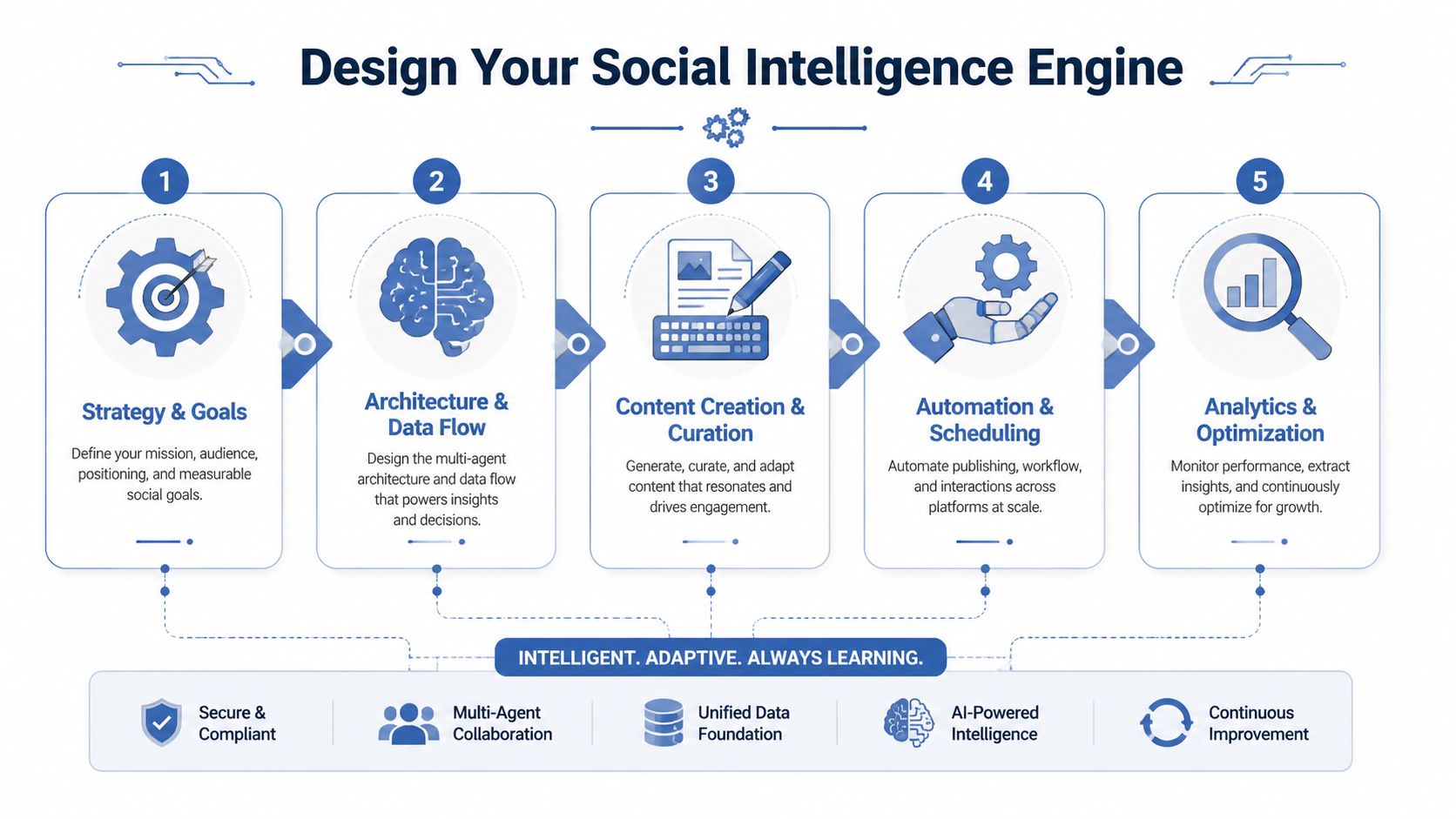
If you start with creation, you'll get generic content. If you start with listening, you get content grounded in live market conditions, customer objections, and competitor positioning.
To make that creation layer useful, feed your AI examples of your past content so it learns your brand voice and style, then keep monitoring performance to refine strategy and align outputs with business goals, as explained in this Powtoon guide on automating social media content with AI. That's why I push founders to treat brand context like training data rather than a vague style preference.
The five-part engine
Here's the model I use.
| Stage | What it does | Why it matters |
|---|---|---|
| Listen | Pulls market conversations, competitor themes, FAQs, objections, and recurring pain points | You stop guessing what buyers care about |
| Analyze | Clusters themes, flags sentiment shifts, spots patterns, and ranks opportunities | Your team focuses on what can move pipeline |
| Create | Drafts posts, hooks, carousels, scripts, replies, and follow-ups using your context | Output becomes sharper and more on-brand |
| Engage | Assists with comments, DMs, and early response handling | You respond faster without sounding robotic |
| Convert | Detects buying intent and routes leads into sales workflows | Social activity turns into measurable revenue motion |
I call this a social intelligence engine because it behaves like one. It senses, processes, and acts.
For most companies, the biggest opportunity sits between Analyze and Create. That's where your positioning turns into a repeatable editorial edge. One competitor keeps posting generic trends. You publish targeted content built from customer complaints, objection patterns, and response data from the last week.
Your AI system should know what your buyers are frustrated about before your content team opens a blank page.
If you want a deeper breakdown of agent roles and orchestration patterns, I've covered that in my piece on AI agents for marketing. That's the foundation for turning disconnected automations into one coordinated machine.
One more thing. Keep humans in the strategic layer. Let agents handle collection, synthesis, drafting, and routing. Keep offer positioning, escalation decisions, and brand-defining judgment with you and your team. That's where the advantage lies.
Build the AI Agent Workflow
At this stage, most companies either become dangerous or stay mediocre. The difference comes down to whether your agents work from live market input or from stale prompt templates.
Marketing departments that automate social posting report an average engagement lift of 20 to 30% per post and a 30% reduction in content creation time, according to Templated's social media marketing automation statistics. I'm not impressed by those numbers on their own. I care about why they happen. The lift comes when automation reduces friction and improves relevance. Mass-produced bland copy doesn't earn it.
A practical LinkedIn workflow
LinkedIn is where generic AI content gets exposed fastest. It's also where B2B revenue lives. So build your best workflow there first.
Use a four-agent chain:
The Market Listener.
Prompt: “Act as a market intelligence analyst. Monitor competitor posts, industry conversations, and recurring customer complaints. Return a daily brief with emerging themes, objections, and phrases buyers keep repeating.”The Insight Analyst.
Prompt: “Review the daily brief. Rank the themes by urgency, emotional charge, and closeness to purchase intent. Identify one contrarian angle and one practical angle.”The Content Strategist.
Prompt: “Using our voice guide and approved positioning, draft three LinkedIn post angles for one high-intent pain point. One should challenge common advice. One should teach a practical fix. One should tell a short operator story.”The Conversion Router.
Prompt: “Review comments and inbound replies. Tag signals such as budget ownership, active problem, implementation timing, vendor dissatisfaction, or request for more detail. Route qualified signals into CRM-ready summaries.”
That workflow is compact, but it changes everything. Your posts stop being guesses and become responses to visible demand.
Prompt structure that actually works
Bad prompts ask for output. Good prompts assign a role, define context, specify constraints, and require a format.
Use this pattern:
- Assign a role, so the model knows who it is.
- Give context: brand voice, audience, offer, and source material.
- Define the task as an exact job.
- Set guardrails for tone, exclusions, and compliance limits.
- Specify an output format your team can use immediately.
Here's a simple creation prompt:
“Act as a B2B content strategist for a company selling workflow automation software to operations leaders. Use the attached voice examples and the market summary from today's listener agent. Draft three LinkedIn posts that address one urgent pain point. Write with conviction, avoid generic inspiration, include one specific operational observation, and end with a question designed to surface real buyer intent.”
You'll also need a way to collect external data cleanly if you're building custom listening workflows. For that side of the stack, this guide on web scraping for AI developers is useful. It's relevant when you want your listener agents pulling structured data from public web sources instead of relying only on native platform dashboards.
A final recommendation. Don't let your engagement agent answer everything. Let it draft first-pass replies, flag sensitive comments, and prepare personalized follow-ups. Keep high-stakes interactions human. That's where deals are won or lost.
Select Your Automation Tech Stack
Most buyers do this backward. They demo a tool, get excited by the dashboard, and then try to force their business into the software's limitations.
That's lazy strategy. Your stack should fit your operating model.
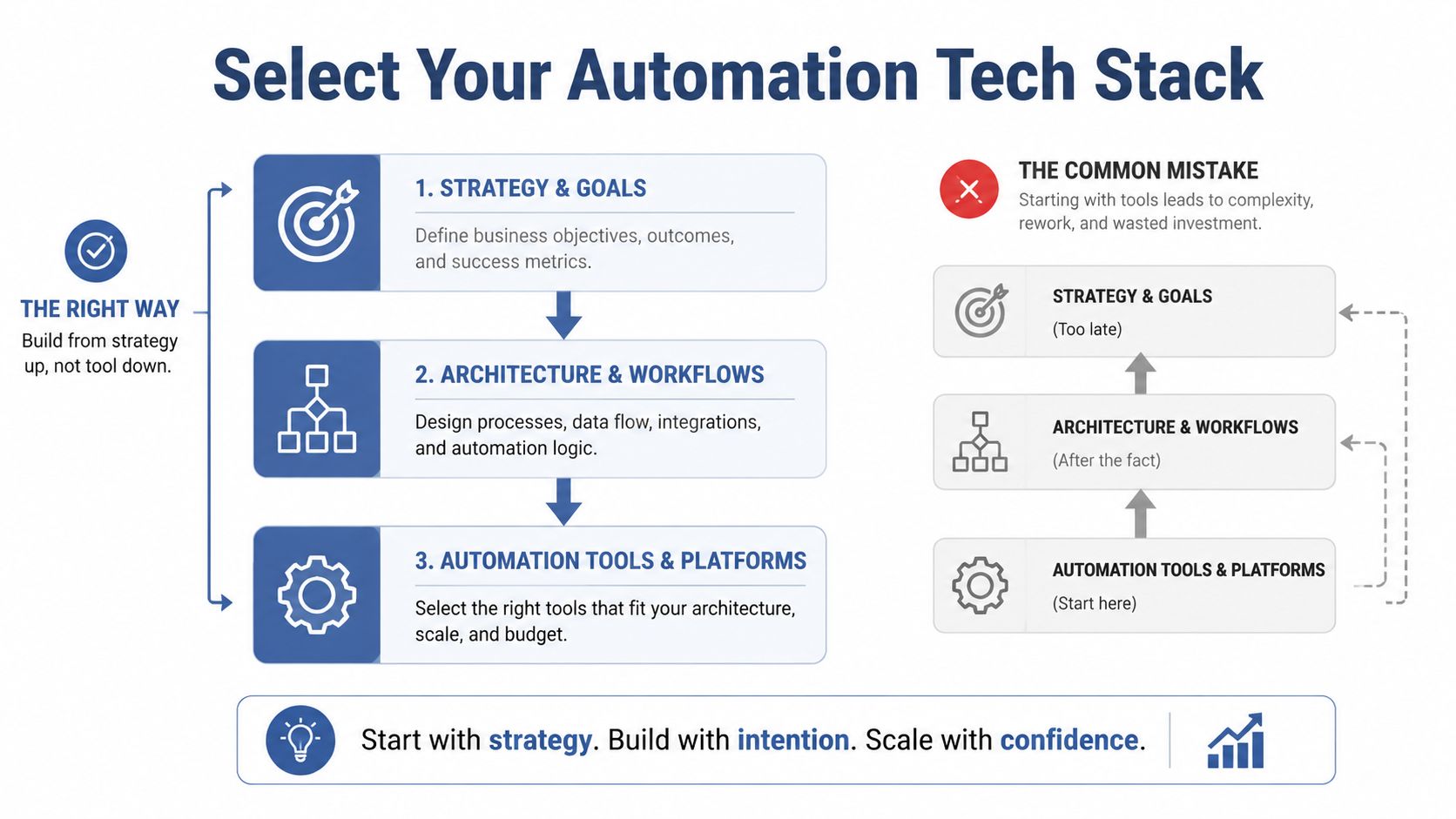
Choose tools in the right order
I split the stack into three layers.
First, the core platform. Publishing, inbox management, reporting, and approvals are managed here. Tools like Sprout Social or Agorapulse sit here.
Second, the reasoning layer employs models like GPT-4, Claude, or Gemini to handle summarization, ideation, classification, drafting, and routing logic.
Third, the integration layer. Here, Zapier, Make, native APIs, webhooks, and CRM connections move data between systems.
If you buy the core platform first and expect it to handle all three layers, you'll hit a wall. Most all-in-one products are good at some combination of scheduling, reporting, and light AI assistance. They rarely excel at custom multi-step agent behavior.
What to look for before you buy
A stack is strong when it answers these questions well:
- Can it accept custom context? If you can't upload voice guides, approved examples, and business context, the outputs will stay generic.
- Does it support workflow depth? You need more than one prompt box. You need branching logic, triggers, approvals, and handoffs.
- Will it connect to revenue systems? If it can't push into CRM, lead tracking, and reporting layers, it will get treated like a content toy.
- Can it handle LinkedIn properly? This matters more than most vendors admit.
LinkedIn is the most underserved major social platform for AI automation, despite its value for B2B growth, and most generic AI tools don't understand LinkedIn's professional context well, as noted in this Code Desk analysis of hidden AI tools for social media marketing. That should change how you evaluate every vendor claiming “cross-platform AI support.”
Here's the quick filter I use:
| Priority | Weak choice | Strong choice |
|---|---|---|
| Context | Generic assistant inside a scheduler | Model layer with reusable brand memory |
| Workflow | One-step post generation | Multi-step agents with approvals |
| Integration | Export CSV and manual upload | CRM sync, webhooks, and API access |
| LinkedIn fit | Consumer-style captions repurposed for B2B | Professional tone and outreach-aware workflows |
If you need a broader view of categories and selection criteria, I've mapped that in my article on AI marketing automation tools. But the core judgment stays the same. Buy for orchestration, context control, and business integration. Ignore flashy feature lists.
Measure for Revenue, Not Applause
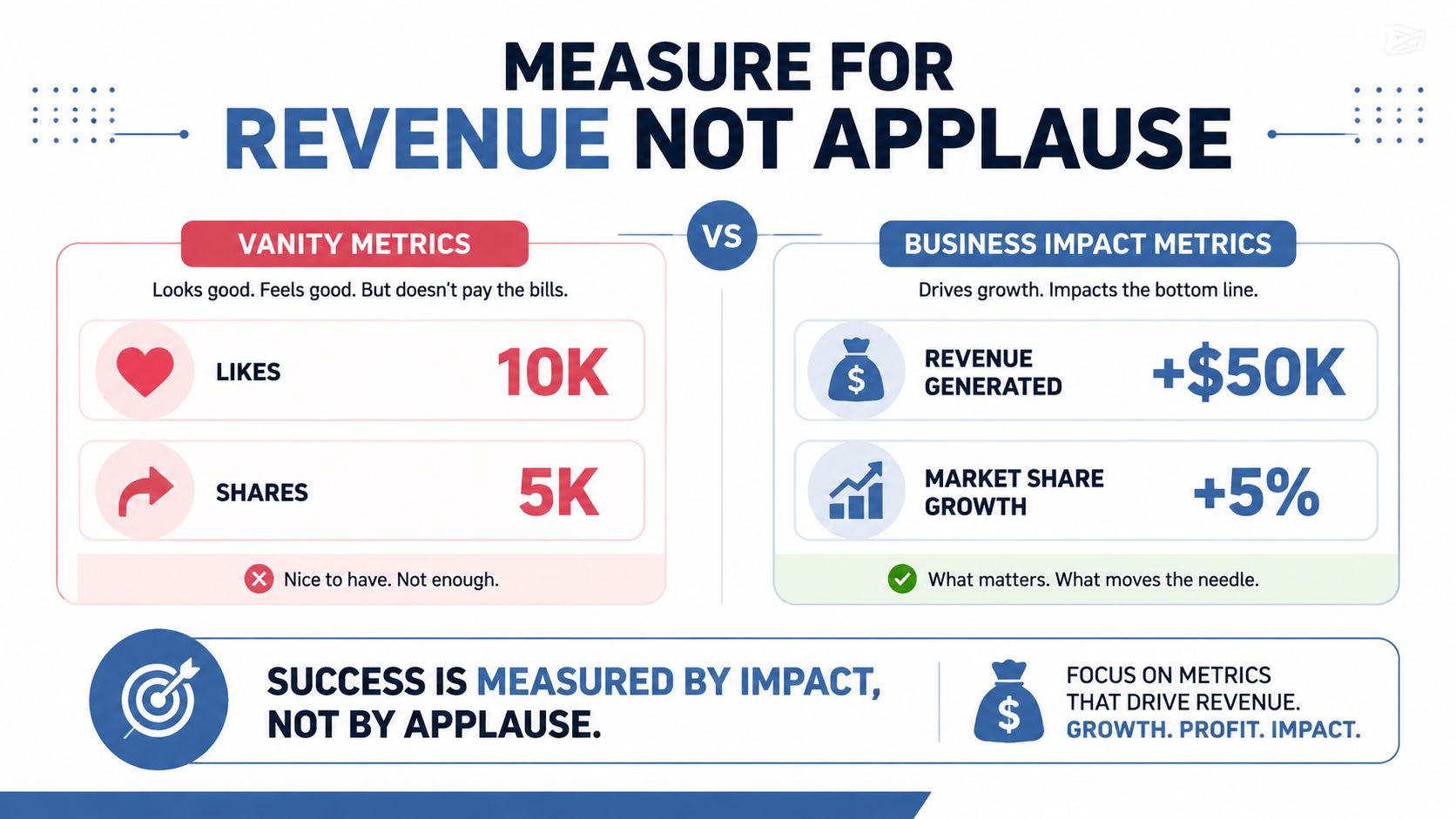
If your report starts with impressions, likes, and shares, you're already on the defensive when you decide where your money goes. Budget belongs with systems that create pipeline, reduce wasted spend, and improve sales efficiency.
Start with business impact. Everything else is secondary.
A useful social automation system can extract contact information from post comments or form fills and push qualified leads into CRM systems, turning passive engagement into measurable lead generation, according to Stepper's overview of social media automation. That's the threshold. If your setup can't do that, call it a publishing tool.
To frame the difference clearly, use this kind of reporting logic with your team:
Connect social to your CRM
Your social engine should feed your sales engine. That means every meaningful interaction needs a path.
I want to know:
- Which posts generated qualified conversations
- Which comments or form actions turned into leads
- Which leads entered pipeline
- Which deals were influenced by social touchpoints
That's how you defend budget. That's also how you decide what content to scale, what audience to prioritize, and which platforms deserve more attention.
Here's the simplest operating model.
| Social event | Automation action | Business outcome |
|---|---|---|
| High-intent comment | Extract details and create CRM record | Sales sees demand immediately |
| DM asking for specifics | Route to owner with context summary | Faster follow-up |
| Repeat engagement on pain-point topics | Add to warm audience segment | Better retargeting and nurture |
| Form fill from social content | Attribute source and campaign | Clear channel accountability |
This short video covers the mindset shift well before teams overcomplicate attribution:
What you should actually review
Ask four questions in every review cycle:
- Which content themes are producing qualified conversations?
- Which social interactions are entering pipeline fastest?
- Where are buyers signaling urgency or dissatisfaction with competitors?
- Which workflows shorten time from engagement to sales action?
Don't praise social for being busy. Praise it when it creates sales opportunities with traceable context.
One more point. Sentiment analysis matters, as long as it isn't a vanity dashboard. AI-driven sentiment analysis can improve accuracy by 60% over traditional monitoring, and teams that use it to allocate resources toward predicted high-performing content can see a 15 to 25% ROI boost, according to MindStudio's guide to AI agents for social media management. That's useful because it helps you decide where to place attention before you waste creative cycles.
The Two Automation Traps That Kill Growth
Most failed AI social media automation setups fail because owners expect automation to remove responsibility. The models are rarely the problem.
It doesn't. It changes where responsibility sits.
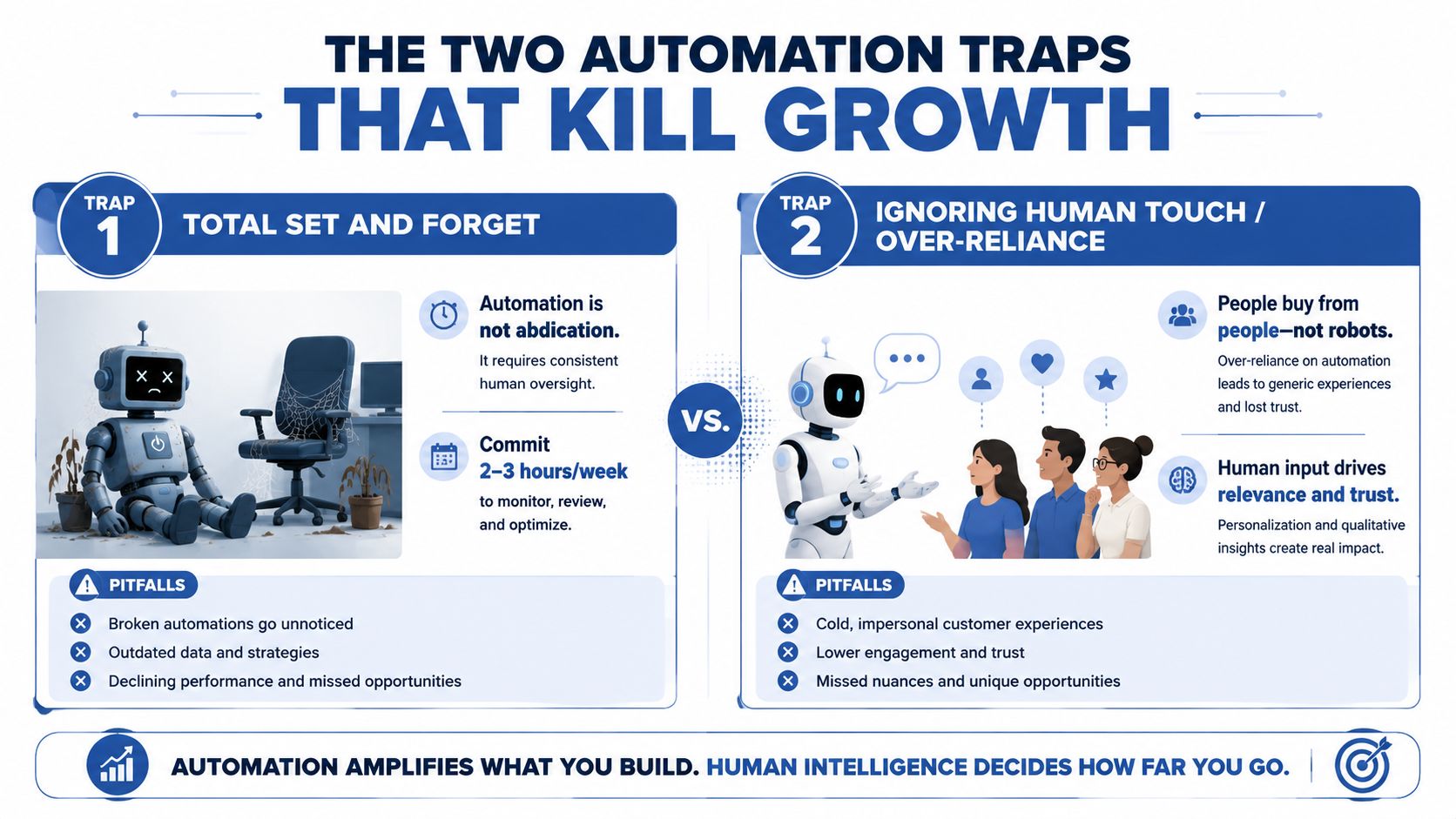
Trap one is abdication
The first trap is Total Set and Forget. I hate this mindset because it usually comes from a founder who wants advantage without stewardship.
Successful implementations still require 2 to 3 hours weekly from humans for high-level strategy, and models typically need one week of learning to align with brand voice, as explained in this Apaya guide to AI social media automation. That time is the work that keeps your system commercially sharp.
Use those hours for things only you should do:
- Review edge cases such as tone misses, sensitive comments, and compliance issues.
- Refine positioning when the market shifts or a competitor changes narrative.
- Engage in key threads where trust, nuance, and authority matter most.
If you skip that layer, the system drifts. It starts sounding polished but hollow. Then performance softens, and people blame AI instead of their own lack of management.
Trap two is impatience
The second trap is expecting polished perfection on day one. Good systems get built through correction.
Treat your agents like new hires. They need examples, edits, corrections, and repeated exposure to what “good” looks like in your business. When a draft is close but not right, don't scrap the whole initiative. Tighten the prompt, update the context, and save the revised version as a better example.
The businesses getting real results from AI are the ones that train it like an operator, not the ones that judge it like a magic trick.
I also recommend a simple review cadence for the first week:
| Day range | Focus | Human job |
|---|---|---|
| Early setup | Voice alignment and structural quality | Edit outputs aggressively |
| Mid-cycle | Relevance of hooks and audience fit | Remove generic language |
| End of first week | Conversion signal quality and routing logic | Tighten lead criteria |
One final warning. Don't automate intimacy. Let AI help you detect patterns, prepare drafts, and route opportunities. Keep founder-level perspective, strategic commentary, and sensitive outreach human. Especially on LinkedIn, buyers can smell low-effort automation immediately.
That's the actual playbook. Build a system that listens before it speaks, routes signals into revenue systems, and stays under human control where it matters. Do that, and AI social media automation becomes a competitive weapon instead of a content gimmick.