
Let's get straight to the point: your Customer Acquisition Cost is a threat to your business. You're pouring money into ad platforms, getting mediocre results, and watching competitors scale. That number on your P&L is a direct drag on your profitability and your ability to win.
My name is Samuel Woods. I’ve been deep in the trenches with machine learning since 2016 and generative AI since 2019, long before the hype cycle. I don't care about buzzwords; I care about business results. Revenue. Margin. Competitive advantage.
The smartest budget wins more often than the biggest one.
To slash your customer acquisition cost, you have to be systematic. Audit your funnel, find the weak spots your competition misses, and then deploy AI to cut costs while increasing revenue. It all starts by setting a ruthless, data-driven baseline for your CAC.
You can't improve what you don't measure. It’s time to stop guessing and start engineering your growth.
Your Customer Acquisition Cost Is A Silent Killer
Most businesses treat acquisition spending like a blunt instrument. They throw money at broad audiences, cross their fingers, and accept a high CAC as the "cost of doing business." This is a losing strategy.
Your marketing funnel is full of expensive leaks. Money wasted on the wrong audiences, with the wrong message, sent to the wrong landing pages. This playbook fixes that.
This guide is the exact process I use to dismantle and rebuild acquisition funnels. You'll shift from guesswork to precision, and from wasteful spending to strategic investment.
Confronting the Data
Your first move is confronting the cold, hard data. The new AI tool can wait. You'll systematically audit your acquisition funnel to find out exactly where your money is going, and pinpoint the hidden cost leaks your competitors completely miss.
This playbook shows you how. By deploying AI and automation correctly, you can cut acquisition costs while simultaneously increasing the lifetime value of each customer.
For a comprehensive guide on the actionable strategies discussed throughout this article, dive deeper into how to reduce customer acquisition cost and boost your ROI.
It’s time to stop bleeding cash and start engineering sustainable, profitable growth.
The CAC Audit: Pinpointing Where Your Money Really Goes
Before you write a single line of code or spin up an AI agent, you need a diagnostic. Most founders I talk to have a foggy idea of their CAC. They can give me a blended number, but when I press for CAC by channel, campaign, or customer segment, the answer gets vague.
This is a fatal flaw. You can't optimize what you don't understand.
Relying on a single, top-level CAC number is like trying to navigate a city with a map of the entire country. Technically accurate. Practically useless.
To really lower your customer acquisition cost, you first have to become a ruthless accountant of your marketing.
Tracing Every Dollar
First, build a simple but powerful CAC audit. The goal is to trace every dollar you spend on getting customers and attribute it correctly. Ad spend is only one part of it.
You have to include everything:
- Direct ad spend is the obvious part: money paid directly to platforms like Google, Meta, and LinkedIn.
- Salaries count too, at least the portion of your sales and marketing team's salaries dedicated purely to acquisition.
- Software and tools add the monthly tab for your CRM, email platform, and analytics tools supporting your funnel.
- Content and creative covers the costs tied to creating ads, writing blog posts, or producing videos for acquisition campaigns.
Forgetting these "soft" costs paints a dangerously misleading picture. For a deeper look at this, check out my guide on how to measure marketing effectiveness.
This simple three-step process cuts through the complexity. It shows you exactly where to look, what to target, and how to act.
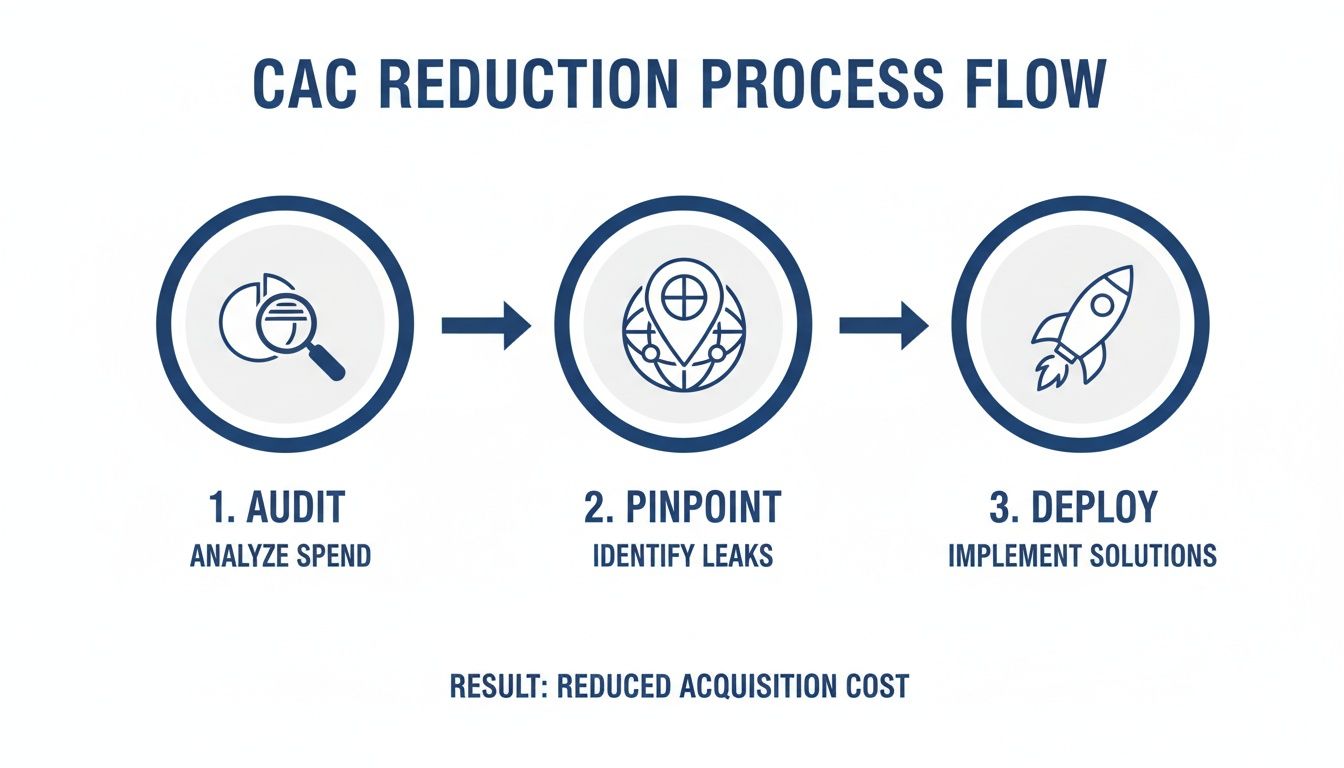
The flow is straightforward: a thorough audit uncovers the specific problems, which then allows you to deploy targeted solutions for the biggest impact.
To calculate your CAC, you can do it the old-fashioned way with spreadsheets or start bringing in AI for a much clearer, real-time picture. Here's what that looks like.
CAC Audit Breakdown: Manual vs. AI-Assisted
| Metric | Manual Calculation (Lagging) | AI-Assisted Analysis (Real-Time) |
|---|---|---|
| Total Acquisition Cost | Sum of ad spend, partial salaries, and tool costs from last month's P&L. | Real-time aggregation of ad spend APIs, payroll data, and software invoices. |
| Channel-Specific CAC | Manually segmenting spreadsheet data by UTM tags; often error-prone and time-consuming. | AI model automatically attributes costs and conversions to specific channels in real time. |
| Campaign-Level CAC | A quarterly, painful exercise to isolate costs and results for major campaigns. | Live dashboard showing CAC per campaign, ad set, and even individual creative. |
| Customer Segment CAC | Rarely calculated; requires complex data joining from CRM and ad platforms. | AI identifies CAC for different personas based on behavioral data and purchase paths. |
| Attribution Model | Typically relies on a simplistic last-click model due to data limitations. | AI applies multi-touch attribution models to more accurately weigh each touchpoint. |
| Time to Insight | Weeks or months after the period ends, providing a historical view. | Instantaneous, allowing for mid-campaign adjustments and budget reallocations. |
The manual approach gives you a decent look in the rearview mirror. An AI-assisted audit is like having a live navigator, telling you where the traffic jams are right now so you can reroute.
A Real-World Scenario
I worked with a B2B SaaS company convinced their paid search campaigns were a home run. They were spending $50,000 a month and getting 100 new customers, giving them a tidy $500 CAC. On the surface, fantastic against their $6,000 LTV.
But when I did a full audit, the picture changed.
I added $25,000 in salaries for the marketing managers running the campaigns, $5,000 for marketing automation tools, and another $10,000 for creative fees. Suddenly, the total cost wasn't $50,000. It was $90,000.
Their true CAC wasn't $500. It was $900. This single insight changed their entire growth strategy, shifting focus from scaling a "profitable" channel to fixing a leaky bucket.
This is the power of a proper audit. It forces you to confront reality. Once you see the numbers laid bare, the opportunities for AI-driven improvement become obvious.
Use AI to Laser-Target Your Ideal Customers
The fastest way to lower your Customer Acquisition Cost is to stop advertising to people who will never buy.
Sounds obvious, I know. But it's where most companies completely fall apart. They spray and pray, hoping something sticks.
This is where AI helps most. Forget basic demographics. Your competitors are stuck targeting by job title and company size. You're going deeper, targeting by demonstrated need and actual purchase intent.
Go Beyond Surface-Level Demographics
The real gold is buried in your unstructured data (the messy, human stuff). I’m talking about CRM notes, support ticket conversations, raw customer survey responses, and Gong call transcripts.
This is the data your competitors are ignoring because it’s a nightmare to analyze manually. For you, it's a goldmine.
You can point advanced reasoning models like Claude 3 or Gemini 1.5 at this mountain of text. Their job is to act as a tireless analyst, sifting through thousands of data points to find recurring pain points, "aha" moments, and the specific language your best customers use.
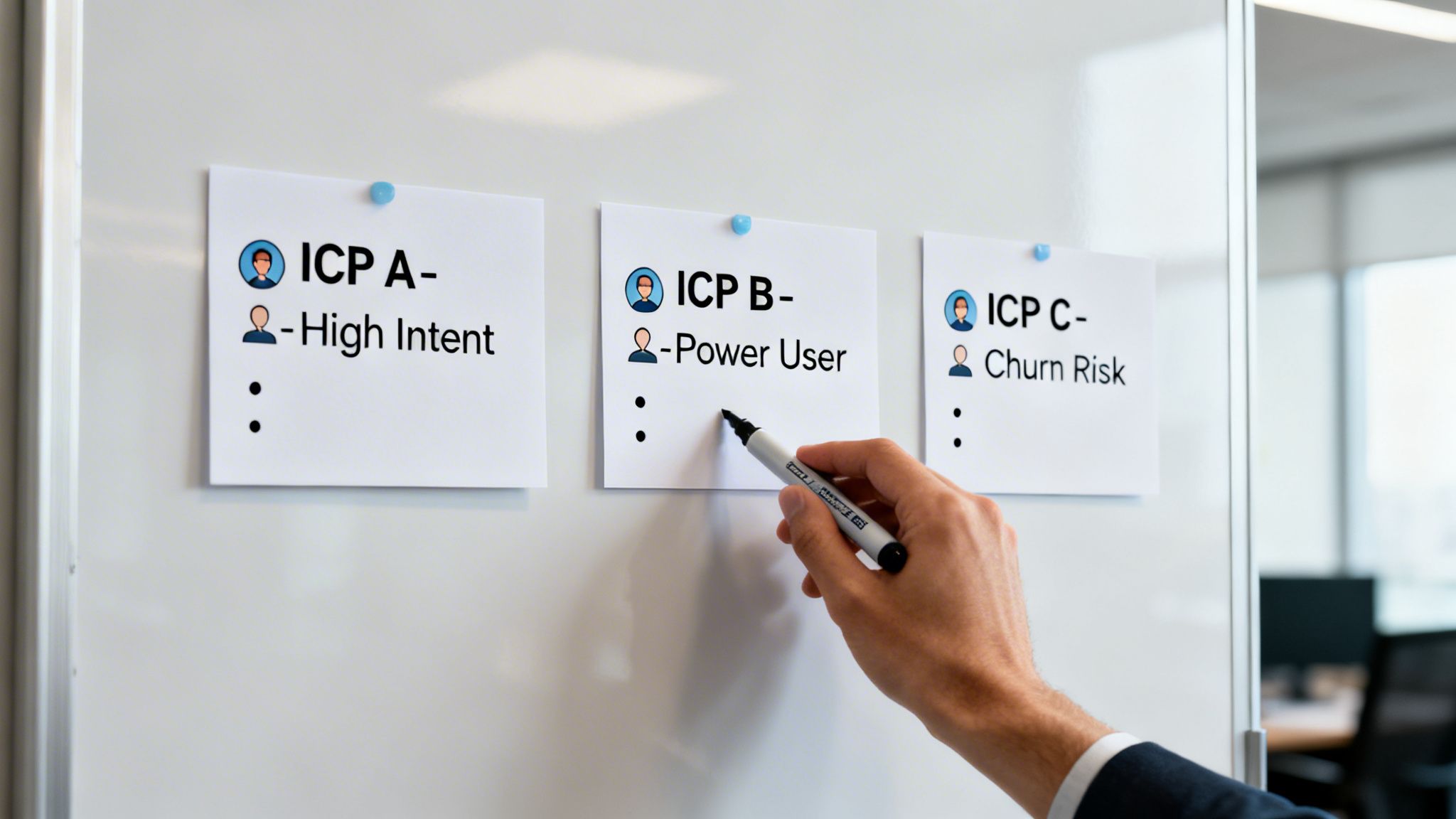
The output is a hyper-specific Ideal Customer Profile (ICP) built from the actual voice of your customers, far sharper than a vague persona.
You’ll go from targeting "Marketing Managers at Mid-Sized Tech Companies" to targeting "Marketing Managers at Series B SaaS companies who recently mentioned 'attribution modeling' and 'funnel leakage' in support chats and are struggling to prove ROI." That's the difference between a shotgun and a sniper rifle.
This level of detail slashes wasted ad spend because you only show up for people who have already signaled they have the exact problem you solve. I get into the nitty-gritty of this process in my guide on hardcore funnel tactics and segmentation methods.
Engineer a Better Lookalike Audience
Once you have these AI-generated ICPs, you can feed them into your ad platforms. But don't just use the platform's default lookalike creation. Give the algorithm a much higher-quality seed audience.
Instead of uploading a list of all your customers, you’ll upload a curated list of only your best customers, the ones who perfectly match that nuanced ICP the AI just built.
Here’s how it works. You pull all the raw text data from your CRM and helpdesk associated with your top 20% of customers by LTV. Then, you feed this into a large language model with a prompt like: "Analyze these customer interactions. Identify the top 5 recurring challenges, goals, and phrases used by our most valuable customers. Synthesize this into a detailed ICP."
Using this new, sharp ICP, you filter your entire customer base to create a "golden cohort" of customers who fit the profile exactly. This is the highly-refined list you'll upload to Meta or Google to create a 1% lookalike audience. The resulting audience is based on demonstrated behavior rather than flimsy firmographics.
Pinpoint High-Intent Buying Signals
The final piece is identifying high-intent behaviors. These are the digital breadcrumbs prospects leave that signal they’re shifting from passive researcher to active buyer.
Your AI can monitor for these signals in real time. A prospect who visited your pricing page twice, downloaded a specific case study, and watched 75% of your demo video is a much hotter lead than someone who just subscribed to your newsletter. Flagging these users lets you retarget them with a more aggressive offer or have a sales rep reach out immediately.
In the competitive B2B SaaS world, this kind of advanced personalization can cut acquisition costs by up to 50% while boosting revenue by 5-15%. You stop wasting money on low-intent prospects and concentrate your firepower where it will generate the highest return.
Build Intelligent Funnels That Convert on Autopilot
Every ad click that doesn't convert is money down the drain. Your marketing funnel is leaking far more cash than you realize, and it's directly pumping up your customer acquisition cost. The old way of plugging these leaks (running one slow A/B test a month) is obsolete.
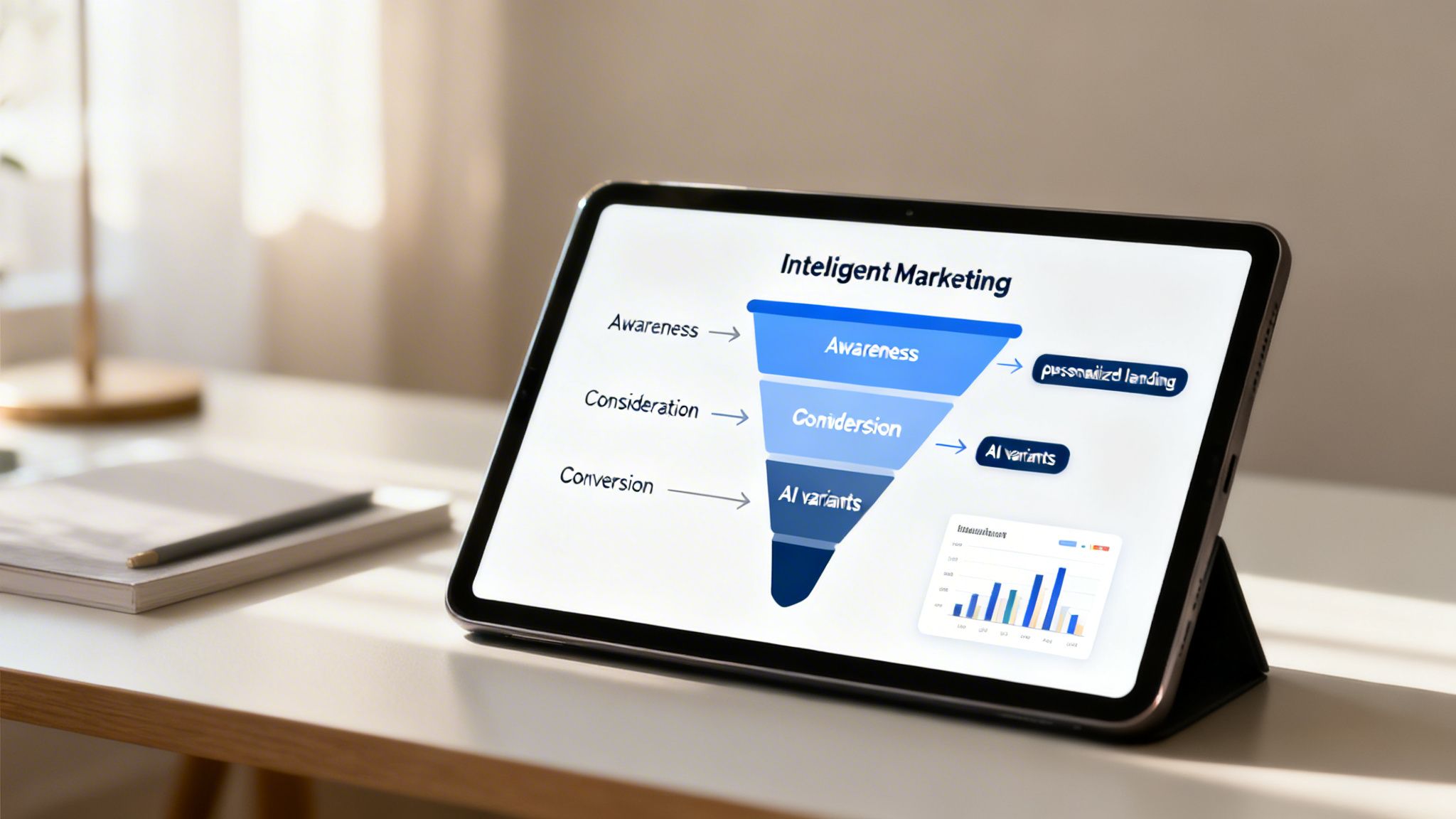
If you want to stay ahead, you have to move faster and with more intelligence. This is where you deploy AI as an entire system. I'm talking about building intelligent funnels that learn, adapt, and optimize themselves for conversion while you sleep.
From Manual Testing to AI-Powered Optimization
Forget the slow, plodding pace of human-led A/B tests. You and I can design AI agent workflows that run at a scale manual testing can't match. Picture an agent that generates, tests, and analyzes dozens of landing page variations and ad creatives all at once.
People are running this right now.
Here’s a real-world example. You can build a "Creative Director" agent that pulls in your core value proposition and the ICPs you defined earlier. Its job is to generate 50 distinct ad headlines and body copy variations aimed at specific audience pain points. This whole process takes hours instead of weeks, which puts you well ahead on speed.
The goal is a dynamic, self-optimizing system. Instead of you manually hunting for what works, the system constantly experiments and reports back with the winning combinations of audience, message, and creative.
Once these variations go live, another AI agent can watch the performance data in real time. It automatically shifts budget toward the ads with the lowest cost-per-conversion. You act on this morning's results instead of reacting to last week's data.
Write Copy That Sells with LLMs
The copy on your landing pages and in your emails is one of the biggest conversion levers you can pull. Using those detailed customer personas you built, you can now task Large Language Models (LLMs) with writing copy that speaks directly to each segment.
I had a fintech client trying to sell to both startups and enterprises with the exact same landing page. Their conversion rates were abysmal.
I used an LLM to create two distinct versions:
- The startup version was all about speed and affordability. Headline: "Launch Your Payments in an Afternoon, Not a Quarter."
- The enterprise version focused on security, compliance, and scalability. Headline: "Enterprise-Grade Payments Infrastructure You Can Trust."
This simple change, driven by AI-generated copy mirroring the specific needs of each audience, led to a 40% increase in qualified demo requests from the startup segment alone. It’s a perfect example of how to reduce customer acquisition cost by simply getting your message-to-market match right.
Implement Dynamic, Personalized Experiences
The final piece is carrying this personalization onto the page itself. You can set up dynamic landing pages that change their content based on where the visitor came from. Someone clicking a LinkedIn ad about "supply chain efficiency" should land on a page that speaks directly to that. A visitor from a Google search for "cheaper accounting software" should see a different version.
This creates a conversion path that feels like a one-on-one conversation.
The tech for this is more accessible than you think. Tools like Unbounce or Instapage have dynamic text replacement features built in. For more advanced setups, you can use platforms like Webflow connected to your marketing automation software. There are plenty of great marketing automation workflow examples that show how to wire these pieces together without needing a team of developers.
By turning your static funnel into an intelligent, adaptive system, you stop paying for unqualified clicks and build an engine that continuously lowers your CAC.
Turn Your Customers Into Your Best Acquisition Channel
Stop paying for cold traffic. It's expensive and inefficient.
The brutal truth is your best future customers are friends with your current best customers. Yet most companies treat referral marketing like an afterthought. They slap a generic "Refer a Friend" link in their website footer and hope for the best. That's wishful thinking.
Next, you'll build a modern, AI-powered referral engine that systematically turns your happiest customers into your most effective, lowest-cost acquisition channel.
The Modern Referral Playbook
The old playbook, famously executed by Dropbox, was brilliant for its time. They offered extra storage to both the referrer and the new user, a simple loop that helped slash their CAC by 60% in the early days.
Add AI to that core concept and you move from a passive, one-size-fits-all program to a proactive, personalized referral machine. The goal is to use AI to pinpoint the perfect moments to ask for a referral. Done right, this can lower your acquisition cost by an order of magnitude.
Referral programs are a powerhouse. Data shows referred customers can cost 20-40% less to acquire, have a 25% higher lifetime value, and an 18% lower churn rate. When a typical SaaS CAC can be over $239, spending just $20 on a successful referral represents a massive 90%+ saving. You can explore more of these powerful customer acquisition cost benchmarks to see how you stack up.
Using AI to Find Your Superfans
Your first job is to find the people most likely to refer others. You're hunting for the true evangelists hiding in your user base.
An AI model can analyze customer behavior from your CRM and product analytics to create a "Referral Propensity Score." It’s looking for specific signals:
- High product usage tells you who’s logging in frequently and using your most valuable features.
- Positive support interactions matter because a customer who just had a fantastic experience with your support team is feeling a lot of goodwill.
- A high Net Promoter Score (NPS) counts too, since anyone who gives you a 9 or 10 on an NPS survey is literally telling you they would recommend you.
Once the AI identifies these "superfans," you can trigger automated, personalized outreach. Instead of a generic blast, the system sends a tailored message at the exact moment of peak happiness.
Imagine a user just completed a key project with your tool. Moments later, they get a message: "Glad we could help you achieve [specific goal]! Know anyone else who could benefit? Here's a special offer for them and a reward for you." The message invites them to share their success instead of asking for a favor.
Frictionless Sharing and Irresistible Offers
The final piece is making the process dead simple for the referrer and a no-brainer for their friend. This is where generative AI comes back into play.
You can use it to create a library of on-brand, compelling, pre-written referral messages tailored for different channels.
- A short, punchy email template.
- A ready-to-post message for LinkedIn.
- A quick text message for mobile sharing.
The referrer just has to click a button. No thinking required.
A well-oiled referral program is a compounding growth engine that drives down your blended CAC over time while bringing in customers who are more loyal and more profitable from day one.
Make Your CAC Irrelevant by Maximizing Lifetime Value
So far this playbook has focused on the front-end cost of getting a customer. Now, let's flip the script. What if you could make your customer acquisition cost almost a non-issue?
A high CAC isn't the real problem if your customers are wildly profitable over time. The best way to "fix" a high acquisition cost is to dramatically increase your customer lifetime value (LTV). Instead of obsessing over the first sale, you'll build a retention and expansion machine on the back end, powered by AI.
This is how you pull ahead. You build a business so good at keeping and monetizing customers that you can afford to outbid everyone for new ones.
Predict Churn Before It Happens
First: stop the bleeding. You probably know that getting a new customer costs 5 to 25 times more than keeping one. Yet, most businesses only react after a customer has canceled.
You can do better by building an AI model to predict churn risk. This model digs into signals already hiding in your business data: a dip in product usage, fewer logins, a string of frustrating support tickets. It combines these into a single "churn risk score" for every customer, updated in real time.
When a customer's score crosses a certain line, it automatically triggers a retention campaign. A precise, automated action: a personalized discount, an outreach from customer success, or an invitation to a training webinar. You solve the problem before the customer is even aware they're unhappy.
Use AI to Uncover Hidden Revenue
Your existing customer base is your single greatest source of new revenue. The cost to sell to a happy, existing customer is practically zero. But most companies are surprisingly bad at spotting their best upsell opportunities.
This is another perfect job for an AI agent.
You can set up a "Growth Analyst" agent that constantly sifts through your customer data, looking for expansion potential. It can find:
- Usage-based upsells, where it spots a customer consistently hitting their plan limits and flags them for an automated upgrade offer.
- Behavioral cross-sells, where it notices a customer using a feature that pairs perfectly with another product they don't have yet, triggering a relevant cross-sell message.
- Company-wide expansion, where it detects when a small team is getting massive value and flags the account for your sales team to pursue an enterprise-wide deal.
By focusing on LTV, you gain room your rivals don't have. You can afford to pay more to acquire customers than they can, so you win more ad auctions and grow market share faster. While they fight over scraps, you keep compounding.
This is about delivering more value. When the AI surfaces these opportunities, you’re proactively helping customers get more out of your ecosystem. This is the ultimate play in learning how to reduce customer acquisition cost, by making that initial cost a tiny fraction of the total value you generate.
Your Burning Questions Answered
You’ve seen the playbook. Now, let’s get into the questions I hear all the time from founders and small-team owners when they start putting these AI-powered strategies to work. Here are the direct, no-fluff answers.
What’s the First AI Tool I Should Use?
Wrong question. Stop right there. Start with a problem, then pick the tool.
Skip the new SaaS signup. Your first move is to open a powerful reasoning model you probably already use, like ChatGPT 4o or Claude 3 Opus, and turn it into your data analyst.
Export your customer list with whatever data you have (industry, deal size, support tickets, you name it). Then, ask the AI to find the patterns. Tell it to segment your best customers and draft Ideal Customer Profiles based on what it finds. This costs you nothing but a bit of time and immediately gives you higher-quality targeting intelligence to feed back into the ad platforms you're already paying for.
The single biggest mistake I see is buying a shiny new AI tool before you have a clear strategy. A powerful model pointed at the right problem is a better first step than a new subscription.
How Much Data Do I Need for This to Work?
You almost certainly have enough to get started right now. For customer segmentation, a modern LLM can spot valuable patterns in just a few hundred high-quality customer records from your CRM.
When it comes to ad optimization, remember that platforms like Google and Meta already have unimaginably massive datasets. Your job is to feed them a cleaner, clearer signal.
Even with just 50-100 conversions, building a lookalike audience from an AI-refined ICP will usually beat generic, broad targeting. Quality matters more than quantity here. A small, clean dataset of your best customers is far more valuable than a massive, messy one.
Will AI Replace My Marketing Team?
No. It will make your existing team much faster.
AI is brilliant at the repetitive, data-heavy work that humans are slow and frankly, bad at. Think analyzing thousands of data points or generating 50 ad variations in a single pass.
This frees up your marketers to do the work that actually matters: strategy, high-level creativity, and developing deep customer empathy. I call this building a "bionic" team. The AI is the exoskeleton, providing superhuman speed and analytical power, but your team’s brain is still directing that force.
Companies that fire their marketers and try to replace them with AI will fail. The companies that give their marketers AI to work with will pull ahead. It’s that simple.