
Most advice about AI for content writers is shallow. It tells you to draft faster, spin up more blog posts, and save time on first drafts. That advice is exactly how you end up producing the same interchangeable content as everyone else in your category.
I'm Samuel Woods. I've been working with ML since 2016 and Generative AI since 2019, and I can tell you bluntly that speed alone is not a strategy. If you use AI as a typing assistant, you're building a commodity operation. If you use AI as part of a disciplined content engine, you're building something competitors will struggle to match.
Your competitors can buy the same model subscriptions you can. They can't easily copy a better operating system for insight collection, content production, brand control, and performance measurement. That's where the win is.
Table of Contents
- Stop Thinking Like a Writer and Start Thinking Like a System Builder
- The Human-AI Content Engine Explained
- Mastering the Tools and Models That Matter
- Practical Prompts and Workflows for Revenue Growth
- Building Your AI Governance and Verification Protocol
- Measuring the ROI of Your AI Content System
- Your First 90 Days as an AI-Augmented Writer
Stop Thinking Like a Writer and Start Thinking Like a System Builder
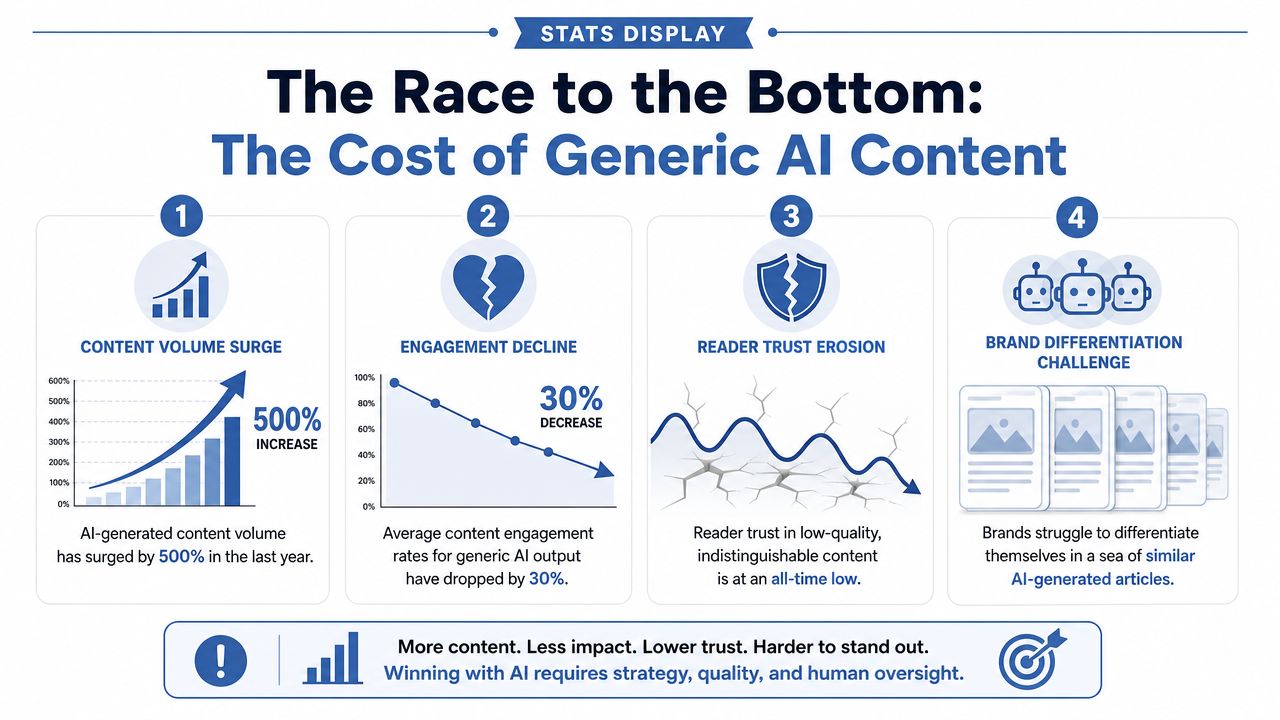
If you're using AI just to write faster, you're stepping into a crowded, low-margin game. Everyone else is doing it too. In 2025, 90% of content marketers actively used AI writing tools daily, and business adoption jumped from 55% of organizations in 2024 to 78% in 2025 according to the verified industry data provided for this article.
That changes the job.
Everyone has access to AI now. You compete on how well you structure decisions around it. The writer who opens ChatGPT and asks for a blog post is replaceable. The operator who builds a repeatable system for market insight, brand alignment, conversion writing, and distribution is not.
The real strategic shift
The phrase AI for content writers confuses people because it sounds like a tool discussion. It is really about your operating model.
You need to think in inputs, workflows, checkpoints, and outputs. That means collecting customer language, feeding models structured context, defining human approval moments, and measuring what the content does after publication. If you haven't built that, what you have is a chatbot habit.
Here is a practical rule. If AI can produce your content without your company's customer insight, sales objections, proof points, and editorial standards, your competitors can produce something close enough.
What system builders do differently
A system builder designs the machine before asking for output. That person creates reusable prompts, research standards, source validation rules, voice guidance, and repurposing workflows. Then they improve the system every week.
That's how you stop reinventing the wheel on every asset.
A simple example. Instead of asking for “a blog post on customer retention,” you build a workflow that pulls in customer interview notes, CRM objections, support ticket themes, product differentiation, approved claims, and target conversion goals. Then AI drafts against that context. The quality jump is massive, and it comes from the better system. The model is the same.
If you want the deeper automation layer behind that kind of workflow, my thinking aligns with building automated content creation systems around repeatable business processes, not isolated prompts.
The Human-AI Content Engine Explained
Most content teams still run a primitive workflow. Idea. Draft. Edit. Publish. That's too thin to create defensible value.
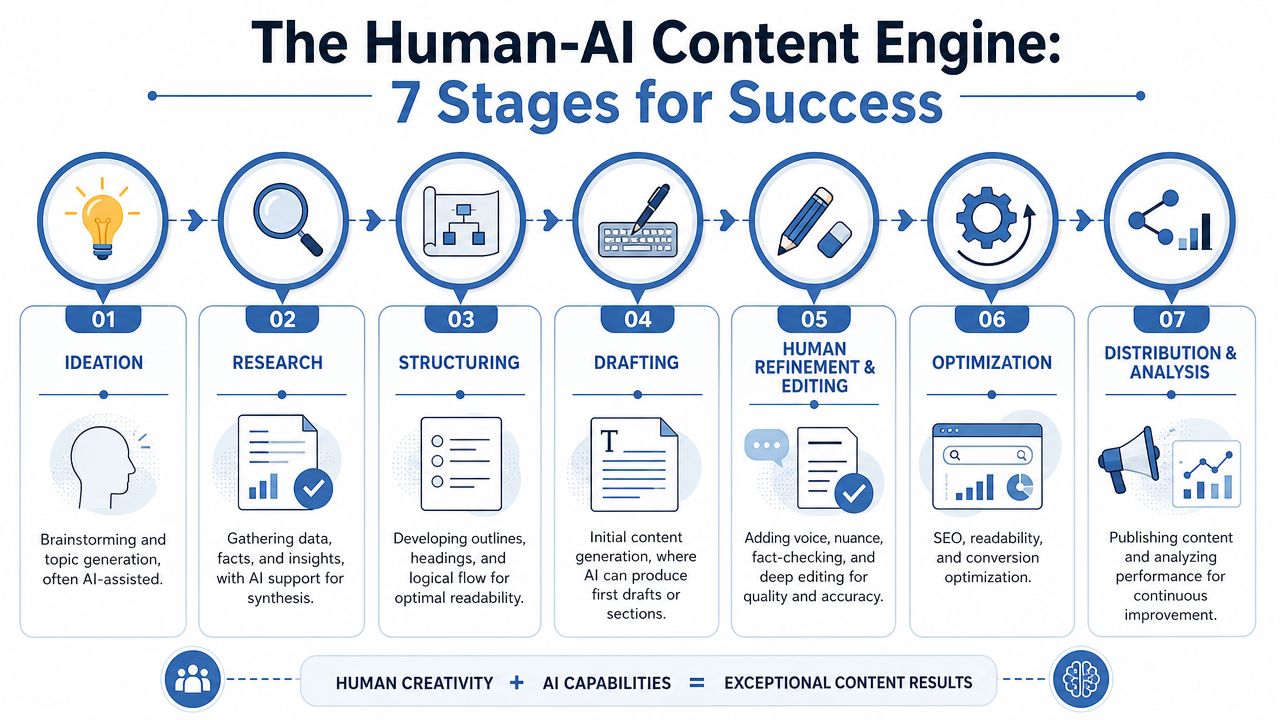
I use a seven-stage engine instead. It gives AI clear jobs and keeps human judgment where it belongs.
Where AI belongs
Here's the workflow I recommend:
| Stage | AI role | Human role |
|---|---|---|
| Ideation | Generate angles, variants, audience-specific hooks | Choose the angle worth owning |
| Research | Synthesize source material, organize notes | Validate facts, reject weak evidence |
| Structuring | Build outlines and argument flows | Decide narrative sequence and persuasion logic |
| Drafting | Produce rough sections and alternatives | Add expertise, specificity, and positioning |
| Refining | Tighten clarity, readability, consistency | Protect brand voice and accuracy |
| Governance | Flag unsupported claims and policy risks | Approve, edit, or block publication |
| Distribution | Repurpose content into channels and formats | Select priorities and review performance |
AI is strong at option generation, summarization, pattern extraction, and first-pass organization. That saves you from wasting time on blank-page work.
It is not strong at lived experience, original perspective, or emotional truth. That's the gap serious operators exploit.
The core weakness matters. As Newfangled's perspective on human writers and AI content tools notes, AI cannot produce “novel, profound, specific content” without human narrative grounding. That's why generic writers are under pressure while experts who can deliver brand voice, conversion copywriting, and emotional storytelling command premiums.
Where humans stay in control
Your moat sits in three places.
First, narrative grounding. AI can rearrange ideas. You provide the story, the stakes, the scar tissue, and the customer truth.
Second, commercial judgment. AI doesn't know which argument will move your pipeline, protect your positioning, or support your pricing. You do.
Third, approval authority. AI should recommend. Humans should decide.
The companies winning with AI-assisted content write the strategy themselves and use the model to speed up execution against it.
The video below is worth watching if you're thinking about workflow design in a more operational way:
A practical split looks like this:
- AI handles the first pass, covering topic clusters, angle expansion, outline options, draft variations, headline sets and repurposed assets.
- Humans add the scarce value through customer anecdotes, strategic positioning, sharp opinions, sales friction and product truth.
- The editing pass protects factual accuracy, readability, legal safety and tone consistency.
- You review outcomes such as pipeline influence, search visibility, content reuse and asset-level ROI.
That is what a content engine looks like.
Mastering the Tools and Models That Matter
The AI tool market is noisy because vendors package the same underlying capabilities in different wrappers. Don't buy based on hype. Buy based on task fit.
I divide the stack into three categories. If you understand these, you'll stop overpaying for overlap and stop expecting one tool to do everything.
Three tool categories that actually matter
Foundation models are the reasoning layer. These include ChatGPT, Claude, and Gemini. Use them when the task needs judgment, synthesis, or nuanced rewriting.
Specialized writing tools sit on top of foundation models. Jasper and Copy.ai are examples of the category. These are useful when your team needs repeatable templates, approvals, collaboration, and lighter training demands.
Workflow integrations connect content operations to the rest of your stack. Think Zapier, Make, CMS connectors, CRM triggers, and document systems. These connections are what move AI from experimental to operational.
The model still matters. As of July 2026, Claude Opus 4.6 leads generative writing benchmarks with a score of 44.9, and that lead translates into an estimated 30% to 40% reduction in post-editing time for high-volume content compared to lower-tier models, according to the LLM Stats writing leaderboard.
That matters if you produce landing pages, ad copy, nurture sequences, or product content at scale. Less cleanup means lower production cost and faster launch cycles.
How I choose the stack
I don't choose tools by brand loyalty. I choose them by failure cost.
If the task is strategic, high-stakes, or voice-sensitive, I use the best foundation model available and give it structured context. If the task is repetitive and format-heavy, a specialized platform can be enough. If the task spans multiple systems, I automate it.
Here's the simple decision framework:
- Use a foundation model when the brief is messy, the audience is specific, or the argument needs thought.
- Use a specialized content platform when you want rails, templates, and approvals.
- Use integrations when the content process touches briefs, docs, review queues, publishing, analytics, or sales enablement.
If your team also produces short-form video from long-form content, it helps to compare AI video clip generators by workflow fit rather than flashy demos. The right choice depends on whether you need social repurposing speed, editing control, or platform-specific outputs.
Better models still need editing. They reduce the amount of bad editing work you have to do.
I also recommend building your stack around roles, not subscriptions. One model for reasoning. One workflow layer for automation. One editing layer for final polish. That's usually enough.
If you're evaluating options more broadly, I'd approach it the same way I approach AI tools for content creation. Start with the workflow, then pick the tools that remove friction inside it.
Practical Prompts and Workflows for Revenue Growth
Most prompts are weak because they ask for text instead of outcomes. That's why the output feels generic. The machine has no commercial frame.
A strong prompt tells the model what asset to produce, who it's for, what source material it can use, what it must avoid, and what business result the asset should support. That's how you get revenue-aligned content instead of fluffy drafts.
Prompt for turning interviews into sales assets
Use this when you've interviewed a customer and need a case study outline that sales can effectively use.
You are a B2B conversion copywriter. Use the transcript below to create a case study outline for decision-makers evaluating our solution. Extract the customer's original problem, failed alternatives, purchase trigger, implementation concerns, business outcomes, and strongest direct quotes. Structure the outline as headline, executive summary, challenge, why change now, why us, implementation, results, objections handled, and CTA. Do not invent outcomes. If evidence is weak, label it as missing proof. Keep the language specific and commercially useful.
Why this works: it forces the model to organize around buying logic, not blog structure.
Prompt for webinar follow-up emails
This one is for lead nurture after a webinar. I use versions of this constantly.
You are writing a 7-email nurture sequence for leads who attended a webinar. Audience: [insert audience]. Offer: [insert offer]. Primary pain point: [insert pain point]. Desired action: [insert action]. Use the webinar summary, attendee questions, and sales objections below. Write 7 distinct emails with subject line, preview text, core message, and CTA. Sequence logic: recap, problem agitation, objection handling, proof, implementation clarity, urgency, final call. Match our brand voice: [insert voice rules]. Do not use hype language, fake urgency, or unsupported claims.
If you want more raw inspiration for this category, Voicy has a practical collection of ChatGPT email writing prompts that's useful for expanding subject line and sequence ideas.
Prompt for content repurposing at scale
This is how you turn one long-form asset into a distribution engine.
You are a content repurposing strategist. Transform the article below into 20 social posts for LinkedIn, X, and email snippets. Keep each post benefit-driven and distinct. Split outputs into 5 authority posts, 5 contrarian posts, 5 educational posts, and 5 demand-generation posts. For each post, include hook, body, and recommended CTA. Use only claims supported by the source article. Preserve brand voice and avoid repeated phrasing.
That prompt saves time, but its primary value is consistency. You stop rewriting the same core ideas from scratch every time.
Here's the workflow I recommend for revenue content:
- Start with customer inputs such as interview transcripts, sales calls, demo questions, support logs, and objections.
- Generate structured assets like case study outlines, email sequences, landing page blocks, ad variations, and social derivatives.
- Review for commercial clarity, so every asset moves a lead toward a decision.
- Push each asset through channel-specific distribution in email, paid social, organic social, landing pages, and sales enablement.
For teams trying to operationalize that distribution layer, I think in terms of a repeatable content distribution strategy rather than one-off promotion.
Building Your AI Governance and Verification Protocol
Speed without governance is reckless. If your team publishes unsupported claims, outdated facts, or off-brand messaging at scale, AI becomes a liability multiplier.
That's why professional content operations need a protocol. A vague reminder to “fact-check” won't hold up. You need a real system.
Your minimum governance stack
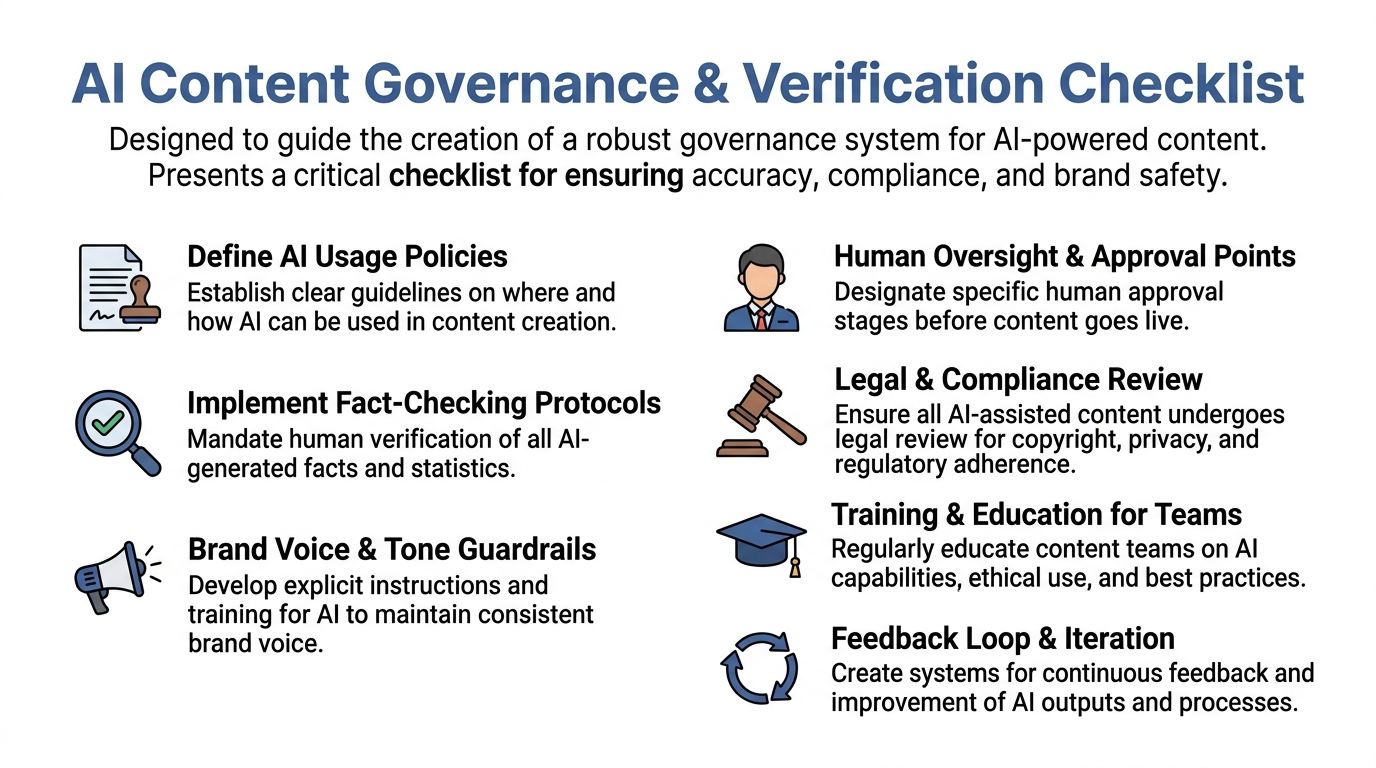
You need four layers.
Start with policy. Define where AI can assist and where it cannot. For example, AI can draft summaries, but a human must approve all claims, examples, and final messaging.
Add voice controls. Build a reference set from your best-performing content, approved phrases, banned phrases, tone notes, and audience language. Feed that into prompts and editorial review.
Set approval gates. Decide where human sign-off is mandatory. I recommend approvals after research, after the draft, and before publication.
Finish with source standards. Require direct source review for every claim that matters to trust, compliance, or conversion.
A verification protocol that professionals actually use
The big unresolved issue in AI research workflows is obvious. How do you verify AI-sourced research against weak, outdated, or opinion-based data without a multi-stage human process?
The answer is simple. You do use a multi-stage human process.
As Optimizely's guidance on AI for content research makes clear, best practice requires prioritizing peer-reviewed studies and established publications, then cross-referencing data points to validate claims. I'd add one more essential layer. Bring in human interviews, firsthand examples, and internal evidence whenever the topic affects positioning or revenue.
Use this checklist before anything goes live:
- Check claim origin by finding the original source, not a blog repeating it.
- Check publication quality and prefer established publications and stronger evidence over opinion pieces.
- Check date relevance, because old data can compromise a new article.
- Check for contradictions by comparing overlapping sources and noting disagreement before publishing.
- Check internal truth by confirming the content matches what you know from sales, product, and support conversations.
If a claim would be embarrassing, expensive, or legally awkward when challenged, don't let AI be the final reviewer.
One more rule. Keep a living verification table for important topics. Put claims, source URLs, publication dates, overlap notes, contradictions, and approval status in one place. That single habit dramatically improves editorial discipline.
Measuring the ROI of Your AI Content System
If you still measure content success by “articles published,” you're missing the point. Output volume only measures activity.
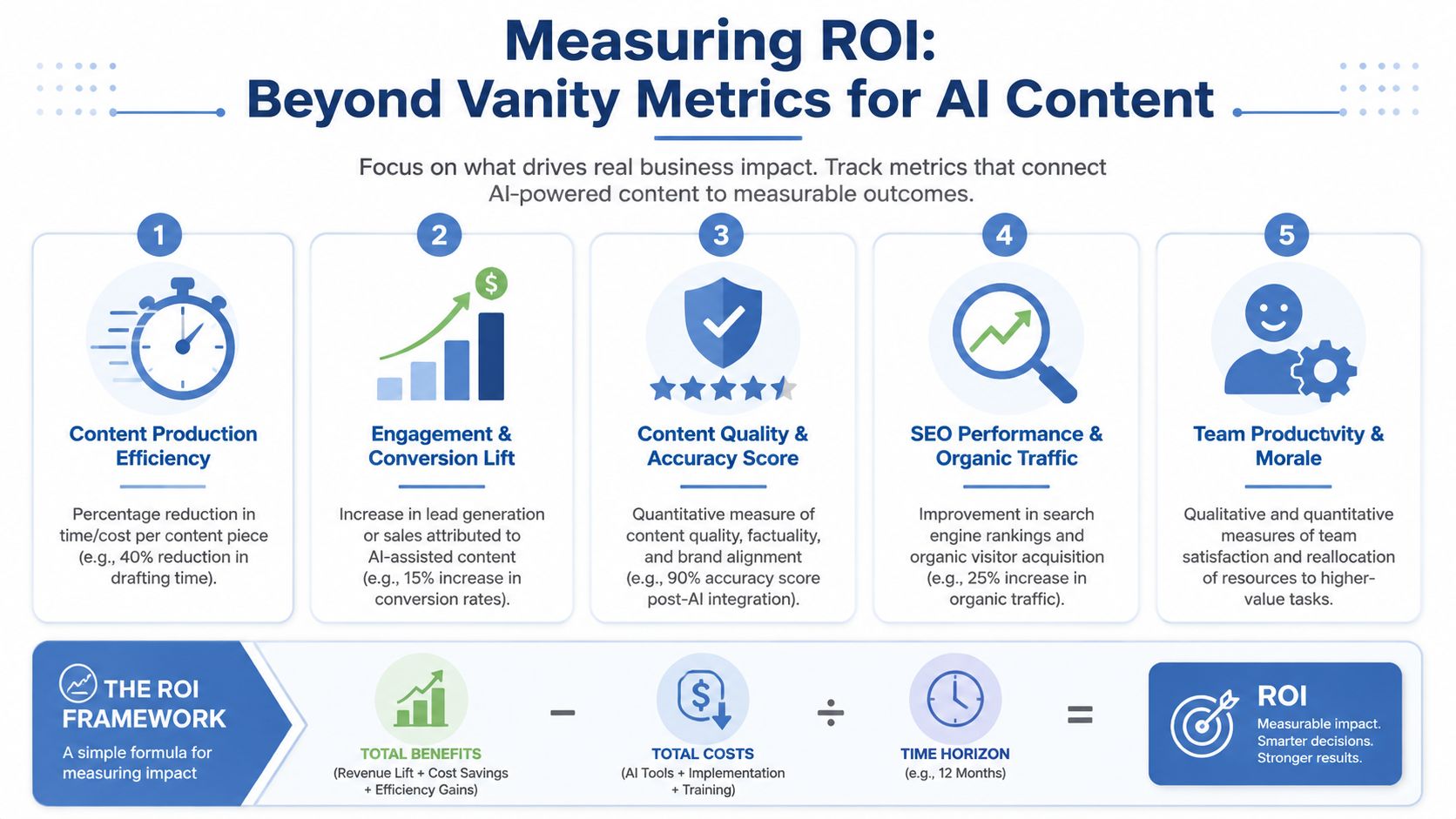
I measure AI content systems in two buckets: operational efficiency and commercial performance. You need both. Faster production without better business results is just cheaper noise.
Efficiency metrics that matter
Track the mechanics first.
| Metric | What it tells you |
|---|---|
| Time to first draft | Whether AI is reducing blank-page friction |
| Editing cycle count | Whether prompts and model choice are improving |
| Time to publish | Whether the workflow is actually faster end to end |
| Asset reuse rate | Whether long-form content is feeding distribution efficiently |
| Human review load | Whether governance is proportionate or bloated |
You can also use readability scores and search performance as quality controls. Acrolinx's overview of content performance metrics is directionally useful here because it highlights readability metrics, organic rankings, keyword performance, and dwell time as ways to judge whether AI-assisted content is helping or hurting visibility.
Performance metrics that prove the investment
Now the harder proof.
Verified industry data shows that marketers who use AI-generated content saw a 36% higher conversion rate on landing pages, while AI copywriting tools improved ad click-through rates by 38% and reduced cost-per-click by 32%. Those are the kinds of outcomes that justify investment because they hit pipeline efficiency, media efficiency, and revenue contribution directly.
I also want you tracking emerging AI-era KPIs:
- AI referral conversion rate, meaning how well traffic from AI-driven discovery converts.
- AI citations, meaning whether your brand appears in AI Overview, ChatGPT, Perplexity, Gemini, and Copilot.
- Share of search, meaning whether your brand occupies more demand than competitors.
Those metrics matter because search behavior is changing. Buyers increasingly discover vendors through AI-assisted interfaces as well as classic blue links.
If you want a broader strategic lens on measurement, The AI CMO's ROI playbook is useful because it pushes the conversation beyond vanity metrics and toward business-level attribution.
A simple reporting model works well:
- Weekly, track time saved, assets produced and review bottlenecks.
- Monthly, track conversion lifts, channel performance, AI citations, share of search.
- Quarterly, track contribution to pipeline, content production cost, and competitive visibility.
That's how you prove your AI content system is a profit center.
Your First 90 Days as an AI-Augmented Writer
Don't try to transform your whole operation in one week. That's how teams create chaos, not advantage. Build in phases.
Days 1 through 30
Pick one foundation model and stick with it long enough to learn its behavior. Stop model-hopping every time a new demo goes viral.
Choose one repeatable content type. A blog post, landing page, email sequence, or case study. Then document your current workflow in plain language, including where you get stuck, where quality drops, and where approvals slow everything down.
Create three core assets:
- A brand voice guide
- A research verification checklist
- A prompt library for your most common jobs
Your mission in this phase is clarity. Not automation for its own sake.
Days 31 through 60
Build one full workflow from start to near-publish-ready draft. Keep it narrow.
For example, take a webinar recording and turn it into a blog outline, landing page support copy, seven nurture emails, and a set of social posts. Put human checkpoints after research and after drafting. Track how long it takes and where cleanup is still painful.
Start with one workflow you can measure. Teams get into trouble when they automate five messy processes before fixing one.
This is also the phase where you connect systems. Your notes, transcripts, briefs, review docs, and publishing process should stop living in disconnected silos.
Days 61 through 90
Now you measure, refine, and standardize. Review editing load, turnaround time, asset reuse, and business outcomes. If the workflow saves time but weakens performance, fix the prompt context or add a stronger human review step.
Then package the workflow into a repeatable operating procedure. Write the instructions. Store the prompts. Define approvals. Decide who owns each step. That's how the process survives beyond one burst of enthusiasm.
By day 90, you should have one dependable AI-assisted content engine producing work that is faster, more consistent, and more commercially useful than your old process. That's the foundation. Then you expand.
AI for content writers only becomes powerful when you stop treating it like a shortcut and start treating it like infrastructure. The writers who win will build the best system for turning insight into revenue, with humans staying firmly in command where it counts.