
Using AI for business growth isn't about the future. It's about what you must do right now to win your market. Forget chasing every new tool. The game is applying AI strategically for measurable lifts in revenue, efficiency, and competitive advantage.
Stop Chasing AI Hype and Start Building Your Growth Engine
I see founders and marketing leaders get this wrong every single day. They chase the newest, shiniest AI tool, hoping it’s the silver bullet for their growth problems.
It’s not.
Real AI for business growth isn't about flashy demos or a passable blog post. It's about building intelligent, automated systems that create a genuine, unfair advantage. I've been in this space since 2016 with machine learning and jumped into Generative AI in 2019, long before the hype. The principles for getting real results haven't changed.
You have to focus on outcomes. More leads. Higher conversion rates. Market domination because you move faster and with more intelligence than your competitors.
This guide cuts through the noise. You and I won't be looking at a list of 101 AI tools you'll forget by tomorrow. We're going to walk through the exact framework I use with my clients—a system to find high-leverage opportunities, pick the right AI, and build automated workflows that directly impact your bottom line.
The Shift From Experiment to Execution
The market is moving past the "let's try AI" phase. Fast. Data shows AI adoption among companies has jumped to 72%, a huge leap after years hovering around 50%. Even more telling: the number of companies with over 40% of their AI projects in full production is set to double soon.
This is the inflection point. Companies are measuring tangible ROI. For you, this means the window to gain a first-mover advantage is closing. Fast.
The process I use boils down to three core actions: Find, Build, and Automate.
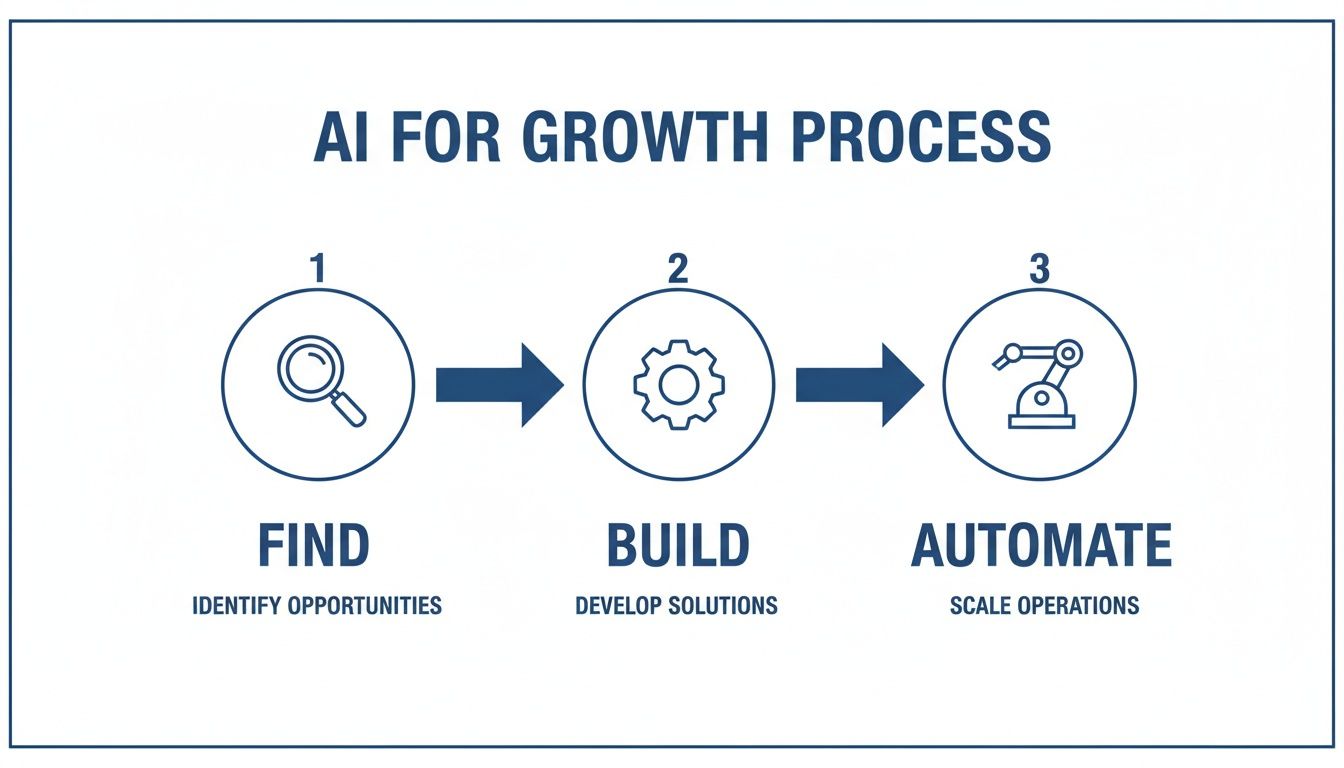
It’s a simple, powerful workflow. You find high-impact opportunities, build intelligent systems to tackle them, and automate the execution. You can't just jump to automation. You must start with a strategic search for the right problems to solve.
Beyond Tools: A True AI Growth Strategy
Here is a quick overview of where AI delivers the most significant business growth, moving from tactical to strategic impact.
| AI Growth Levers for Business | ||
|---|---|---|
| Growth Lever | Description | Primary Business Impact |
| Cost Reduction | Automating repetitive, low-value tasks like data entry, basic customer support, or content generation. | Frees up cash flow and human capital for higher-value strategic work. |
| Efficiency Gains | Accelerating core processes such as market research, lead qualification, or data analysis. | Increases speed of execution and allows teams to accomplish more with the same resources. |
| Revenue Lift | Improving key conversion points through personalization, better targeting, and optimized user experiences. | Directly increases top-line revenue by converting more prospects into customers. |
| Competitive Moat | Creating proprietary intelligent systems and data feedback loops that are hard for competitors to replicate. | Builds a sustainable, long-term advantage that compounds over time, making you harder to beat. |
The real value emerges when you move past simple cost savings and start building systems that give you a strategic edge.
The goal isn't just to use AI. It's to embed it into the DNA of your growth strategy. Creating systems that are defensible and compound over time. Your AI isn't just a content assistant. It's your primary market intelligence analyst, your lead qualification engine, your campaign optimization specialist.
The most dangerous thing in business today is being slow. AI is the single greatest tool we have to increase the speed and quality of our decisions and execution. It's your mechanism for market domination.
To truly build a sustainable growth engine, you need a robust strategy that integrates AI, allowing you to effectively navigate both traditional search and new AI chatbot interfaces. A Hybrid SEO and AI Strategy is fundamental to this approach, ensuring your hard-won visibility translates to future platforms.
We're moving beyond using AI tactically. We're building a "bionic" organization where AI handles the repetitive, data-heavy lifting, freeing your best people to focus on what humans do best: strategy, relationships, and creative breakthroughs.
Let's get to work.
Find: The AI Growth Audit for Surgical Precision
Before you touch a single AI model or write one line of code, you need a map. Most businesses I see get burned by AI make the same mistake: they try to apply it everywhere at once, like a coat of cheap paint. That approach guarantees mediocre results and a massive, wasted budget.
The key to real growth with AI is surgical precision. Forget boiling the ocean. Your goal is to find one small, winnable battle that proves AI's value, delivers an immediate return, and funds your next move. This is what an AI Growth Audit is for.
This isn’t some complex, month-long consulting gig. It’s a focused analysis you can knock out in an afternoon. You’re hunting for the points of maximum leverage in your business—the bottlenecks, the time-sinks, the hidden revenue opportunities.
Map Your Core Business Workflows
First, break your business into its three core functions: Marketing, Sales, and Operations (including customer support). For each one, map out the critical workflows step-by-step. Don't overcomplicate this.
- Marketing: How does a stranger become a lead? (e.g., Ad -> Landing Page -> Form Fill -> Email Nurture)
- Sales: How does a lead become a customer? (e.g., Lead Assigned -> Qualification Call -> Demo -> Proposal -> Closed Won/Lost)
- Operations: How do you deliver your product/service and support customers? (e.g., Onboarding -> Support Ticket -> Resolution -> Follow-up)
As you map these flows, ask yourself one question at each step: "Where is the friction?" Where do things slow down, fall through the cracks, or demand absurd manual effort? These are your starting points.
Identify High-Impact AI Opportunities
Once you've flagged the friction points, you can start looking for specific AI use cases. I've found that business functions leaning heavily on data, repetitive tasks, and pattern recognition are prime targets for quick wins.
I always advise my clients to look for opportunities in these areas first:
Repetitive Data Tasks. Think lead enrichment, where a salesperson manually looks up every new lead on LinkedIn. Or consider the mind-numbing data entry from invoices into your accounting software. An AI agent can take over these low-value tasks in its sleep.
Initial Triage and Qualification. Your best people shouldn't be wasting time on basic "how do I reset my password" questions or qualifying every webinar attendee. AI chatbots and smart lead-scoring models can handle 80% of these initial interactions, freeing your experts for high-value conversations that close deals.
Content and Data Synthesis. How long does it currently take your team to analyze a competitor's new messaging or summarize customer feedback from 100 survey responses? An AI model does this in seconds, turning raw, messy data into actionable intelligence you can use immediately.
Your goal is to find a task that is both painful for your team and valuable to the business. Automating a process nobody cares about is a waste of time. Automating something that saves 20 hours a week for your top salesperson? That’s a game-changer.
Score and Prioritize Your Wins
By now, you should have a solid list of potential AI projects. To pick your first target, you need to score each opportunity against three simple criteria. Just use a 1-5 scale, where 5 is high.
| Opportunity Scoring Framework | |||
|---|---|---|---|
| Potential Project | Impact (1-5) | Effort (1-5) | Data (1-5) |
| Automate Lead Enrichment | 4 | 2 | 5 |
| AI Chatbot for Tier-1 Support | 5 | 3 | 4 |
| Competitor Pricing Scraper | 3 | 4 | 3 |
Let’s break down what these criteria really mean:
- Impact: How much revenue will this generate or save? A project that can increase your lead-to-meeting conversion rate by 10% gets a much higher score than one that just saves a few hours of admin time. Be ruthless here and tie it directly to a core business KPI.
- Effort: How hard is this to implement? A project using a pre-built tool and a simple API connection is a 1 or 2. A completely custom-built model requiring months of development is a 5. Always start with low-effort projects.
- Data: Do you have the necessary data, and is it accessible and structured? AI needs clean fuel. If your customer data is a disaster spread across five spreadsheets, that’s a low score and a red flag.
The highest-scoring opportunity is your first target. It should have a high impact, require low effort, and use data you already have. This is how you build momentum, prove the business case for AI, and create a self-funding engine for growth that will leave your competitors wondering what just happened.
Build Your AI-Powered Market Intelligence System

Let's be honest: your competitors are slow. Most are still making decisions based on quarterly reports, gut feelings, and manual research. This is a massive opening. It’s where you can build an information advantage they simply can’t compete with.
We’re not just scraping a few headlines. You and I are going to design an automated intelligence system that works for you 24/7. A proactive market force, feeding you critical insights while your rivals are still trying to schedule their next meeting. This system is a cornerstone of using AI for business growth.
Designing the Intelligence Workflow
Stop thinking like a researcher. Start thinking like an intelligence agency. What information, if you had it in real-time, would give you a decisive edge? The goal is to focus on signals that predict what your competitors will do next.
Here’s a breakdown of the workflow I build with my clients:
Automated Data Collection. We deploy a team of specialized AI agents. Not basic scrapers. We configure them to monitor specific, high-value targets: key competitor websites, their social media ad libraries, press releases, and even their job boards. One agent might track pricing page changes, while another captures new customer testimonials.
Contextual Data Processing. Raw data is just noise. The real magic happens when you use context engineering to feed this information into a powerful reasoning model like Claude 3 or Gemini 1.5. You give the model your strategic priorities, product positioning, and details about your ideal customer.
Actionable Synthesis. The model's job is to find the "so what." It cross-references the scraped data with your strategic context and generates a concise, executive-level summary. It’s looking for patterns, anomalies, and strategic shifts.
Imagine waking up to a daily Slack message: "Competitor X just dropped their enterprise tier price by 15% and is A/B testing three new ad angles on Facebook targeting our core demographic. Their new messaging focuses on 'scalability,' a direct challenge to our latest campaign."
That's the power you're building.
From Data Points to Market Domination
This isn't a theoretical exercise. One of my ecommerce clients put this exact system in place to monitor their top five competitors. Within two weeks, their AI agent flagged that a key rival had quietly removed a popular product while launching a massive discount on a related item.
My client's AI synthesized this as a probable inventory clearance event ahead of a new product launch. We immediately launched a targeted campaign for our own, superior alternative. The result? A 22% lift in sales for that product line over the next 30 days, capturing market share before the competitor even announced their new item.
This is the tangible outcome of a well-designed intelligence system. It flips the script. You turn from a reactive player into a proactive one. You can read more about how this creates an almost insurmountable edge by exploring how AI market intelligence is your unfair advantage.
The Right Time to Build Your System
I'll be direct: this level of automation isn't for day one. If you’re still figuring out product-market fit, this is complete overkill. Focus on the audit I mentioned earlier. But if you’re in a crowded, competitive market and fighting for every percentage point of growth, an automated intelligence system is non-negotiable.
The cost of entry is also dropping fast. The global AI software market is projected to hit $174 billion in 2025 and scale to a staggering $467 billion by 2030. Generative AI, the engine behind this system, is growing even faster. This signals a critical moment: companies that build this infrastructure now will capture disproportionate value. Discover more insights about these projections and what they mean for your business.
Start small. Task an agent with monitoring one competitor's homepage and ad campaigns. Feed the results into a model and see what you learn. The first time you get an actionable insight that prevents a loss or creates a win, you’ll be hooked. You'll have proof that AI isn't just a tool for efficiency. It's a weapon for market domination.
Automate: Deploying AI Agents for Bionic Growth
Alright, let's get down to business. We’ve done the audit. We've built the intelligence system. Now it’s time to turn insight into action—and revenue.
If you’re just using Generative AI to write blog posts, you’re already behind. That’s table stakes. The real path to AI for business growth is automating your entire marketing and sales workflow with autonomous AI agents. This is how you build a bionic team.
Think of it this way: your team focuses on being strategists, closers, and relationship builders. The AI agents become tireless executors, grinding through the 80% of repetitive work that bogs down your best people. This isn't about replacing humans. It's about augmenting them to a superhuman level.

From Content Asset to Autonomous Campaign
Let me walk you through a practical, battle-tested example I’ve built for clients. You just published a fantastic new case study. In a typical company, that kicks off a slow, manual process where a project manager chases down marketing, social, and email teams to get the word out.
Now, imagine an AI agent pipeline instead.
The moment that case study goes live, it triggers an AI agent. This agent reads and fully understands the content—the customer, their pain points, your solution, and the specific results, like a 40% increase in lead conversion.
From there, the agent autonomously executes a whole series of tasks. It writes five different email outreach sequences, each one tailored to a different customer persona in your CRM. It drafts a series of posts for LinkedIn and X, with relevant hashtags and mentions. It even creates a summary for your internal sales newsletter.
This isn’t a sci-fi dream. These are systems I build for businesses today. The agent doesn't just create content; it orchestrates the entire go-to-market motion for that one asset, guaranteeing maximum impact with zero manual project management.
Building Your Bionic Sales Development Team
You can apply the exact same logic to your sales pipeline, where speed is everything. A slow response to a new lead is often the difference between a closed deal and a lost opportunity. This is where a sales-focused AI agent gives you an almost unfair advantage.
Picture this workflow for a new inbound lead:
- Lead Arrives: A new lead from a form submission hits your CRM.
- Enrichment Agent: An AI agent grabs it instantly. It scrapes the lead’s LinkedIn profile, their company website, and recent news articles to build a rich, detailed profile.
- Qualification Agent: A second agent takes that enriched data and scores the lead against your Ideal Customer Profile (ICP). Is this a decision-maker at the right kind of company?
- Drafting Agent: If the lead is a match, a third agent drafts a hyper-personalized opening email for your human sales rep. This email might reference the lead’s recent company announcement or a post they shared, making it instantly relevant.
Your sales rep never sees a raw lead. They get a fully qualified, pre-vetted opportunity with a personalized outreach draft ready for their final review and send. This single workflow can slash lead response time from hours to minutes and easily double the number of qualified meetings your sales team sets.
The objective is to create a system where your human experts are only involved at the most critical, high-leverage points—strategy, final review, and building human-to-human relationships. Everything else can and should be automated.
The impact here isn't trivial. It's macroeconomic. The productivity gains are staggering. Some analyses suggest AI could add up to USD 15.7 trillion to the global economy by 2030, and we're already seeing 92.1% of businesses report measurable results. By automating these core functions, you're tapping into a massive driver of economic value.
The Practicalities of Agentic Workflows
Now, building these systems requires careful thought. You have to make smart decisions about the underlying technology and, most importantly, decide where to keep human oversight in the loop.
A key consideration is the trade-off between open-source models (like Llama 3) and proprietary ones (like OpenAI's GPT-4o or Anthropic's Claude 3). For tasks demanding world-class reasoning and complex instructions, proprietary models are often the best choice out of the box. For specific, repetitive tasks where you can fine-tune a model on your own data, an open-source solution can be more cost-effective.
Crucially, you must build "human-in-the-loop" checkpoints. An AI agent should never have the final say on sending a pricing proposal or launching a major ad campaign. Instead, it should complete 95% of the work and then present its output to a human for final approval. This gives you the speed of AI with the strategic judgment of an expert. You can explore a variety of applications by checking out these powerful AI agent use cases.
Start with one, high-value workflow. Automate lead enrichment or content distribution first. Once you see the time saved and the revenue generated, you'll have the proof—and the budget—to build your next automated engine.
Measure: The ROI and Trade-Offs of AI Growth
If you can't measure your AI efforts, it’s not a business strategy—it's an expensive hobby. I've seen too many companies get swept up in the excitement, pointing to vanity metrics like "number of articles generated" or "queries handled." These numbers are meaningless.
We need to connect every single AI activity directly to dollars and cents. Your dashboard shouldn't just show you AI usage; it should show you business growth.

Beyond Vanity Metrics to Bankable KPIs
Let's forget the fluff. When I work with clients, we build dashboards that track KPIs that make CFOs pay attention. These are the metrics that prove the value of your AI investment and justify pouring more fuel on the fire.
Here’s what you should actually be measuring:
- AI-Assisted Lead Velocity: How much faster are leads moving from initial contact to a qualified meeting now that an AI agent is handling enrichment? A 20% reduction in the time-to-first-meeting is a massive win.
- Conversion Rate Lift: Are the AI-generated landing page variants or email copy actually converting better? A/B test everything. A sustained 5% lift in conversion from AI-optimized copy can translate into millions in new revenue.
- CAC Reduction: By how much has your Customer Acquisition Cost dropped since automating top-of-funnel marketing tasks? Calculate the hours saved and reallocated to tie AI directly to a more efficient growth engine.
These are not technical metrics. They are business metrics. This is the language of growth. If you're struggling with the fundamentals, it's worth reviewing how to measure marketing effectiveness before you even think about layering on AI-specific KPIs.
Weighing the Inevitable Trade-Offs
Now, let's cut through the hype. Implementing AI isn't some magical process with zero downsides. There are always trade-offs, and you need to measure them with the same rigor as your wins. Ignoring them is a recipe for disaster.
For example, you might build a fully automated content engine that increases your article output by 500%. That sounds incredible. But what if your analytics show a 10% dip in brand voice consistency and a slight increase in bounce rate?
Is that trade-off worth it? Only the data can tell you. You might decide the sheer volume of content and its SEO impact outweighs the slight brand dilution. Or you might add a human review step, sacrificing some speed for quality. There’s no single right answer, only the answer your data supports.
This is where you act like a true strategist. You analyze the data, you understand the give-and-take, and you make a calculated business decision—not an emotional one.
Scale Your Wins with the Flywheel Effect
Once you have a proven, profitable AI workflow, it's time to scale. And here’s the secret: your first successful AI project should fund the next one. This is how you create a self-perpetuating flywheel for innovation that your competitors simply can't keep up with.
Let’s say your automated lead qualification agent saves your sales team a combined 40 hours per week. That's one full-time employee's worth of time. You have two choices: bank the savings or reinvest them.
The smart move is to reinvest. Take that newfound efficiency—that "found money"—and allocate it to your next AI project from your growth audit. Perhaps it’s building that market intelligence system we discussed earlier.
This creates a powerful loop. You implement a workflow. You measure the financial gain. You reinvest those gains into your next high-impact AI project. And you repeat.
Each rotation of this flywheel makes your business faster, smarter, and more profitable. While your competitors are stuck in budget meetings trying to justify an AI experiment, you’re already on your third or fourth implementation, funded entirely by the successes of the last. That's how you use AI for business growth to not just compete, but to dominate.
Common Questions on Using AI for Business Growth
Over the years, I've heard every question imaginable about using AI for business growth. After the initial excitement fades and the real work begins, founders and marketing leaders always land on the same practical concerns.
These aren't theoretical debates. They're the real-world hurdles you need to clear. Here are the no-fluff answers to the questions you're probably asking right now.
How Much Does It Cost to Get Started with AI?
This is always the first question, and the honest answer is: it depends entirely on where you're starting.
You can begin experimenting with AI for the price of a ChatGPT Plus subscription or a few API calls. This is a great way to learn the ropes and handle some small-scale content tasks.
But building a real, automated growth engine is a different ballgame. The cost quickly shifts from tools to talent. Your biggest investment won't be software. It will be the strategic time required to audit your processes, design smart workflows, and manage the implementation.
A focused pilot project can run anywhere from a few thousand dollars for consulting and setup to significantly more if you're developing custom agents.
Don’t fixate on the tool's price. Focus on the cost of the problem you're solving. If an AI system can solve a $100,000 bottleneck, a $10,000 investment is an easy decision.
Should I Build a Custom AI or Buy an Off-the-Shelf Tool?
For 90% of businesses, the answer is to buy—or more accurately, to assemble. The market is flooded with powerful, pre-built AI solutions for common tasks like customer service, marketing automation, and data analysis.
Don't try to reinvent the wheel. Your job is to be a business operator, not a research scientist.
Building a custom solution only makes sense in two very specific scenarios:
- You possess truly proprietary data that gives you a unique, defensible competitive advantage.
- Your core business process is so specific that no existing tool on the market can possibly support it.
Even then, I almost always advise my clients to start by connecting off-the-shelf tools with APIs. You can create incredibly powerful, "custom-feeling" systems just by chaining together best-in-class products.
Only consider a full custom build when you've exhausted every other option and have a crystal-clear, high-value use case that justifies the massive investment of time and capital.