Everyone’s talking about AI. Most of it is noise. You and I are here to talk about one thing: using AI to build a revenue-generating machine that leaves your competitors in the dust.
This isn’t about cute prompts or shiny new toys. It’s about building integrated AI systems that automate entire workflows, deliver measurable results, and give you a brutal competitive advantage. I’ve been building with ML since 2016 and Generative AI since 2019. I’m here to show you how to move past the hype and into execution.
Why Your Competitors Are Already Winning With AI
Let’s cut right to it. The question isn’t if you should use AI for marketing—it’s how fast you can get it working to steal market share. While you’re thinking about it, your rivals are already deploying.
They’re using AI to analyze market data, personalize campaigns at a scale you can’t match, and optimize ad spend faster than any human team. This isn’t a future trend. It’s a present-day reality creating a massive gap between the winners and the losers.

This guide isn’t another high-level overview. It’s my playbook for founders, CMOs, and marketers who care about one thing above all else: results. Tangible, bankable results.
The New Competitive Landscape
We are well past the early adoption phase. Business adoption of AI has hit a tipping point, with 78% of organizations now using it—a huge leap from 55% just the year before. That 41% increase shows how quickly AI is becoming table stakes. For marketers, the number is even higher: 88% now use AI in their day-to-day work. You can dig into this data in the latest Stanford HAI report.
So, what does this actually mean for you?
It means your competition is already using AI to generate qualified leads while your team is sleeping. They’re creating hyper-personalized email sequences that convert better. They’re spotting emerging market trends before they hit the industry reports.
Ignoring this isn’t a strategy. It’s a surrender. Your competitors are building a moat, and every day you wait, that moat gets wider.
The goal is to build a bionic marketing system. One that combines the strategic brilliance of your human team with the speed, scale, and analytical power of machines. This isn’t about replacement; it’s about amplification.
Moving From Theory To Action
What you and I are about to walk through isn’t about chasing shiny objects. It’s a methodical process for building an intelligent system that helps you dominate your market. We’ll focus on practical application and tangible outcomes—more revenue, higher efficiency, and a sustainable edge.
Over the next sections, we’re going to break down the entire playbook. We’ll cover everything from assessing your real needs and data readiness to picking the right tools, designing smart AI agents, and—most importantly—measuring the cold, hard ROI. Forget the hype. It’s time to build.
Laying the Foundation for Market Intelligence
Before you touch a single AI tool, you need to get brutally honest about the problem you’re trying to solve. Too many companies get hypnotized by a new model and forget the business case. Your first move is a ruthless audit of your data and your marketing goals.
Don’t start by asking, “What can AI do?” Ask, “Where are we bleeding revenue?”

This isn’t a vague digital transformation project. It’s about surgically targeting a specific, expensive problem. Your competition isn’t winning because they have more AI; they’re winning because they’ve aimed their tools at the right targets.
Your Data Readiness Scorecard
Let’s be clear: AI is useless without good data. A powerful model fed garbage information will just produce garbage results, only faster. You have to be honest about the state of your data. Let’s run a quick “data readiness scorecard.”
Score each from 1 (terrible) to 5 (excellent):
-
Accessibility: Can your marketing team actually get the customer data they need? Or is it locked in engineering databases, requiring a ticket and a two-week wait?
-
Cleanliness: Is your CRM a graveyard of duplicate contacts and inconsistent formatting? Dirty data poisons any AI project from the start.
-
Completeness: Do you have a unified view of your customer? Or is web analytics in one silo, purchase history in another, and support logs gathering dust?
-
Timeliness: How fresh is your data? Real-time data lets you act now, while month-old reports are just history lessons.
Be honest. A low score doesn’t mean you can’t use AI. It just means your first project is data cleanup—which will give you a massive competitive edge on its own.
Find Your High-Impact Use Cases
Once you have a clear picture of your data, map it to your biggest marketing bottlenecks. Forget boiling the ocean. You’re hunting for one or two projects that deliver a clear, undeniable ROI within a quarter.
Here’s a real-world example. I worked with an e-commerce client plagued by massive cart abandonment. Their data was strong and clean. We built a simple predictive model to identify users likely to bail and triggered a personalized discount before they could click away.
The result? A 12% reduction in cart abandonment and a 7% lift in overall revenue inside of 60 days. That’s a win you can take straight to the board.
This is the key: Align a specific business problem with a specific, ready dataset. Your goal isn’t to “do AI.” Your goal is to increase lead conversion by 15% or slash content costs by 40%. The AI is just the tool.
Think about your business. Where does the funnel leak most?
-
Top of Funnel: Is your ad spend a black hole? AI-driven audience segmentation could be your target.
-
Middle of Funnel: Are leads going cold? A predictive lead scoring model can focus your sales team on prospects ready to buy.
-
Bottom of Funnel: Is your email marketing painfully generic? Automated content personalization can dramatically boost click-through rates.
This focused approach creates momentum. You prove the value with a small project, then use that win to fund your next, more ambitious initiative. I break down this process in my guide on building AI market intelligence as your unfair advantage. It’s about creating a flywheel of wins that leaves your competitors in the dust.
Choosing Your AI Stack and Architecture
Alright, you have your goals. Now it’s time to pick your weapons. The AI tool landscape is a chaotic mess of hype. My job is to help you cut through that noise and focus on what actually moves the needle.
The big question is whether to buy an off-the-shelf platform or build a custom solution. There’s no single right answer, just a series of trade-offs. Your choice will define your marketing’s agility, cost, and competitive ceiling for years.
The Critical Buy vs. Build Decision
The AI marketing world is exploding. The global market hit $36 billion and is expected to climb to $47 billion next year. It’s no surprise that marketing and sales are leading this charge—64% and 61% of teams, respectively, are cranking up their AI spending.
Why the rush? Because it works. Predictive AI improves conversion rates by 20-30%, and 79% of marketers point to efficiency as its biggest win. You can get a deeper look at these AI marketing and sales statistics over at sopro.io.
This spending frenzy creates two very different paths:
-
Buying Off-the-Shelf: This is the plug-and-play route. Think tools like Jasper for content or the AI features in your HubSpot CRM. It’s the fastest way to get started.
-
Building Custom Solutions: This path involves using foundational models like GPT-4 or Claude 3 through their APIs. You’re building workflows tailored precisely to how your business operates.
Off-the-shelf tools are great for speed. The catch? You’re living in their world, stuck with their features and limitations. It’s a solution that’s good enough for everyone but perfect for no one.
Building a custom architecture gives you a powerful competitive moat. By connecting a model like Claude 3 to your own customer data, you create an AI that understands your audience better than any generic tool ever could. The downside is the need for technical skills and a longer runway.
Don’t let perfect be the enemy of profitable. Start with off-the-shelf tools to solve immediate problems. Then, identify the single highest-value process and build a custom AI agent around it to create a true competitive advantage.
AI Marketing Tooling Decision Matrix
| Approach | Best For | Pros | Cons | Typical Use Case |
|---|---|---|---|---|
| Buy (Off-the-Shelf) | Teams needing speed and simplicity for common tasks. | Fast to deploy, user-friendly, no technical team needed. | Less flexible, high long-term cost, generic output, vendor lock-in. | Generating social media posts, writing blog drafts, basic email automation. |
| Build (Custom API) | Businesses with unique workflows needing a sustainable competitive edge. | Total control, highly scalable, deep data integration, creates a competitive moat. | Higher upfront cost, requires technical expertise, slower to deploy. | A personalized customer support agent, a lead scorer trained on your sales data. |
Looking at it this way makes the choice about your reality and ambition, not just about the tool itself.
A Framework for Evaluating AI Tools
Whether you buy or build, you need a ruthless, business-focused way to evaluate your options. Forget the marketing fluff and zero in on what truly matters.
Here’s what I look at:
-
Integration Capability: How well does this play with your existing systems? A brilliant AI tool is useless if it can’t talk to your CMS. It must fit into your existing workflow, not create a new one.
-
Data Security: Where is your data going? When you feed prompts into a third-party tool, you’re handing over strategic plans. You must understand their security protocols.
-
Scalability & Cost: Does the pricing model punish you for success? Model your costs based on your growth ambitions, not your current state.
-
Performance & Reliability: Does it actually work? You have to test everything. Pit its output against a human. Validate its insights against your own data. Don’t take their word for it.
If you’re digging into content creation tools, you might find our review of 41 AI writing tools and apps useful.
And don’t forget measurement. It’s critical to include the best AI search tracker tools that match your goals. An AI stack without a feedback loop from your SEO performance isn’t smart; it’s a high-tech guessing machine.
Designing and Deploying AI Agents and Workflows
A model sitting by itself is useless. Its value only comes when you embed it into a workflow that does something for the business. This is where we move past prompts and start architecting multi-step AI agents.
This is where you build your competitive moat.
We’re going to stop thinking about one-off tasks and start designing automated systems. This is how you use AI for marketing in a way that truly scales your operation.
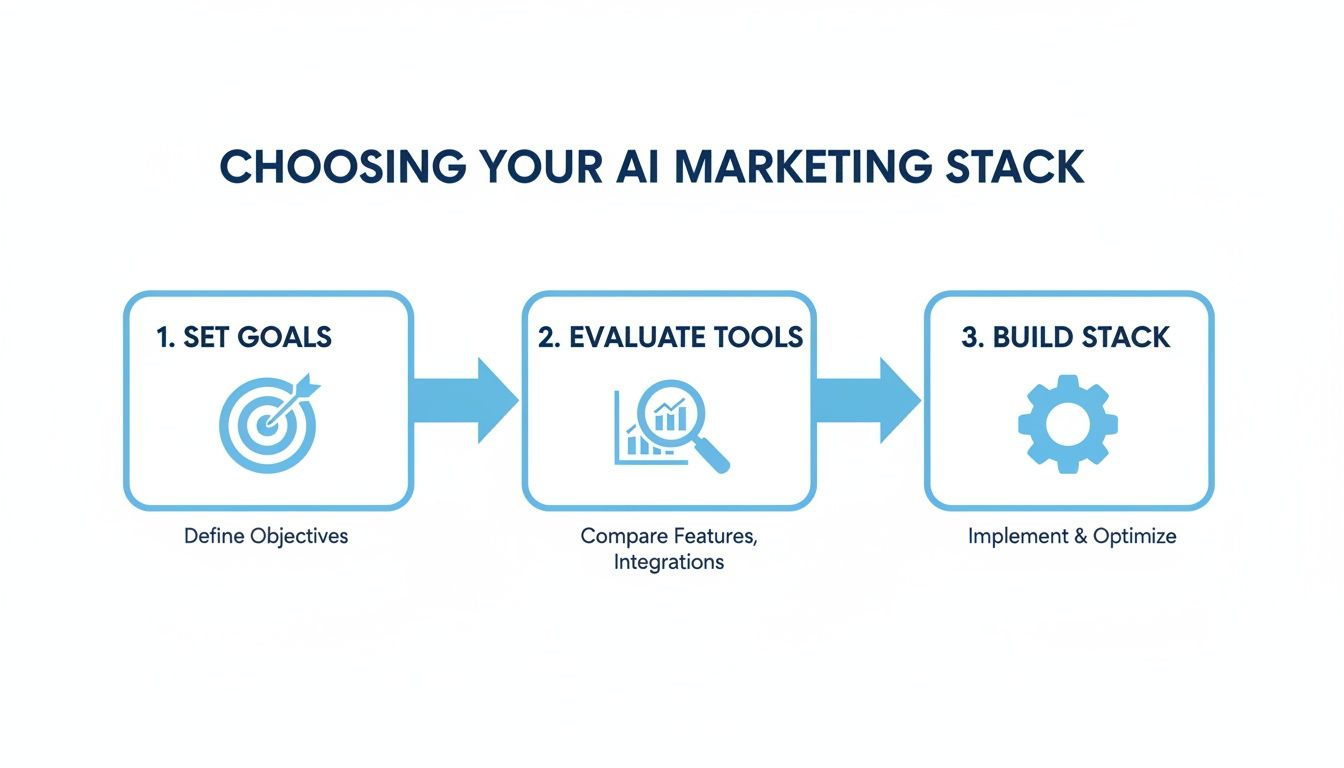
The key insight is that the ‘build’ phase is the final step. Proper evaluation, guided by clear business goals, is what prevents you from wasting money on the wrong tools.
From Prompt to Intelligent Agent
Let’s make this real. An AI agent isn’t one model performing one task. It’s a sequence of actions designed to handle a complex business process from start to finish. It’s about automating 80% of the repetitive work.
Imagine you want to dominate a new content vertical. A simple prompt gives you garbage. An intelligent agent, however, could execute this workflow:
-
Analyze Competitors: The agent scrapes the top 10 ranking articles for your target keyword.
-
Identify Gaps: It feeds that content into a model to find underserved topics your competitors missed.
-
Generate Briefs: It generates three distinct, SEO-optimized content briefs with target personas and key headings.
-
Write First Drafts: It produces high-quality first drafts incorporating your brand’s specific voice.
-
Human Handoff: It packages the drafts into a Trello card, ready for a human strategist to add the final 20% creative polish.
That’s not a prompt. That’s a system. It’s a machine that turns a business goal into a high-quality asset. I’ve put together a quick primer on AI marketing automation that dives deeper into these mechanics.
The Power of Context Engineering
The reliability of any AI agent comes down to context engineering. This is the science of giving the model precisely the right information at the right time. Forget “prompt engineering”; this is the professional league.
Your goal is to eliminate the model’s need to guess.
A well-engineered context window is the difference between an AI that’s a frustrating intern and one that’s a world-class operator. The model is only as good as the information you give it.
For instance, the context for that content agent isn’t just the brief. It’s a payload containing:
-
The Content Brief: Instructions for this single article.
-
Brand Voice Guide: Your complete style guide.
-
Exemplars: Three to five examples of your best-performing articles.
-
Target Persona: A detailed description of the ideal reader.
By engineering this context, you constrain the model’s output and force it to align with your strategic objectives. You’re not hoping for a good result; you’re architecting it.
A direct application is a well-designed Lead Generation Chatbot that engages prospects 24/7. This is how you build reliable, scalable AI workflows that actually drive business growth.
Running Experiments and Measuring True ROI
Deploying a new AI agent is just the opening act. If you can’t prove its value on the balance sheet, it’s just an expensive science project. This is the part that separates the serious operators from the hobbyists.
Proving value is how you win.
To do this right, you need a rigorous measurement framework. I’m not talking about vanity metrics like “engagement.” I mean the numbers the C-suite cares about: Customer Acquisition Cost (CAC), Lifetime Value (LTV), and raw conversion rates.
Focus on Hard Financial Metrics
Every AI initiative you launch must be tied directly to a core business KPI. Draw a straight, undeniable line from your AI workflow to a financial outcome. This is non-negotiable.
Here’s how to structure the experiments:
-
A/B Test AI vs. Human Copy: Run a split test on your next email campaign. Send an AI-generated version to 50% of your list and a human-written version to the other 50%. Let the revenue tell you what works.
-
Optimize Landing Pages: Unleash a predictive AI to re-architect a key landing page. Pit that new version against your control page and measure the lift in sign-ups or sales. A 2% conversion lift on a high-traffic page can mean millions.
-
Analyze Ad Spend Efficiency: Deploy an AI agent to manage a segment of your ad bidding strategy. Compare its return on ad spend (ROAS) directly against your human-managed campaigns. Prove the machine can allocate capital more effectively.
The most powerful argument is a simple one: “This AI workflow cost us $1,200 in API credits and saved the team 80 hours. It also generated a 7% increase in qualified leads, translating to $75,000 in new pipeline.” Hard numbers are undefeated.
Quantifying Operational Gains
Don’t forget the other side of ROI—operational efficiency. Sometimes the biggest win isn’t making more money, but doing more with the team you have. This is about creating leverage.
Track the time savings meticulously. If an AI agent automates content briefs, calculate how many hours that frees up for your strategists. Turn that time into a dollar value based on their salaries.
When you can show a $500/month AI tool saves $8,000/month in labor costs, the business case is irrefutable. Your competitors are scaling by adding headcount; you’re scaling by adding intelligence. That’s a fundamental advantage.
Understanding the Global Landscape
As you get more sophisticated, remember that AI adoption isn’t the same everywhere. Geographic differences can reveal crucial insights.
For instance, while North America leads the AI marketing market with a 32.4% revenue share, emerging markets are catching up fast. A Nielsen survey found 59% of marketers worldwide see AI for personalization as the most impactful trend. But priorities shift by region: Latin America is at 63%, Asia-Pacific at 62%, and Europe trails at 50%. You can dig deeper into these global AI marketing trends and their implications on Nielsen.com.
This data shows a one-size-fits-all AI strategy is doomed. The application for how to use AI for marketing differs across cultures. Your measurement framework has to be flexible enough to account for these regional nuances.
Common Questions About AI in Marketing
Alright, let’s get into the questions I hear all the time. These are the real-world roadblocks people hit when they start getting serious. My answers come from what I’ve seen work—and fail spectacularly—in the trenches since 2016.
Will AI Replace My Marketing Team?
No. But marketers who use AI will replace those who don’t. That’s the new reality.
Think of AI as a force multiplier. Its job is to take over the repetitive, data-heavy tasks that burn out your best people. This frees your team to focus on big-picture strategy, creative breakthroughs, and building human relationships.
The best teams I work with are “bionic”—they blend human creativity with machine intelligence. Your team’s roles will shift from manual doers to AI operators and strategists.
The question isn’t about replacing people. It’s about empowering them to create 10x the value by offloading grunt work to an AI agent. A small, AI-powered team can run circles around a much larger, traditional one.
How Do I Make AI Content Actually Sound Like My Brand?
This is where most teams fail. You can’t just lob a generic prompt at ChatGPT and expect high-converting copy. The solution is a mix of sharp prompt engineering and deep context engineering.
First, build a detailed brand voice “constitution.” This is a master document you feed the AI for every content task. It needs your messaging pillars, tone principles, a glossary of terms, and examples of on-brand and off-brand copy.
Second, get good at few-shot prompting. This means you provide three to five stellar examples of your best content inside the prompt itself. This gives the model a concrete target. Finally, always have a human in the loop for that last 10% polish.
What’s the Biggest Mistake Companies Make With AI Marketing?
The single biggest mistake is starting with the tech instead of the business problem. Teams get hyped about a new tool and scramble to find a problem it can solve. That’s backward and a surefire way to light money on fire.
Start with a brutally honest look at your marketing and sales funnel. Where is your biggest bottleneck? Is it a garbage lead conversion rate? Is customer acquisition cost through the roof? Define the problem and the specific business outcome you’re after.
Only then can you start looking for the right AI solution. This problem-first approach ensures you’re investing in workflows that deliver a measurable ROI, not just chasing trends.
How Much Is This AI Stuff Going to Cost Me?
The cost can swing from practically nothing to millions. The good news? You can start making a real impact for less than you spend on coffee.
-
Getting Started (Under $100/month): You can jump in with off-the-shelf SaaS tools. A subscription to a content generator and some API access for small experiments fits in this budget.
-
Mid-Range Customization ($1,000 – $5,000/month): This is where you begin building custom workflows using APIs from OpenAI, Anthropic, or Google. You can create the kinds of intelligent agents we’ve been talking about.
-
Large-Scale Deployment ($20,000+/month): This involves fine-tuning custom models, building out data pipelines, and maintaining a dedicated AI infrastructure.
The key is to not boil the ocean. Start small with a single, high-ROI pilot project. Prove the value on a contained budget, then use those hard numbers to justify a bigger investment. This is how you build a sustainable AI capability that leaves your competitors wondering how you’re moving so fast.