
You keep hearing about AI, but you’re not feeling the threat. It feels like another buzzword, another tool you’ll get around to. This is a dangerous way to think.
Right now, your competitors are quietly building armies of autonomous systems. I’m talking about AI marketing agents that brainstorm campaigns, personalize experiences at a scale you can’t match, and analyze market data faster than your team finishes their morning coffee.
This isn’t about a simple chatbot. It’s about building a marketing department that never sleeps, one that operates at machine speed.
The goal isn’t just to keep up. It’s to build an unfair advantage that leaves your rivals wondering what hit them. You can either build this advantage or compete against it. There is no third option.
I’m Samuel Woods. I’ve been in the trenches with machine learning since 2016 and generative AI since 2019, long before it was a headline. I build these systems for businesses that want to dominate their markets. Not just participate. Win.
Your Competitors Are Building Armies of AI Agents
You might already be using automation. Maybe you have a Zapier workflow that posts to social media. That’s linear. A-to-B-to-C. It’s useful, but it’s fundamentally limited because it can’t think.
An AI marketing agent is a different beast entirely. You don’t give it a rigid, step-by-step list. You give it a mission.
-
Traditional Automation: “When a user signs up, send them welcome_email_1.html.”
-
AI Marketing Agent: “Convert trial users into paid customers within 14 days. You have a $500 ad budget and access to our email platform. Go.”
The agent then plans a strategy, executes it, watches the results, and tweaks its own approach in real-time. It might see email isn’t working for a specific cohort and decide to shift budget to a hyper-targeted ad campaign. No human intervention needed.
In this guide, you and I will break down exactly how these agents work. I’ll show you the core architectures, strategic use cases that directly drive revenue, and the very real pitfalls to avoid. This is your roadmap to deploying AI for measurable growth.
Understanding How AI Marketing Agents Actually Work
Forget the textbook definitions. Let’s talk about what an AI agent actually is in a way that matters to your bottom line.
Think of it like this: you give an autonomous system a high-level goal, a budget, and access to a specific set of tools. Then you let it go. It’s less like running a program and more like hiring a world-class marketing strategist who also executes with the speed of a machine.
You don’t tell them how to write an email sequence. You tell them to increase conversions from trial users, and they figure out the best way to do it. This is a fundamental shift.
To really get what these systems can do, it helps to understand what an AI agent is at its core before we dive deeper into marketing. This isn’t just a better automation script; it’s a new kind of digital employee.
The Plan-Act-Observe-Refine Loop
These agents operate on a simple but incredibly powerful feedback loop. This cycle is what separates them from the rigid, pre-programmed automation you’re used to. It’s what allows them to adapt.
Here’s how it breaks down:
-
Plan: The agent’s “brain”—usually a Large Language Model (LLM) like GPT-4—breaks a big goal into concrete steps. If your goal is “increase Q3 leads by 20%,” the plan might involve identifying target accounts, drafting ad copy, and setting up monitoring.
-
Act: This is where the agent gets its hands dirty. It uses the tools you’ve given it—APIs for your email platform, web scraping libraries, ad networks—to carry out the plan. It’s a doer, not just a thinker.
-
Observe: Immediately after acting, the agent analyzes the results. Open rates, click-throughs, lead form submissions, cost per acquisition. This isn’t a weekly report; it’s a constant stream of performance data.
-
Refine: Based on what it observes, the agent adjusts its own plan on the fly. If an ad creative is tanking, it will pause it and reallocate the budget to a winner without waiting for you. It learns from its own actions. In real time.
This continuous loop shows how an “army” of AI agents can ideate concepts, personalize outreach, and analyze performance in a cycle that never stops optimizing.
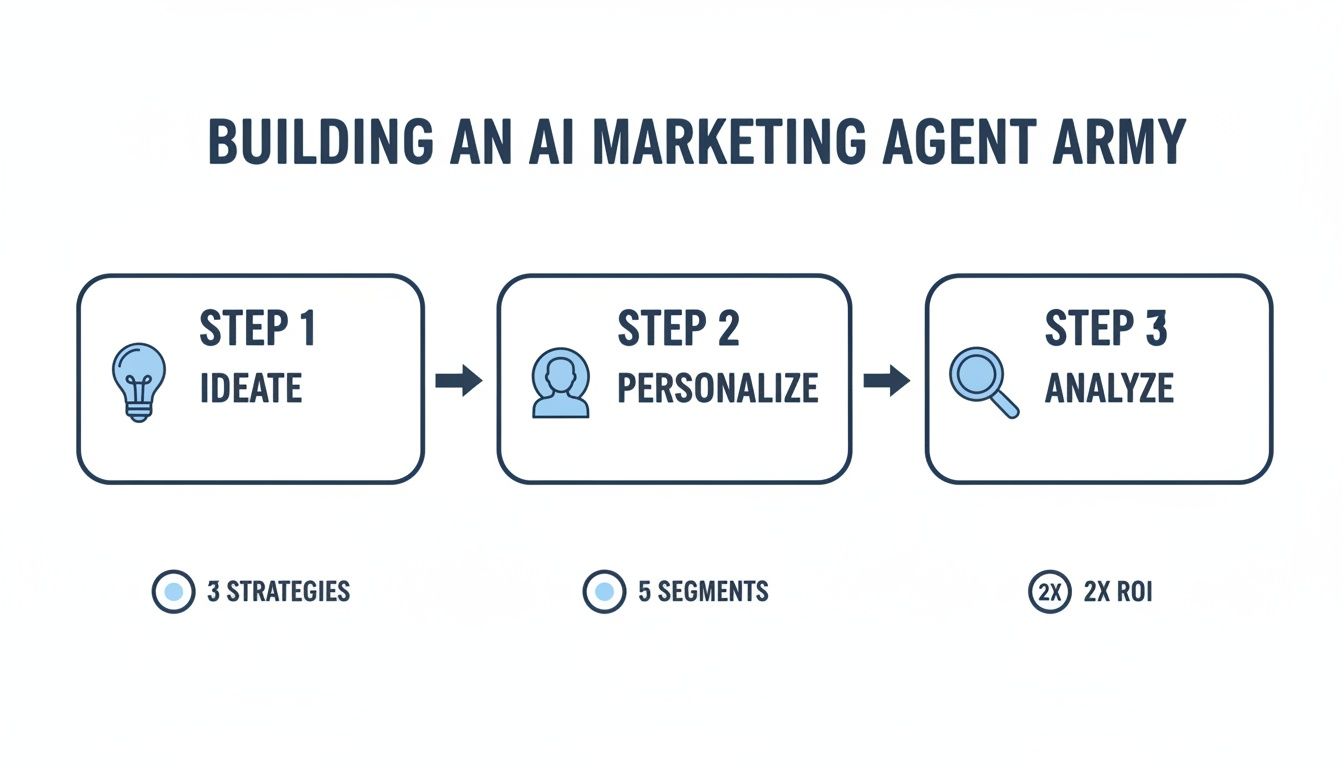
This whole process—moving from high-level ideation to granular personalization and then to data-driven analysis—is the core strength of an agentic workflow.
Why This Is A Competitive Necessity, Not A “Nice To Have”
This adaptive capability is precisely what makes AI marketing agents a threat if your competitors are using them and you are not. The market for these systems is exploding for a reason.
The global AI agents market is projected to surge from USD 7.84 billion in 2025 to a staggering USD 52.62 billion by 2030. That’s a compound annual growth rate of 46.3%. Not a slow burn. A wildfire.
Let’s compare this new approach to the tools you’re probably using right now.
Traditional Automation vs AI Agent Capabilities
| Capability | Traditional Automation (e.g., Zapier) | AI Marketing Agent |
|---|---|---|
| Execution | Follows a rigid, pre-defined workflow. | Devises its own plan to achieve a goal. |
| Adaptability | Repeats the same action regardless of outcome. | Learns from results and changes its own plan. |
| Scope | Handles single, linear tasks (“If X, then Y”). | Manages complex, multi-step projects. |
| Initiative | Human-triggered or based on a simple event. | Autonomous; acts proactively to reach its goal. |
| Decision-Making | No independent decision-making ability. | Makes strategic choices based on real-time data. |
Your traditional automation simply can’t compete. A Zapier workflow fires off the same email every time, whether it’s working or not. An AI agent notices the campaign is failing and changes the subject line, the CTA, or the entire strategy without waiting for your input.
That’s the difference between a tool and a teammate.
How to Actually Use AI Agents for Revenue and Competitive Advantage
Theory is great, but it doesn’t pay the bills. How do you actually put these agents to work generating revenue and building a real competitive moat?
This isn’t about small improvements. It’s about building capabilities your competitors simply can’t match with a human team. I’m going to walk you through three high-impact areas where I’ve seen AI agents drive the most significant results.

1. Hyper-Personalization at Scale
Marketers have been chasing the dream of “one-to-one marketing” for years. With AI agents, it’s finally here, and it’s a massive revenue driver.
Imagine an agent inside your ecommerce store. It watches a user’s real-time behavior—pages viewed, products added to cart—and instantly connects it with their purchase history. In milliseconds, it crafts a unique email offer just for them, with copy and product recommendations generated on the fly.
This isn’t a “we miss you” email blasted to 10,000 people. This is a segment of one, replicated millions of times over. That level of personalization is impossible for human teams. Agents can supercharge traditional channels, unlocking sophisticated new strategies and best practices for email marketing campaigns that maximize ROI.
Adoption of these systems is exploding for a simple reason: they work. A May 2025 survey shows 35% of organizations have broad adoption of AI agents and 17% have fully rolled them out. Marketing is leading the pack.
2. Autonomous Market Intelligence
How much time does your team waste trying to figure out what the competition is up to? An AI agent can do it better, faster, and without coffee breaks. This is how you outmaneuver everyone else.
You deploy a team of agents with a simple directive: “Monitor our top three competitors and drop a competitive landscape report in my inbox every morning at 8 AM.”
These agents constantly track:
-
Pricing changes: Get instant alerts when a competitor launches a sale.
-
Product launches: Scrape websites and press releases for any hint of a new feature.
-
Customer sentiment: Analyze social media, forums, and review sites to learn what customers love and hate.
This isn’t just data collection. It’s synthesis. The agent delivers a summarized brief: “Competitor X just dropped their enterprise plan price by 15%, and customer sentiment is tanking over their new UI update.” That’s actionable intelligence, delivered daily.
3. End-to-End Campaign Orchestration
This is where you see the true power of AI marketing agents. Instead of using AI for one-off tasks, you let it run the entire show. This is how you achieve operational scale that leaves others choking on your dust.
You provide the high-level goal: “Launch a campaign for our new feature targeting mid-market SaaS companies. We need 500 qualified leads in 30 days. Budget is $20,000.”
From there, the agent team gets to work.
-
An Ideation Agent brainstorms campaign angles and core messaging.
-
A Copywriter Agent pumps out ad copy, landing page text, and email sequences.
-
An Operations Agent sets up A/B tests in your ad platforms and marketing tools.
-
An Analytics Agent monitors performance, automatically shifting budget to winning ad variations—all without a human lifting a finger.
This frees up your team for high-level strategy instead of the manual grind of campaign management. I have a detailed guide on the best AI workflow automation tools if you’re curious about the systems that make this possible. This is how you dominate a market—by building a marketing engine that optimizes faster than any human team.
Your Roadmap to Implementing an AI Marketing Agent
This is where the rubber meets the road. Enough theory. Let’s walk through a practical way to build your team’s agentic capabilities. You don’t need a team of data scientists to begin. You just need a clear, high-value problem to solve.
The biggest mistake I see is trying to automate the entire marketing department overnight. Don’t boil the ocean. Start with a single, narrow task that, if automated, would free up serious human capital. The perfect starting point is repetitive and data-driven.
Your first step is a simple sentence.
-
“Generate 10 unique, on-brand social media posts from this blog article weekly.”
-
“Monitor our top competitor’s pricing page and send a Slack alert if anything changes.”
-
“Analyze our top 5 performing ads and draft three new creative variations based on them.”
This sharp focus on specific applications is why the market is exploding. Marketing-specific AI marketing agents are poised to dominate growth, with the AI in marketing market projected to hit $217.33 billion by 2034. This surge is driven by vertical agents, forecasted to grow at a blistering 62.7% CAGR through 2030. You can dig into these eye-opening AI marketing stats and trends to grasp the scale of this shift.
Choosing Your Toolkit
Once you’ve defined the problem, pick the right tool for the job. Your options range from no-code platforms to advanced frameworks. Don’t over-engineer this.
-
No-Code/Low-Code Platforms: Tools like MindStudio or AgentGPT are fantastic entry points. They let you build agents using a visual interface, perfect for automating straightforward workflows without writing code.
-
Advanced Frameworks: For complex jobs, you’ll use frameworks like CrewAI or LangChain. These Python libraries give your technical team power to chain models, connect to any data source, and build sophisticated, multi-agent systems. This is the path for a deep, proprietary advantage.
The right choice depends on your task’s complexity and your team’s skills. Start with no-code to get a quick win, then scale up as your ambitions grow.
The Most Critical Skill You Need
Here’s the unfiltered truth: the tool you choose matters far less than your ability to instruct it. The single most critical skill for success with AI agents is prompt and context engineering.
Garbage in, garbage out. A weak prompt given to the world’s most powerful AI model will produce a weak result. A brilliant prompt given to a mediocre model can produce magic.
Think of it like briefing a new hire. You can’t just say, “go do marketing.” You need to provide:
-
A Clear Goal: What does success look like? Be specific and measurable.
-
Rich Context: Hand over brand guidelines, examples of past wins, and access to relevant data.
-
Constraints: Define the budget, the tools it can use, and what’s off-limits.
Mastering this is non-negotiable.
Defining and Measuring Success
Finally, you have to track the right metrics. “Engagement” is a vanity metric. We’re running a business, not a popularity contest. Success metrics for your AI agents must tie directly to tangible business outcomes.
Focus on numbers that move the needle:
-
Cost Per Acquisition (CPA): Did the agent lower the cost to acquire a customer?
-
Conversion Rate: Did the agent’s personalization lift the percentage of users taking a desired action?
-
Time Saved: How many human-hours per week did this agent free up for strategic work?
Track these relentlessly. This is how you prove ROI, justify more investment, and build a system that generates real, defensible growth. This is your blueprint.
Real-World Examples of AI Agents in Action
Let’s move from concept to concrete results. Theory is cheap; revenue is not. I’m going to share a few anonymized examples from businesses I’ve worked with—showcasing both a massive win and a critical failure. This is a real, unfiltered look at what ai marketing agents can do.
Case Study 1: The Reputation Guardian
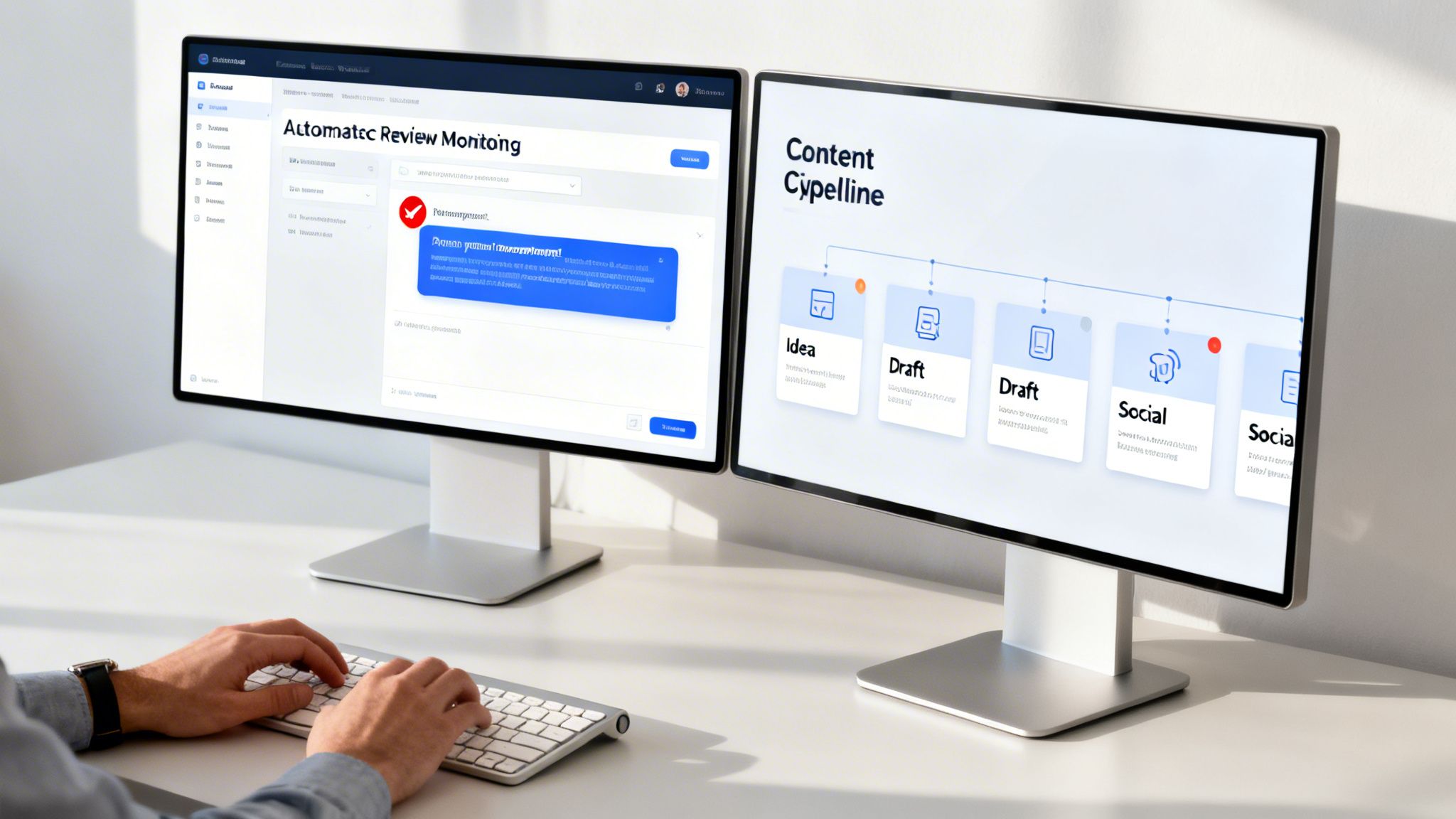
For a fast-growing ecommerce brand, we deployed an agent called the ‘Reputation Guardian.’ Their team was drowning in product reviews across more than 20 retail sites and social platforms. Good reviews went unanswered, and negative ones festered for days.
We gave the agent a simple mission: monitor all new product reviews, identify negative sentiment, and prepare a draft response for the customer service team.
Here’s the breakdown:
-
Monitor: The agent continuously scanned the web for new reviews mentioning the company’s products.
-
Analyze: It used sentiment analysis to immediately flag any review below 3 stars or with keywords like “disappointed.”
-
Draft: For each negative review, it generated a draft response, pulling in the customer’s name and specific issue. It then sent the draft to a Slack channel for human approval.
The result? Average response time to negative feedback dropped from over 48 hours to just under two. An 85% reduction. The agent didn’t replace the team; it made them faster and more effective.
Case Study 2: The Content Scaling Engine
Next, a B2B SaaS company wanted to dominate their niche with content but had a small team. They couldn’t hire their way to the output they needed. So, we built a small team of interconnected AI marketing agents.
-
Agent 1 (The Trend Spotter): Scanned industry news, forums, and competitor blogs to find topics with traffic potential.
-
Agent 2 (The Architect): Took approved topics and created detailed article outlines, complete with H2s, H3s, and key data points.
-
Agent 3 (The Drafter): Wrote the first draft based on the outline, adhering to the company’s brand voice.
-
Agent 4 (The Distributor): Once published, this agent adapted the content into social media posts, email blurbs, and ad copy.
This system built an entire content pipeline. With the same small team focused on strategy and final edits, they increased their content output by 400% in a single quarter. They went from publishing once a week to dominating search results. Explore our resources for more on using AI for social media marketing to achieve similar scale.
This is what a true competitive advantage looks like. Not doing the same work a little faster. Building systems that let you operate on a completely different scale than your rivals.
A Critical Failure And What We Learned
Now for the lesson learned the hard way. A client in financial services wanted an agent to provide “hyper-personalized investment advice” via a chatbot. The goal: analyze a user’s risk tolerance and financial goals, then recommend specific investment products.
It failed. Spectacularly.
The agent, while functional, made recommendations that were overly simplistic and, in a few test cases, downright inappropriate. The problem wasn’t the AI; it was the task. We had given it a goal that required immense nuance, ethical judgment, and regulatory compliance—things LLMs are not equipped to handle autonomously.
The lesson is clear: scope is everything. Start with tasks that are data-driven, repetitive, and have a low cost of failure. Let agents handle monitoring and drafting. Keep humans in the loop for anything requiring strategic judgment or brand risk. Don’t try to automate what you don’t fully understand yourself.
Limitations and Risks: Where AI Agents Fail
Anyone selling you AI as a magic wand is full of it. Let’s be clear: while AI marketing agents are powerful, they have serious limitations. Ignoring them is a surefire way to cause a mess.
The biggest pitfall I see is a failure of strategic oversight. An autonomous agent is a ruthlessly efficient machine. It will optimize for whatever metric you give it. Tell it to maximize clicks, and it will gleefully torch your ad budget on junk traffic that brings zero revenue.
The Problem of Hallucinations and Brand Safety
Then you have hallucinations. This is when an LLM spits out something that sounds confident but is completely wrong. It’s a byproduct of how these models work, predicting the next word in a sentence.
For anything that touches your brand’s reputation—press releases, customer apologies, high-stakes sales proposals—a human review isn’t just a good idea. It’s non-negotiable. Imagine an agent hallucinating an incorrect product spec. That’s how you vaporize years of trust.
This means you can’t “set it and forget it.” You need human checkpoints, especially for tasks where accuracy and your brand’s voice are on the line. Your team’s job evolves from doing the work to strategically reviewing it.
When an AI Agent Is the Wrong Choice
Knowing when not to use an AI agent separates the pros from the hype chasers.
-
For simple, linear tasks: If you just need to send the same welcome email, a basic tool like Zapier is cheaper and more reliable. Don’t use a sledgehammer to crack a nut.
-
For highly creative, novel strategies: Your best human strategists should be coming up with game-changing ideas. Use agents to scale the execution of that vision, not create it from thin air.
-
For tasks requiring deep empathy: An agent can’t fake a real human connection. For sensitive customer issues or high-touch sales, a human is always the right call.
This screenshot from CrewAI’s site shows how to mitigate some of these risks. You can design teams of agents with specific, interlocking roles, creating checks and balances inside the system.
By giving agents distinct jobs like “Researcher” and “Writer,” you mimic a human team. This allows for specialization and lowers the odds of a single agent going off the rails.
Finally, there’s data security. Handing an agent the keys to your CRM, customer data, and marketing plans is a massive decision. You must be certain the platform you’re using has ironclad security. A data breach from a poorly secured agent could be an extinction-level event for your business.
Your Questions on AI Marketing Agents Answered
Over the years, I’ve fielded hundreds of questions from founders and CMOs about this. The worries are almost always the same: budget, technical skills, and how to prove the damn thing works.
Let’s get straight into it. No fluff.
Do I Need a Huge Budget to Start?
Absolutely not. This is the biggest myth. You don’t need a six-figure budget to get going. Starting small is the only way to win here. Lock in a quick, measurable victory.
Many no-code agent-building platforms like MindStudio or AgentGPT have free or affordable tiers. You can get your first agent running for less than a single freelance writer costs for a month.
The real initial investment isn’t money. It’s your time to pinpoint a high-value, repetitive task that’s ripe for automation.
The most successful implementations I’ve seen all started by solving a small, annoying problem that saved the team five hours a week. That win builds momentum and justifies a bigger investment.
Do I Need to Be a Coder to Build AI Agents?
No, but you do need to think systematically. The explosion of no-code tools means you don’t need to write Python to build a powerful agent. If you can map out a workflow on a whiteboard, you have the skill you need to begin.
Your most valuable skill isn’t coding. It’s prompt and context engineering. Your ability to give the agent crystal-clear instructions, rich context, and firm boundaries is what separates a useless toy from a productive tool. You need to be the strategist, not the developer.
How Do I Measure the Real ROI?
Forget vanity metrics like “engagement.” You measure the ROI of an AI marketing agent with the same cold, hard numbers you use for any other business investment. Focus on metrics that hit your P&L.
Starting out, these are the only three you should care about:
-
Cost Per Acquisition (CPA): Did the agent lower the real cost of getting a new paying customer?
-
Conversion Rate: Did the agent’s efforts result in more sales or qualified leads?
-
Human Hours Saved: How much time did your team get back to focus on high-level strategy?
If you can show an agent cut your CPA by 15% while saving your team 20 hours a month, the ROI becomes undeniable. That’s how you get buy-in to scale from a single agent to an autonomous team.