
You see the lists everywhere. “100 ChatGPT prompts” that are mostly fluff. Generic. Disconnected from the only thing that matters in business: revenue and market domination.
I’ve been in the trenches with ML since 2016 and Generative AI since 2019. My job is to build systems that give companies an unfair competitive advantage. This isn’t about playing with chatbots. This is about building a bionic marketing operation that moves faster than anyone else in your space.
The difference between winning and losing is the quality of your prompts. Generic prompts get you commodity-grade content that blends in. A strategically engineered prompt, however, becomes a force multiplier for your entire marketing team. It’s the difference between an intern writing social posts and a senior strategist outlining a multi-channel campaign to steal market share. Understanding the core principles of using GPT for marketing is the first step.
You and I are going to walk through 10 battle-tested prompt frameworks. These aren’t just copy-paste templates; they are strategic assets designed to extract maximum value from the AI. We’ll cover everything from high-level strategy to granular landing page copy. Each one is a tool to sharpen your competitive edge.
Forget the hype. This guide provides the specific, actionable ChatGPT prompts for marketing that produce tangible business outcomes. Ready to build a real AI advantage?
1. The AIDA Framework Prompt
Let’s start with a classic. Why? Because it works. AIDA (Attention, Interest, Desire, Action) has generated billions in revenue long before AI was a talking point. Now, we can weaponize it with ChatGPT, turning a proven formula into a high-speed conversion engine.
Most marketers ask ChatGPT for “ad copy.” The result is usually weak. AIDA gives the AI a structured path to follow, forcing it to think like a seasoned direct-response copywriter. You’re not just asking for copy; you’re commanding a specific, persuasive sequence.
The Core Prompt Template
Here’s a base prompt you can adapt. The magic is in the details you provide.
Act as a world-class direct-response copywriter specializing in [Your Industry, e.g., B2B SaaS]. Your task is to write compelling copy for a [Your Asset, e.g., landing page, email campaign] for our product, [Product Name], using the AIDA framework. Our target audience is [Detailed Persona Description]. Their primary pain point is [Specific Pain Point].
Attention: Craft a headline that stops them cold and addresses their pain point directly.
Interest: Build on the headline. Use storytelling or surprising statistics to explain how we solve their problem in a unique way.
Desire: Shift from logic to emotion. Paint a vivid picture of the successful outcome they will achieve. Focus on the transformation, not just the features.
Action: Write a clear, urgent, and low-friction call-to-action. Tell them exactly what to do next.
How to Tune It for Better Results
-
Be Hyper-Specific: Don’t say “marketers.” Say “overworked B2B content marketing managers at Series A startups struggling to prove ROI.” Specificity is the difference between generic fluff and copy that converts.
-
Request A/B Variations: Ask ChatGPT for two versions. For the “Desire” section, have one focus on “gaining a benefit” and the other on “avoiding a loss.” Immediate testing material.
-
Inject Your Metrics: Add a line like, “The primary goal is to increase our free trial conversion rate from 2% to 4%.” This frames the task around a tangible business outcome, not just creative writing.
2. The Content Cluster & Pillar Prompt
You can’t publish random blog posts and expect to rank. Google rewards topical authority. The fastest way to build it is with a deliberate pillar and cluster model. This isn’t a new concept, but using ChatGPT to architect it collapses months of strategic planning into an afternoon.
Most marketers use AI for one-off articles. A massive waste. This prompt forces the AI to think like an SEO strategist. You’re commanding it to build a defensible content moat around your core topics, establishing you as the authority in your niche.
The Core Prompt Template
Here’s a base prompt to build a comprehensive content strategy. Specificity is your greatest weapon.
Act as an expert SEO Content Strategist with 15 years of experience building topical authority for [Your Industry, e.g., B2B Fintech] companies. Your task is to develop a comprehensive pillar and cluster content model.
Our core pillar topic is: “[Pillar Topic, e.g., AI-Powered Marketing Automation]”
Our target audience is: “[Detailed Persona Description]”1. Generate 12-15 distinct, high-intent cluster topics that support the main pillar. These should address specific user questions and pain points.
2. For each cluster topic, create a compelling, SEO-optimized headline.
3. For the primary pillar page, create a detailed outline that links out to each cluster topic.
4. Provide a list of recommended anchor text variations for internal links pointing from the cluster pages back to the pillar page.
How to Tune It for Better Results
-
Validate with SEO Tools: Use the AI’s output as your strategic map, but use Ahrefs or Semrush to validate keyword volumes and difficulty. This combines AI’s speed with hard data.
-
Add a Competitor Angle: Add this line: “Analyze the top 3 ranking articles for the pillar topic and identify content gaps our strategy can exploit.” This moves you from creating content to creating market-leading content.
-
Plan Your Calendar: Ask the AI to “organize these 15 topics into a 3-month content calendar, with a publishing cadence of one post per week.” This turns a list of ideas into an actionable plan.
3. The Customer Empathy Map Prompt
Your messaging fails when it talks about what you do instead of what they feel. Most marketers guess at their customer’s inner world. We’re going to use AI to build a detailed psychological profile, moving from flimsy personas to an actionable empathy map.
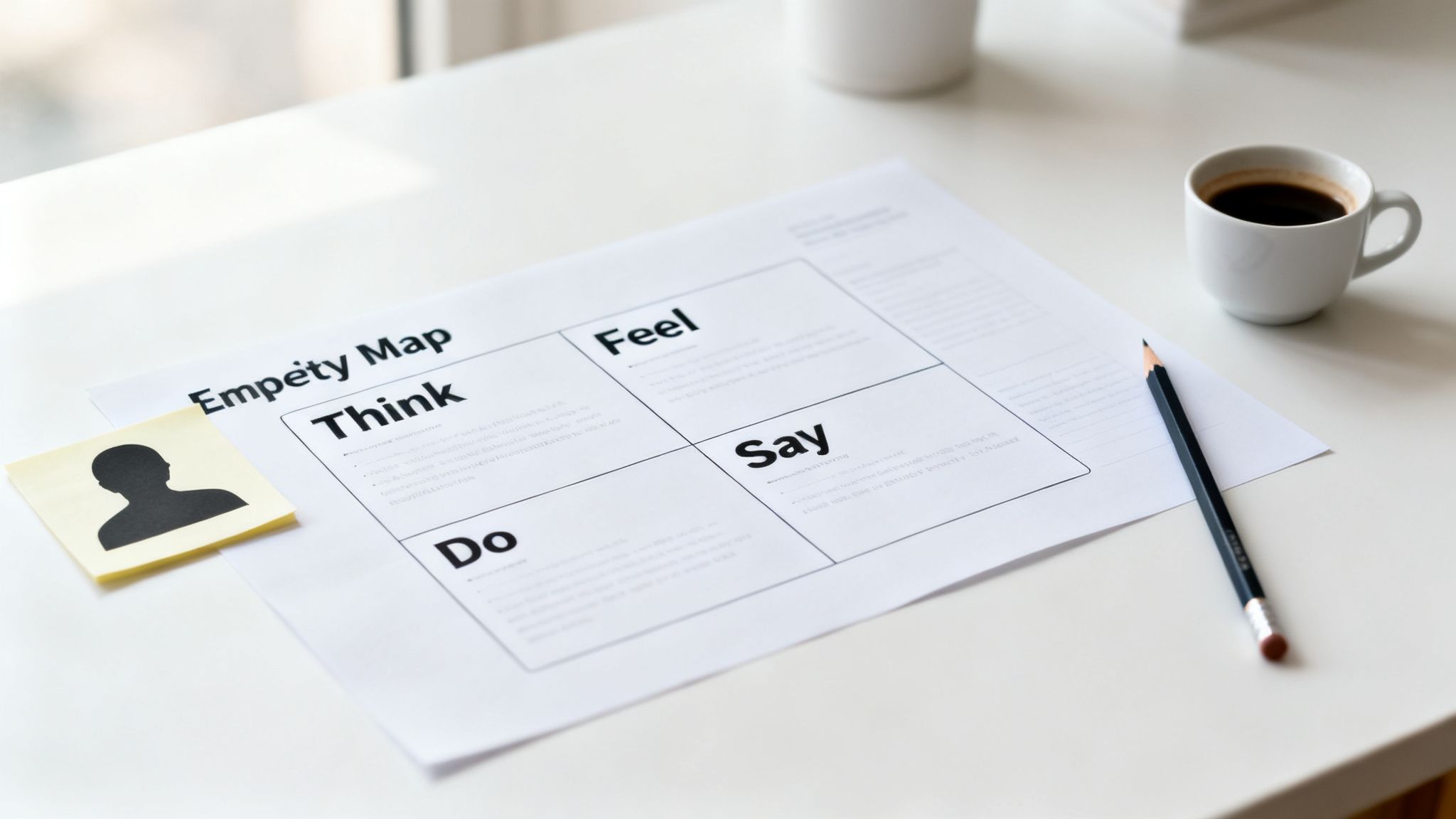
This prompt transforms raw data—interviews, surveys, reviews—into a clear picture of what your customers think, feel, say, and do. It uncovers the hidden anxieties that drive buying decisions. A B2B agency I work with discovered decision-makers fear ‘being left behind on AI.’ That became the core of their entire lead generation campaign. You stop selling features and start solving their real problems.
The Core Prompt Template
Feed ChatGPT your raw customer data. More context, better map.
Act as a seasoned qualitative researcher and brand strategist. Your task is to create a detailed Customer Empathy Map for our target customer based on the following data: [Paste in customer interview transcripts, survey results, support tickets, or online reviews].
Our product is [Product Name], which helps [Target Audience] solve [Problem]. Synthesize the provided data to fill out these four quadrants:
Says: What are the direct quotes and common phrases they use?
Thinks: What’s going on in their mind that they might not say out loud? What are their underlying beliefs and worries?
Feels: What are their primary emotional states? Identify their main fears, frustrations, and aspirations.
Does: What actions do they take? Describe their daily routines and behaviors related to the problem we solve.
Finally, summarize their core Pains (fears, obstacles) and Gains (wants, measures of success).
How to Tune It for Better Results
-
Feed It Real Data: This prompt is only as good as its inputs. Use real customer interview transcripts, survey data, or even negative reviews for the most accurate and sometimes brutal insights.
-
Map Multiple Segments: If you serve different customer segments, run this prompt for each one. A SaaS founder’s empathy map is vastly different from their enterprise marketing manager’s.
-
Ask for Strategic Recommendations: Add this: “Based on this empathy map, suggest three key messaging angles we should test in our ad campaigns to address their primary pains.” This turns insight directly into action.
4. The Email Sequence Automation Prompt
Email sequences are the engine of automated marketing. Building one from scratch is a soul-crushing task of mapping triggers and writing dozens of copy variations. Most teams burn out, ship a generic three-email sequence, and call it a day.
With the right prompt, you can generate an entire, behavior-driven email campaign in minutes. This isn’t just about writing copy; it’s about architecting the entire communication flow. You’re instructing the AI to act as a seasoned email strategist, considering timing, triggers, and psychological hooks. This moves email from a broadcast tool to an automated relationship builder.
The Core Prompt Template
This template commands ChatGPT to think about the entire customer journey, not just one email.
Act as an expert email marketing strategist specializing in [Your Industry, e.g., Ecommerce Fashion]. Your task is to design a complete [Sequence Type, e.g., cart abandonment] email sequence for our brand, [Brand Name]. Our target audience is [Detailed Persona Description]. The primary goal is to [Specific Business Goal, e.g., recover 15% of abandoned carts].
Sequence Logic: Outline a [Number]-email sequence over [Timeframe, e.g., 3 days]. Detail the trigger for each email and the ideal delay between sends.
Email 1 (Immediate): Write a subject line and body copy focused on [Psychological Angle, e.g., helpful reminder/customer service].
Email 2 ([Time Delay]): Write a new subject line and copy introducing [New Element, e.g., social proof or a FAQ section].
Email 3 ([Time Delay]): Craft a final subject line and copy that creates urgency with a [Incentive, e.g., limited-time 10% discount].
Implementation Notes: Suggest relevant UTM parameters for tracking each email’s performance.
How to Tune It for Better Results
-
Specify Your Platform: Mention your ESP. “Adapt this sequence for Klaviyo, ensuring the trigger logic is compatible” gives the AI technical constraints to work within.
-
Define the Customer’s State: Are they a new lead (Awareness) or a repeat buyer (Loyalty)? Add a line like, “This sequence targets customers in the ‘Consideration’ phase of their journey.”
-
Request Contingency Plans: Ask for a re-engagement branch. For example: “If a user doesn’t open the first two emails, suggest a third ‘breakup’ email with a pattern-interrupting subject line.” This builds resilience into your automation.
5. The Competitor Intelligence Prompt
You can’t dominate a market you don’t understand. Yet, most competitive analysis is a slow, manual process that results in an outdated spreadsheet. With the right prompt, you can transform this chore into a strategic weapon, giving you a real-time map of your competitor’s playbook.
Most marketers use AI for creation, not analysis. Big mistake. Using ChatGPT for competitor intelligence forces it to act like a market strategist. It synthesizes public data—messaging, pricing, positioning—and highlights exploitable gaps. You stop guessing what your competitors are doing and start surgically dismantling their strategy.
The Core Prompt Template
This prompt turns ChatGPT into your personal intelligence analyst. Provide it with the raw data, and it will deliver the insights.
Act as a world-class market intelligence analyst specializing in the [Your Industry, e.g., legal tech] sector. Your task is to conduct a competitive analysis based on the provided marketing materials from our top three competitors. Our target audience is [Detailed Persona Description].
Analyze the following data [paste in competitor website copy, landing page text, or ad scripts]:
Positioning: What is their core value proposition and unique selling point?
Messaging: What key phrases, pain points, and benefit claims do they repeat? Identify their messaging framework.
Weaknesses: Based on their messaging, what are they NOT saying? Where are the potential gaps or vulnerabilities in their positioning that we can exploit?
Opportunities: Summarize 2-3 strategic opportunities for our company, [Your Company Name], to differentiate ourselves and capture market share.
How to Tune It for Better Results
-
Feed It Specific URLs: Instead of pasting text, ask ChatGPT (with browsing capabilities) to analyze specific competitor landing pages or pricing pages. This provides richer, more current context.
-
Request a SWOT Analysis: Ask the AI to frame its findings in a SWOT (Strengths, Weaknesses, Opportunities, Threats) format for each competitor. This is a classic framework that gives you immediately actionable intelligence.
-
Focus on Language Patterns: Add a command like, “Identify the top 5 most frequently used emotional trigger words across all competitor copy.” This reveals the psychological levers they’re pulling.
6. The Social Media Content Calendar Prompt
The biggest drain on social media ROI isn’t the algorithm; it’s the relentless, manual effort of content creation. You spend hours brainstorming, writing, and scheduling, only to post inconsistently. This prompt turns ChatGPT into your dedicated social media strategist, building a structured, goal-oriented content calendar you can execute in a fraction of the time.
Most marketers ask for “a few post ideas.” A recipe for random acts of content. A content calendar prompt forces the AI to think strategically about cadence, content pillars, and business objectives. You move from being a content creator to a content system architect.
The Core Prompt Template
Here’s a powerful template to get you started. More detail, better calendar.
Act as a senior social media strategist specializing in [Your Industry, e.g., DTC ecommerce]. Your task is to generate a one-month content calendar for [Your Brand] on [Platform(s), e.g., Instagram and TikTok]. Our target audience is [Detailed Persona Description]. Our primary business goal for this month is [Specific Goal, e.g., driving traffic to our new product launch].
Adhere to the following content mix:
40% Educational: [e.g., How-to guides, industry tips]
30% Entertaining: [e.g., Behind-the-scenes, trending audio memes]
20% Promotional: [e.g., Product features, user-generated content]
10% Community-Building: [e.g., Q&As, polls]
For each post, provide:
Post Date & Optimal Time
Content Pillar/Theme
Platform-specific copy (e.g., Instagram caption vs. TikTok script outline)
A relevant Call-to-Action
A list of 5-7 researched hashtags
How to Tune It for Better Results
-
Inject Your Brand Voice: Add a line like, “Our brand voice is witty, slightly irreverent, and highly knowledgeable. Please reflect this in all copy.” This prevents generic, robotic outputs.
-
Request Creative Formats: Don’t just ask for copy. Ask for “a 3-part Twitter thread outline,” “an Instagram Reel script with scene-by-scene descriptions,” or “a LinkedIn carousel concept.”
-
Set Performance Goals: Tell the AI what success looks like. For instance, “The goal is to increase our Instagram engagement rate from 1.5% to 3% and drive 500 clicks to the landing page.” This focuses the AI on hitting specific KPIs. You can learn more about how AI can supercharge your social media marketing and drive tangible results.
7. The Landing Page Copy & Conversion Prompt
A great landing page is an engineered conversion machine. Most marketers ask ChatGPT for “landing page copy” and get a wall of generic text. This prompt changes the game by forcing the AI to think like a Conversion Rate Optimization (CRO) specialist, blending persuasion, clarity, and user psychology.
You’re not just asking for words. You’re commanding the AI to architect a conversion path. This prompt integrates specific goals, audience objections, and psychological triggers directly into the copy generation process. It shifts the focus from “what we want to say” to “what the user needs to hear to convert.”
The Core Prompt Template
This template structures the copy around a clear conversion goal.
Act as an expert CRO copywriter specializing in high-converting landing pages for [Your Industry, e.g., DTC ecommerce]. Your task is to write the complete copy for a landing page for our product, [Product Name]. The single conversion goal is to [Specific Goal, e.g., get users to purchase our starter kit]. Our target audience is [Detailed Persona Description] and their biggest objection is [Common Objection, e.g., “I’ve tried similar products and they didn’t work”].
Above the Fold:
Headline: Create 3 variations that address the main benefit and counter the primary objection.
Sub-headline: Expand on the headline, introducing a unique mechanism or promise.
CTA Button: Write a compelling, low-friction call-to-action.
Body Copy:
Problem/Agitation: Detail the pain point in the audience’s own language.
Solution/Benefits: Introduce our product as the specific solution. Focus on the transformation, not just features.
Social Proof: Write placeholder copy for testimonials and logos that reinforce trust and results.
Objection Handling: Directly address and dismantle the primary objection.
Final CTA Section:
Urgency/Scarcity: Craft a closing argument with a compelling reason to act now.
Final CTA: Repeat the call-to-action with a risk-reversal element (e.g., money-back guarantee).
How to Tune It for Better Results
-
Define the Funnel Stage: Tell the AI if the traffic is cold (from a Facebook ad) or warm (from an email list). This dramatically changes the level of trust you need to build in the copy.
-
Provide a Wireframe: Give ChatGPT a simple layout structure like “Headline, Image, 3 Benefit Icons, Testimonial, CTA.” This helps it allocate the right copy to the right visual sections.
-
Set a Conversion Target: Add, “Our goal is to increase the page’s conversion rate from 1.5% to 3%.” This anchors the AI’s output to a tangible business outcome, making its copy more focused and aggressive.
8. The Product Launch Campaign Prompt
A successful product launch isn’t a single event; it’s an orchestrated campaign. Most marketers ask AI for bits and pieces like “launch day emails” or “teaser social posts.” This siloed approach creates a disjointed experience and a launch that fizzles.
This prompt forces ChatGPT to act as a seasoned product marketing director. It thinks holistically about the entire launch arc: building anticipation before, maximizing impact on launch day, and nurturing new customers after. You’re not just getting tactics; you’re generating a strategic roadmap. This is how you dominate the conversation.
The Core Prompt Template
Here is a comprehensive prompt to build a full-funnel launch plan.
Act as a world-class Product Marketing Director specializing in [Your Industry, e.g., consumer tech, B2B SaaS]. Your task is to create a comprehensive go-to-market launch plan for our new product, [Product Name]. The launch date is [Date].
Our target audience is [Detailed Persona Description]. Their core need is [Specific Need]. The product solves this by [Key Differentiator].
Structure the plan into three distinct phases:
Pre-Launch (4 weeks prior): Outline tactics for building awareness and anticipation. Include content ideas (blog posts, webinars), social media teasers, and PR outreach angles.
Launch Day: Detail the coordinated activities for maximum impact. Specify email sequences, social media announcements, paid ad strategies, and influencer collaborations.
Post-Launch (4 weeks after): Create a plan to maintain momentum and nurture new users. Include onboarding email flows, case study development, and a content calendar.
For each phase, define the primary messaging, key channels, and success metrics (e.g., pre-launch waitlist sign-ups, launch day sales, post-launch activation rate).
How to Tune It for Better Results
-
Work Backwards: Start your prompt with a firm launch date. This forces the AI to create a realistic, time-bound plan instead of a generic list of ideas.
-
Set a Budget: Include a line like, “The total paid media budget for this launch is $10,000. Allocate this budget across the different phases and channels.” This adds a layer of financial reality to the strategic output.
-
Demand Cross-Functional Alignment: Add: “Include a pre-launch internal checklist to ensure sales, marketing, and support teams are aligned.” A launch’s success depends as much on internal readiness as external promotion.
9. The Sales Enablement & Objection Handling Prompt
Your marketing generates a lead, but the deal dies in sales. Why? Your sales team wasn’t prepared for real-world objections. This prompt turns ChatGPT into a sales enablement machine, arming your team with bulletproof responses before they ever pick up the phone.
Most marketers stop at lead generation. Elite marketers build a bridge to revenue. This prompt does just that by anticipating customer friction points and scripting the counters. You’re building a sales playbook that turns “maybe later” into “where do I sign?” This is how you use AI to close more deals, faster.
The Core Prompt Template
This prompt creates a resource your sales team will actually use.
Act as a world-class sales enablement coach for a [Your Industry, e.g., B2B software] company. Your task is to create an objection handling guide for our sales team for our product, [Product Name]. Our target audience is [Detailed Persona Description].
Based on the following data [Paste snippets of sales call transcripts, CRM objection notes, or customer support tickets], generate a list of the top 10 most common objections.
For each objection, provide:
A Reframing Question: A question to understand the root cause of the objection.
A Data-Backed Response: A concise talking point that uses a statistic, social proof, or a specific feature benefit to counter the objection.
A Relevant Proof Point: Suggest a specific case study, testimonial, or demo to share.
How to Tune It for Better Results
-
Segment by Persona: Don’t create one generic guide. Ask ChatGPT to generate separate objection-handling scripts for different customer segments. A CFO’s budget concerns are different from a Head of IT’s integration fears.
-
Incorporate Competitive Landmines: Add this line: “Also, create responses for objections related to our main competitor, [Competitor Name]. Arm our team with talking points about our key differentiators without badmouthing them.”
-
Request Risk Reversals: Ask the AI to script language for your trial periods or money-back guarantees. This gives your sales team powerful tools to de-risk the decision for the prospect.
10. The Brand Voice & Messaging Guidelines Prompt
Without this prompt, every other prompt is a gamble. You’re asking an AI to create content for a brand it doesn’t know. The result is a schizophrenic brand presence where your emails sound different from your ads. This is a foundational, non-negotiable step for scaling content with AI.
Most marketers add “write in a friendly tone” to their prompts. That’s not a brand voice; it’s a vague instruction. This prompt forces you to codify your brand’s personality, creating a central nervous system for all future AI-generated content. You move from hoping for brand alignment to engineering it.
The Core Prompt Template
This prompt creates your brand’s AI-ready style guide. Use it to start every new content creation chat.
Act as a world-class brand strategist. My company is [Company Name] in the [Your Industry] industry. Our brand personality is a blend of [Adjective 1, e.g., Confident], [Adjective 2, e.g., Approachable], and [Adjective 3, e.g., Insightful]. Our target audience is [Detailed Persona Description].
Based on this, generate a comprehensive Brand Voice & Messaging Guideline document. It must include:
Tone Descriptors: Define our core personality traits with “We are…” and “We are not…” statements.
Vocabulary Guide: List 10-15 “on-brand” words/phrases and 10-15 “off-brand” words/phrases to avoid (include corporate jargon).
Rhythm & Pace: Describe our sentence structure (e.g., short and punchy, or long and descriptive).
Core Messaging: Articulate our primary value proposition and a short brand story narrative that embodies our values.
How to Tune It for Better Results
-
Include Real Examples: Add this to your prompt: “Here are three examples of on-brand copy we’ve used: [Paste examples]. Here are two examples of off-brand copy: [Paste examples].” This gives the AI concrete data to model.
-
Define Contextual Shifts: Ask ChatGPT to define how the voice adapts. “Define how our ‘Confident & Approachable’ tone shifts for a product launch announcement versus a customer service apology.”
-
Build a Persona: Before generating the guide, use another prompt to create a brand persona. “Create a persona for our brand, ‘BrandX.’ Give it a name, a personality, and a communication style.” Then, use that persona as the foundation for your brand voice prompt.
Top 10 ChatGPT Marketing Prompts Comparison
| Title | Implementation complexity | Resource requirements | Expected outcomes | Ideal use cases | Key advantages | Key limitations |
|---|---|---|---|---|---|---|
| The AIDA Framework Prompt | Low–Medium — straightforward template with minor customization | Basic audience inputs, brand voice, marketer review | Conversion-focused headlines and CTAs; clear funnel progression | Landing pages, email campaigns, PPC ads, lead magnets | Proven persuasion flow; consistent CTAs; easy to teach | Can feel formulaic; needs customization for complex B2B journeys |
| The Content Cluster & Pillar Prompt | Medium — requires strategic planning and keyword mapping | SEO tools (Ahrefs/SEMrush), editorial resources, keyword data | Topical authority, improved organic visibility, content calendar | Long-form SEO strategy, thought leadership, site architecture | Systematic content mapping; scalable clusters and internal linking | Needs SERP/volume validation; may produce generic clusters without differentiation |
| The Customer Empathy Map Prompt | Medium — requires synthesis of qualitative data | Customer interviews/surveys, analytics, team workshops | Deep personas, messaging angles, reduced wasted spend | Audience research, messaging development, product positioning | Reveals emotional triggers and hidden pain points; improves targeting | Output quality depends on input data; risk of reinforcing biases |
| The Email Sequence Automation Prompt | Medium — sequence logic and personalization needed | Email platform details, customer data, testing resources | Automated onboarding/nurture flows, higher opens/CTRs, many variants for testing | Onboarding, cart abandonment, lead nurturing, re-engagement | Rapid copy generation, consistent sequences, A/B variations | Can be generic without personas; requires testing and segmentation logic |
| The Competitor Intelligence Prompt | Low–Medium — data gathering and synthesis task | Competitor sources, manual validation, market data | Positioning gaps, pricing insights, differentiation opportunities | Market positioning, pricing strategy, product roadmap decisions | Fast competitive synthesis; identifies messaging and product gaps | May miss subtle/private data; needs validation and frequent updates |
| The Social Media Content Calendar Prompt | Low–Medium — planning across platforms | Brand voice, visual assets, scheduling tools, audience data | Multi-channel calendar, platform-specific variations, posting schedule | Social strategy, multi-platform campaigns, content scaling | Ensures cadence, platform-native copy, reduces daily decision fatigue | May feel robotic without human personality; timing recommendations need tuning |
| The Landing Page Copy & Conversion Prompt | Medium — requires goal clarity and collaboration with design | CRO tools, analytics, design/layout input, testing resources | Conversion-optimized page copy, objection handling, CTA variants | Paid ad landing pages, product pages, lead generation forms | Produces A/B-ready variations; uses psychological CRO tactics | Needs A/B testing and design to validate; can feel pushy if overused |
| The Product Launch Campaign Prompt | High — multi-phase cross-channel orchestration | Cross-functional teams, budget, timelines, influencer/PR resources | Coordinated launch plan, increased reach, sustained post-launch momentum | Product/feature launches, rebrands, market expansion | End-to-end sequencing; cross-channel integration; measurable milestones | Execution-heavy; timing risks; may overestimate reach without real metrics |
| The Sales Enablement & Objection Handling Prompt | Medium — requires sales data and playbook integration | CRM/call recordings, case studies, sales training time | Consistent objection responses, higher close rates, shorter cycles | Sales training, demo prep, playbook development | Improves rep confidence; aligns sales and marketing; proof-backed replies | Scripted responses can sound inauthentic; needs regular updates and adoption |
| The Brand Voice & Messaging Guidelines Prompt | Medium–High — foundational work and iteration | Leadership input, examples, style guide documentation, reviews | Consistent brand voice across channels; scalable content production | Brand identity, content guidelines, AI prompt standardization | Ensures brand consistency; reduces misalignment; clear vocabulary rules | Time-intensive to define well; can be restrictive and requires human refinement |
Your Next Move: From Prompts to Profit
We’ve walked through ten powerful frameworks. These aren’t just collections of words; they are strategic assets. The difference between the companies that will dominate the next decade and those that become footnotes is how they implement these tools. The market is already flooded with businesses using low-effort AI. That’s your opportunity.
These ChatGPT prompts for marketing are starting points. Their real power is unleashed when you infuse them with your unique customer data, your hard-won market insights, and your specific brand voice. Adapt them. Chain them together. Build proprietary prompt systems that become your company’s intellectual property.
The goal was never to “use AI for marketing.” The goal is to build an intelligent, scalable marketing engine that your competitors can’t reverse-engineer. It’s about creating a sustainable advantage where your speed of execution and depth of customer understanding are amplified by a factor of ten.
Three Steps to Turn These Prompts into an Unfair Advantage
So, where do you go from here? The path from reading an article to generating revenue requires deliberate action. Here’s your immediate implementation plan:
-
Select One Framework and Master It: Don’t try to implement all ten at once. Choose the one that addresses your biggest bottleneck right now. Struggling with content strategy? Start with the Content Cluster & Pillar Prompt. Dedicate two weeks to mastering its application within one specific campaign.
-
Establish a Baseline and Measure Relentlessly: Before you launch anything, know your numbers. What’s your current landing page conversion rate or email open rate? Implement the AI-generated asset and measure the exact impact. An increase of even 2% in conversion can translate into significant revenue. This data is your proof.
-
Systematize and Scale: Once you have a proven, refined prompt that delivers results, document it. Turn it into a standard operating procedure (SOP) for your team. This is how you move from one-off wins to building a scalable system. As you build out your library of custom prompts, you’re building a proprietary AI-powered operational layer for your entire growth function. Grasping the core ChatGPT Ranking Factors will give you a significant edge in crafting prompts that the AI executes with precision.
The prompts are the tools. Your strategic mind is the architect. The businesses that win will be those that move beyond basic chatbot interactions and start designing the intelligent marketing systems that define this new era. Pick one prompt. Measure the result. Begin building your advantage.