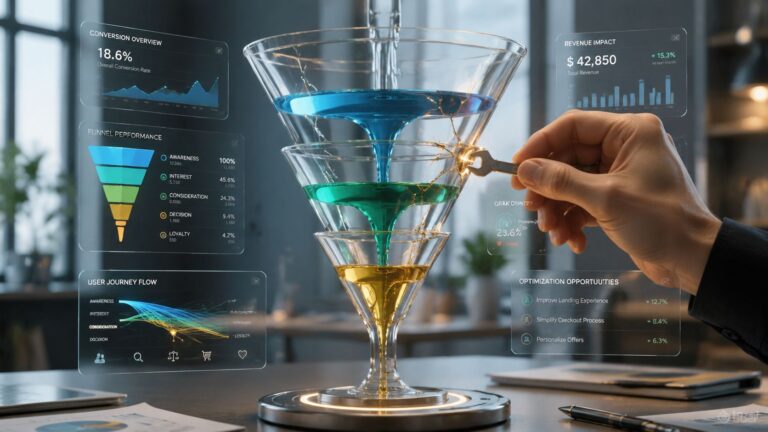
Traffic is up. Revenue isn't.
I see this constantly. Founders pull up a dashboard, point at growing sessions, and ask why sales or signups feel stuck. The answer is usually simple. You're staring at the wrong metric.
I'm Samuel Woods. I've worked with machine learning since 2016 and generative AI since 2019, and I've spent enough time inside growth systems to know this pattern cold. Frequently, the real problem is poor visibility inside the funnel.
Your overall conversion rate won't tell you where money is leaking. Conversion funnel analysis will. Done right, it shows you the exact transition where buyers hesitate, leave, or get lost. That's where revenue gets won back. That's also where you pull ahead of slower competitors who are still optimizing headlines while their checkout, onboarding, or qualification flow bleeds demand.
Why Your Funnel Is Leaking Revenue and How to Fix It
You've probably looked at the top-line conversion rate and felt annoyed by how useless it is. It tells you performance is bad, flat, or maybe “fine.” It doesn't tell you what to fix on Monday morning.
That's the trap. A funnel is a chain of micro-conversions. Pricing page to trial click. Trial click to form completion. Form completion to email confirmation. Confirmation to activation. When you compress all of that into one percentage, you hide the underlying problem.
Stop worshipping the blended conversion rate
One industry guide on funnel diagnostics says mature funnels often have just one or two “leaky” steps that account for 60–80% of total drop-off, and fixing those steps can improve completion rates by 20–40% without adding new features, according to UXCam's conversion funnel analysis guide. That matches what I've seen in practice. The biggest gains usually come from one broken transition, not a dozen small tweaks spread everywhere.
That changes how you should think. What you have is a step-level failure somewhere in the journey.
A practical rule: if you can't name the exact step where users abandon, you're not doing funnel analysis. You're doing dashboard tourism.
A founder might say, “Our signup conversion is weak.” I'd rather hear, “Users click Start Trial, but too many abandon the form before submitting business email.” That statement gives you a basis for action. The first one gives you frustration.
Treat the funnel like a diagnostic system
The best operators map the journey in order, measure completion between each step, then inspect behavior with session replays, heatmaps, and segmentation. That turns your funnel from a report into a diagnosis engine.
Here's the shift I want you to make:
- Move from aggregate to sequence. Measure each transition as well as the final outcome.
- Move from blame to evidence. Don't assume “traffic quality” or “pricing” is the issue until the step data shows it.
- Move from cosmetic CRO to commercial impact. Fix the transitions that block revenue before the pages people complain about.
A modest overall conversion rate can hide a strong first step and a broken middle step. That's why broad averages mislead owners. You may not need a new offer, a new homepage, or more ad spend. You may need to remove one bad field, one weak CTA, or one trust gap in the middle of the flow.
If your landing page is part of that leak, I'd start with these landing page optimization best practices and connect them directly to the funnel step they're supposed to improve.
What this gives you over competitors
Most companies optimize what's visible. Smart companies optimize what's causal.
If you know which transition is losing qualified demand, you can recover revenue faster, improve efficiency without buying more traffic, and build a cleaner learning loop. Your competitors will keep arguing about channel mix while you fix the step that controls conversion.
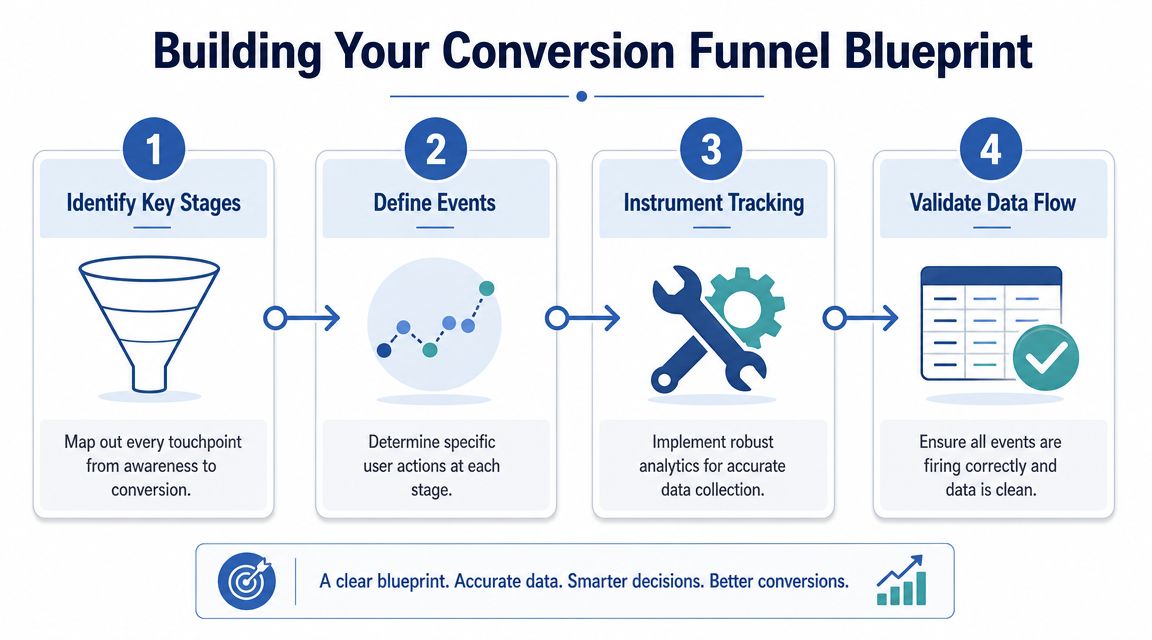
Defining Your Funnel and Instrumenting Events
Most funnel analysis fails before the analysis starts.
The failure happens in instrumentation. Teams track whatever their tools make easy, then wonder why the reports contradict each other. If your event taxonomy is sloppy, your conclusions will be sloppy too.
Build the funnel around business logic
Your funnel should reflect how a buyer moves toward value. Not how your analytics platform prefers to label events. Not how one team documented the CRM two years ago.
For a SaaS trial funnel, I'd usually start with a sequence like this:
- Visited pricing page
- Clicked start trial
- Completed signup form
- Confirmed email
- Reached first in-product milestone
That sequence gives you behavioral clarity. It separates curiosity from intent, intent from commitment, and commitment from activation.
Track what actually makes the analysis rigorous
A rigorous setup requires stage-specific data, conversion timestamps, and prospect attributes, then calculation of transition rates between consecutive stages, as outlined in Count's sales funnel analysis reference. That means each event needs context as well as a name.
I want three layers in place:
- Stage data, so you know which step a person completed
- Timestamps, so you can measure how long movement between stages takes
- Attributes like source, device, campaign, geography, or account type so you can segment later
Without those, you'll get a funnel report that looks tidy and tells you almost nothing.
Clean instrumentation beats fancy dashboards. Every time.
A simple event taxonomy example
Here's a practical structure I use with teams.
| Funnel stage | Event name | Why it matters |
|---|---|---|
| Commercial intent | Viewed Pricing Page | Signals buyer evaluation |
| Conversion attempt | Clicked Start Trial | Captures movement into action |
| Commitment | Submitted Signup Form | Shows form completion friction |
| Verification | Confirmed Email | Exposes activation blockers |
| Early value | Completed First Key Action | Connects signup to product adoption |
Notice what's missing. Vanity events. Random clicks. Page views with no commercial meaning.
If you run ecommerce or lead gen instead of SaaS, the same principle applies. Define the handful of transitions that move a user toward revenue. Ignore the noise. If you want another practical perspective on optimizing your sales funnel, that overview is useful because it keeps the focus on user progression rather than isolated page metrics.
Validate before you trust anything
Instrumentation is done when the data is validated, which can be well after the code ships. I've seen teams make decisions off events firing twice, missing on Safari, or breaking after a checkout update.
Use a short validation checklist:
- Check event firing across major browsers and device types
- Confirm naming consistency so one action isn't tracked three different ways
- Review timestamps to make sure sequences appear in the right order
- Spot test attributes so campaign and user metadata come through cleanly
If one of those breaks, the funnel lies. And when the funnel lies, you waste time fixing the wrong thing.
The Metrics That Actually Drive Growth
Once the funnel is instrumented, a common mistake still arises. Many still default back to the final conversion rate because it's easy to explain in a meeting.
Easy isn't useful.
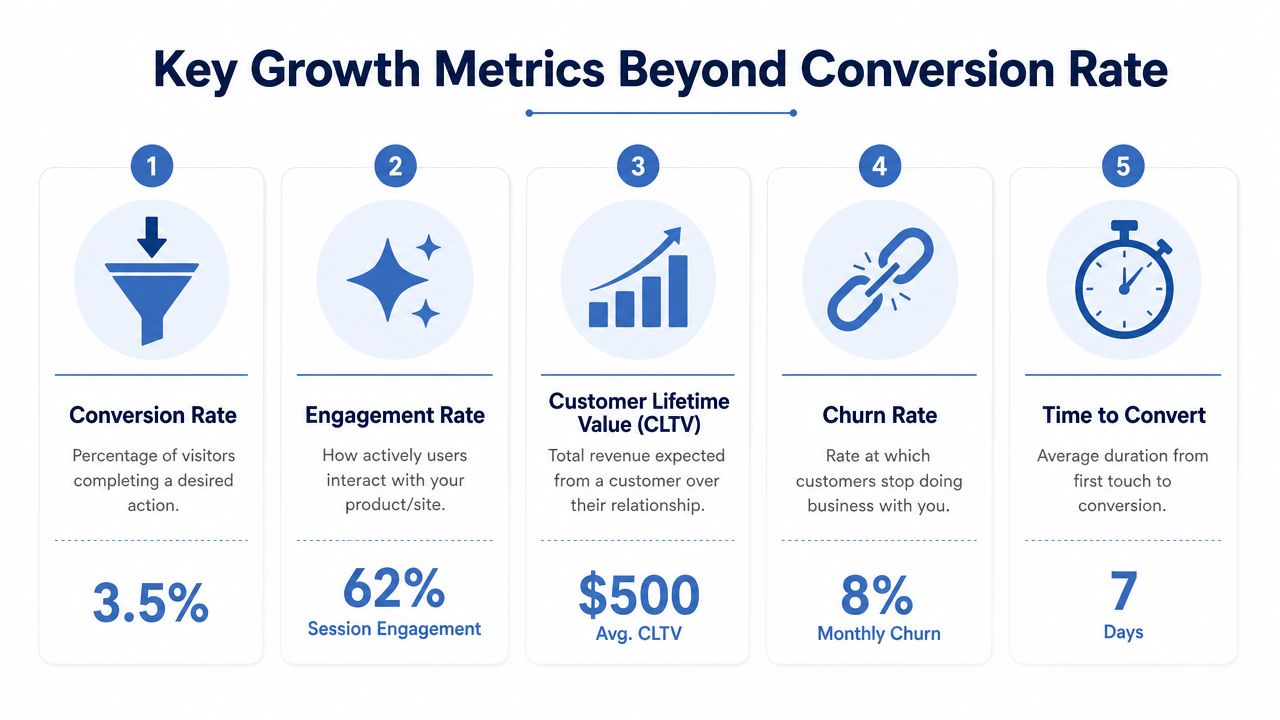
You need a metric stack that tells you where demand enters, where it slows down, and whether the customers you win are worth winning.
Start with stage-to-stage conversion
Benchmarks matter, but only if you use them with context. One benchmark source says most sales funnels convert between 3% and 10%, with B2B funnels typically at 1% to 5% and B2C funnels often at 5% to 15%, according to VWO's funnel conversion benchmark report. Useful. Don't obsess over the averages; use them to locate the category of problem you have.
If your visitor-to-lead step is weak, that's different from a lead-to-close issue. The fix, owner, and timeline are different too.
The metrics I actually care about
I use a small set of metrics together. Never in isolation.
| Metric | What it reveals | Why you should care |
|---|---|---|
| Stage-to-stage conversion | Where users move or stall | Shows the exact leak |
| Absolute drop-off volume | How many users are lost at each step | Prioritizes revenue impact |
| Time to convert | How long movement takes between steps | Exposes hesitation and complexity |
| Source-level conversion quality | Which channels create progressing users | Protects budget allocation |
| Post-conversion value | Whether converted users become good customers | Prevents low-quality growth |
A funnel that converts well but brings in poor-fit customers can wreck margins and distract your team. That's why I never treat conversion rate as the finish line. It's one signal inside a commercial system.
Read the story behind the numbers
If top-of-funnel traffic looks healthy but few users move into the next stage, your messaging or offer alignment may be off. If plenty of people begin but few complete, you likely have friction. If prospects progress smoothly until the final step, trust, pricing clarity, or sales follow-up may be the issue.
A good funnel report should let you say, in plain English, where buyers lose momentum and what that costs you.
That's how you connect behavior to revenue. You need fewer metrics and a clear sense of which one justifies the next decision.
Don't let benchmark envy make you stupid
Treat benchmarks as context. They don't give orders.
I've watched teams chase some imagined “good” conversion rate while ignoring the fact that their best leads were already converting, and the actual problem was poor-fit traffic entering the funnel. If you copy another company's numbers without understanding your sales motion, price point, or buying cycle, you'll optimize yourself into nonsense.
Use benchmarks to orient. Use your own funnel to decide.
Finding Gold with Segmentation and Cohorts
Aggregate funnel reports are polite lies.
They smooth out the differences that matter most. They hide the profitable segments, bury the bad traffic, and make weak performance look average instead of fixable.
Segments show you where profit actually lives
When I audit a funnel, I don't trust the blended view for long. I want to see the flow by source, device, geography, campaign, and user type. The useful questions start there.
Maybe paid social generates volume but poor progression. Maybe branded search users convert cleanly on desktop but struggle on mobile. Maybe one audience reaches checkout consistently while another bounces after pricing. Those findings are budget decisions.

The leak with the worst percentage isn't always the one to fix
Unlike some weak CRO advice, a guide focused on funnel optimization recommends prioritizing the step with the highest absolute drop-off, not necessarily the largest percentage loss, because a smaller percentage decline can affect far more users, as explained in Userflow's funnel analysis article.
That's the contrarian move I agree with.
Here's the practical difference:
- A large percentage drop on low volume may look dramatic but have limited business impact
- A smaller percentage drop on high volume can be a significant revenue leak
- Segment-level absolute loss often tells you where the fastest gains are hiding
If you're serious about this, get more deliberate with your growth funnel segmentation and nurturing approach. Segmentation is how you decide where to focus your money and time.
Cohorts separate progress from noise
Cohorts solve a different problem. They tell you whether changes are improving the funnel or whether you're just seeing a temporary mix shift.
I like cohort views for questions like these:
- Did users acquired this month move through activation faster than last month's group?
- Did a pricing change improve progression or attract different traffic?
- Did campaign quality drop, or did the product experience get worse?
If you don't compare like with like over time, you'll confuse traffic shifts for product wins.
A cohort view keeps your team honest. It stops you from celebrating a temporary spike that came from channel mix, seasonality, or a short-lived promotion. It also stops you from overreacting when the product is fine and the audience changed.
My blunt recommendation
Run every serious funnel review in two passes. First by segment. Then by cohort.
If you skip segmentation, you miss where money is hiding. If you skip cohorts, you misread why performance changed. Teams generally require both before they've earned the right to launch another redesign or campaign.
From Insight to Action with Experimentation
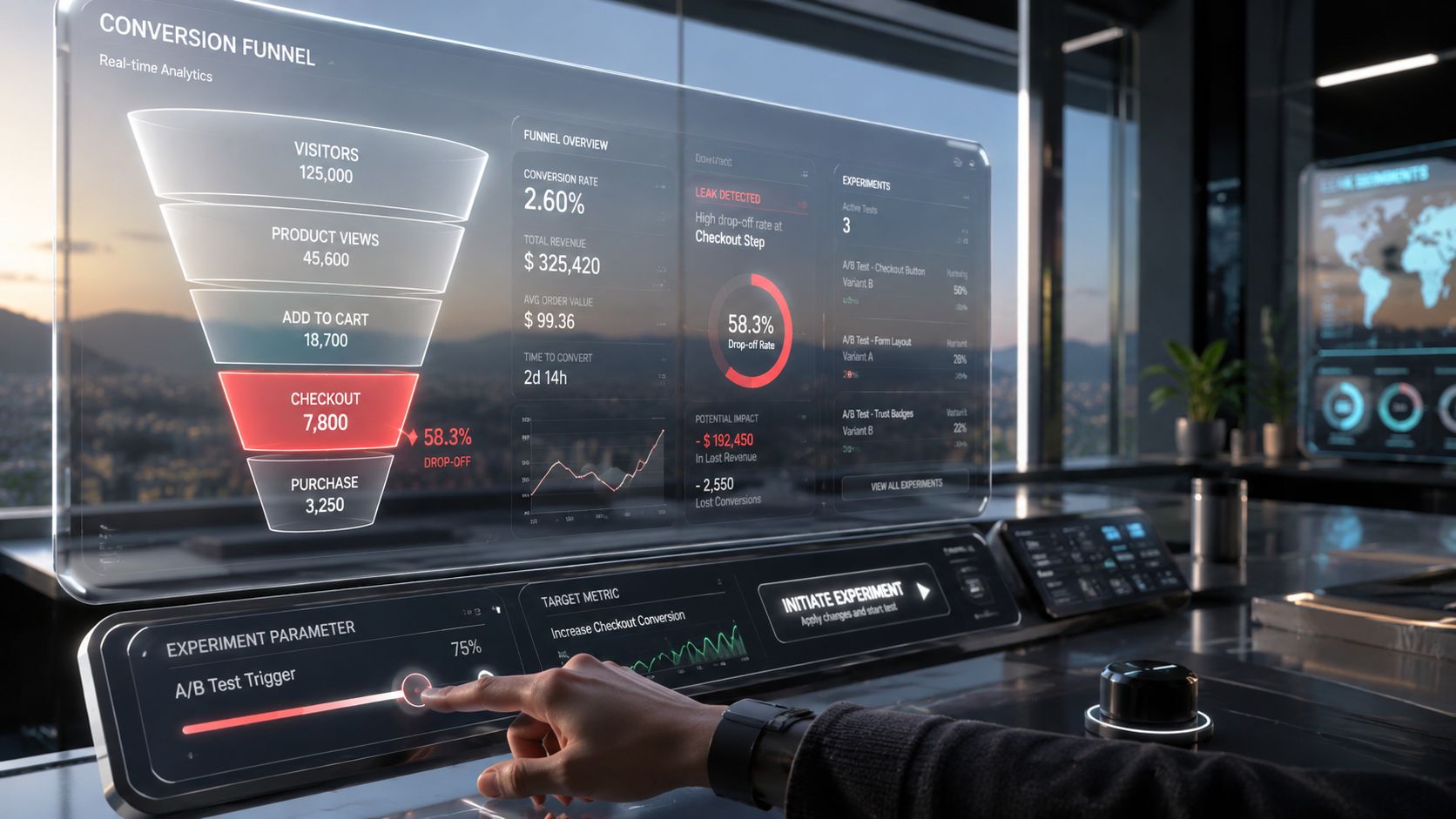
Analysis without experimentation is expensive theater.
You've identified the leak. Good. Now you need to test your way to a better funnel without fooling yourself with noisy results or premature conclusions.
Write hypotheses that can survive contact with reality
Bad testing starts with vague ideas. “Let's improve the page” is not a hypothesis. “Reducing friction on the signup form will increase completion” is closer, but still weak unless you specify what friction and what step.
I want hypotheses in this format:
Observed problem: users reach the form but abandon before submission.
Suspected cause: the form asks for information too early or creates trust concerns.
Specific change: remove non-essential fields, clarify what happens next, or reposition trust cues.
Expected impact: more users complete that transition without hurting downstream quality.
That's how you keep experimentation tied to business logic instead of opinion.
Match the test to the funnel step
One piece of guidance I strongly agree with is this: compare the same funnel definition across the same time window and historical baselines, and for each experiment determine sample size and duration from the baseline rate and expected uplift, then use stopping rules to reduce false positives, according to Plane's guide for product managers on conversion funnel analysis.
That sounds technical. It is. It's also essential if you want trustworthy reads.
Use a simple operating discipline:
- Pick one primary metric tied to the step you're fixing
- Add guardrails so you don't improve one stage while damaging another
- Set duration and sample expectations in advance
- Don't peek early and call a winner because you got excited on day three
I've seen teams ship losing variants because someone liked the early trend line. Calling a test that early is self-sabotage.
A solid practical companion for this is my guide to conversion optimization best practices, especially if you're building a repeatable testing workflow across marketing and product.
Use media, replays, and human review before you test
Numbers show where. Replays and qualitative evidence help you understand why. Before I approve a test backlog, I want to see some combination of session recordings, heatmaps, support conversations, sales notes, and form behavior.
This short walkthrough is worth your time if you want to sharpen how you evaluate test opportunities:
Don't run endless tests. Run decisive ones.
A mature experimentation program doesn't test random page elements forever. It targets the steps that control movement and value.
The best test backlog is boring to look at and profitable to run. It stays close to the biggest leak.
If you can't explain why a test matters to revenue, pipeline, or customer quality, kill it. The goal is fewer bad decisions.
The AI Augmentation Layer for Funnel Analysis
Manual funnel analysis is too slow when you're running a small business that needs to move fast.
The old playbook still works. It's incomplete. If you still pull dashboards by hand, watch replays one by one, and brainstorm hypotheses from scratch, you're handing speed to competitors who've already added AI to the loop.
Where AI helps most
The biggest gap in most funnel advice is multi-session and cross-device attribution. Most guides explain the idea of a funnel but not how to reconstruct fragmented journeys when users return later, switch devices, or convert after several touchpoints. That gap matters because single-session attribution is getting less reliable, as noted in Unbounce's discussion of conversion funnel strategy.
This is exactly where AI earns its keep.
I use AI augmentation in four practical ways:
- Insight discovery. Models can scan event streams, segment patterns, and anomaly shifts faster than you can by working through dashboards.
- Journey reconstruction. AI can help infer path continuity across fragmented sessions when identity is incomplete.
- Hypothesis generation. LLMs are useful for producing test ideas from funnel data, replay summaries, survey responses, and CRM notes.
- Operational automation. Agents can move findings into briefs, tickets, alerts, or experiment queues without waiting for a weekly meeting.
AI speeds up the analysis while you keep the judgment
People often get sloppy. They assume AI will tell them what to do. It won't. It will surface candidates, compress synthesis time, and widen the search space. You still need commercial judgment.
If you're building that layer, I'd also look at resources on Ekipa AI automation insights because the implementation challenge is usually operational, not theoretical. Asking an LLM for ideas is easy. The hard part is wiring data, workflows, ownership, and feedback loops so the suggestions become action.
The stack I'd put in place
My preferred setup is simple in concept:
| AI layer | Job inside funnel analysis |
|---|---|
| Event and warehouse layer | Centralizes the signals |
| Behavioral analysis layer | Surfaces patterns and drop-offs |
| LLM synthesis layer | Explains likely causes and drafts hypotheses |
| Agent workflow layer | Routes insights into execution |
That can include your own internal systems, common analytics platforms, warehouse queries, and workflow tools. I also offer consulting and workshop frameworks for businesses designing these AI-assisted growth systems. That work should sit alongside your existing stack and keep the basics in place.
The advantage is compression. Faster detection. Faster prioritization. Faster experimentation. When you shorten that loop, conversion improves and so does how quickly the business learns.
If your funnel feels stuck, stop asking why the overall conversion rate looks bad. Ask which transition is breaking, which segment is worth the most, and which experiment can fix the leak fastest. That's how you turn conversion funnel analysis into revenue, not reporting.