
Let’s start with the obvious:
The skill – and ability – of “Great Leads” that breaks through all the noise…
…Will increase your results dramatically.
Masterson and Forde reckon 80% of the success of an ad or a sales letter comes from the lead, the first 500-800 words of a funnel message.
Your process for creating great leads and headlines starts before you even put pen to paper – it begins in the planning stage.
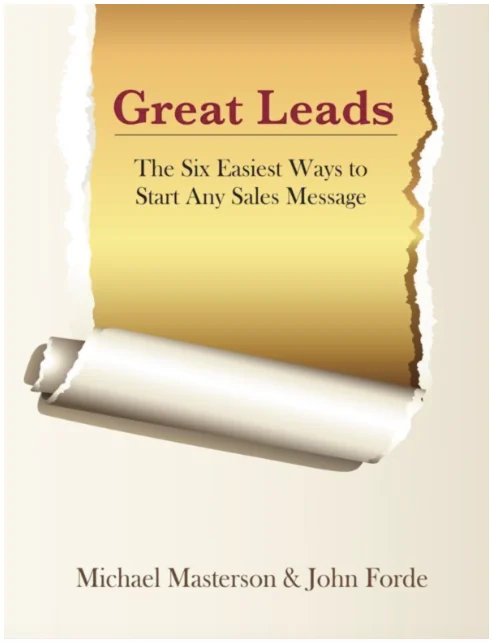 “Great Leads” will teach you:
- How to produce more compelling, stronger copy
- Create results your employer or clients will notice
- Increase demand for your skills
- Earn more money for your copywriting
- Learn how to start off your sales copy
- Become a more effective copywriter.
Pareto’s Law
Pareto’s Law, loosely defined on page 10, refers to the statistic that 80% of the value of a business or endeavor comes from only 20% of its matter.
In terms of marketing and sales, that equates to 80% of the impact of advertising copy coming from the first 20% of its copy.
Why does that matter?
It means that when it comes to writing copy that breaks through the noise, the lead is the most important part.
Masterson and Forde tell us that you have to first move the prospect emotionally – and then persuade them intellectually.
You have to write copy that speaks to the prospect’s heart – capture their attention, then reel them in with your persuasive copy.
You can’t sell to someone if they aren’t reading your copy in the first place.
One Big Idea
As you’re well aware, people have a short attention span.
They want to hear about one idea – and they want deep, insightful information on it.
Pick one, big idea – one core idea – and focus on it. Plan out what your One Big Idea is, and then write your copy.
Research on product claims backs this up. When irrelevant details were added to a product description, people became less sure it would deliver its main benefit, even after they agreed the details were irrelevant (Meyvis and Janiszewski, 2002). And when readers knew they were being sold to, their impression peaked at three positive claims and dropped at four as skepticism kicked in (Shu and Carlson, 2014).
Necessary elements for sales copy to be engaging that Great Leads introduces are:
- One good idea
- One core emotion
- One gripping story
- One desirable benefit
- One response
Start Off Your Copy With a Simple Premise
In Great Leads, Masterson and Forde suggest starting off your promotional copy with a simple question – but don’t forget to answer it.
The question is: “What does your customer already know?”
Do they know who you are? Do they know about your product, the stats that back it up, the problem it gives the solution to – or any other solution?
Why should you do this?
Because if your customer is aware of your product, you start with your product in the headline.
If they have the desire, but not awareness, your headline starts with desire.
If they have no background, then you start with the problem your product solves – and why they need it.
Gene Schwartz broke the system out into his “Five Levels of Awareness.”
Direct or Indirect Sales Approach
When it comes time to decide on a direct or indirect sales approach, there are a number of ways you could approach your copy.
Great Leads details how TurboTax used a direct lead, focusing on the pain and cost of preparing taxes.
They knew their target audience, knew a relationship had already been developed, and already had a need for which TurboTax was the solution.
Therefore, the copy just had to persuade the lead to close with an offer.
However, a purely direct lead can come on too strong, warn Masterson and Forde.
An indirect lead can help overcome some simple obstacles, like if your potential client doesn’t know who you are, or how your product can solve their problems.
An indirect approach can be especially helpful if you have a less aware or skeptical customer.
There’s a model for why. Marian Friestad and Peter Wright argued that people build up knowledge of how ads and salespeople try to persuade them, and they use it to cope once they spot an attempt (Friestad and Wright, 1994). A lead that opens with the pitch gives that knowledge something to push against straight away.
Below, a promotion that uses a successful indirect approach:
The lead and headline entertain and inform the viewer – before it even tries to sell them something. It provides that quick emotional connection and then involves the viewer in making the connection to the product.
Types of direct and indirect leads include:
- Offer lead
- Promise lead
- Problem-solution lead
- Big Secret lead
- Proclamation lead
- Story lead
Write Better Sales Leads
With an Offer Lead, you’re starting off your sales copy from the get-go with your offer.
Copywriting guru Gene Schwartz says that offer leads are the easiest to write because if you have a good deal and a receptive audience, it’s almost impossible to screw it up.
When creating an offer lead, chapter three details following this formula:
- Immediately get to your emotionally-compelling offer
- Stress the value or benefit of the deal
- Expand on the deal-benefit in the lead that follows
- At some point, include your “reason why” that is compelling, and explains why you’re offering the deal
The idea, the book explains, is to create excitement about the topic in general, and then give an offer too good to miss out on – which is your closer.
In this example, the prospect is being pitched all 56 commemorative quarters. His savings are clear (67%) and the gift is the offer.
More aware customers should be given a direct lead, while a less aware customer should be given an indirect lead, say the authors. The offer lead is for more aware customers, as they already know about you and are potentially prepared to buy.
Double Your Sales with This Lead
In 1904, a Canadian policeman named John E. Kennedy who had studied ads and Albert Lasker, a young Chicago ad exec, began to change the game with Reason-Why advertising.
They tested their ads with a washer company, chapter 5 details, and within four months of successful sales, they increased their $15,000 a year budget with the ad agency to $30,000 – a month.
Huge companies like Quaker, Palmolive, Pepsodent, and Oldsmobile have utilized promise-driven (or Reason-Why) advertising.
The premise is simple: you have to give your reader a reason why they should listen to your message. And that reason should be bound up in a promise they can’t resist.
Ellen Langer’s photocopier study shows how much work a reason does. Asking to cut in line to copy 5 pages worked 60% of the time with no reason, and 93% of the time with “because I have to make copies”, a reason that says nothing. For 20 pages the empty reason did nothing (24% either way), and only a real reason (“because I’m in a rush”) lifted it, to 42% (Langer, Blank and Chanowitz, 1978).
Great Leads says that this type of advertising works best if you promise something people want – not just shock them.
Find the unique selling proposition – or USP – and detail how it’s different from anything or everything your prospect has heard before.
Find Your Hook
The problem-solution lead is a classic in terms of sales copy. But it’s useless if you don’t know what’s keeping your customer up at night.
In many prospect types, there’s a gap between what they know about themselves – and what they know about your product. That’s the gap your problem-solution lead and your hook need to cross.
In the above example, your company is addressing that your customer has concerns – and you hear them, you feel them, and you have a solution.
The idea, then, in effective sales copy is to create a lead that’s a hook – what differentiates your product from everything else in the marketplace.
The Velvet Pouch
Masterson details the velvet pouch approach in a simple way – the longer you can get your prospect mesmerized by a product that’s hidden, the greater your chance it will close.
You begin the Velvet Pouch approach by teasing your prospect with a secret – and then once you finally show it, they’re so deeply, emotionally connected, the close is easy.
The secret lead is universal and useful. It can compel the casual reader to read dozens of pages before the secret is revealed.
There’s lab evidence for that pull. In a study by Min Jeong Kang and colleagues, people who were more curious about a trivia answer spent more of their limited tokens or waiting time to see it. They also remembered surprising answers better one to two weeks later (Kang et al., 2009).
In this example from Great Leads, the company is using dowsing as their secret. The secret is danced around until at the very end, it’s finally revealed.
To use the secret lead in your own writing, make sure your secret is:
- Intriguing and beneficial
- Introduced in the headline
- Not disclosed in the lead
- And gives clues as your letter progresses
George Loewenstein describes curiosity as a feeling of deprivation that starts when we notice a gap in what we know. He also points out that curiosity is often followed by disappointment once it’s satisfied, so make the reveal worth the wait (Loewenstein, 1994).
The Proclamation Lead
When thinking of proclamations, most people think of editorial writing and literature. They’re usually what’s used in rhetorical speech. But they deserve special attention when crafting great leads.
Proclamation leads are emotionally compelling. They’re declarations, pronouncements. They’re assertions that your product will be beneficial to the customer, in a startling, intriguing, and tempting manner.
Chapter 8 of Great Leads details a proclamation lead as an emotionally-compelling beginning, usually as a headline, and then in the copy, you demonstrate the validity of the promise you made.
The proclamation lead distracts the reader from the fact that you’re selling them something and suspends their disbelief. It speaks to a reader emotionally, encouraging them to read on.
In your own writing, you would use a proclamation lead to excite and tempt the reader from the beginning. Then, following up in your body copy, detail how your product will solve their issue.
Rules for proclamation leads:
- Make the proclamation bold
- Make a promise
- Make the subject relevant
- Return to the proclamation at the end
The Best Sales Letters
The following sales letter has made an estimated two billion dollars in revenue. It ran for nearly 30 years.
The letter is a story lead. It contains a promise, is an indirect form of a lead, and holds power because it’s well-told.
A story lead also leans heavily on the One Big Idea. It’s strong, desirable, drives an emotion, and gives one inevitable solution.
To write a story lead of your own, create a strong headline that tells a story.
Convey your information in a way that’s easy to remember for your reader. Give information of quantity and quality, in a form that other versions of advertisements cannot communicate.
Think of the Dos Equis ads with “The Most Interesting Man in the World.” They tell the story of the man – and only at the end, when you’re hooked, do you realize it’s a commercial about beer.
Melanie Green and Timothy Brock measured this. Readers who got more absorbed in a story came away holding more of the story’s beliefs, and they spotted fewer false notes in it. Labeling the story as fact or as fiction made little difference (Green and Brock, 2000).
In Great Leads, the writers tell us that the headline and the photo grab the prospect’s attention. Then, you have to sell the product – and carry that initial sentiment into the final emotion that you close the sale with.
How to Make It Work For You
Test your leads with your audience. Every audience is different, and if you try to shove one thing at them, it may not be successful.
But another type may be.
Effectiveness is maintained as long as the copywriter uses different tools to stick to one core message, Great Leads ends with.
Single out your sales message, focus on it, and then slowly branch out once you’ve found what works for your company.
Rules for more effective copywriting:
- Write in the second person, and test it
- Keep headlines short, and test longer ones too
- Try to stick to black headlines
- Provide a premium and a money-back guarantee
- Use power words like “free” and “now”
- Use data (like 15% of people don’t know about how they can save money)
The word “free” has real research behind it. At a booth on MIT’s campus, 73% of buyers picked a 15-cent Lindt truffle over a 1-cent Hershey’s Kiss. When both prices dropped by one cent, making the Kiss free, 69% took the Kiss (Shampanier, Mazar and Ariely, 2007).
Two of these rules don’t hold up as well in testing. Across more than 24,000 pairs of headlines A/B tested on Upworthy, longer headlines tended to win, and “you” in the headline showed no clear benefit (Gligorić et al., 2023). A separate set of studies on Facebook brand posts found that “you” raised involvement and brand attitude, but only for readers lower in collectivism (Cruz, Leonhardt and Pezzuti, 2017).
Sources
- Cruz, R. E., Leonhardt, J. M., & Pezzuti, T. (2017). Second person pronouns enhance consumer involvement and brand attitude. Journal of Interactive Marketing, 39, 104–116. doi.org/10.1016/j.intmar.2017.05.001
- Friestad, M., & Wright, P. (1994). The persuasion knowledge model: How people cope with persuasion attempts. Journal of Consumer Research, 21(1), 1–31. doi.org/10.1086/209380
- Gligorić, K., Lifchits, G., West, R., & Anderson, A. (2023). Linguistic effects on news headline success: Evidence from thousands of online field experiments. PLOS ONE, 18(3), e0281682. doi.org/10.1371/journal.pone.0281682
- Green, M. C., & Brock, T. C. (2000). The role of transportation in the persuasiveness of public narratives. Journal of Personality and Social Psychology, 79(5), 701–721. doi.org/10.1037/0022-3514.79.5.701
- Kang, M. J., Hsu, M., Krajbich, I. M., Loewenstein, G., McClure, S. M., Wang, J. T., & Camerer, C. F. (2009). The wick in the candle of learning: Epistemic curiosity activates reward circuitry and enhances memory. Psychological Science, 20(8), 963–973. doi.org/10.1111/j.1467-9280.2009.02402.x
- Langer, E. J., Blank, A., & Chanowitz, B. (1978). The mindlessness of ostensibly thoughtful action: The role of “placebic” information in interpersonal interaction. Journal of Personality and Social Psychology, 36(6), 635–642. doi.org/10.1037/0022-3514.36.6.635
- Loewenstein, G. (1994). The psychology of curiosity: A review and reinterpretation. Psychological Bulletin, 116(1), 75–98. doi.org/10.1037/0033-2909.116.1.75
- Meyvis, T., & Janiszewski, C. (2002). Consumers’ beliefs about product benefits: The effect of obviously irrelevant product information. Journal of Consumer Research, 28(4), 618–635. doi.org/10.1086/338205
- Shampanier, K., Mazar, N., & Ariely, D. (2007). Zero as a special price: The true value of free products. Marketing Science, 26(6), 742–757. doi.org/10.1287/mksc.1060.0254
- Shu, S. B., & Carlson, K. A. (2014). When three charms but four alarms: Identifying the optimal number of claims in persuasion settings. Journal of Marketing, 78(1), 127–139. doi.org/10.1509/jm.11.0504