
Most marketing campaign templates are just glorified checklists. You fill in the blanks, cross your fingers, and hope. It’s a recipe for mediocrity and wasted budget.
This guide is different. I’m not just handing you a template; I’m giving you the system to turn it into a dynamic growth engine. A machine that learns, adapts, and scales your results predictably. We’re going to build you a real competitive weapon.
Stop Planning Campaigns and Start Building Growth Engines
I’ve seen this play out for years—good teams getting mediocre results because their plan is a static document. It’s a snapshot in time. Your market, your customers, and your competitors are in constant motion. A filled-out template gathering dust in a shared drive won’t help you pivot when a competitor makes a surprise move. Or when your ad performance suddenly tanks.
What you need is a dynamic system. A framework that doesn’t just guide your launch but adapts in real-time. I call it a ‘bionic’ framework because it integrates AI to process market data and react faster than your rivals can think. Since I started working with machine learning back in 2016, the objective has always been the same: create a competitive advantage that can’t be easily copied.
From Static to Bionic
This isn’t about throwing away structure. It’s about making that structure intelligent.
For instance, instead of manually guessing at customer segments, an AI can analyze thousands of data points to surface micro-segments with 3x the conversion potential. To make this work, you need a solid destination for that traffic. A proven lead generation landing page template is a great starting point for building out these highly targeted experiences.
My objective is to help you build a marketing engine that learns from every action, optimizes on the fly, and scales your results predictably. This is how you stop competing and start dominating.
This guide gives you that entire system. It’s built around the template you need, but it’s much more. It’s a playbook for creating a marketing machine that compounds its wins over time.
If you want a head start, you can also grab some of my quick tools for building a growth engine that perfectly complement this approach. We’re moving beyond simple planning and into the business of building a true, lasting asset.
The Eight Pillars of a Campaign Blueprint That Wins
A campaign that actually moves the needle is built on eight core pillars. These aren’t just sections in a document to fill out; they’re interconnected systems that work together. A single, cohesive, data-driven engine. I’ll walk you through each one, explaining not just the ‘what’ but the critical ‘why’ from my experience building these for aggressive growth.
Forget the checklists. Think like an architect.
This structure is what separates campaigns that merely make some noise from those that genuinely dominate their markets. It’s the foundation for repeatable success. It lets you generate comparable data across every initiative. This is how you start making smarter decisions, much faster than your competitors.
This simple visual shows how we’ll turn your planning from a static document into a dynamic growth engine.
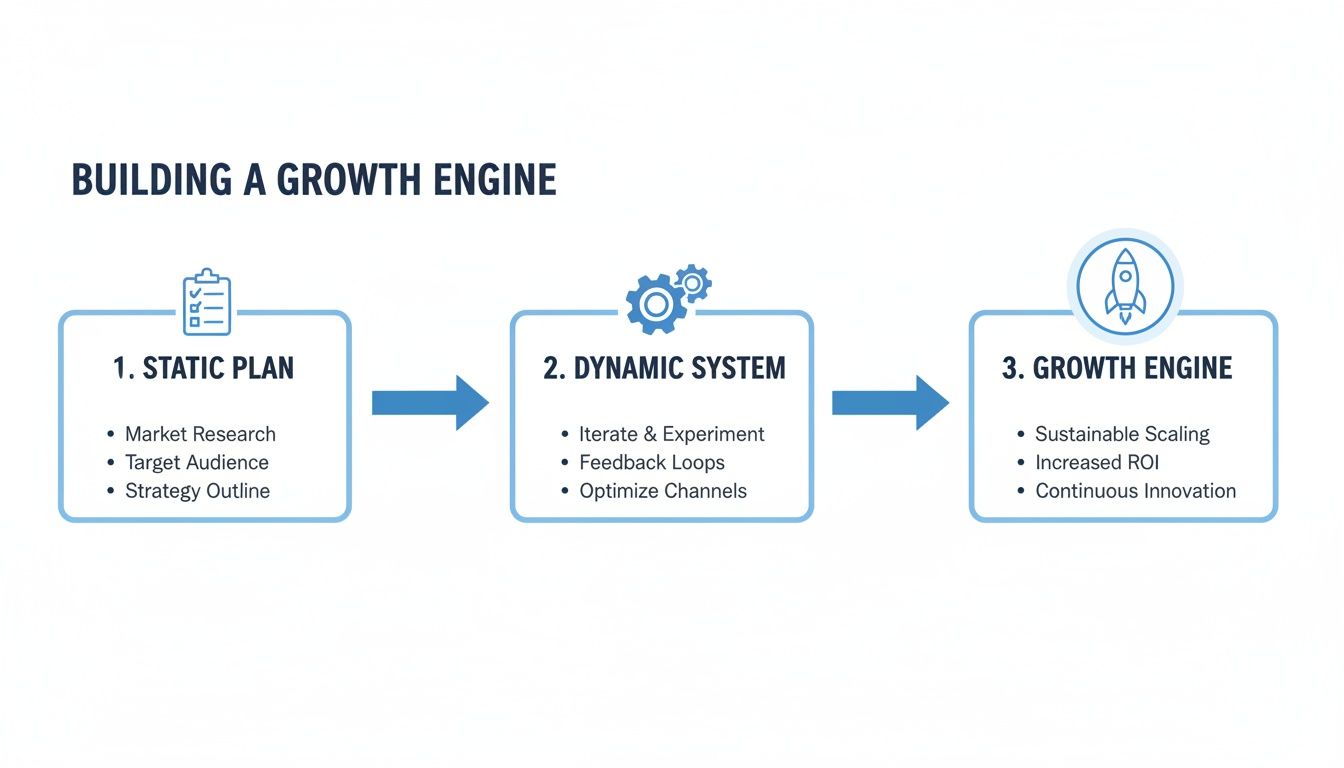
The idea is to move from a rigid plan to an adaptive system. And finally, to an engine that propels real business growth.
The Foundational Four Pillars
Let’s break down the components. Each one feeds the next, creating a loop of strategy, execution, and intelligence. If you skimp on one, the whole structure weakens. The first four pillars set your strategic direction.
-
Strategic Goal & Success Criteria: This is your ‘why’. What business metric are you trying to move? A 15% increase in MQLs? A 10% reduction in customer acquisition cost? Be brutally specific. Tie it directly to revenue.
-
Target Audience Profile: Go way beyond basic demographics. What are their deep-seated problems? What triggers their buying decisions? I use AI to analyze customer data and create psychographic profiles that make your messaging feel almost uncannily personal.
-
Core Offer & Messaging Hierarchy: What’s the one thing you want the audience to do? From there, what are the primary, secondary, and tertiary messages that will convince them? This clarity prevents cluttered and ineffective campaigns.
-
Channel & Content Strategy: Where will you reach your audience, and what will you say? This pillar defines the exact mix of paid ads, blog posts, emails, and social content needed to guide prospects through their journey.
These first four pillars are your strategy. The next four operationalize it, turning your plan into real-world, measurable action.
The Operational Framework
Execution is where most campaigns fall apart. Bottlenecks, messy data, and slow approvals are momentum killers. These next four pillars are designed to prevent exactly that.
-
Budget & Resource Allocation: Map out every dollar against your channels and activities. Critically, you must track estimated vs. actual spending in near real-time. This agility allows you to double down on what’s working and cut what’s not, maximizing your ROI.
-
Timeline & Task Ownership: This is more than a simple calendar. It’s a dependency map. Who is responsible for what, and by when? Which tasks are blocking others? A clear, visual timeline is non-negotiable for a smooth launch.
-
Performance KPIs & Measurement Plan: How will you know if you’re winning? Define your key performance indicators (KPIs) for each channel and each stage of the funnel. This includes everything from ad CTR to email open rates to final conversion rates. As you build this out, seriously consider implementing clear campaign naming conventions to ensure your analytics are clean.
-
Risk Mitigation & Approval Workflows: What could go wrong? A competitor launches a surprise counter-offer? An ad account gets flagged? Plan for it. At the same time, define exactly who needs to approve what—and when—to avoid those frantic, last-minute scrambles.
Together, these eight components create a powerful marketing campaign planning template. It’s not just a document; it’s a system for repeatable success.
Industry benchmarks show that teams using such a comprehensive structure see faster execution and a 25-30% efficiency gain in resource allocation alone. That’s a direct result of having clear KPIs and tight financial controls. This isn’t theoretical; it’s how the best teams operate.
Structuring Your Budget and SMART Goals for Growth
Let’s get practical. A plan without a budget and clear goals is just a wish list. Every dollar has to work for you. Vague ambitions like ‘increase brand awareness’ are worthless in a boardroom. This is where we separate professional operators from amateurs.

I’ve seen too many promising campaigns fail because the budget was based on guesswork or last year’s numbers. Your budget shouldn’t be a random number; it must be a direct investment tied to your growth targets. A solid way to ground this is by setting your total marketing budget as a percentage of projected revenue.
From Wishful Thinking to Strategic Investment
In fiercely competitive markets, having a solid marketing campaign planning template is a critical differentiator. For 2026, aiming for 5-10% of your projected revenue as your marketing budget keeps you in a realistic, competitive zone. If you want to dig deeper, you can read a detailed breakdown of marketing plan templates for more context on how other businesses are planning.
Once you have that top-line number, you allocate it with precision. A common allocation I use with clients as a baseline looks something like this:
- 25-40% for Paid Media: Your primary engine for driving immediate traffic and leads, covering everything from Google Ads to paid social.
- 20-35% for Content & SEO: Your long-term asset building. This funds blog posts, videos, and guides that attract organic traffic and build authority.
- 10-15% for Marketing Technology: The tools that make everything else work—your CRM, analytics platforms, and automation software.
- 5-15% for Offline & Other Initiatives: This could be trade shows, direct mail, or experimental channels.
This isn’t a rigid rule. It’s a starting point that forces you to justify every dollar. The real power comes from tracking your spend weekly and reallocating funds based on what’s actually working. That’s how you truly learn how to improve marketing ROI instead of just hoping for it.
Defining Victory with SMART Goals
Money is only half the equation. The other half is defining success with absolute precision. We use the SMART goal framework: Specific, Measurable, Achievable, Relevant, and Time-bound. This is non-negotiable. It forces clarity and accountability.
Vague goals are poison to a marketing team. They create ambiguity and make it impossible to prove your value.
A goal like “get more leads” is useless. A goal like “Achieve a 15% increase in marketing-qualified leads from organic search in Q2, tracked via our CRM” is a weapon. It tells your team exactly what to do and how they will be measured.
This level of clarity is how you prove marketing’s value to the C-suite. It transforms your department from a cost center into a documented growth engine.
Connecting Budget to Goals
Now, connect the two. Your SMART goals dictate your budget allocation. If your primary goal is lead generation from organic search, your content and SEO budget must reflect that priority. Simple as that.
Let’s use our example:
- Specific: Increase marketing-qualified leads (MQLs) from organic search.
- Measurable: By 15%, from a baseline of 500 MQLs/quarter to 575 MQLs/quarter.
- Achievable: Our past content efforts have shown 5-7% quarterly growth, so 15% is an aggressive but attainable stretch goal with focused investment.
- Relevant: MQLs from organic search have a 25% higher conversion rate to sales opportunities than any other channel.
- Time-bound: Within Q2 (April 1st to June 30th).
With this goal defined, you can now confidently allocate a larger portion of your budget to activities like keyword research, high-value content production, and link-building outreach. This isn’t just spending money; it’s funding a specific, measurable outcome. This is how you win.
The AI Playbook for an Unfair Advantage
Here’s where you get your edge. Your campaign plan is about to become a living intelligence system, not just a static document. I’m going to walk you through the exact AI prompts and workflows I’ve used since 2019 to turn hours of manual planning into an automated, strategic weapon.
Forget the generic hype. We’re getting tactical. This is all about concrete business results—revenue, market share, and a serious competitive advantage. The goal is to make your team incredibly efficient, able to process data and act at a speed that’s impossible for humans alone.
This is how you win.
Uncover Hidden Customer Segments with AI
Most campaigns fail because of a vague understanding of the audience. You can’t afford to target “millennials who like tech.” We need to get surgical. AI models like Claude or Gemini can tear through your customer data and surface high-value micro-segments your competitors don’t even know exist.
Instead of spending days buried in spreadsheets, you run a prompt that does the heavy lifting in minutes. Just feed the model your anonymized customer data—purchase history, website behavior, support tickets, survey responses—and give it a clear objective.
This isn’t about replacing your marketers. It’s about arming them with intelligence that allows them to operate at a scale and speed that was previously unimaginable. This is the new baseline for high-performance teams.
For instance, I had a B2B SaaS client convinced they had two main customer segments. We ran their data through this process and uncovered a third, incredibly profitable segment: “legacy system escapees.” These were companies stuck on outdated software, actively searching for migration-friendly alternatives, and valuing fast onboarding above all else. This overlooked segment had a 2.5x higher LTV than their average customer.
Automate Creative Ideation and Production
Once you’ve zeroed in on these valuable micro-segments, you have to create messaging that connects. This used to be a major bottleneck, bogged down by endless brainstorming and revision cycles. Now, we can automate the initial creative grunt work.
With a well-crafted prompt, you can generate dozens of ad angles, email subject lines, and social media post ideas tailored specifically to each segment. The key is to ground the AI in your brand voice and proven conversion principles. Feed it your brand guidelines, examples of past winning campaigns, and customer testimonials.
The AI doesn’t write the final copy. It provides the raw material—the angles, the hooks, the core ideas—for your skilled copywriters to polish and perfect. This process took one of my ecommerce clients from generating 5 ad variations per week to over 50. That velocity let them A/B test their way to winning creative in a fraction of the time.
Below is a table of prompts you can adapt. The goal is to give the AI specific context and constraints so it can generate genuinely useful starting points for your team.
AI Prompt Examples for Campaign Planning
Use these starting prompts with models like Claude 3 Opus or Gemini 1.5 Pro to accelerate key planning tasks. Replace bracketed text with your specific data.
| Task | AI Prompt Example |
|---|---|
| Audience Segmentation | “Analyze the attached anonymized customer data (CSV with columns: [purchase_history, website_activity, support_ticket_themes]). Identify 3-5 distinct customer segments based on behavior and purchase patterns. For each segment, create a detailed persona including their primary goals, pain points, and motivations. Name each segment descriptively (e.g., ‘Power Users,’ ‘Budget-Conscious Beginners’).” |
| Creative Ideation | “Act as a senior copywriter for a [your industry, e.g., B2B SaaS] brand. Our target audience is ‘[Segment Name from above].’ Their main pain point is [specific pain point]. Our solution offers [key benefit]. Generate 20 distinct ad copy angles for a Facebook campaign. For each angle, provide a headline, body copy, and a call-to-action. Ground your ideas in these copywriting principles: [e.g., PAS, AIDA]. Here are our brand voice guidelines: [paste guidelines].” |
| Channel Strategy | “Based on this target audience persona: [paste persona], recommend the top 3 marketing channels to reach them for our upcoming ‘[Campaign Name]’ campaign. For each channel, explain why it’s a good fit and suggest specific content formats or tactics that would work well. Our campaign goal is [e.g., lead generation, direct sales].” |
| Email Subject Lines | “We are sending a 5-part email nurture sequence to our ‘[Segment Name]’ audience. The goal is to get them to book a demo. Generate 10 subject line options for each of the 5 emails. The emails cover these topics: 1. Acknowledging their problem, 2. Introducing our solution, 3. Social proof/case study, 4. Overcoming a common objection, 5. Final call-to-action with urgency. Make them engaging and click-worthy.” |
These prompts aren’t magic. They are structured requests that force the AI to think critically about your specific inputs. The more context you provide, the better the output.
Deploy AI Agents for Competitive Intelligence
This is where your campaign plan becomes a truly dynamic system. While your plan is running, the market doesn’t stand still. Your competitors are launching their own campaigns, tweaking their pricing, and bidding on your keywords. Trying to track all of this manually is a fool’s errand.
I help companies set up autonomous AI agents to act as their 24/7 market monitors. These agents are configured to:
- Scrape competitor websites and press releases daily for any changes in pricing, product features, or messaging.
- Monitor social media and forums for mentions of your brand and your competitors, analyzing sentiment shifts in real time.
- Track competitor ad campaigns on platforms like Facebook and Google, flagging new creative and offers as they launch.
These agents don’t just dump raw data on you; they synthesize it. They deliver a summarized daily or weekly briefing straight to your team, highlighting critical threats and opportunities. Imagine getting an alert that your top competitor just launched a discount targeting one of your key customer segments. With this system, you can formulate and launch a counter-offer in hours, not weeks. For a deeper dive, I’ve written extensively about how to deploy AI agents for your marketing efforts.
This intelligence loop—from AI-driven segmentation to automated ideation and real-time market monitoring—is what turns a simple template into a growth engine. It closes the gap between planning and execution, letting you adapt faster and smarter than anyone else in your space.
Designing a Measurement Dashboard That Drives Action
“If you can’t measure it, you can’t improve it.” You’ve heard it a million times. It’s a cliché for a reason. But most teams I see don’t have a measurement problem—they have a signal problem. They’re drowning in data because they track everything, and as a result, they understand nothing.
A great marketing campaign planning template does more than list KPIs. It arranges them to tell a clear story to different people in your organization. This is how you stop obsessing over vanity metrics and start driving actions that lead to revenue.

The secret is a tiered dashboard. Everyone gets the exact data they need to make decisions in their role, without the noise. This isn’t about creating more reports. It’s about creating focused views that align the entire company, from the CEO down to the marketing specialist running the ads.
Tier 1 The Executive View
Let’s be honest. Your CEO and CFO care about one primary thing: business impact. They don’t need to get into the weeds of click-through rates. The Tier 1 dashboard is their high-level summary, designed to answer the most critical questions about the campaign’s contribution to the bottom line.
This dashboard focuses exclusively on top-level outcomes:
- Influenced Revenue: How much new revenue can we tie back to this campaign, directly or indirectly?
- Customer Acquisition Cost (CAC): What was the all-in cost to acquire a single new customer through this campaign?
- New Customers Acquired: The raw number of new logos or buyers we brought in.
- Campaign ROI: For every dollar we put in, how many dollars did we get back?
This view has to be simple, visual, and updated weekly. It’s the ultimate proof of marketing’s value. It shifts conversations from, “So, what did marketing even do last month?” to “How can we get more funding for campaigns that deliver a 3:1 ROI like this one?”
Tier 2 The Marketing Lead’s View
The marketing lead or manager lives between big-picture strategy and day-to-day execution. Their job is to manage resources effectively and optimize the campaign’s overall performance. Their dashboard needs more granularity than the executive view but must be broader than what individual practitioners are looking at.
This tier is all about campaign effectiveness and efficiency:
- Cost Per Lead (CPL) / Cost Per MQL: What are we paying for qualified interest? Is it sustainable?
- Channel Performance: Which channels—like Google Ads, Organic Search, or Email—are actually driving the most conversions?
- Lead-to-Customer Conversion Rate: What percentage of the leads we’re generating are actually turning into paying customers?
- Budget Pacing: Are we on track with our spend, or do we need to shift funds from an underperforming channel to a winner?
Think of this dashboard as the campaign’s main diagnostic tool. If CAC is creeping up, the marketing lead can dive in here, see that a specific channel is underperforming, and then work with the team to get it back on track.
By building a tiered measurement plan into your campaign template from the start, you create a closed-loop system of continuous improvement. Every campaign makes the next one smarter and more profitable.
This kind of structured measurement is transforming how the best marketing teams operate. Modern campaign planning templates now build these tiered KPIs right in, ensuring every tactic ladders up to real business wins. For more on this, you can discover more insights about campaign measurement frameworks for 2026 on influenceflow.io.
Tier 3 The Practitioner’s View
Finally, you have your channel specialists. These are the folks in the trenches—running the ads, crafting the emails, and managing social media. They need real-time, tactical data to do their jobs well. This is where the daily optimization opportunities live.
Their dashboards are hyper-specific to the channels they own:
- For the Paid Media Specialist: They’re watching Click-Through Rate (CTR), Cost Per Click (CPC), and Conversion Rate by ad group like a hawk.
- For the Content Marketer: Their world revolves around Organic Traffic, Time on Page, Bounce Rate, and New Keyword Rankings.
- For the Email Marketer: It’s all about Open Rate, Click Rate, Unsubscribe Rate, and, most importantly, Conversions per email send.
This data allows them to make quick, informed adjustments. Is an ad’s CTR tanking? Time to test new creative. Is an email’s open rate pathetic? They can A/B test a different subject line on the next send. This constant feedback loop at the practitioner level is what ultimately rolls up to improve the metrics your marketing lead and CEO care about.
Your Questions Answered
I get asked the same handful of questions by founders and CMOs who are looking at this system. The concerns are always valid, so let’s tackle them head-on. No hype, just the reality of making a framework like this work inside your business.
The point isn’t to pile on more complexity. It’s to build a framework for speed and intelligence so you can make better, faster decisions.
How Often Should I Update My Marketing Plan?
Your big-picture strategic goals—the quarterly or annual revenue and market share targets—should be your north stars. They don’t change often.
But your tactics? The day-to-day execution you’re tracking in this marketing campaign planning template needs to be liquid. Think weekly, not monthly. With the AI monitoring and real-time dashboards we’ve set up, you should be looking at budget allocation, channel performance, and creative results every single week.
If an ad campaign is tanking after three days, you don’t wait a month for a report to tell you what you already know. You kill it. You reallocate that budget to what’s actually working, right now.
Does This Template Work For Small Startups?
Absolutely. In fact, it’s more critical for you. When every dollar and every hour counts, this framework forces the ruthless prioritization that separates a surviving startup from a thriving one.
A typical startup spreads its tiny budget across ten channels, praying something sticks. That’s a recipe for failure. This system is designed to find your single point of leverage.
The data might show that 80% of your results are coming from one very specific channel or tactic. For a startup, that kind of focus isn’t just a strategy—it’s the difference between burning out and breaking out.
How Do I Get My Team to Adopt This New System?
This is the most important question. Don’t roll this out as more admin work or another spreadsheet to fill out. That will fail.
You have to frame it as the weapon they need to win. Show them how it takes the guesswork out of their jobs. Show them how it gives them irrefutable proof of their impact on the company’s bottom line.
Run a single pilot campaign using this exact system. Choose one clear goal. When your team sees the AI save them hours of mind-numbing research, and they watch the dashboard light up, connecting their work directly to new revenue—adoption is no longer an issue. It becomes their competitive advantage.