
Most businesses get branding wrong. They think it’s a logo or a tagline: a soft, creative cost. I’ve watched this mistake cost companies their revenue, their market share, and their future. I'm Samuel Woods, and I've been applying AI in businesses since 2016. I'm here to tell you that this misunderstanding is fatal.
I’ve seen companies with superior products fail because their brand was an afterthought. Weak. Forgettable.
Your brand is how you win.
Your Brand Is Your Competitive Weapon, Not Your Logo
Treat your brand as the core of your competitive strategy rather than a line item in a marketing budget. It’s that invisible force that makes someone reach for a "Kleenex" instead of a tissue.
That comes from relentless, powerful branding. Research consistently shows that 77% of consumers make purchases based on the brand name alone. This is about trust more than features.
The Brand as a Competitive Moat
Think of your brand as an economic moat. It’s what protects your business from competitors. A rival can copy your product. They can slash their prices.
But they can't copy the trust you've built. They can't replicate the feeling a customer gets when they interact with you.
Your brand is the sum of every interaction a customer has with your business. It is the ultimate strategic asset that lets you charge a premium, attract top talent, and own a market category. It is the engine of your long-term profitability.
This guide is about rewiring how you think about branding. Skip the fluffy creative work: the goal here is to engineer a strategic advantage. It's especially critical when every impression counts and access to the right printing resources tailored for startups and SMBs can make a tangible difference.
Before you go further, reframe the conversation.
| Aspect | Traditional Approach (Cost Center) | Strategic AI Approach (Revenue Driver) |
|---|---|---|
| Primary Focus | Visual identity (logo, colors) | Customer feeling, trust, and market position |
| Goal | To look professional | To create a competitive moat and pricing power |
| Metrics | Subjective feedback ("I like it") | Brand recall, customer lifetime value, market share |
| Process | One-off creative project | Ongoing, data-informed strategic process |
| Technology Use | Design software for visuals | AI for market analysis, sentiment tracking, and personalization |
This shift in perspective is the first step toward building a brand that actively drives revenue.
This diagram breaks down how these pillars build your competitive weapon.
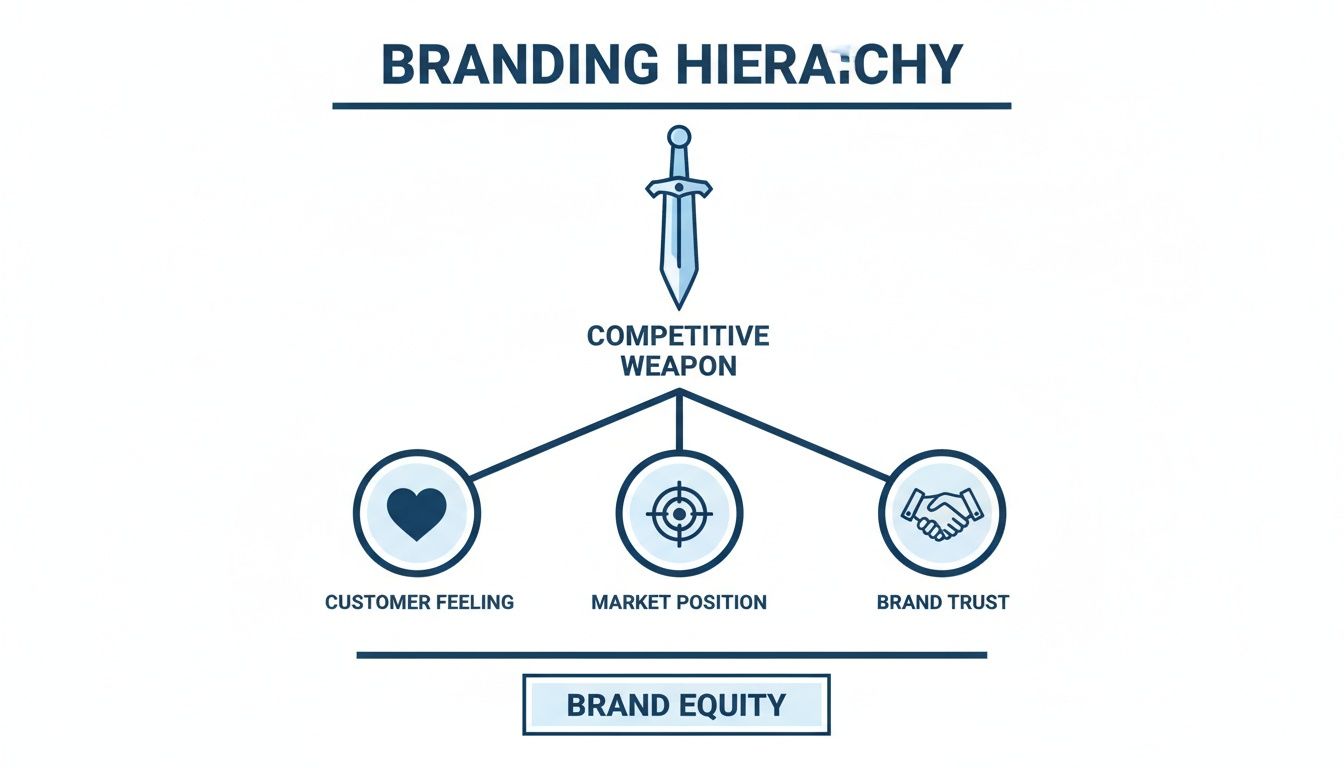
See how it works? Market position, customer feeling, and brand trust work as interconnected gears. When you weave them together, you become the only logical choice for your ideal customer.
Throughout this guide, you and I will turn these abstract concepts into a concrete asset that drives your growth.
Define Your Core Identity and Market Position
Stop. Before you spend a dollar on a designer, you need to get something straight.
Most businesses sprint toward visuals without ever answering the most basic questions. It’s a recipe for expensive mistakes and a brand that feels generic.
Who are you? What do you stand for? And who do you serve better than anyone else? Answering these questions is the strategic bedrock for every decision you'll make.
From Vague Ideas to a Concrete Asset
Your mission, vision, and values are your decision-making framework, and they do more work than any line on your 'About Us' page. When you're faced with a choice, you filter it through this core identity. Does it align? If not, the answer is no.
Let's make this practical.
Your mission is your why. It is your purpose: why you do the work, more than what you do. A coffee shop's mission would be "to be the community's third place, where connections are brewed over the perfect cup," rather than "to sell coffee."
Your vision is your where, your long-term destination. If you execute your mission flawlessly for a decade, what does the world look like? "To become the most trusted local coffee brand in the tri-state area."
Your values are your how, the non-negotiable principles you work by. Ditch generic words like "integrity." Be specific. "Source beans only from fair-trade farms." "Know every regular's name and order."
These three elements are your brand's DNA. They are your strategic compass. If you want to dive deeper into crafting a story that sets you apart, I've detailed how to use AI for that in my guide on AI prompts for marketing.
Creating a Category of One
Your market position means creating a "category of one" where you are the only logical choice for a specific customer, which goes further than finding some tiny niche.
You do this by carving out a unique space at the intersection of what you do best and what a specific audience desperately needs. AI is your weapon here, taking you from guesswork to data-driven certainty in hours, not weeks.
This 'brand-on-a-page' document becomes your source of truth.
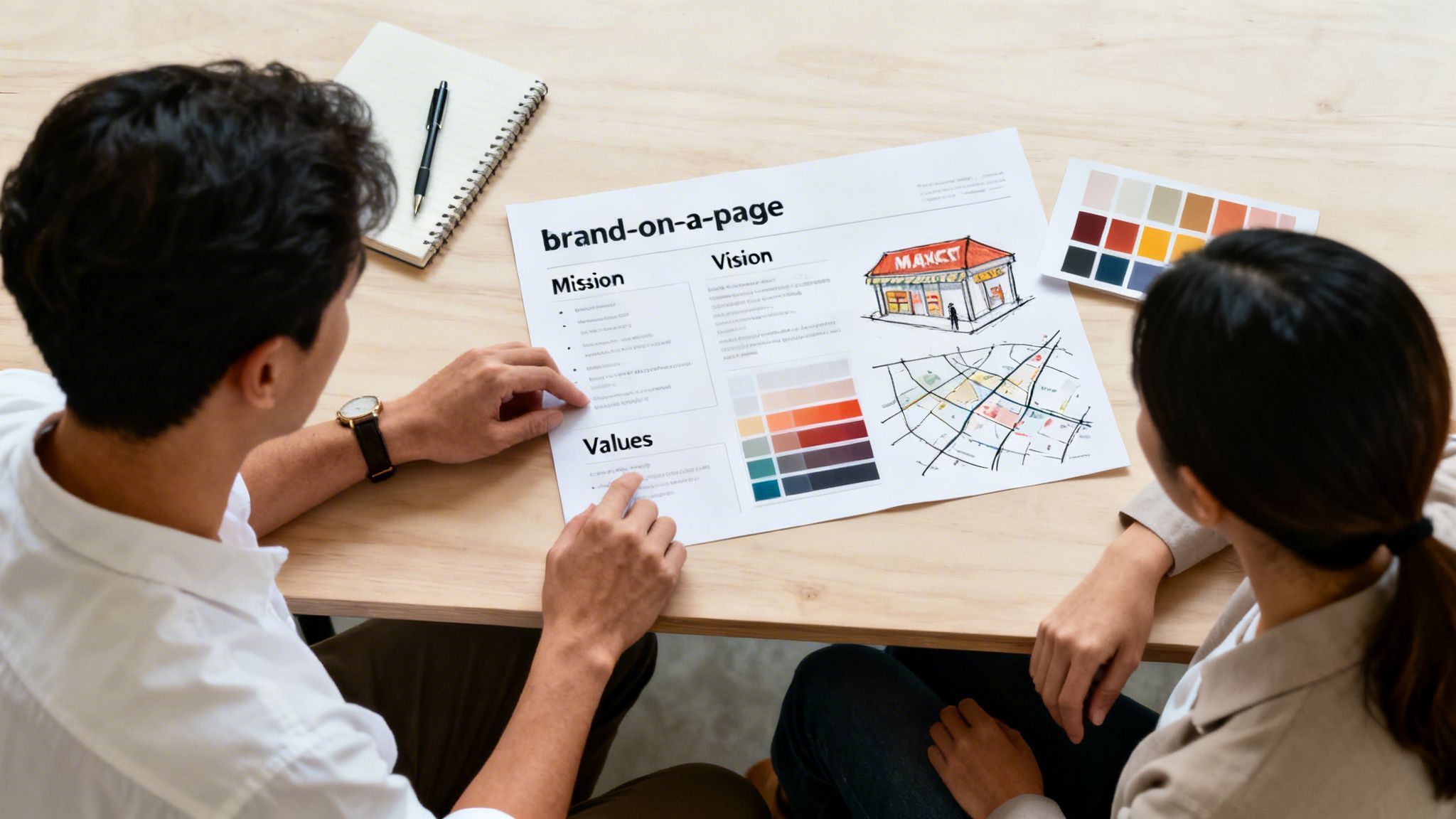
Research shows maintaining a consistent brand can boost revenue by up to 23%. That is a direct line between strategic clarity and your bottom line.
A competitor can’t steal this position. They can copy your product, but they can't copy the identity you own in your customer's mind.
Your goal is to make your brand synonymous with a specific solution for a specific group. When they have the problem, your name should be the only one that comes to mind. This is how a small business owns its corner of the market.
This document (your brand-on-a-page) is the most valuable strategic asset you can create. It guides your copy, design, product development, and hiring. It turns abstract ideas into a concrete playbook for growth.
Build a Consistent Brand Voice with AI Assistants
Inconsistency is the silent killer of a small business brand. An email sounds like a lawyer wrote it, but the next social post is packed with Gen-Z slang. This chaos chips away at trust.
The old-school reaction is to hire more people. A copywriter, a social media manager, an email marketer. That’s a direct path to a bloated payroll and even more inconsistency.
A better way is to build consistency directly into your operations using AI. I mean building a system, which is a long way from asking ChatGPT to "write a post." This move creates enterprise-level coherence on a startup budget.
Your AI Brand Voice Guardian
As a Fractional CAIO, my job is to build systems that let clients scale creative output without losing their brand's soul. The central idea is to create a “Brand Voice Guardian,” an AI assistant that is expert in one thing only: your brand’s voice. This becomes the single source of truth for all communication.
Before you can teach an AI, you have to define the voice yourself. It's vital to get a handle on What Is Brand Voice and How to Define Yours so your unique personality can shine through. Once that foundation is solid, you can start building your AI.
This exercise is about revenue. Data shows 32% of organizations saw a revenue jump of over 20% just by being consistent. It’s no surprise, then, that 71% of businesses agree brand inconsistency leads to customer confusion. You can see more in this detailed report on branding statistics.
Engineering the AI Assistant
So, how do you build this? Use a powerful large language model like Claude 3 Opus or Gemini 1.5 Pro, both with massive context windows perfect for this task.
Here’s the basic architecture:
Start by feeding the AI your core identity documents: your 'brand-on-a-page', mission, vision, and values statements.
Next, feed it 5-10 high-performing examples of your best copy: emails with killer open rates, social posts that sparked real conversation, landing page copy that converts. You're training the AI on what already works.
Finally, define the rules with crystal-clear instructions. This is where sharp prompt engineering comes in. Define the tone (e.g., "Authoritative but approachable"), the personality ("Like a trusted expert, not a salesperson"), and the guardrails ("Never use these 10 jargon words…").
This AI assistant becomes your tireless brand editor. It can generate new copy, review copy written by a human, and score any content on a scale of 1-10 for brand alignment. It's like having your best brand strategist on call 24/7.
The competitive advantage is huge. While your competitors manually review every tweet, you’re shipping on-brand content at 10x the speed. Beyond efficiency, that lets you lead the conversation in your market. To get a head start, check out these actionable ChatGPT prompts for marketing and adapt them for your own Brand Voice Guardian.
This is how you scale a brand in 2026. You use AI to amplify human creativity, ensuring every word builds your brand.
Systematically Deploy Your Visual Identity
Think of your visual identity (logo, colors, fonts) as the uniform your brand wears into battle. If that uniform is sloppy or inconsistent, you've already lost ground. Most small businesses stop at, "I need a logo." That’s a task, not a strategy.
This is about building a comprehensive visual system and deploying it with ruthless consistency. The goal is to make your visual presence so cohesive that it builds subconscious trust and makes you look like the market leader.

Beyond the Logo: A Brand Style Guide That Actually Works
A brand style guide is your rulebook for visual consistency. Treat it as a living document that prevents your brand from looking like a mess, rather than a dusty PDF. When you hire a freelancer, you don't explain the brand. You give them the guide.
The point is to build brand equity. A consistent brand presentation can increase revenue by up to 23%. That’s a hard business result.
Your style guide must include these non-negotiables:
- Set clear rules on how your logo can and cannot be used. Define minimum sizes, clear space requirements, and all official variations.
- Specify your primary, secondary, and accent colors with their exact codes: HEX for web, RGB for digital, and CMYK for print. This ensures your "brand blue" is the same exact blue everywhere.
- For typography, define your headline font, body copy font, and any accent fonts. Be specific about sizes and weights for web and print.
- Set an image style. What kind of photos and graphics represent your brand? Bright and airy? Dark and moody? Specify the desired tone, composition, and subject matter.
AI as Your In-House Design Team
Enforcing that style guide used to be the hard part. It meant manually checking every social post. For a small team, that's impossible. AI completely changes the game.
Instead of designing assets one-by-one, you can use AI to generate an entire suite of on-brand materials in minutes. New tools let you upload your style guide (logo, colors, fonts) and then instantly create templates for anything you need.
This is your new workflow: instead of asking an AI to 'make a cool graphic,' you tell your brand-trained AI, 'Generate five Instagram post templates for our summer sale using our primary color palette and headline font.' The difference in outcome is massive.
This approach gives you two critical advantages. First, speed. While competitors wait a week for a designer, you've already created and tested ten ad variations.
Second, consistency at scale. You eliminate the "off-brand" visuals that inevitably creep in. Every single asset is perfectly aligned. It creates the impression of a much larger, more professional operation.
Inject Your Brand Story at Every Customer Touchpoint
Your competitors can list features. They can talk about specs. Those are commodities.
What they don't have is your story. It's the connective tissue between what you do and what your customer truly needs. It’s the real reason they’ll choose you and, more importantly, the reason they’ll stick around.
The goal is a strategic narrative, with no fairytale spin. Story is how you turn a simple transaction ("I need to buy a widget") into a real partnership ("I only trust this brand for my widgets"). Your job is to inject this story into every single place a customer interacts with your business.
The result? You stop fighting over price and start winning on connection.

Map the Journey to Find Your Moments
Before you can tell your story, you have to know where to tell it. Most businesses get this wrong. They focus on the big, loud moments: the first ad, the final sale. That's a mistake. The real brand building happens in all the small, quiet interactions in between.
You need a map of your entire customer journey. Forget the simple sales funnel. This means every single touchpoint.
- Awareness is the very first time they hear your name. Is it a social media post, a blog they stumbled upon, or a friend’s recommendation?
- In consideration, they're actively looking for a solution. They’re on your website, scrolling through reviews, and stacking you up against the competition.
- Purchase is the transaction itself. The checkout page and the payment confirmation email are part of the experience too.
- Post-purchase is where loyalty is made or broken. The shipping notification, the product arriving on their doorstep, the follow-up email.
- Loyalty shows when they use your product for the tenth time, contact your support team, or open a newsletter about what’s next.
For each of these stages, you have to ask yourself: How can you reinforce your core story here? How do you turn this functional, forgettable interaction into a memorable brand experience?
Injecting Story Where It Counts
Let's make this practical. Imagine you run a small business selling artisanal, sustainably sourced coffee. Your core story is about "bringing the world's best, most ethical coffee from the farm to your kitchen."
Here’s how you weave that story across the entire journey:
- At the awareness stage, your Instagram ad is a 15-second clip of Maria, the farmer in Colombia, talking about her farm, rather than a plain "20% off coffee" banner. The story begins at the source.
- During consideration, your product page has a small section titled "The Journey of These Beans" right next to the "Add to Cart" button. It has a map showing the path from her farm to their cup.
- After purchase, the confirmation email subject line reads "Get Ready, Maria's Harvest Is on Its Way" instead of "Your Order #12345 Is Confirmed." Inside, you link to a short bio about Maria and her family.
What you're selling is a direct connection to a person and a place. That’s a story. And it's a powerful moat your commodity-focused competitors can’t cross. It’s no surprise that nearly two-thirds of consumers now expect these kinds of personalized interactions; they’re tired of feeling like just another number.
This is how you build a brand that people believe in. You transform mundane touchpoints into chapters of your brand's story. The unboxing experience, the welcome email, even a customer support chat: they all become opportunities to reinforce why you exist.
Personalizing the Narrative with AI
This is where it gets really powerful. Manually tailoring stories for every customer segment is impossible for a small team. But with AI, you can personalize your brand narrative at scale.
By connecting an AI model to your customer data (like purchase history or website behavior), you can dynamically adjust the story you tell. For instance, a customer who repeatedly buys your darkest roast from Ethiopia could get an email with the subject line, "A New Roast from the Yirgacheffe Region We Think You'll Love."
The email content, generated by your Brand Voice Guardian, could then tell the specific story of that new farm, the family that runs it, and the unique tasting notes they discovered this season.
This is a world away from the generic "You might also like…" recommendations. It shows you understand why they buy, along with what they buy. This level of personalized storytelling was once only available to giants like Amazon. Now, you can deploy it to build an army of loyal customers who become your most effective salespeople.
Frequently Asked Questions (The Straight Answers)
When I talk about using AI for branding, founders and marketers tend to ask me the same handful of questions. They’re good questions, too, rooted in the tough realities of running a business: budgets, results, and the fear of making a costly mistake.
Here are the straight answers. No fluff, just the intelligence you need to make your next move.
How Much Should a Small Business Budget for Branding?
Let's start by reframing this. It’s the wrong question.
Stop thinking about branding as a one-time, fixed cost like buying a new laptop. Branding is an ongoing investment in a strategic asset, one that should grow in value over time if you manage it correctly.
In the early days, your single biggest investment is your own time. It’s the hours you and your team will spend hammering out your core identity, your position in the market, and the voice you'll use to speak to customers. That deep strategic work is priceless, and it costs you nothing but focus.
As for external costs? Forget the $20,000 agency project. A lean business can get 80% of the way there with a much smarter, more surgical approach.
Budget around $500 for a high-quality freelance designer to create a proper logo system and a practical style guide. Then, plan for $20-$100 per month to cover your AI tool subscriptions. That's your starting point.
The real "budget" is your unwavering commitment to consistency. You can spend a fortune on a logo, but if your brand is inconsistent, its asset value is effectively zero. It just erodes trust and confuses your market.
How Can I Measure the ROI of My Branding Efforts?
Measure branding with hard business metrics that directly tie to revenue, instead of fuzzy feelings or social media "likes." Your brand is a strategic weapon, and you need to track its effectiveness like one.
If you’re not tracking these metrics, you’re flying blind. These are the KPIs that tell you whether your branding is actually driving growth or just making you feel good about your business.
Here are the key performance indicators to watch:
Track aided and unaided brand recall. Periodically survey your target market. Ask them to name brands in your category (this is unaided recall). Then, show them a list with your brand on it and ask which ones they recognize (aided). If your name starts popping up more over time, your branding is cutting through the noise.
Watch website direct traffic. Are people typing your URL directly into their browser? This is a crystal-clear signal that they know you and are seeking you out by name, a direct result of strong brand recall.
Check branded search volume. Use a tool like Google Search Console to see how many people are searching for your brand name or your specific product names each month. An upward trend here means your brand is gaining mindshare.
Follow customer lifetime value (CLV). A powerful brand builds loyalty. It creates repeat customers who are less sensitive to price. If your average CLV is increasing, it's a strong sign your brand is building real connection and trust.
Measure the conversion rate on higher-priced offers. A strong brand gives you pricing power. As your brand equity grows, you should find it easier to convert customers on your premium products or services. Track this specific conversion rate closely.
Track these metrics every single month. If the charts are trending up and to the right, your branding investment is paying for itself.
Can I Rebrand My Business If My Current Branding Is Not Working?
Yes, but you have to approach it like a surgeon, not a demolition crew. A rebrand is a strategic pivot, far more than a chance to pick a new color you like, and it has to be driven by data and executed with precision.
First, diagnose why the current brand is failing. Don't guess. Use customer surveys, dig into your sales data, and conduct actual interviews. Is the core message wrong? Is the visual identity confusing? Is your brand voice resonating with the wrong audience entirely? You need a data-backed diagnosis before you operate.
Once you know the problem, you can execute the rebrand. But the most critical part is communicating the change to your existing customers and the market. You must explain the 'why' behind the evolution. Tell the story of where you've been and where you're going.
A rebrand done right is a massive opportunity to re-engage your entire audience and signal a new chapter. A rebrand done wrong just makes you look like you’re panicking.
What Is the Single Biggest Branding Mistake Small Businesses Make?
Inconsistency. Without a doubt, it’s the number one brand killer.
I've seen it a hundred times. A founder invests in a beautiful strategy document and a sharp style guide, only to let a dozen different people (employees, freelancers, interns) create content with zero oversight. The result is a fractured, chaotic brand that builds absolutely no trust.
Your brand is what you repeatedly do. If your marketing actions are chaotic, your brand is chaotic. This is precisely why I emphasize building systems like the AI Brand Voice Guardian and enforcing a strict style guide. Consistency is the very foundation of brand equity.
Enforce it like your business depends on it. Because it does.