
You’re drowning in data but starving for insights. Your analytics tells you what is happening—where users drop off, which pages underperform—but it never explains why. This gap between data and action is where most growth strategies die. Bleeding cash with every unconverted click.
I started deep-diving into machine learning in 2016 and generative AI in 2019. I’ve seen countless companies burn millions on traffic that goes nowhere, all because they lack a system. They chase shiny objects and copy competitors’ button colors. That’s not a strategy; it’s a lottery ticket. Your competitors are hoping you keep playing that game.
We’re going to fix that right now. This is my personal, battle-tested conversion rate optimization checklist. It’s the framework I use as a Fractional Chief AI Officer to build marketing systems that dominate markets, blending data-driven diagnostics with the sheer speed of AI.
To stop guessing, you must first diagnose the leaks. Before jumping into isolated tests, you need a baseline. The most effective way to begin is by conducting a thorough Conversion Rate Optimisation Audit to find the highest-impact opportunities first.
This guide will walk you through implementing heatmaps, auditing core page elements, designing an AI-driven testing stack, and reducing friction in your forms. We’ll cover everything from technical performance to the psychology of social proof.
Forget guesswork. Let’s build your system.
1. Implement Heat Mapping and Session Recording to Identify User Behavior Bottlenecks
Your analytics tell you what is happening. They show drop-off rates and bounce rates. But they will never tell you why users are leaving your checkout page or ignoring your primary call-to-action. To get that crucial context, you need to see your site through your users’ eyes.
Heat mapping and session recording tools are my go-to for this initial diagnostic phase. They provide a visual record of user behavior, turning abstract data into actionable human stories. A heat map shows you which elements draw attention and which are ignored. Session recordings are like a DVR for individual user visits.
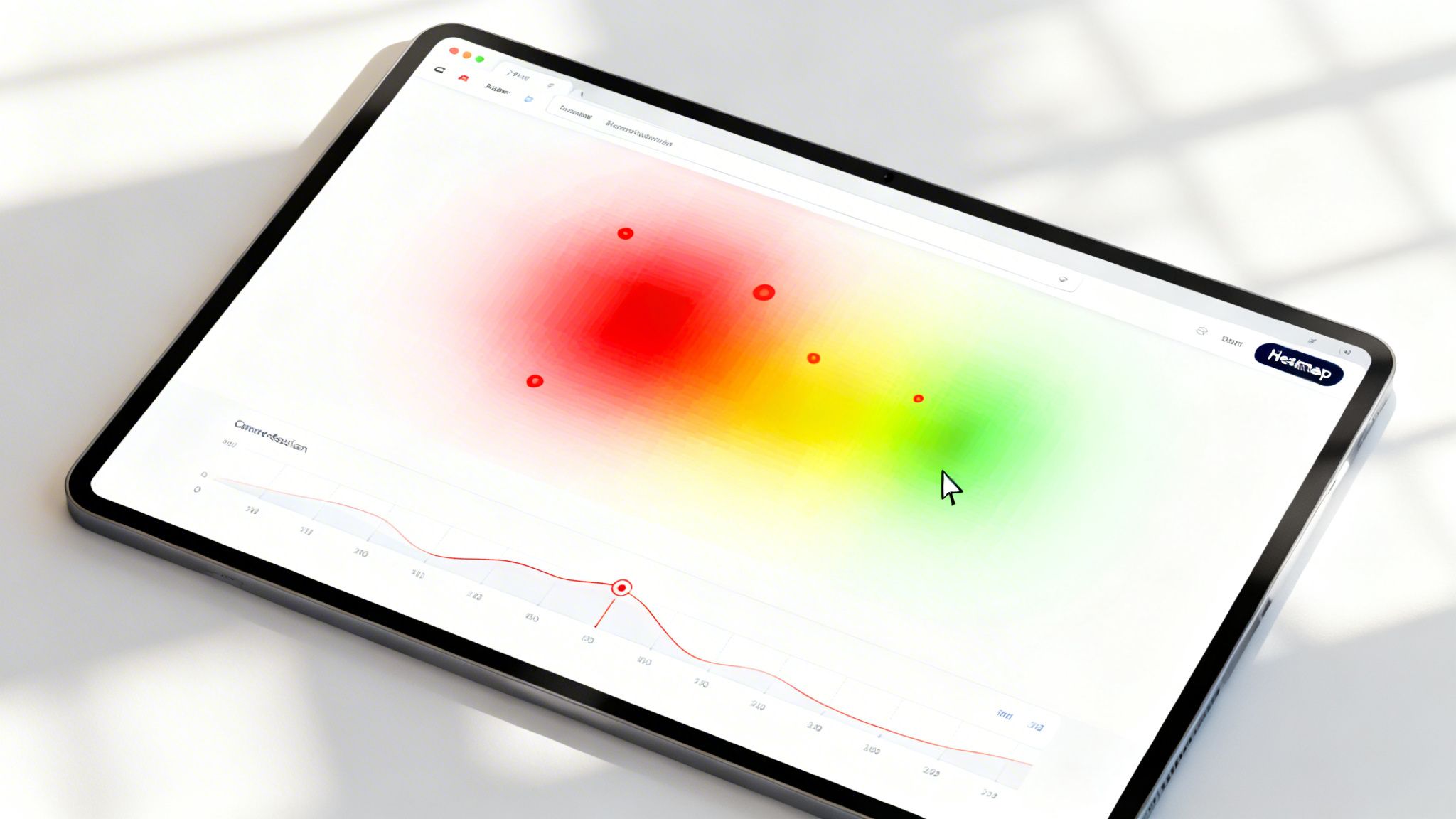
This qualitative insight is the foundation of any effective conversion rate optimization checklist. Without it, you’re just guessing.
How to Implement This Strategy
Deploying these tools is straightforward. I often recommend services like Hotjar or Microsoft Clarity. Once you install a small tracking script, they begin collecting data. The key is to be strategic in your analysis to avoid getting lost in the noise.
Start with high-impact pages. Focus your initial efforts on pages with high traffic but low conversion rates. Your homepage, key landing pages, pricing page, and checkout flows are prime candidates.
Look for patterns. Don’t base a redesign on a single confusing user session. I tell my clients to watch at least 20-30 recordings for a specific page to identify recurring patterns of frustration or confusion.
Segment your data. Analyze behavior based on the traffic source. Users arriving from a targeted ad campaign will behave differently than those from organic search. These differences reveal channel-specific friction points.
Inform your A/B tests. Use heat maps to validate your hypothesis. If your scroll map shows 80% of users never see your primary CTA, your A/B test should focus on moving that CTA above the fold. This data-informed approach dramatically increases the odds of a successful test.
By watching real users, you move from abstract analytics to concrete, human-centered problems. This step alone can uncover your most significant growth opportunities, giving you a massive advantage over competitors still staring at spreadsheets.
2. Audit and Optimize Core Page Elements (Headlines, CTAs, Value Props)
Your site’s core elements—the headline, value proposition, and call-to-action (CTA)—do 90% of the heavy lifting. If these three fail to connect with a visitor’s intent in the first five seconds, you’ve lost them. No amount of fancy design can save a page with a fundamental messaging problem. This is where we stop guessing and start engineering clarity.
The goal is to systematically audit and refine these critical conversion drivers. I’ve seen a SaaS company increase conversions by 27% just by changing their headline from “Project Management Software” to “Reclaim 10 Hours/Week Your Team Wastes in Status Meetings.” This isn’t wordplay; it’s aligning your message with the user’s core problem. A foundational part of any serious conversion rate optimization checklist.
This systematic audit moves your copy from a creative exercise to a data-driven science. It’s about finding the precise combination of words that triggers a “yes” in your prospect’s mind.
How to Implement This Strategy
A strong message-market fit is your biggest lever for growth. The good news is we can now use AI to accelerate this process, generating and analyzing copy variations at a scale that was previously impossible.
Generate headline variations with AI. Use a tool like ChatGPT or Claude to generate 15-20 headline variations. Your prompt should be grounded in customer research. I tell my clients to feed the AI their top customer testimonials and survey responses to ensure the output is based on real pain points.
Focus on benefits, not features. A/B test a benefit-driven headline against your current feature-focused one. Benefits almost always outperform features because they answer the user’s primary question: “What’s in it for me?”
Test your Call-to-Action (CTA). A simple CTA change can have a massive impact. An ecommerce brand I worked with saw a 34% lift by testing “Get My Results in 30 Days” against a generic “Shop Now.” Be specific and action-oriented.
Isolate your tests. When testing CTAs, test the button copy and the button color in separate experiments. If you change both at once, you’ll never know which element drove the change. Isolate variables to get clean, actionable data.
By continuously refining these core elements, you create a powerful conversion engine. For more inspiration, you can analyze some of the best landing pages to see how they master their headlines and CTAs.
3. Design a Robust Testing Framework and AI-Driven Optimization Stack
Gut feelings don’t scale. If you’re not testing, you’re just guessing, and your competitors are out-learning you. But a haphazard approach to A/B testing is almost as bad, leading to false positives and wasted resources. You need a systematic process for experimentation.
This is where a robust testing framework comes in. It’s your rulebook for running clean A/B tests and multivariate tests. This framework defines everything: how you calculate sample sizes to avoid “peeking” and declaring premature winners, how you document learnings, and what your success criteria are. Then, you supercharge this system with AI.
This hybrid approach gives you human-led strategy with machine-level execution speed. One SaaS client I worked with increased their experiment velocity by 8x, discovering multiple new wins per week instead of per quarter. This is how you build a dominant market position.
How to Implement This Strategy
Your goal is to build an experimentation engine that runs continuously in the background. Tools like Optimizely, VWO, or Convert are essential for managing the technical side, but the process is what truly matters.
Document everything. Create a central repository for all tests. For each test, document the hypothesis, the variant details, the results, and your key learnings. This prevents you from re-running failed tests and builds an internal knowledge base.
Set rules and stick to them. Use a sample size calculator before launching any test. Do not stop a test early just because a variation is “winning.” I’ve seen countless “winners” regress to the mean when the test was allowed to reach its required sample size.
Start simple, then scale. Begin by testing one variable at a time (e.g., a headline or a CTA button color). Once you have sufficient traffic and a mature process, you can scale to more complex multivariate tests.
Integrate and automate with AI. This is the force multiplier. Start by connecting your testing platform to your analytics and AI copywriting tools via APIs. Then, deploy AI agents with clear guardrails. For a deeper dive into the specific tools for this, you can explore the landscape of AI marketing automation tools that form the foundation of this stack.
4. Reduce Friction in Forms and Checkout Processes with Progressive Profiling
Every extra field in your signup form is another reason for a potential customer to leave. I’ve seen companies ask for a prospect’s life story upfront, killing their lead flow. The modern approach is to treat data collection like a conversation, not an interrogation. You start with the absolute essentials and gather more information over time.
This is the core idea behind progressive profiling. Instead of a single, intimidating form with 12 fields, you present a simple one asking for just an email. Once that initial conversion is secured, you can intelligently ask for more details on subsequent visits. This dramatically lowers the initial barrier to entry, a critical factor in any conversion rate optimization checklist.
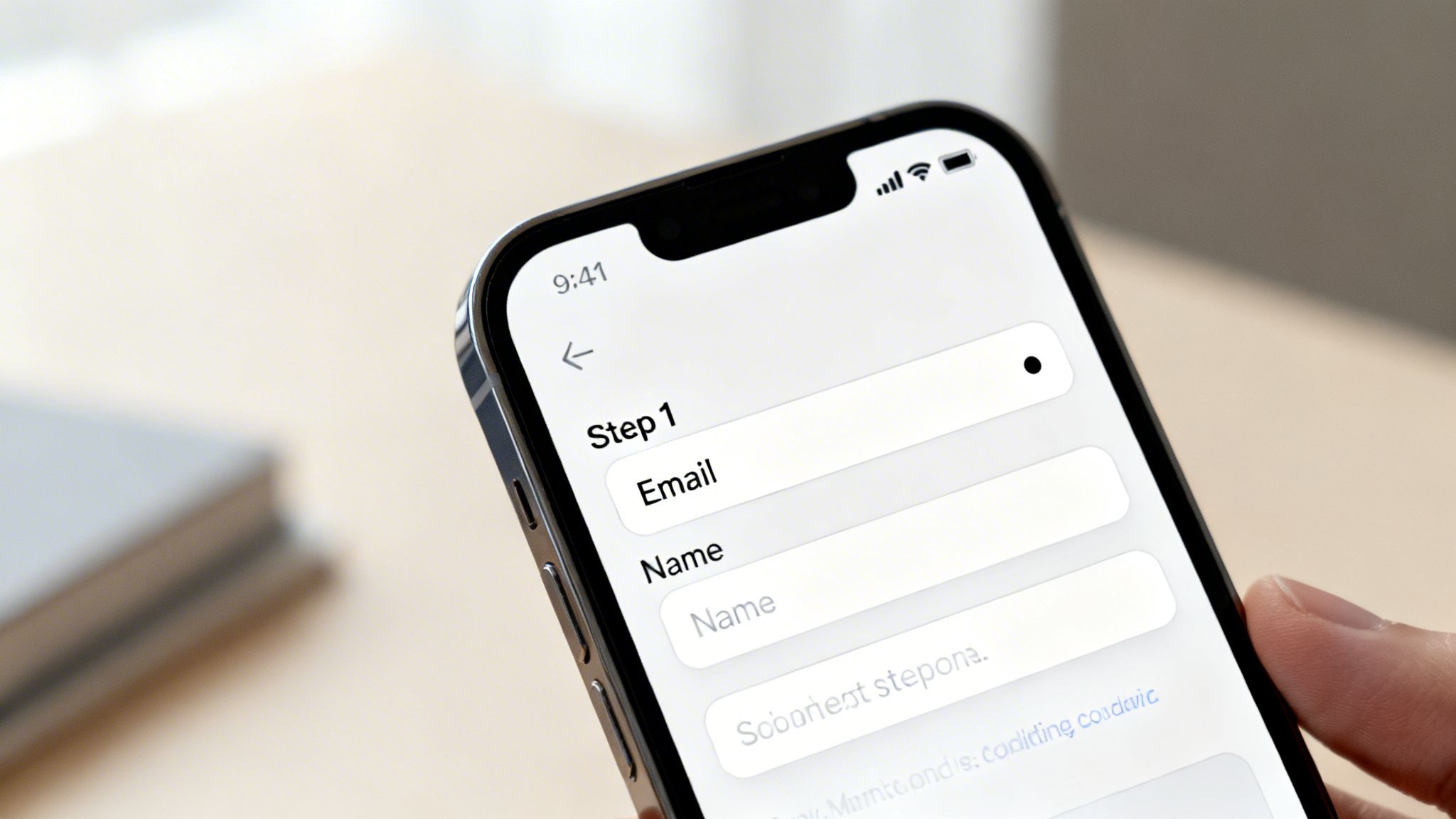
This method respects the user’s time and builds trust, turning a transactional data grab into a gradual, more natural exchange of information.
How to Implement This Strategy
Pioneered by platforms like Marketo and HubSpot, this strategy is now accessible to everyone. The goal is to make your forms dynamic and context-aware, reducing user effort at every stage.
Audit and simplify. Start by ruthlessly auditing your current forms. For each field, ask yourself: is this data absolutely critical for the initial conversion? A B2B client boosted their demo requests by 34% simply by cutting their form from 12 fields down to four essentials.
Use conditional logic. Show fields only when they are relevant. If a user selects “Other” in a dropdown, then reveal a text field asking for more information. This keeps the form clean and tailored to the individual user’s input.
Leverage AI and automation. Use AI tools to auto-fill fields based on an email domain or backfill data from third-party sources. You can also build automated email workflows that ask for the next piece of information after a successful signup.
Test and iterate. Don’t guess which form length is best. Run A/B tests comparing a 2-field version against a 4-field version. The data will show you the sweet spot between lead quantity and quality. For a specific focus on improving form performance, delve into these actionable conversion rate optimization tips for forms to significantly boost completion rates.
By asking for less upfront, you get more conversions. You can then strategically gather the rich data you need to qualify and nurture those leads effectively. The best of both worlds.
5. Segment Traffic and Personalize Messaging by Source, Audience, and Intent
A generic landing page is a dead end. It treats a visitor from a Reddit thread about a specific problem the same way it treats someone who clicked a branded Google ad. This one-size-fits-all approach ignores a visitor’s context and intent. A massive missed opportunity in any conversion rate optimization checklist. The goal isn’t just to get traffic; it’s to speak directly to the person behind the click.
Personalizing the user journey based on its origin is one of the highest-leverage actions you can take. It’s about creating message-to-market match. When the ad copy, the headline, and the on-page offer all align perfectly with the user’s original intent, you create a seamless, high-relevance experience that naturally boosts conversions. A B2B software company I worked with saw a 27% conversion lift simply by ensuring their landing page headline perfectly mirrored the promise made in their ad copy.
This isn’t about creating hundreds of unique pages. It’s about strategically targeting your most valuable visitor segments.
How to Implement This Strategy
The core idea is to deliver a tailored experience that acknowledges where a user came from and what they likely want. With modern tools, especially AI, this is more accessible than ever.
Identify high-value segments. Don’t try to personalize for everyone at once. Start by analyzing your analytics. Isolate your top 3-5 traffic sources (e.g., organic search, a specific ad campaign, a key referral partner) or user personas.
Establish message-to-market match. The most critical link is between your ad and your landing page. If your ad promises a “free trial,” your landing page headline must reinforce that offer immediately. Any disconnect creates friction and kills trust.
Leverage Dynamic Text Replacement (DTR). Instead of building dozens of static pages, use a single template with dynamic fields. DTR scripts can automatically swap out headlines, images, or calls-to-action based on the UTM parameters in the URL the visitor clicked.
Use AI for copy variations at scale. This is where AI becomes a superpower. I use models like GPT-4 or Claude to instantly generate persona-specific copy. Feed the AI a user persona (e.g., “a startup founder from a Reddit post concerned about burn rate”) and ask for headline and body copy variations. This drastically cuts down on the time it takes to create tailored content for each segment.
By personalizing the journey, you show visitors you understand their specific needs from the moment they land. This builds immediate rapport and guides them more effectively toward conversion. For a deeper dive into this, you can learn more about these popular segmentation methods.
6. Leverage AI-Powered Copywriting and Content Generation for Rapid Testing Iteration
Your copy is the lifeblood of your conversion rates. The right headline can double your sign-ups. The wrong one ensures failure. But traditionally, testing copy variations has been slow and expensive. This is where your competition is getting left behind.
AI-powered language models completely change the economics of copy testing. Instead of painstakingly drafting a few variations, you can now generate dozens of high-quality headlines, calls-to-action, and landing page sections in minutes. This isn’t about replacing your copywriters; it’s about giving them superpowers to test more hypotheses faster than ever before. Failing to leverage this speed is a critical error.
This lets you move from a “best guess” approach to a data-driven one at an unprecedented scale. I’ve seen a SaaS founder use ChatGPT to create 20 headline options, A/B test the top five, and find a winner that boosted conversions by 19% in under a week. That’s the kind of velocity that builds market leaders.
How to Implement This Strategy
The secret to great AI-generated copy isn’t the model itself, it’s the quality of your instructions. Generic prompts produce generic copy. Your goal is to combine the speed of AI with the strategic insight of your team.
Develop a brand voice prompt. Create a detailed document outlining your brand’s tone, voice, key messaging points, and target audience persona. Feed this into your prompts to ensure consistency and quality. This is your most valuable asset for scaling content.
Build a prompt library. Don’t start from scratch every time. Create and save templated prompts for different copy types like headlines, CTAs, product descriptions, and email sequences. This standardizes output and accelerates your workflow.
Focus on human refinement. Use AI to generate the first 80%. Have your copywriters spend their valuable time refining, editing, and elevating the best AI-generated options rather than staring at a blank page. This perfectly balances speed with quality.
Test aggressively. The real power here is velocity. Don’t just generate one new version; generate ten. A/B test AI-generated copy against your human-written control. With strong prompts, you’ll often find the performance difference is minimal, allowing you to iterate much faster.
7. Implement Trust Signals and Social Proof Strategically Across High-Friction Pages
You’ve built a great product and your landing page copy is compelling, but visitors are still hesitating. Why? Because every purchase or sign-up involves a calculation of risk versus reward. Your job is to systematically de-risk that decision for the user. Without trust, you have nothing.
Trust signals and social proof are the currency of online credibility. They include testimonials, case studies, security badges, and satisfaction guarantees. These elements work because they leverage a powerful psychological principle: people trust the actions and endorsements of others, especially when they are uncertain.

Strategic placement is everything. A testimonial buried on a dedicated page is less effective than one placed right beside your checkout button. This element of your conversion rate optimization checklist is about building a fortress of confidence around every call-to-action.
How to Implement This Strategy
The goal is to answer the user’s subconscious question, “Can I trust you?” before they even have to ask it. A SaaS platform I worked with saw a 17% conversion lift simply by adding a customer logo section directly above the primary CTA.
Identify high-friction points. Use your session recordings and heat maps to find where users hesitate. Common areas include pricing pages, sign-up forms, and the final checkout step. These are your prime locations for trust signals.
Be hyper-specific. Vague praise is useless. A testimonial that says “Their service increased our revenue significantly” is weak. One that says “We saw a 27% revenue increase in Q1” is powerful. Always push for quantifiable results.
Automate and personalize proof. Integrate review platforms like Trustpilot or G2 to automatically pull in fresh, authentic reviews. I also use AI tools to dynamically display social proof relevant to a visitor’s industry or location, making the endorsement feel more personal.
Test placement and format. Don’t just place logos and leave them. A/B test their placement: above the fold, next to the CTA, or near a pricing table. Test video testimonials against text. Test a “98% Customer Satisfaction” badge against a money-back guarantee seal.
By strategically weaving these credibility markers throughout the user journey, you reduce perceived risk and make it easier for customers to say “yes.” This isn’t about vanity; it’s about building a tangible asset of trust that directly impacts your bottom line.
8. Optimize Page Load Speed and Technical Performance for Conversion Impact
In a world of instant gratification, a slow website is a conversion killer. Every fraction of a second a user waits for your page to load, you’re losing their attention, trust, and ultimately, their business. This isn’t just about user experience; it’s a direct-impact, revenue-generating activity.
I’ve seen firsthand how technical performance is the bedrock of a solid conversion rate optimization checklist. An ecommerce client of mine reduced their page load time from 4.2 to 2.1 seconds and saw an 18% lift in conversions. Google, Shopify, and Amazon have all published data proving that speed equals revenue. If your site is slow, you are telling potential customers you don’t value their time. They will go to a competitor who does.
Fixing your page speed isn’t a “nice-to-have” technical task; it’s a foundational marketing and sales function. It impacts your SEO rankings, your ad Quality Scores, and the overall perception of your brand.
How to Implement This Strategy
Optimizing for speed requires a systematic approach. Don’t just randomly install a caching plugin and hope for the best. You need to diagnose the specific bottlenecks and address them with precision.
Audit your performance. Start with a baseline. Use tools like Google PageSpeed Insights or GTmetrix to analyze your site. These tools will give you a detailed report on what’s slowing you down, from large images to render-blocking scripts.
Aggressively optimize images. Images are almost always the biggest culprit of page bloat. I tell my clients to compress every image and serve them in next-gen formats like WebP. This step alone can often cut page weight by more than 50%.
Implement smart loading. Use lazy loading for images and videos that are below the fold. This means they won’t load until the user scrolls down to them, dramatically speeding up the initial perceived load time.
Leverage a Content Delivery Network (CDN). A CDN stores copies of your site’s assets on servers around the world. When a user visits your site, content is delivered from the server closest to them, slashing latency for your global audience.
Monitor Core Web Vitals. Keep a close eye on Google’s Core Web Vitals (LCP, FID, CLS) in your Google Search Console. These are the specific metrics Google uses to judge user experience, and improving them directly correlates with better rankings and higher conversions.
A faster website feels more professional and more reliable. In a competitive market, that speed can be the deciding factor that turns a visitor into a paying customer.
9. Create Urgency and Scarcity Tactics (Ethically) to Motivate Immediate Action
Analysis paralysis is a conversion killer. When a potential customer thinks, “I’ll come back to this later,” they rarely do. Your job is to give them a compelling, authentic reason to act now. This is where ethical urgency and scarcity come in; they are powerful psychological triggers that combat procrastination.
I’m not talking about fake countdown timers or inflated inventory claims. Those tactics destroy trust. True urgency is about transparently communicating real-world limitations. A limited number of seats in a workshop, an early-bird pricing tier that expires, or a seasonal product with finite stock. This shifts the customer’s mindset from “Should I buy this?” to “Should I buy this now before the opportunity is gone?”
The key is authenticity. A SaaS client running a cohort-based course saw a 34% spike in signups in the final 48 hours simply by enforcing a hard “Enrollment closes Friday at midnight” deadline. The scarcity was real. The results were immediate.
How to Implement This Strategy
Deploying urgency requires a delicate balance between motivation and pressure. You want to encourage, not coerce. The foundation must always be a strong value proposition; urgency amplifies a good offer, it cannot save a bad one.
Use real deadlines and limits. Only promote scarcity that is genuine. If you have 50 spots for an early-bird discount, close it after the 50th signup. If a flash sale ends at midnight, ensure the prices revert. Your credibility is your most valuable asset.
Leverage countdown timers. For time-based offers like flash sales, a visual countdown timer makes the deadline tangible. I’ve seen these timers increase ecommerce conversions by over 28% during a 6-hour sale window. Use them sparingly on your highest-impact offers to maintain their effectiveness.
Show social proof of demand. Displaying messages like “15 people are looking at this right now” or “Last one sold 10 minutes ago” leverages real-time activity to create a sense of demand. This implies the product is valuable and stock might not last.
Track post-purchase behavior. Monitor refund and cancellation rates for customers who converted via an urgency-driven campaign. A high refund rate might indicate the urgency attracted the wrong audience or created buyer’s remorse. A signal to refine your targeting.
By ethically communicating genuine limitations, you align with the customer’s desire to get the best deal or secure a limited opportunity, motivating them to act decisively.
10. Conduct Voice of Customer Research and Integrate Insights into Copy and Design
Your assumptions about why customers buy are probably wrong. You think they love a specific feature, but what they really value is the five minutes it saves them. You highlight technical specs, but their biggest fear is a complicated setup. Relying on your internal perspective is like trying to guess the combination to a safe. Voice of Customer (VoC) research gives you the code.
This process involves systematically gathering customer feedback to understand their true pain points, motivations, and language. It’s about listening, not pitching. When you swap your company jargon for the exact words your customers use, you create an instant connection. This research-backed copy consistently outperforms marketing messaging created in a boardroom vacuum.
For example, a productivity app I worked with discovered their customers’ biggest fear was the “learning curve.” We immediately added “Setup takes 5 minutes” to key pages, and conversions jumped by 28%. This isn’t magic; it’s just aligning your message with the customer’s reality.
How to Implement This Strategy
The goal is to get out of your own head and into your customer’s. Today, AI makes analyzing this qualitative data easier than ever, allowing you to spot themes at scale that were previously impossible to find.
Interview your audience. I recommend starting with 10-20 customer interviews. Talk to your best customers, new customers, and even people who churned. Ask open-ended questions like, “What almost prevented you from buying?”
Analyze reviews and support tickets. Your customer support inbox and public review sites are gold mines of unfiltered feedback. Look for recurring complaints, praises, and questions. This is a crucial part of any comprehensive conversion rate optimization checklist.
Use AI for thematic analysis. Manually sifting through hundreds of pages of interview transcripts or reviews is a nightmare. I use tools like Claude or ChatGPT to analyze this raw text. You can upload transcripts and prompt the AI to “Identify the top 5 customer pain points and provide 10 direct quotes for each.”
Build a messaging matrix. Organize your findings. Create a simple spreadsheet mapping customer pain points to your value propositions, using their exact language. When your copywriter needs a new headline for a landing page, they pull directly from this validated source.
By systematically listening to your customers and embedding their voice into your copy, you don’t just optimize a webpage. You build a brand that resonates on a fundamentally human level. This is how you win.
10-Point CRO Checklist Comparison
| Item | Implementation complexity | Resource requirements | Expected outcomes | Ideal use cases | Key advantages |
|---|---|---|---|---|---|
| Implement Heat Mapping and Session Recording to Identify User Behavior Bottlenecks | Low–Medium (install script, consent management) | Heatmap/session tools, analyst time; cost scales with traffic | Qualitative insights into friction; prioritized UX fixes | High-traffic pages, checkout/signup flows, landing pages | Reveals “why” behind drop-offs; informs test hypotheses |
| Audit and Optimize Core Page Elements (Headlines, CTAs, Value Props) | Low (copy audit + A/B tests) | Copywriting skill, testing platform, modest traffic | Quick conversion uplifts from messaging and CTA changes | Any conversion page with messaging mismatch | High ROI; fast to implement; improves ad relevance |
| Design a Robust Testing Framework and AI-Driven Optimization Stack | High (statistical design + automation) | Experimentation platform, dev/data engineers, substantial traffic | Reliable winners, faster experiment velocity, institutional learnings | Organizations scaling experiments across channels | Prevents false positives; repeatable, scalable testing |
| Reduce Friction in Forms and Checkout Processes with Progressive Profiling | Medium (conditional logic + integrations) | Dev/CRM integration, form tools, testing resources | Higher form completion rates; phased data capture | Lead-gen flows, mobile checkout, high-friction forms | Boosts submissions and data quality; better mobile UX |
| Segment Traffic and Personalize Messaging by Source, Audience, and Intent | Medium–High (segmentation infra + dynamic content) | Analytics, personalization tools, content variants, traffic | Improved relevance and conversion; better ad efficiency | Diverse traffic sources, international audiences, paid campaigns | Message-to-market matching; scalable personalization |
| Leverage AI-Powered Copywriting and Content Generation for Rapid Testing Iteration | Low–Medium (prompting + review process) | AI APIs/tools, prompt libraries, human editors | Rapid generation of testable copy; higher test velocity | High-volume testing, limited copy resources | Speeds content production; reduces copywriting bottleneck |
| Implement Trust Signals and Social Proof Strategically Across High-Friction Pages | Low–Medium (collecting & placing proof) | Customer outreach, review integrations, modest design work | Reduced purchase anxiety; higher conversions on decision pages | New brands, high-consideration purchases, checkout pages | Builds credibility; handles objections near CTAs |
| Optimize Page Load Speed and Technical Performance for Conversion Impact | Medium–High (front-end & server optimizations) | Dev/infra resources, monitoring tools, CDN | Faster load times, improved conversion, SEO gains | Media-heavy sites, global audiences, paid landing pages | Lowers abandonment; improves SEO and ad quality scores |
| Create Urgency and Scarcity Tactics (Ethically) to Motivate Immediate Action | Low (copy, timers, inventory logic) | Campaign setup, inventory/logic, monitoring; must be authentic | Short-term conversion spikes; higher immediate revenue | Flash sales, enrollment windows, limited-inventory offers | Converts fence-sitters; amplifies time-bound offers |
| Conduct Voice of Customer Research and Integrate Insights into Copy and Design | Medium (interviews, synthesis, integration) | Research time, tools, analysts or AI for transcript analysis | More persuasive, evidence-backed messaging; fewer assumptions | New products, repositioning, messaging overhauls | Uncovers real language, objections, and emotional triggers |
From Checklist to Competitive Advantage
You’ve made it through the list. But let’s be clear: a checklist is a map, not the engine. The real competitive advantage isn’t found in a single A/B test win; it’s built by creating a high-velocity optimization system that learns and adapts faster than your market.
This conversion rate optimization checklist isn’t about ticking boxes. It’s about building a fundamentally different operational cadence. Your competitors are still manually analyzing spreadsheets and debating button colors for weeks. You and I, we’re building bionic systems. We’re using AI to compress that entire cycle from weeks into hours.
Moving Beyond Manual Tweaks
The ten items we’ve covered aren’t isolated tactics. They are interconnected components of a single growth machine. Think of it this way:
- Voice of Customer research (Item 10) provides the raw fuel for your hypotheses.
- AI-driven copywriting tools (Item 6) refine that fuel into high-octane messaging variations.
- Your robust testing framework (Item 3) is the engine that burns that fuel, running multiple experiments simultaneously.
- Heatmaps and session recordings (Item 1) act as your diagnostic dashboard, showing you exactly where the engine is misfiring.
When you connect these pieces, you stop being a marketer who runs tests and become an architect of a system that constantly learns. You’re no longer guessing what headline works best. You’re building an AI-assisted workflow that generates 50 headline variants based on real customer pain points, launches tests, analyzes the data, and feeds the learnings back into the next iteration. That’s the difference between incremental gains and market domination.
The True Power of an AI-Enhanced CRO System
The real breakthrough isn’t just speed; it’s intelligence at scale. By integrating AI agents for hypothesis generation, copy creation, and results analysis, you’re not just improving a landing page. You’re building a market intelligence network that captures user intent and translates it into revenue, automatically.
This is how you get ahead and stay ahead. While your competitors are stuck in analysis paralysis, your system is already on its third iteration of a high-converting funnel. They are playing checkers; you are playing 3D chess, with AI agents moving the pieces for you. The goal isn’t just a higher conversion rate. It’s to achieve a rate of learning and adaptation that your competition simply cannot match.
Your new competitive moat isn’t your product or your brand; it’s the speed and intelligence of your optimization engine.
Don’t just complete the checklist. Internalize the methodology. See each point not as a task but as a gear in a larger machine. Your job is to assemble that machine, wind it up, and let it run. The initial setup requires focus, but the compounding returns are what create category-defining businesses.
Now, take this conversion rate optimization checklist and go build your engine.