
Let's get straight to it. Your marketing is burning cash on things that don't move the needle. You see the budget draining, but revenue growth isn't keeping pace.
This is a systems problem. Your marketing is inefficient, and it's costing you market share. The good news? You can fix this by building a 'bionic' marketing system. It's a critical part of a real marketing spend optimization tips strategy.
Your Marketing Is Inefficient and It’s Costing You Market Share
Most marketing setups are a mess of disconnected tools, manual processes, and decisions based on gut-feel. I've seen it countless times. The cause is almost always the system.
While your team is bogged down with low-impact tasks, your competitors are building automated systems. They gather market intelligence and act on it instantly. They are building a moat, getting faster and smarter every day while you're stuck exporting spreadsheets.
The Real Cost of Inefficiency
Wasted budget is only part of the cost. The bigger part is lost opportunity: the slow erosion of your competitive edge.
Every hour your team spends on manual data entry is an hour they don't spend on strategy or creative work. Think about the compounding effect. A competitor automates reporting and saves 10 hours a week. That's over 500 hours a year they reinvest into high-level activities.
The person who takes your job will be someone who uses AI better than you do. That's the reality you and I operate in.
I'm not here to give you another "top 10 AI tools" list. That's a distraction.
Instead, I'm handing you the playbook I've been using since 2016 to build marketing systems that turn inefficiency into a competitive weapon. This playbook dismantles the old, slow way of doing things.
- Diagnose bottlenecks by pinpointing the exact friction killing your speed.
- Build a command center, a single source of truth for all your marketing data.
- Deploy AI agents to automate the grunt work holding you back.
This is your manual for turning marketing from a cost center into a predictable growth engine. Let's begin.
Conduct a Ruthless Audit of Your Marketing Stack and Workflows
Before building a high-speed engine, you have to find what's broken. This means a brutally honest audit of your operations.
Most people start by listing software subscriptions. A rookie mistake. You and I need to go deeper and map the actual human processes that power your marketing. Forget the idealized flowcharts. I want to see what really happens.
This process will expose the friction that quietly drains your budget. This visual breaks down the typical flow of inefficiency: budget drain to disconnected tools to gut-feel decisions.
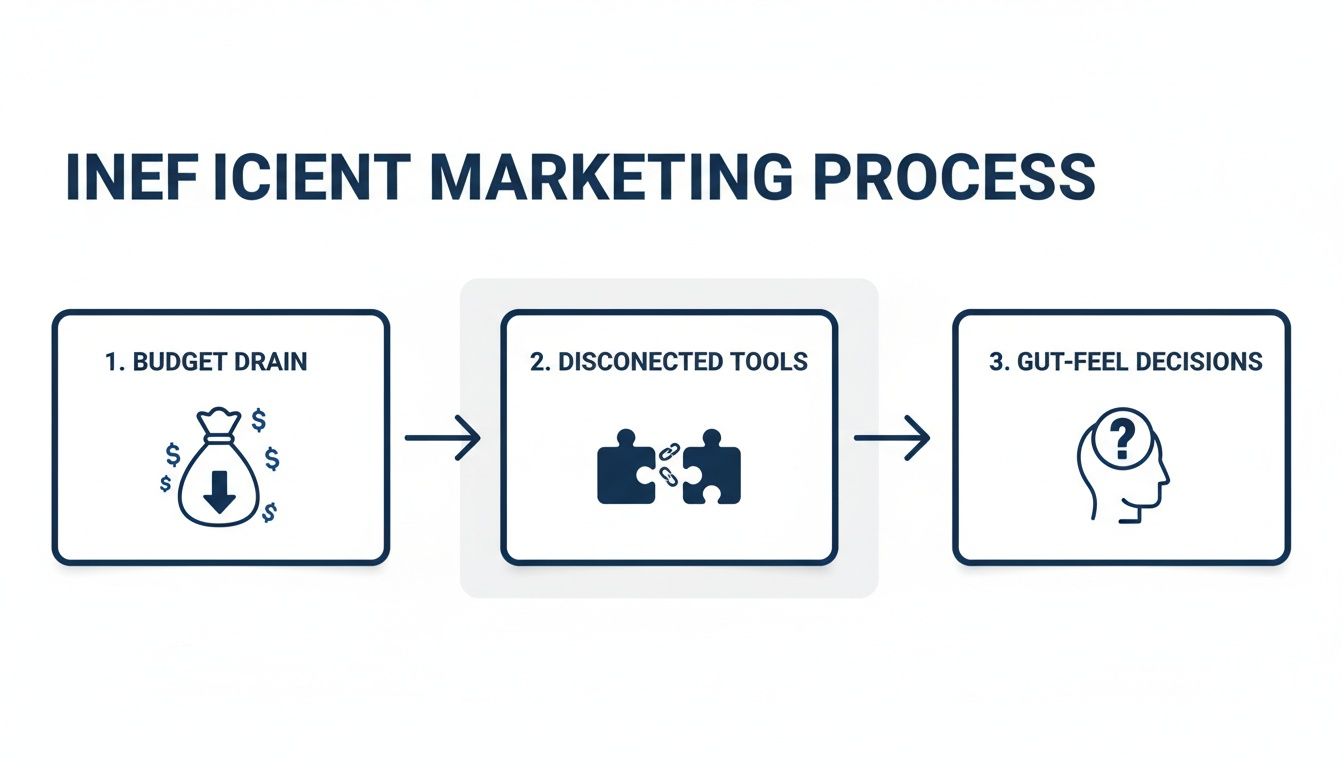
This cycle is how marketing becomes a cost center. Your job is to break it.
Map Your Core Workflows
First, identify your two or three most critical, revenue-impacting marketing workflows. Don't try to boil the ocean.
Common examples:
- Lead capture to sales handoff, the entire path from a form fill to a sales call.
- Content creation to distribution, from idea to promotion across all channels.
- New customer onboarding, the sequence of touchpoints for a new customer.
Now, document every single step. Who does what? Which tool? How long does it take? Be painfully specific. Not "Create social posts," but "I draft 5 tweets in Google Docs, find images in Dropbox, and schedule them in Buffer."
This level of detail is non-negotiable. It’s how you find the rot.
Uncover the Friction and Inefficiency
With workflows mapped, hunt for the hidden drags on performance. I’ve been doing this since 2016, and the problems always fall into a few key buckets. You're looking for where things slow down or require exhausting manual labor.
A task that takes a human 15 minutes a day is a silent killer. That’s over 60 hours a year on one tiny action. Automating just a few of these starts winning back time for real strategy.
Here’s your hit list:
Look for manual data entry. Are you copying info between your CRM and email platform? This is the most common time sink. One company I worked with was losing a combined 25 hours per week manually updating lead statuses.
Look for siloed data. Can you see the full customer journey in one place? If it takes more than five minutes to answer a basic performance question, your data is siloed.
Look for repetitive, low-value tasks: pulling reports, resizing images, posting to social media. These are prime candidates for automation. They don't require strategic thinking, yet they devour your attention.
Create a spreadsheet for your audit. List every workflow step. Add columns for "Time Spent (Weekly Hours)," "Tools Used," and an "Inefficiency Score" from 1 to 5. This gives you a quantified, prioritized list of problems to solve.
Establish Core KPIs and Build a Mission Control Dashboard
You can't improve what you don't measure. Now that you've audited your workflows, it’s time to define victory. Most marketing teams drown in vanity metrics (likes, opens, traffic). These numbers feel good but have no direct line to revenue.
This is a critical failure. It leads to optimizing for the wrong outcomes. You're going to change that by focusing only on the numbers that prove marketing is a growth engine.
Identify Your 3-5 Core KPIs
Less is more. A cluttered dashboard is an ignored dashboard. For most businesses, marketing health boils down to just 3-5 core Key Performance Indicators (KPIs).
Your KPIs depend on your business model, but they always revolve around the cost to get a customer versus what that customer is worth.
Here are the non-negotiables I start with:
- Customer acquisition cost (CAC) is the total sales and marketing cost to acquire one customer, and your core efficiency metric. $10,000 spend for 100 customers means a $100 CAC.
- Lifetime value (LTV) is the total revenue you expect from a single customer. It tells you how much you can afford to spend.
- The LTV:CAC ratio is the magic number, the direct measure of marketing profitability. A 3:1 ratio is healthy: for every $1 you spend, you get $3 back.
- Lead-to-customer conversion rate is the percentage of leads who become paying customers, a direct measure of your entire funnel's effectiveness.
Forget impressions and click-through rates. If you can only track one thing, track your LTV:CAC ratio. It's the ultimate arbiter of performance and the one number that tells you whether your marketing pays.
Design Your Mission Control Dashboard
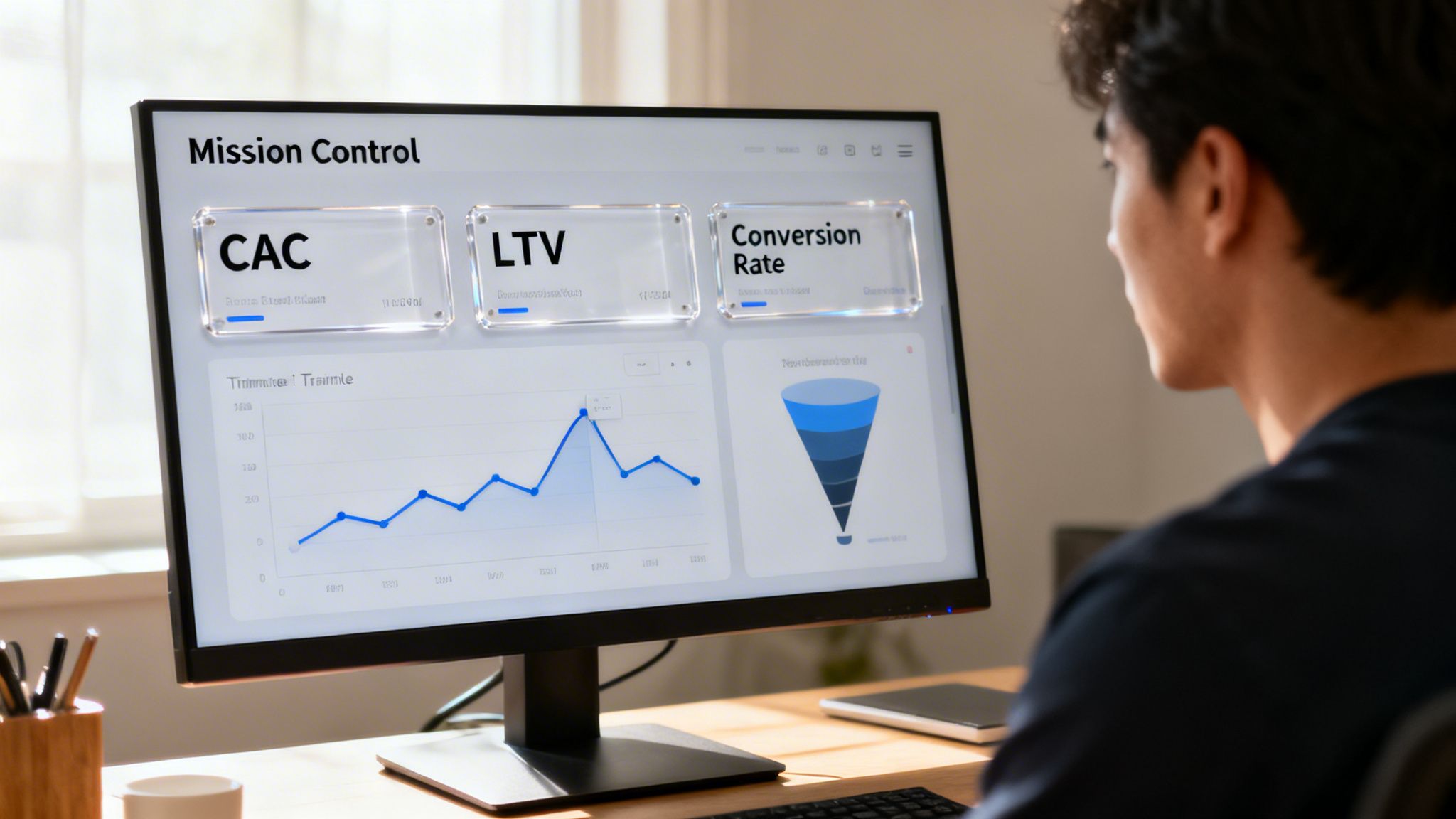
With your KPIs defined, build your "Mission Control." This is a real-time, unified view of your entire funnel, designed for a 60-second health check.
The goal is to eliminate logging into five different platforms. The work is connecting disparate data sources (your CRM, ad platforms, and website analytics) into one source of truth. You need a platform that pulls from Google Analytics, your ad accounts, and your CRM (like HubSpot or Salesforce). Tools like Looker Studio or Databox can do this.
What Makes a Dashboard Actionable
A great dashboard flags problems instead of only presenting data. I structure them to answer critical business questions.
- The top-level view shows your 3-5 core KPIs with trend lines. Is CAC going up or down? What's your LTV:CAC ratio this month vs. last?
- The funnel analysis is a visual representation of your funnel from first touch to sale. This immediately highlights leaks. A big drop-off between MQL and SAL? You've found a major inefficiency.
- Channel performance gives you a breakdown of CAC by channel. It tells you where to double down and where to cut. Organic Search has a $50 CAC and Paid Social has a $250 CAC? You know where your next dollar goes.
This dashboard becomes your operational center. For a deeper dive, check out my guide on how to measure marketing effectiveness.
Optimize for Conversions Before Spending Another Dollar on Traffic
Pouring traffic into a leaky funnel is the fastest way I know to torch a marketing budget. Like trying to fill a bucket riddled with holes.
If you're serious about improving marketing efficiency, you have to stop pouring and start plugging. Optimize your website for conversions before scaling ad spend. It's the highest-return activity you can do.
Getting this right can literally double your marketing efficiency without increasing your ad budget by a single dollar.
Find Where Your Funnel Is Leaking
Your first job is to become a digital detective. You need to find the exact pages where visitors are abandoning ship. Don't guess. Use data.
Install a heatmap and session recording tool immediately. I recommend Clarity (it's free) or Hotjar. These let you watch real user sessions. You’ll see exactly where people get stuck and where they give up.
Zero in on your most critical pages: your homepage, key product pages, pricing page, and lead capture forms. Look for patterns. Rage-clicking an element that isn't a button? Scrolling right past your main CTA? This qualitative data is gold.
Use AI to Generate an Arsenal of Test Ideas
Once you know where the leak is, you need to figure out how to fix it. This is where generative AI, which I've used since 2019, becomes a massive competitive advantage. Instead of struggling to brainstorm a few headlines, you can generate 50 variations in five minutes.
Let's say your heatmap shows people bouncing from your demo request page. The problem could be the headline, body copy, or the button itself.
Your competitors have a two-hour meeting to come up with three new headlines. You are using a large language model with engineered prompts to generate dozens of variants. Who do you think will find the winner faster?
I use AI to systematically attack every element of the page. I feed it the existing copy, audience details, and the desired action, then ask for variants based on proven copywriting frameworks like AIDA or PAS. This gives you a massive arsenal of testable ideas.
I cover this process in more detail in my guide to conversion optimization best practices.
Run Tests and Deploy Winners Systematically
With a library of variants, it's time to test. This part is non-negotiable. Never push a change live because it "feels" better. Use a tool like Optimizely to run A/B tests.
Test one major change at a time. If you change the headline, image, and button color all at once, you’ll have no clue what actually worked. Be methodical. Once a test reaches statistical significance (usually a 95% confidence level), you have a winner. Deploy it immediately.
This is how you systematically increase your conversion rate, turning existing traffic into revenue. A great place to start is by focusing on elements that historically have a high impact.
| Test Area | What to Test | Potential Impact on Efficiency |
|---|---|---|
| Headline | Clarity, benefit-orientation, emotional hook, use of numbers or questions. | High: The first thing visitors read. A strong headline can dramatically reduce bounce rates and increase engagement. |
| Call-to-Action (CTA) | Button text (e.g., "Get Started" vs. "Request a Demo"), color, size, placement. | High: Directly impacts the action you want users to take. Small changes can lead to significant lifts in clicks. |
| Above the Fold | Hero image/video, social proof (logos, testimonials), primary value proposition. | High: Forms the visitor's first impression. Must immediately answer "What is this?" and "Why should I care?" |
| Forms | Number of fields, field labels, error messaging, required vs. optional fields. | Medium-High: Reducing friction here is key. Removing just one unnecessary field can boost form completions. |
| Social Proof | Testimonials (with photos/videos), case study snippets, customer logos, review ratings. | Medium: Builds trust and credibility. Testing different formats and placements can reduce visitor anxiety. |
| Page Layout | Single vs. multi-column, order of sections, use of white space. | Medium: Affects readability and visual hierarchy. Guides the user's eye toward the most important elements. |
Focusing your initial A/B tests here helps you find impactful wins faster. You'll build a better intuition for what resonates with your audience, making each subsequent test more effective.
Automate Repetitive Work with Smart AI Agents
With your foundations in place, it’s time to build your bionic team. This is where you stop just looking at data and start acting on it, by deploying smart AI agents to take over the tedious work.
I mean intelligent, multi-step AI agents that execute complex tasks on their own, a step beyond basic Zapier zaps that shuttle data from A to B. Systems designed to observe, decide, and act.

Beyond Basic Automation
The automation most marketers know is passive. It waits for a trigger. An AI agent is active. It's given a goal and it works to achieve it. Understanding what marketing automation is in this AI-powered context is the first step.
Imagine an AI agent tasked with monitoring your competition. Its order: "Every morning, scan the ad libraries of our top three competitors. Analyze their messaging and offers. Distill the key shifts into a three-bullet summary and post it to our #competitive-intel Slack channel."
I've been building and deploying systems like this for years. That one agent can replace hours of manual busywork every week.
Building Your First Marketing Agents
An "agent" is simply a system combining a large language model (like GPT-4o) with a set of tools and a clear objective. The model does the "thinking," and the tools let it interact with the world, browsing websites or pulling data.
Here are two high-impact agents you can design today:
- The "Voice of the Customer" agent plugs into support tools (like Zendesk), review sites (like G2), and social media. It ingests customer chatter, sorts feedback by theme (e.g., "Feature Request," "UI Complaint"), and outputs a weekly report on top themes with direct quotes.
- The "Content Angle" agent monitors top industry blogs. When it finds a new article on your core topics, it analyzes the content, checks it against your own blog, and suggests three unique angles for a better piece of content, posting them right into your content calendar.
This is how you get 10x output without a 10x headcount. You free up your own time for high-level strategy and creative thinking, the things AI still can't do.
Prompts, Logic, and Limitations
Building these agents requires incredibly clear instructions, which I call context engineering. It's about giving the AI a role, goal, process, and examples of what "good" looks like. It’s a huge part of my work, and you can see more about building AI agents for marketing on my blog.
What are the limits? Don't hand over tasks that require deep brand nuance or complex judgment calls. An agent can't figure out your quarterly marketing strategy. But it can give you the summarized data you need to make that decision in half the time.
While your competitors have their smartest people stuck compiling reports, you'll have digital specialists working 24/7. That gap compounds every week.
Consolidate Ad Spend to Feed the Algorithm
The old way of running paid media is over. If you’re still crafting dozens of hyper-segmented ad sets, you’re actively working against the algorithms on platforms like Google and Meta.
You’re starving the machine of the one thing it needs to succeed: data.
I’ve seen this exact mistake cripple countless marketing budgets. Teams spread their ad spend so thin that no single ad set ever gets enough data to escape the "learning phase." The result is always volatile performance and sky-high CPAs.
The truth is, the algorithms are now far better at finding your ideal customer than you are. Your job is no longer to micromanage audience targeting. Your job is to feed the machine.
The Surprising Power of Consolidation
To get better results, you have to do something that feels counterintuitive: consolidate. Collapse all those granular ad sets into a few broader, unified audience buckets. Instead of 20 different ad sets with tiny budgets, think 3-4 broad campaigns with significant spend.
Why does this work? It’s about data velocity. Platforms like Google and Meta now explicitly recommend aiming for at least 50+ conversions per week at the campaign level. This gives their machine learning models enough data to stabilize and optimize. You can read more about the moves accelerating marketing performance in 2026.
When you fragment your budget, you deny the algorithm the data volume it needs. Consolidating your campaigns is like focusing sunlight with a magnifying glass: it concentrates your data into a powerful beam that lets the AI find customers faster and cheaper.
This approach changes your role. You stop being a button-pusher and start acting like a high-level strategist.
How to Audit and Restructure Your Ad Accounts
Here’s how to put this into action. Open your ad accounts and look for campaigns that consistently fail to generate 50 conversions per week. These are your candidates for consolidation.
- Find the underperformers. Hunt down ad sets targeting slight variations of the same audience. For example, "people interested in SaaS" and "people interested in B2B software." These can and should be combined.
- Collapse them into broad buckets. Group these similar, low-conversion ad sets into a single, broader ad set. Trust the algorithm to find the right people. Your new buckets might look like "Tech Interests" or "Business Decision-Makers."
- Shift your focus to creative and offer. With the algorithm handling targeting, your energy must shift to what truly moves the needle: your creative and your offer. Instead of testing 20 audiences with one ad, you should be testing 20 different ads against one broad audience.
This is how you win on paid media today, by letting the machine handle the micro-optimizations while you focus on the macro-strategy that actually grows the business.
Your Top Questions, Answered
Whenever I talk to founders and small business owners about bringing AI into their marketing, the same questions always come up. Most are past the "what if" stage. Now, it’s all about the nuts and bolts.
You're probably wrestling with these same practical questions. Here are the straight answers I always give.
How much does it cost to start using AI in my marketing?
A lot less than you think. There's a myth, pushed by big enterprise software companies, that you need a six-figure budget to get started. It's just not true.
Many of the most effective tools have free tiers or low-cost plans. The real investment is the strategic time you put in upfront to find the right problems to solve, more than cash. The ROI from automating just one tedious task often pays for a year's subscription several times over.
Does my team need to be full of data scientists to do this?
Absolutely not. In fact, hiring a data science team before you have a clear problem to solve is a classic mistake.
The new wave of AI and automation tools is built for marketers, not coders. They're designed to be intuitive.
The most valuable skill here is process thinking. If you can map out a workflow and pinpoint the friction, you have what it takes. Your hard-won marketing knowledge is far more valuable than a PhD in machine learning.
What is the single biggest mistake companies make when adopting AI for marketing?
Easy. Chasing shiny tools instead of solving real business problems. It happens almost every time.
A founder reads about some hot new AI tool, gets excited, and signs up immediately. But they skip the most important part: the ruthless audit of their own processes I covered earlier.
They end up automating a process that was already broken. All the AI does is help them do the wrong thing faster. Start with the problem, always, and pick the technology second. A tool is just a means to an end. Never the end itself.