
Most startup growth advice is lazy. It hands you a pile of tactics, tells you to post more content, test more channels, and spend more on ads, then acts surprised when your pipeline dries up the moment costs rise or a platform changes the rules.
I'm Samuel Woods. I've worked with ML since 2016 and generative AI since 2019, and I can tell you the uncomfortable truth. Most founders don't have a growth strategy. They have a collection of disconnected activities and a hope that one of them hits.
Call it what it is: drift.
If you want durable growth, you need an engine. Something that senses market signals faster than competitors, turns those signals into decisions, and executes without waiting on a human to push every button. AI is useful here, but only if you stop treating it like a copy machine and start using it as operating infrastructure.
Growth Is a System You Build
Growth hacking trained founders to chase surface area. More landing pages. More ad sets. More cold emails. More channels.
That approach breaks fast.
When your growth depends on rented distribution, you don't own the outcome. A channel gets crowded, CAC rises, and your team starts calling a structural problem a “testing issue.” I've seen this pattern for years. The startup looks busy, the dashboard looks active, and revenue still stalls because nobody built a real system.
Tactics don't compound without a control layer
A real growth engine does three things well:
- It captures signal from customers, competitors, and campaigns.
- It decides what to do next based on evidence, not gut feel.
- It executes repeatedly with speed and consistency.
That's the shift. You stop asking, “What campaign should we run next?” and start asking, “What machine are we building that gets smarter every week?”
Growth gets fragile when every win depends on manual effort.
This is also why so many startup growth strategies fail before they even get a chance to work. Founders jump into acquisition too early, before the offer is tight, the onboarding is clear, or the product creates enough value to keep people around. Then they blame the channel.
The channel usually isn't the problem.
What I tell founders to do first
I tell founders to audit the system, not the slogan. Look at your journey from first touch to first value to repeat usage to purchase. Find the points where a human currently has to step in, guess, or manually stitch together information.
Those are your strategic advantages.
A lot of teams also need a planning discipline they can run. If you need a clean starting point, use a structured marketing campaign planning template and force every initiative to answer four questions: who it targets, what signal it uses, what action it triggers, and how revenue shows up.
The hard truth about modern startup growth strategies
The market doesn't reward activity. Buyers reward relevance, timing, and trust. AI helps when it improves those three.
Used badly, AI gives you more noise at lower cost.
Used well, it gives you a company that notices shifts earlier, responds faster, and compounds learning while competitors are still arguing about prompts. That's the standard you should build for: more intelligent output tied to revenue.
The AI-Centric Growth Framework
Founders love funnels because funnels look clean in a dashboard. Growth does not happen in a dashboard. It happens in a fast loop that helps you detect change, decide what matters, and ship the right response before a slower competitor catches up.
That is the framework I want you to build. Sense, Reason, Act. Your funnel stages still exist, but they sit inside this operating loop.

Sense
Start with signal.
Your company should collect live inputs from competitor pricing changes, ad messaging patterns, review themes, sales objections, support tickets, demo transcripts, keyword movement, and product usage events. Feed it into one working layer your team can use every day.
Do not turn this into a bloated data initiative. Build a signal system that helps you notice what changed, who it affects, and where revenue is at risk or available.
I have seen weaker products beat stronger ones for one reason. They learned faster.
If you want a practical input layer for turning market signals into usable prompts, use these AI prompts for marketing as a starting point, then customize them around your own customer data and competitive inputs.
Reason
Signal without interpretation is noise.
Reasoning models earn their keep here. Use them to cluster objections, find message mismatch, spot onboarding friction, suggest segment-specific positioning, and rank tests by likely business impact. Their job is to reduce the delay between new information and a smart decision. The strategy stays with you.
Keep one rule in place. If your team needs a week to turn feedback into an experiment, your growth system is slow.
I see the same mistake over and over. Founders automate output first. They generate more emails, more content, more campaigns, and more reporting before they have a clear judgment layer. That gives you volume without precision.
There is also a hard constraint here. Product market fit still comes first. 42% of startup failures are caused by “no market need,” and only 2 in 5 startups are profitable, according to this startup statistics guide. If the product does not solve a painful problem, AI helps you scale bad assumptions faster.
The same logic applies to pipeline generation. If your acquisition model depends on generic outreach and weak qualification, what you have is a spam engine. Solving the small business lead generation problem starts with better signals and tighter decision logic, not more top-of-funnel noise.
Act
Execution is the final layer, where you turn insight into revenue-producing systems.
Use AI to run personalized onboarding, content production, outbound support, nurture sequences, referral triggers, pricing page variants, win-back flows, and sales enablement assets. Automate the low-risk work. Keep human control over decisions with financial, legal, or brand risk.
Use this split:
| Layer | What AI should do | What you should keep human |
|---|---|---|
| Low-risk execution | Draft, tag, route, summarize, personalize | Final QA for brand-sensitive output |
| Mid-risk optimization | Recommend tests, spot drop-offs, prioritize segments | Approve experiments and trade-offs |
| High-risk decisions | Provide options and scenario analysis | Pricing changes, market repositioning, strategic pivots |
The companies that win with AI run tighter loops, make better calls, and ship faster with less waste.
That is the advantage. A growth engine that learns, decides, and responds with a level of speed and precision your competitors cannot match.
AI-Powered Acquisition Playbooks
Acquisition used to mean “buy traffic and hope the landing page works.” That playbook is weak. It gets weaker every year.
Smart startup growth strategies build acquisition as a mix of market intelligence, content systems, conversion infrastructure, and built-in distribution. Paid media can help, but it should not be your spine.
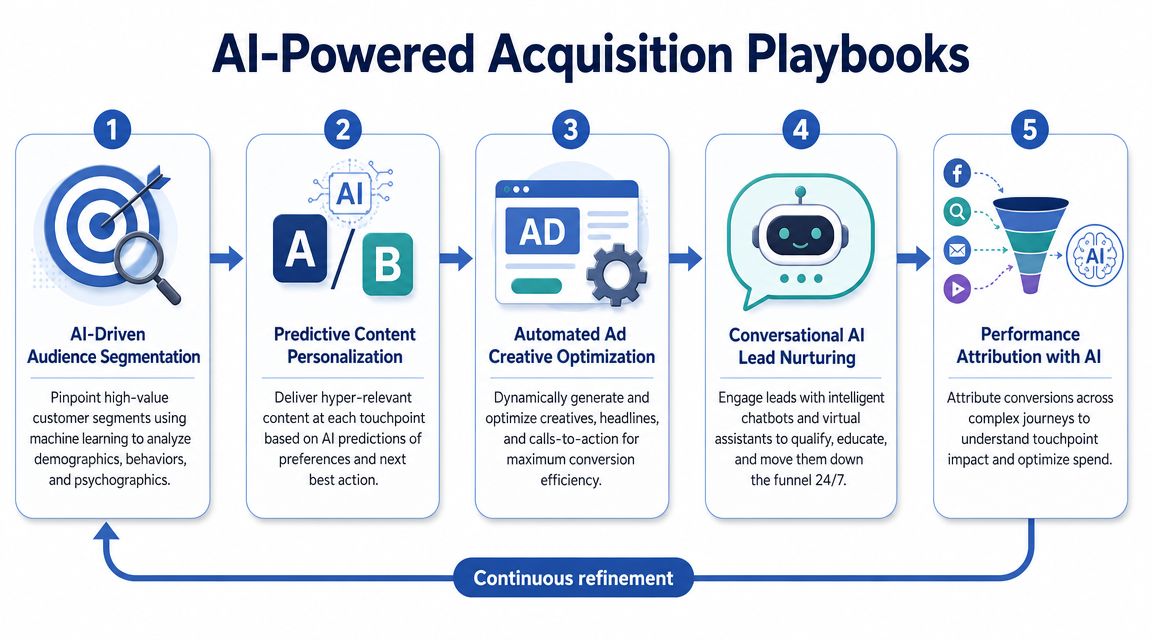
Build a competitor intelligence agent first
I'd start with a simple but ruthless system.
Have an agent monitor competitor blogs, landing pages, YouTube titles, ad libraries, changelogs, and customer reviews. Feed that into a structured prompt that answers:
- Message gaps where competitors are weak or vague
- Offer patterns showing what they push hardest
- Topic white space your buyers care about but nobody explains well
- Objection clusters repeated in review sites or sales transcripts
That output should create content briefs, landing page angles, and outbound hooks automatically. You then edit and ship.
This is far better than asking ChatGPT for “content ideas” in a vacuum. If you want a starting point for that workflow, my collection of AI prompts for marketing is useful as a practical input layer, but only if you feed it real market signal.
Use AI to produce variations, not strategy
Here's where founders get sloppy. They ask AI to replace positioning. Don't.
Use AI after positioning is clear. Let it generate headline variants, ad angles, intro hooks, CTA options, email subject lines, and vertical-specific rewrites. Then tie every variation back to a known customer segment or problem state.
That turns content from “more stuff” into a controlled acquisition machine.
A simple execution pattern looks like this:
- Pick one segment with painful, obvious demand.
- Define one promise tied to one outcome.
- Generate many variants around that message.
- Route traffic to aligned pages instead of one generic homepage.
- Feed performance data back into your prompt and briefing system.
The firms that win will be the ones learning fastest from every asset they ship.
Here's a useful walkthrough on the acquisition side:
Design owned growth loops
This is the part most articles miss. Durable scale often comes from built-in distribution like referral mechanics, community features, newsletters, and social sharing paths, alongside paid ads, as noted in Brex's overview of startup growth strategies.
If your acquisition falls apart when ad spend drops, what you have is a bill.
The better question is how your users help distribute the product without being asked every single time.
For service businesses and lean teams, I also like practical resources that focus on pipeline basics before complexity. This breakdown on Solving the small business lead generation problem is useful because it forces attention onto actual lead flow and qualification instead of vanity-channel obsession.
My opinionated acquisition stack
Don't overbuild this. Start with:
- A scraping or monitoring layer for competitor and market signals
- An LLM layer for summarization, clustering, and brief creation
- A CMS and landing page system that lets you publish fast
- An analytics layer tied to conversion events
- A CRM or lead routing workflow so leads don't rot
That combination beats most “growth hacking” stacks because it turns acquisition into a repeatable intelligence loop. Competitors can copy a campaign. They can't easily copy a system that learns faster than they do.
Automating Activation and Retention
Acquisition gets applause. Activation and retention decide whether you have a business or a leak.
I see the same failure pattern over and over. Founders pour effort into getting signups, then act surprised when users stall in setup, miss the core workflow, and never come back. The cause is weak onboarding logic, weak product guidance, and weak response to user signals.
Define first value with brutal clarity
You need a small set of actions that prove a user is getting closer to value. Not 40 events. Not a bloated dashboard your team stops checking after two weeks.
For your product, that might be importing data, connecting an integration, inviting a teammate, generating a first report, or launching the first workflow. Pick the few actions that predict repeat usage and revenue.
Then build automation around those moments.
| User behavior | What it probably means | Automated response |
|---|---|---|
| Visited setup but stopped | Friction or confusion | Trigger a short walkthrough, relevant help content, or a support prompt |
| Viewed pricing early | Commercial intent or uncertainty | Send proof of ROI and explain plan differences clearly |
| Invited teammate | Strong adoption signal | Reinforce team use cases and suggest the next collaborative action |
| Used one feature repeatedly | Narrow value discovery | Recommend the next feature tied to the same job to be done |
That table is your real lifecycle engine. Generic nurture sequences are lazy. Behavior-based intervention is what gets users to value faster.
Personalization should change the path, not the headline
A first-name token is not personalization. A swapped hero image is not personalization. Those tricks make marketers feel busy and users feel nothing.
Useful personalization changes what happens next. If a user keeps returning to one workflow, onboarding should deepen that workflow. If they hit a technical blocker, the next message should reduce effort with a checklist, a template, or a fast path to support. If they show buying intent early, stop sending beginner education and start answering commercial objections.
I write these systems with one test in mind. Would a sharp customer success manager make the same move if they were watching the account manually? If the answer is no, the automation is bad.
A strong activation and retention system usually includes:
- Event-triggered onboarding that adapts to in-app behavior
- Support ticket summarization so recurring blockers turn into product fixes and message fixes
- User scoring based on progress, intent, and risk signals
- Re-engagement flows triggered by specific drop-off patterns, not arbitrary delays
Use predictive retention only after your signals are clean
A lot of startup teams rush into churn scoring too early. They throw a model at weak product data and call it intelligence. It is noise with a dashboard attached.
Use predictive retention after you have enough user volume, consistent event tracking, and clear definitions for success and failure. Before that, stay simple. Track where users stall, which actions precede repeat usage, and which support issues show up before drop-off. Once your data quality improves, AI can spot patterns across cohorts, surface likely churn risks, and prioritize intervention far faster than a human working through spreadsheets.
That timing matters because bad prediction systems create fake confidence. Good ones help your team intervene before an account goes cold.
Do not automate reminders for everyone. Automate the next best action for users showing the signals that actually matter.
Keep humans in high-stakes moments
Founders over-automate recovery. That mistake costs revenue.
If a customer is angry, stuck in a billing dispute, or signaling churn on a high-value account, route the case to a person. Use AI for detection, summarization, prioritization, and recommended responses. Let a human handle the relationship when nuance matters.
The rule is simple. Automate repetition. Keep judgment close to the customer.
That is how activation and retention become a growth system instead of a pile of disconnected emails.
Intelligent Monetization Strategies
Most pricing is lazy. Founders pick a model, copy a competitor page, tweak a few plan names, then leave it untouched while users signal what they value.
That's money left on the table.
Monetization starts with usage patterns
I don't look at pricing first. I look at behavior first.
Which features show up in accounts that expand smoothly? Which workflows correlate with longer retention? Which user types consume support while resisting upgrades? Which accounts hit obvious ceilings and still don't convert because the packaging is wrong?
AI helps by clustering these patterns faster than a human analyst working in spreadsheets. It can group customers by usage shape, identify the moments where willingness to pay becomes visible, and surface mismatches between product value and pricing structure.
That gives you options.
Better pricing questions
You don't need a giant pricing science project. You need sharper questions.
Try these:
- What feature set signals serious intent versus casual experimentation?
- Where does complexity rise enough that service, support, or controls should be packaged separately?
- Which users need proof before purchase and which need speed?
- What should stay free because it drives adoption or referral behavior?
A static pricing page usually hides these distinctions. An intelligent monetization system exposes them.
Where AI can help and where it shouldn't
Use AI to support analysis, packaging hypotheses, sales-assist prompts, expansion triggers, and pricing page personalization. You can also use it to summarize win-loss calls and identify repeated pricing objections by segment.
Don't let AI unilaterally change pricing in a young startup. That's reckless.
For many teams, the highest-return monetization work looks like this:
| Opportunity | What AI can do | Human call required |
|---|---|---|
| Packaging redesign | Cluster usage and feature value patterns | Final tier structure |
| Expansion prompts | Detect upgrade-ready behavior | Approve messaging and offer |
| Sales pricing support | Summarize objections and likely fit | Discount decisions and deal strategy |
| LTV prediction | Score likely account value early | Budget allocation and strategic trade-offs |
What matters is that monetization becomes adaptive instead of random, fully automated or ignored.
Revenue quality beats top-line noise
I care less about “more customers” than better customers.
A solid monetization system helps you identify accounts that activate well, stay longer, adopt deeper, and expand with less friction. That changes who you target, what you build, and how aggressively you can invest in growth.
That's where startup growth strategies get serious. Revenue is feedback. If you read it correctly, pricing and packaging become one of your strongest strategic weapons.
Building Your AI Growth Stack
Founders waste months buying AI tools before they decide how growth should run. That order is backward. Your stack should follow your operating model, not the other way around.
What you need is a system that moves information from capture, to judgment, to execution without breaking in the middle.
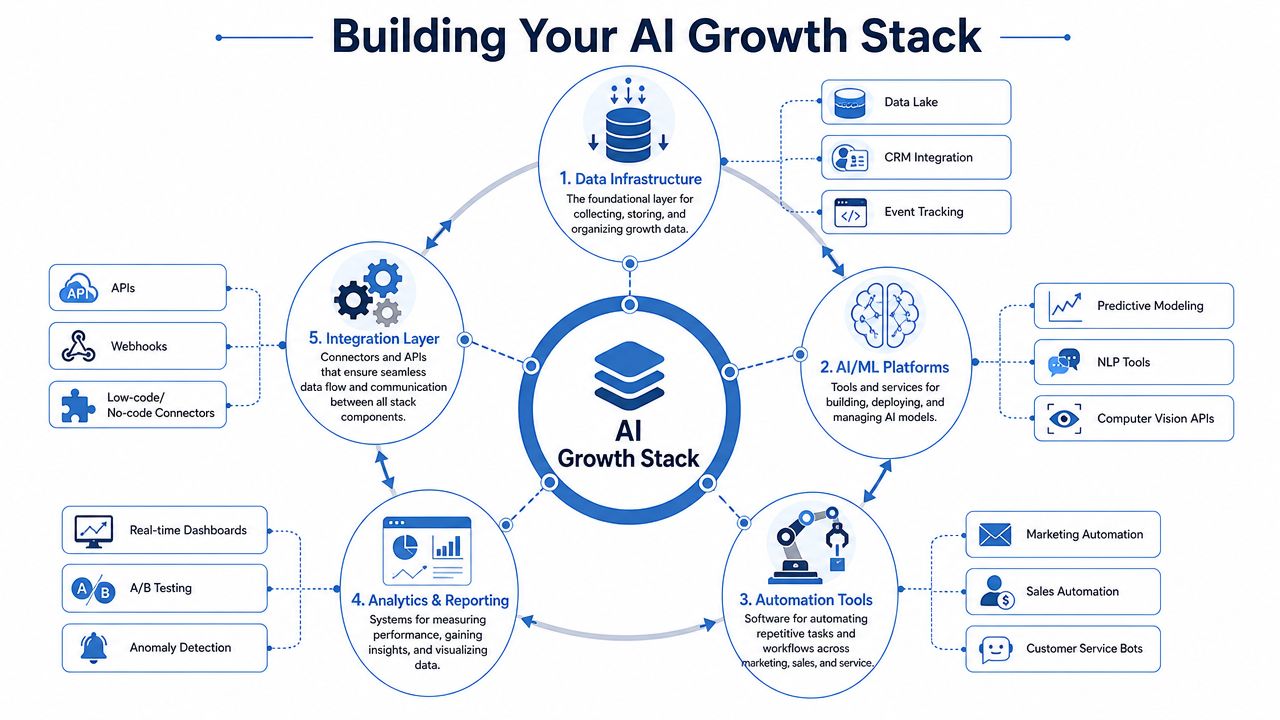
The three layers that matter
I build AI growth systems around three layers because it forces discipline.
The first is the data layer. Product events, CRM records, campaign inputs, support logs, call transcripts, and revenue data live here. If naming is inconsistent, fields are missing, or key events never get tracked, your models will still produce answers. They'll just be wrong.
The second is the reasoning layer, where models classify intent, score accounts, summarize calls, detect patterns, and recommend next actions. Teams spend too much time debating model brands and too little time defining what the model should decide, what inputs it gets, and where a human needs to approve the output.
The third is the action layer. CRM updates, outbound sequences, support routing, ad audience syncs, content updates, and internal alerts happen here. This layer is where AI stops being a demo and starts producing revenue.
Buy for control, not novelty
I buy tools that connect cleanly, expose their data, and let my team inspect what happened. I skip all-in-one AI platforms that hide logic in a polished interface and make it painful to export workflows later.
A lean stack usually includes:
- A CRM and customer record system your team will keep clean
- Event tracking and product analytics once enough usage exists to justify the overhead
- Automation tooling for routing, enrichment, task execution, and alerts
- Model access through APIs when you need logging, control, and modular workflows
- Reporting tied to decisions and actions instead of passive dashboards
If you need help sorting categories and tradeoffs, this breakdown of AI workflow automation tools is useful because it organizes tooling by job to be done, not by vendor hype.
Build the stack around decisions
A lot of startup teams still buy software by department. Marketing picks one tool. Sales picks another. Success builds workarounds. Ops gets stuck cleaning up the mess.
Build around decisions instead. Ask four questions.
- What signal matters?
- Who or what interprets it?
- What action should happen next?
- Where does human review belong?
That approach gives you a stack with a clear purpose. It also makes automation safer, because every workflow has an owner, an input, a decision rule, and an observable output.
If you sell online, the same principle applies to commerce metrics and merchandising workflows. This guide to ecommerce KPIs for Shopify is useful for pressure-testing whether your reporting is tied to commercial action or just tracking noise.
You probably do not need a big data team yet
Early stage teams often overspend on analytics infrastructure and underspend on instrumentation quality. I've seen startups buy advanced BI tooling before they could even define an activated user consistently. That is amateur behavior.
You do not need a full data org on day one. You do need one person accountable for event definitions, field hygiene, reporting logic, and pipeline reliability once growth decisions start depending on AI outputs.
As noted earlier, richer segmentation and cohort work make more sense after your company has enough clean usage volume to support reliable patterns. Before that point, focus on disciplined tracking and clean joins across product, sales, and customer data.
My stack selection rule
Use five filters before any tool makes it into production.
| Requirement | Why it matters |
|---|---|
| Clear data ownership | Prevents conflicting reports and broken automations |
| Good API access | Lets you swap models and extend workflows |
| Human review points | Keeps risky actions under control |
| Fast deployment | A stack that takes too long to launch slows learning |
| Observable outputs | Logs, traces, and QA visibility let you fix failures fast |
The winning stack is the one your team can trust, improve, and use every week to turn signal into revenue.
The KPIs That Actually Matter
Founders waste months staring at dashboards that reward motion instead of progress. More traffic, more impressions, more followers. None of that matters if activation stalls, retention slips, and your AI stack is producing reports instead of revenue.
Measure the health of the machine.
If you are building an AI-powered growth engine, your KPIs should answer one question fast. Is the system getting better at finding high-intent users, moving them to value, and converting that behavior into cash with less manual effort?
I track a tighter set of signals:
- Activation quality tied to the behaviors that predict first value
- Retention signal by segment, use case, and onboarding path
- Conversion readiness at each major handoff between product, sales, and customer success
- Time to insight, meaning how fast your team turns new signal into a decision or workflow change
- Automation rate, meaning how much repetitive growth work AI agents handle reliably without human intervention
- Personalization effectiveness, meaning whether customized journeys produce better business outcomes than generic campaigns
Those labels can change. The logic should not.
If a metric does not trigger an action, remove it from the dashboard.
Your data strategy should change by stage
Teams get this wrong all the time. They copy reporting habits from bigger companies and bury themselves in metrics that do nothing.
Your KPI stack should match your stage. Pre-product-market-fit teams need proof that the offer works. Early growth teams need evidence that users stick and revenue moves. Growth-stage teams need forecasting, workflow automation, and decision systems. That stage-based shift is laid out in this framework for startup data strategy development.
| Stage | What to watch | What to ignore for now |
|---|---|---|
| Pre-PMF | Validation, onboarding friction, early conversion | Predictive scoring and bloated attribution |
| Early growth | Activation, retention by cohort, sales velocity | Tool-heavy reporting debates |
| Growth stage | Forecasting, automation coverage, operational analytics | Vanity engagement metrics |
Build one operating dashboard
I prefer one weekly operating dashboard with four panels. Acquisition quality. Activation and retention. Revenue movement. AI system performance.
That last panel matters more than many teams admit. If your agent workflows are misclassifying leads, sending weak follow-ups, or routing users into the wrong journey, your growth numbers will decay before anyone notices why.
If you run ecommerce or a hybrid product-led sales motion, generic SaaS metrics will not save you. You need metric design tied to your buying cycle, catalog structure, and margin model. This guide to ecommerce KPIs for Shopify shows how to turn broad KPI advice into an operating model that a commerce team can use every week.
Clarity wins. Your dashboard should show where the system leaks, where AI improves throughput, and where a human needs to step in. Chart volume is for show. You are here to build a machine that compounds.
Your First 90-Day AI Growth Roadmap
Most founders don't need more ideas. They need sequencing.
A good growth system appears when you install the loop in a controlled order and tie it to measurable business outcomes. Buying a few subscriptions and telling the team to “use AI more” won't produce one. Effective startup growth often uses a 90-day plan with clear KPIs, metrics, and milestones, which helps founders focus on leading indicators like activation and retention, as described in this 90-day startup growth guide.
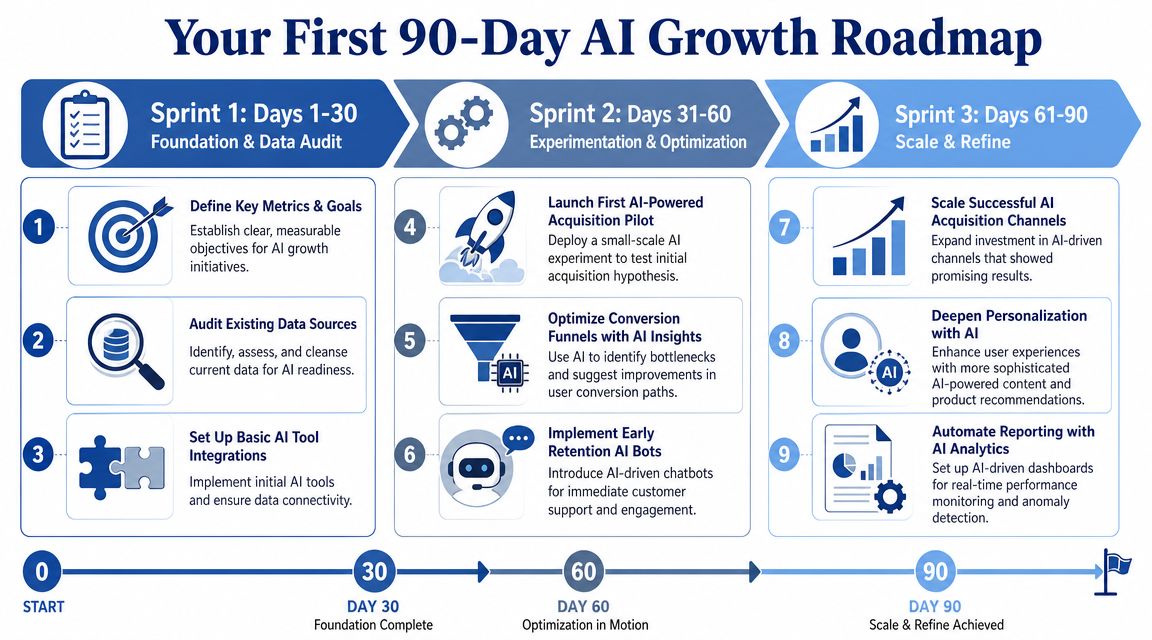
Days 1 to 30
Don't start by generating content. Start by cleaning signal.
Audit your data sources, your funnel definitions, your CRM fields, your product events, and your current campaign reporting. Decide which customer actions matter most. Then build a basic market intelligence layer that captures competitor messaging, common objections, and top-performing offers in your category.
Your output in this sprint should be operational clarity.
- Choose one core growth objective tied to revenue, activation, or retention
- Define the few KPIs that matter for the next quarter
- Set up one source of truth for customer and campaign signal
- Install one recurring review rhythm so decisions happen weekly, not randomly
Days 31 to 60
Now you ship one working loop.
For most startups, that's either an AI-assisted acquisition system or a behavior-based activation flow. Don't do both unless your team is strong enough to handle it. One loop, fully implemented, beats three half-built experiments.
I'd usually choose based on constraint:
| If your problem is… | Build this first |
|---|---|
| Weak pipeline | Competitor intelligence plus content and landing page system |
| High signup drop-off | Behavioral onboarding and support-triggered interventions |
| Sales inefficiency | Lead enrichment, summarization, and follow-up assistance |
If you want another strategic lens on early execution, AI CMO's startup marketing guide is worth reading because it stays closer to practical operating choices than generic startup inspiration.
Days 61 to 90
Teams either start compounding or start getting distracted.
By now you should know which signals predict quality, which prompts or models are producing usable output, and where human review is still required. Tighten the workflows. Expand the winning loop to a second segment or adjacent channel. Add reporting that surfaces exceptions as well as averages.
Build one loop that learns. Then scale it. Don't build a maze of automations you can't govern.
A simple end-of-quarter checklist:
- Review output quality across every automated action.
- Cut low-signal workflows that create work without insight.
- Document human approval points for risky decisions.
- Promote the best loop into a standard operating process.
- Pick the next bottleneck and repeat.
That's the roadmap. Not glamorous. Very effective.
If you want startup growth strategies that survive budget pressure, channel volatility, and competitor noise, build the AI operating system first. Then let campaigns sit on top of it. That's how busywork turns into revenue.