
Everyone wants to buy autonomy like it's a software license. That's the wrong move, and it's why so many pilots stall after the demo looks impressive.
If you run a business on your own or with a team under ten, the key question is whether your business is ready to let software sense, reason, and act inside live workflows without turning you and your team into cleanup crews. Which agent platform to pick comes later. The businesses getting this right redesign how the work runs before they add a new tool.
Table of Contents
- Why Most Companies Get Autonomous Business Systems Wrong
- What Autonomous Business Systems Do
- The Architecture Behind Systems That Act on Their Own
- Where Autonomy Pays Off First in Marketing, Sales, and Ops
- A Practical Roadmap From Pilot to Governed Autonomy
- Measuring Autonomy the Way the Business Cares About
- Common Pitfalls and How to Avoid Them
- Your First 30 Days With Autonomous Business Systems
Why Most Companies Get Autonomous Business Systems Wrong
The popular advice is seductive. Deploy an agent, connect it to your stack, cut headcount, and let it run. That story sells well because it sounds simple, but it ignores the hardest part of autonomy, the process around the agent.
The tooling trap
I've seen this mistake in real businesses. Owners start with a model or vendor, then go looking to “find a use case.” The result is usually a brittle pilot that works only when the inputs are clean, the exception rate is low, and someone is watching every step.
What you get is a fragile wrapper around manual work.
The better framing comes from enterprise guidance that treats autonomy as an operating-model and architecture problem. You need a real-time, interoperable data foundation, workflow redesign, and decision guardrails before the system can do useful work at scale. InformationWeek's discussion of the autonomous enterprise makes the point plainly, the safe entry point is a noncritical internal pilot, then redesign the surrounding process so the agent has something coherent to operate on rather than a list of tasks to imitate InformationWeek guidance on the autonomous enterprise.
Why the hype breaks down in practice
The reason this matters is simple. Autonomous business systems are strongest when the process already has repeated structure, clear outcomes, and a tolerable risk envelope. If the workflow is full of hidden exceptions, scattered data, and human judgment calls nobody has documented, the agent won't save you. It will surface every weakness you've been avoiding.
My practical rule: if you can't describe the finish line of a recurring job, don't automate it with autonomy yet.
That's the filter I use with business owners. Skip “Can a model do the task?” and ask “Can the business define the task well enough that the model can finish it safely?” Until you answer that, vendor selection is a distraction.
The strongest operators shift the conversation away from platform shopping and toward redesign. They map where work starts, where it stalls, who approves what, and what happens when the process drifts. That's the work most coverage skips, and it's the work that decides whether autonomy becomes a competitive advantage or another abandoned experiment.
What Autonomous Business Systems Do
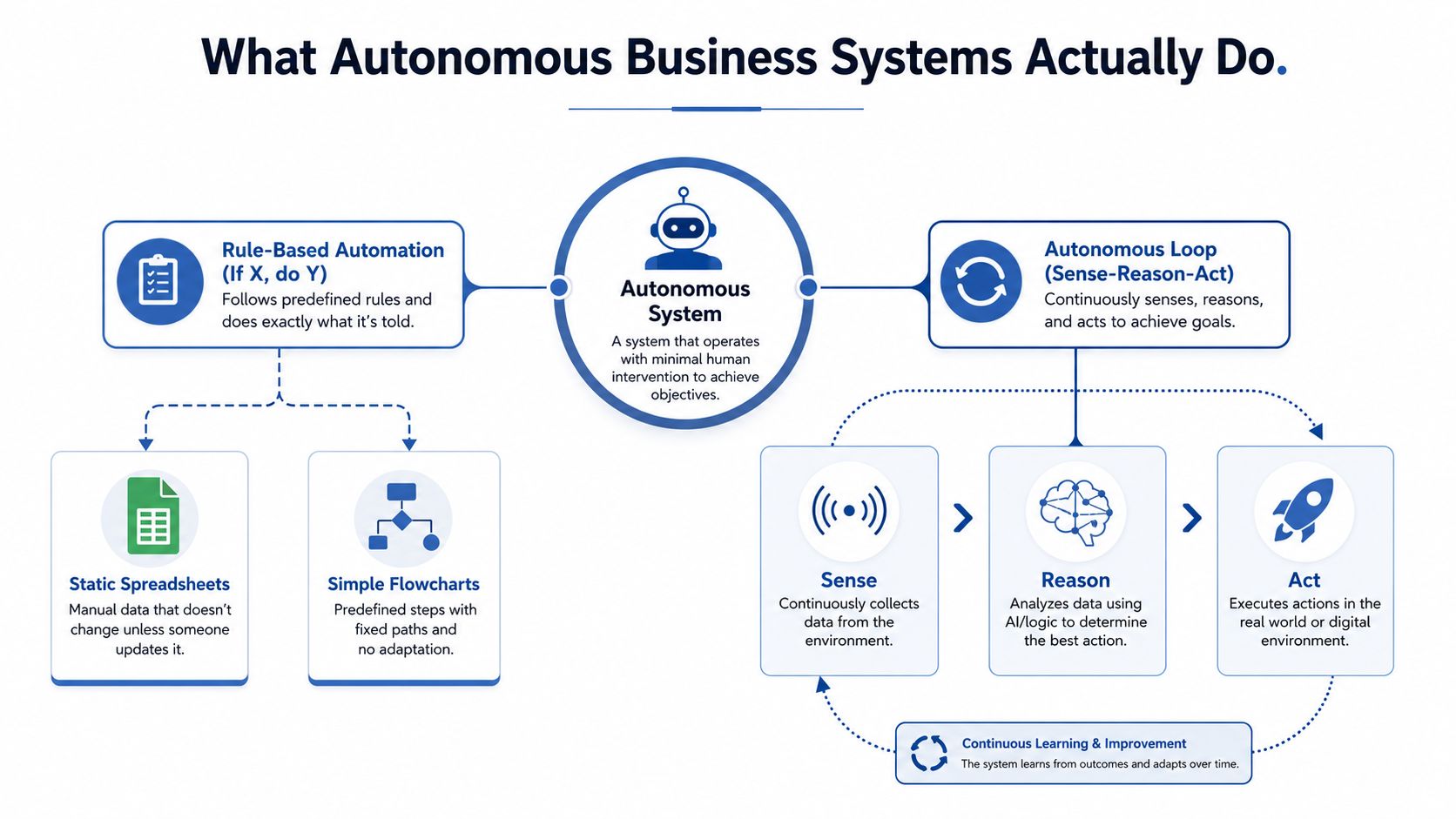
A lot of teams still blur automation and autonomy. Automation follows rules. Autonomy runs a control loop.
Rule-based automation versus autonomous loops
Rule-based automation says, “If X happens, do Y.” That works only when the environment stays inside the script. Autonomous business systems go further. They sense signals, reason over context, act through connected tools, and then use the outcome to shape the next decision.
Teradata describes autonomous AI as systems that can operate with a level of independence while staying within defined guardrails, and Nevermined frames autonomous business systems around goal-directed execution with policy boundaries, not fixed scripts Teradata on autonomous AI, Nevermined on autonomous business systems. That is the distinction that matters in practice.
A marketing-ops system shows it plainly. The system watches conversion data, pauses weak variants, reallocates spend, and drafts replacement creative. A human still owns strategy and approval limits, but the system keeps adjusting the work in motion. That is autonomy in a business setting, because the machine closes part of the loop without waiting for a person to click through every step.
What to look for in a real system
A vendor demo or internal pilot should answer four questions fast.
- To sense, does the system ingest live signals from connected systems, or is it running on stale exports?
- To reason, does it weigh context, policy, and expected outcome, or does it only fire on a trigger?
- To act, can it execute a step through APIs, workflow tools, or controls?
- To learn, does it record what happened and feed that result into the next decision?
SAP's framing is useful because it describes an autonomous enterprise as a system that senses what is happening, reasons over business context and rules, and acts across end-to-end processes without manual coordination at every step SAP on the autonomous enterprise. That is a better model than calling everything an AI assistant.
If you're evaluating implementation patterns, my AI agent tech stack guide is a useful reference for how the layers fit together. For business workflows already being packaged into coordinated operations, Ekipa AI automation is a practical example. Judge both by the loop, not the pitch.
If a system can only draft a response, suggest a next step, or summarize data, it helps. It is not autonomous enough to change operating behavior. The primary test is simpler. Does it reduce the number of times your team has to step in? If the answer is no, you have a helper, not an autonomous system.
The Architecture Behind Systems That Act on Their Own
Autonomous systems don't appear because a company buys one. They emerge when the stack can support a control loop with real boundaries.
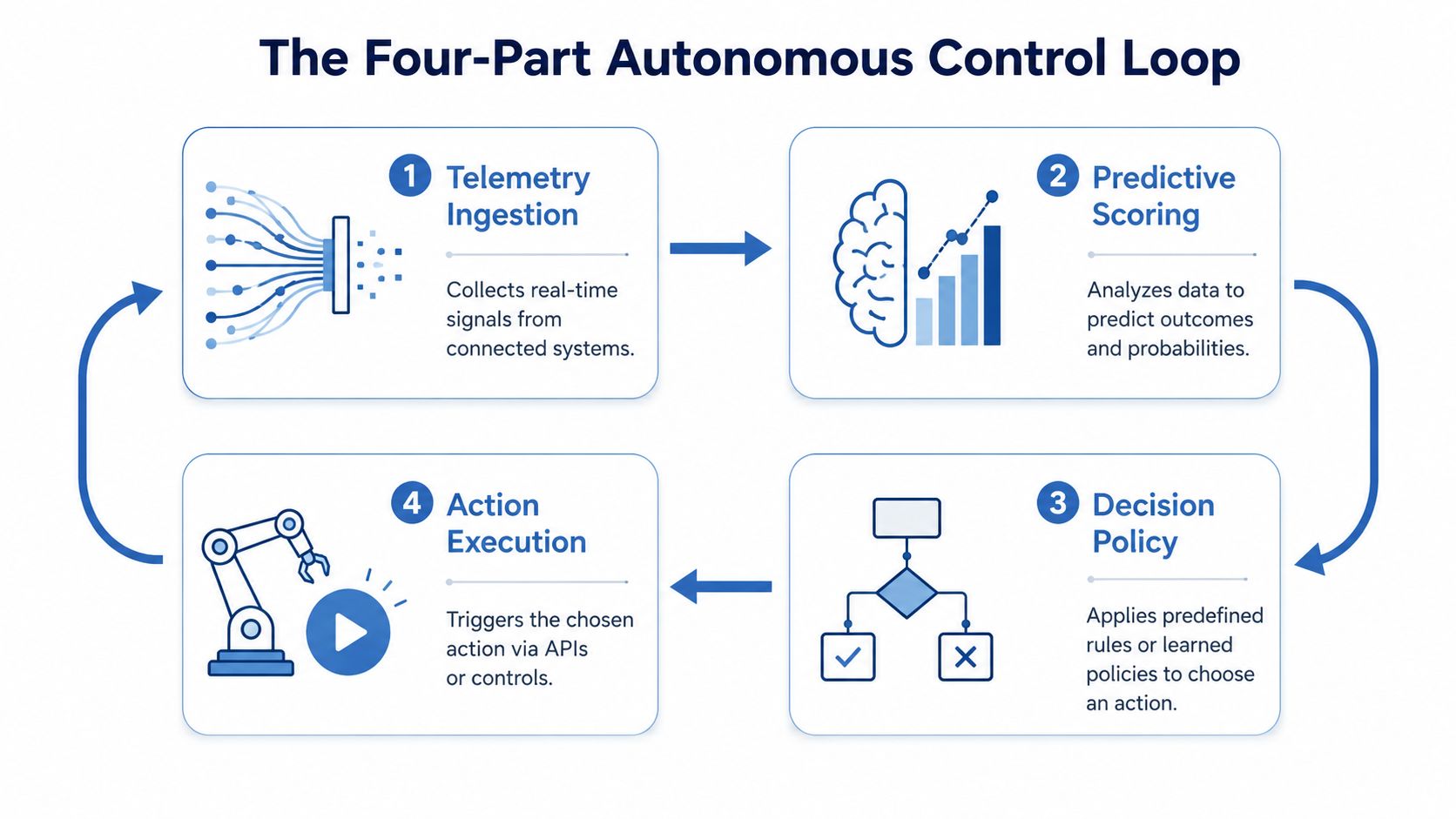
The four layers that matter
The first layer is telemetry ingestion. The system has to read live signals from SaaS tools, observability platforms, ITSM systems, or business apps. ISG describes this as governed, cross-system autonomy, which is exactly right, because a system that can't see across tools can't make coherent decisions ISG on the autonomous enterprise.
The second layer is predictive scoring. The system needs to estimate likely outcomes, risk, or priority before it acts. That scoring doesn't have to be magical. It just has to be better than guessing, and it has to update as conditions change.
The third layer is decision policy. This layer defines thresholds, escalation paths, and human gates. You keep your judgment. You specify when the machine may act, when it may recommend, and when it must stop.
The fourth layer is executable action plus audit logging. The system needs a safe action it can trigger, and it needs a record that explains what it saw, what it chose, and what happened afterward. Without that record, you have a black box instead of governance.
A remediation flow you can actually design
Take a SaaS usage spike. The telemetry layer sees logins, seat activity, and support volume climbing. The scoring layer flags churn risk because adoption is rising in one segment but stalling in another. The policy layer decides whether to trigger an outreach sequence, assign a customer success task, or escalate to a human. The action layer sends the message or creates the task. The audit layer records whether the intervention improved the account's trajectory.
That's the shape of a useful autonomous system.
My design rule: start with one recurring job, one external score, one safe action, one hard budget, one stop condition, and one escalation path.
That advice lines up with practical autonomy guidance that emphasizes a clear finish line, a scoreboard, and a human gate AutonomousBusiness.com on autonomous business design. It also matches the architecture I've used in real deployments, where the system is treated as a governed loop instead of an experimental chatbot attached to operations.
If you want a deeper stack view, I've mapped the underlying components in my AI agent tech stack guide. The point of that stack is making sure every action has context, permission, and a paper trail. Sophistication for its own sake adds nothing.
The control loop only works if you can enforce thresholds and rollback paths. If the system acts outside policy and nobody notices, the architecture failed long before the model did.
Governance is part of the architecture
I'm blunt about this with clients. Human-in-the-loop is a design constraint, and I treat it as one. If the business can't tolerate a wrong action, the system needs tighter thresholds, stronger escalation, or a narrower scope.
That's why the best setups skip “Can it automate this?” and ask “Can it operate safely under policy?” The answer should come from the stack, not from optimism.
Where Autonomy Pays Off First in Marketing, Sales, and Ops
Not every team should start in the same place. The fastest ROI comes from recurring work where exceptions are common, outcomes are measurable, and manual oversight is expensive.
Marketing first, but only in the right lane
Marketing is a strong early candidate when the process already has a feedback signal. Campaign optimization, content refresh, and lead nurturing all benefit from systems that can watch performance, adjust sequencing, and trigger follow-up without waiting for a weekly meeting.
If you're building email journeys or account-based sequences, automated B2B lead nurturing is a practical reference point because it sits close to this operating model. I'd still avoid anything that depends on high-stakes brand approvals, delicate messaging, or constant creative novelty. Those workflows can support autonomy later, but not as a first move.
Sales and ops usually pay off faster
Sales use cases are attractive when the business already loses time to pipeline hygiene, lead routing, or follow-up delays. The best systems leave the selling to people and reduce the lag between a signal and a response. That's where autonomy creates competitive advantage, because the faster team owns the conversation before the slower team even opens the inbox.
Operations often produces the clearest early value. Invoice handling, ticket triage, and vendor onboarding all contain repetitive decisions, clear handoffs, and a lot of manual exception handling. Those are good autonomy candidates because the work is structured enough to govern and messy enough to benefit from machine speed.
Here's the way I rank them.
| Function | Best Early Use Case | Typical Payback Window |
|---|---|---|
| Marketing | Campaign optimization and lead nurturing | Early, when feedback loops are already visible |
| Sales | Follow-up sequencing and pipeline hygiene | Early, when response speed matters |
| Ops | Invoice handling, ticket triage, vendor onboarding | Early, when exceptions consume team time |
I'm deliberately not putting vanity automation at the top of the list. Counting automated tasks is a distraction. You want the jobs where a machine can remove friction, shorten cycles, and reduce the number of times a person has to rescue the process.
If you're mapping use cases, my AI agent use cases guide is a useful way to compare candidates without falling in love with the wrong one. It's one thing to automate content drafting. It's another to let a system shape the next action in a revenue process.
When not to use autonomy
Don't use it where the process is politically sensitive, legally fragile, or highly customized. If every exception needs your personal judgment, the system will spend its life escalating, which defeats the purpose.
Autonomy belongs where the business can define a safe action and accept a bounded failure mode. If you can't define that, the project is premature.
A Practical Roadmap From Pilot to Governed Autonomy
Businesses that get autonomous business systems right do not start by handing work to software and hoping for the best. They redesign the operating model first, then let the system take over a narrow slice of work.
Start with data and process reality
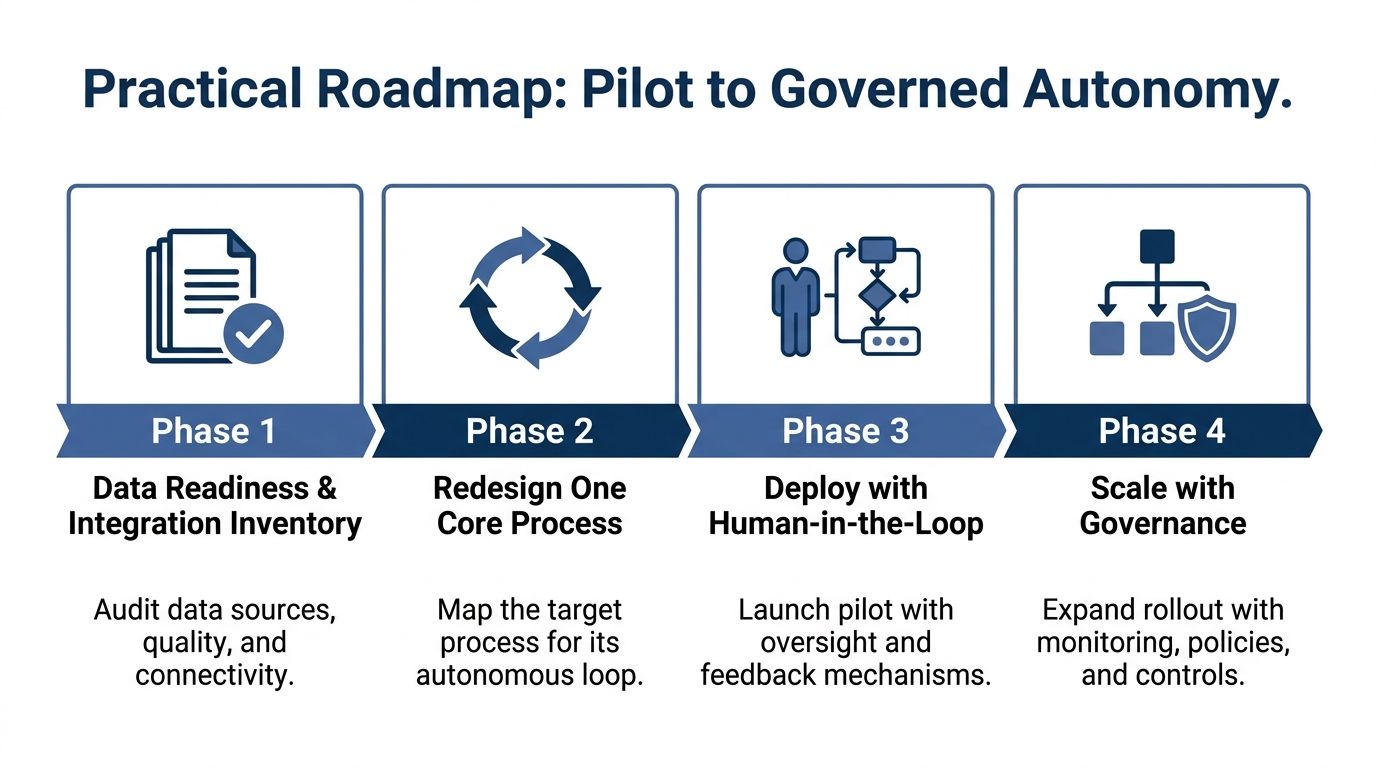
The first gate is data readiness. Automation Anywhere on autonomous agents recommends inventorying current automations, checking what share of routine work is already automated, then running an integration readiness assessment and a data inventory and quality review before you expand. That is not process theater. If the underlying records are inconsistent, the system will act on bad input and create bad output.
I have seen pilots fail because three systems disagreed on the same customer record, or because nobody could say which field drove the business process. If the agent cannot read the business state with confidence, it should not be allowed to act on it.
Build one recurring job, then give it a narrow loop
Next, redesign one recurring job around a clear outcome. Start with a noncritical internal process. Pick work the business already pays for, define the accepted outcome, and build the smallest possible loop around it.
Keep that loop tight. One score. One safe action. One hard budget. One stop condition. One escalation path.
If you are deploying in a small team, this deployment guide for AI agents in small teams is a practical reference for keeping scope narrow and governance visible. Briq's guidance on autonomous systems reinforces the same operating discipline, with context retention, feedback from outcomes, dynamic risk thresholds, and explainable audit trails. That is what separates a script from a system that can improve with use Briq on autonomous systems.
Implementation should follow the business, not the hype cycle. The field's roadmap guidance points to a staged rollout, where core process automation lands first and more advanced autonomous capabilities mature later. Treat that timing as a planning range, not a guarantee.
Expand only after the loop proves itself
Once the pilot works, expand into predictive operations and continuous optimization. Add more signals, more guarded actions, and better feedback on whether the system improved the outcome. Do not open the floodgates just because the first workflow behaved itself.
I have deployed enough of these systems to know the hard truth. The pilot is only the setup. The win is when the second and third workflows become cheaper to launch because the team already built the governance, telemetry, and decision logic once.
Measuring Autonomy the Way the Business Cares About
Task counts look good on slides and tell you almost nothing. If you want to know whether autonomy is compounding value, measure the parts of the business you actually feel.
The metrics that matter
Start with manual exception handling. If autonomy is working, the number of times people have to rescue the process should fall. That's the strongest signal that the system is doing real operational work.
Track cycle-time variance next. A system that makes work faster on average but still unpredictable is hard to scale. What you want is steadier throughput, not random bursts of speed.
Measure decision-to-action latency too. That tells you how long it takes for a signal to become a move. In competitive markets, that gap is where revenue gets lost.
You should also watch revenue per workflow where the process is tied to customer value. If a workflow influences sales, retention, or collections, the goal is to make each run more productive. More automation on its own proves nothing.
Governance metrics belong on the same dashboard
Autonomy without oversight is a liability. I'd put override rates, escalation volume, and audit-trail completeness on the same dashboard as the business metrics. If overrides spike, the policy is too loose or the scope is too broad. If escalation volume never drops, the system may be doing little more than routing work back to humans.
The money test: if you can't connect the system to time saved, risk reduced, or revenue protected, what you have is a feature. It hasn't become an operating capability.
Many teams get sloppy here. They celebrate volume. They should be measuring reduction in manual rescue work and variance, because those are the signals that autonomy is compounding performance.
The best operators use these metrics to decide where to expand next. If the loop is stable, expand it. If it keeps tripping guardrails, narrow it. The data should tell you whether the business can handle more autonomy, not whether the demo looked impressive.
Common Pitfalls and How to Avoid Them
Most failures are boring. They happen because owners rush past the hard part, then act surprised when the system behaves exactly as designed, just not as hoped.
The four mistakes I see most often
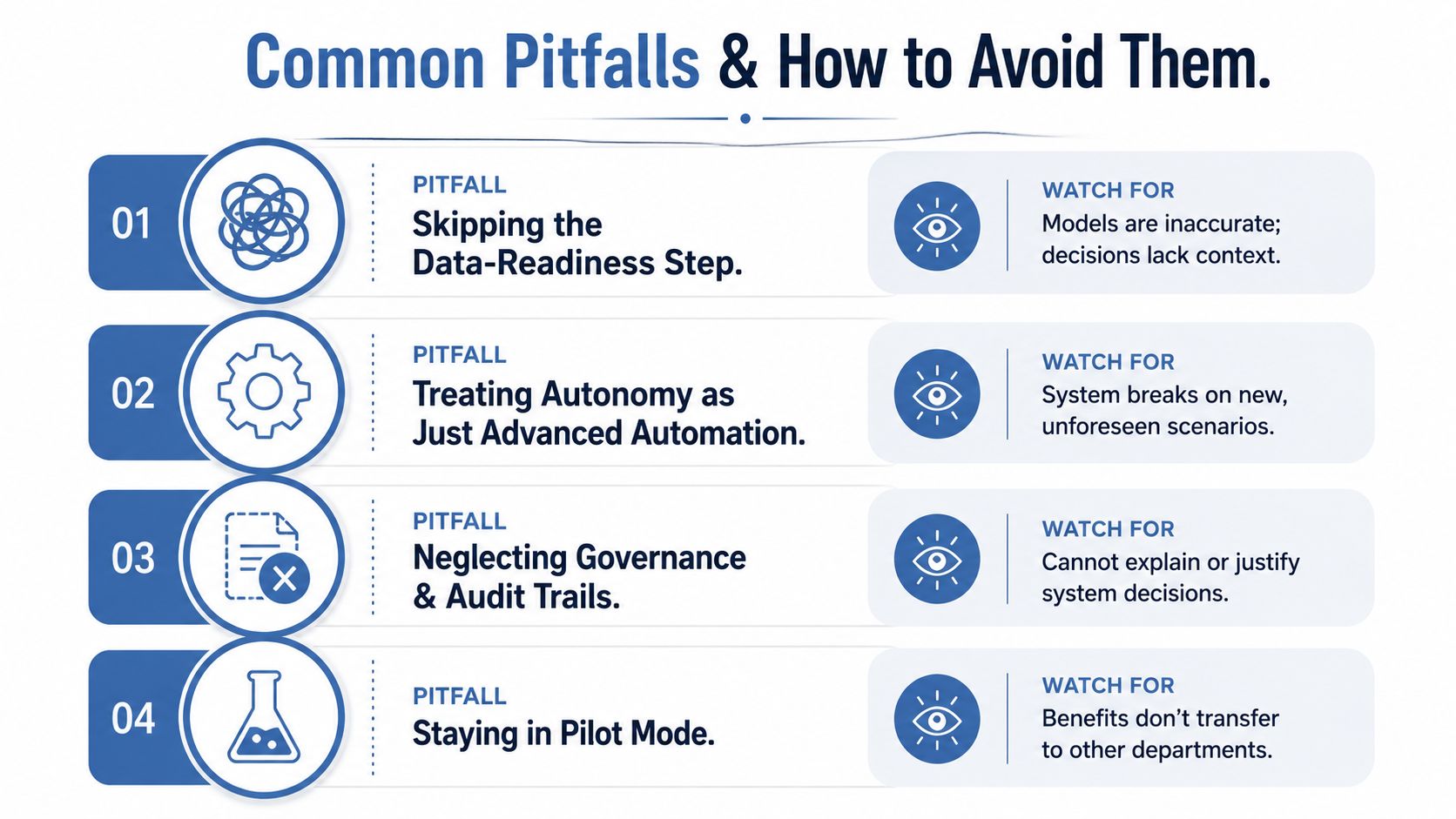
- The first is skipping the data-readiness step. Watch for inaccurate decisions, missing context, and repeated human corrections. The fix is an inventory of systems, quality review, and dependency mapping before the pilot grows.
- The second is treating autonomy as advanced automation. Watch for systems that collapse when a new scenario appears. The fix is a sense-reason-act design with explicit policy and escalation.
- The third is neglecting governance and audit trails. Watch for decisions nobody can explain after the fact. The fix is logging, override paths, and clear human gates.
- The fourth is staying in pilot mode too long. Watch for wins that never transfer beyond one team. The fix is to codify the loop so it can be reused, not admired.
The biggest trap is chasing agent counts instead of business outcomes. More agents don't mean more benefit. Better loops do.
What good looks like six months in
At the six-month mark, I want to see fewer rescues, tighter cycle times, and clearer handoffs. I want to see a team that knows where the system can act and where it must stop. I want to see one pilot become a repeatable pattern, not a one-off experiment.
That's the whole game. Autonomous business systems are valuable when they reduce friction, sharpen decisions, and let your people spend time where judgment matters. If they don't do that, they're a cost center with a cool interface.
Your First 30 Days With Autonomous Business Systems
Start Monday with the unglamorous work. That's how you avoid buying a shiny failure.
Week one through week four
In week 1, build the data and integration inventory. Deliverable, a list of systems, owners, dependencies, and quality issues. Decision gate, do you have enough reliable context to let a system act safely?
In week 2, choose one recurring job with a measurable outcome. Deliverable, a single workflow defined with a finish line, owner, and stop condition. Decision gate, does the process have enough structure to redesign before you automate it?
In week 3, build the minimum viable autonomy loop. Deliverable, one score, one safe action, one hard budget, one escalation path. Decision gate, can the system act without creating cleanup work?
In week 4, stand up governance and measurement. Deliverable, a dashboard with manual exception handling, cycle-time variance, decision-to-action latency, override rate, and audit completeness. Decision gate, is the loop improving the business or just producing activity?
That sequence is conservative on purpose. It protects you from the two failures that kill most autonomy programs, bad data and missing guardrails.
The advantage is that every well-designed loop makes the next one cheaper to build, which matters more than any one workflow getting smarter. That's how autonomy turns into a compounding operating capability, and that's how you beat slower competitors who are still trying to buy transformation off the shelf.
If you're ready to move, pick one recurring job this week, not ten. Write the stop condition, the escalation path, and the safe action before anyone touches a model. Then build the smallest governed loop that can prove the business can trust it.