
AI agents in ecommerce are no longer experimental, 43.6% of brands already use them in at least one major area, and the strongest ROI is showing up in product discovery, customer support, and post-purchase interactions. That matters because the winner isn't the brand with the flashiest model, it's the brand whose stack can let an agent act on real commerce data.
I've been working with ML since 2016 and Generative AI since 2019, and the pattern is the same every time a new interface becomes useful, the market rushes to talk about the front end while the core bottleneck sits in the plumbing. With ai agents for ecommerce, that bottleneck is whether your catalog, inventory, pricing, policies, and support workflows are legible enough for an agent to do useful work without making things worse.
Table of Contents
- Why Most Ecommerce AI Agent Coverage Misses the Point
- What an AI Agent Is Inside an Ecommerce Stack
- The Four Use Cases That Actually Pay Back First
- The Architecture and Data Flows That Decide Whether It Works
- Two Real Ecommerce Agent Deployments and What They Prove
- A Five-Phase Deployment Roadmap From Discovery to Production
- The Metrics That Prove Your Agent Is Working
- Guardrails, Risks, and the Decision That Matters This Quarter
Why Most Ecommerce AI Agent Coverage Misses the Point
43.6% of brands already use AI agents in at least one major area, and 26% have expanded them across multiple customer touchpoints, so this is no longer a speculative category. The same 2026 report shows the strongest ROI in product discovery at 82.4%, followed by customer support at 73.1% and post-purchase interactions at 68.3% (Salesmate report on AI agents in ecommerce).
That's the part most coverage misses. The hard question isn't which model to pick, it's whether your stack can support an agent that can see the right data, take the right action, and leave a trace your team can trust.
The real competition is happening inside the workflow
If your competitor is already using an agent to help shoppers discover products faster, answer support questions instantly, or handle post-purchase friction, they're not waiting for a perfect architecture. They're learning in production. That gives them better intent data, cleaner feedback loops, and a faster path to revenue.
A lot of AI content still reads like a feature parade. Chat here, summarize there, maybe answer a FAQ. That framing misses the commercial point. The business value comes when the agent shortens the path from intent to purchase, or from problem to resolution, while staying inside policy.
Practical rule: if an AI agent can't change a conversion metric, a support metric, or a retention metric, it's probably a demo, not an operating system.
I'm going to stay away from vendor cheerleading and vague “AI will transform shopping” language. You'll get the decision criteria that matter in production, what to automate first, what to leave alone, and how to tell whether you've built a revenue system or an expensive conversational widget.
What an AI Agent Is Inside an Ecommerce Stack
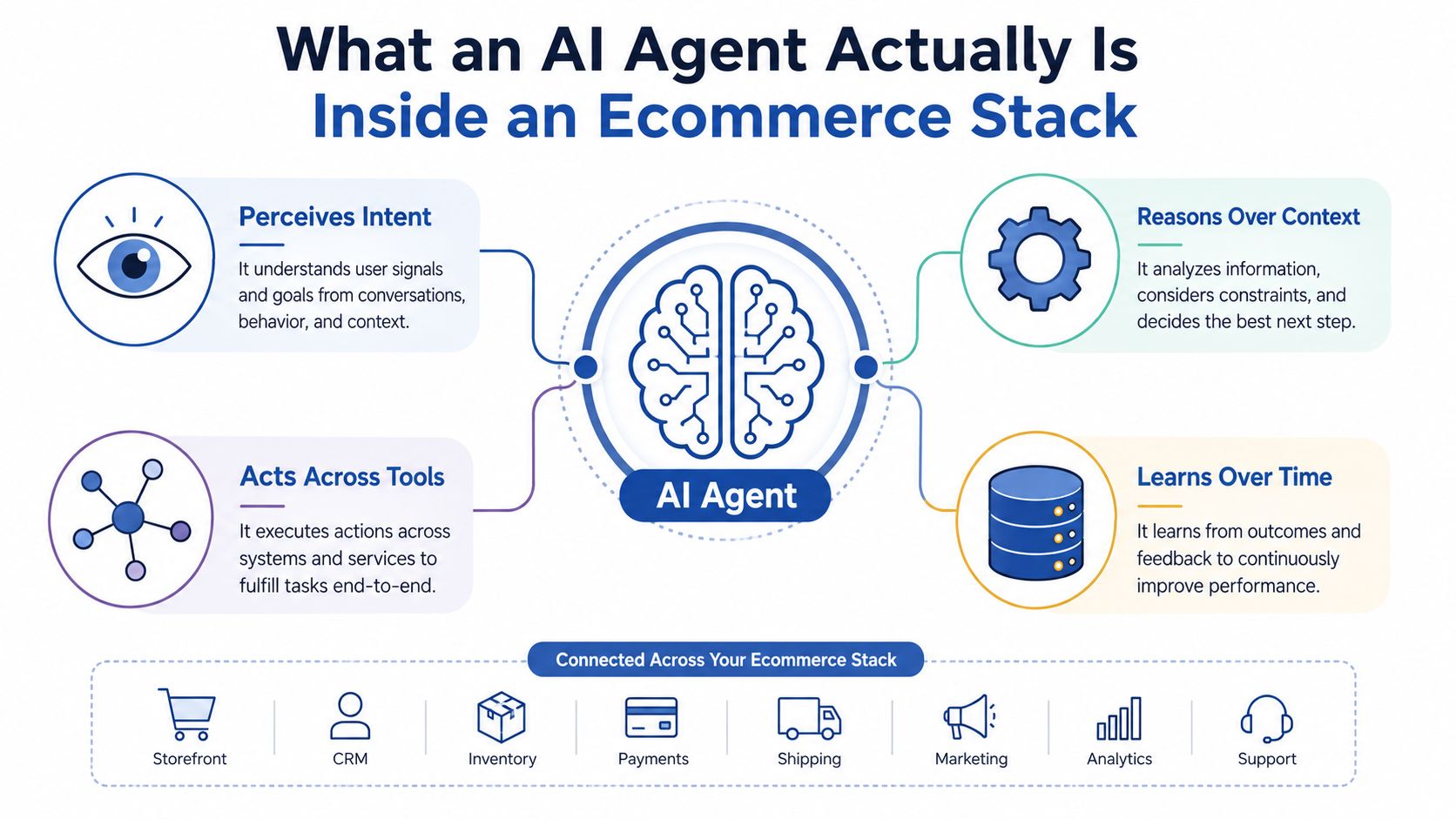
An AI agent in ecommerce is closer to a capable merchandising operator than a chatbot. A chatbot answers. A good agent notices what the shopper is trying to do, checks the right systems, and acts across tools to move the interaction forward.
A strong in-store associate works the same way. They listen, pull context from the customer's question, check stock or sizing, compare options, and hand off to a manager when the request gets risky. That is the agent model, expressed through software layers instead of human judgment.
The layered model that matters in practice
A production agent usually has perception, reasoning, memory, action/tools, and safety. Perception interprets shopper intent. Reasoning maps that intent to a decision. Memory keeps enough context to avoid starting over every turn. Action/tools let the system query catalog data, update carts, or escalate to support. Safety keeps it from improvising outside policy (AI agent architecture for ecommerce).
That layered view is the difference between real agency and wrapped prompts. A rules-based chatbot can only follow branches. A static recommender widget can only display suggestions. A basic LLM prompt can sound helpful without being connected to anything useful.
For teams building or buying, I'd use a simple test. If the system can't retrieve live product data, can't write to a commerce tool, and can't hand off cleanly, it isn't an agent in any operational sense.
You can also sanity-check a vendor pitch against a practical reference like the POD business AI toolkit, especially if you're trying to connect content, merchandising, and support tooling into one workflow.
How to spot fake autonomy fast
A lot of “AI agent” products are just thin conversational layers over static knowledge bases. If the system can't verify inventory, can't explain its decision path, and can't take a bounded action, it is not doing the work that moves revenue.
That is why I prefer to evaluate agents by workflow depth, not language quality. A model that writes beautiful answers but can't complete a cart update is less useful than a modest model with reliable tool access and policy boundaries.
The same applies to your stack. If your product data is messy, if your support macros are inconsistent, or if your checkout rules are locked in a dozen places, the agent will inherit that chaos and make it visible faster.
Use Samuel Woods' analysis of ecommerce agent use cases as a practical checklist for where an agent can take a real next step, not just hold a conversation.
The Four Use Cases That Actually Pay Back First
The fastest payback usually comes from narrow workflows with clear intent and a measurable next action. That is why most ecommerce teams should start with personalization and guided selling, merchandising automation, customer support, and inventory plus pricing optimization.
A useful external lens is ad campaign insights from Online Brand Growth, because merchandising and paid media often collide at the same decision points. When ad traffic lands on a site, the agent's job is to keep that intent alive instead of letting the session die in search friction. For a broader menu of practical starting points, see Samuel Woods' ecommerce agent use cases.
Personalization and guided selling
The competition that matters is happening inside the workflow. A well-scoped agent asks a few useful questions, interprets intent, and narrows options instead of dumping a long product list on the shopper. Constructor's AI Shopping Agent is a strong proof point here, because its reported lift in revenue and search performance ties directly to better discovery, not just more engagement.
This use case breaks down quickly if your catalog is shallow, your variant data is incomplete, or your product attributes are inconsistent. Guided selling only works when the agent can tell one item from another in ways that matter to the shopper.
Merchandising automation
This is the less glamorous path, and often the one that pays back faster. Agents can help prioritize collections, surface underexposed products, and keep merchandising decisions aligned with actual search behavior and stock realities. Used well, this reduces the amount of manual tuning your team has to do every week.
That only works if your merchandising rules are already clear. If the assortment is weak or the taxonomy is broken, automation just spreads the mess faster. The agent should support a merchandising system, not invent one.
Customer support
Support is usually the easiest place to get a clean ROI read because the outcomes are obvious. Did the agent remove queue volume, resolve the issue, or hand off correctly? If the answer is yes, the investment is defensible. If the answer is no, the failure shows up fast.
I would keep the scope tight. Routine order questions, shipping updates, and basic policy explanations are good candidates. Emotional complaints, refunds with edge cases, and account disputes still need human control.
Inventory and pricing optimization
This use case is more operational than customer-facing, but it can protect revenue just as effectively. Agents can watch availability, flag risk, and help teams respond faster to demand shifts. The key is that the agent must read fresh data and respect pricing policy.
If inventory feeds lag or pricing rules live in too many places, the agent will make the wrong recommendation with confidence. That is a stack problem, not a model problem.
Rule of thumb: the more a workflow touches margin, inventory, or customer trust, the more guardrails it needs before you automate it.
Start where the intent is obvious, the business outcome is measurable, and the failure mode is reversible. That is how you earn the right to expand.
The Architecture and Data Flows That Decide Whether It Works
Production success starts with fresh catalog and inventory data. If the agent is reading stale stock or incomplete product fields, it will answer confidently and incorrectly, which is worse than saying nothing. In practice, the best teams sync structured catalog and inventory data on a cadence that matches stock movement, keep product fields complete, and keep retrieval fast enough that shoppers do not lose attention while waiting for an answer (How to build an AI agent for ecommerce).
Latency is not a vanity metric. Slow retrieval turns a shopping assistant into friction. A shopper asking about size, fit, availability, or compatibility expects an answer right away, not after the session has gone cold.
RAG and APIs do the heavy lifting
For ecommerce, the reasoning layer should be grounded in live product data through RAG plus API integrations to storefront and commerce systems. That is what lets the agent interpret intent, pull catalog, variant, and inventory context, and then take actions like cart updates or support escalations. For a practical view of the moving parts, see this ecommerce AI agent tech stack guide.
If you skip the API layer, the agent cannot do anything useful. If you skip RAG over structured fields, it will hallucinate product details or mismatch variants. If you skip audit trails, support and operations teams will not know what changed or why.
Here is the production checklist I would expect an engineering team or vendor to answer clearly:
- Freshness: How often are catalog, pricing, and stock fields synced?
- Completeness: Which structured attributes are required before the agent can respond?
- Speed: Can retrieval stay under the latency threshold during peak traffic?
- Action scope: What can the agent change, and what always needs human approval?
- Traceability: Is every agent-initiated action logged in a way support and ops can inspect?
The point of this architecture is not complexity for its own sake. It is reliability. A smart answer that creates the wrong cart change is still a failure.
The failure modes are predictable
Most production issues come from three places. Data is stale. Schema is messy. Or the agent is allowed to act without enough policy context. Once you see those patterns, the fixes are usually boring, which is exactly what you want in commerce systems.
I would also treat transparency as a system requirement, not a nice extra. Merchants need to know when the agent answered from live product data, when it escalated, and when it refused to act. That makes post-incident review possible, and that matters more than polished demo transcripts.
Two Real Ecommerce Agent Deployments and What They Prove
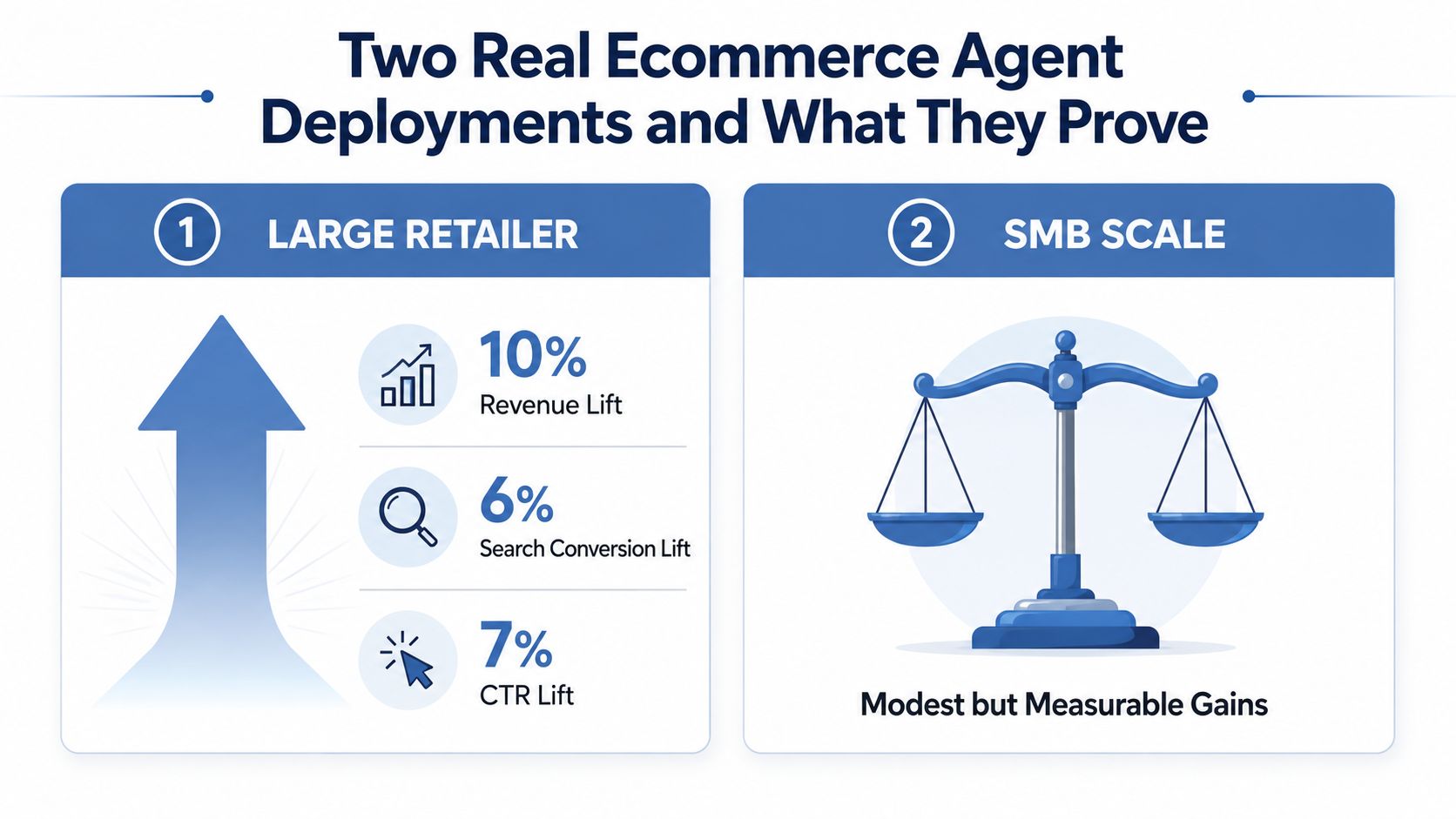
Constructor reports that its AI Shopping Agent produced a 10% lift in website revenue, a 6% boost in search conversions, and a 7% increase in click-through rate (Constructor's ecommerce AI agent results). That's valuable because the lift is tied to commercial outcomes that executives care about.
Those numbers don't mean every merchant will see the same result. They do show what changes when discovery gets better. Search becomes more useful, product comparison gets tighter, and shoppers are less likely to stall before they buy.
What the large-retailer case tells you
The big lesson is measurement discipline. A retailer like that doesn't get a result from conversation alone, it gets it from connecting the agent to discovery, catalog structure, and merchandising decisions. The agent can only lift revenue if the underlying product data and session logic are already coherent enough to support better intent matching.
That's why the result matters more than the headline. It proves that agent-driven discovery can move a real commercial metric, not just engagement. It also shows why product data quality and search integration are not side issues.
What smaller teams should expect
SMBs shouldn't read that case and expect the same scale of lift. Smaller catalogs, narrower traffic patterns, and simpler support workflows usually produce more modest gains, but they can still be worth it when the workflow is repetitive and the handoff logic is clear.
For a smaller operator, the win might be fewer repetitive support tickets, better guided selling on a handful of high-margin products, or a cleaner path from ad click to product page. The absolute numbers will be smaller, but the operating discipline can be stronger because the scope is tighter.
I like this contrast because it keeps the budget conversation honest. Enterprise teams need proof that the agent can influence revenue at scale. SMBs need proof that the agent reduces labor or raises conversion in a focused workflow before they widen the blast radius.
A Five-Phase Deployment Roadmap From Discovery to Production
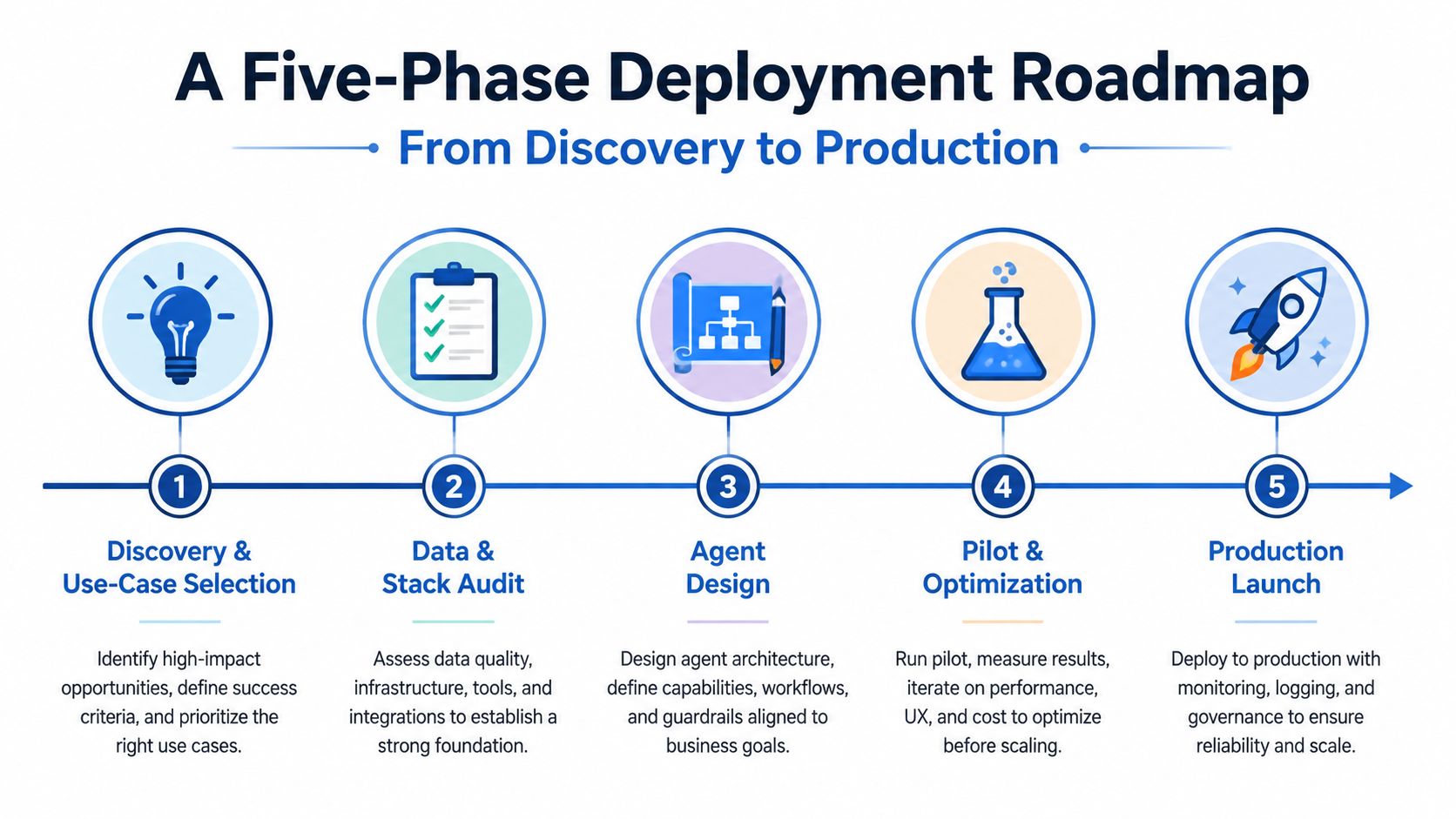
The cleanest deployments don't start with prompts. They start with a decision about where the agent can create measurable value without stepping into chaos. In practice, that means five phases, each with a go or no-go gate.
1. Discovery and use-case selection
Pick one workflow with obvious intent and a clear business outcome. Guided selling, order-status questions, or post-purchase support usually beat broad “site assistant” ambitions because they're easier to measure and easier to contain.
2. Data and stack readiness audit
Check whether catalog, inventory, pricing, shipping, and policy data are structured enough for machine use. This is the stage where many projects die, and that's healthy. If the data isn't legible, the agent isn't ready.
3. Agent design with prompts and tools
Design the behavioral contract carefully. Define role, decision rules, tool rules, policy boundaries, and response style. Use the model for interpretation, but keep the commerce actions inside bounded tools. That's also the point where a product like Samuel Woods' ecommerce agent stack can sit alongside other internal or external tooling, but only if the workflow already has clean data and clear ownership.
4. Controlled pilot
Run the agent on a narrow slice of traffic or a single category. Measure whether shoppers complete the intended action, whether support load drops, and whether any failure mode shows up repeatedly. Keep humans in the loop until the pattern is stable.
5. Production rollout with monitoring
Only expand when the pilot is boring in the right way. That means the agent is predictable, auditable, and improving the right metric. Production isn't about “full autonomy” everywhere, it's about expanding the surface area without losing control.
The best pilot is the one that teaches you where your data breaks before a customer does.
A lot of teams stall because they treat deployment as a technical launch instead of an operating change. The central question is whether your team is ready to let an agent make bounded decisions inside the systems that already run revenue.
The Metrics That Prove Your Agent Is Working
The mistake I see most often is measuring agent success with the wrong numbers. Chat volume, session length, and message count can look busy, but they do not show whether the business got better. The useful metrics are the ones tied to work removed, problems resolved, or revenue influenced.
A useful benchmark is to tie measurement to operational impact, not conversation quality. That means watching queue volume removed, full-resolution rate, CSAT, conversion lift, cart additions, and reduced support volume rather than vanity engagement numbers (AI agents ecommerce metrics guidance). It also means being honest about the trade-off: a flashy agent that only chats longer is usually a cost center, while a narrower agent that clears repetitive work can pay back fast. If you want a clearer framework for tying agent output to business value, this AI agent ROI guide is a useful reference.
Start with a baseline you can defend
Before the pilot starts, document the current state. How many tickets does the workflow handle? How often do shoppers abandon the path? How many interactions require human follow-up? Without that baseline, you'll have a story, but not proof.
Then run the agent long enough to observe a pattern, not a spike. A few good conversations do not mean the system works. You want consistency across sessions, categories, and edge cases, because that is where the operational cost shows up.
Watch for the failure signals
If the agent sounds fluent but does not change the queue, the cost structure has not moved. If it increases handoffs because it cannot answer product questions accurately, the data layer is weak. If it drives more confusion during checkout, the tool permissions or policy logic need work.
A practical metric stack should answer four questions:
- Did it remove work?
- Did it resolve the shopper's need?
- Did it improve revenue or conversion?
- Did it avoid creating new operational risk?
My rule: if a KPI would not change your next budget decision, it is probably not the KPI you need.
The right reporting also changes stakeholder politics. Support leads care about deflection and resolution quality. Merchandising cares about discovery and conversion. Finance cares about whether the tool changes labor or revenue enough to justify expansion. That is why the same deployment can look successful to one team and useless to another, unless you define the scorecard up front.
Guardrails, Risks, and the Decision That Matters This Quarter
The big forecasts are real, but they only matter if you make the right near-term decision. Gartner's projection that 20% of digital commerce transactions will be executed through AI platforms or AI agents by 2030 sits alongside market forecasts that put U.S. agentic commerce at $300 billion to $500 billion by the same year (agentic commerce market guide). The decision this quarter is simpler, cleaner data, a legible stack, and one workflow that can be automated without damaging trust.
Guardrails matter because agents will make confident mistakes if you let them improvise. Use human handoff for exceptions, price-policy boundaries for anything margin-sensitive, and audit trails for every agent-initiated change. The advantage isn't the model. It's whose commerce stack is most legible to the agents already shopping on behalf of customers.