
Everybody wants to talk about fully autonomous sales agents. That story sells slides, but it hides the operating model. In practice, the win comes from making you and your reps faster at the work that burns time. Software can't replace judgment, timing, and relationship building.
I've been building with ML since 2016 and Generative AI since 2019, and the pattern is the same every time. The teams that get paid are the ones that treat AI agents for sales prospecting as a layered productivity system rather than a magic employee. The market is already moving that way, with Salesforce reporting that 87% of sales organizations use some form of AI, 54% of sellers have already used agents, and nearly 9 in 10 plan to by 2027 in its 2026 State of Sales report.
The practical question is where agents move revenue, where they just add complexity, and where a human still needs to step in.
Table of Contents
- Why Most AI Prospecting Hype Misses the Mark
- The Layered Agent Architecture That Delivers in Production
- Cleaning Your Data and Defining Your ICP First
- Prompt Templates and Orchestration Flows in Practice
- The Economics of AI-Human Hybrid Outbound
- Phased Rollout and Guardrails That Protect Your Brand
- Where Automation Wins and Where Humans Still Matter
Why Most AI Prospecting Hype Misses the Mark
The loudest pitch in the market is the wrong one. You do not need a fully autonomous digital sales employee to make prospecting better, and in most businesses that idea creates more risk than return. What you need is a system that takes the non-selling work off your plate, and your reps' plates, so more time goes into conversations that create pipeline.
AI agents are different from fixed-rule automation because they can perceive data, reason over it, and execute multi-step actions without a human triggering each step. That matters in prospecting, where the work is messy and the context keeps changing. Salesforce's AI prospecting material defines the category as using machine learning, predictive analytics, and natural language processing to identify and engage likely buyers rather than fire off canned sequences at scale. Salesforce's AI prospecting overview makes that distinction clear.
The real job is coverage
I've seen teams waste months trying to automate the whole sales motion. The smarter move is to use agents where the work is repetitive enough that humans shouldn't be doing it by hand, but important enough that bad execution hurts output. That's why the strongest use case is top-of-funnel coverage, especially the non-selling work that can eat roughly 65% of a rep's time, as described in AI agents for sales.
A practical rule: if a task is frequent, structured, and low-emotion, the agent should handle it first.
That usually means CRM updates, contact enrichment, basic prioritization, and first-pass outreach drafting. It does not mean handing qualification, negotiation, or relationship repair to software. Those are judgment-heavy motions, and bad automation there can do real damage to trust.
The clean way to think about this is as a stack. Start with the lowest-risk workflow, usually CRM automation, then lead enrichment, then outbound sequencing, and only later qualification. That sequencing is consistent with the implementation guidance in IBM's AI sales prospecting playbook, and it's the sequence I'd recommend if you care about adoption instead of demos.
That's the difference between an agent and a toy. One removes drag from the revenue engine. The other just adds another dashboard.
The Layered Agent Architecture That Delivers in Production
The architecture that keeps working in production is a layered stack. Each layer cuts manual work and tightens timing, which is what improves reply quality. When teams skip layers, they usually scale bad targeting faster.
The five-step flow that pays off
The sequence that holds up is signal detection → enrichment and verification → scoring and prioritization → personalized outreach → CRM handoff. I trust that order because each stage sharpens the next one instead of trying to do everything at once.
- Signal detection watches for buying triggers, intent signals, and account events that show a prospect deserves attention now.
- Enrichment and verification pull firmographic, contact, and account data from connected systems so the agent is not guessing.
- Scoring and prioritization rank prospects by ICP fit and signal strength, so the best opportunities get worked first.
- Personalized outreach drafts messaging from the research layer instead of generic templates.
- CRM handoff writes the result back into the system of record so nothing disappears into a side workflow.
That layering is what separates useful automation from noisy automation. The prospecting workflow guide from The Agentic Group points to the same sequence, and the point is simple. If you jump straight to outreach before enrichment, you just speed up bad data.
Where to start depends on your data
If your CRM is clean and your ICP is sharp, you can build deeper into the stack sooner. If both are messy, start with signal detection and CRM handoff only. In that state, the agent should mostly do administrative lifting, not decision making.
What works in practice: add one layer at a time, then prove that it improves the next layer's output before you expand.
The other trade-off is operational complexity. Every added layer means more dependencies, more failure points, and more places where stale data can create false confidence. That is why I prefer phased builds over grand launches.
For a useful comparison of how teams think about connected customer data and agent workflows, I also point you to my AI customer data platform guide, especially if your prospecting stack is pulling from multiple systems and no one fully trusts the CRM.
For teams that need a tighter starting point, define your target customers in UAE before you ask any agent to score or sequence prospects. A weak target definition makes every downstream layer less useful.
The right architecture feels orderly rather than flashy, because it is doing the job the rep used to do by hand, with better consistency and less context switching.
Cleaning Your Data and Defining Your ICP First
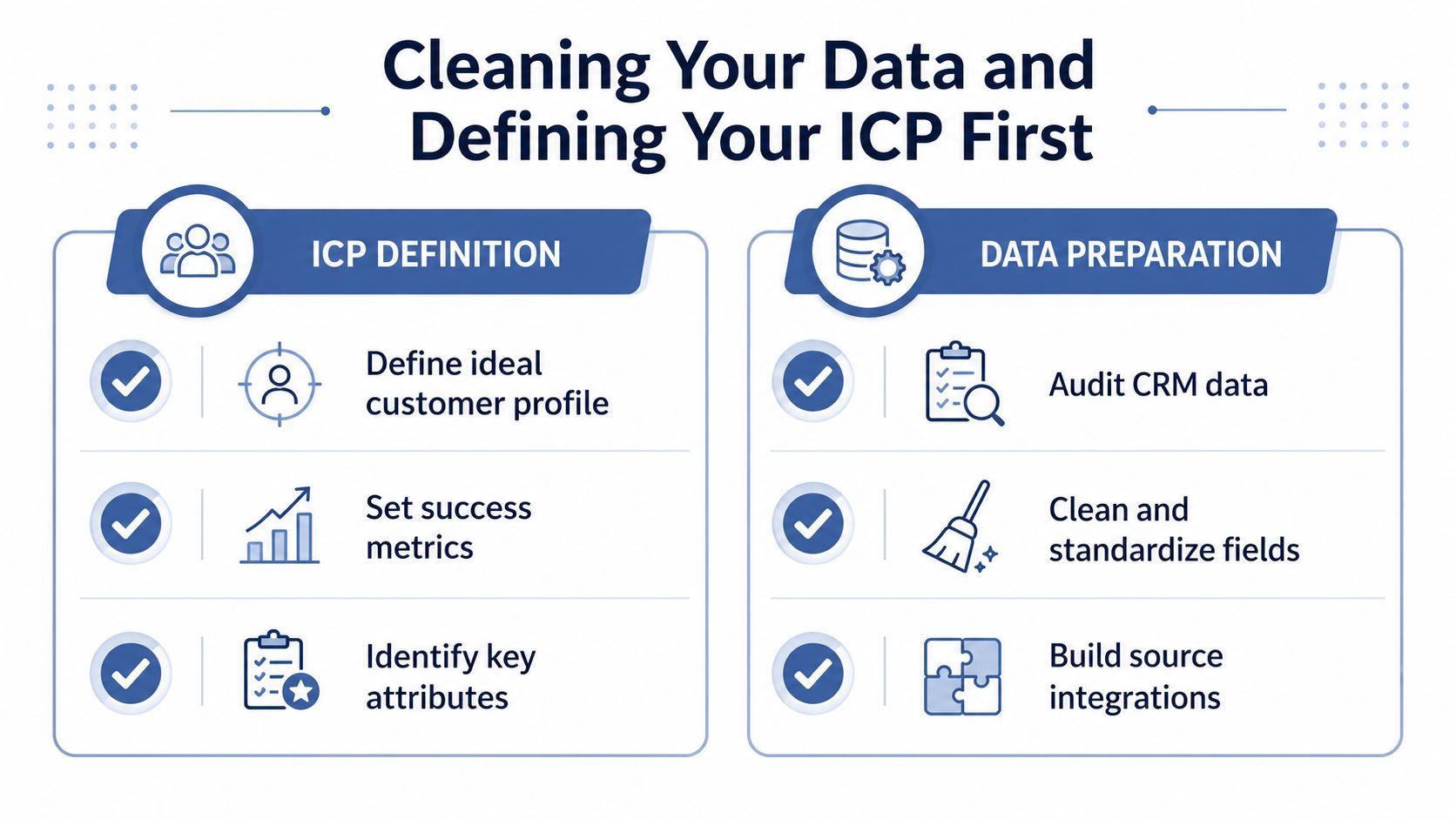
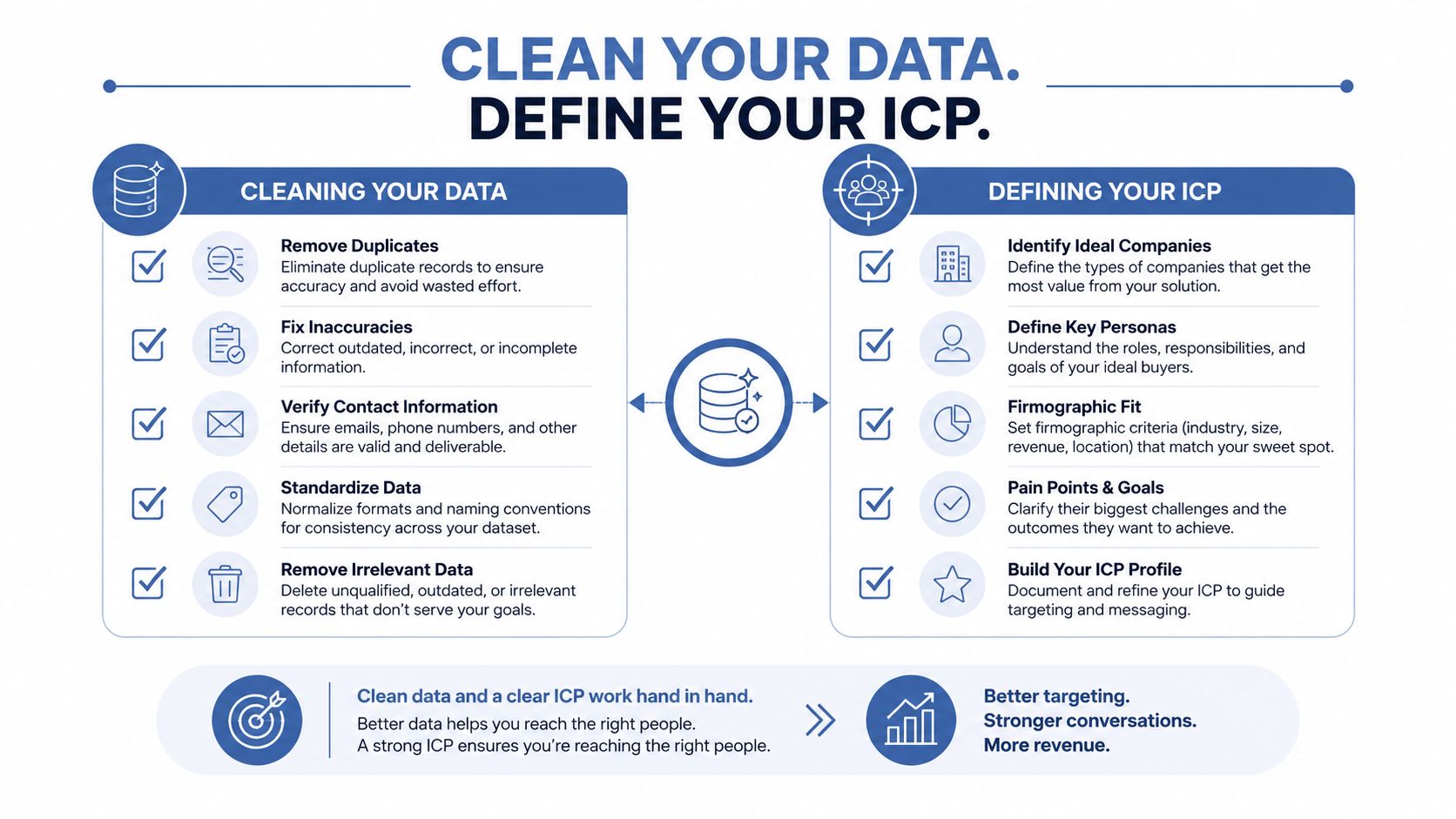
Bad input data makes smart automation look sloppy. I've seen strong models fail because the CRM was full of duplicates, stale titles, inconsistent firmographic fields, and an ICP that read like a wish list. If the agent cannot tell who fits, it will scale confusion instead of precision.
The sequence that keeps implementation sane
The order matters. Start with the ICP and success metrics, clean CRM and source data, then build or configure the model. After that, connect it bidirectionally with CRM and sales-engagement tools, run a pilot, deploy with close monitoring, and keep tuning as buying signals change. That sequence is recommended in IBM's AI sales prospecting guidance, and it keeps you from rebuilding the stack after the first pilot.
The data cleaning part is boring, but it is where ROI starts. Deduplicate records. Standardize firmographic fields. Validate email domains. Remove stale contacts. If you skip those steps, the agent inherits the mess and spreads it faster. If you're working across several systems, my guide to an AI customer data platform is a useful reference for how to keep customer records usable before automation touches them.
ICP precision beats vague ambition
A vague ICP turns into vague targeting. “Mid-market tech companies” is not enough if you want the agent to rank accounts with any seriousness. The agent needs enough detail to separate a true fit from a lookalike, including the attributes that consistently correlate with success in your own pipeline.
That is also where your success metrics matter. If you do not define the outcome before the model goes live, you end up debating anecdotes instead of measuring contact quality, conversion quality, and time saved. The strongest pilots stay narrow for a reason. They make cause and effect visible.
For teams selling into a specific geography, define your target customers in UAE before you ask any agent to score or sequence prospects. A weak target definition makes every downstream layer less useful, no matter how good the automation looks on the surface.
If the foundation is weak, the system amplifies bad inputs. If the foundation is strong, even a modest agent setup can make the team feel much larger than it is.
Prompt Templates and Orchestration Flows in Practice
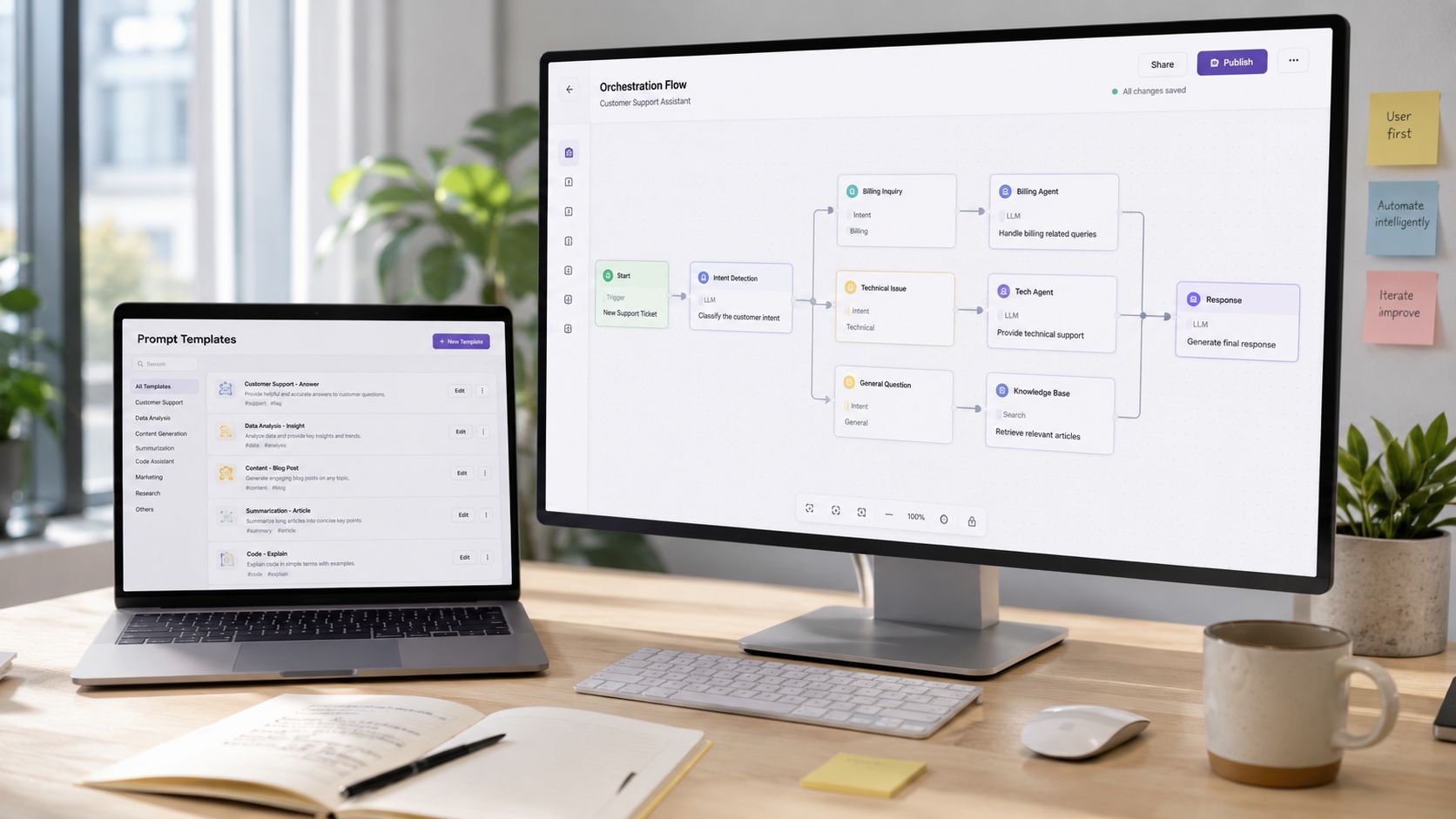
Prompt quality matters, but orchestration matters more. I've watched teams obsess over clever prompt wording while ignoring the sequence that moves information from research to scoring to outreach. The advantage comes from chaining tasks cleanly, so each step hands structured output to the next one.
Research, then score, then write
A good research prompt should force the agent to gather the basics in a usable format. Ask for the company's business model, the prospect's role, recent company signals, likely pain points, and any evidence that confirms or weakens fit. Don't ask for a stream of prose if what you need is fields you can reuse downstream.
That output then becomes the input for scoring. A scoring prompt should compare the account against your ICP, weigh firmographic fit against signal strength, and return a clear prioritization result. If the prospect is high fit but low urgency, the agent should say so. If urgency is high but fit is weak, that should also be visible.
Outreach should borrow, not improvise
The outreach prompt should never start from scratch. It should pull from research and scoring, then generate a first line, a value proposition, and a next step that match the prospect's context. That's how you get personalization that feels grounded rather than decorative.
Personalization at scale only works when the input is specific enough that the output has something real to say.
Human checkpoints belong before send, but not every draft deserves the same level of review. Review the highest-risk message types, the first touch to strategic accounts, and anything where the agent had weak evidence. Keep track of which drafts were edited, which were sent as-is, and which message types performed best after human edits. That feedback loop is how you stop drift.
If you want a practical example of how teams design this kind of flow, my guide to AI agent orchestration is relevant because it focuses on connected task execution rather than isolated prompts. That distinction matters. In a crowded market, precision of targeting, timing, and workflow design beats raw message generation almost every time.
The Economics of AI-Human Hybrid Outbound
The economics change fast once you stop measuring AI by novelty and start measuring it by cost per meeting, rep hours recovered, and the quality of the pipeline it creates. In AI-human hybrid outbound models, 2026 sales AI market research reports cost per meeting dropping from $312 in early 2025 to $94 in Q1 2026, a 70% reduction. That kind of shift matters because it changes how much outbound a team can afford without increasing headcount.
The hidden win, beyond cheaper meetings, is the way the stack separates work that machines handle well from work that still needs judgment. Research, enrichment, list prep, scoring, and first-draft copy can be automated with enough structure. Positioning, account judgment, edge-case review, and brand-sensitive sends still belong with humans.
What the time savings really buy
Salesforce's 2026 State of Sales reporting says sellers expect agents to cut prospect research time by 34% and email drafting time by 36%. Their announcement also says sales reps expect to save 4.8 hours per week. Those hours do not create value by themselves. They matter only if you use them for live selling, better follow-up, cleaner prioritization, and more thoughtful review of the outbound that carries the most brand risk.
That is why ROI reviews should not stop at activity volume. A clearer way to judge the stack is by how much work it removes from reps, how much review it still needs, and how much pipeline it produces after human edits. For a practical framework on how those costs and savings show up in real deployments, this AI agent ROI breakdown is useful because it treats the hybrid model as an operating system, not a demo.
A useful way to view the trade-off is simple.
| Metric | Improvement |
|---|---|
| Cost per meeting | $312 to $94, a 70% reduction in AI-human hybrid outbound models |
| Prospect research time | 34% expected reduction |
| Email drafting time | 36% expected reduction |
| Rep time saved | 4.8 hours per week |
The KPI stack that matters
I care less about vanity automation numbers and more about qualified pipeline, time-to-first-contact, and lead-to-opportunity conversion. Those are the metrics that reveal whether the system is creating revenue or just producing more outbound noise. The best agents reduce manual work without lowering reply quality, and that balance is where the economics usually get decided.
The same market materials point to a 73% increase in qualified leads within six months for B2B teams using AI-powered lead generation. Other sources point to teams reporting 30–50% gains in qualified pipeline, 40–60% reductions in time-to-first-contact, and 20–35% better lead-to-opportunity conversion. I would treat those as directional, not universal. Results depend on data quality, ICP clarity, approval rules, and whether a human stays in the loop where judgment matters most.
If you are comparing capacity models, Hire SDRs is part of the same decision set as the agent stack because the core question is how much human labor you need alongside automation. Some teams need more software than people. Others need people who can refine the agent output, handle nuance, and protect the reply rate. The right mix is the one that produces more qualified conversations without making the brand sound automated.
The broader market reinforces that this is an operating shift rather than a side experiment. The AI agents market is described at roughly $11–12 billion in 2026, with more than 45% CAGR, and some forecasts expect 75% of B2B sales organizations to use AI-driven sales development by the end of 2026. That points to a simple reality. The advantage goes to teams that know where automation saves time, and where human judgment still protects the economics of the channel.
Phased Rollout and Guardrails That Protect Your Brand
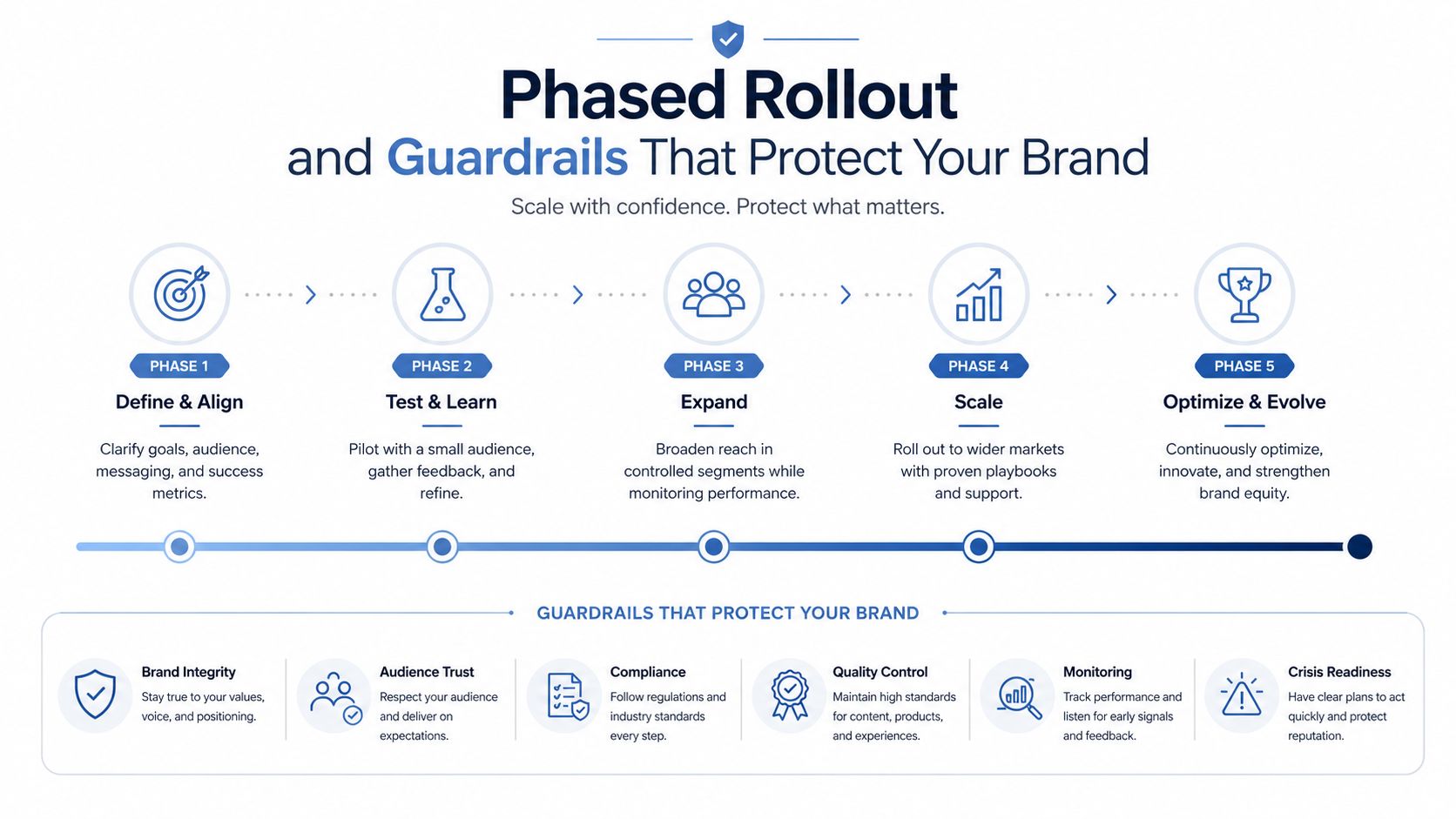
Speed without guardrails is how teams damage deliverability and erode brand trust. I prefer a staged rollout because it surfaces weak spots before they harden into process. Start with human review, move to tightly controlled automation, and watch the system closely at every step.
Roll out in phases, not all at once
A practical pilot begins with humans reviewing drafts and target lists in the early weeks, then expands into controlled outreach automation once the inputs are stable. Track deliverability, reply quality, and sentiment as the system starts to run. That rollout pattern protects the brand while the agent stack learns what good outbound looks like in your market.
The guardrails are operational, not abstract. Watch email deliverability. Track spam complaints. Review reply sentiment. Set override triggers so a human can stop sequences that start sounding repetitive, off-brand, or too aggressive for the segment.
Compliance and quality drift are operational issues
CAN-SPAM, GDPR, and LinkedIn automation limits shape how far you can push the system. If an agent starts over-segmenting or stuffing messages with personal details, prospects feel the mismatch quickly. They may not know the mechanics, but they know when outreach sounds assembled from a template instead of written for the conversation.
HubSpot's Agent Hub documentation shows where the software side is heading, toward configurable agents, custom workflows, and managed AI context. That is the direction I would plan around. More control over context. More explicit management of knowledge and instructions. Less blind automation.
The feedback loop should stay simple. Track which drafts get edited, which message types get the most replies, and which prospects convert after agent-assisted contact. If quality slips, check the input data first, then the prompt, then the workflow design. The problem is usually in the pipeline feeding the model, not the model itself.
Where Automation Wins and Where Humans Still Matter
The cleanest framework I use is this. Automate repetitive top-of-funnel work, keep humans in the moments that shape trust. That split is what protects reply quality and brand reputation while still letting the system scale.
Let agents handle the mechanical work
CRM automation is the safest entry point because it removes admin burden without changing the customer conversation too much. Lead enrichment is next. Outbound sequencing can also be handled well when the inputs are clean and the message structure is tightly controlled.
Qualification is different. So are complex negotiations and relationship-building. Those are the moments where tone, timing, and nuance matter more than throughput, and humans still outperform software in critical, high-value interactions.
Measure the system by revenue motion
After launch, I watch qualified pipeline, time-to-first-contact, lead-to-opportunity conversion, and cost per meeting. Those metrics tell you whether the system is creating actual commercial value or just more activity. If you're busier but not converting better, the automation is probably serving the wrong layer of the stack.
Watch for the warning signs too. Reply rates falling. Spam complaints rising. Prospects saying they've seen the same message before. Those are all signals that the agent needs retraining, better targeting, or a narrower use case.
The strongest operators treat AI as a force multiplier rather than a replacement. They use agents to cover the work that slows humans down, then let human sellers focus on the moments that close business. That's how you get the upside without handing your brand over to automation.
If you're building AI agents for sales prospecting right now, start with one clean ICP, one narrow workflow, and one measurable revenue goal. Get the data right, run a small pilot, and keep humans in the loop until the system proves it can protect deliverability and improve conversion at the same time.