
Sales and marketing are probably blaming each other in your company right now.
Marketing says sales ignores good leads. Sales says marketing sends junk. Leadership sits in the middle and wonders why pipeline looks noisy, forecasts slip, and conversion rates refuse to improve.
I've seen this pattern for years. It isn't a chemistry problem. It's a systems problem. If your revenue engine depends on hand-wavy definitions, tribal knowledge, and manual follow-up, you don't have alignment. You have leakage.
I treat sales and marketing alignment as an operating system. Shared targets. Clear handoff rules. Unified data. Automated routing. Tight feedback loops. When you build it that way, the finger-pointing stops because the system makes failure visible.
Stop Talking About Alignment and Start Building a Revenue Engine
The boardroom version of this problem is always the same. Marketing presents lead volume. Sales presents missed quota. Everyone nods along while the company keeps paying for inefficiency.
That's why I'm blunt about this. Sales and marketing alignment is not a culture initiative. It's a revenue system.
B2B organizations with tightly aligned sales and marketing functions achieve 24% faster three-year revenue growth and 27% faster three-year profit growth. The same research shows these companies see a 20% annual growth rate, while poorly aligned peers see a 4% decline, according to ZoomInfo's sales and marketing alignment statistics.
Those numbers tell you what matters. Better alignment changes growth, profit, and execution. It's not about getting two departments to like each other more.
The real problem is operational
Most companies still handle alignment with recurring meetings, vague shared goals, and a pile of disconnected tools. That approach fails because meetings don't fix broken routing logic, missing CRM fields, or inconsistent qualification criteria.
If marketing and sales define the market differently, use different dashboards, and judge success by different outcomes, conflict is the correct result. The system is producing it.
Practical rule: If two teams touch the same buyer journey but don't share definitions, response rules, and reporting, they are not aligned.
I've helped teams align sales and marketing by stripping the problem down to mechanics. Who counts as a fit account. What action qualifies a handoff. How fast sales must respond. What data travels with the lead. What happens when a rep rejects it. That's where revenue gets won or lost.
What I recommend instead
Build one commercial machine. It needs a few hard requirements:
- One revenue target: Marketing and sales should be accountable to the same business outcome, not separate vanity metrics.
- One buyer definition: Shared ICP, shared account rules, shared qualification logic.
- One handoff contract: Written SLA, enforced in your CRM.
- One reporting layer: A unified dashboard that shows stage conversion, velocity, and revenue impact.
- One automation layer: AI and workflow automation should handle enrichment, routing, and context transfer.
Founders typically get stuck. They keep trying to coach around structural flaws. You can't coach your way out of a bad system.
You need to engineer the system so the right behaviors become the default. Once that happens, alignment stops being a debate and starts behaving like infrastructure.
The Blueprint Define Shared Revenue Goals and KPIs
Quarterly planning starts. Marketing presents lead targets. Sales presents quota coverage. Finance asks how any of it connects. Two weeks later, both teams leave with different scoreboards and the same problem. Pipeline misses.
That is not an alignment issue. It is a system design failure.
I fix this by setting one commercial model first, then forcing every metric underneath it to support revenue. If you skip that step, you get busy teams, noisy dashboards, and weak pipeline quality hidden behind activity.
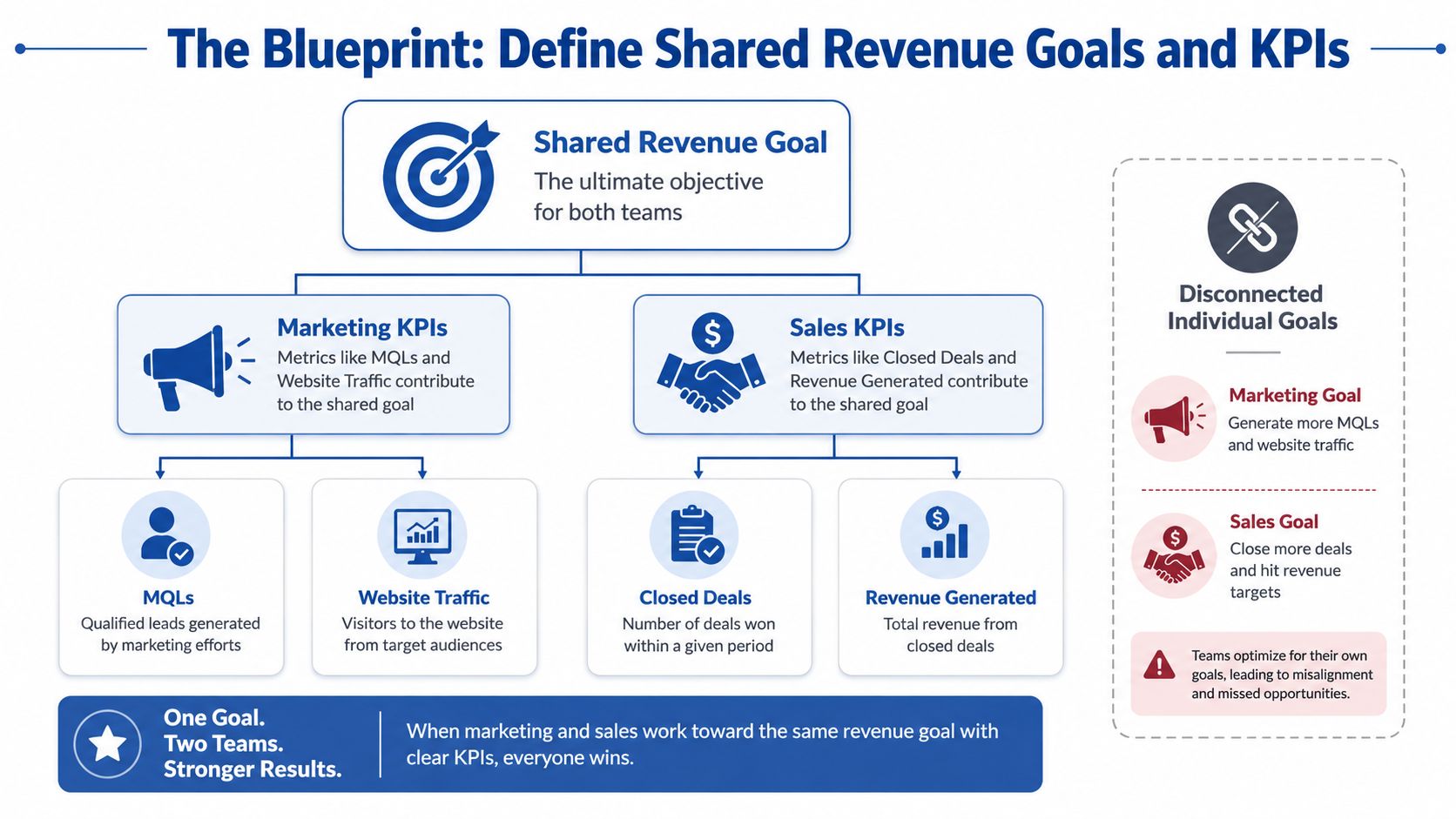
Build the KPI stack from revenue down
Start with the number the business cares about. Then work backward into the inputs required to produce it.
I use a descending model because it exposes nonsense fast. If a team cannot show how its metric contributes to pipeline creation, conversion, or revenue, that metric does not belong at the top of the dashboard.
Here's the structure I recommend:
| Level | What it answers | Primary ownership |
|---|---|---|
| Shared revenue goal | What outcome the business must hit | CEO, CRO, CMO |
| Pipeline requirement | How much qualified pipeline is needed to hit the number | Sales and marketing leadership |
| Funnel conversion metrics | Which stages are slowing growth or killing yield | Revenue ops, sales leaders, marketing leaders |
| Execution metrics | What work must happen each week to support the model | SDR leaders, campaign managers, AEs |
This order matters.
A lot of leadership teams start at the bottom. They ask for more leads, more meetings, more campaigns, more outbound volume. That creates motion, not performance. If conversion rates are weak or account quality is poor, more activity just feeds waste into the machine faster.
Choose KPIs that force shared ownership
You do not need a long list. You need a small set of metrics that both teams can affect and neither team can hide from.
My baseline KPI stack is simple:
- Revenue target
- Qualified pipeline value
- Opportunity conversion rate
- Sales cycle length
- Revenue attribution
- Lead-to-opportunity velocity
Those six metrics do two jobs. They show whether demand is turning into real pipeline, and they show where the revenue engine is breaking.
That is the point. Alignment should create commercial accountability, not polite cooperation.
Your dashboard should make it obvious when marketing is generating volume without fit. It should also make it obvious when sales is sitting on viable demand, working the wrong accounts, or rejecting handoffs without evidence. Shared KPIs change behavior because they remove room for storytelling.
Keep team metrics in their place
I still track tactical metrics. I just refuse to let them run the company.
Marketing should watch campaign engagement, source mix, conversion by channel, and account penetration. Sales should watch response time, meeting quality, stage progression, and rep-level conversion. But those are supporting metrics. They are not the goal.
If your reporting model gives equal weight to email opens and sourced revenue, you built a reporting system that rewards distraction.
I also recommend mapping each tactical metric to one shared KPI. That sounds basic, but very few teams do it. Once you make that link explicit, bad metrics die quickly because nobody can defend them.
If you need a practical model for building those links into automation and reporting, study these marketing automation workflow examples. They show how to connect execution data to pipeline outcomes instead of trapping it inside channel reports.
What leadership needs to enforce
This part is simple. One planning process. One revenue target. One metric language.
I have seen founders tolerate separate scoreboards because it feels easier in the short term. It is expensive. Marketing protects MQL volume. Sales protects close rate. Ops gets stuck reconciling definitions after the quarter is already lost.
Strong leadership removes that option. You set shared targets at the top, tie compensation and reporting to the same model, and review performance through pipeline movement and revenue contribution. That is how alignment stops being a meeting topic and starts producing money.
The Handshake Protocol Designing Your SLA and Handoffs
A shared revenue target means nothing if the handoff between marketing and sales is sloppy.
This is the choke point. Leads die here. Context disappears here. Reps reset conversations here. Buyers feel the disconnect here.
Only 11% of companies have an effective audience overlap and hand-off process, and the operational benchmark to copy is a same-business-day outreach SLA with a checklist that includes source, content consumed, and intent score, according to Infuse's sales and marketing alignment best practices.
That should tell you two things. First, many teams struggle with this. Second, the fix is operational, not philosophical.
Treat the SLA like a contract
Your SLA is not a shared document that nobody reads. It is an internal contract that defines what marketing must send, what sales must do next, and what your CRM will enforce.
If it's not documented in the CRM, it's not real.
Here's the template I use.
| Category | Agreement Item | Owner | Metric / Definition |
|---|---|---|---|
| ICP fit | Minimum firmographic and account criteria | Marketing and sales leadership | Shared definition of target account and buyer role |
| Qualification trigger | What qualifies a handoff | Marketing ops | Agreed combination of fit, intent, and engagement |
| Required fields | Data that must travel with the handoff | Marketing ops | Source, content consumed, intent score, account context |
| Routing rule | Who gets the lead and under what conditions | RevOps | CRM-based territory, segment, or account owner logic |
| Response SLA | How fast sales must act | Sales leadership | Same-business-day outreach |
| Acceptance rule | What counts as accepted by sales | Sales leadership | Logged follow-up or status update in CRM |
| Rejection rule | Valid reasons for rejecting a handoff | Sales and marketing leadership | Standardized rejection codes with notes |
| Recycling path | What happens to rejected or stalled leads | Marketing ops | Automated return to nurture or requalification flow |
The checklist matters more than the meeting
A lot of companies think a weekly sync will fix handoff problems. It won't. A rep can't act on vague handoffs.
I want every routed lead or account to include enough context so sales can continue the conversation without starting from zero. At minimum, capture the source, last meaningful engagement, content consumed, buying role, account context, and intent signal.
If sales has to hunt for context across email threads, call notes, and separate platforms, your handoff is broken even if everyone says the process is fine.
Design rejection rules carefully
Most rejected leads are invisible learning opportunities. Companies waste them.
Don't allow free-text excuses as the primary feedback mechanism. Use standardized rejection reasons. Not ICP. No active priority. Wrong contact. Duplicate account. Bad timing. Already in sequence. Then require notes where needed.
That gives marketing something usable. It also exposes whether sales is rejecting leads because of quality or because reps don't trust the process.
For teams building this into workflow logic, these marketing automation workflow examples show the kind of operational structure you want. The point is simple. The handoff should run because the system is designed well, not because one good manager keeps chasing people.
What not to do
Don't overcomplicate the first version. I've seen teams create giant SLA docs full of exceptions and edge cases. Nobody follows them.
Start with a compact rule set:
- define fit
- define trigger
- define required fields
- define routing
- define response time
- define rejection reasons
Then enforce it through CRM fields, workflows, and reporting. Operational discipline beats theoretical elegance every time.
The Central Nervous System Unifying Data and Reporting
Monday morning. Marketing walks into the pipeline meeting with one dashboard. Sales brings another. Both sides have numbers. Neither side trusts the other. You do not have alignment. You have a reporting failure that will keep costing you revenue until you fix the system underneath it.
I fix this by building one shared revenue view. One set of definitions. One funnel. One reporting layer that tracks the path from first touch to closed won, without each team filtering reality to protect its own story.
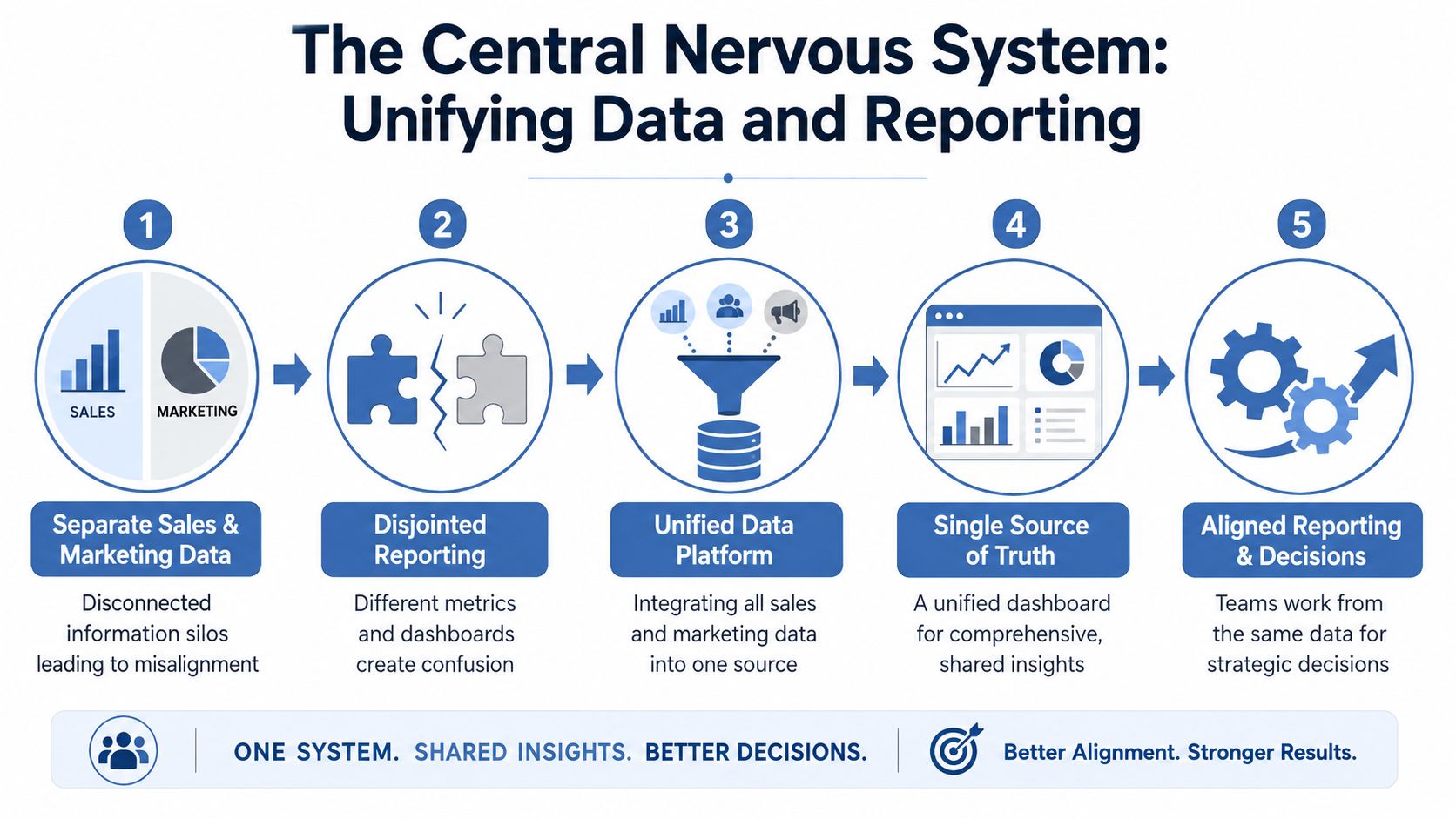
Separate reports create political noise and bad decisions
Once sales and marketing pull from different tools, date ranges, field logic, or attribution models, the meeting stops being commercial and turns into arbitration. Marketing argues for campaign influence. Sales dismisses the leads. RevOps burns time reconciling definitions instead of improving conversion.
That is a systems problem, not a culture problem.
Shared reporting changes the conversation. You stop asking who is right and start asking where the engine is leaking revenue. That is the point of alignment. Not harmony. Output.
What the shared dashboard must show
I do not want dashboards packed with vanity metrics. I want a diagnostic layer that helps you spot friction fast and act on it in the same week.
Your primary view should cover:
- Pipeline value by source, segment, and owner: This shows where real revenue potential enters the system.
- Stage-to-stage conversion rates: This exposes exactly where qualification, messaging, routing, or follow-up breaks down.
- Time in stage and total sales cycle length: This shows where deals stall after handoff.
- Revenue attribution: Use it to make budget decisions, not to win internal arguments.
- Lead and opportunity aging: This reveals ignored records, weak routing, and rep delay.
- Acceptance and rejection trends: This tells you whether the handoff rules are working in practice.
If a metric does not help you diagnose a bottleneck or allocate budget better, remove it.
Build one operating view, then let teams drill down
The shared dashboard is the executive layer. Sales and marketing can still have team-specific views, but those views must roll up into the same funnel logic. If marketing reports on MQL volume while sales reports on created opportunities and neither view reconciles cleanly, you built two scoreboards for one game.
I have seen this mistake over and over. Teams buy more tools, add more attribution models, and produce cleaner charts that still do not answer the only question that matters. Is the revenue engine getting stronger or weaker?
That answer should be obvious in minutes.
Use the dashboard in a weekly operating review
A dashboard no one uses is decoration. Put it in a weekly review with sales, marketing, and RevOps looking at the same numbers and answering the same three questions:
- Where is conversion dropping?
- Where is velocity slowing?
- Which sources, segments, or reps are creating avoidable delay?
That meeting should end with decisions. Reassign budget. Fix routing rules. Tighten stage criteria. Retrain reps. Update lifecycle logic. Shared data matters because it supports fast correction, not because it makes reporting look tidy.
Blame drops fast when everyone is held to the same funnel math.
If you need a practical filter for deciding which metrics belong in that shared operating layer, use this framework for measuring marketing effectiveness across the full funnel. It will help you cut clutter and keep the dashboard tied to revenue.
My bias on tooling
I do not care whether you run this in HubSpot, Salesforce, or a warehouse-first stack. I care that the definitions stay fixed, the syncs are reliable, and the reporting logic does not change by department.
Alignment fails when the system allows multiple truths. Build one reporting spine for the revenue team, then automate the data flow into it. Once that spine is in place, you can improve forecasting, attribution, routing, and planning without restarting the same argument every quarter.
The AI Accelerator Automating Lead Intelligence and Routing
Here, most companies can create a real edge.
Once you've got shared goals, SLA logic, and unified reporting in place, AI stops being a shiny object and starts becoming infrastructure. I've been implementing machine learning systems since 2016 and generative AI systems since 2019, and the pattern is consistent. AI works best when it's attached to a clear commercial workflow.

Where AI actually helps
Don't use AI to paper over bad process. Use it to speed up good process.
In this context, I care about four jobs:
- Lead enrichment
- Intent interpretation
- Routing and prioritization
- Rep assistance at handoff
A manual team can do all of that, badly and slowly. AI can do it consistently if the workflow is well defined.
Here's a practical example. A lead hits your site, engages with high-intent content, replies to a nurture email, and appears in your CRM with incomplete context. A basic automation would assign the lead based on territory. A better AI-assisted system enriches the account, classifies the buyer role, summarizes engagement history, detects buying signals from unstructured text, and routes the record with a recommended next action.
That's useful. It saves rep time and improves follow-up quality.
Build AI into the handoff, not around it
The biggest mistake I see is treating AI as a separate layer that generates “insights” nobody uses. I want AI embedded in the workflow the rep already lives in.
That means your system should do things like this:
- Summarize buyer context: Pull together recent content consumption, campaign touches, account notes, and prior outreach.
- Classify intent from messy data: Email replies, form text, and call transcript snippets are full of usable signals.
- Prioritize queues: Surface the next best lead or account based on the rules you've already defined.
- Draft first-touch messaging: Give the rep a strong starting point tied to actual context, not generic templates.
If you're exploring that model, this guide on AI agents for sales lays out the practical architecture. One option in this category is the workflow design and advisory work I do through Samuel Woods, which focuses on AI agents, automation, and context engineering inside real revenue systems.
Field note: AI should reduce decision latency. If it adds another review step, you built the wrong thing.
The constraint most leaders miss
AI is not magic lead scoring. If your CRM is full of bad fields, your qualification logic is weak, and your reps ignore routing, AI will automate chaos.
That's why I push sequence over enthusiasm:
- first fix definitions
- then fix routing
- then add enrichment
- then add AI classification and drafting
Only after the underlying process is stable should you trust autonomous actions.
Here's a useful primer before you implement any of this:
When not to use AI here
If your lead volume is low and your process is still changing weekly, don't rush into heavy AI orchestration. You'll spend more time reworking prompts, rules, and handoff logic than you'll save.
Also, don't let AI overwrite human judgment for strategic accounts. Reps still need to decide how to approach nuanced opportunities. AI should narrow the field, package context, and remove admin drag. It should not pretend to be your best AE.
The competitive advantage comes from response speed and context quality. The company that reaches the buyer quickly with the right message has a structural advantage over the company that responds later with a generic email.
Making It Stick Change Management and Continuous Optimization
Most alignment projects fail after the kickoff.
The playbook gets documented. Dashboards get built. Workflows go live. Then human behavior drifts back to old habits. Reps skip fields. Marketers loosen qualification. Leadership stops reviewing the funnel. The system decays.
That's why change management matters more than the rollout.
Expect resistance and manage it directly
You will hear familiar complaints. Sales will say the new rules slow them down. Marketing will say the qualification standard is too strict. RevOps will get dragged into every exception request.
Don't overreact. Friction at this stage usually means the system is exposing ambiguity that used to stay hidden.
Influ2 reports that only 11% of companies have successfully aligned their marketing and sales audiences and built an effective hand-off process. For those that do, marketing can influence up to 29% of pipeline, according to Influ2's alignment research.
That's why I push leaders to hold the line. The payoff sits on the other side of operational discipline.
Put governance in writing
You need named owners, not good intentions.
I recommend a compact governance model:
- Executive sponsor: One leader who can break ties and enforce priorities.
- Weekly operating review: Non-negotiable meeting around the shared dashboard.
- Monthly process review: Evaluate rejected leads, routing issues, and field compliance.
- Quarterly model reset: Revisit ICP assumptions, messaging drift, and handoff criteria.
The companies that treat sales and marketing alignment as a one-time setup always slide backward. The teams that win treat it like product development. They iterate.
Review rejected leads together. Not to assign blame. To improve targeting, qualification, and follow-up logic.
Expand alignment beyond acquisition
A lot of companies stop at pipeline creation. I think that's short-sighted.
Your revenue engine doesn't end at closed-won. If sales promises one thing, marketing says another, and onboarding delivers a third experience, you've built churn into the system. The more mature model carries alignment into post-sale communication, retention, and expansion.
That's especially important in SaaS and subscription businesses where account growth matters as much as net-new acquisition. A clean handoff into customer success, shared visibility into customer context, and coordinated expansion plays are all part of the same operating system.
The standard I use
If the system is healthy, you'll see a few behaviors become normal. Sales follows up quickly because routing is clean. Marketing refines campaigns using actual rejection feedback. Leadership looks at one dashboard. Customer context survives each stage transition.
That's the bar.
If you want sales and marketing alignment to produce revenue instead of meetings, build it like infrastructure. Shared goals. CRM-enforced handoffs. Unified reporting. AI-assisted routing. Weekly operating discipline.
That's the playbook I use because it works in practice. Not in workshops. In companies that need pipeline, speed, and commercial clarity.