
Most advice on risk taking in business is weak.
It tells you to reduce exposure, stay cautious, validate everything forever, and avoid mistakes. That mindset builds polite companies that get outpaced by sharper competitors. I don't advise founders that way.
I advise them to treat risk as a system. Something you can model, pressure-test, automate, and use offensively.
I've worked with machine learning since 2016 and generative AI since 2019. The pattern is consistent. The companies that win don't avoid uncertainty. They build mechanisms to move through it faster than everyone else.
Your Competitors Are Playing Not to Lose You Should Play to Win
A lot of founders confuse caution with competence.
They're careful with product launches. Careful with hiring. Careful with new channels. Careful with automation. Then they wake up and realize a competitor with worse branding, worse messaging, and worse ops just took the category lead because they moved first and learned faster.
This is the core issue. Not risk itself. Bad risk management.
46% of small businesses fail due to incompetence in managing risks (entrepreneurscan.com). Read that again carefully. The problem isn't that they took risks. The problem is that they handled them badly.
Why timid companies lose anyway
If you refuse to make bold bets, you don't eliminate downside. You just accept a slower, quieter version of it.
You miss the distribution shift in your market. You keep manual processes while a competitor automates them. You delay product expansion until somebody else owns the customer relationship. That's still a risk. It's just passive risk, and passive risk is harder to detect because it feels responsible.
Practical rule: If your current strategy mostly protects existing revenue, you're probably underinvesting in future advantage.
I see this all the time with AI. Teams say they want innovation, but they only approve projects with guaranteed outcomes. That means they never build the data, workflows, or internal capabilities required to compound. They end up buying generic tools, copying generic prompts, and calling that transformation.
It isn't.
Risk is a weapon when you can measure it
The founder who wins doesn't ask, "How do I avoid risk?" They ask, "Which risks create asymmetrical upside, and how do I limit the blast radius if I'm wrong?"
That's a much better question.
It changes how you approach product decisions, channel expansion, pricing tests, AI agents, partnerships, and hiring. Instead of treating every unknown as a threat, you start sorting unknowns into categories. Some should be rejected immediately. Some should be tested cheaply. Some should be attacked hard because the strategic upside is too large to ignore.
If you want a useful operating layer for that, study competitive intelligence best practices to dominate in 2026. The value isn't theory. It's the discipline of turning external signals into better decisions before your competitors do.
My stance
I want you to become harder to beat, not merely harder to damage.
That requires aggression with discipline. You need to place more informed bets, gather feedback faster, and shut down weak bets without ego. That's what modern risk taking in business should look like.
Not gambling. Not paralysis.
A repeatable system for taking bold shots while weaker operators are still asking for certainty.
The Four Arenas Where You Place Your Bets
Most founders make risk harder than it needs to be because they don't classify it properly.
They throw every hard decision into one mental bucket. That's sloppy. When you separate risk into arenas, your decision-making gets cleaner, your mitigation gets more precise, and your team stops talking past each other.
73% of firms globally identify economic uncertainty as their biggest risk (procurementtactics.com). That's exactly why classification matters. When the outside world gets unstable, you need to know where your internal bets sit.
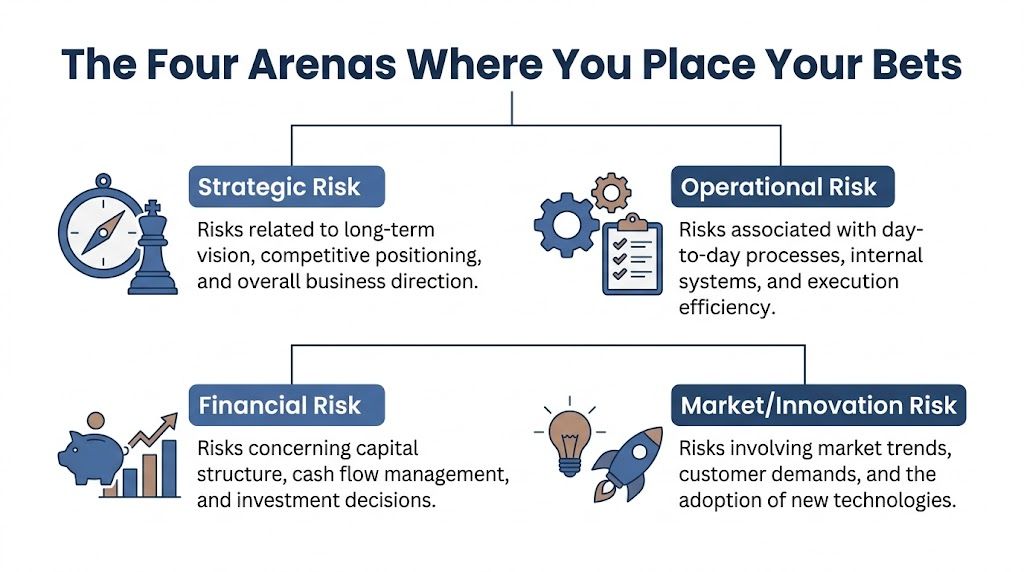
Strategic risk
This is the big one. Direction.
Strategic risk shows up when you enter a new market, change your positioning, acquire a company, pivot your product, or rebuild your business model around AI. If you're wrong, the damage is broad because you've pointed the whole company in the wrong direction.
But this is also where market leaders are made.
A founder choosing to move from services into a software product is taking strategic risk. So is a SaaS company deciding to build an AI-native workflow while incumbents keep bolting features onto old architecture. You don't manage this by hiding from the decision. You manage it by forcing hard assumptions into the open before you commit serious resources.
Operational risk
This one lives in execution.
You redesign a fulfillment workflow. You replace a manual reporting process with an AI agent. You centralize support in a new helpdesk. You change sales handoff rules. Every one of those decisions creates operational risk because performance now depends on systems, people, and process behaving the way you expect.
Operational risk is where a lot of AI projects fail, often going unacknowledged.
Not because the model is bad, but because the inputs are messy, ownership is fuzzy, escalation paths don't exist, and nobody defined what happens when the automation makes a wrong call. Founders often underestimate this because the demo looked smooth.
It isn't enough for the workflow to be clever. It has to be governable.
Financial risk
This is capital allocation. Cash flow. Exposure.
You're taking financial risk when you hire ahead of revenue, finance inventory, sign a large software contract, or commit budget to a channel that hasn't proved itself yet. At such junctures, founders either gain advantage or suffocate the business.
I look at financial risk through one lens first. Optionality.
If this bet fails, do you still have room to move? If the answer is no, the bet needs a tighter structure. A staged release. A smaller initial commitment. A kill switch. Something that preserves your ability to recover and redeploy.
Market and innovation risk
This is the arena many organizations underplay until it's too late.
Customer preferences change. Competitors copy features. Distribution channels get crowded. New technology shifts buying expectations. Suddenly your offer isn't bad, but it feels dated.
Market and innovation risk matters because speed compounds here. The team that learns faster gets the strategic advantage, even if their first move isn't perfect.
A simple way to think about the four arenas:
| Arena | What you're betting on | Common founder mistake |
|---|---|---|
| Strategic | Direction | Confusing ambition with strategy |
| Operational | Execution | Automating chaos |
| Financial | Resource allocation | Committing too much too early |
| Market/Innovation | Relevance | Reacting after buyers have moved |
If you can't name the arena, you probably can't manage the risk properly.
When you look at risk taking in business through these four arenas, decisions become easier to price, test, and sequence. That's when risk stops being abstract and starts becoming useful.
How to Quantify the Upside Before You Commit
A bet feels dangerous when it's vague.
The fix isn't more meetings. The fix is forcing the idea through a decision framework before you burn money, team attention, or credibility. I use three layers for this. Start simple. Then get sharper.
Use a risk matrix first, but don't stop there
A basic matrix is useful because it forces a conversation around likelihood and impact.
That sounds obvious, but most leadership teams skip it. They argue from gut feel. One person says the idea is exciting. Another says it's risky. Nobody defines risky. That's amateur hour.
Here is a stripped-down version you can use fast.
| Risk Level | Likelihood | Impact | Action |
|---|---|---|---|
| Low | Low | Low | Monitor and proceed |
| Moderate | Medium | Medium | Add controls before launch |
| High | High | Medium or High | Test in a contained environment |
| Critical | High | High | Delay until assumptions change |
Use this when you’re reviewing something like an AI-led outbound campaign, a pricing change, or a product rollout.
But don’t worship the matrix. Its limitation is obvious. It helps you rank downside, but it doesn’t tell you whether the upside justifies the bet. For that, you need expected value thinking.
Use expected value to force economic discipline
Expected value is where founders stop sounding visionary and start sounding competent.
The principle is simple. Estimate possible outcomes, assign probabilities based on the best evidence you have, and compare likely upside against likely downside before acting. You’re not trying to predict the future perfectly. You’re trying to make a better decision than the founder who relies on instinct alone.
A practical formula:
Expected Value = sum of possible outcomes multiplied by their estimated probabilities
Let’s keep this qualitative since your exact numbers depend on your margins, deal size, and cycle length.
Say you’re considering an experimental AI-driven campaign. The upside case is meaningful pipeline creation, reusable audience insight, and faster learning on messaging. The middle case is modest learning with limited direct return. The downside case is wasted spend, weak lead quality, and team distraction.
Now score each case realistically. Not optimistically. Realistically.
Then ask:
- What evidence supports each probability
- What assumptions are fragile
- What cost is recoverable if I’m wrong
- What do I learn even in the weak outcome
- What follow-on opportunities open if this works
Most founders only ask the first question. Strong operators ask all five.
If your team struggles to connect campaign outcomes to business results, tighten that first with a measurement discipline. I wrote a practical guide on that here: https://samueljwoods.com/how-to-measure-marketing-effectiveness/
Run hypothesis-driven experiments before scaling
This is the most impactful move in the entire article.
Big bets shouldn’t begin as big bets. They should begin as tightly scoped experiments designed to answer one expensive question at a low cost.
Instead of saying, “Let’s replace half our support team with AI,” say, “Our hypothesis is that an AI agent can reliably handle a defined class of repetitive tickets, escalate edge cases cleanly, and free human staff for higher-value work.”
That’s a testable statement.
Then structure the experiment:
- Define the hypothesis: State what you believe will happen and why.
- Choose one narrow use case: Don’t test five variables at once.
- Set a success signal: Decide in advance what outcome earns the next tranche of trust.
- Cap the downside: Time-box it, limit exposure, and preserve rollback.
- Review fast: If the signal is weak, kill it. If it’s strong, expand carefully.
Small experiments don’t reduce ambition. They increase the quality of your ambition.
The point of risk taking in business isn’t to sound bold in a strategy deck. It’s to collect decision-grade evidence before you scale commitment. That’s how you move with speed without behaving like an idiot.
Your AI Playbook for High-Velocity Risk Taking
AI changes the speed of risk analysis.
That’s the key opportunity. Not prettier content. Not novelty demos. Better decision cycles.
The old model was slow. A team gathered market inputs, built a deck, debated assumptions, launched one careful test, waited, and called that rigor. The new model is faster because you can use reasoning models, agents, and automation to assess more scenarios, monitor more variables, and run more contained experiments without bloating headcount.

CEOs taking calculated risks achieve long-term success, yet most guidance ignores how AI can model these risks. AI can predict interconnected cyber and supply chain threats, which are chronically under-managed, enabling 10x faster decision-making (wgu.edu).
That last part matters. Faster decision-making is not a nice bonus. It’s a competitive edge.
Use LLMs to pressure-test strategic bets
I use tools like Claude, Gemini, and ChatGPT as structured adversaries.
Not as oracles. That’s where people go wrong.
Give the model a market hypothesis, your constraints, likely customer objections, current positioning, and a few competitor signals. Then ask it to generate failure modes, second-order effects, and scenario branches. Done properly, this surfaces assumptions your team would have missed because humans get attached to their own plans.
For example, if you’re considering a move upmarket, an LLM can help map the likely downstream risks across onboarding complexity, sales cycle friction, support burden, content requirements, and implementation readiness. You still own the judgment. The model accelerates the analysis.
Build agents that watch the market while you operate
A founder shouldn’t have to manually scan every market signal.
Agents prove useful. Set them up to monitor competitor messaging changes, review-site themes, category terms, customer feedback clusters, support pain points, channel performance anomalies, and internal process failures. Then route the findings into a decision workflow your team routinely uses.
That gives you a living risk system.
I recommend keeping the first version simple:
- Signal capture: Pull in competitor pages, campaign language, call transcripts, reviews, and support logs.
- Signal classification: Sort by strategic, operational, financial, or market risk.
- Escalation logic: Flag only meaningful changes so your team doesn’t drown in noise.
- Decision routing: Send the right issue to product, growth, ops, or leadership.
If you’re building that capability, this primer on Mastering AI Marketing Campaigns is useful because it stays close to execution rather than fantasy.
Automate experimentation loops
AI swiftly begins to provide substantial returns.
Let’s say you’re testing landing page messaging for a new offer. A traditional team writes a few variants, waits on approvals, launches slowly, and learns almost nothing. A stronger team uses AI to generate message angles, cluster them by buying motive, create draft variants, route them for human review, and launch controlled tests quickly.
That doesn’t mean you let a model spray nonsense directly into the market.
It means you compress the cycle between idea, review, deployment, and learning.
Here are the rules I use:
- Human approval before public release
- Narrow test environments before broad exposure
- Clear rollback conditions
- Consistent measurement across variants
- Post-test synthesis so the learning compounds
If you want to understand how I think about this operationally, start here: https://samueljwoods.com/ai-agents/
A quick visual helps. This breakdown gets into the mechanics of using AI systems in marketing workflows.
Where not to use AI for risk decisions
Don’t use AI to hide weak leadership.
If your data is poor, your ownership is unclear, or your team won’t act on the output, adding AI just creates faster confusion. Also, don’t hand final judgment on reputation-sensitive decisions to an unsupervised system. Brand, legal, compliance, and customer trust still require human accountability.
AI should reduce uncertainty in the decision process. It should not replace responsibility.
That’s the playbook. Use AI to widen scenario coverage, increase signal detection, and accelerate learning loops. Then use human operators to make the actual bet.
Calculated Bets That Paid Off
Most founders say they want innovation. Fewer build the operational discipline that lets innovation produce results.
That’s the difference between random experimentation and calculated risk. The former burns energy. The latter compounds advantage.
Empirical studies show risk-taking positively mediates the link between professionalization and technological innovation, boosting firm performance with an explained variance of 29.6% (pmc.ncbi.nlm.nih.gov). I like this finding because it matches what I see in practice. Structured teams make better bets, and better bets create real momentum.
Netflix and the strategic bet that redefined the business
Netflix is a useful example because the move to streaming wasn’t just a technology update. It was a strategic risk.
The company moved away from the old distribution model and committed to a future that could have cannibalized its existing business. That takes nerve, but nerve wasn’t the important part. The important part was willingness to place a directional bet before the old model fully broke.

They weren’t taking risk for the sake of drama. They were responding to where customer behavior and technology were going. That’s what strong strategic risk looks like. You move before consensus makes the move feel safe.
A SaaS team I advise and the operational bet that unlocked growth
I’ll keep this one qualitative because client specifics matter.
A SaaS company I worked with had a familiar problem. Support demand was growing, response quality varied by agent, and leadership was hiring around inefficiency instead of fixing it. The safe move would have been adding more people and revisiting systems later.
I pushed them in a different direction.
We identified a narrow class of repetitive support interactions, built an AI-assisted workflow around that scope, defined escalation paths for ambiguity, and reviewed outputs tightly in the early phase. That was an operational risk. If the workflow failed, they could frustrate users and create internal distrust.
Instead, the opposite happened.
The automation handled the repetitive layer consistently, human staff focused on complex customer situations, and the company gained room to reallocate attention toward growth initiatives. This was the primary achievement. Not automation theater. Resource redeployment.
If you’re thinking about similar moves, these examples of practical implementations will help: https://samueljwoods.com/ai-agent-use-cases/
What these bets had in common
They weren’t reckless. They were structured.
- Clear thesis: Each move had a reason beyond hype.
- Defined scope: Nobody tried to transform everything at once.
- Operational follow-through: The system around the bet mattered as much as the bet itself.
- Learning speed: Evidence came back fast enough to inform the next move.
Winning bets usually look obvious in hindsight. They rarely feel comfortable in real time.
That’s why founders who rely on comfort lose. Risk taking in business works when you combine conviction with process. Without process, you’re guessing. Without conviction, you’re stalled.
Building Your Safety Net for Monitoring and Mitigation
The strongest risk-takers I know are not reckless people.
They’re people with better safety systems.
That matters because bold decisions create pressure on the team. Pressure on judgment. Pressure on process. Pressure on morale. If you don’t account for that, your company starts confusing intensity with progress.
Psychosocial factors like burnout are a major, under-explored risk. Tech founders in high-pressure AI environments report 40% higher burnout rates (pmc.ncbi.nlm.nih.gov). Ignore that and you’ll sabotage your own execution capacity.
Install tripwires before launch
Every serious bet needs predefined tripwires.
A tripwire is a condition that forces review. Not a vague feeling. A concrete signal your team agrees on before the project goes live. If the signal appears, you pause, diagnose, and decide whether to continue, adjust, or shut the thing down.
Your tripwires might include:
- Quality failure: Output degrades beyond the acceptable threshold for customer-facing work.
- Escalation breakdown: Human handoff stops working cleanly.
- Team overload: Operators spend more time babysitting the system than benefiting from it.
- Customer friction: Complaints cluster around a specific workflow or promise.
Teams under pressure rationalize problems. Tripwires remove some of that bias.
Protect your people, not just the balance sheet
Founders usually build financial contingency plans first. Good. You should.
But if you ignore founder fatigue, team anxiety, or fear around visible failure, your risk system gets weaker. People stop telling the truth. They hide edge cases. They sand down bad news. Then you make decisions off distorted information.
I want the opposite culture.
I want operators who can say, “This experiment isn’t working the way we expected,” without thinking they’re volunteering for blame. Intelligent failure should tighten your systems, not poison your team.
My standard for healthy risk culture
A healthy team knows three things:
- What we’re testing
- What success looks like
- What happens if the test underperforms
Clarity lowers emotional drag.
When you build that kind of safety net, you increase your appetite for strong bets because your team trusts the process. That’s the paradox. Monitoring and mitigation don’t slow down risk taking in business. They make better risk possible.
Your Questions on Business Risk Answered
Founders usually push back in three places. Budget. Governance. Fear of looking reckless.
Good. Those are real concerns. They just shouldn’t stop you.
Isn’t this only for bigger companies
No.
The principle scales down better than commonly assumed because smaller companies can move faster and AI lowers the effort required to gather, summarize, and compare information. You don’t need a giant strategy team to classify a decision, pressure-test assumptions, run a contained experiment, and monitor the result.
What you do need is discipline.
Start with one decision that matters. One offer. One workflow. One channel test. One AI-assisted process. Smaller firms usually win here because they don’t have layers of bureaucracy slowing every move.
How do I get a board or leadership team to approve a risky project
Stop pitching the project as vision alone.
Bring a risk memo with a clear thesis, core assumptions, likely upside, likely downside, guardrails, and a staged rollout plan. Show that you’re not asking for blind trust. You’re asking for permission to run a controlled learning cycle.
A simple board-ready structure works well:
- The bet: State the move in one sentence.
- Why now: Explain why waiting creates its own risk.
- How we’ll test it: Show the contained first move.
- What we’ll monitor: Define your tripwires.
- What we’ll do if it fails: Prove that downside is managed.
That changes the conversation. You’re no longer selling excitement. You’re demonstrating command.
What’s the line between a calculated risk and a reckless gamble
A calculated risk has evidence, bounded downside, active monitoring, and a decision rule.
A reckless gamble has enthusiasm.
That’s the line.
If you can’t explain the assumptions, the exposure, the early warning signs, and the rollback plan, don’t call it strategy. Call it what it is. Hope. Hope is not a system.
The founder who dominates a market isn’t the one who avoids uncertainty. It’s the one who turns uncertainty into faster learning than everyone else.
That’s the standard I want for you and your team. Use risk deliberately. Model it. Test it. Watch it. Then press the advantage when the signal is real.