
Most businesses still think prompt engineering means finding a clever sentence to paste into ChatGPT. That's already outdated.
The market is moving too fast for that amateur view. The global prompt engineering market is valued at USD 505.43 million in 2025 and projected to reach USD 6703.84 million by 2034, with a 33.27% CAGR, according to Fortune Business Insights. That kind of growth doesn't happen because people got better at typing. It happens because businesses are turning prompting into infrastructure.
I've been working with ML since 2016 and generative AI since 2019. My blunt take is simple. If you're still treating prompting like a copywriting trick, you're building a toy. If you treat it like a control system for revenue, operations, and speed, you're building a competitive edge your competitors will struggle to copy.
Table of Contents
- Everyone Is Thinking About Prompting Wrong
- Prompt Engineering Is a Control Layer
- Why Better Prompts Produce Better Business Results
- From Prompt Crafting to Building Prompt Systems
- Prompting in Action: A Before and After Example
- Adopting Prompt Engineering to Win Your Market
- The Future Is Engineered Context
Everyone Is Thinking About Prompting Wrong
Prompt engineering decides whether AI becomes a business asset or a recurring source of rework.
Too many teams still treat prompting like a writing trick. They swap prompt templates in Slack, praise the person who gets a surprisingly good answer, and call that an AI strategy. That approach does not survive contact with real operations. Your lead research needs to be consistent. Your support classification needs to be reliable. Your outputs need to fit a workflow rather than look good once in a demo.
What wins is structure.
A business pulling ahead with AI is usually doing something much less glamorous than "better prompting." It is defining context, setting boundaries, specifying output formats, and routing responses into repeatable processes. That is a systems discipline. The prompt is one input inside that system.
| Approach | What happens |
|---|---|
| One-off prompting | Output quality swings from run to run, and staff spend time fixing it |
| Engineered prompting | Outputs follow a defined structure and can be reviewed faster |
| Prompt systems | AI work plugs into operations, scales across teams, and gets better over time |
This shift matters because the market is already treating prompt engineering as an operational capability rather than a novelty role. IBM frames prompt engineering as the practice of translating human intent into instructions models can execute with more accuracy and consistency in its explanation of prompt engineering. That definition is much closer to what you actually need to manage.
If you want proof in the market, look at where companies are spending. They are rolling out copilots, internal assistants, workflow agents, and unlimited AI agents tied to sales, service, research, and execution. None of that works well without disciplined prompt design. Once AI touches customer communication or internal decisions, variance becomes expensive.
Stop asking who writes the cleverest prompts.
Ask who owns AI reliability, output quality, and workflow fit. That is where prompt engineering is headed, and that is where the advantage starts.
Prompt Engineering Is a Control Layer
Prompt engineering is best understood as a control layer between human intent and model output.
IBM puts it clearly in its explanation of prompt engineering as a control layer. The job is to convert ambiguous human intent into model-consumable constraints such as role, format, scope, examples, and output structure. That's the part most people miss.
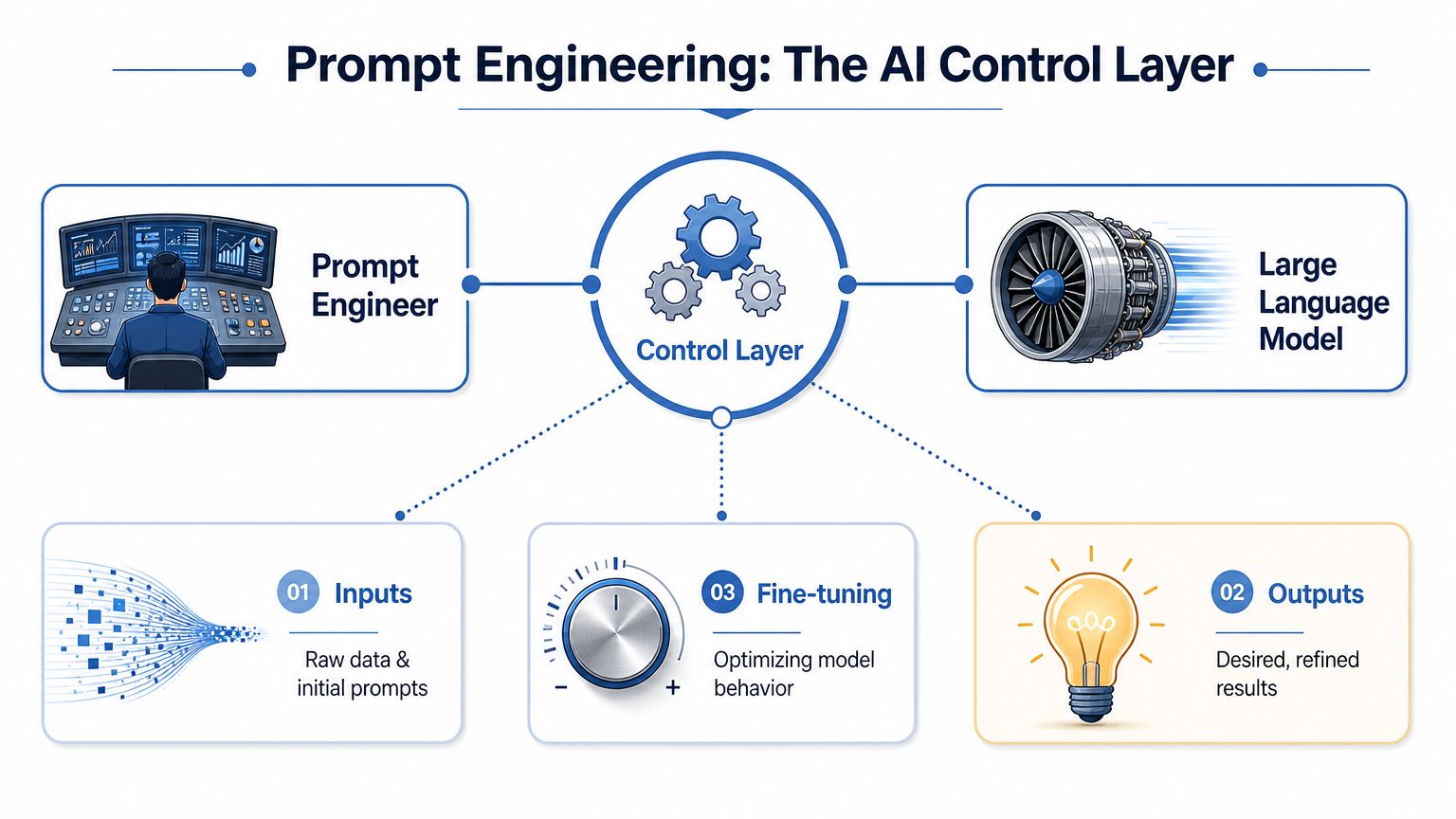
What the control layer actually controls
When I build AI workflows for companies, I don't start with "what should we ask the model?" I start with control points.
Those control points usually include:
- Define the role. Tell the model what function it serves. Market analyst, SDR assistant, support triage agent, compliance reviewer.
- Set scope boundaries. Limit the data it should use and the problem it should solve.
- Fix the output format. Force structure. JSON, bullet hierarchy, table, short summary, decision memo.
- Set success criteria. State what a good answer must include.
- Add examples. Show the pattern, especially when tone or categorization matters.
That's operational discipline.
A weak prompt says, "Summarize these reviews." A strong prompt says, "Act as a product researcher, analyze only the attached reviews from canceled customers, group complaints into themes, and return a structured output for the retention team." One gives you prose. The other gives you something a business can act on.
Why owners should care
Once you see prompting as a control layer, you stop treating AI like a chat interface and start treating it like a system component.
That's where products and workflows change. If you're building unlimited AI agents or even simple automations, the value lies in whether the system produces dependable outputs across repeated scenarios.
A practical rule: if a prompt can't be handed to someone else and used consistently, it isn't engineered well enough.
This is also where prompt engineering starts overlapping with product design. The prompt is now part instruction set, part interface contract, part quality-control mechanism. That's why serious builders create base prompts, testing rules, fallback paths, and approved output schemas.
If you want the shortest answer to what is prompt engineering, here it is. It's the discipline of controlling AI behavior well enough that the output becomes commercially useful.
Why Better Prompts Produce Better Business Results
Better prompts improve business results because they reduce ambiguity.
A vague request leaves the model too much room to guess. That guesswork shows up as generic messaging, missed constraints, inconsistent formatting, and extra editing time. The cost shows up as bad copy and as slower execution across the business.
Vague prompts create variable output
Take a common marketing example.
If you ask an LLM to "write an ad for our SaaS product," you might get something readable. You might also get bland positioning, the wrong customer pain point, and a CTA that doesn't match your funnel. The model has too many possible directions, so you get variance.
Now compare that with a structured prompt:
- The audience is SaaS founders with churn issues.
- The format is three Facebook ad headlines under 90 characters.
- The framework is AIDA.
- The pain point is revenue leakage from customer churn.
- The constraint is to avoid jargon and hype.
That second version narrows the possible output. The model is no smarter, but the task is clearer.
The fastest way to waste time with AI is to ask a broad question and then spend the next twenty minutes fixing the answer.
Structure turns AI into a production asset
This is why I tell teams to stop chasing "better outputs" and start chasing usable outputs.
A usable output has a destination. It goes into a CRM note, a dashboard, a content brief, a product feedback report, or a sales enablement doc. If the response arrives in the wrong shape, you have to reformat and reinterpret it, which kills the efficiency you thought AI would create.
Three practical upgrades usually matter most:
- Add business context so the model knows the goal, audience, and constraints.
- Specify the structure so the output can move directly into the next workflow step.
- Give examples when style, taxonomy, or decision criteria matter.
If you want more practical examples for campaign work, my guide on AI prompts for marketing shows the difference between loose prompting and performance-oriented prompt structure.
Here's the competitive angle. The business that gets cleaner first-pass outputs can test more angles, review more customer data, and ship decisions faster. Over time, that compounds into faster learning cycles. Your rival is still rewriting AI output by hand. You are already using the output to launch the next campaign.
From Prompt Crafting to Building Prompt Systems
The biggest shift happening right now is this. Prompt engineering is moving from a writing skill to a systems discipline.
That change matters because single prompts are fragile. A prompt that works in a chat window can fail when a model changes, when the input data gets messy, or when another team member uses it differently. Businesses need something sturdier than that.
Single prompts break easily
Most bad AI implementations look the same. Someone on the team finds a prompt that produces a decent answer. Everyone copies it. A month later, output quality drifts, nobody knows why, and trust in the system drops.
The root cause is design, and the prompt is only where it shows.
A single prompt usually fails for one of four reasons:
- Input varies. Real business data is messy, and the prompt wasn't built for edge cases.
- There is no evaluation loop. The team never defined what good output looks like.
- There is no modularity. Too many jobs were crammed into one instruction.
- There is no owner. Nobody maintains the prompt when needs change.
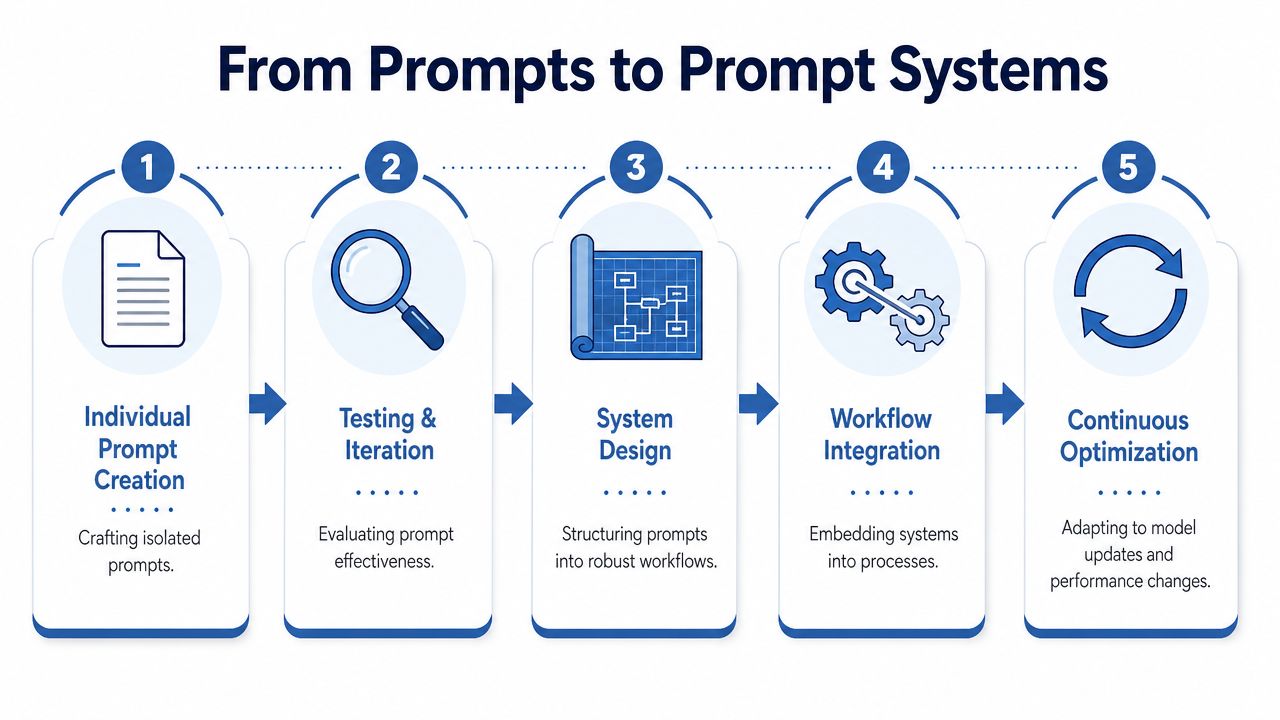
The workflow that actually works
For complex tasks, the strongest pattern is iterative decomposition. DataCamp describes it as a workflow of draft → test → evaluate → refine, and emphasizes breaking jobs into smaller steps and refining prompts based on failure modes in its guide to iterative prompt engineering workflows.
That's the professional standard.
Instead of asking one model prompt to do everything, break the work apart. If you're generating a customer retention campaign, don't ask for research, segmentation, messaging, and channel strategy in one shot. Separate the tasks.
A better workflow looks like this:
- Extract themes from customer feedback.
- Classify segments based on those themes.
- Generate messaging angles for each segment.
- Format assets for email, paid social, or SDR outreach.
- Review failures and tighten the instructions where the model drifts.
This is also why teams working with private deployments and local models need disciplined templates. If that's your environment, this guide to effective prompts for local models is worth studying because local setups punish sloppy instructions fast.
What a prompt system looks like in practice
A prompt system has components rather than text blobs sitting in a Notion doc.
It usually includes:
| Component | Purpose |
|---|---|
| Base prompt | Sets role, rules, tone, and core logic |
| Input schema | Standardizes what data enters the workflow |
| Output schema | Ensures consistency for downstream use |
| Test cases | Reveals failure modes before rollout |
| Evaluation rules | Defines whether the output is acceptable |
If you use Claude, structured system instructions matter a lot. My breakdown of Claude system prompts goes deeper on how to think about persistent behavior instead of one-off commands.
One more hard truth. Prompt systems aren't worth building for every task. If a task is rare, low-value, or highly subjective, manual work may still be cheaper. Use systems where output volume, repetition, and speed matter. Lead handling, content operations, support categorization, research synthesis. That's where the returns show up.
Prompting in Action: A Before and After Example
Theory is cheap. This is how it looks in a business workflow.
Say you run a SaaS company and want to understand why customers cancel. You have a batch of exit surveys, and you need something useful enough to influence retention strategy.

Before the vague request
The beginner prompt looks like this:
Summarize these customer exit surveys.
That sounds reasonable. It also invites a weak result.
The model will usually produce a soft paragraph with generic themes like pricing, missing features, and support concerns. That has some use, but it isn't decision-grade. You still have to read it, interpret it, count patterns manually, and turn it into something you can use for product decisions.
The problem is that you didn't specify the job.
What was missing:
- The role was unclear. Should the model think like a researcher, a support lead, or a founder?
- There were no process instructions. Should it cluster reasons, count mentions, or extract quotes?
- The output shape was undefined. Should it return prose, a table, or structured data?
- The business use case was missing. Is this for a slide, a dashboard, or internal analysis?
Without those constraints, you get a soft answer to a vague question.
After the engineered prompt
Now tighten it.
Tell the model it is a senior market research analyst. Instruct it to identify the top cancellation reasons, classify each survey under one category, and pull a representative quote for each reason. Then force the response into a JSON structure with fields for the reason name, count, and example quote.
That changes the result.
Now the output can feed a dashboard, a retention report, or a planning session without another person reprocessing the text. Instead of loosely "summarizing," the AI is performing a bounded analysis task in a way you can put to work.
A quick walkthrough helps if you want to see how this style of prompting gets applied in practice:
What changed between the before and after versions?
- The task became narrower.
- The output became structured.
- The model got a process to follow.
- The result became usable by other systems and people.
A good prompt improves the answer and reduces the amount of human cleanup required after it arrives.
That's the business test I care about: whether the output is ready for action, however impressive the wording feels.
Adopting Prompt Engineering to Win Your Market
Prompt engineering decides whether AI becomes a cost center or an operating advantage.
Treat it as a management system for AI behavior. If you use AI across sales, support, marketing, research, and operations, prompts set the rules for how work gets done, what format outputs follow, and how much rework humans need to do after the model responds.

Why this deserves your attention
The competitive question is simple. Can your business turn AI into a repeatable production system before your market catches up?
Saying "use ChatGPT more" won't get you there. It happens when you define where AI fits in the workflow, what good output looks like, which tasks need structured inputs, and how results get reviewed. Businesses that do this well move faster with less noise. They standardize research, speed up execution, and reduce the drag of low-value manual cleanup.
I see the same mistake over and over. Owners treat prompting like an informal writing habit instead of a design discipline. Then every prompt gets improvised from scratch, quality drops, and nobody trusts the outputs.
Fix that early.
How to operationalize it
Start with workflows that repeat every week and already consume expensive human time. Sales follow-up drafts. Support triage. Call summaries. Competitive research briefs. Proposal first drafts. Those are better starting points than flashy experiments because they produce measurable operational gains.
Then put structure around them.
- Assign an owner. One person or a small team should manage core prompts, output schemas, approval rules, and test cases.
- Standardize inputs. Define the fields, source data, and context each workflow requires so nobody is prompting from memory.
- Create prompt assets, not prompt scraps. Store approved prompts in a shared library with version history, examples, and known failure cases.
- Review output quality against business standards. Measure accuracy, formatting compliance, speed to usable output, and how often you still need to rewrite the result.
- Connect prompts to systems. Significant value comes when prompts feed dashboards, CRMs, ticketing systems, internal knowledge bases, or agent workflows.
- Audit failure patterns. Track where the model goes off course, then update instructions, context, or validation logic instead of blaming the model in general.
This is the shift that matters. Instead of collecting clever prompts, you are building a controlled layer between the model and the business.
That is how prompt engineering becomes a moat.
If you want the next step after prompt design, read this guide on context engineering vs prompt engineering. If you're already planning agent workflows, this resource for building effective AI prompts is worth reviewing because it connects prompt design to system behavior.
I offer strategy and implementation help with AI agents, prompt engineering, and business workflows. If you want that, contact me here.
One warning. Do not automate a broken process. If your qualification rules are vague, your naming conventions are inconsistent, or your source data is unreliable, AI will scale those mistakes with impressive speed.
The winners will be the businesses that turn prompt engineering into a repeatable operating discipline. The most creative prompts won't decide it.
The Future Is Engineered Context
Prompt engineering is the entry point, not the finish line.
Once you've learned to define roles, constrain outputs, and build testing loops, the next step is context engineering. That's where you decide what information the model should have at each moment, what tools it can call, and how it should move through a multi-step workflow without losing the business objective.
This is also where AI agents become practical. Agents become useful when you combine prompts with memory, retrieval, task boundaries, and evaluation logic. A dramatic prompt won't do it. If you're exploring that evolution, this resource for building effective AI prompts is useful because it pushes beyond prompt wording into system behavior.
For a deeper breakdown, I covered the distinction in my guide on context engineering vs prompt engineering.
My opinion is straightforward. If you master prompt engineering today, you are training for the bigger game. That game is engineered context, agentic workflows, and AI systems that can support execution at scale.
Skip becoming a prompt poet. Become a builder of reliable AI behavior.
That's the edge.