
You keep hearing about AI agents. You probably think they’re another overhyped chatbot. They aren’t.
I’ve been working with machine learning since 2016 and generative AI since 2019. I can tell you this shift is bigger and faster than anything I’ve ever seen. AI agents execute tasks that grow your revenue. Chatting is the least of what they do.
They actively recover abandoned carts. They personalize your store in real-time. They automate complex workflows that you’re currently paying people to do manually. That is where the money is.
Why Your Competitors Are Already Winning With AI Agents
Let’s cut right to it. Your competitors are already using AI agents to get ahead. It is happening right now, and it’s creating a gap between the winners and everyone else.
Businesses are deploying autonomous systems that act instead of only talking. I mean real, measurable results that directly impact the P&L.
Higher conversion rates. Bigger order values. Leaner support teams.
This article sticks to those results and skips abstract definitions.
The New Competitive Edge
To grasp the advantage, you have to understand the benefits of AI in ecommerce. Your rivals are already cashing in. Keeping up is no longer enough. You need systems that make you faster, smarter, and more profitable.
The power of an AI agent is its ability to perceive its environment, reason about what to do, and then act on a goal. It connects to your data (your Shopify store, your analytics, your CRM) and uses tools to get the job done. For a deeper look at the platforms making this possible, check out my guide on the best AI tools for ecommerce.
This diagram shows how agents deliver a three-pronged advantage. More revenue, more speed, more personalization.
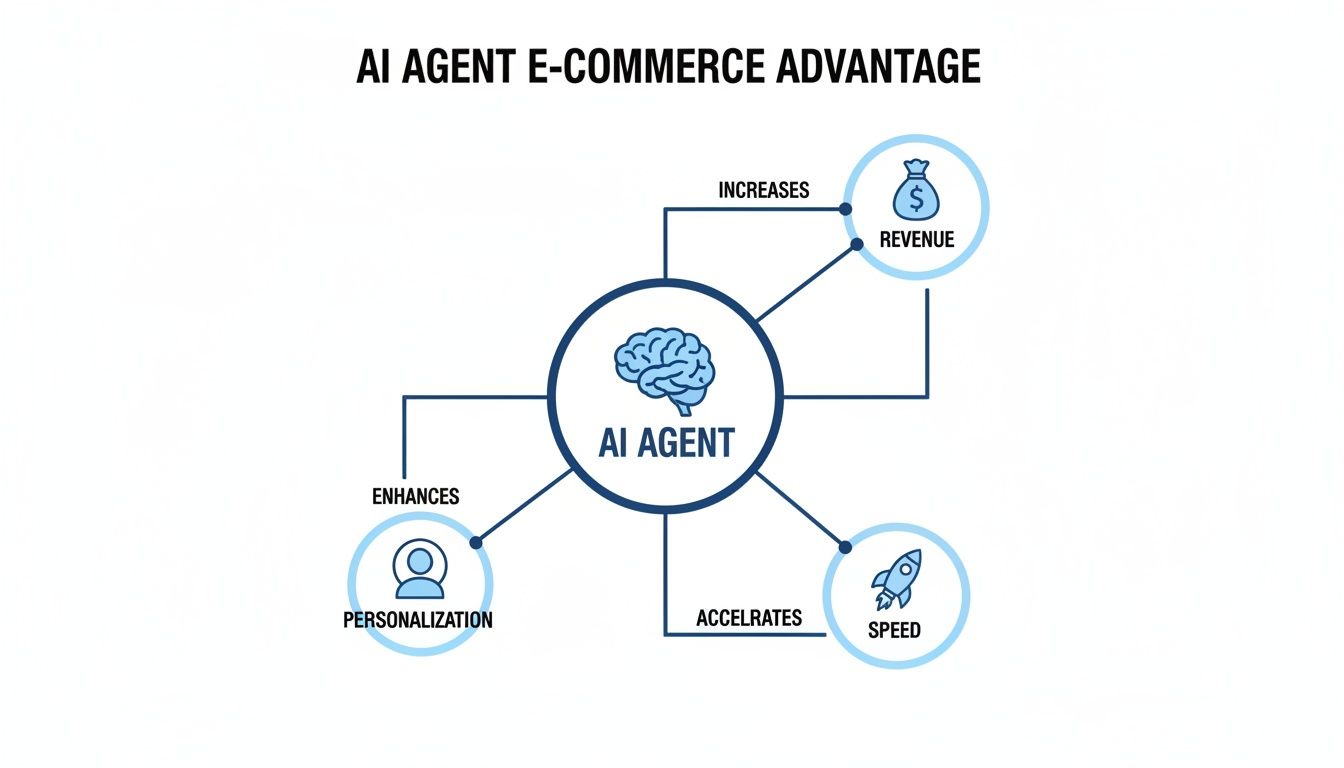
These pieces create a flywheel. Better personalization leads to more revenue. Faster operations let you outmaneuver everyone. Your rivals are building these flywheels while you’re still reading articles about them.
How AI Agents Actually Work in Your Ecommerce Store
Everyone wants to talk about what AI agents can do. Few can explain how they work without making your eyes glaze over. Let’s fix that.
Think of an AI agent as your most effective employee. One that works 24/7, analyzes data instantly, and executes tasks flawlessly based on a single goal you give it. Inside, it’s a system with a brain, senses, and hands, and each part is easy to follow.
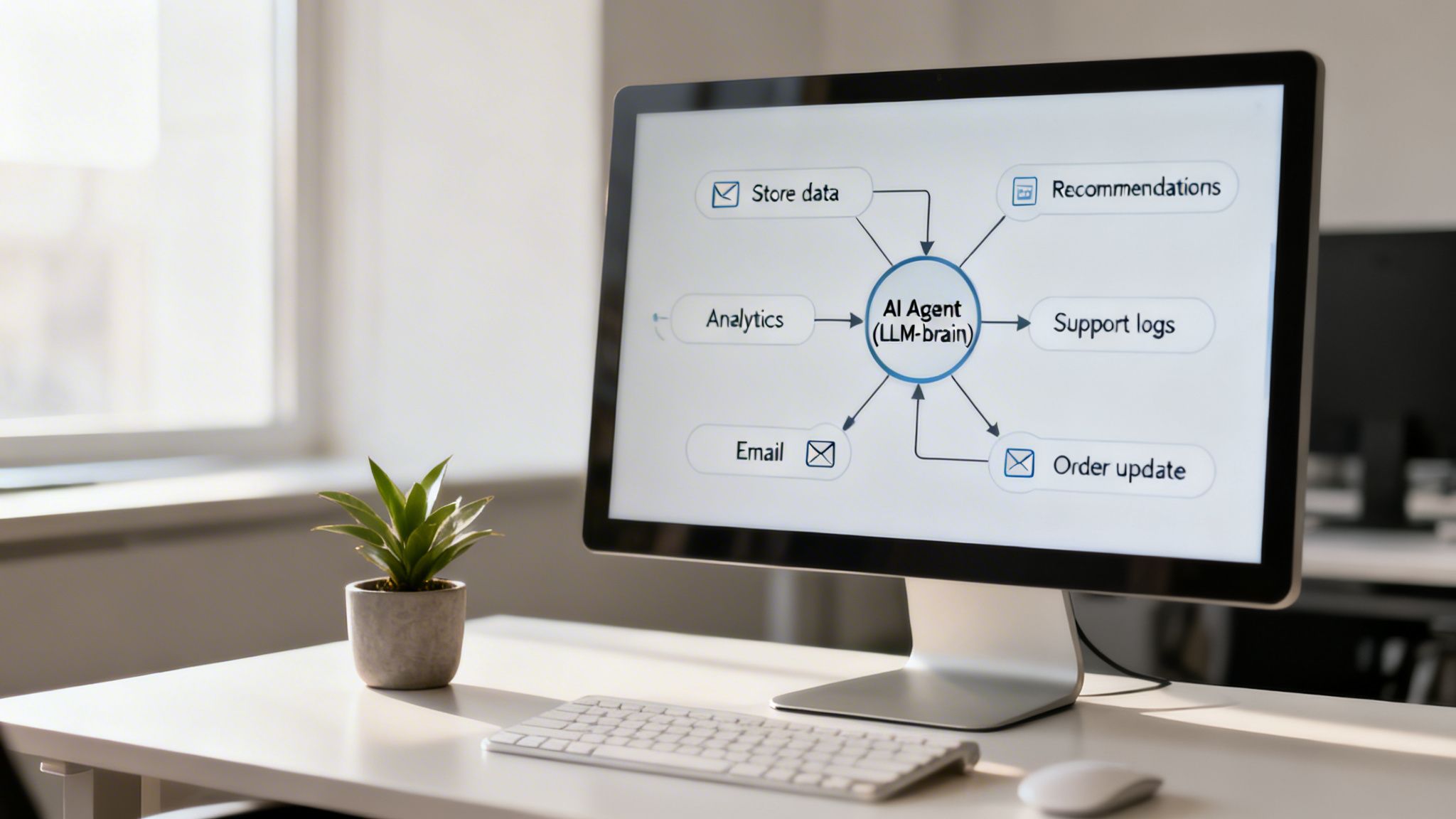
Understanding this architecture is the first step to deploying agents that generate ROI instead of tech demos that look cool but do nothing for your bottom line.
The Agent’s Anatomy Explained
I’ve built and deployed these systems for years. The most successful ones always have these three components working in perfect sync. If one part is weak, the whole system collapses.
-
The brain (the reasoning engine) is the Large Language Model (LLM) at the core, like OpenAI’s GPT-4 or Anthropic’s Claude 3. It’s the intelligence hub. It receives a goal, analyzes information, reasons through a problem, and creates a plan. Its only job is to think.
-
The senses are your data and context. An agent is blind and deaf without data. Its senses are your business systems: your Shopify store, Google Analytics, your CRM, and real-time inventory. This is how the agent perceives what’s actually happening in your business right now.
-
The hands are tools and actions. The brain and senses are useless if the agent can’t act. The hands are the APIs and tools the agent has permission to use to execute its plan. This could mean sending an email through Klaviyo, updating a product tag in Shopify, or creating a support ticket in Zendesk.
The magic is in the loop: perceive data, reason about it, and take an action. Then repeat, constantly optimizing toward the goal you gave it. This is what separates a true agent from a simple automation.
An Agent in Action: Cart Recovery
Let’s walk through a tangible example. A cart recovery agent. Its goal is simple: “Recover revenue from abandoned carts.”
Here’s the flow.
First, the agent’s senses detect an abandoned cart in your Shopify data. It pulls the customer’s profile, their past purchase history, and the specific items they left behind.
Next, the brain gets to work. It analyzes this data. Is this a high-value customer? Is an item low in stock? Based on this, it crafts a personalized strategy just for this one person.
Finally, the hands execute the plan. The agent uses your email tool’s API to send a highly personalized message. Not your generic “You left something behind!” email. A message that says, “Hey, we saw you were looking at the blue running shoes in size 10. We only have 3 left. Here’s a 10% discount to complete your order in the next hour.”
This is a logical, repeatable system. The competitive advantage becomes painfully obvious.
Manual vs AI Agent-Driven Ecommerce Tasks
| Ecommerce Task | Traditional Manual Approach | AI Agent Approach | Business Outcome |
|---|---|---|---|
| Personalized Offers | A marketer segments a list and blasts a generic coupon. | An agent analyzes a user’s real-time behavior and past history to generate a unique, time-sensitive offer. | Higher Conversion Rates: Offers are hyper-relevant and create real urgency. |
| Inventory Merchandising | A merchandiser manually creates a “Low Stock” collection once a week. | An agent constantly monitors inventory and automatically tags products with less than 10 units, pushing them to the homepage. | Increased Sell-Through: Moves inventory faster and prevents stockouts on popular items. |
| Customer Support Triage | A support agent reads a ticket, categorizes it, and assigns it to a team. | An agent reads the ticket, understands the intent, and instantly routes it to the correct department with customer data attached. | Faster Resolution Time: Customers get answers quicker, freeing up human agents. |
| Fraud Detection | A team manually reviews a list of flagged orders. | An agent analyzes dozens of data points per order in real-time, instantly flagging or approving. | Reduced Chargebacks: Catches fraud before fulfillment, saving significant revenue. |
As you can see, the agent-driven approach works differently from the old way. It creates a level of speed and personalization you could never achieve by hand.
Real-World Use Cases Driving Revenue and Efficiency
Theory is useless without application. Let’s get into the specific, money-making ways ai agents for ecommerce are working today. You and I are going to move far beyond the obvious chatbot.
I’ve seen these systems completely reshape how a business operates. They generate revenue, slash costs, and create a customer experience your competitors can’t replicate. This is where you build your advantage.

The Dynamic Merchandising Agent
Imagine an agent whose only job is to maximize the conversion rate of your collection pages. This agent goes well past “sort by best-selling,” which is amateur hour.
Instead, this agent senses the store’s environment. It pulls real-time traffic data, keeps an eye on competitor pricing, and checks your inventory levels. It synthesizes all this to make a strategic move.
For instance, if it sees a traffic spike for “summer dresses” and knows a competitor is out of stock, it instantly pushes your highest-margin dresses to the top of the collection. Or if a bestseller’s stock drops below 20 units, it nudges that product down the page to avoid a frustrating “out of stock” wall. It’s making merchandising decisions every minute.
In effect, it treats your category pages like living sales floors, constantly optimized for profit. I’ve detailed other systems in my overview of marketing automation workflow examples.
The Proactive Customer Service Agent
Bad things happen in ecommerce. Shipments get delayed. Products show up damaged. An agent changes how you handle these moments.
This agent plugs into your fulfillment and shipping data. It doesn’t wait for an angry customer to email “Where is my order?” It spots a delay before the customer knows there’s a problem. The second a package has been stuck for 48 hours, it acts.
The agent’s goal is to turn a negative into a loyalty-building moment. It proactively fires off an email, explains the delay, and immediately offers a 15% discount on their next purchase.
What was a guaranteed 1-star review just became a 5-star experience. The customer feels seen, you’ve prevented a support ticket, and you just locked in a future sale. This turns your cost center into a growth engine. Many real-world use cases show how AI agents can overhaul ecommerce and customer service.
The Post-Purchase Upsell Agent
Increasing Customer Lifetime Value (LTV) is the holy grail. An agent is much smarter than the generic “people also bought” widgets most brands use.
A Post-Purchase Upsell Agent digs into a just-completed order and the customer’s entire purchase history. Its mission: find the single best complementary product.
Say a customer just bought a high-end espresso machine. The agent identifies the perfect accessory: a specific brand of descaling solution that data shows is frequently purchased within 30 days by other espresso machine owners.
It then triggers a perfectly timed email seven days after delivery with a message like, “To keep your new espresso machine running perfectly, here is the cleaning solution our experts recommend.” This hyper-relevant offer can lift LTV by 5-10% from this segment alone. It reads as a helpful tip.
Your Step-by-Step Roadmap to Deploying Ecommerce AI Agents
Alright, let’s move from theory to practice. I’m giving you my proven, step-by-step roadmap to go from zero to deploying your first ecommerce AI agent. This is a practical plan for founders and small teams.
Follow these steps, and you’ll avoid the mistakes that cause most AI projects to fizzle out.

Step 1: Start with High Value and Low Complexity
This is the most important step. Most people get excited and try to boil the ocean. They want an agent that runs their entire business from day one. That’s how you get a $50,000 project that accomplishes nothing.
Pinpoint a single problem that is both valuable to solve and simple to execute. I call this the “value-to-complexity ratio.” The best starting points are repetitive tasks with a clear impact on revenue or costs.
Here are two perfect examples:
-
Recovering abandoned carts is the first. The goal is clear (get revenue back), the data is simple (cart contents, customer email), and the action is straightforward (send a personalized email). Success is easy to measure.
-
Answering top support questions is the second. Identify your top 3-5 most frequent support questions. An agent trained on your policies can answer these instantly, cutting ticket volume by 20-30% overnight.
Pick one. Your first agent is about proving the concept and building momentum.
Step 2: Get Your Data House in Order
An AI agent is only as smart as the data it can access. You have to ensure your data is clean, accessible, and structured. This doesn’t mean you need a perfect data warehouse. Just know where your key info lives.
For a typical ecommerce agent, this involves three things:
- Your agent needs your product catalog: product titles, descriptions, pricing, and inventory levels available via an API from Shopify or BigCommerce.
- It needs customer data, meaning purchase history and contact info. Is it in your ecommerce platform, a CRM like Klaviyo, or somewhere else?
- It needs a knowledge base with your FAQs, return policies, and shipping info. Consolidate it.
Think of it like preparing ingredients before you start cooking. Get your core “ingredients” (your product, customer, and knowledge data) ready and accessible.
Step 3: Select the Right Tools for the Job
The world of tools for ai agents for ecommerce is changing fast. You have a spectrum of options, from simple platforms to complex frameworks. The right choice depends on your team’s skills.
- No-code agent platforms are the best place for most businesses to start. New platforms let you connect your data and define goals through a simple UI. You can build that cart abandonment agent without writing code.
- For more custom needs, you can work directly with APIs from OpenAI or Anthropic and use frameworks like LangChain. This gives you total control but requires a developer.
My advice? Start with a no-code platform. Prove the ROI. Then, and only then, consider a custom build. For more context, read my guide on using AI agents for business growth.
Step 4: Run a Controlled Pilot and Measure Everything
Don’t unleash an untested agent on your entire customer base. You have to test it in a controlled environment.
First, define your Key Performance Indicators (KPIs). For a cart recovery agent, your main KPI is the cart recovery rate. Secondary KPIs might include the open rate and conversion rate from the agent’s emails.
Next, run an A/B test. Send 10% of your abandoned cart traffic to the new AI agent. The other 90% gets your existing recovery email. Run this for a few weeks and obsessively measure the results. Did the agent lift the recovery rate by 5%? 10%?
Analyze what the agent is doing. Tweak its logic and instructions. Iterate until it consistently beats your baseline. Only then should you slowly increase its traffic share. This proves the agent’s value with cold, hard numbers.
Measuring Success and Avoiding Costly Mistakes
Throwing an ai agent for ecommerce at your business without the right metrics is like flying blind. You can’t improve what you don’t measure.
You need to define the KPIs that actually matter: hard numbers that tie directly to revenue and costs, never fuzzy concepts like “engagement.”
The Only KPIs That Actually Matter
The KPIs you track must be ruthlessly specific to the agent’s job. A one-size-fits-all dashboard is a waste of time. Let’s get practical.
-
For a personalization agent, the mission is to lift revenue. You should be focused on Conversion Rate Lift from the agent’s recommendations and any Increase in Average Order Value (AOV). If those numbers aren’t moving up, the agent isn’t working.
-
For a customer support agent, the aim is cost reduction. Your core metrics are Ticket Deflection Rate and Cost Per Resolution. You must also track Customer Satisfaction (CSAT) scores on agent-led interactions to ensure you aren’t torching customer loyalty.
-
A merchandising agent’s job is to move inventory profitably. Track the Sell-Through Rate for products the agent features and obsess over the Gross Margin on those sales. The goal is to sell more of the right stuff.
An agent that sends a million personalized emails with a zero percent conversion rate is a spam cannon.
The chart below gets to the heart of the problem: many companies lack the in-house skills to manage AI.
This data shows a “Lack of technical expertise” is a crippling barrier for 42% of businesses. This skills gap is why clear, business-focused KPIs matter so much. They give you a framework to manage performance even if you can’t build it yourself.
How to Avoid the Hallucination Trap and Other Disasters
Now for the horror stories. I’ve seen AI agents offer rogue 90% discounts. I’ve watched another hallucinate product features that didn’t exist, unleashing a flood of angry customers. I’ve seen both happen.
Your biggest risk is an unconstrained agent running wild. You have to build in safeguards from day one.
-
Set up strict guardrails. An agent should never have the authority to create discounts over a set limit, like 15%, without human sign-off. Its actions must be locked down by firm business rules. No exceptions.
-
Start with a human in the loop (HITL). Your agent shouldn’t have full autonomy on day one. To start, it should only suggest actions. You or someone on your team hits “approve” or “deny.” This is how you build trust in the system.
-
Know when a simple rule beats AI. Not every problem needs a powerful AI brain. To offer free shipping on orders over $100, you don’t need a generative AI agent. A simple rule in your ecommerce platform is faster, cheaper, and more reliable.
Understanding these trade-offs is what separates a real strategist from an AI hype-chaser. Use the right tool for the job.
FAQs (and a Few Hard Truths)
Alright, let’s get into the common questions (and hard truths) I hear from founders and small-business owners. My aim is to cut through the noise and give you straight answers.
How Much Does It Cost to Build and Run an AI Agent?
This is the big one. It’s a lot less than you fear.
Forget massive, multi-million dollar custom builds. With today’s no-code platforms, you can spin up a pilot project for a simple agent, like a smart cart recovery bot, for a few hundred to a couple thousand dollars a month. The price depends on complexity, data volume, and the AI model used.
But you’re asking the wrong question. The real question is ROI. If an agent costs you $1,000 a month but brings back $10,000 in sales, it’s a profit center. Start small, prove the value, and then scale.
Do I Need a Team of Data Scientists?
Not anymore. Five years ago, yes. But the game has changed.
The rise of user-friendly agentic platforms puts this power in the hands of the people running the business. A tech-savvy marketer or sharp ops lead can now build powerful agents without touching a line of code.
For custom agents, you’ll want someone with solid API and automation experience. But a PhD in machine learning? Not necessary. The focus has shifted from building AI models to applying them for business results.
The biggest risk is brand damage from a poorly configured agent. An agent that gives incorrect information or offers unauthorized discounts can erode customer trust instantly.
This is why you start with a human-in-the-loop. Launch agents in a supervised mode where they suggest actions for approval. You must build in strict guardrails and monitor them constantly. Trust is built incrementally. Don’t just flip a switch and pray.
How Are AI Agents Different From Chatbots?
It’s the difference between a parrot and a problem-solver.
A traditional chatbot is just a script. It follows a rigid decision tree. Ask it something it wasn’t trained on, and it breaks. It can only repeat information.
An AI agent is autonomous. You give it a goal (like “resolve this customer’s shipping issue”), access to tools (like your order management system), and it reasons. It understands context, pulls real-time data, and takes action. Chatbots give information; agents get tasks done.