
Most businesses buy AI digital marketing services the same way they buy software subscriptions. They add an AI writer, an ad tool, maybe a chatbot, then wonder why nothing material changes. Output goes up. Advantage doesn't.
I think that advice is broken.
If you run a business on your own or with a small team, more automation won't fix that. You need a marketing system that learns faster than competitors, acts faster than competitors, and protects brand quality while it scales. That's the difference between using AI as a helper and using AI as part of how the business runs.
I've worked with machine learning since 2016 and generative AI since 2019. The pattern is consistent. Teams that treat AI like a cheap content machine get commodity results. Teams that wire it into data, decisions, execution, and measurement build something much harder to copy.
Stop Buying AI Services and Start Building an AI Engine
The phrase AI digital marketing services sounds useful, but it pushes you toward the wrong mental model. It makes you think in isolated deliverables. AI blog posts. AI ads. AI social scheduling. That's how vendors think.
Your competitors aren't standing still. A 2026 HubSpot report says 80% of marketers currently use AI for content creation, and nearly 24% are already exploring SEO updates for generative AI search through HubSpot's marketing statistics. If you only use AI to publish more content, you're entering the same race as everyone else.
Commodity services create commodity outcomes
Buying one-off AI services usually creates three problems.
- You scale noise. More content doesn't mean more demand if positioning is weak.
- You fragment your stack. One tool writes, another schedules, another analyzes, and none of them learn from each other.
- You lose strategic control. The vendor owns the process, but you still carry the business risk.
That's why I push clients away from menu-style service buying and toward an integrated engine.
What an AI engine actually is
An AI marketing engine is a connected system. It senses customer behavior, market shifts, and campaign performance. It reasons over those signals. Then it changes what you publish, who you target, how you bid, and what you measure.
That system can include human operators, models, workflows, and AI agents for business workflows. What matters is how fast the system learns.
A practical rule: if your AI stack can't influence targeting, creative, content, and measurement from the same data loop, you don't have an engine. You have scattered automation.
Founders often ask me where to start. My answer is blunt. Stop asking, "Which AI service should we buy?" Start asking, "What proprietary decision system are we building that our competitors can't rent next month?"
That's the move that matters.
The Five Pillars of a Modern AI Marketing Engine
A real engine needs structure: a system where each layer improves the next one, rather than a pile of tools.

The pillars that actually matter
I use five pillars when I design AI digital marketing services as a growth system.
The data foundation comes first, because your first-party data has to be usable. CRM data, product usage, sales calls, conversion events, support issues, and campaign results should feed one operating layer. If the data is dirty, the engine gets stupid fast.
AI-powered analytics should tell you what to do next as well as what happened last month. Predictive signals are essential for this purpose. The technical model described by AI Digital's explanation of the closed-loop AI marketing system is the right mental model: ingest data, score or generate, activate, measure, retrain.
Content automation and personalization is where many businesses start, and too many stop there. AI can draft copy, produce variants, adapt offers, and change messaging by segment. But without the other pillars, it just produces more average content.
Predictive modeling and optimization let the engine estimate what matters before the result fully lands. That includes conversion likelihood, churn risk, and likely value by audience or offer. Such insights sharpen spend allocation.
Integrated activation and measurement close the loop. If your insights don't reach channels, they're dead. If your channels don't feed performance back into the model, you're blind.
Where platform AI already outperforms manual work
Paid media gives the clearest example. Google Performance Max, Meta Advantage+ Campaigns, and TikTok Smart Performance Campaigns continuously re-optimize targeting, placements, creatives, and spend in near real time, as described in Zipline's breakdown of AI in paid media optimization.
That doesn't mean you hand over strategy. It means the machine should handle the micro-decisions that humans are too slow to manage manually.
| AI Pillar | Core Business Function Empowered |
|---|---|
| Data foundation | Customer understanding and signal quality |
| AI-powered analytics | Strategic decision-making |
| Content automation and personalization | Scaled message relevance |
| Predictive modeling and optimization | Budget allocation and conversion improvement |
| Integrated activation and measurement | Cross-channel execution and accountability |
Interconnected systems beat isolated tools
I've seen teams buy excellent point solutions and still lose because each team operated from a different version of reality. Demand gen had one dashboard. Content had another. Paid social had another. Nobody could tell which message was moving pipeline.
That's why context matters. If you're mapping prompts, rules, memory, and business logic across workflows, context engineering for production AI systems becomes operational, not theoretical.
If you want another useful perspective on connected execution, Cyndra has a solid piece on AI marketing workflows and ROI that gets into how workflow design affects business outcomes.
Build the engine so each campaign makes the next campaign smarter. Otherwise you're just paying for acceleration without learning.
The Real ROI: Competitive Moats and Faster Learning
The weakest pitch in AI marketing is "it saves time." Fine. Saving time matters. But nobody wins markets because they shaved a few hours off content production.

The primary return is that a well-built AI engine lets you identify demand sooner, adapt offers faster, and compound learning across channels. That creates a moat.
Scale matters, but the operating model matters more
The category is already large and still expanding. Statista-based figures cited in 2025 marketing research put AI in marketing at $47.32 billion in 2025, up from $12.05 billion in 2020, with a projection of $107.5 billion by 2028. The same research notes that 39% report EBIT impact at the enterprise level from AI, with efficiency and innovation driving much of that impact, according to this 2025 AI marketing statistics roundup.
Those numbers don't tell me to buy more tools. They tell me serious operators are redesigning how work gets done.
The moat is speed of iteration
When your engine is wired correctly, you can test positioning, audience, offers, and creative in tighter loops. You don't wait for a quarterly postmortem to find out what failed. You see weak signals early and reallocate quickly.
That matters because competitors still work in silos. Their content team publishes. Their paid team spends. Their analytics team reports. Your engine should coordinate all three.
The biggest upside is faster strategic correction. Lower labor costs come second.
If you're trying to connect that idea directly to revenue discipline, I wrote more about how to improve marketing ROI with better systems.
A short demo helps make the point:
What winning looks like in practice
It looks like this.
- You identify audience shifts faster. Search behavior, sales objections, and campaign data feed the same model.
- You repackage offers faster. Messaging variants move from insight to launch without weeks of delay.
- You stop overfunding weak channels. Budget follows predicted business value, not internal politics.
- You defend margin better. Better targeting and better timing reduce wasted spend and sloppy execution.
I want AI changing how quickly your business learns, decides, and captures demand. Making your current marketing a little more efficient is the smaller prize. The compounding starts with the first.
Your Implementation Roadmap From Crawl to Run
It's easy to make this too complicated. You don't need full autonomy on day one. You need sequence.
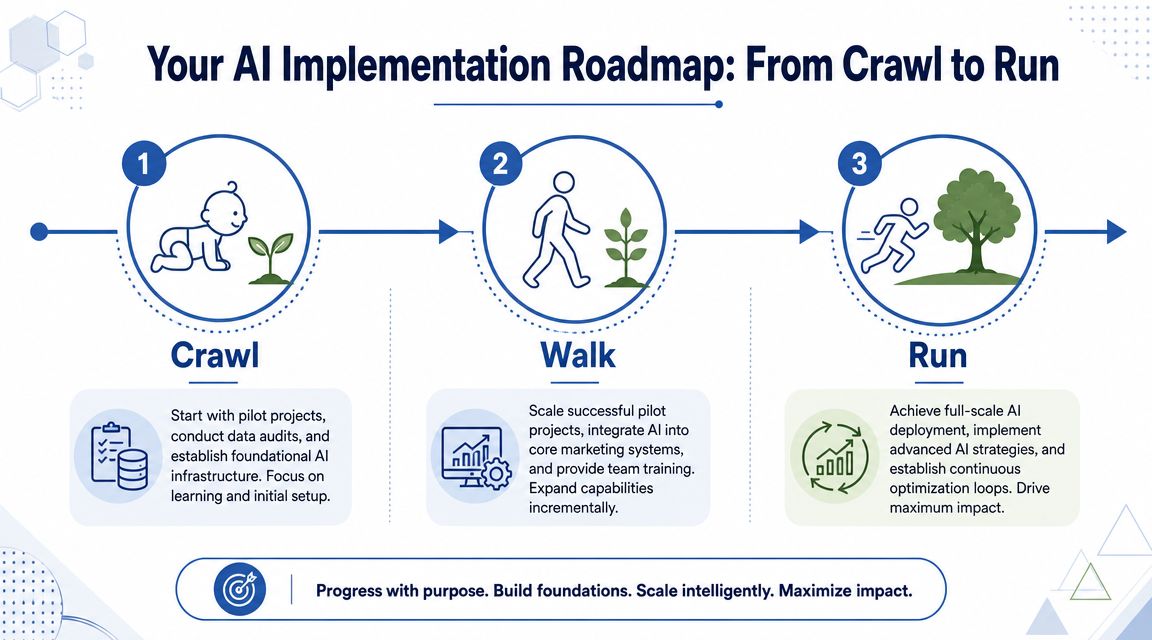
Crawl
Start where signal quality and execution speed can improve quickly.
Use generative AI for briefs, first drafts, ad variant generation, email ideation, and creative testing support. Tighten event tracking. Audit your CRM fields. Standardize naming conventions across campaigns. If your inputs are chaotic, every later phase gets harder.
What I want in this phase:
- A clean data audit, so you know what customer and campaign data you can trust.
- A controlled content workflow in which AI drafts and a human edits and approves for brand.
- A baseline measurement layer covering revenue, pipeline contribution, qualified leads, retention signals, and campaign-to-outcome mapping.
This is also the right moment to define what AI should never touch without review.
Walk
Now you connect systems and push AI into higher-value decisions.
Pipe CRM and first-party behavioral data into your campaign workflows. Use predictive scoring to prioritize audiences. Let platforms like Google and Meta handle more tactical optimization inside clear strategic guardrails. Build segment-specific messaging frameworks instead of one master message for everyone.
A healthy Walk phase usually includes:
- Lead and audience scoring tied to actual downstream outcomes.
- Semi-automated campaign orchestration across email, paid media, and landing pages.
- Content adaptation by segment so prospects don't all receive the same recycled message.
- Performance review loops that make you act on findings instead of admiring dashboards.
Most businesses should not jump to AI agents before they can trust their data and measurement.
Run
This is where the engine starts to pay off.
You introduce agentic workflows for market research, content operations, competitive monitoring, reporting synthesis, and campaign recommendations. You move from descriptive dashboards to systems that suggest actions or execute bounded actions. You create a closed loop where performance data retrains the next wave of decisions.
What that can include:
- Market intelligence agents that monitor customer language, competitor positioning, and sales call themes
- Activation workflows that trigger content, bidding, or lifecycle changes from predictive signals
- Reporting layers that translate model output into business decisions
- Governance rules for approvals, risk thresholds, and brand control
What to do Monday morning
If you want the practical version, do these three things first.
| Phase | What you implement first |
|---|---|
| Crawl | Data audit, AI-assisted content workflow, measurement baseline |
| Walk | CRM integration, predictive scoring, semi-automated campaign orchestration |
| Run | Agentic workflows, closed-loop optimization, governance and retraining |
Don't start with "Which shiny tool should we test?" Start with "Which decision bottleneck is slowing growth, and what data would let AI improve it?"
That's how you avoid expensive theater.
How to Choose Your Path In-House vs Agency vs Consultant
Once you've decided to build an engine, the next question is who should build it. At this point, a lot of businesses burn money.
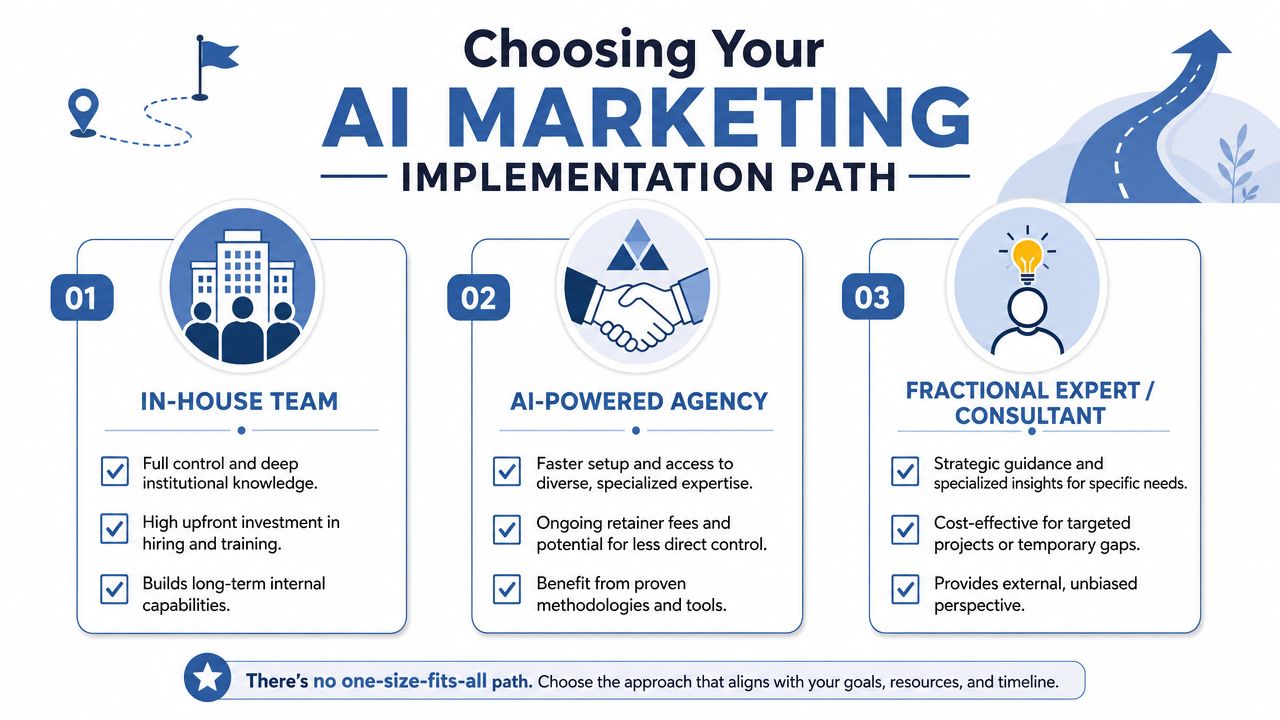
I see three viable paths. In-house team. Agency. Fractional expert or consultant. Each works in the right context. Each fails in the wrong one.
In-house team
Build internally when AI will become part of your operating core, not a side project. This path gives you control, institutional memory, and tighter alignment with sales, product, and customer data.
The downside is speed. Hiring is slow. Internal politics are real. And many businesses hire tool operators before they hire systems thinkers.
Agency
Agencies can move faster at the start. They already have processes, specialist talent, and implementation muscle.
But here's the problem. Most agencies still sell output, not accountability. Search Engine Land argues that many agencies promise faster content without explaining how they'll measure AI's true impact as the customer journey shifts toward LLM citations and multi-touch influence in this analysis of how agencies are adapting to AI search.
If an agency can't explain how it proves incremental revenue when classic attribution gets weaker, don't hire them.
Fractional expert or consultant
This is often the best middle path when you need strategic architecture, governance, vendor selection, and workflow design before you scale internal execution. A consultant should help you decide what to centralize, what to automate, and what to leave human.
That can include a fractional CAIO model, hands-on enablement, or systems design support. I offer advisory work in that category, focused on AI agents, marketing systems, and bionic operating models. It only makes sense if you need design and decision support rather than content production.
The buyer's checklist
Ask these questions before you sign anything.
- How will you measure business impact? If they only talk about content velocity, rankings, or traffic, keep looking.
- What data will the system learn from? No learning loop means no compounding advantage.
- Which decisions stay human? If they say "everything can be automated," they don't understand brand risk.
- What proprietary capability will I own after the engagement? You should gain an engine, not dependency.
- How will this affect attribution and reporting? If they can't answer that, they can't lead the project.
| Path | Best fit |
|---|---|
| In-house | Long-term capability building and deep integration needs |
| Agency | Fast execution when the scope is clear and measurement is strong |
| Consultant | Strategic design, governance, vendor selection, and capability transfer |
Hire for system design and accountability. Not for AI-flavored deliverables.
Where AI Marketing Fails and Human Oversight Wins
This is the part too many vendors skip because it makes the sale harder.
AI can absolutely help you produce more. It can also flatten your brand, confuse your positioning, and create polished nonsense at scale. I've seen all three.
Bad output is the smaller danger
The bigger danger is strategic drift. Teams start with AI-assisted content, then let the model shape messaging, then let it influence campaign logic, then wonder why everything sounds interchangeable.
Bain estimates generative AI could affect 47% of marketing activities and save 24% of marketing labor time, but the important warning is that companies need to reimagine workflows and agency relationships rather than replace humans, as covered in Bain's analysis of marketers, agencies, and AI.
That matches what I see in practice. The real danger is lazy automation.
Where I keep humans firmly in control
There are a few areas I don't want fully delegated.
- AI can summarize the market. It shouldn't decide your strategic positioning or category narrative.
- The model can draft. A human should give final brand voice approval and decide what sounds like you.
- High-stakes customer interactions such as escalations, sensitive accounts, and trust repair need judgment.
- AI can surface patterns in offer design and pricing logic. You should decide the trade-offs.
- Validate every claim. Never let a model publish unsupported product or performance claims.
The more expensive the mistake, the more human review you need.
What good oversight looks like
Good oversight doesn't mean slowing everything down. It means creating review checkpoints where judgment matters and automation where the work is repetitive.
I want AI doing synthesis, variation, tagging, scoring, and recommendations. I want humans handling taste, risk, strategy, and accountability.
That's how you build a bionic team instead of a generic content factory.
Your Questions on AI Marketing Services Answered
A few direct answers to the questions I hear most from founders and small business owners.
The short answers
| Question | Answer |
|---|---|
| Should you start with content generation? | Only if you also define data, approval, and measurement rules. Otherwise you scale clutter. |
| Do you need AI agents right away? | No. Start with clean workflows and reliable data first. Agents help after the basics work. |
| Can AI replace your agency or team? | It can replace some tasks. It should not replace strategy, governance, or brand judgment. |
| What should you measure first? | Start with business outcomes and influence on pipeline, revenue, retention, and conversion paths. |
| Is paid media the easiest place to apply AI? | Usually yes, because major platforms already support automated optimization inside campaign constraints. |
| How do you avoid generic brand output? | Use AI for drafts and variants, then enforce human review for positioning, tone, claims, and final approval. |
The question behind the question
Most owners ask about tools. The real issue is the operating model.
If you treat AI as a separate marketing trick, results will stay shallow. If you use it to improve market sensing, decision quality, execution speed, and measurement discipline, you'll build something far more valuable than a faster content calendar.
I don't think the winners in this category will be the teams with the most tools. I think they'll be the teams that build the best learning loops.
That's the standard I'd use if I were in your seat.