
Most advice on AI marketing is junk.
You're told to stack tools. Add a copy generator, a chatbot, an analytics assistant, a social scheduler, maybe an AI SDR. What you get is a messy pile of subscriptions, disconnected workflows, and a team moving faster in the wrong direction.
I've worked with machine learning since 2016 and generative AI since 2019. The pattern is consistent. Companies that win build an operating system instead of treating AI like a bag of tricks. A real AI digital marketing strategy is an intelligence engine tied to workflows, governance, and revenue decisions. That system compounds. Random tools don't.
Everyone Is Wrong About AI in Marketing
The mainstream advice says your first move is choosing tools. I think that's backwards.
If you start with tools, you inherit the vendor's view of your business. Their categories. Their workflow assumptions. Their reporting logic. Your team adapts to software instead of building a marketing system around your customers, margins, and sales motion.
That's why so many AI initiatives look busy but don't move revenue. The content volume goes up. The dashboards get prettier. The pipeline doesn't improve enough to matter.
The real problem is fragmentation
AI is already mainstream. The global AI-in-marketing market was valued at $47.32 billion in 2025 and is projected to exceed $107.5 billion by 2028, with a 36.6% CAGR, while 88% of marketers report using AI daily, according to SEO.com's AI marketing statistics. That's exactly why tool collecting is now a losing strategy. Your competitors already have access to the same apps.
What they usually don't have is a coherent system that connects:
- Market signals from search, reviews, support, and sales calls
- Decision logic for prioritizing audiences, offers, and channels
- Execution workflows that move from insight to campaign launch fast
- Validation loops that connect AI output back to actual conversion data
That system is where market share gets won.
My practical rule: if a tool doesn't improve how your team senses demand, makes decisions, or executes faster, it's software overhead.
Stop buying features and start designing systems
You don't need another AI writer if your positioning is weak. You don't need another analytics assistant if nobody trusts the underlying data. You don't need “AI personalization” if your customer inputs are shallow and your offer is vague.
You need an advantage.
Here's how I think about it:
| Bad approach | Better approach |
|---|---|
| Buy isolated AI apps | Build an integrated marketing system |
| Generate more content | Generate sharper decisions |
| Automate tasks blindly | Automate high-friction revenue workflows |
| Optimize keywords only | Optimize for both search engines and answer engines |
The companies that pull ahead in 2026 will be the ones with the strongest intelligence loop, whatever the size of their tool stack. They'll know what buyers are asking, what competitors are claiming, what objections are stalling deals, and how to deploy that information across content, paid media, lifecycle marketing, and sales enablement before everyone else catches up.
That's the shift. Less tool obsession. More system design.
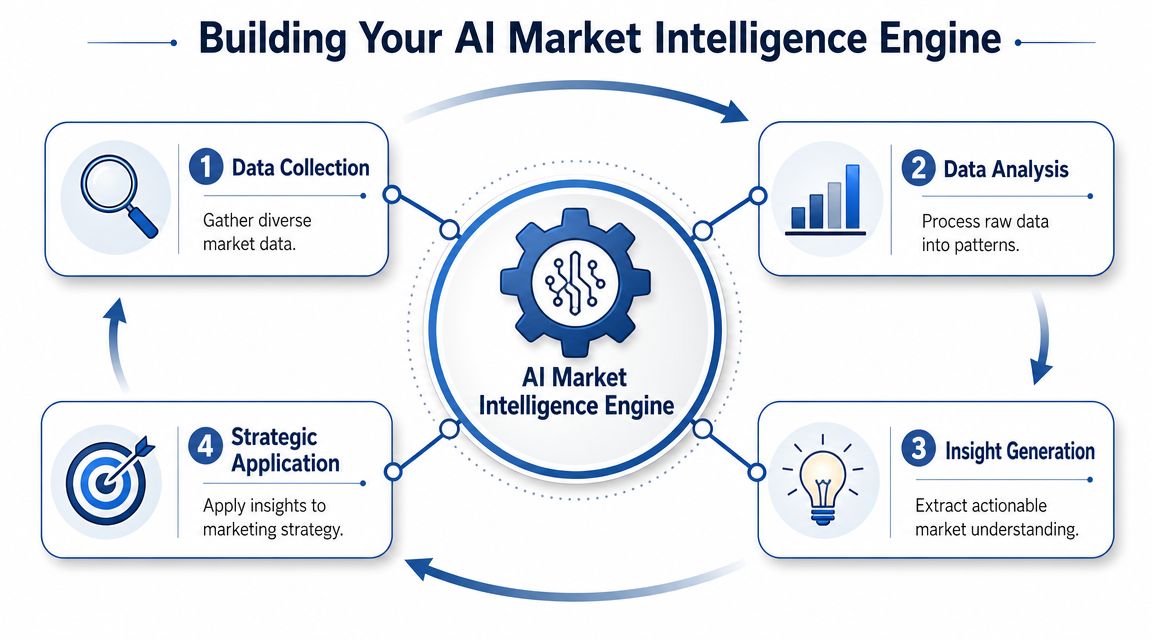
Build Your Market Intelligence Engine First
Before you automate anything, build the part that listens.
Most marketing teams are publishing into a fog. They're guessing at messaging, guessing at objections, guessing at what buyers ask AI platforms before they ever visit a website. That's reckless. Your first job is to build an engine that collects market reality and turns it into usable signals.
What goes into the engine
I want this engine pulling from places your team already has access to, plus the places buyers reveal intent in public.
Start with sales conversations. Pull transcripts, notes, and objection patterns from discovery calls and demos. These conversations hold real buying language.
Add support and success data. Tickets, onboarding questions, churn reasons, and implementation friction tell you what your marketing should clarify before the sale.
Watch public market signals. Competitor pages, review platforms, community forums, and product comparisons expose gaps in the market narrative.
Track search and prompt behavior. Think in questions, comparisons, and recommendation prompts as well as keywords.
If you need a starting point for assembling that stack, I've put together a practical guide to marketing intelligence tools.
Why AEO and GEO now matter
One of the most ignored shifts in marketing is this. Buyers increasingly ask AI systems for recommendations before they click through to a brand website. That means traditional SEO is no longer enough. Brands now need Generative Engine Optimization and Answer Engine Optimization for platforms like ChatGPT, Perplexity, and Gemini, as noted in this analysis of AI-driven marketing strategy.
If you're only optimizing for rankings, you're late.
You need assets that are easy for answer engines to extract, synthesize, and trust. That means:
- Clear comparison pages that resolve buyer confusion
- Detailed FAQ content based on real pre-sales questions
- Strong entity clarity so your brand, offer, use cases, and category are unambiguous
- Proof-rich pages with specifics, not generic claims
- Consistent language across your site, help docs, and public profiles
The brand that gets cited inside the AI answer often wins before the buyer ever opens a tab.
The output is something your team uses
I don't want your team producing a slide deck nobody reads.
I want a living intelligence layer with a few concrete outputs:
| Input | Output your team can use |
|---|---|
| Sales calls | Objection library for ads, pages, and emails |
| Support tickets | Pre-purchase FAQs and onboarding content |
| Competitor messaging | Positioning gaps and counter-messaging |
| AI prompt audits | Answer-ready content briefs |
That engine becomes your source of truth. It tells you what to publish, what to automate, what to test, and what not to waste time on.
Without it, your AI marketing stack is just producing faster guesses.
Design AI Workflows That Drive Revenue
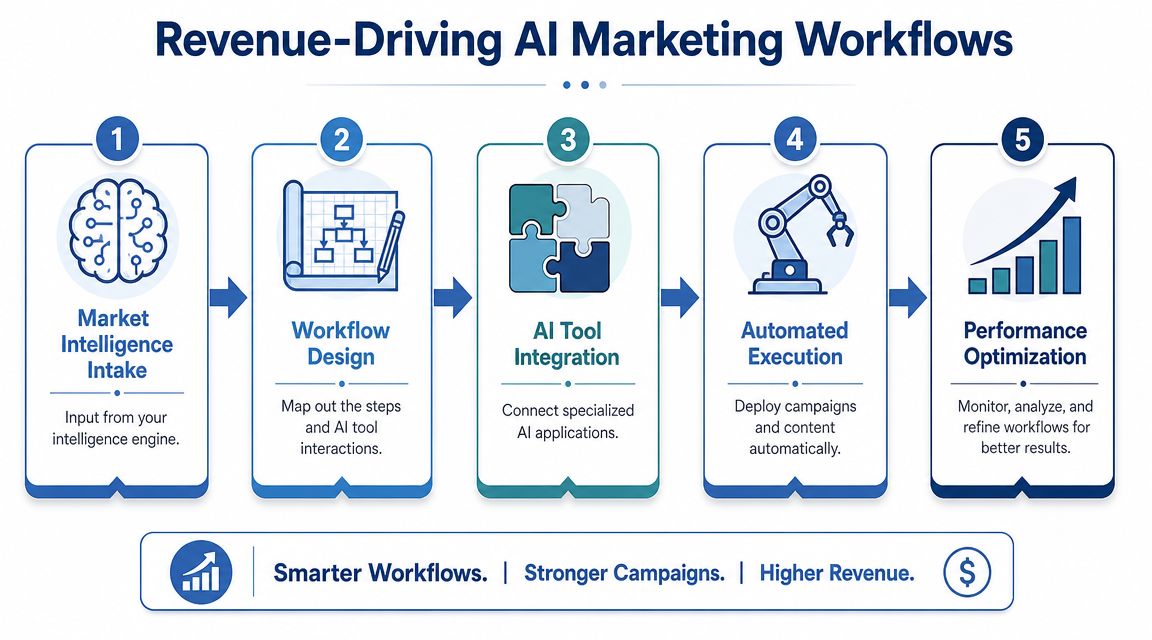
Once your intelligence engine is working, the next mistake to avoid is simple. Don't automate content first. Automate revenue movement.
That means designing workflows around moments where money is won or lost. New lead intake. Demo follow-up. Trial onboarding. Expansion signals. Churn risk. Those are the places where AI should earn its seat.
A workflow I'd build before anything fancy
Let's say you run a SaaS company with demo requests and trial signups coming in every day.
A weak setup sends every lead into the same nurture path and asks reps to figure it out later. A strong setup uses AI to triage, enrich, route, and personalize before a human touches the account.
Here's the workflow:
- A lead submits a form.
- The system enriches the account using public company and role information.
- An AI agent compares the lead against your ideal customer profile.
- The lead gets categorized by likely fit, urgency, and use case.
- The system drafts a relevant follow-up sequence and routes edge cases to a human for review.
- Sales sees a cleaner queue. Marketing sees stronger segmentation. The buyer gets a more relevant experience.
That's operational advantage.
For teams evaluating where this overlaps with paid acquisition and media buying, this breakdown of performance marketing AI is useful because it frames AI around execution and optimization, not shiny features.
What good workflow design looks like
The best AI workflows have four traits:
They start with a business event: a form submission, a cart abandonment, a product usage milestone, a pricing page visit.
They use context as well as prompts. Brand rules, customer history, segment logic, compliance constraints, and offer priorities should travel with the workflow.
They include human checkpoints, because high-risk messages, pricing decisions, and strategic account outreach still need review.
They produce a measurable downstream action, such as better routing, timing, follow-up, or conversion quality.
If you're mapping these systems out, this resource on AI workflow automation tools will help you think beyond one-off automations and into connected agentic processes.
Here's a visual walkthrough of the mindset behind this kind of build:
Where not to automate
I've seen teams get this wrong.
Don't hand full control to AI for:
- Strategic positioning
- Sensitive customer escalations
- Large account negotiations
- Claims that need legal or compliance review
Automate the repeatable logic. Keep humans on judgment-heavy decisions.
That division matters. AI should handle pattern recognition, drafting, scoring, and routing. Your people should own exceptions, trade-offs, and final calls where business context outweighs speed.
If a workflow can't be tied back to pipeline quality, sales efficiency, or retention, I usually don't prioritize it. Revenue first. Cleverness later.
Automate Content and Personalization the Right Way
Most AI content systems fail for one reason. They optimize for output volume instead of message control.
That's why the internet is filling up with content that's technically correct, emotionally flat, and strategically useless. If your AI digital marketing strategy turns your brand into another generic content machine, you're training buyers to ignore you.
Build a brand voice layer first
Before you ask a model to write anything, give it constraints that matter.
I want a reusable brand voice layer that includes:
- Approved claims your team can safely make
- Banned phrases that sound inflated, vague, or off-brand
- Audience-specific language for founders, operators, buyers, or technical users
- Offer framing so every draft reflects the actual commercial angle
- Examples of strong past content to anchor tone and structure
This is context engineering. Done properly, it creates consistency across blog posts, email nurture, ad variants, landing page sections, and sales enablement content.
If you're building this capability, my guide on AI for content creation shows how to structure prompts, context, and review workflows so the outputs stay useful.
Personalization needs rules
Personalization is where teams get seduced by possibility and create chaos.
You can and should use AI to adapt:
- Website headlines by segment
- Email CTAs by funnel stage
- Retargeting creative by product interest
- Onboarding content by use case
But don't personalize core positioning every five minutes. Buyers need consistency. Your value proposition should stay stable while the framing adjusts to context.
For smaller teams trying to put structure around this without overbuilding, this guide to automated marketing for small businesses is a practical reference because it stays grounded in workflows and operational simplicity.
My rule for content automation
Use AI for briefs, outlines, first drafts, derivatives, and repurposing.
Keep humans responsible for:
- Final claims
- Strategic narrative
- Original points of view
- High-value landing pages
- Anything that shapes category perception
Here's the split I recommend:
| Let AI handle | Keep human-led |
|---|---|
| Content briefs | Positioning decisions |
| Draft expansion | Final editorial judgment |
| Meta descriptions and variants | Thought leadership |
| Repurposing into social and email | Sales-critical copy |
You win by publishing sharper language across more touchpoints without losing your voice.
Establish Your AI Governance and Measurement Plan
If you let AI operate without guardrails, you won't get scale. You'll get drift.
AI can produce output. The issue is whether you can trust that output enough to use it in campaigns, segmentation, messaging, and budget decisions without creating risk.
Validation has to be operational
SurveyMonkey reports that 88% of marketers use AI in day-to-day roles, and it highlights a primary failure mode: trusting biased or hallucinated outputs. The same guidance recommends using AI for ideation and drafting, then validating against first-party analytics and conversion data before scaling decisions, as summarized in SurveyMonkey's AI marketing statistics.
That matches what I see in the field. High-performing teams trust systems that are checked against real outcomes, however confident the AI sounds.
If the model says a segment matters, prove it with your own conversion and revenue data before shifting spend.
Governance that doesn't slow everyone down
A practical governance model runs on a few clear rules.
I'd put these in place immediately:
Set decision tiers. Low-risk outputs like draft metadata can move fast. High-risk outputs like pricing language, legal claims, and messages sent in your name need review.
Set approved data boundaries. You should know what customer data can be used for prompts, enrichment, segmentation, and personalization.
Write output review standards. Define what must be checked for factual accuracy, brand alignment, and compliance before publishing.
Log errors. Track hallucinations, misleading summaries, and workflow failures so your system improves instead of repeating mistakes.
If your team needs a broader framework for structuring the data side of that work, these insights from ButterflAI on data governance are useful because they force discipline around ownership and policy.
Measure what actually changes the business
I don't care if AI saved a marketer twenty minutes if it didn't improve output quality or throughput where it counts.
Track metrics that connect to business movement:
- AI-assisted conversion rate
- Lead routing quality
- Content production velocity
- Time from insight to campaign launch
- Human review load
- Revenue influence by AI-assisted campaigns
Some teams also need a simple scorecard. Here's one I like:
| Metric type | What to look for |
|---|---|
| Efficiency | Less manual work in repetitive campaign tasks |
| Quality | Better alignment between message and buyer intent |
| Revenue | More qualified pipeline and stronger conversion paths |
| Risk | Fewer inaccurate or non-compliant outputs |
Governance is what lets you trust the machine enough to use it at scale.
Your 90-Day AI Marketing Implementation Plan
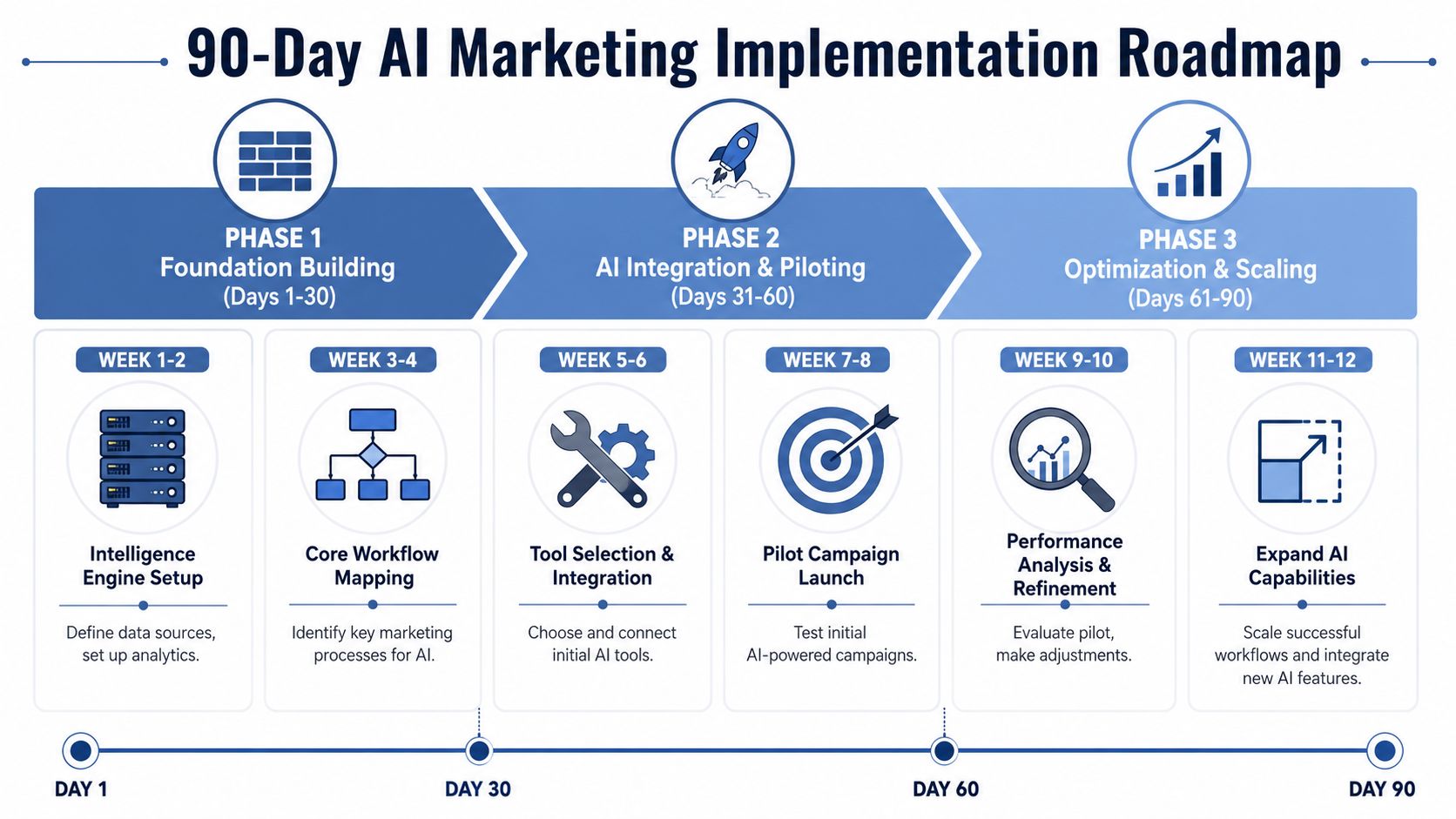
You do not need a year-long transformation program to get this moving. You need a disciplined quarter.
The strongest implementation plans I've seen start narrow, wire the system together, and scale only after validation. A practical roadmap also keeps budget concentrated in the right places. One industry guide recommends allocating budget across tools (30-40%), content (25-35%), automation (20-25%), and analytics (10-15%), while also recommending an FAQ database of 100+ customer questions and optimizing your top 10 pages for answer extraction, based on this 90-day AI marketing roadmap.
Days 1 to 30
This first phase is about foundation.
Audit your funnel. Identify where leads enter, stall, convert, or disappear. Pull together your sales objections, support questions, high-intent pages, and current campaign assets. Then start building the FAQ database from real customer language, not from what your team assumes buyers ask.
Your deliverables in this phase should be concrete:
- One source-of-truth document for positioning, segments, and offers
- A question library built from actual customer and prospect conversations
- A list of your top pages that need to become answer-ready
- A shortlist of workflows that are closest to revenue
Days 31 to 60
Now you build.
Pick two or three workflows only. That's enough. I'd usually choose lead intake, follow-up personalization, and one content production workflow tied to a commercial priority.
Use this phase to connect your tools, prompts, context layers, approvals, and reporting. If you need implementation support, I can help design the agentic workflow architecture with you, but the principle matters more than the provider. Keep the scope tight and the feedback loop short.
Small systems that work beat ambitious systems that never leave planning.
Days 61 to 90
Teams usually get impatient and overexpand. Don't.
Launch one AI-assisted campaign set built on the intelligence and workflows you've already validated. That might include updated answer-focused pages, segmented lifecycle emails, refined ad angles, or onboarding content personalized by use case. Then measure the downstream effects with your governance rules still in place.
I'd also review the quarter through three lenses:
| Lens | Questions to ask |
|---|---|
| System strength | Did data, workflows, and review processes actually connect? |
| Commercial impact | Did the implementation improve qualified demand or conversion flow? |
| Scale readiness | Which parts are reliable enough to expand next quarter? |
“We use AI now” is a meaningless outcome after 90 days.
The right outcome is this. You have a functioning AI digital marketing strategy built as a system. It listens better than your competitors. It executes faster than your old process. And it makes your marketing harder to outmaneuver.
If you want help building that kind of system rather than picking tools, you can read about my advisory work.