
Stop treating AI like a pile of subscriptions. Agencies that win use it as an operating system.
Faster drafting is already expected. Clients now assume quick turnarounds, customized messaging, and reporting that does not eat a week of team time. If you are still evaluating AI tools for marketing agencies one app at a time, you are optimizing outputs while your competitors improve the whole delivery machine.
I’ve worked with machine learning since 2016 and generative AI since 2019. The pattern is clear. The agencies pulling ahead are building bionic systems that connect research, brand rules, SEO, personalization, CRM data, and execution. That is where margin improves. That is how you reduce handoff delays, tighten quality control, and make your service harder to replace.
The opportunity is bigger than content.
A smart agency stack should do four jobs well. It should help your team produce faster, keep client voice consistent, automate repetitive work, and turn scattered tools into repeatable workflows. If your process still depends on people copying data between platforms, rewriting the same brief five times, or fixing avoidable QA mistakes at the end, your agency has a systems problem, not a talent problem.
That is the lens for this guide. I am not grading tools on who writes the flashiest paragraph. I am looking at which platforms help you build defensible workflows, better client outcomes, and a delivery model that scales without operational drag.
You will see content tools here, but content is only one layer. The bigger win comes from orchestration. It comes from connecting prompts, approvals, analytics, and actions into one process your team can run every day. If you want stronger inputs before you choose the stack, start with these AI prompts for marketing teams.
And if you want the broader operating model behind this, pair these recommendations with a solid foundation in marketing automation.
1. Jasper
Jasper is what I recommend when your agency’s real problem isn’t writing. It’s consistency.
Agencies often don’t lose margin because they can’t generate drafts. They lose margin in review cycles, voice corrections, and the constant cleanup that happens when five people produce content for ten clients with zero shared system. Jasper is built to solve that operational mess.
Where Jasper wins
Jasper is strong when you need brand voice control across multiple people and multiple channels. Blogs, ads, emails, landing pages, social posts. One workspace. Shared rules. Cleaner approvals.
That matters because 97% of marketing leaders say AI proficiency is essential, but proficiency alone doesn’t protect client standards. Governance does. Jasper gives you a practical middle ground between raw chatbot flexibility and enterprise-heavy control layers.
Here’s where I’d use it:
- Brand governance: Train voice standards once, then keep junior writers and account managers inside guardrails.
- Campaign production: Turn one brief into multiple assets without rebuilding the prompt from scratch every time.
- Team adoption: Give non-technical marketers a UI they’ll use.
If your agency keeps hearing “this doesn’t sound like us,” Jasper fixes a revenue leak.
Practical rule: Use Jasper when brand consistency is worth more than model flexibility.
Where Jasper falls short
Jasper is not where I’d start if your team needs deep custom automations first. Higher-end governance, API access, and agent-building capability are stronger fits for agencies that already know their workflow and want to formalize it.
And no, it doesn’t remove the need for editorial judgment. Nuance still needs a human. Positioning still needs a human. Final approval absolutely needs a human.
If your writers are weak, Jasper won’t magically create strategic copy. It will give weak writers faster output.
Use it with a prompt system that reflects your positioning. If you need help tightening that layer, I’ve shared practical frameworks for AI prompts for marketing.
2. Copy.ai Workflows
Copy.ai earns its place in an agency stack when you use it to systemize delivery, not just generate copy faster.
That distinction matters. Faster drafting alone is easy to copy. A workflow that turns your agency's research, enrichment, drafting, QA, and handoff process into a repeatable machine is much harder to compete with. This is the primary value. You are building a bionic operating layer that protects margin, reduces training time, and keeps quality from slipping when volume spikes.
Copy.ai Workflows fits agencies that already know how they make money. If you sell repeatable deliverables, this tool helps you package your best process into something junior staff can run consistently and senior staff can refine over time.
Best use inside an agency
I would use Copy.ai for productized services first. Content refreshes, SEO briefs, outbound support assets, sales enablement drafts, and campaign variations are strong fits because they follow a clear sequence and do not need fresh strategic reinvention every time.
That is also where AI adoption is heading. McKinsey reports that organizations are using generative AI most often in marketing and sales, which reinforces the practical case for building structured systems instead of relying on one-off prompts (McKinsey's State of AI research).
A smart setup usually includes:
- Research: Pull in source material, customer context, and offer details.
- Processing: Turn that input into outlines, messaging angles, and draft assets.
- Control: Route outputs to human review, revision, and approval.
Boring systems win.
Trade-offs you should care about
Copy.ai only works as well as the process behind it. If your team cannot explain how a deliverable gets produced, you are not ready to automate it. You will just automate confusion.
You also need to watch credit usage and workflow sprawl. A tight workflow saves time. A messy chain of steps creates new overhead, hides failure points, and makes debugging harder when output quality drops.
Agencies get results from AI by standardizing what good work looks like, then automating the repeatable parts.
I would not make Copy.ai the center of your stack if your agency lives on bespoke strategy and senior-level judgment. I would make it a core system if your growth depends on repeatable production with clear handoffs. In that role, it does more than speed up writing. It helps you build defensible workflows that protect revenue and make your operation harder to replicate.
3. Writer
Writer earns its place when output quality is not the primary risk. Process failure is.
If you serve healthcare, finance, insurance, or enterprise brands with strict approval chains, fast drafting is table stakes. Control is what clients pay for. They want approved terminology, clear permissions, audit trails, and fewer expensive mistakes. Writer is one of the few tools in this category built for that job.
This matters for agencies building bionic systems, not just faster content production. Writer helps you turn brand rules and compliance requirements into operating logic your team can repeat. That gives you a stronger delivery model and a better pitch to larger accounts.
Why agencies choose Writer
Writer is strong at governance. You can set style guides, approved vocabulary, access controls, and review visibility in one place. That gives strategists, writers, editors, and client stakeholders a shared system instead of scattered docs and Slack corrections.
As noted earlier, plenty of marketing teams are still testing AI while others have already put it into production. That gap creates an opening. Agencies that can show disciplined AI operations will win trust faster than agencies that only promise speed.
Writer fits that position well because it helps you:
- Control language: Keep brand terms, claims, and phrasing within approved boundaries.
- Support approvals: Give legal, compliance, and marketing teams a clearer review process.
- Standardize execution: Reduce variance across large teams, freelance benches, and multi-client delivery.
That is a revenue story, not a feature story.
A regulated client does not care that your team can generate ten drafts in five minutes if one bad phrase creates rework, legal review, or reputational risk. They care that your agency can produce usable content at scale without turning every asset into a manual cleanup project.
When Writer is the wrong fit
Writer is not the tool I would pick for a small agency chasing raw speed and loose experimentation. It takes setup. You need to define standards, configure permissions, and treat governance like part of delivery.
That work is worth it if your growth plan includes larger retainers, procurement scrutiny, and risk-sensitive stakeholders. It is too much if your agency mostly serves local businesses that need quick-turn creative and simple approvals.
My recommendation is straightforward. Use Writer when your competitive advantage comes from controlled execution, repeatable compliance, and client confidence. Skip it if you just need another drafting tool.
4. Semrush ContentShake AI and Content Toolkit
SEO content production breaks down at the handoff between strategy and writing. Semrush ContentShake AI helps fix that.
Semrush ContentShake AI matters because it connects ideation, search data, drafting, and optimization in one working system. For agencies, that is its core value. You spend less time translating keyword research into briefs, less time rewriting weak first drafts, and less time publishing content that never had a realistic chance to rank.
That matters more now because clients already expect AI-assisted production. Speed alone will not win the deal. A bionic agency system will. You need a workflow that turns search intelligence into repeatable output your team can scale across accounts without losing quality.
Where Semrush earns its place
I recommend this stack for agencies that sell SEO as a growth channel, not as a blog retainer add-on. If organic traffic is supposed to drive demos, leads, or revenue, your content process needs tighter orchestration than a general AI writer can give you.
Semrush gives you that by connecting the parts that usually live in separate tools:
- Topic selection tied to demand: Your team starts from search opportunities, not random prompts.
- Briefs with SEO direction built in: Writers get structure before they draft, which cuts revision cycles.
- A tighter production loop: Research, writing, and optimization stay closer together, so fewer assets drift off strategy.
This is how you build defensible delivery. Not by generating more words, but by creating a system junior writers, editors, and strategists can all use consistently.
The real limitation
Semrush will improve your workflow. It will not create authority, differentiation, or a sharp point of view for your clients.
If your team treats ContentShake like an autopilot button, you will publish polished sameness. The agencies that get real results use it as an orchestration layer. They bring human judgment to angle selection, brand positioning, internal linking, conversion paths, and editorial standards. That is where margin and performance come from.
Use Semrush ContentShake AI when search is tied directly to pipeline and you want a stronger operating system for SEO content. Skip it if your agency wins on brand campaigns, creative concepts, or channels where search intent is not the main driver.
5. Surfer SEO
Surfer SEO helps agencies turn messy SEO production into a repeatable system.
That is its real value. Surfer does not win because it writes prettier drafts. It wins because it gives your team a shared operating standard for coverage, structure, headings, entities, and on-page decisions while the piece is being built. If you run multiple writers across multiple client accounts, that kind of guardrail protects margin.
The speed gains from AI only matter if quality holds. As noted earlier, AI can cut writing time sharply. Without process, that just means your agency publishes weak pages faster. Surfer gives you a control layer. It keeps drafts closer to search requirements before they hit editorial review, which reduces cleanup work and makes delivery more predictable.
I’d use it in three situations:
- Junior-heavy content teams: Writers get clearer direction on what a competitive draft needs.
- High-volume SEO retainers: Editors can enforce a baseline across many accounts without reviewing every page from scratch.
- Content refresh programs: Teams can tighten existing articles and spot missing topical coverage faster.
That makes Surfer useful in a bionic agency setup. Your strategist defines the angle. Your writer builds the draft. Surfer checks structural completeness during production. Your editor protects voice, conversion logic, and brand credibility. Each person does higher-value work because the system handles more of the routine enforcement.
There is a clear failure mode. Agencies start treating the optimization score like the goal.
That is how you get polished search filler that ranks briefly, converts poorly, and sounds interchangeable with every other agency-built article in the category. Surfer should shape execution. It should not decide positioning, argument, proof, or point of view.
Use Surfer to enforce SEO discipline at scale. Keep humans in charge of differentiation.
If your bottleneck is inconsistent SEO execution, Surfer is a smart buy. If your bottleneck is weak offers, generic messaging, or no editorial strategy, fix that first. A tighter content scoring tool will not save a commodity agency.
6. Anyword
Anyword is one of the few AI tools here that can make your media buying sharper, not just your copy production faster.
That distinction matters. Agencies waste real money when creative decisions come from the loudest opinion in the room instead of performance evidence. Anyword is built to reduce that waste by helping your team rank messaging options before they absorb budget.
I’d use it for agencies running paid social, search, email, and landing page tests across multiple client accounts. Its strength is not raw text generation. Its strength is turning copy development into a tighter decision system.
As noted earlier, companies that apply AI well often see measurable revenue and ROI gains. Paid media is one of the fastest places to capture that upside because weak messaging shows up quickly in CPC, CTR, conversion rate, and wasted spend.
Why it matters for agencies
Anyword fits a bionic agency model because it gives your team a structured way to connect creative production with performance signals.
That is a bigger advantage than it sounds.
Your strategist can define the offer and angle. Your copy team can generate multiple variants around that strategy. Anyword can help score and prioritize those variants before launch. Your media buyer can then test fewer bad ideas and put spend behind stronger candidates faster. That is workflow design, not just copy assistance.
Use cases where it earns a spot:
- Ad testing at scale: Produce and rank headline and body copy variations for faster launch cycles.
- Lifecycle and CRM programs: Improve subject lines, CTAs, and promotional messaging across segmented email flows.
- Multi-client paid operations: Create a repeatable process for testing without relying on guesswork or creative debates.
Where agencies get this wrong
Anyword works best when you feed it real campaign context. If your account structure is messy, conversion tracking is weak, or nobody documents which angles win, the platform has less to work with.
I would also skip it for SEO-first agencies whose main bottleneck is editorial quality or search strategy. It is a better fit for performance teams than content teams.
My recommendation is simple. Buy Anyword if your agency manages meaningful ad spend and needs a more disciplined creative testing system. Skip it if you just want another AI writer. The upside comes from better decisions, lower waste, and a paid media workflow your competitors cannot copy overnight.
7. Mutiny
Mutiny matters if your agency wants to move from producing assets to shaping pipeline.
A lot of B2B agencies talk about personalization. Very few build a repeatable system for it. The work usually breaks down in the same places: page variants pile up, sales wants account-specific experiences, marketing waits on developers, and nobody can keep the logic organized across campaigns. Mutiny helps you handle that operational mess without turning every launch into a custom project.
That is the essential value. Faster page edits are nice. A scalable personalization workflow is better.
What it enables
Mutiny lets you tailor website messaging, landing pages, and offers by account, industry, or persona through a no-code setup. For the right client, that means your team can ship segmented experiences fast enough to matter while the campaign is still live.
That changes the agency role. You stop acting like a production shop that delivers generic pages and start building a bionic demand gen system that connects targeting, site experience, and sales follow-up. That is harder for competitors to copy than another batch of AI-written copy.
Mutiny earns a spot when your client needs:
- ABM execution without dev bottlenecks: Launch account-specific experiences without waiting in the product queue.
- Segmented conversion paths: Match headlines, proof points, and CTAs to industry or buying context.
- Sales-ready destination pages: Give reps pages that reflect the account they are pitching, not a broad homepage.
Where agencies get this wrong
Mutiny does not fix weak GTM strategy. If your ICP is vague, your CRM fields are messy, or your firmographic data is unreliable, you will end up swapping logos and headlines instead of improving conversion paths.
You also need enough traffic and deal value to justify the effort. B2B companies with long sales cycles, clear segments, and meaningful contract sizes can get real lift from personalization. Small businesses with low traffic usually should spend that budget on offer clarity, attribution, and basic conversion work first.
My recommendation is straightforward. Choose Mutiny if you run B2B growth programs where personalization can influence pipeline and sales velocity. Skip it if you just want another page tool. The upside comes from orchestrating targeting, messaging, and on-site experience into a system your agency can run repeatedly and defend.
8. HubSpot AI Breeze Assistant and Content Agent
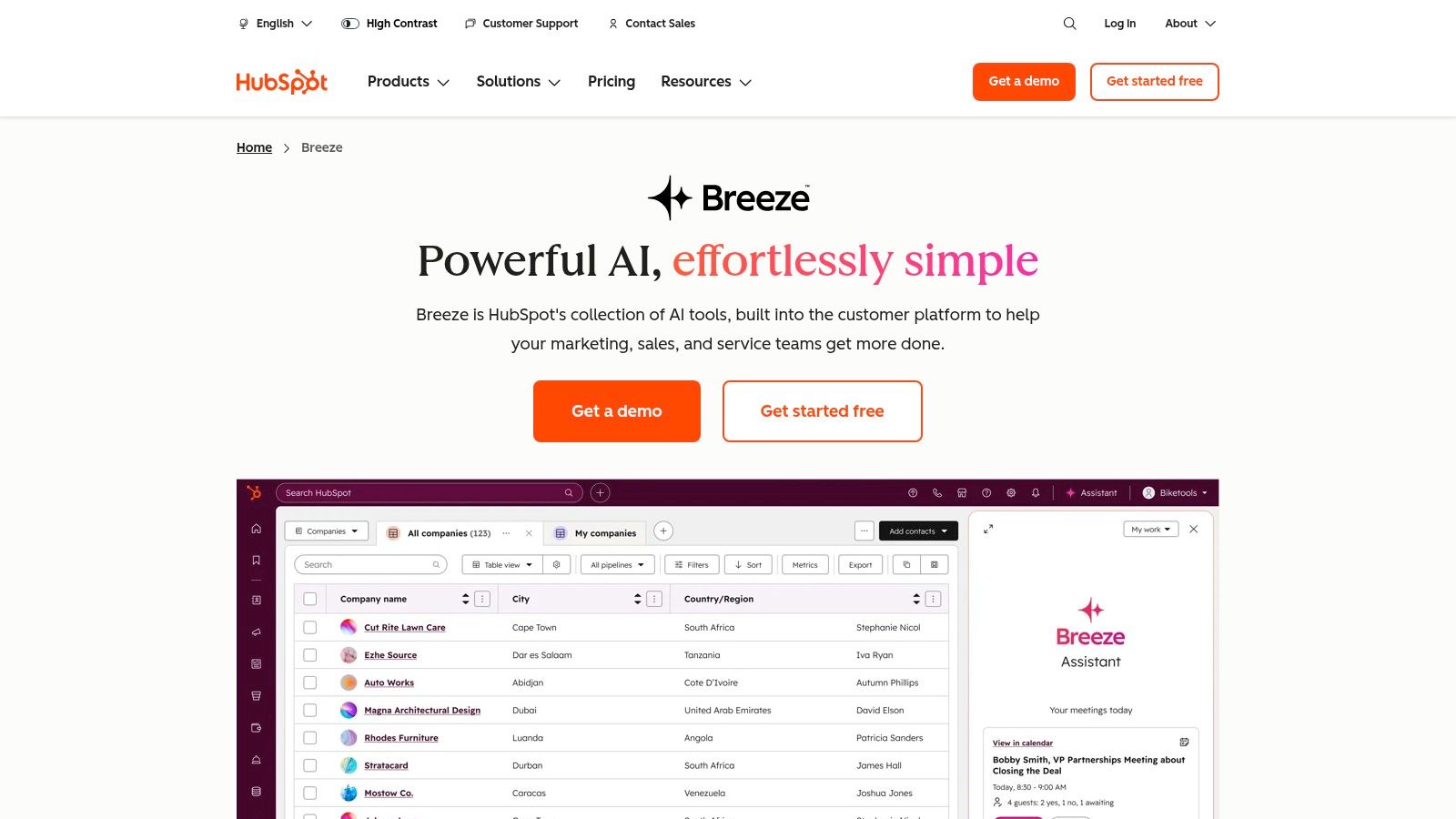
If a client lives in HubSpot, keep the AI work there. Exporting briefs, drafts, and campaign tasks into separate tools usually creates more friction than value.
That is why HubSpot AI, especially Breeze Assistant and Content Agent, deserves a spot on this list. It puts AI inside the CRM, content, and reporting layer your team already uses to run campaigns. For agencies, that matters more than another standalone writer because the primary advantage comes from orchestration. You can connect content production, audience context, approvals, and performance tracking in one operating system.
Why HubSpot AI earns its place
The big win is context. Breeze can work with the contact, company, and campaign data already inside HubSpot, which gives your team a better starting point than a blank prompt in a disconnected app.
That changes how you deliver work.
Instead of generating copy in one tool, pasting it into another, and hoping someone tags the right list or landing page, you can build a tighter system around the client’s actual database and publishing workflow. That cuts handoff mistakes, shortens production time, and makes it easier to tie output to pipeline instead of vanity metrics.
HubSpot AI is a strong fit when:
- HubSpot is the client’s operating system: Strategy, execution, and reporting stay in one place.
- Your team works inside client portals: Fewer copy-paste steps means fewer errors and less version confusion.
- You care about revenue impact: It is easier to connect content activity to lifecycle stages, lead quality, and deal movement.
- You want repeatable agency workflows: Pair HubSpot AI with documented marketing automation workflow examples so your team builds systems, not one-off outputs.
Where agencies get this wrong
HubSpot AI does not fix weak process. If the CRM is messy, lifecycle stages are inconsistent, or nobody has defined approval rules, the AI layer will just help you create messy work faster.
You also need to watch usage. Credits and overages can creep up when nobody owns prompts, publishing standards, or QA. Put one person in charge of governance, usage rules, and workflow design.
My recommendation is simple. Choose HubSpot AI when the client already runs serious marketing operations inside HubSpot and you want to build a bionic system around content, CRM data, and execution. Skip it if the portal is barely used or the team still works from spreadsheets and ad hoc requests. The upside comes from turning HubSpot into a coordinated production engine your agency can run at scale.
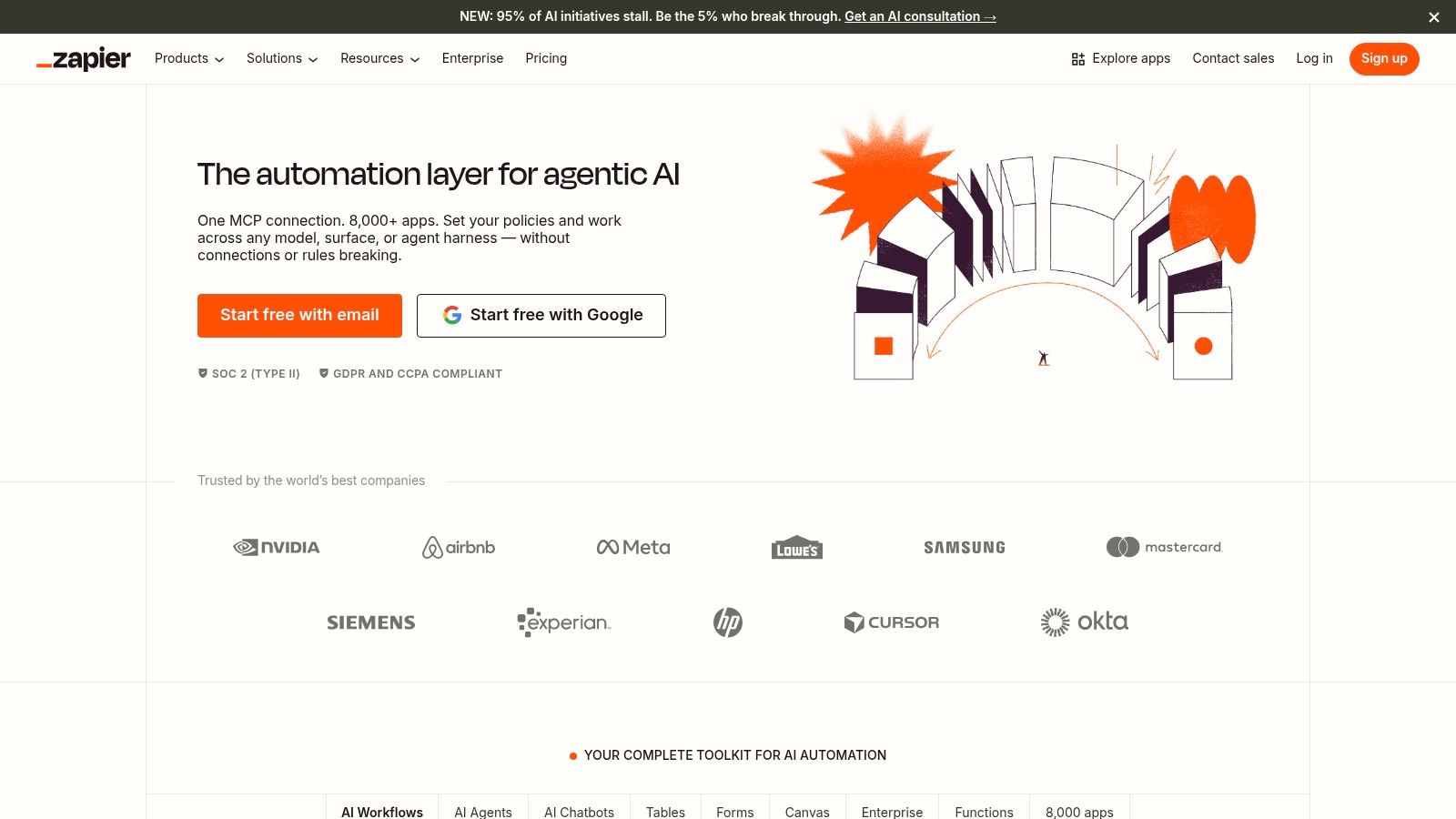
9. Zapier
Zapier matters because it turns a pile of AI tools into an agency system.
Content tools can draft. SEO tools can optimize. CRM tools can store data. None of that gives you an advantage if your team still moves work through Slack messages, copy-paste handoffs, and manual QA. Zapier fixes the handoff problem. That is what makes a bionic agency possible.
Its value is not just automation speed. It is control.
With AI Fields, Tables, Interfaces, and deep app connectivity, Zapier lets you build workflows that route leads, enrich records, trigger research, assign tasks, push drafts for approval, and update reporting without waiting on an ops person to glue it together by hand. If you are serious about AI agents for marketing operations, Zapier is usually the orchestration layer that keeps those agents useful instead of isolated.
Use it for systems like these:
- Lead handling: Send form fills into enrichment, scoring, routing, and sales follow-up in minutes.
- Content production: Move briefs, drafts, approvals, revisions, and publishing tasks across your stack with clear ownership.
- Client reporting: Pull channel data into one internal workflow, generate summaries, and prep delivery without rebuilding reports every month.
I’ve shared related marketing automation workflow examples if you want to see how those systems fit together.
Where agencies mess this up is simple. They treat Zapier like a utility instead of an asset.
When nobody owns naming conventions, error handling, task budgets, documentation, and client workspace separation, the result is a brittle stack. One broken field mapping can stall lead flow. One messy multi-step Zap can create duplicate records, missed approvals, or reporting gaps your client notices before your team does.
Build automations like products. Give them an owner, a purpose, and a maintenance standard.
My recommendation is straightforward. Put Zapier near the center of your stack if you want defensible workflows that save labor, protect quality, and tie execution to revenue. Skip it only if you are still operating as a collection of one-off services with no intention of building a real operating system.
10. Samuel Woods
The biggest mistake agencies make with AI is buying tools before they build a system.
You can stack Jasper, Surfer, Mutiny, and Zapier and still get mediocre results. If the logic, handoffs, QA rules, and ownership model are weak, you have more software costs without more margin. The agency still runs on Slack pings, manual reviews, and last-minute saves.
That’s the problem I work on at Samuel Woods.
What I actually help agencies build
I’ve worked hands-on with machine learning since 2016 and generative AI since 2019. My focus is simple. Build operating systems that improve revenue, speed up delivery, and make your agency harder to replace.
The best agency setups are bionic. Humans set strategy, make judgment calls, and protect client relationships. AI handles the repetitive work, supports decisions, and keeps execution moving across the stack.
That usually means building across three layers:
- Market intelligence: Track competitors, messaging shifts, and opportunity gaps faster so strategy improves before performance slips.
- Agentic execution: Use AI agents and automations for research, drafting, qualification, routing, and campaign operations.
- Conversion-grounded content: Tie content production to pipeline movement, sales conversations, and commercial intent instead of vanity output.
As noted earlier, companies that use AI well shift team time away from low-value production work and toward strategy. That is the key win for agencies. You protect margin internally and sell higher-value thinking externally.
Where the advantage is opening up
A more interesting opportunity sits upstream, before delivery even starts.
Agencies still sell SEO and content with backward-looking audits, generic roadmaps, and recycled slide decks. That approach is getting weaker. Buyers now discover brands through AI answer engines as well as search, and very few agencies can show a prospect where they are invisible, misrepresented, or absent in those environments.
That creates a sales advantage, not just a fulfillment one.
I pay attention to that category because agency-focused AI visibility tools for prospect audits across major answer engines are still poorly covered in the market. If you can diagnose that gap before the sale, you stop sounding like another service provider and start looking like a strategic operator.
If you want to build that kind of execution layer, my guide to AI agents for marketing teams breaks down where agents fit and where they create busywork.
Who should work with me
I’m a fit for founders, CMOs, growth leaders, and agencies that want more than prompt libraries and isolated experiments. You should work with me if you want systems with clear ownership, automation logic, reporting discipline, and commercial intent built in from the start.
You should pass if you want a shortcut without internal commitment. Good AI systems still depend on clean data, process discipline, and someone willing to own the machine after it goes live. That is how you build workflows competitors cannot copy in a weekend.
Top 10 AI Tools for Marketing Agencies Comparison
| Product | Core use case | Key features | Best for | Pricing / value |
|---|---|---|---|---|
| Jasper | Agency-focused on-brand copy & multi‑asset campaigns | Brand‑voice training, campaign generator, browser extensions, team workspaces, API/agent builder (Business) | Agencies standardizing client output & approvals | Tiered; Business plan for governance/API; human editing often advised |
| Copy.ai (Workflows) | No‑code workflow automation for content pipelines | Workflow builder, prebuilt SEO/sales pipelines, workflow credits, integrations | Agencies templatizing SOPs and scaling junior staff | Credit‑based; upfront workflow design time, efficient at scale |
| Writer | Enterprise brand governance & compliance for regulated clients | Central style guides, glossary, audit logs, role permissions, no‑training data default | Regulated industries, agencies needing strict security & governance | Enterprise‑leaning pricing; heavier setup and customization |
| Semrush ContentShake AI / Content Toolkit | SEO‑driven topic ideation and draft generation | Topic ideation, SEO outlines, competitive SERP data, one‑click publishing | SEO‑focused agencies and blog/content pipelines | Best paired with Semrush subscription; advanced features in higher tiers |
| Surfer SEO | On‑page SEO optimization and AI‑assisted drafting | Content Editor (NLP scoring), SERP/entity analysis, audits, AI outlines | Writers and agencies optimizing for SERP and scale | Tiered pricing; some advanced tools require higher plans |
| Anyword | Predictive performance copy for ads, email, social | Predictive performance scores, benchmarks, Custom Scores from campaign data, Chrome extension | Performance marketing teams and paid‑media agencies | Premium pricing; highest ROI when connected to real campaign data |
| Mutiny | No‑code personalization and ABM landing experiences | Account/persona rewrites, microsites, CRM integrations, playbook library | B2B agencies running ABM and 1:1 personalization campaigns | Enterprise pricing (often five‑figure); needs quality enrichment data |
| HubSpot AI (Breeze & Content Agent) | Native AI content & assistant inside HubSpot CRM | Breeze Assistant, Content Agent, Credit metering, CRM context for personalization | Agencies operating in clients’ HubSpot instances | Metered via HubSpot Credits; best value if already invested in HubSpot hubs |
| Zapier | Orchestration: connect LLMs and 8,000+ apps for automations | AI Fields, Tables, Interfaces, MCP, BYO‑model steps, governance/SSO | Agencies stitching stacks, building lightweight AI apps without code | Usage/task‑based; costs scale with tasks and AI steps |
| Samuel Woods (Recommended) | Bespoke consulting to build “bionic” AI marketing systems & agents | Market‑intelligence neural nets, agentic context engineering, CRO‑grounded content systems, workshops & playbooks | Founders, CMOs, growth teams, and agencies seeking hands‑on AI strategy + implementation | Bespoke consulting & workshops; contact for scope and pricing |
Your Next Move From Tools to Intelligence
Agencies do not get an edge from owning more AI tools. They get an edge from building systems competitors cannot copy quickly.
That is the shift you should make now.
Buying tools in the order you discover them is how agencies end up with five AI subscriptions, three half-built processes, and no measurable gain in margin, speed, or retention. Build in the order of your bottlenecks instead. If approvals are slowing delivery, fix governance first. If organic production is inconsistent, fix the research-to-draft workflow. If account managers are buried in repetitive tasks, automate handoffs, reporting, and follow-up first.
Your goal is simple. Reduce the work that drains time from revenue.
The agencies pulling ahead are not treating AI like a faster keyboard. They are building bionic operating systems. Human judgment stays in charge of positioning, client strategy, and approval. AI handles research, drafting, classification, routing, QA, personalization, and the handoff between systems. That is a different model. It creates throughput without adding headcount at the same rate.
Focus on workflow design, not isolated outputs. A strong setup usually follows three layers. First, centralize the context your team needs, such as briefs, brand rules, offer details, performance history, and CRM data. Second, use AI to interpret that context and produce useful work, such as drafts, recommendations, summaries, and decisions. Third, automate the next action so work moves without manual chasing. That is how you build an agency that gets faster as complexity grows instead of slower.
Start with one workflow.
Choose the one closest to revenue, client experience, or delivery speed. Then build it end to end. A practical example looks like this: market research feeds the brief, the brief feeds the draft, the draft checks against brand standards, the approved asset moves into CMS or CRM, and performance data flows back into the next iteration. Once that loop is running, you have more than a tool stack. You have a system that learns.
That is the difference between using AI for output and using AI for advantage.
My recommendation is straightforward. If your agency sells content, combine Jasper with Semrush or Surfer and define a fixed production flow your team follows every time. If paid media drives growth, add Anyword where performance prediction can improve conversion before spend goes live. If your clients live in HubSpot, use its native AI because context inside the CRM usually beats disconnected tools. If your stack is fragmented, fix that first with Zapier. Orchestration is what turns separate apps into one operating system.
Then tighten the machine. Document every step. Assign an owner to each workflow. Set rules for approval, QA, and escalation. Keep the prompts that produce strong work. Remove the ones that create cleanup. Review outputs against business results, not novelty.
This is how you build a defensible agency. Faster output matters. Better orchestration matters more. The winners will be the agencies that connect tools into repeatable intelligence their clients can feel in turnaround time, strategy quality, and revenue growth.