You're probably seeing the same pattern I see inside growing companies.
Marketing runs campaigns across email, paid social, content, webinars, landing pages, and outbound support. Sales says lead quality is uneven. The CRM is full of duplicates, half-complete records, and fields nobody trusts. Reporting arrives late, and when it does, it describes activity instead of business impact.
That chaos usually means the system behind your marketing is weak, rather than the people running it.
I've spent years helping companies wire AI, automation, and decision systems into revenue teams. The same issue comes up again and again. Owners want faster execution, cleaner attribution, and more value from AI, but they're trying to build on top of scattered processes, disconnected tools, and unreliable data. That's why the question “what is marketing operations” matters a lot more than most business owners think.
Marketing operations is the control layer that lets marketing move with precision, prove impact, and scale without turning into operational debt. It goes well beyond cleaning up lists and pushing buttons in HubSpot or Salesforce.
If you want AI agents, automated workflows, better forecasting, and a marketing team that can out-execute competitors, this is where the groundwork gets laid.
Your Marketing Feels Chaotic for a Reason
A familiar scenario. Your team launches a campaign on Monday. Paid social is live, the email sequence is scheduled, the landing page is up, and sales has been told to expect inbound interest. By Thursday, three problems appear.
The form submissions aren't routing correctly. Sales is following up on stale or incomplete records. Your dashboard can show clicks and opens, but not whether the campaign influenced pipeline in a way you can trust.
That's an operating model problem, and better creative won't fix it.
Most companies don't start with a true marketing system. They start with individual tools, good intentions, and a few smart people doing manual work to hold everything together. One person exports CSVs. Another fixes naming conventions by hand. Someone else rebuilds the same workflow every time a campaign launches. It works until volume increases.
Then the cracks widen.
When marketing feels random, it usually means execution, measurement, and technology were never designed to work as one system.
This is the part owners often miss. Marketing chaos is the default state when strategy, technology, and execution aren't wired together. You can have strong copy, solid offers, and a capable team and still burn time and budget because nobody owns the operational layer.
The cost goes beyond inefficiency to lost speed. Your competitors launch faster, learn faster, and reallocate spend faster because their systems are cleaner.
Here's what that looks like in practice:
- Campaigns stall in handoffs because approvals, asset management, and launch dependencies live across email threads and chat messages.
- Sales distrusts marketing data because routing rules, lifecycle stages, and lead definitions are inconsistent.
- You get weak answers because reports explain channel activity but don't connect clearly to revenue outcomes.
That's the gap marketing operations fills. It turns scattered execution into a repeatable machine.
The Core Engine of Marketing Operations
When business owners ask me what marketing operations is, I give a direct answer.
Marketing operations is the integrated management of people, processes, technology, and data that turns marketing strategy into measurable execution, as described in this marketing operations framework.
That's the clean definition. In practice, I think of it as the operating system for growth.
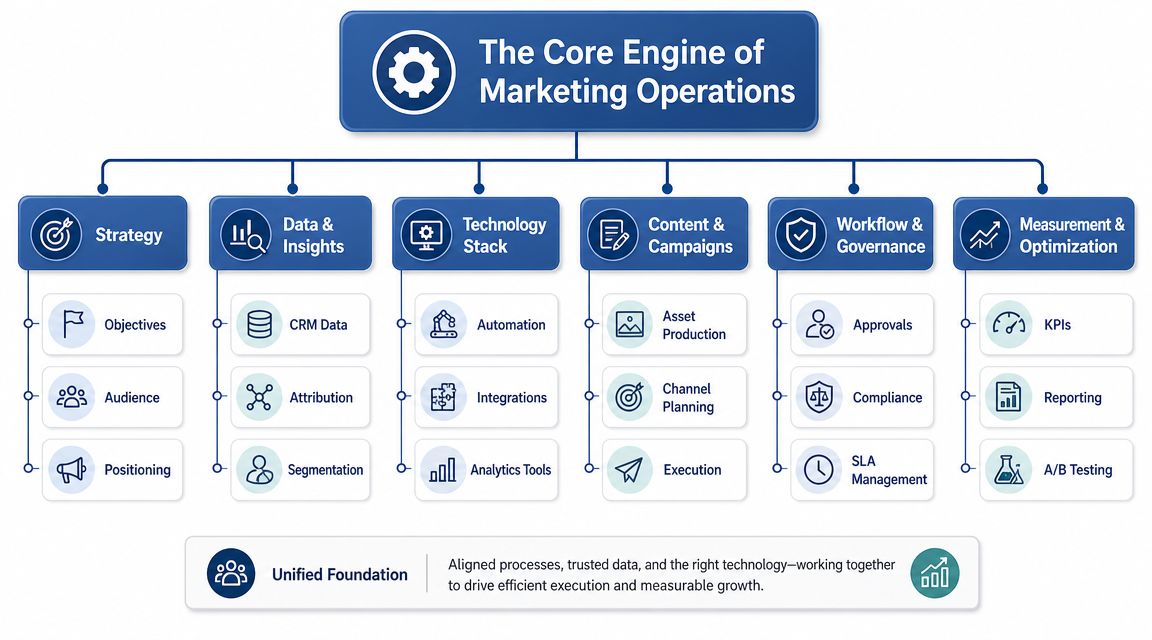
The four pillars that actually matter
If one pillar is weak, the whole machine slows down.
| Pillar | What it controls | What breaks without it |
|---|---|---|
| People | Ownership, accountability, handoffs, skill coverage | Tasks get duplicated, dropped, or trapped with the wrong team |
| Process | How campaigns are planned, approved, launched, measured, and improved | Every launch becomes a reinvention |
| Technology | CRM, automation, analytics, CMS, and workflow tooling | Data silos grow and manual work multiplies |
| Data | Field standards, reporting definitions, attribution inputs, QA | Decisions get made from noise |
The mistake I see most often is overinvesting in one pillar and ignoring the rest. A company buys a powerful automation platform but keeps weak process design. Or it hires strong marketers but leaves data definitions loose. Or it sets reporting expectations without fixing the underlying systems.
That never holds.
How the pillars interlock
People decide who owns campaign setup, lead routing, and reporting. Process defines the sequence. Technology enforces the sequence. Data tells you whether the sequence is producing business results.
Miss one, and everyone compensates manually.
- People without process creates hero culture. Fast for a while, fragile forever.
- Process without technology creates bureaucracy. Clean docs, slow execution.
- Technology without data governance creates false confidence. Pretty dashboards, bad decisions.
- Data without ownership creates endless arguments about what's true.
Practical rule: If your team can't launch a campaign the same way twice, you have marketing activity and no marketing operations.
This is why I push owners to treat MOps as something closer to mission control than back-office support. It governs martech selection, workflow design, reporting, and QA so marketing can scale without drowning in rework.
And once AI enters the picture, that operating system becomes even more important. AI punishes a lack of operational discipline.
Key Roles and Modern Organizational Structures
An engine needs operators. Marketing operations is no different.
In lean companies, one person may cover automation, reporting, campaign setup, and CRM hygiene. In larger organizations, those responsibilities split across specialists. Either way, the work usually clusters into a few core roles.
The roles that keep the machine running
A Marketing Operations Manager usually owns the system design. This person decides how campaigns move from brief to launch, how teams use the stack, and how reporting connects to business goals.
A MarTech Specialist handles the technical plumbing. Integrations, platform administration, automation logic, field mapping, and the ugly troubleshooting nobody sees until something breaks.
A Marketing Analyst turns execution into decision-grade reporting. Not vanity dashboards. Useful dashboards. The kind that help you decide what to scale, cut, or fix.
Some teams also need a campaign operations coordinator or lifecycle manager. That depends on complexity, not fashion.
Three common structures and their trade-offs
Every org chart comes with trade-offs.
| Model | What it looks like | Strength | Risk |
|---|---|---|---|
| Centralized | One MOps team supports all of marketing | Strong standards and cleaner governance | Can become a bottleneck |
| Decentralized | Ops capability sits inside channel or regional teams | Faster local execution | Inconsistent systems and reporting |
| Hybrid | Central standards with embedded operators in teams | Balance of control and speed | Requires strong management discipline |
For many growth-stage companies, hybrid wins. Centralize the rules, the architecture, and the core data model. Embed enough operational support close to campaigns so execution doesn't choke.
If you're building the broader team around this model, my guide on the perfect growth hacking team is a useful reference point for thinking about how specialists and generalists should fit together.
Where MOps ends and RevOps begins
This question matters because bad boundaries create politics, duplicated work, and blind spots.
The cleanest practical line is this. Marketing operations owns campaign execution, tooling, automation, reporting, and process improvement inside marketing, while overlap begins when systems, definitions, and reporting extend across sales and customer teams, as outlined in this marketing operations and RevOps analysis.
Use that boundary to make structural decisions:
- Keep MOps inside marketing when the main challenge is campaign execution, marketing tooling, reporting quality, and internal workflow discipline.
- Move toward RevOps when lifecycle definitions, handoffs, forecasting, and shared data governance across GTM functions become the bigger problem.
- Avoid premature centralization if your marketing team still lacks basic process maturity. A RevOps label won't fix broken marketing execution.
I've seen companies create RevOps too early and end up with a strategic shell sitting on top of messy systems. That's backwards. Marketing ops has to be solid enough to contribute clean data and consistent process into a larger revenue model.
Mapping Core Processes and Performance KPIs
If marketing operations is the engine, processes are the moving parts that keep pressure, timing, and output under control.
This is where you should get demanding. You don't need more dashboards first. You need clear operational flows for the work that drives revenue. Once those flows exist, the right KPIs become obvious.
For channel context, Validity's overview of marketing operations notes that marketing ops professionals use data and analytics to establish KPIs, measure campaign performance, and assess ROI, and it cites HubSpot's 2025 State of Marketing report showing that in 2024 the top ROI-driving channels for B2B brands were website/blog/SEO, paid social content, and social shopping tools, while for B2C brands they were email marketing, paid social content, and content marketing. That's exactly why MOps matters. Somebody has to connect channel strategy, tooling, and analytics to measurable returns.
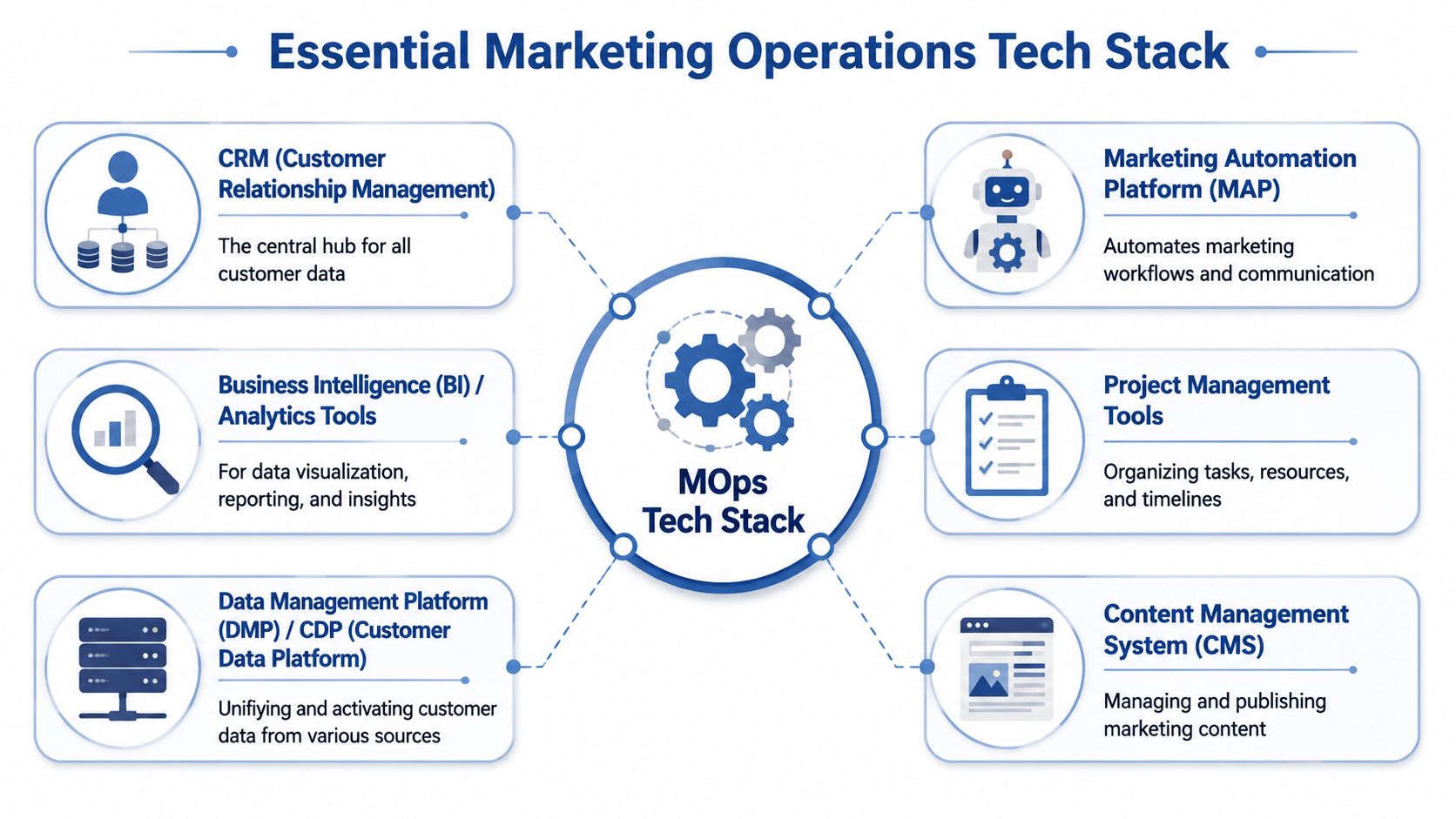
The processes MOps should own
The specifics vary by business model, but a few workflows almost always belong here.
- Lead management means capture, enrichment, scoring logic, routing, lifecycle updates, and sales handoff rules. If this process is loose, sales complains and everyone blames the wrong thing.
- Campaign operations covers intake, asset readiness, QA, launch sequencing, naming conventions, tracking standards, and post-launch review.
- Data governance includes field definitions, required properties, duplicate control, sync rules, and reporting logic.
- Budget and resource management tracks where effort and spend are going so you can shift investment toward working programs.
If you want concrete workflow patterns to model, these marketing automation workflow examples show the kind of operational sequencing that removes manual drag.
What to measure instead of vanity metrics
Clicks matter a little. Revenue matters a lot more.
I usually separate KPIs into two buckets.
Operational KPIs tell you whether the machine is functioning. Launch accuracy, handoff quality, SLA adherence, data completeness, and reporting reliability sit here.
Business KPIs tell you whether the machine is producing results. Pipeline contribution, marketing-sourced revenue, customer acquisition cost, lead-to-opportunity conversion quality, and funnel progression matter far more than broad engagement snapshots.
A dashboard should help you make a decision. If it only proves your team was busy, it's a vanity artifact.
A useful owner's view
Your dashboard doesn't need fifty widgets. It needs a small set of answers.
- Which programs are creating qualified demand?
- Where are leads getting stuck or downgraded?
- How fast is marketing activity moving toward pipeline?
- Which channels deserve more budget?
- Where is data quality undermining confidence?
What doesn't work is measuring everything equally. Teams drown in reporting noise, and nobody fixes the bottleneck. Good MOps simplifies. It surfaces friction early and ties activity back to business impact with enough rigor that everyone in sales and marketing can act on the same picture.
Building Your Marketing Operations Tech Stack
Most martech stacks are too large, too messy, or too disconnected.
Owners often assume the answer is another tool. It usually isn't. The goal is building an operational control layer across the stack so campaign setup, automation, governance, and analytics work consistently across systems. Atlassian describes marketing operations in exactly those terms in its operational control layer view of marketing operations.
That framing is useful because it shifts the question from “What software do we buy?” to “How do these systems behave together?”
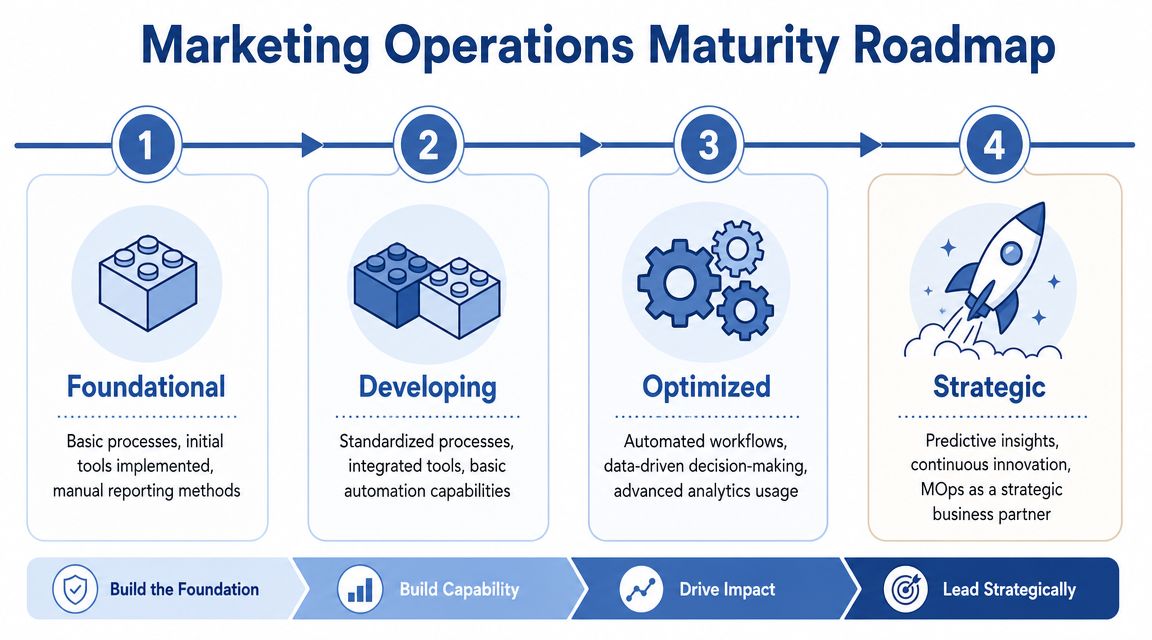
The stack categories that matter most
You don't need every category at enterprise depth. You do need clarity on each role.
| Category | Job in the stack | What to watch for |
|---|---|---|
| CRM | System of record for contacts, accounts, stages, and revenue context | Weak field discipline ruins everything downstream |
| Marketing automation platform | Executes nurtures, routing, segmentation, and triggered communication | Automation without governance creates spam and confusion |
| CMS | Publishes and manages conversion paths and content experiences | Broken tracking and inconsistent forms create attribution gaps |
| Analytics and BI | Turns raw activity into decision-ready reporting | If definitions differ from system to system, dashboards mislead |
| Project or workflow management | Coordinates campaign execution and approvals | Too many side channels bring back chaos |
The best stack is the one your team can govern, whatever it costs.
Integration is the real battleground
Disconnected tools slow decisions and erode trust. Data sync issues, mismatched lifecycle stages, duplicate contacts, and inconsistent campaign naming all lead to the same outcome. You stop believing the numbers.
That's why I recommend studying practical tool integration strategies before adding new software. Integration discipline matters more than vendor sprawl.
When teams are evaluating automation platforms, orchestration layers, or AI-assisted execution systems, I also point them toward resources on AI marketing automation tools because the right tool choice depends heavily on your current data quality and process maturity.
What works and what fails
What works is a small set of well-connected systems with explicit ownership.
- Choose a primary source of truth so reporting doesn't become a political debate.
- Document sync logic and field ownership so teams know what can change and who approves it.
- Standardize campaign setup across channels so analysis is clean later.
- Automate low-value repetition like routing, status changes, alerts, and standard follow-up sequences.
What fails is logo collecting.
A bloated stack creates duplicate functionality, fragmented attribution, and fragile workflows that only one specialist understands. Then that person leaves, and the whole thing becomes archaeology.
If you remember one thing here, remember this. Treat your stack as an operating environment rather than a shopping list.
A Practical Roadmap to MOps Maturity
You won't build a disciplined marketing operations function in one sprint. This capability matures in stages.
That's normal. In fact, the field itself has matured into a real career path. In the MO Pros Community's State of Marketing report, 61% of marketing operations respondents reported six or more years of experience, a sign that the discipline has moved well beyond ad hoc support work, according to MO Pros Community's state of marketing operations findings.
What matters is knowing your current stage and acting accordingly.
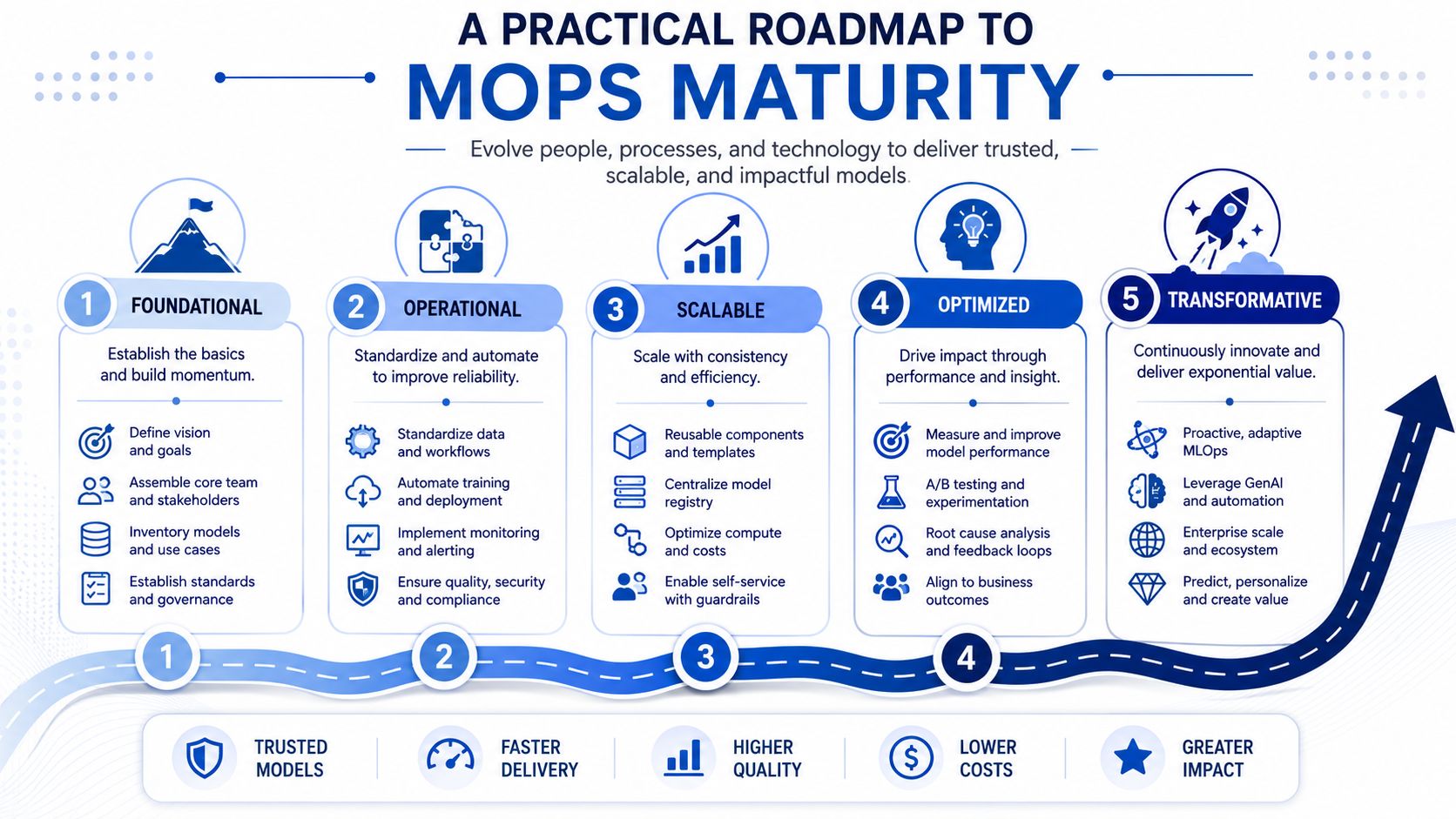
Stage 0 through Stage 1
Stage 0 is chaotic. Campaigns launch through habit and heroics. Reporting is manual. Data quality issues are common. You ask basic questions and get inconsistent answers.
Your priority here is containment.
- Document one critical workflow such as inbound lead routing or campaign launch QA.
- Choose a source of truth for core contact and lifecycle data.
- Assign ownership for automation changes, reporting logic, and data hygiene.
Stage 1 is emerging. You have some defined workflows, but enforcement is uneven. Teams still improvise under pressure.
At this stage, standardization matters more than sophistication. Don't chase advanced attribution if you can't trust field mapping.
Stage 2 through Stage 3
Stage 2 is established. The stack is functioning, workflows are repeatable, and reporting is good enough for management decisions. Many companies at this stage finally stop feeling like every campaign is a fire drill.
Focus here on reliability.
| Stage | Priority | Executive outcome |
|---|---|---|
| Stage 2 Established | Standard operating procedures, cleaner data flows, repeatable campaign execution | Better forecasting and less wasted effort |
| Stage 3 Optimized | Advanced automation, stronger governance, proactive insights | Faster decisions and sharper budget allocation |
Stage 3 is optimized. Marketing operations becomes a strategic partner. Beyond executing requests, the team identifies friction, shapes investment decisions, and helps you see what to scale.
The inflection point is when MOps stops reporting on marketing and starts steering it.
How to move without overbuilding
I've seen two common mistakes.
The first is underbuilding. Owners refuse process discipline because they fear bureaucracy. The result is expensive chaos.
The second is overbuilding. Teams create approvals, fields, forms, and governance layers far beyond their actual complexity. That slows execution and frustrates marketers.
The right path is tighter than expected:
- Fix the highest-friction workflow first.
- Clean the data required for one core dashboard.
- Automate only after the manual version is stable.
- Expand governance when complexity increases.
That sequence works because it builds trust. Once teams see cleaner launches, better reporting, and fewer handoff failures, adoption gets easier.
The Future of MOps Is Your Competitive Edge
At this point, the conversation gets more urgent.
A lot of business owners want AI-driven marketing. They want agentic workflows, faster experimentation, adaptive content systems, and better decision support. Fair. But most of them are trying to install AI on top of operational disorder.
That doesn't work.
Recent industry coverage highlights a major gap in how people explain MOps today. They still describe the classic responsibilities, but often miss what changes when AI enters the operating model. As MarTech's discussion of modern MOps roles and AI change notes, the practical questions now include how teams evaluate AI-generated outputs, enforce brand and data controls, and redesign workflows so humans supervise exceptions instead of manually doing every task.
That shift is massive.
What AI changes inside marketing operations
AI provides greater advantage, but it also increases the need for control.
- Prompted content generation requires brand rules, approval paths, and content traceability.
- AI-assisted segmentation and routing require cleaner input data and clear override logic.
- Automated campaign orchestration requires stronger QA, because errors now scale faster.
- Agentic workflows require decision boundaries so the system knows when to act and when to escalate.
Without MOps, AI becomes a speed multiplier for mistakes.
The competitive reality
Companies with strong marketing operations can deploy AI in a disciplined way. They can test faster, personalize more precisely, and measure outcomes with less confusion. Their teams spend less time stitching tools together and more time making strategic moves.
Companies without it stay stuck in demo mode. They generate ideas, not systems.
I've been working with machine learning since 2016 and generative AI since 2019, and this pattern keeps repeating. The businesses achieving substantial benefits from AI have enough operational discipline to plug AI into reliable workflows, trusted data, and clear business objectives. Chasing novelty doesn't get them there.
If you want to win your market, start there.
Marketing operations is the nervous system that lets your marketing think, coordinate, and act at speed. It is the prerequisite for trustworthy automation. It is the layer that turns activity into signal. And in an AI-driven market, it's one of the clearest separating lines between companies that scale intelligently and companies that just get louder.
If you're building toward AI agents, automation, and a more controlled growth engine, start by fixing the operating layer first. That's the work that makes everything else compound.