
Your team is sending more emails, doing more manual research, and sitting through more pipeline reviews. Yet growth still feels harder. Meanwhile, competitors are responding faster, personalizing better, and getting into deals before your reps even finish list building.
That gap is usually a system problem.
I'm Samuel Woods. I've been working with machine learning since 2016 and generative AI since 2019. I've built enough of these systems to tell you this plainly. If you're treating an ai agent for sales outreach like a shiny add-on, you're already behind. The companies winning with AI are building a bionic sales system where agents, CRM data, prompts, workflows, and human reps operate like one revenue machine.
That's the only framing that matters. Revenue. Speed. Control. Competitive advantage.
Your Competitors Are Already Using AI Sales Agents
Your top rep opens the CRM at 8:03 a.m. A competitor has already touched the account, referenced the prospect's hiring pattern, tied the message to an active initiative, and queued the next step before your team finishes basic research.
That is the new sales situation.
Analysts at Salesforce found that 56% of sales professionals use AI daily, and those daily users are more than twice as likely to exceed their goals. The same research reports that 45% of sales teams use a hybrid model of humans plus AI for prospecting. Read the data in Salesforce's State of Sales report.

So stop treating an ai agent for sales outreach like a copy generator bolted onto outbound. The companies pulling ahead are building a bionic sales system. The agent handles research, context assembly, message drafting, workflow triggers, and signal detection. Reps handle judgment, objection handling, and deal strategy. You get speed without losing control.
This is the part many guides skip. The actual advantage comes from integration, more than automation alone. Your agent should sit inside a market intelligence neural network that connects CRM history, account signals, website activity, buying committee changes, and rep feedback into one operating loop. If your agent cannot improve the system around the rep, you bought software without building capability.
I care about one question. Does your system create more qualified conversations before your competitors do?
Your reps should not burn prime selling hours stitching together account context from five tabs and three databases. The system should assemble the brief, recommend the angle, log the activity, and flag the handoff moment before the rep joins the conversation.
If you want another practical angle on AI-assisted outbound, this breakdown of LinkedIn growth strategies using Claude Opus is useful because it shows how AI can support pipeline creation beyond email alone.
I write more about this operating model in my guide on how sales AI agents fit into a real revenue system. What you need is a sales machine that learns faster than the market, instead of another disconnected tool.
Define the Mission Before Building the Machine
Monday morning. Your reps open their queues, the agent starts firing, and by noon the team has sent a pile of activity into the market. If you did not define the mission first, you have no idea whether that activity built pipeline, created noise, or trained the system on the wrong behavior.
Start there.
An ai agent for sales outreach should have a job tied to revenue. In a bionic sales system, the agent is one node in a larger operating model. It feeds signal, context, and execution into the rep workflow. That only works if you decide, in plain commercial terms, what the machine is supposed to improve.
Pick one mission with economic weight
Choose one outcome that changes pipeline or rep capacity in a measurable way.
Good missions usually look like this:
- Increase qualified meetings in a specific segment.
- Cut lead response time for inbound hand-raisers.
- Improve first-touch relevance for named accounts.
- Re-engage stalled opportunities with timely follow-up.
- Remove research and prep work from rep calendars.
Keep it narrow enough that you can tell whether it worked.
If you say the agent is for prospecting, personalization, follow-up, forecasting, CRM hygiene, and coaching, you have a shopping list instead of a mission. Broad mandates create messy systems, weak accountability, and adoption problems inside the sales team.
Write the mission in business language
Do not brief the team with AI language like agent autonomy, orchestration, or multi-step reasoning. Reps do not care. You should not care either.
Write the mission the way you would say it in a pipeline review:
- Generate more meetings from enterprise accounts in healthcare.
- Respond to demo requests before competitors do.
- Bring dormant opportunities back into active conversation.
- Give reps a usable pre-call brief before every first meeting.
That framing matters because it forces you and me to design the system around throughput, conversion, and handoff quality. It also keeps the build grounded in behavior change, which is where these projects usually break.
Assign a role the team can recognize
Role-based design gets adopted faster because everyone knows where the agent fits.
Use roles like these:
Scout.
Finds accounts, gathers context, surfaces buying signals, and prepares the brief.Prospector.
Drafts outreach, prioritizes contacts, and manages early follow-up until a human reply needs judgment.Coordinator.
Books meetings, updates records, advances sequences, and catches no-response cases.Analyst.
Reviews outcomes, spots pattern shifts, and recommends targeting or messaging changes.
What you need is a small set of clear responsibilities connected to the rest of the revenue system, rather than one giant agent doing all of this. That is how you build a bionic sales motion. The machine handles speed, memory, and pattern detection. The rep handles judgment, trust, and deal strategy.
A rule of thumb: if a sales manager cannot explain the agent's job in one sentence, the design is too loose.
Set boundaries before the first live send
Strategy is central to the build. Every agent needs clear operating limits or it will create confusion at scale.
Define these five points before deployment:
Target segment.
Which accounts and contacts are in scope?Primary action.
What exact behavior should increase because this agent exists?Handoff trigger.
When does the rep take over?Guardrails.
Which claims, tone choices, and actions are prohibited?Success metric.
What result proves the mission is working?
These constraints do more than reduce mistakes. They make the agent usable inside a real team. Reps know when to trust it. Managers know what to inspect. Operations knows what to measure. That is change management as much as prompt writing.
Mission clarity is where the market intelligence neural network starts to become real. Your agent is part of a system that senses, decides, acts, and routes context back to the team. Define the mission well, and the machine improves the whole go-to-market motion. Define it poorly, and you get more activity without more revenue.
Prepare Your Data and CRM for the Agent
Most AI outreach projects fail because the data is dirty, fragmented, stale, or missing the context needed to make decent decisions, far more often than because the model is weak.
An ai agent for sales outreach is only as sharp as the memory you give it. Your CRM is that memory.
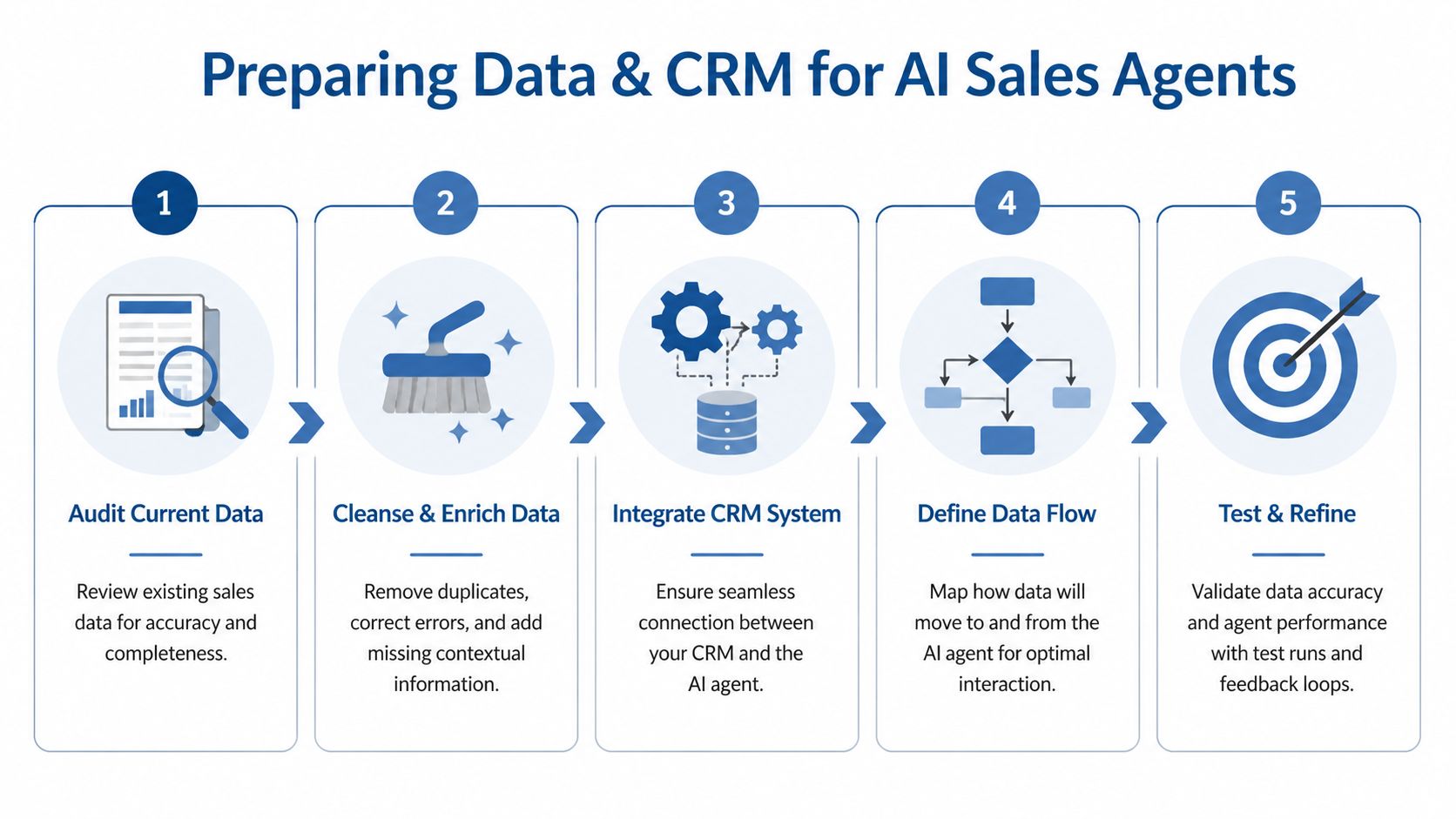
What the agent actually needs
Beyond names and email addresses, the agent needs context that helps it judge relevance.
That usually includes:
Firmographic context.
Company size, industry, geography, growth stage, and team structure.Contact context.
Role, seniority, department, and prior interactions.Behavioral context.
Email engagement, website activity, content downloads, sequence history, and meeting history.Commercial context.
Deal stage, source, lead owner, status accuracy, and qualification notes.Signal context.
Hiring activity, tech stack clues, account movement, and intent indicators your team trusts.
If a human rep can't open the CRM and quickly understand why this account matters, the agent won't magically figure it out.
Personalization only works when context is real
People fool themselves. They think AI personalization means sprinkling a first name into a template and referencing a company headline. That's cosmetic automation.
The reason AI works in outreach is that it can process more context than a rep can handle manually at scale. Using AI to personalize outreach boosts email response rates by 28% on average, with advanced customization producing a 25% increase in prospect reply rates and a 15% higher conversion rate according to Rev Empire's 2025 AI in sales statistics.
Those gains come from relevant context more than clever wording.
A simple agent-readiness audit
Before you automate anything, check the basics.
| Area | What you need to verify |
|---|---|
| CRM hygiene | Lead statuses are current, duplicates are reduced, owners are accurate |
| Activity history | Emails, replies, calls, and meetings are logged consistently |
| Field structure | Important segmentation fields are standardized, not buried in notes |
| Signal access | The agent can reference relevant account and contact signals |
| Workflow clarity | Your team knows what happens before and after the agent acts |
And be honest about one ugly truth. Messy systems create bad outreach.
- Bad lead routing means the wrong prospects get contacted.
- Missing engagement history leads to awkward or repetitive messaging.
- Stale account records cause the agent to personalize around outdated facts.
- Fragmented tools force reps to override the system and go rogue.
A clean CRM makes your outreach reliable, which matters more than making it sexy.
Choose Your AI Sales Agent Architecture
Founders often overcomplicate things. They hear "agent" and immediately imagine a custom stack with orchestration layers, vector databases, multiple models, and a six-month engineering roadmap.
Most of you don't need that on day one.

Two viable paths
You have two broad options. Both can work. The right one depends on your stage, technical capacity, and need for control.
| Path | Best for | Strengths | Trade-offs |
|---|---|---|---|
| Managed platform | Startups, SMBs, lean teams | Faster launch, less technical overhead, built-in workflows | Less control, possible platform constraints |
| Custom architecture | Teams with engineering depth | More ownership, deeper integration, tailored logic | More complexity, slower rollout, higher implementation burden |
Managed platforms include products like Outreach.io and Bika.ai. They shorten time to value. You can stand up workflows, connect data, and test outreach logic without building every layer yourself. That's often the right first move.
Custom architecture makes sense when AI outreach is becoming core infrastructure and you need direct control over logic, model selection, internal systems, and proprietary workflows.
My recommendation for most founders
Start managed. Prove the economics. Then decide if custom gives you a real moat.
I don't recommend custom builds unless you already have a team that can handle agent design, system reliability, prompt versioning, integration maintenance, and performance review. Otherwise, you'll spend months building a machine your reps still don't trust.
For a broader market view, this founder's guide to AI sales is a useful companion if you're comparing categories of tools before you commit to one architecture.
You can also explore my work on AI agents if you're thinking beyond outreach and want to connect sales agents into a wider operating system.
Where architecture breaks in the real world
The breakdowns are predictable.
According to Bika.ai's step-by-step build guide, disconnected data causes 30% to 50% of bottlenecks in AI agent workflows, and unoptimized agents can underperform by over 50% without continuous analysis and iteration. That's exactly what I see in the field.
The gaps are usually the problem, more than the tool.
- Integration gaps create blind spots between outreach activity and CRM truth.
- Weak review loops let bad messaging persist too long.
- Over-automation removes judgment from deals that still need human nuance.
- Tool sprawl creates multiple sources of truth and kills adoption.
This short walkthrough is worth watching if you're evaluating how architecture choices affect implementation speed and control.
One more point. If you want a bionic system, architecture is an operating model question as much as a software one. Outreach.io, Bika.ai, and custom stacks are all valid depending on constraints. I’m another option if you want help designing the workflow, context layer, and adoption plan around whichever tooling you choose. You can work with me on that part.
Choose the path your team can run. Not the one that sounds the smartest in a pitch deck.
Design the Agent's Prompting and Reasoning Model
Most AI outreach underperforms because the prompt is lazy. Teams give the model a task without a thinking process. Then they wonder why the output sounds bland, generic, or slightly off.
That's a design failure.
Context carries more of the load than prompts.
A one-line instruction like "write a cold email to this VP" produces average output because the model has no grounded understanding of the buyer, account, timing, product angle, or desired next action.
You need a reasoning model. That means the agent follows a sequence of thinking steps before it writes anything.
I break this into four layers:
Research layer.
Pull account, contact, signal, and CRM context into one working memory.Hypothesis layer.
Infer what problem or opportunity is most likely relevant for this buyer now.Message layer.
Draft outreach based on that hypothesis, your positioning, and the chosen offer.Review layer.
Check tone, specificity, compliance, and whether the message sounds human.
That is the difference between a prompt toy and an actual sales agent.
Give the agent a brand mind
Your agent needs more than instructions. It needs boundaries and preferences.
That includes:
Voice rules.
How direct should it be? How formal? How punchy?Commercial rules.
What offers are allowed? What claims are forbidden? What CTA should it prefer?Decision rules.
When should it send, wait, escalate, or stop?Relevance rules.
Which signals matter enough to reference, and which are too weak?
Context engineering matters more than most people think. If you want the deeper distinction, I explain it in my piece on context engineering vs prompt engineering. Prompting is one layer. Context is the operating environment that makes the prompt useful.
A good sales agent chooses what matters before it writes a word.
A practical reasoning flow
Here is a clean structure I like for outbound agents:
Step one.
Review the account record, recent signals, and prior touch history.Step two.
Form one hypothesis about a likely business pain, friction point, or growth priority.Step three.
Match that hypothesis to one offer, one proof point, and one simple call to action.Step four.
Rewrite for clarity and remove any line that sounds synthetic, inflated, or vague.Step five.
Score confidence. If confidence is low, route to human review instead of auto-send.
This is also where you should avoid overreach. Don't ask the agent to handle complex objections, negotiate pricing, or improvise strategic recommendations in first-touch outbound. That's where humans still win.
When not to rely on autonomous messaging
There are situations where I pull the automation back.
- High-stakes enterprise accounts often need heavier human oversight.
- Early positioning shifts are dangerous because your messaging is still changing.
- Weak data environments lead the model to invent relevance where none exists.
- Founder-led sales usually depend on nuance and personal authority that should not be over-automated.
Use the agent where repeatable reasoning beats manual inconsistency. Keep humans where judgment, trust, and negotiation matter most.
Measure, Iterate, and Win More of Your Market
Week one looks promising. The agent sends at volume, replies tick up, and the dashboard gives everyone something to celebrate. Then the harder truth shows up. Half the meetings are weak, good accounts are getting generic copy, reps stop trusting the workflow, and nobody can explain which part of the system is creating revenue.
That is the difference between deploying a tool and building a bionic sales system.
A real system learns. It gets sharper account by account, reply by reply, handoff by handoff. If you're serious about competitive advantage, measure the agent like an operating layer inside the revenue team rather than a campaign add-on.
Measure business output and learning speed
Start with revenue metrics, because that is where bad automation gets exposed fast.
Track:
- Qualified meetings created
- Sales accepted opportunities
- Pipeline created or influenced
- Closed-won revenue tied to agent-assisted workflows
- Rep hours returned to live selling
- CRM accuracy after agent actions
- Human override rate
- Time from signal detection to first relevant outreach
The last two matter more than many teams realize. Override rate shows whether reps trust the machine's judgment. Speed to outreach shows whether your market intelligence loop is working. In a bionic model, the agent is part of your sensing system. It should catch changes in account behavior, route them into action, and improve the team's timing.
Open rate still has diagnostic value. It just should not drive strategy.
Run experiments like an operator
Do not roll the agent out across every motion and hope the averages work out. Isolate one use case and force a clean test.
A disciplined pilot usually looks like this:
Pick one revenue motion.
Prospecting, inbound follow-up, reactivation, or post-event outreach.Pick one controlled segment.
One territory, one ICP slice, or one rep pod.Set one baseline.
Compare against the prior human-led process using the same audience and window.Review every failure mode.
Bad targeting, weak hypotheses, poor handoff timing, CRM pollution, and rep rejection.Decide what changes.
Prompt logic, enrichment rules, routing thresholds, or human approval steps.
That review cadence is where the neural network gets trained. Every missed reply, every bad meeting, every manual rewrite tells you something about positioning, signal quality, or account selection. If nobody captures that feedback, the agent stays static and your competitors catch up.
Fix the hidden blockers before rewriting the model
Teams often blame copy when the true problem sits somewhere else.
If replies are weak, examine the full chain:
- Was the account selected for a real reason or just because it matched a list filter?
- Did the agent use current signals or stale CRM fields?
- Did the message reach the inbox?
- Did the rep follow up fast enough once intent appeared?
- Did the handoff preserve context, or force the buyer to restart the conversation?
Inbox placement deserves special attention. If performance suddenly drops, verify deliverability before you start rewriting prompts. Use a simple operational check like this guide on how to check if emails are going to spam.
Change management decides whether the system survives
The technical work is rarely the reason these programs fail. Sales teams kill weak implementations through quiet noncompliance.
Reps ignore recommendations they do not trust. Managers allow side workflows. Operations teams patch over bad data manually. Within a quarter, the agent still exists, but the system is dead.
Set rules early and enforce them.
| Problem | What you should do |
|---|---|
| Reps bypass the workflow | Require agent-assisted research or draft review in the chosen motion |
| Low-confidence output slips through | Route those accounts to human approval and tighten confidence thresholds |
| The agent sounds off-brand | Create a small set of approved voice patterns and lock them |
| Managers stop inspecting quality | Add weekly reviews of agent output, overrides, and pipeline quality |
| CRM quality drops | Log every write action and audit field changes on a fixed schedule |
This is the part the tooling guides skip. You are redesigning how the revenue team senses the market, acts on signals, and learns from outcomes, which is a bigger job than buying productivity software.
Get that right, and your ai agent for sales outreach becomes part of a bionic sales system that compounds judgment across the team. That is how you build an advantage that is hard to copy.
Operate it with discipline, and the agent will improve more than message quality. It will improve how fast your business learns.