Most advice on the ai agent for content marketing is shallow. It tells you to buy a tool, write a prompt, and crank out more posts. That approach creates cheap content and expensive disappointment.
I’ve been working with ML since 2016 and generative AI since 2019. The teams winning with agents aren’t chasing blog volume. They’re building bionic systems that combine machine speed with human judgment, brand discipline, and commercial intent.
If you want revenue, your agent can’t be a novelty. It has to become part of how your team researches, writes, personalizes, ships, measures, and improves content.
Your Competitors Are Building Content Robots, You Should Build a Bionic Team
By 2025, 87% of marketers were using AI for content creation, which means AI is no longer an edge by itself. It’s table stakes. The actual gap sits in execution, because high performers are 2.5x more likely to have fully implemented AI operations, and Gartner projects that 80% of enterprise content will involve AI-powered SEO agents by 2027 according to Eminence’s AI content marketing analysis.
That’s the part teams often miss.
They think an agent is a chatbot with better prompts. It isn’t. An agent is a designed operating system for a specific job. Research. Drafting. optimization. Personalization. Reporting. Escalation. Human review. Publishing. Learning. That chain is where the value lives.
Your competitors are building content robots. They’re asking generic systems for generic blog posts, then wondering why the output sounds like everyone else in the category.
You should build a bionic team instead. Humans own positioning, judgment, offers, differentiation, and final editorial calls. Agents handle the repetitive work, the pattern recognition, the memory, and the speed.
Why the tool-first mindset fails
When you buy an AI writing tool before defining the operating model, you get output that lacks strategic value. You produce more assets, but you don’t create a better content business.
That’s why I push leaders to study how AI creative automation platforms fit into a broader system, not as isolated software purchases. The platform matters less than the architecture you build around it.
Practical rule: If your agent can write, but can’t access your strategy, your historical winners, your CRM signals, or your editorial rules, you haven’t built an asset. You’ve rented a faster intern.
The companies pulling away aren’t asking, “Which AI app should we try?” They’re asking, “What repeatable marketing decisions can we systematize before competitors do?”
What a bionic team actually looks like
A useful mental model is simple:
| Team component | Best owner | Business impact |
|---|---|---|
| Market positioning | Human | Clear differentiation |
| Content research and synthesis | Agent | Faster decision cycles |
| First drafts and variations | Agent | More throughput |
| Brand voice enforcement | Human plus agent | Consistency without bottlenecks |
| Final commercial judgment | Human | Better revenue alignment |
If you want a deeper breakdown of how these systems work in practice, my guide on AI marketing agents goes into the operating logic behind them.
The point is straightforward. Don’t build a content robot. Build a revenue-producing marketing team where agents amplify your best people.
Design the Job Before You Hire the Agent
Most failed agent projects die before the first API call. The team never defined the job.
They started with a model. They should’ve started with a business problem.
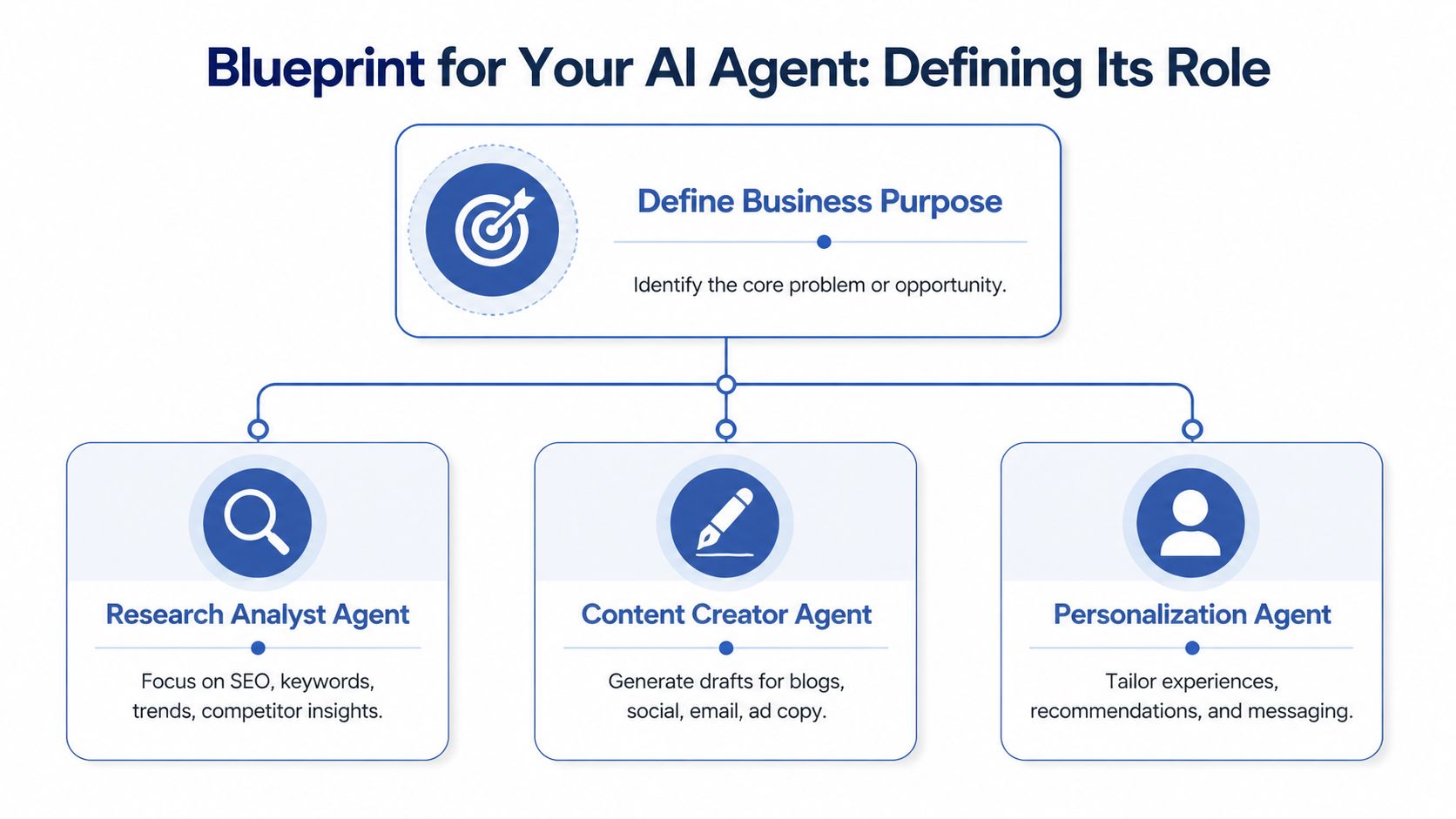
Start with the commercial outcome
Don’t ask, “What content should the agent create?”
Ask better questions.
- Where does content influence revenue? Pipeline creation, conversion, retention, upsell, expansion.
- Where does your team waste time? Research loops, rewrites, repurposing, content QA, handoffs.
- Where does inconsistency hurt you? Brand voice, follow-up speed, channel fit, offer messaging.
That gives you an actual role definition. Not AI theater.
Here are three high-value agent roles I recommend often:
- SEO research agent that identifies content gaps, clusters topics, summarizes competitor coverage, and briefs your writers.
- Conversion copy agent that drafts landing pages, nurture emails, offer pages, and testing variants tied to a clear funnel stage.
- Personalization agent that adapts messaging by segment, behavior, lifecycle stage, or product interest.
Each one maps to a measurable business function. That’s what matters.
Single specialist or multi-agent team
A lot of founders overbuild too early. They want a swarm of agents before they’ve proven one useful workflow.
Start with a single specialist if your bottleneck is narrow. For example, if your team loses time turning sales calls and product notes into publishable drafts, use one content production agent with tight instructions and human approval.
Use a multi-agent setup when the workflow has distinct handoffs. Researcher to strategist. Strategist to writer. Writer to editor. Editor to publisher.
That structure isn’t theory. In one consumer goods case study, intelligent agents for blog production cut costs by 95% and accelerated speed by 50x, and agencies using multi-agent systems have reduced production costs by 40% while increasing output according to Bika’s review of AI agents in content marketing.
Don’t design agents around tasks alone. Design them around handoffs, approvals, and business ownership.
Write the agent job description like you’d hire a senior operator
I use a simple job spec:
- Mission: What business outcome does this agent support?
- Inputs: What data, documents, or triggers does it need?
- Actions: What can it do on its own?
- Guardrails: What requires approval?
- Success criteria: How do you know it’s helping?
Here’s a compact example:
| Field | Example |
|---|---|
| Mission | Increase demo requests from bottom-funnel content |
| Inputs | CRM notes, call transcripts, top pages, offer library |
| Actions | Draft briefs, emails, CTAs, page variants |
| Guardrails | No publishing without editor approval |
| Success criteria | Better conversion quality and faster production |
If you’re serious about making the agent useful instead of flashy, learn agentic context engineering. Context is what turns a model from a generic generator into a business operator.
Many teams don’t have an AI problem. They have a role design problem.
Fueling the Engine with Models, Prompts, and Proprietary Data
Once the job is clear, you can build the brain. At this stage, people usually obsess over the wrong thing.
The model matters. Your data and context matter more.

Pick models based on work, not prestige
I use frontier models when the task needs deeper reasoning, messy synthesis, nuanced positioning, or complex planning. I use faster, cheaper models for repeatable production steps like reformatting, metadata drafting, content repurposing, and classification.
You don’t need the most expensive model at every stage. You need the right one for each stage.
A practical setup often looks like this:
- Reasoning-heavy step: strategy memo, audience synthesis, content angle selection.
- Production step: draft expansion, social variants, title options, schema-friendly summaries.
- Evaluation step: tone check, policy check, factual consistency review against approved materials.
That mix protects margins. It also gives you more control over latency and quality.
Prompting is not enough
A one-shot prompt is fragile. Agents need an operating loop.
The strongest pattern is observe, plan, act. That means the agent first reads the current situation, then decides the next best move, then executes inside defined limits. In one example, a campaign agent first used a free shipping email for price-sensitive customers and saw a 2% conversion, then escalated non-responders to a 10% discount, with tactics in this model improving key metrics by 22% to 35% according to CDP’s guide to AI marketing agents.
That same logic applies to content marketing. Your agent should observe performance, plan revisions, and act on low-risk optimizations. Not just generate text on command.
A useful agent doesn’t ask, “What should I write?” It asks, “What does this audience, page, or funnel stage need next?”
Your proprietary data is the moat
If your agent only knows what the public internet knows, you’re building a commodity.
Feed it the materials your competitors can’t copy:
- Customer language: call transcripts, support tickets, reviews, survey responses
- Commercial reality: CRM stage notes, objections, win-loss patterns, churn reasons
- Brand memory: approved messaging, content style guides, offer frameworks, past winners
- Performance context: page-level analytics, campaign outcomes, email engagement by segment
To achieve optimal results, context engineering beats prompt hacking. Your system needs the right information, in the right order, at the right moment.
If your team struggles with robotic outputs, a tactical cleanup pass with tools that humanize chatgpt text can help during editing. But don’t confuse surface polish with strategy. If the source context is weak, the polished version is still weak.
For teams building these workflows seriously, I’d also study stronger AI prompts for marketing that are designed for multi-step execution, not just single-turn generation.
What the agent should know before it writes a word
Here’s the minimum context package I want connected before an agent touches core content:
| Context source | Why it matters |
|---|---|
| Brand guidelines | Protects tone and positioning |
| Product and offer details | Prevents generic claims |
| Customer voice data | Improves resonance |
| Funnel stage and audience segment | Matches intent |
| Past performance signals | Informs better choices |
That’s how you turn a model into an operator. Not with clever prompting alone, but with permissioned access to the intelligence your business already owns.
Connecting Your Agent to Your Marketing Stack
An agent that can’t take action is just a nice demo.
If you want commercial value, your agent needs to connect to the systems where marketing work happens. CMS. CRM. Analytics. Email. Internal docs. Project management. Approval flows.

Connect it to triggers, not just dashboards
I prefer event-driven workflows over passive reporting. That means something happens in the stack, and the agent responds.
A few examples:
- New lead enters HubSpot: agent researches the company, drafts a customized email sequence, and creates a rep task.
- Blog post loses traction in GA4 or Search Console: agent prepares a refresh brief with content gaps, internal linking suggestions, and CTA updates.
- Product team ships a feature: agent converts release notes into a landing page draft, customer email draft, and social copy queue.
Founders usually see the difference between “AI content” and “AI operations.” The latter compounds.
Keep the action surface narrow at first
Don’t start by letting the agent publish everywhere. Start by letting it prepare work inside existing systems.
I like this progression:
| Level | Agent permission | Human role |
|---|---|---|
| Draft only | Create briefs, outlines, first drafts | Review and approve |
| Assisted action | Update records, route tasks, prep content in CMS | Approve final action |
| Limited autonomy | Publish low-risk updates, trigger nurtures within rules | Audit exceptions |
That structure reduces risk without slowing momentum.
Your stack might include WordPress or Webflow for publishing, HubSpot for CRM and email, Notion for knowledge, Slack for approvals, GA4 for performance, and Zapier or Make for orchestration. The exact tools matter less than the architecture. Trigger. Context retrieval. Reasoning. Action. Approval. Logging.
Build the workflow around real commercial moments
A good marketing agent doesn’t operate in isolation. It plugs into moments that matter.
For example, if someone downloads a buyer’s guide from your site, your system can:
- Pull firmographic and behavioral context from the CRM.
- Match the lead to a relevant industry narrative.
- Draft personalized follow-up emails.
- Queue supporting content for sales enablement.
- log outcomes so the system improves over time.
That’s a practical standard worth seeing in motion:
What to connect first
If you’re an SMB or a lean SaaS team, I’d connect these in order:
- First, CRM and knowledge base so the agent understands customers and offers.
- Next, CMS and analytics so it can create and improve content with feedback loops.
- Then, email and tasking systems so content supports pipeline movement.
The mistake I see all the time is building a clever agent in a sandbox with no path to execution. If it can’t create work inside the stack your team already uses, it won’t survive past the pilot.
The 90-Day Plan for a Safe and Scalable Launch
Teams often fail by giving the agent too much freedom too early. Then they blame the model.
The main issue is rollout discipline.

A structured rollout works better. In benchmarks from Edge Digital’s guide to building an AI marketing agent, a successful program moves from data prep in Days 1 to 14, into a pilot in Days 30 to 60, and then to scaled action in Days 75 to 90. That phased approach can lead to a 25% engagement uplift and a 30% reduction in customer acquisition costs.
Days 1 to 30
Focus on prep, rules, and sandbox testing.
Clean the inputs. Decide what the agent can access. Write clear instructions. Test on historical tasks before exposing the system to live marketing operations.
I want answers to four questions in this phase:
- Can it complete the task?
- Can it follow brand and compliance rules?
- Can it explain why it chose an action?
- Can a human review it quickly without fixing everything?
Days 31 to 60
Run a controlled pilot with strict approval.
The agent drafts real assets, analyzes real signals, and recommends real next steps. But humans approve everything. Every email draft. Every page update. Every audience decision.
Leadership rule: If your team can’t audit the agent’s choices during the pilot, you’re not piloting. You’re gambling.
Keep a scorecard. Track task completion, revision burden, output quality, and whether the recommendations help the team move faster.
Days 61 to 90
Expand permissions only where performance justifies it.
Good candidates for limited autonomy are low-risk tasks. Internal tagging. Draft generation. Content formatting. Queueing approved updates. Triggering routine nurture variants inside clear boundaries.
I also want an exception process by this point. Someone owns edge cases. Someone owns QA. Someone owns rollback if the system behaves badly.
The practical launch checklist
| Phase | Primary focus | What success looks like |
|---|---|---|
| Days 1 to 30 | Data prep and testing | Reliable outputs in sandbox |
| Days 31 to 60 | Human-approved pilot | Useful work with manageable edits |
| Days 61 to 90 | Limited scale | Safe automation in low-risk workflows |
A mature launch isn’t flashy. It’s controlled, measurable, and boring in the best way. That’s what lets you scale without cleanup chaos later.
Scaling with Governance and Preserving Your Brand Voice
This is the final test. Your system can now produce a lot more content. That does not mean you should let it.
Speed without governance creates content decay. Worse, it trains your audience to ignore you.
The warning signs are already obvious. AI can increase output, but 70% of AI-generated content can fail E-E-A-T signals without strong human editorial oversight, as noted in ALM Corp’s discussion of AI agents for marketing. That’s why raw volume is a weak strategy.
Human editorial oversight is not optional
I don’t believe in fully automated brand publishing for serious companies. Not if you care about trust, positioning, or conversion quality.
The winning structure is hybrid:
- Agents handle research, outlines, formatting, repurposing, and first drafts.
- Human editors sharpen arguments, add original perspective, validate claims, and protect tone.
- Senior marketers decide what should exist at all.
That’s how you scale without sounding synthetic.
Your brand voice is not a prompt. It’s a set of editorial decisions repeated consistently over time.
Build a voice constitution
Teams often have a style guide. That’s not enough.
I recommend a voice constitution with practical instructions the agent and the humans can both follow:
- What we sound like: plainspoken, assertive, specific, commercially aware
- What we never sound like: vague, inflated, academic, generic, over-polished
- What claims require review: product claims, comparative claims, regulated statements
- How we persuade: examples, clear recommendations, direct trade-offs
- How we end pieces: action-oriented, commercially relevant, no filler wrap-up
This document should sit next to your prompt templates, content briefs, and approval rules. It’s not branding theater. It’s operational control.
Know when not to use an agent
Some work should stay human-led.
Use caution when the content depends on founder voice, sensitive reputation issues, major category narratives, legal risk, or original thought leadership that differentiates the company. In those cases, agents can support research and structure, but the final expression should come from a person with real stakes in the outcome.
A simple decision rule helps:
| Content type | Agent role | Human role |
|---|---|---|
| SEO support articles | Draft and optimize | Review and polish |
| Email nurtures | Personalize and variant-test | Approve messaging logic |
| Thought leadership | Research and structure | Write core argument |
| High-risk claims | Assist only | Full human ownership |
If you ignore governance, you’ll publish faster and weaken the brand. If you install governance properly, you get the upside of scale without sacrificing distinctiveness.
That’s the whole game.
If you want help designing a bionic content system instead of another AI experiment, explore my work at Samuel Woods. I help teams build agent-powered marketing operations that tie content, automation, and revenue into one system.