Monday morning. A strong candidate applies before your team starts work. By Tuesday afternoon, a faster company has already screened them, booked interviews, and set expectations. Your team is still passing resumes around, waiting on feedback, and hoping nobody drops the ball.
I see this constantly. You usually lose top candidates because your hiring process is slow, fragmented, and too dependent on people remembering the next step. A weak brand is rarely the cause.
That is why an AI agent for hiring and recruiting deserves serious attention. I mean a custom recruiting agent built to screen, route, follow up, schedule, document, and escalate across your existing systems with clear rules and human checkpoints, rather than another chatbot bolted onto your ATS.
The business case is simple. AI is already common in hiring, and hiring leaders keep adopting it for one reason first: it saves time. That matters because speed changes outcomes. Faster response times improve candidate experience, reduce recruiter drag, and give you a better shot at closing strong applicants before a competitor does.
My advice is to treat this as an operating model decision, not a software experiment. I would architect the agent the same way I do in a fractional CAIO engagement. Start with one painful workflow, connect the agent to your ATS, calendar, email, and scorecards, then put controls around bias, privacy, and approvals before you expand usage.
If you are hiring for technical roles, alignment matters even more. Your recruiting agent should reflect the actual requirements of the job, not guess at them. If you need sharper hiring criteria for engineering roles, review Buttercloud's app development guide.
Get this right and you save recruiter hours, move candidates faster, and make better hiring decisions. Get it wrong and you build a high-speed system that creates compliance risk, frustrates candidates, and scales bad judgment.
The Unwinnable War for Top Talent
It’s 9:12 a.m. on Monday. A strong candidate applies before their first meeting. By lunch, they have already heard back from a competitor. Your team still has the resume sitting in a queue, waiting for a recruiter, then a hiring manager, then a coordinator. By the time you respond, the candidate has framed your company as slow, unclear, and hard to work with.
That is the war you are fighting.

I treat this as a systems problem before I treat it as a talent shortage. Good candidates are lost in the gaps between tools, teams, and approvals. If you want better hiring outcomes, fix the operating model before you add headcount.
The pattern is painfully consistent:
- Resume backlog, where recruiters spend time triaging volume instead of judging fit.
- Weak follow-up, where qualified candidates get slow replies, generic outreach, or no clear next step.
- Interview friction, where scheduling turns into an email relay with no single owner.
- Workflow decay, where candidates stall in the ATS because each stage depends on someone remembering what to do next.
This is exactly why I push businesses toward a custom AI agents operating model for business workflows instead of another point tool. A recruiting agent should move work across your existing ATS, email, calendar, scorecards, and approval steps. It should not sit off to the side as a flashy assistant with no authority.
If you are hiring technical talent, weak process hurts twice. First, you lose speed. Then you misjudge the role itself and automate the wrong criteria. That is why I like resources such as Buttercloud's app development guide. It gives founders and hiring leads better market context before they turn requirements into screening logic.
My rule is simple: if you cannot point to the exact stage where strong candidates stall, you are not ready to scale hiring volume. You need to fix the system first.
AI adoption in hiring is already widespread, as noted earlier. The strategic takeaway is simple. Speed is no longer an edge by itself. Speed with control is the edge. That means building an agent that can screen, route, follow up, schedule, document, and escalate while keeping human checkpoints for judgment, bias review, and exceptions.
Get this right and you cut recruiter drag, protect candidate momentum, and close stronger hires before competitors do. Get it wrong and you automate confusion. That is faster, but not better.
Your First AI Recruiting Agent Blueprint
Most companies start in the wrong place. They ask which model to use, or which vendor has the flashiest demo. I start with friction.
Your first recruiting agent should attack the narrow slice of work that creates the biggest delay. Not every workflow. Not every role. Just the part of the pipeline that keeps slowing down decisions.
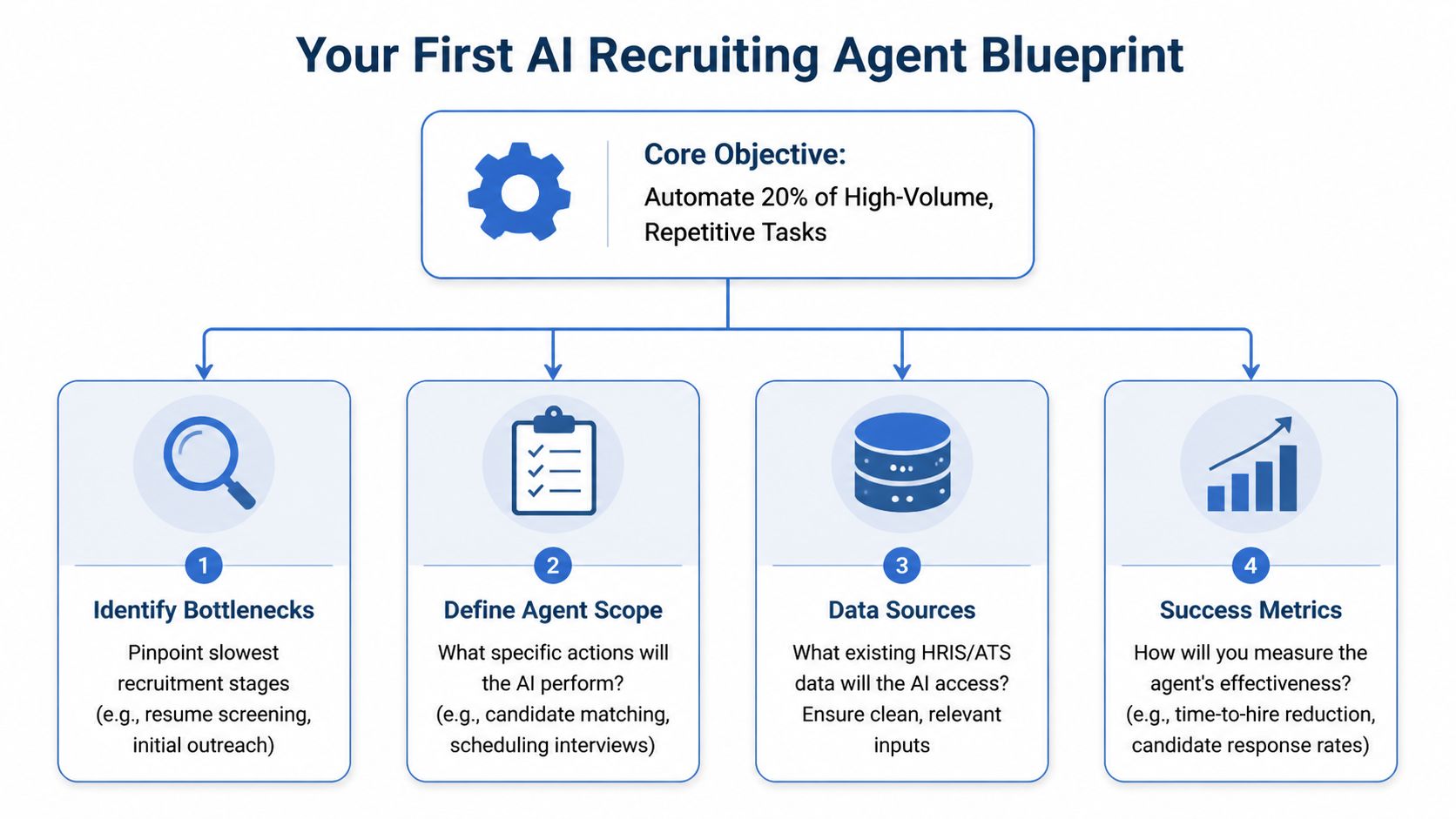
The three use cases I’d start with
I’d usually begin with these three because they create immediate business value.
Passive talent sourcing
70% of the global workforce is passive talent, meaning they aren’t actively applying but may be open to the right opportunity, based on LinkedIn workforce data discussed here. If your system only reacts to inbound applicants, you’re fishing in the smallest pond.Context-aware screening
Keyword matching is lazy. A good agent should read resumes, job requirements, and knockout criteria in context, then rank candidates with reasons that a recruiter can inspect.Always-on engagement
Good candidates don’t wait around for your team to answer at convenient times. Your agent should send outreach, respond to basic questions, tag objections, and route promising people into the next step automatically.
Here’s a useful way to think about architecture if you’re comparing implementation paths. Realtime Comms Ltd on agent frameworks is worth reviewing because framework choice affects orchestration, memory, tool use, and maintenance later.
The operating flow
Your first version needs to be reliable. Fancy can wait.
A simple blueprint looks like this:
| Layer | What it handles |
|---|---|
| Inputs | ATS records, job descriptions, recruiter notes, historical outreach, calendars |
| Logic | Matching rules, prompts, routing conditions, escalation rules |
| Actions | Source candidates, score applicants, send follow-ups, schedule interviews, update stages |
| Oversight | Human approval for rejections, score audits, exception handling |
The mistake I see most often is over-scoping. Teams try to automate sourcing, screening, scheduling, interview notes, scorecards, and offers in one sprint. Then they get mediocre behavior everywhere instead of excellent behavior somewhere.
Start with one workflow that you already understand well. Complexity hides bad design.
If you want a broader grounding in how these systems behave in production, I’d also point you to my work on AI agents. The important idea is that useful agents are operational systems that do real work, which a prompt wrapper can’t.
Here’s a quick walkthrough that complements this build approach:
What the first agent should own
Don’t give your first agent authority over final hiring decisions. Give it authority over movement.
I’d let it:
- Scan and shortlist candidates against structured criteria
- Launch personalized outreach across the channels you already use
- Tag replies like “interested,” “not now,” or “revisit later”
- Push scheduling forward once a candidate crosses a confidence threshold
- Write back into the ATS so your data stays current
That last point matters more than people think. If your agent works outside your ATS, you’ll create a shadow process. Shadow processes kill adoption.
Architecting the Agent's Brain and Body
An agent has three parts. Reasoning, memory, and action.
If one of those is weak, the whole system becomes annoying. You’ll get polished nonsense, stale context, or recommendations that never turn into real work completed.
The reasoning layer
Agentic AI is different from basic generative AI because it operates across multi-step recruiting processes with human oversight rather than isolated tasks, as explained in this analysis of AI agents in recruiting. That’s the key distinction. A chatbot answers. An agent progresses the workflow.
For recruiting, I usually separate reasoning into two categories:
- High-judgment tasks, such as screening nuance, candidate fit summaries, and outreach personalization
- High-volume tasks, such as message drafting, follow-up routing, stage updates, and FAQ replies
You don’t need one model for everything. In practice, I’d choose the model stack based on latency tolerance, cost sensitivity, and how often the workflow runs. Expensive reasoning belongs where judgment affects quality. Fast, cheaper calls belong where throughput matters more.
The memory layer
A recruiting agent without memory is just autocomplete wearing a suit.
Your memory layer should include role requirements, ideal-candidate traits, approved messaging, hiring manager preferences, candidate interaction history, and stage rules. I’d usually implement this through retrieval against trusted company data so the model answers from your context, not generic internet assumptions.
That means your knowledge base needs discipline:
- Clean job descriptions, with contradictions and outdated requirements removed
- Structured candidate records, with fields standardized before retrieval
- Conversation history, with enough context kept to avoid repetitive outreach
- Governance tags that define what the agent may and may not access
If your underlying data is messy, the agent won’t “figure it out.” It will operationalize your mess faster.
If you’re building more advanced orchestration, agentic context engineering is the right mental model. The quality of the agent depends heavily on what context it receives, when it receives it, and what tools it can call after reasoning.
The best recruiting agent is usually boring under the hood. Clean inputs. Tight rules. Clear handoffs.
The action layer
Here, most prototypes die. They can analyze, but they can’t do.
Your agent needs tools. Real ones. ATS APIs, calendar access, email or messaging integrations, maybe LinkedIn workflows where appropriate, and a logging layer for every action it takes. If it can’t update a candidate stage, create a note, trigger a follow-up, or request interview times, you don’t have an agent. You have a draft assistant.
Interview logistics are a good example. Most hiring teams underestimate how much time dies in coordination. If you want a quick sense of the scheduling mechanics that break under load, managing interview schedules is a practical read because round-robin and availability routing become very relevant once the agent starts booking conversations.
The integration rule I don’t bend on
The agent must connect to your existing stack before you expand its responsibilities.
I want direct flow between:
| Component | Minimum connection |
|---|---|
| ATS | Read candidates, update stages, write notes |
| Calendar | Check availability, book slots, reschedule |
| Communication tools | Send outreach, log replies, trigger follow-ups |
| Reporting layer | Track actions, outcomes, exceptions |
When teams skip integration and build standalone “AI recruiting tools,” adoption falls apart. Recruiters go back to the system of record they already trust. Your fancy agent becomes shelfware.
The Prompting Playbook for Recruiting Agents
Bad prompts create expensive confusion.
I mean the kind of mistakes that waste recruiter time, annoy candidates, and make hiring managers distrust the whole setup. If your prompts are vague, your agent will sound polished while doing the wrong thing at scale.
The system prompt comes first
Your master prompt defines role, boundaries, priorities, and escalation rules. It should read like an operating manual, not a motivational speech.
Here’s the structure I use.
| Prompt Type | Template Snippet |
|---|---|
| System prompt | “You are a recruiting operations agent supporting talent acquisition for [Company]. Your job is to screen candidates, draft outreach, update records, and recommend next actions. You must follow role criteria exactly, avoid unsupported assumptions, and escalate uncertain cases to a human recruiter.” |
| Screening prompt | “Compare the candidate profile to the job requirements. Return a structured assessment with must-have matches, missing requirements, notable strengths, possible concerns, and a final recommendation of advance, hold, or reject. Do not infer protected traits.” |
| Outreach prompt | “Write a concise outreach message for this candidate using the company tone guide and the role context provided. Personalize only with facts found in the profile or prior conversation. End with one clear next step.” |
| Scorecard prompt | “Summarize the candidate for the hiring manager using only available evidence from resume, screening notes, and prior interviews. Separate evidence from interpretation.” |
| Re-engagement prompt | “The candidate said now is not the right time. Draft a short follow-up for future outreach based on the stated timeline and prior interest. Do not pressure the candidate.” |
What a strong screening prompt includes
The screening prompt should force structure. Free-form outputs are harder to audit and easier to manipulate.
I want five things every time:
- Evidence extraction, meaning what the resume reveals
- Requirement mapping, showing where the candidate matches or misses
- A confidence level for how certain the agent is
- Unknowns that still need human validation
- A decision recommendation of advance, hold, or reject
This keeps the model from pretending certainty where none exists.
If your agent can’t say “I don’t know,” it will quietly invent confidence.
Outreach needs guardrails
Many teams use AI outreach badly. They ask for “personalized messaging” and end up sending creepy, overfamiliar emails built from weak signals.
I tell agents to personalize narrowly. Mention role relevance, specific skills, and timing. Don’t fake intimacy. Don’t invent enthusiasm. Don’t claim you’ve “been impressed” unless there’s concrete evidence in the profile or prior exchange.
A safer outreach instruction looks like this:
Write like a sharp recruiter with limited time. Be clear, respectful, and specific. Use only facts present in the candidate record. Never imply personal familiarity that doesn’t exist.
Chain prompts into decisions
A reliable AI agent for hiring and recruiting runs on decision chains rather than single prompts.
A practical chain might look like this:
- Candidate enters from ATS or sourcing list.
- Agent screens against the role.
- If confidence is high, agent drafts outreach.
- If candidate replies positively, agent checks scheduling availability.
- If the candidate hesitates, agent tags intent and sets a follow-up path.
- If confidence is low or ambiguity is high, the case goes to a human recruiter.
That’s where prompting stops being content generation and starts becoming workflow control.
The goal is an agent you can depend on, whether or not it sounds smart.
Navigating Data Privacy and AI Bias
A lot of teams get reckless at this stage.
They get excited about automation, wire a model into candidate data, and assume legal and ethical concerns can be cleaned up later. That’s backwards. If your agent touches candidate records, it is already operating in a risk zone.

Privacy design before automation
Your recruiting agent will handle personally identifiable information. Names, email addresses, work history, compensation context, maybe even interview notes that include sensitive details. You don’t get to treat that casually.
I recommend a few hard rules:
- Limit access by task, since the scheduling workflow does not need the same context as the screening workflow
- Separate storage from inference, and don’t dump your full candidate universe into an unrestricted prompt stream
- Log every action, so every score, summary, message draft, and stage update is traceable
- Define retention rules, and if you don’t know how long candidate data should remain active, fix that before deployment
Most businesses have a governance problem here, and AI exposes it.
Bias gets worse when you scale it
The ugliest failure mode is bias amplification.
As this recruiting AI bias analysis points out, screening agents can amplify historical hiring biases at scale. If the agent learns from prior “successful” hires and those hiring patterns reflect discrimination, then the model learns those patterns as success signals. It will reproduce them faster and more consistently than your team ever could manually.
That’s why “we trained it on our past hiring data” is not reassuring. It’s often a warning sign.
A biased recruiter can harm people one conversation at a time. A biased agent can do it across your whole pipeline before anyone notices.
The audit framework I’d use
You need a retrospective review loop. Not vibes. Not vendor promises.
I’d put these controls in place:
Human review on high-risk decisions
Don’t let the agent autonomously reject candidates in sensitive workflows without review.Reason capture
Every recommendation should store the evidence used. If you can’t inspect why a candidate was down-ranked, the system is not safe enough.Prompt constraints
Tell the model explicitly to ignore protected traits and avoid proxies. This isn’t sufficient on its own, but it matters.Dataset challenge tests
Feed the system edge cases and compare outputs for consistency. If similar profiles receive materially different treatment, stop and investigate.Regular policy review
Hiring rules change. Legal expectations change. Your prompts, retrieval logic, and scoring thresholds need scheduled review.
Where human oversight belongs
Human oversight means people own judgment, exceptions, and accountability. A recruiter doesn’t have to repeat every task by hand.
I’m comfortable letting the agent draft, rank, route, schedule, and summarize. I’m not comfortable pretending that removes the need for governance. People still own the process, the standards, and the consequences.
If you skip that, the system may become faster. It will not become safer.
Measuring Success and Scaling Your Wins
If you can’t measure the hiring system, don’t call it a strategy.
Nobody cares that you “implemented AI.” What matters is whether you’re filling roles faster, presenting stronger candidates, and doing it with less friction. That’s the result worth paying for.
The scoreboard I actually care about
I focus on operating metrics tied to hiring outcomes, not AI vanity metrics.
Start with these:
| KPI | What to watch |
|---|---|
| Time-to-fill | Days from role open to accepted offer |
| Qualified candidate throughput | How many solid candidates reach hiring manager review |
| Offer-accept rate | Whether the candidates sourced and screened by the new system actually convert |
| Recruiter cycle time | How long admin-heavy tasks take before and after automation |
| Exception volume | How often humans have to step in because the agent got stuck or uncertain |
The dashboard should compare baseline performance against current workflow behavior. If you don’t have a baseline, create one before rollout.
If you need a practical measurement mindset, the logic is the same as any performance system. Track the business outcome, the conversion path, and the operational lag. I write about that more broadly in how to measure marketing effectiveness, and the same discipline applies here.
What good looks like
The upside can be meaningful when the workflow is chosen well. Organizations that adopted recruiting automation filled 64% more jobs compared to their baseline performance, submitted 33% more candidates per recruiter, and AI sourcing tools expanded candidate pools by an average of 340%, according to this recruitment automation report.
I treat those numbers as proof that better workflow design can materially change output, and never as a promise for your business.
How I’d scale it
Don’t scale breadth first. Scale depth first.
A sensible rollout looks like this:
- Phase one covers one role, one workflow, and one clear owner
- Phase two adds adjacent tasks once the first workflow is stable
- Phase three connects multiple agents or sub-agents across sourcing, screening, scheduling, and reporting
Here’s the practical sequence I prefer:
- Start with inbound screening for a high-volume role.
- Add outreach automation for qualified candidates.
- Add calendar and rescheduling logic.
- Add nurture automation for “not now” candidates.
- Add reporting summaries for recruiters and hiring managers.
At the tools layer, you can do this with off-the-shelf orchestrators, custom API workflows, or one of several agent-building environments. You can also hire me to build it. I build AI agents and business automations around your existing workflows rather than replacing your core systems. That matters if you want your ATS and comms stack to remain the source of truth.
The fast win is removing one painful delay you hit every week, instead of trying to “automate recruiting.”
That’s how you earn internal trust. Then you scale.
If your hiring process is slow, an AI agent for hiring and recruiting is infrastructure.
Build it around the bottleneck. Connect it to the systems you already use. Keep humans in charge of judgment. Audit for bias like your brand depends on it, because it does. Then measure outcomes hard enough that nobody can dismiss it as AI theater.
That’s how you turn hiring from a drag on growth into an operating advantage.