You’re drowning in AI headlines. Everyone’s promising a revolution, but no one is talking about revenue. Market share. Competitive advantage.
I've been in the trenches with machine learning since 2016 and Generative AI since 2019, implementing these systems inside businesses to drive real outcomes. Let me tell you, most AI tools for business growth are a distraction. They create busywork, not value. Shiny objects that waste your time and budget.
But a select few, when applied with surgical precision, are weapons. They give you an unfair advantage. These specific platforms let you move faster, get smarter, and out-execute competitors who are still stuck in meetings debating prompts. This isn't another generic list. This is my field-tested playbook.
You and I are going to walk through the 12 AI platforms that actually matter for scaling your company. For each one, I’ll show you exactly how to use it to generate revenue and win market share. No theory. No hype. Just a clear, actionable guide to building a dominant business with the right AI. Let's get to work.
1. OpenAI (ChatGPT + OpenAI Platform)
You can't talk about AI for business growth without starting at the source. OpenAI provides the foundational models that power a huge portion of the AI ecosystem. For you, this means direct access to the engine itself. This isn't just about writing blog posts; it's about building a complete AI-powered growth stack.
Why It's a Core Growth Tool
The versatility is unmatched. Your marketing team can use ChatGPT for rapid content ideation, while your dev team uses the API to embed intelligence directly into your product. A two-pronged approach. Immediate productivity gains via the chat interface, and long-term competitive advantage via custom API integrations. You can build internal tools for summarizing sales calls, agentic workflows for lead qualification, or even customer-facing features that use the latest GPT-4o model.
Implementation and Use Cases
- Content & SEO: Generate article outlines, meta descriptions, and ad copy variations in seconds. For a masterclass, I've compiled my advanced ChatGPT prompts for marketing that my clients use to scale their content engines. One client cut their time-to-first-draft by 70%.
- CRO & Analytics: Feed it raw user feedback or analytics data and ask for themes and hypotheses. Understanding ChatGPT for Data Analysis unlocks significant value here.
- Agentic Workflows: Use the Assistants API to build agents that can read documents, analyze data, and perform actions, automating complex operational tasks.
Trade-offs: The model quality is consistently top-tier and the API is reliable for production. However, API costs can escalate quickly with high volume. Don't use it without proper governance for prompt logging and handling personally identifiable information (PII).
Pricing: ChatGPT has a free tier, a Plus subscription (~$20/month), and a Team plan. The API is pay-as-you-go.
Website: https://openai.com
2. Anthropic Claude
If OpenAI is the raw engine, Anthropic's Claude is the finely-tuned sedan. Engineered for reliability, safety, and staying on-brief. For businesses that need high-quality, long-form content with a consistent brand voice, or for analyzing extensive documents like market research, Claude is my go-to. It’s a different philosophy focused on trustworthy and coherent output.
Why It's a Core Growth Tool
Claude’s strength lies in its massive context window and strong reasoning. You can feed it entire books or massive codebases and ask for nuanced summaries or strategic recommendations. This makes it exceptional for deep work. I had a client analyze 200 pages of customer interview transcripts in 10 minutes, saving a week of manual work. The emphasis on safety also means less time spent editing weird AI output, increasing your team's net productivity.
Implementation and Use Cases
- Brand Voice & Long-Form Content: Use it to draft white papers or detailed reports that require a specific, consistent tone. It's often better "out of the box" for maintaining a professional voice.
- Market & Document Analysis: Upload competitor reports, customer survey data, or legal documents to quickly extract key insights. Its large context window is perfect for synthesizing information from multiple dense sources.
- Team Collaboration: The Team plan adds a shared workspace, making it a solid choice for marketing or product teams needing a central hub for AI-powered research.
Trade-offs: Excellent at maintaining tone. The safer outputs are a huge plus for regulated industries. However, API costs and per-seat pricing can add up. The largest context windows are reserved for higher-tier plans.
Pricing: Offers a free tier, a Pro/Max subscription (~$20-$30/month) for individuals, and custom-priced Team/Enterprise plans. The API is pay-as-you-go.
Website: https://claude.ai
3. Google Gemini (AI Studio + Vertex AI)
For any business already running on Google's stack, looking outside for a foundational model can feel disjointed. Gemini closes that gap, providing a direct line from prototyping in AI Studio to enterprise deployment on Vertex AI. This isn't just about an alternative to OpenAI. It's about integrating powerful generative capabilities directly into the data and infrastructure you already use.

Why It's a Core Growth Tool
The key advantage is the smooth path from idea to production in one ecosystem. Your growth team experiments in AI Studio. Your technical team takes that exact configuration and deploys it as a scalable endpoint in Vertex AI, inheriting all the MLOps and security of Google Cloud. This tight integration makes it one of the top AI tools for business growth for any company on GCP.
Implementation and Use Cases
- Data-Driven Content: Connect Gemini directly to your BigQuery data to generate personalized marketing copy based on real-time customer behavior.
- Search & RAG: Use Vertex AI Search to build powerful retrieval-augmented generation (RAG) applications on your company’s internal knowledge base. Expert chatbots.
- Multimodal Analysis: Feed the model images of your product listings or user-generated content and ask for analysis or tag generation. Perfect for e-commerce and social media teams.
Trade-offs: The transition from AI Studio to Vertex AI is a huge workflow accelerator. But the pricing structure can be complex. You'll find feature parity between the two platforms isn't always 1:1, which can create friction.
Pricing: AI Studio offers a generous free tier for prototyping. Vertex AI operates on a pay-as-you-go model based on character or token counts.
Website: https://ai.google.dev
4. Microsoft Copilot for Microsoft 365 + Copilot Studio
If your company runs on Microsoft 365, this isn't just an option; it's your native-tongue AI. Microsoft has embedded Copilot directly into Word, Excel, PowerPoint, Outlook, and Teams. This is about meeting your team where they work, bringing AI directly into their existing workflows. It’s one of the best AI tools for business growth for any organization committed to the Microsoft ecosystem.
Why It's a Core Growth Tool
The power here is in its deep integration and enterprise-grade security. Instead of exporting data to a third-party tool, your team analyzes sales figures in Excel or summarizes meeting notes in Teams with an AI that understands your organizational context. With Copilot Studio, you can build custom copilots that securely access your business data, creating specialized agents for HR queries or sales data retrieval.
Implementation and Use Cases
- Operational Efficiency: Use Copilot in Teams to summarize long meetings and generate action items, saving hours of manual review each week. My clients report saving 3-5 hours per manager per week.
- Sales & Marketing Content: Draft proposals in Word, generate presentation slides from a document in PowerPoint, and triage leads in Outlook. All with contextual AI assistance.
- Custom Business Agents: Use Copilot Studio to build a secure, internal agent that answers team questions about marketing performance by connecting directly to your data in the Microsoft cloud.
Trade-offs: Unbeatable for rapid adoption within M365 environments. Data governance is robust. However, licensing can be complex, with feature access tied to specific M365 plans. Don't assume everyone on your team has access.
Pricing: Requires a Microsoft 365 Business Standard/Premium or Enterprise E3/E5 plan. Copilot for Microsoft 365 is an add-on for ~$30/user/month.
Website: https://www.microsoft.com/en-us/microsoft-365/copilot/pricing
5. HubSpot AI (Campaign Assistant and AI features across Hubs)
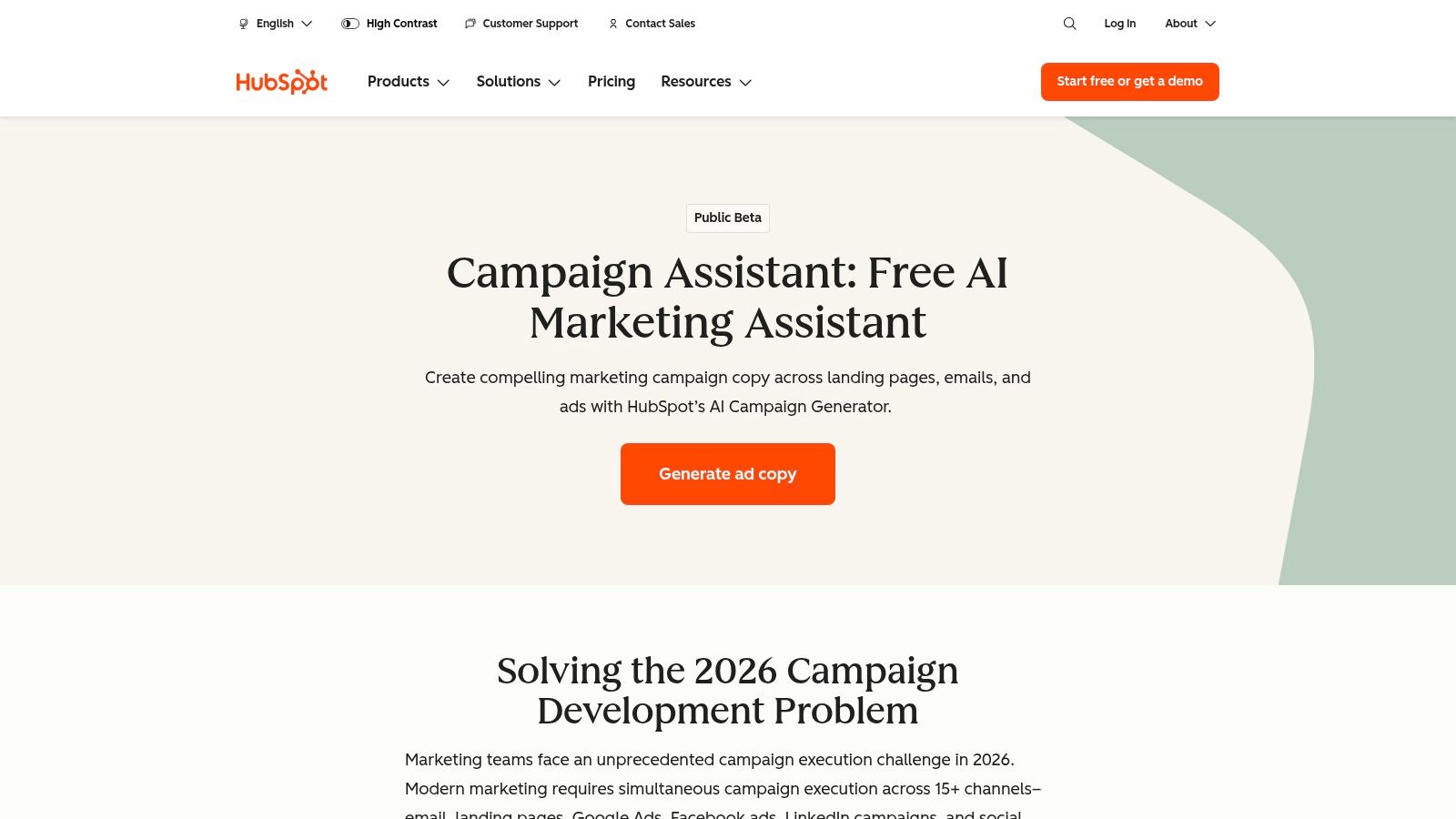
If you're already in the HubSpot ecosystem, its native AI features are your fastest path to meaningful gains. Rather than bolting on another tool, HubSpot is embedding AI directly into the workflows your team already uses. This isn't just about generating copy. It's about using the data continuity of your CRM to make your AI-powered marketing smarter.
Why It's a Core Growth Tool
HubSpot AI’s power comes from integration. The Campaign Assistant, for example, doesn't just write a single email. You give it a brief, and it generates a coordinated set of assets for a full campaign: landing page copy, social posts, and emails. Because it’s all connected to your CRM, you can accelerate workflow building and get a clear picture of performance. For lean teams, this means launching multichannel campaigns without a huge headcount.
Implementation and Use Cases
- Campaign Acceleration: Use the Campaign Assistant to go from a product brief to a live, multichannel campaign in a fraction of the time. Generate landing pages, emails, and ad copy that are all thematically aligned.
- CRM Intelligence: Leverage AI features within the CRM to draft sales emails, summarize call notes, and analyze contact data for better targeting. This tightens the bond between sales and marketing.
- Content Operations: Speed up content creation directly within the blog and email editors. I’ve seen teams launch 3x more campaigns per quarter using just this feature.
Trade-offs: The idea-to-GTM speed within a single system is a massive advantage. But the total cost can scale quickly with more contacts and seats. Access to the most advanced AI capabilities often depends on your specific Hub and subscription tier.
Pricing: HubSpot has various free tools and tiered pricing for its Marketing, Sales, and Service Hubs. Many AI features are included in paid plans.
Website: https://www.hubspot.com/campaign-assistant
6. Jasper
Where general-purpose tools offer a blank canvas, Jasper provides a purpose-built studio for marketing teams. It's designed to solve one of the biggest challenges with AI content: keeping it on-brand and consistent at scale. For any founder tired of editing generic AI output, Jasper is one of the essential AI tools for business growth focused purely on marketing execution.
Why It's a Core Growth Tool
Jasper’s power is in its governance and workflow features. The Brand Voice and Style Guide tools act as guardrails, ensuring every piece of content aligns with your company’s specific tone. This isn't just about speed; it's about creating a scalable content engine that doesn't dilute your brand identity. It’s built for collaboration, allowing your entire team to work from a single source of truth.
Implementation and Use Cases
- Brand-Consistent Content: Upload style guides and past marketing materials to train Jasper on your unique voice. Use it to generate blog posts, social media updates, and email campaigns that sound like you.
- Campaign Execution: Use Jasper's agent-like workflows to move from a simple brief to a full campaign asset, including copy and visuals. Ideal for performance marketing teams needing to create high-volume, on-brand ad variations quickly.
- Team Collaboration: Set up your entire content team with access to shared templates and brand knowledge. This centralizes content creation and prevents brand fragmentation.
Trade-offs: It’s built specifically for marketers and offers a great balance between generation speed and brand safety. But the most powerful features are locked behind the Business tier. You'll need separate analytics tools for post-publish performance measurement.
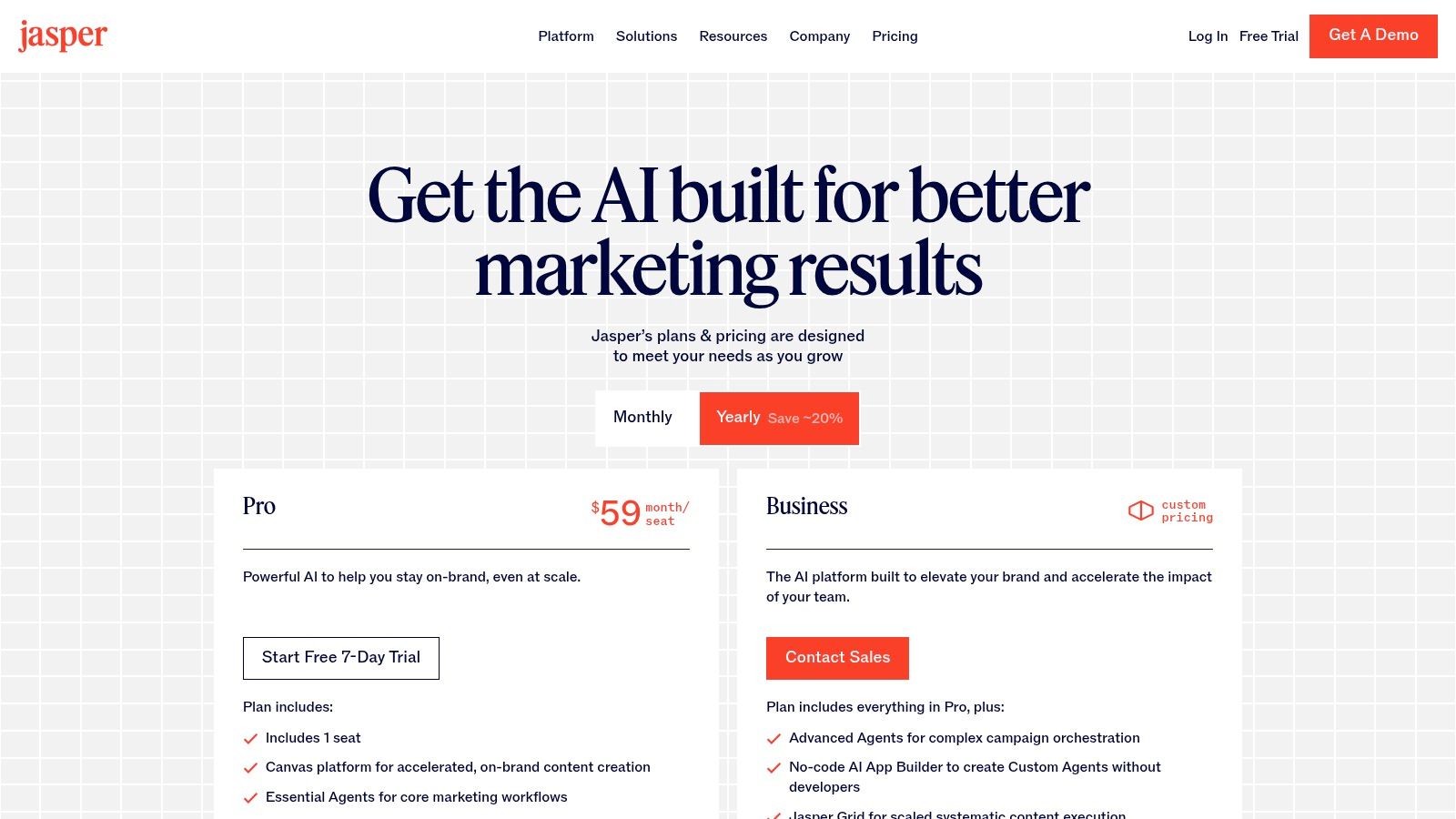
Pricing: Offers Creator, Pro, and Business tiers with pricing based on features and user seats. The Pro plan starts at $59/user/month (billed annually).
Website: https://www.jasper.ai/pricing
7. Copy.ai
For teams that need to standardize content creation without hiring an army of prompt engineers, Copy.ai is a solid contender. It’s less about raw model power and more about building repeatable workflows for your marketing and sales teams. Think of it as putting guardrails on generative AI, guiding non-technical users from a simple brief to a finished draft. This makes it one of the most practical AI tools for business growth when speed and consistency are your main goals.
Why It's a Core Growth Tool
Copy.ai shines in its ability to quickly get your entire team producing on-brand content. Its strength lies in the vast library of pre-built templates and workflows. You're not just getting a blank text box; you're getting a structured process for specific marketing assets. This drastically lowers the barrier to entry, allowing you to scale content production without extensive AI training. It's a pragmatic choice for standardizing your brief-to-draft pipeline.
Implementation and Use Cases
- Content Operations: Use the "Workflows" feature to automate multi-step content tasks, like turning a product description into a blog post, social media updates, and an email announcement.
- Sales Outreach: The platform has dedicated tools for generating cold outreach sequences and personalizing messages at scale, helping your SDRs book more meetings.
- SEO & Long-Form: Feed it a target keyword and a few talking points, and it can generate a complete blog post draft. Use the Brand Voice and Infobase features to ensure the output aligns with your style.
Trade-offs: The template library makes it incredibly fast to onboard non-technical users. It’s an excellent fit for SMBs that need to move quickly. However, the output quality still requires a human QA process. Don't use it for final drafts without review.
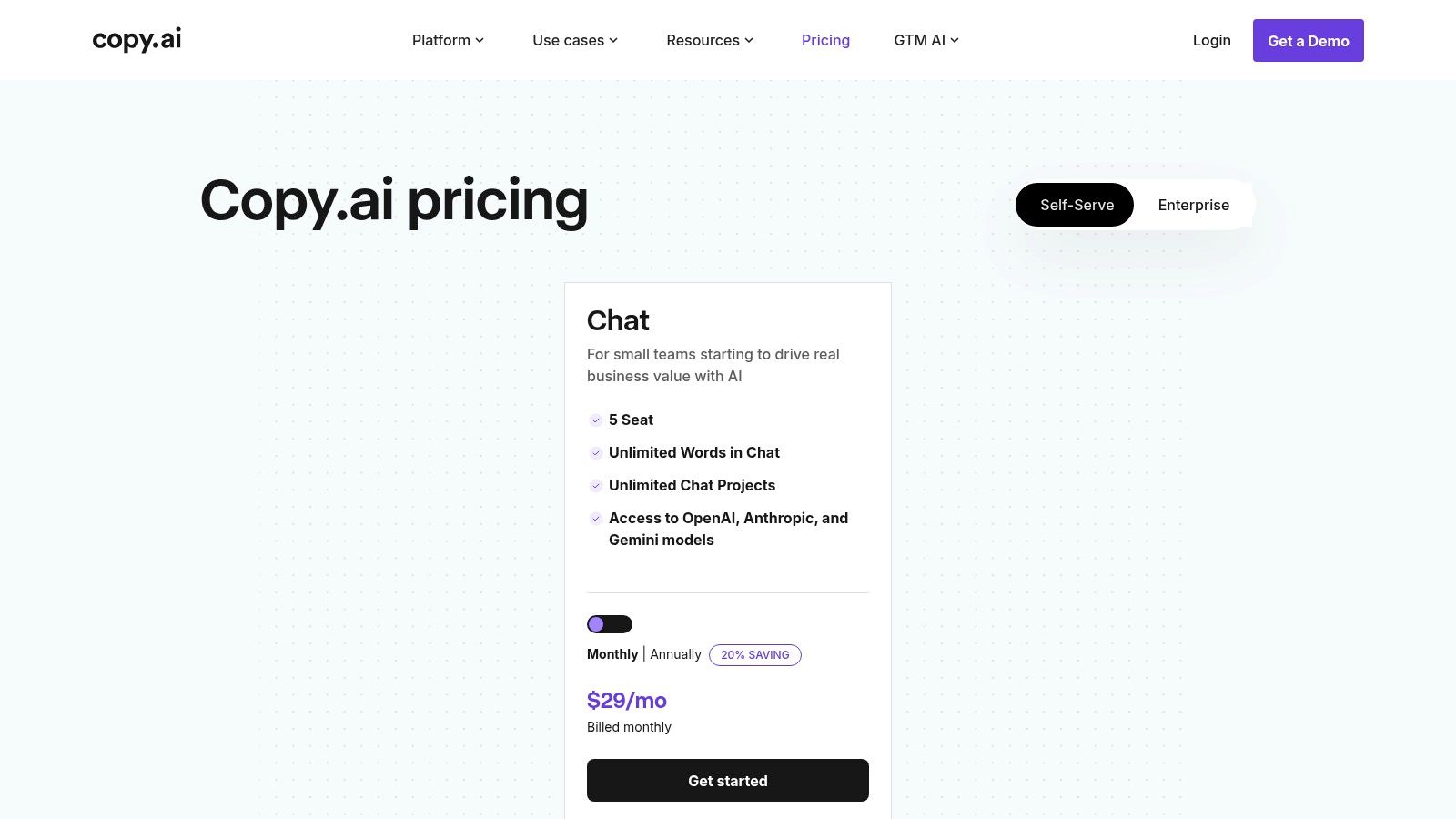
Pricing: Offers a free plan for individuals. Paid plans start at $36/month (billed annually) for Pro, with custom pricing for Enterprise teams.
Website: https://www.copy.ai/prices
8. Klaviyo (AI for Email/SMS & CDP)
Your customer data is a gold mine, but only if you can act on it. Klaviyo integrates AI directly into the lifecycle marketing stack, moving beyond simple automation. It uses predictive analytics and generative AI to help you send smarter, more personalized messages that actually drive revenue. It’s one of the best AI tools for business growth because it ties intelligence directly to your bottom line.

Why It's a Core Growth Tool
This is about turning your customer data platform (CDP) into an active growth engine. Klaviyo’s AI doesn't just write a subject line; it predicts who is likely to churn, who has a high lifetime value, and when each individual is most likely to open your email. This allows for hyper-targeted segmentation that was previously only possible with a data science team. For you, it means higher open rates, better conversions, and more repeat purchases.
Implementation and Use Cases
- Predictive Segmentation: Build segments of customers predicted to make their next purchase soon or at high risk of churning. Target them with specific campaigns to increase LTV. One of my e-commerce clients saw a 12% lift in repeat purchase rate this way.
- AI-Assisted Copywriting: Use the built-in AI to generate subject lines, preview text, and entire email or SMS bodies. This is a massive accelerator for small teams that need to create and test multiple campaign variations.
- Smart Send Time: Let the algorithm determine the optimal send time for each contact based on their historical engagement patterns. This simple feature can give you an immediate lift in campaign performance.
Trade-offs: It’s built for ecommerce with deep integrations for platforms like Shopify. The AI features are directly tied to clear ROI. The cost scales directly with your active profiles and message volume, so list hygiene is critical. If you don't clean your data, your bill can grow unexpectedly.
Pricing: A free plan is available for up to 250 contacts. Paid plans scale based on the number of contacts and email/SMS credits.
Website: https://www.klaviyo.com/pricing
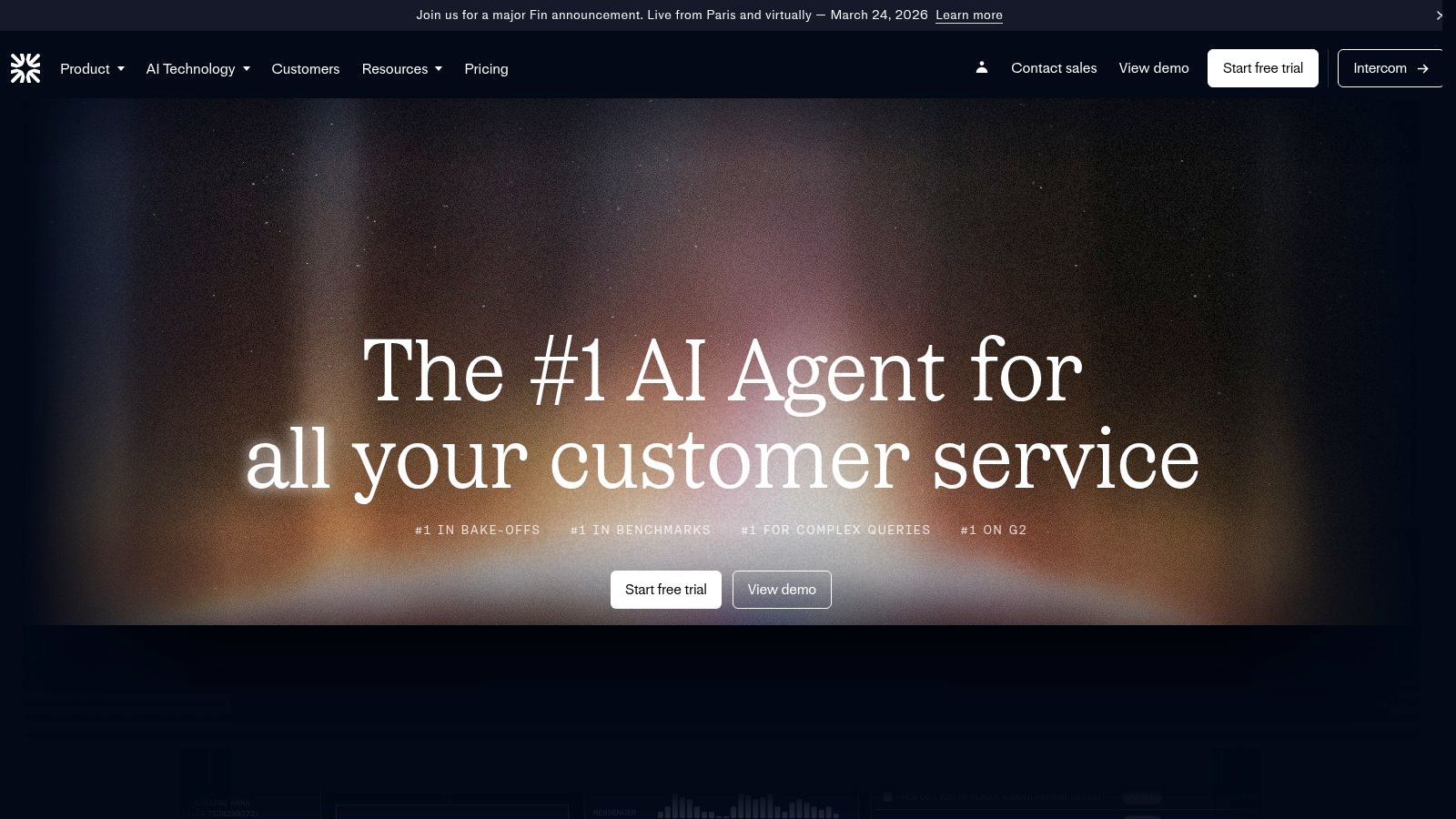
9. Intercom + Fin (AI Agent for Support-driven Growth)
Support isn't a cost center; it's a growth engine. Every pre-sales question is a potential conversion. Every post-sales ticket is a chance to build loyalty. Intercom’s Fin AI Agent is designed to capture that value by resolving customer questions instantly. This isn't about deflecting tickets. It's about providing accurate, immediate answers that drive sales and improve retention.
Why It's a Core Growth Tool
Fin operationalizes support-led growth. By connecting to your help docs and internal knowledge bases, it delivers answers grounded in your specific business logic. It works seamlessly with human agents, ensuring a smooth handoff when a question requires a human. This means you can automate 80% of common queries while freeing up your expert team for high-value conversations that close deals.
Implementation and Use Cases
- Pre-Sales Qualification: Use Fin on your pricing pages to answer prospect questions instantly, overcoming objections and guiding them toward a purchase or demo booking.
- 24/7 Support Automation: Provide round-the-clock support by letting Fin handle inquiries after hours, dramatically improving customer satisfaction and reducing response times.
- Ticket Deflection: Integrate Fin with your help desk to automatically resolve inbound tickets before they reach an agent’s queue. My SaaS clients see deflection rates of 40-60% within the first month.
Trade-offs: The ROI is tangible in high-volume support environments. But the pay-per-resolution model means costs can grow with volume. The agent is only as good as the knowledge base you provide, requiring diligent upkeep for accuracy. Don't set it and forget it.
Pricing: Fin is an add-on to Intercom’s paid plans, with pricing based on the number of successful resolutions per month.
Website: https://fin.ai
10. Zapier AI (Chatbots, Agents, and Automation)
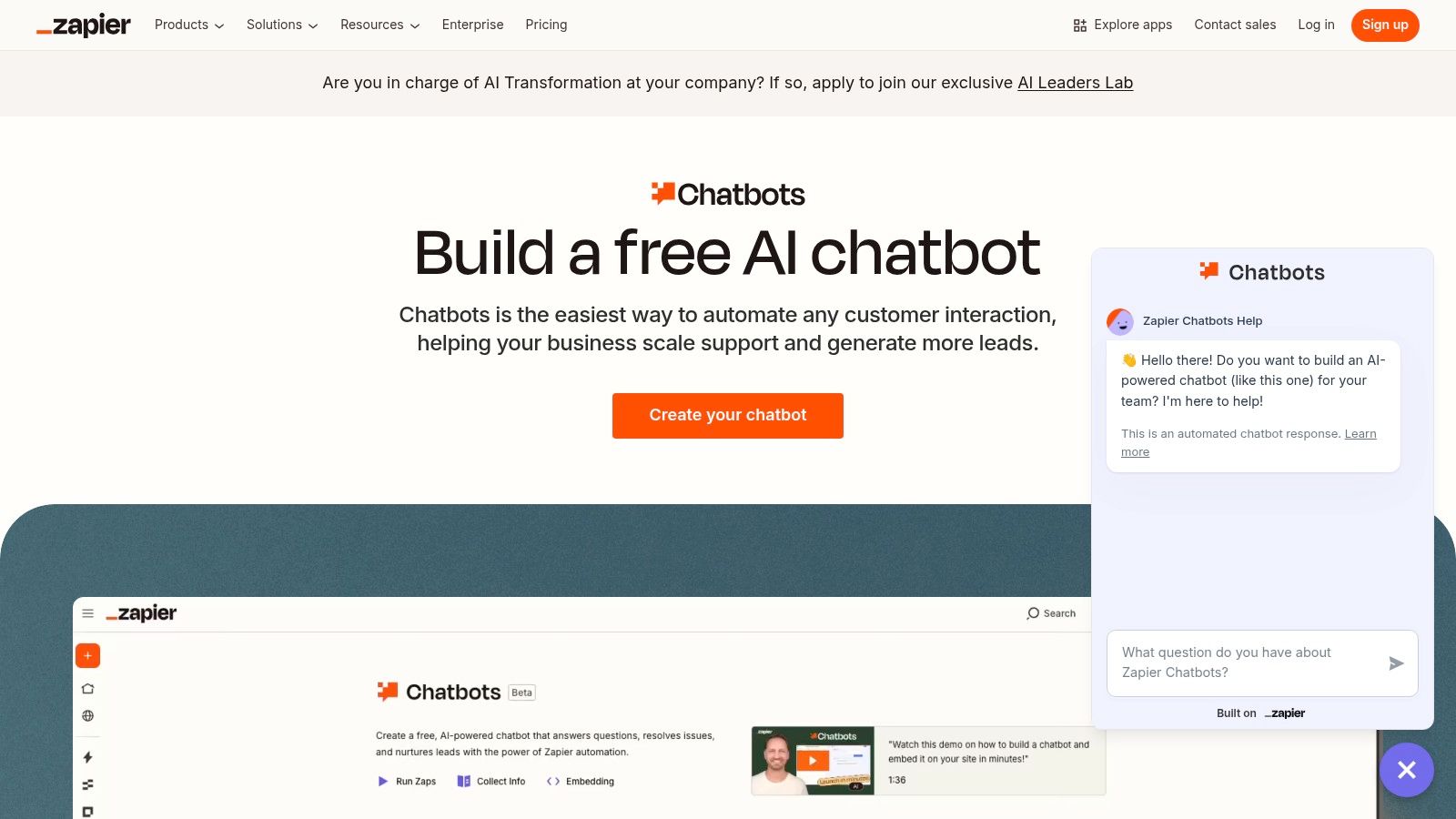
If you're wondering how to make AI actually do things without hiring a developer, Zapier is your answer. They've baked AI directly into their automation platform, turning it from a simple data-mover into a tool for building intelligent workflows. This isn't just connecting App A to App B anymore. It's about adding a reasoning layer in between that can classify, extract, and act on information.
Why It's a Core Growth Tool
This is the fastest path to practical AI for non-technical teams. While other platforms offer powerful models, Zapier offers action. Their no-code chatbot builder lets you deploy an AI on your site that doesn't just answer questions; it can take actions across 6,000+ apps. This means a chatbot can qualify a lead, book a meeting, and add them to your CRM in one conversation. This is what turns passive traffic into active, qualified pipeline.
Implementation and Use Cases
- Lead Capture & Qualification: Build a chatbot that asks qualifying questions and, based on the answers, routes the lead to the right salesperson in Slack and creates a deal in your CRM.
- Customer Support Automation: Create a bot trained on your help docs that can answer common questions and, if needed, create a support ticket in Zendesk or Jira with the full conversation history.
- Agentic Workflows: Combine multiple AI steps in a single Zap to build basic agentic systems. To understand the mechanics, I explain how to assemble these in my guide to marketing AI agents.
Trade-offs: The sheer breadth of the app ecosystem is its biggest advantage. It's the most direct way for SMBs to build AI-powered automations. However, the per-task billing model can become expensive as you scale. You must monitor usage to prevent costly errors.
Pricing: Zapier offers a free tier with limited tasks. Paid plans start at around $19.99/month (billed annually) and scale up based on tasks and advanced features.
Website: https://zapier.com/ai/chatbot
11. Apollo.io (AI-Assisted GTM: Data, Outreach, Sequencing)
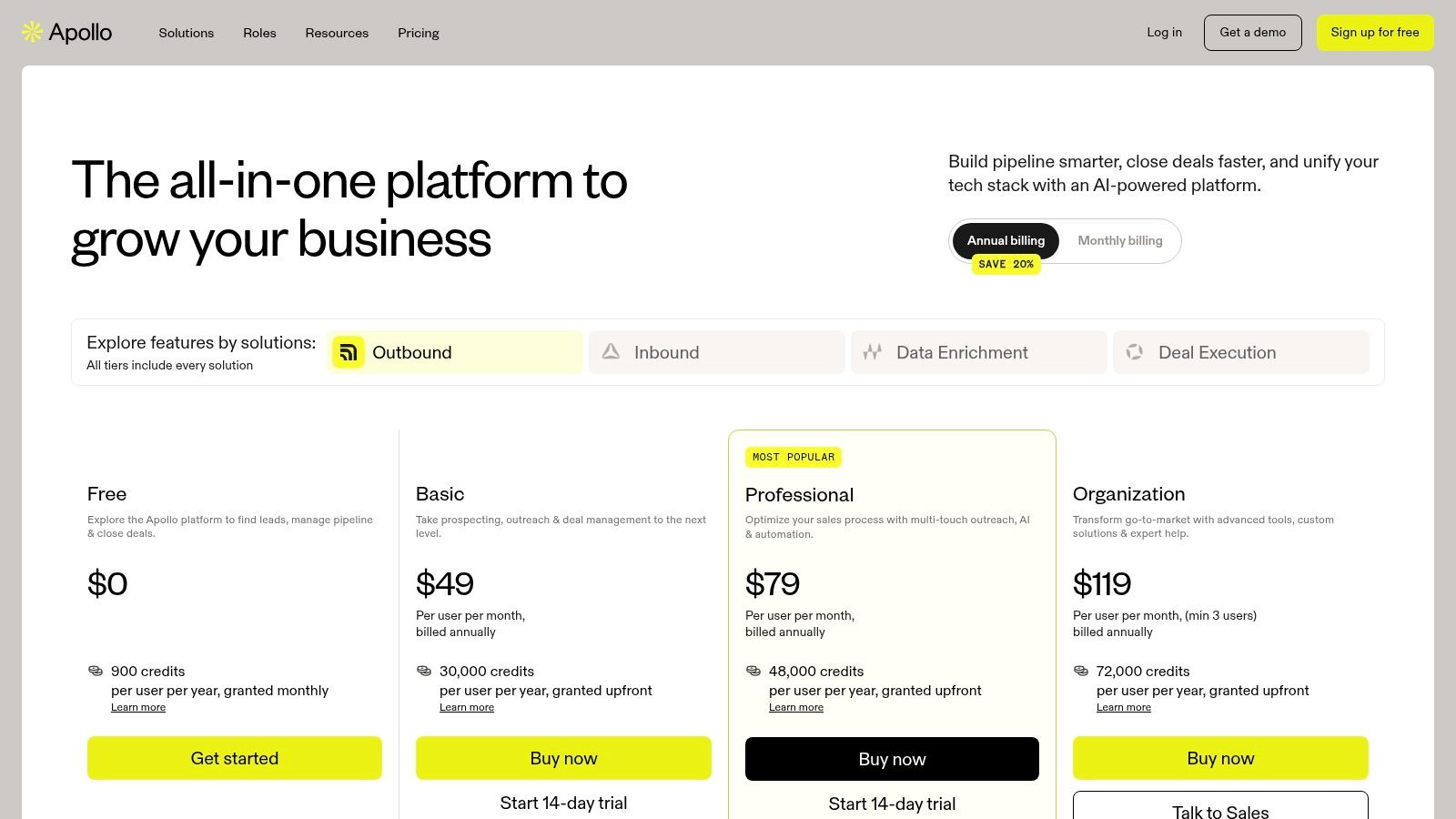
If your business relies on outbound sales, you need to consolidate your stack. Apollo.io is one of the key AI tools for business growth because it combines B2B data, enrichment, and outreach sequencing into a single platform. It’s designed to be the command center for your sales development representatives (SDRs), helping them find prospects, craft messages, and execute campaigns.
Why It's a Core Growth Tool
Apollo's real power is in its integration of data and action. The AI assistant helps your team quickly research prospects and generate first-draft emails, which dramatically cuts down on manual work. This allows your SDRs to focus on personalization and execution rather than tedious data entry. It’s an all-in-one outbound system that accelerates pipeline creation.
Implementation and Use Cases
- SDR Acceleration: Use the integrated dialer, email sequencing, and templates to onboard new SDRs and get them productive in days, not weeks. The AI Assistant provides a starting point for messaging that new hires can refine.
- Targeted Prospecting: Build highly specific lead lists using their vast B2B database, then enrich that data directly within the platform. The Chrome extension lets you pull contact information from LinkedIn profiles on the fly.
- AI-Powered Outreach: The AI assistant is a solid starting point for drafting personalized messages. For a deeper look into how AI is changing sales, I recommend this guide on defining Outbound Sales in the Age of AI which covers its modern role.
Trade-offs: An all-in-one outbound stack reduces tool sprawl and costs. It significantly speeds up SDR productivity. But data accuracy can be inconsistent depending on the industry, so always verify contacts before a large-scale campaign. Don't trust the data blindly.
Pricing: Apollo offers a free tier for basic prospecting, paid plans starting around $49/user/month (billed annually) for more credits and features, and custom enterprise packages.
Website: https://www.apollo.io/pricing
12. Shopify Magic (AI for Commerce)
For any brand on Shopify, your growth engine just got a native upgrade. Shopify Magic embeds AI directly into the platform you already use every day. This isn't about adding another app or dealing with a complex integration. It's about making your core e-commerce operations faster and more effective. It accelerates everything from merchandising and content creation to customer service.

Why It's a Core Growth Tool
The key benefit here is zero friction. Your team doesn't need to learn a new tool. Shopify Magic uses your own store data to generate relevant content, like product descriptions that match your brand voice or email subject lines designed to boost open rates. It's a prime example of contextual AI that provides an immediate productivity lift for e-commerce teams.
Implementation and Use Cases
- Product Merchandising: Instantly generate compelling product descriptions. Instead of staring at a blank page, you get a solid draft that you can quickly edit and publish, speeding up new product launches.
- Email Marketing: Use the Sidekick assistant to generate entire email campaigns, from subject lines to body copy, based on your store's upcoming promotions or new collections.
- Media Editing: Automatically remove backgrounds from product photos or generate new ones, creating clean, professional visuals without needing a separate photo editor.
Trade-offs: It’s seamlessly integrated into the Shopify workflow, making adoption incredibly easy. This directly speeds up catalog updates and campaign production. However, its power is confined to the Shopify ecosystem. For advanced CRO and experimentation, you'll still need specialized tools.
Pricing: Included with Shopify plans. Features are being progressively rolled out to merchants.
Website: https://www.shopify.com/magic
12 AI Tools for Business Growth — Comparison
| Tool | Best for | Key features | Unique strengths | Trade-offs / Pricing |
|---|---|---|---|---|
| OpenAI (ChatGPT + Platform) | Growth teams needing versatile models & agentic automations | ChatGPT for content; API for embeddings, RAG, agents; multimodal models | Broad model breadth; reliable API; fast iteration; enterprise controls | Generation/analysis costs can escalate; governance setup required |
| Anthropic Claude | Brand-sensitive long‑form content and research | Long context windows; strong summarization; team tiers & API | Excellent tone/voice control; safer defaults for regulated content | Per-seat/pricing limits; advanced features on higher tiers |
| Google Gemini (AI Studio + Vertex AI) | Teams on Google Cloud or using BigQuery/Looker | AI Studio prototyping; Vertex AI deployment; multimodal models; GCP integrations | Smooth prototype→production path; tight Google ecosystem integrations | Pricing and feature availability can be complex and vary by platform |
| Microsoft Copilot (M365 + Copilot Studio) | Organizations standardized on Microsoft 365 | Native Office AI; Copilot Studio agents; Entra ID compliance; governance | Rapid adoption in M365 environments; strong admin & compliance controls | Licensing complexity; feature access depends on plans and recent product changes |
| HubSpot AI (Campaign Assistant) | Founders and lean teams wanting integrated CRM→campaigns | Campaign Assistant for multichannel assets; CRM AI summaries; cross‑hub data continuity | Speeds idea→GTM; data continuity improves personalization & measurement | Pricing scales with contacts/seats; advanced features tied to hub/tier |
| Jasper | Marketing & content teams scaling branded output | Agents for campaign workflows; Brand Voice/Style Guide; templates & API | Built for marketers with governance tools and templates | Best value on Business tier; needs analytics for post‑publish measurement |
| Copy.ai | SMBs and agencies standardizing brief→draft pipelines | Prebuilt templates/workflows for blogs, ads, email; brand inputs; collaboration | Fast onboarding; strong template library for non‑technical users | Governance and analytics for scale are limited; quality varies by prompt |
| Klaviyo | Ecommerce and lifecycle marketers (email/SMS/CDP) | AI subject lines & messages; predictive segments; email/SMS orchestration | Deep ecommerce integrations; ready for lifecycle marketing | Cost scales with active profiles and sends; requires list hygiene |
| Intercom + Fin | Support‑led growth and high‑volume customer support | Pay‑per‑resolution AI agent; multichannel coverage; KB ingestion | Reduces tickets; improves CSAT and conversion from pre‑sales chat | Costs vary by resolution volume; needs KB upkeep; often needs wider Intercom suite |
| Zapier AI | Non‑technical SMBs automating growth operations | No‑code chatbot builder; AI steps in Zaps; 6,000+ app integrations | Fastest path to practical automations that act across tools | Per‑task billing and task limits; governance/testing required as scale grows |
| Apollo.io | B2B outbound, SDRs and pipeline teams | Large B2B database & enrichment; AI for research & first drafts; sequencing | All‑in‑one outbound stack; accelerates SDR productivity | Data accuracy varies; pricing/credit rules can be complex |
| Shopify Magic | DTC merchants and Shopify stores | AI product descriptions; subject lines; media editing; native store integration | Zero‑friction inside Shopify; speeds catalog & campaign production | Best inside Shopify ecosystem; advanced CRO/testing needs extra tools |
Your Next Move: From Tools to Systems
We’ve walked through a dozen platforms. The temptation now is to sign up for a few free trials and hope for magic. That's a mistake. A tool is just a tool. A subscription to Jasper doesn't make you a content machine any more than a gym membership makes you an athlete.
The real goal is not to have AI tools. The goal is to build an AI-powered operating system for your business. This is the difference between dabbling and dominating. Your competitors are buying tools. You need to be building systems. Systems are where your strategy meets AI's executional power. That’s how you create a competitive moat.
How to Build Your AI Growth Engine
So, where do you begin? Not with a dozen new subscriptions. You start with a single, painful bottleneck. Pick one core business function that, if improved by 30%, would have an outsized impact on your revenue.
Identify the Constraint: Is it the speed of your market research? The volume of your content production? The quality of your lead qualification? Be brutally honest about the single biggest thing slowing your growth.
Select a Single Tool: Based on that constraint, choose one tool from the list we discussed. If content velocity is the problem, start with Jasper or Copy.ai. If your GTM data is a mess, look at Apollo.io. If you need to automate workflows, Zapier AI is your first stop. Don’t boil the ocean.
Design the Workflow First: Before you even log in, map out the process. Who does what? Where does the AI step in? For example:
Analyst identifies trend -> AI agent in Apollo drafts outreach sequence -> SDR reviews and personalizes for top 20% of leads -> Sequence launched.The AI does the grunt work; your team applies the strategic human touch.Measure and Iterate: Define your success metric before you start. Is it "time to first draft reduced by 50%," or "qualified meetings booked increased by 15%?" Track it religiously for 30-60 days. Prove the ROI on this single use case. Only then should you look for the next bottleneck to solve.
This methodical approach is how you successfully integrate AI tools for business growth without chaos and wasted spend. It builds momentum and gets your team comfortable working alongside AI counterparts.
The Final Word
The difference between the businesses that will thrive in the next five years and those that will become obsolete is simple. It's not about who has the most AI. It's about who builds the smartest systems. The tools you and I have reviewed are the building blocks. Your strategy, your focus, and your willingness to integrate them into cohesive, revenue-driving systems are the mortar.
Your job as a leader isn't to be an expert in every AI tool. It’s to be an architect of AI-enabled growth. Start small, prove the value, and then scale your systems relentlessly. This is your path to weaponizing AI for market leadership. Now, go build.