
Most founders I talk to already have dashboards, funnels, attribution reports, heatmaps, and CRM stages. They still can't answer a basic question with confidence: where, exactly, does the customer experience break, and who's fixing it?
That gap is expensive.
I'm Samuel Woods, and I've been working with machine learning since 2016 and generative AI since 2019. I can tell you from experience that customer journey mapping is usually handled far too softly. Teams treat it like a workshop exercise for empathy. I treat it like a market intelligence system that shows you where revenue leaks, where handoffs fail, and where competitors can steal your customers.
If you run a startup or SMB, you don't need another pretty mural in Miro. You need a working model of how buyers move, hesitate, buy, churn, complain, upgrade, and refer. Then you need AI and automation wired into that model so it stays current.
Stop Guessing What Your Customers Want
Most companies are still guessing. They call it strategy, but it's really inference from partial data.
Marketing sees ad clicks. Sales sees objections. Product sees feature requests. Support sees complaints. Nobody sees the whole movie. That's why customer journey mapping matters. Treat it as a way to build a sharper sensing system than your competitors have, and forget the UX deliverable.

Why this stopped being optional
The market already told you what matters. Salesforce reports that 88% of customers say the experience a company provides is as important as its products, and 71% switched brands at least once in the previous year because of a poor experience, in its customer journey mapping research. That's the battlefield.
If your competitor delivers a smoother evaluation process, clearer onboarding, faster support response, or more consistent handoff between channels, your product advantage gets neutralized fast. Customers don't buy based on your org chart. They buy based on what the journey feels like.
Customer journey mapping became business-critical when companies realized isolated channel optimization wasn't enough. End-to-end visibility wins.
What founders get wrong
Founders often think they already understand the customer because they talk to users. That's useful, but it's not the same as seeing the full journey across awareness, consideration, purchase, retention, and loyalty.
I see the same mistakes repeatedly:
- They map their funnel, not the customer's reality. Internal stages like MQL, SQL, demo booked, and closed won don't explain what buyers were trying to do.
- They optimize channels in isolation. Paid media improves. Demo conversion stalls. Support queues rise. Retention slips.
- They confuse opinions with evidence. Teams describe what they think users do instead of validating with interviews, analytics, CRM notes, and support logs.
IBM's framing is the right one. A modern journey map is a visual representation of every experience a customer has with a brand, and it starts with data, stages, touchpoints, and validation. That's how you stop debating and start diagnosing.
If you want your messaging layer to match real customer intent, resources like my guide on AI prompts for marketing can help your team extract sharper patterns from research and customer language. But prompts are downstream. First, you need the map.
The competitive framing that matters
A strong journey map shows you where friction lives. A better one shows you which friction matters commercially.
That distinction is everything.
The goal is to identify the moments where a fix improves conversion, retention, expansion, or operating efficiency. Making every touchpoint prettier is a distraction. That's why I push founders to stop talking about customer journey mapping as documentation and start treating it as a revenue weapon.
The Blueprint for Your Intelligence System
Don't start with boxes and arrows. Start with a business objective.
A journey map without a sharp commercial target turns into corporate wallpaper. The map has to answer a hard question your business cares about. Reduce onboarding drop-off. Improve free-to-paid conversion. Cut support-driven churn. Increase activation of high-value accounts.
Start with one target and one persona
I use a simple rule. One map, one outcome, one priority persona.
If you try to map "all customers," you'll build something so generic that nobody can act on it. Go narrower. Pick the customer type that matters most to the economics of the business. Usually that's your most profitable segment, your fastest-expanding segment, or the segment where friction is blocking growth.
A disciplined workflow follows the five-step cycle described in the Harvard Business School customer journey map process: Define, Analyze, Research, Map, Act. For research, 20 to 30 customer interviews is a practical benchmark to surface recurring patterns without wasting effort.
A practical rule: if the objective isn't specific enough to assign an owner and judge progress, it isn't ready for mapping.
What evidence to collect before you map
Teams often get lazy. They hold a workshop too early.
I want mixed evidence. Qualitative input explains why customers behave the way they do. Quantitative input shows where and when that behavior appears. You need both.
A useful research stack often includes:
- Customer interviews for motivations, fears, objections, and emotional lows.
- Survey responses for recurring themes in customer language.
- Product and web analytics for drop-offs, repeated actions, dead ends, and time spent.
- CRM and support logs for objections, escalations, onboarding blockers, and handoff failures.
Not every source deserves equal weight. A founder's intuition can be a starting point, but it should not drive the map. HBS is right to warn against a company-first view. Internal assumptions routinely miss the sequence of needs and emotions the customer experiences.
The minimum viable blueprint
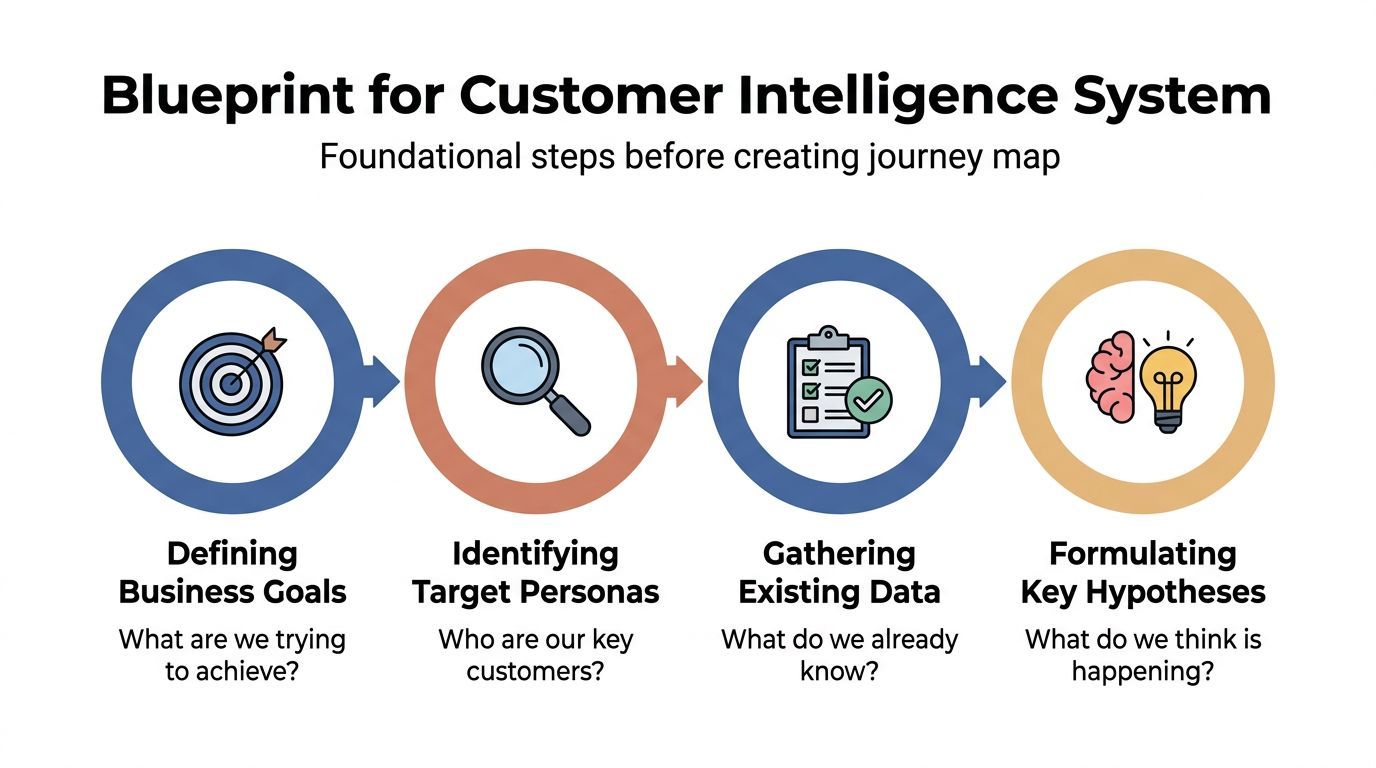
Before I let a team build the first draft, I make them answer four questions:
| Question | What a strong answer looks like |
|---|---|
| What are we trying to change? | A single business outcome with a clear owner |
| Whose journey is this? | A specific persona or segment, not everyone |
| What do we already know? | Evidence from interviews, analytics, CRM, and support |
| What do we suspect is happening? | Testable hypotheses, not slogans |
Tools start to matter. AI systems can accelerate synthesis, but only if you've structured the inputs well. If you're building autonomous workflows around research, segmentation, and insight extraction, AI agents for growth operations are useful because they can monitor sources, summarize patterns, and route findings to the teams that need them.
The order matters. Objective first. Persona second. Evidence third. Hypotheses fourth.
Anything else is theater.
Mapping the Touchpoints, Stages and Emotions
Once the research is in, the actual work begins. You translate fragments into a coherent story.
By story I mean a reconstruction of the buyer's lived sequence, with nothing added for effect. What triggered the search. Where confusion showed up. Which interaction increased confidence. Which handoff created doubt. Which moment made continuing feel easy.
Build the journey from the customer's viewpoint
The stages should reflect the customer's world. Your internal departments don't belong in them.
For a SaaS company, that might look something like this: problem recognition, solution exploration, vendor comparison, internal approval, purchase, onboarding, first value, habitual use, renewal, advocacy. For ecommerce, the shape changes, but the principle doesn't. You map the experience as customers live it.
A useful map usually includes these layers:
- Stages that reflect what the customer is trying to accomplish.
- Touchpoints such as ads, landing pages, demos, checkout, email, chat, or support tickets.
- Actions the customer takes at each touchpoint.
- Questions and objections that create hesitation.
- Emotions so you can spot peaks, anxiety spikes, and frustration troughs.
A practical example
Let's say you run a B2B SaaS company and your sales team says the product demo is strong, but close rates are uneven. Marketing thinks the problem is lead quality. Product thinks pricing is confusing. Support says onboarding expectations are wrong before the contract is even signed.
A solid customer journey mapping exercise often reveals something more specific. Prospects arrive with confidence from paid search, lose momentum on the pricing page, recover during the sales call, then hit anxiety when security review begins because nobody prepared them for procurement friction.
That's a sequence of problems.
If you don't map the emotional dip, you often fix the wrong touchpoint.
What emotions are really telling you
Founders sometimes roll their eyes at the emotional layer. That's a mistake.
Emotion highlights opportunities. Excitement signals a value moment. Frustration signals friction. Confusion signals a missing explanation. Anxiety often signals risk perception, especially around pricing, onboarding, implementation, or support responsiveness.
Use plain labels. Curious. Skeptical. Overwhelmed. Reassured. Frustrated. Relieved. Skip the therapy language and look for commercial signal.
Here's the key distinction:
| Element | Weak mapping | Strong mapping |
|---|---|---|
| Stages | Your funnel names | Customer goals and decisions |
| Touchpoints | Channel list only | Specific interactions and handoffs |
| Emotions | Ignored | Linked to friction and conversion risk |
| Opportunities | Generic ideas | Concrete fixes tied to moments that matter |
The best maps read like a diagnostic report. Beyond what happened, they show where confidence rises, where momentum breaks, and where a competitor can win with a better experience.
That gives you something rarely achieved. Clarity on which moments deserve engineering time, copy changes, automation, or service redesign.
From Hypothesis to Certainty with Metrics and KPIs
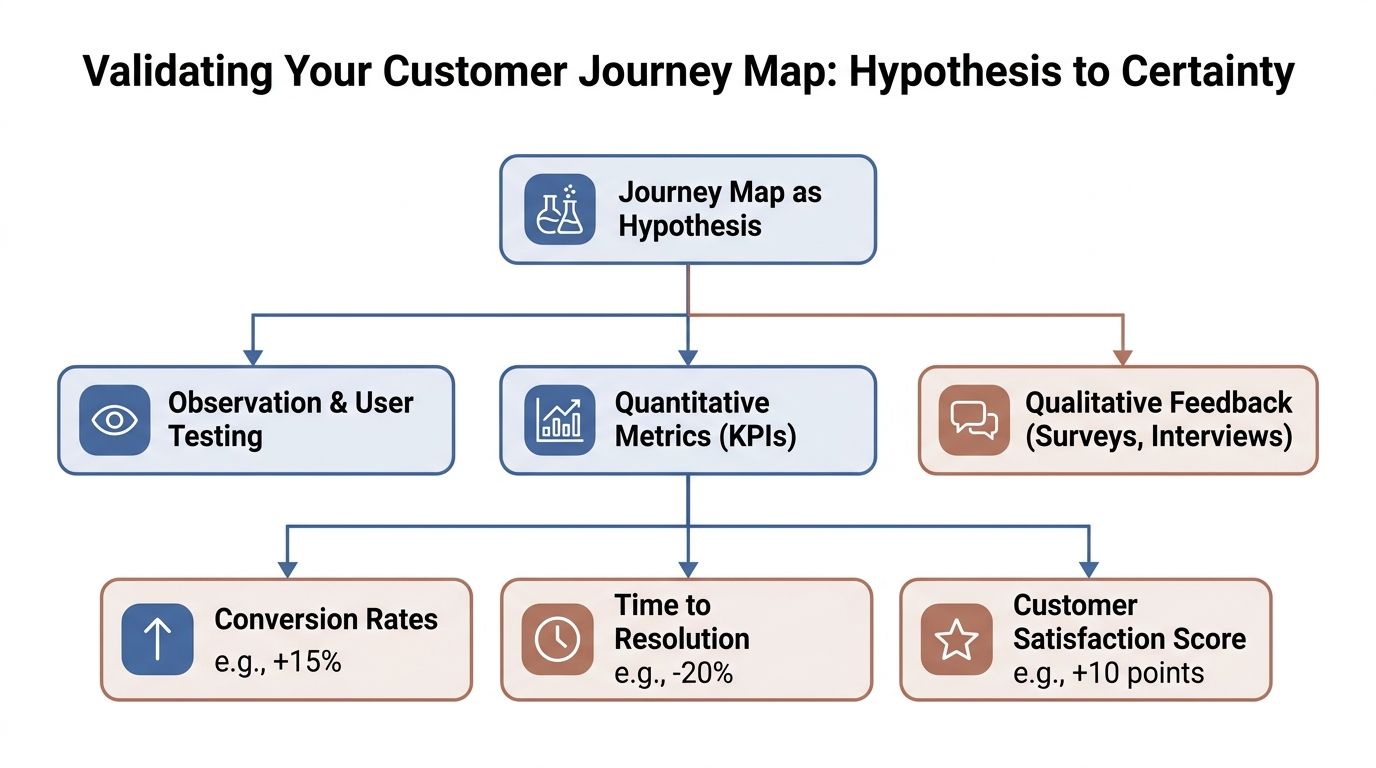
Your first map is a structured hypothesis.
That's healthy. It means you're operating like an adult business instead of pretending a workshop produced certainty. The next step is validation. You test the map against observed behavior and assign metrics so each stage can be managed.
Validate the weak points first
Start where the map says the experience breaks.
If the draft map shows frustration during onboarding, pull session recordings, onboarding completion data, support tickets, and interview excerpts from new customers. If it shows hesitation during evaluation, inspect pricing page behavior, demo attendance patterns, objection notes, and follow-up email engagement.
You are looking for agreement or contradiction.
- If the signals align, the friction point is probably real.
- If the signals conflict, dig deeper before anyone changes product or messaging.
- If there's no usable data, that's its own finding: your instrumentation is weak.
This discipline matters because companies with properly documented customer journey maps see a 54% greater return on marketing investment, according to Glance's summary of journey mapping best practices. The gain comes from better capital allocation decisions, and map aesthetics have little to do with it.
Put a KPI on every stage
A map becomes operational when each stage has a measurable outcome.
You don't need exotic metrics. You need metrics that reflect movement through the journey. Awareness might use branded search trends or qualified traffic patterns. Consideration might track demo requests, trial starts, or sales acceptance. Onboarding might use activation milestones. Retention might use renewal behavior, support burden, or repeat purchase patterns.
A pain point without a KPI becomes a debate. A pain point with a KPI becomes a work item.
I like to force this conversation with a simple structure:
| Stage | Friction signal | Evidence source | KPI owner |
|---|---|---|---|
| Evaluation | Pricing confusion | Interviews, session reviews, CRM notes | Marketing or sales |
| Purchase | Procurement delay | Deal notes, emails, call summaries | Sales ops |
| Onboarding | Setup abandonment | Product analytics, support tickets | Product or CS |
| Retention | Service frustration | Ticket themes, survey responses | Support or CX |
Make the map accountable
Once the KPIs are attached, the map stops being descriptive and starts becoming managerial. Teams can see where movement is happening and where it isn't.
This is also where founders should tighten measurement discipline. If your team needs a stronger framework for connecting spend, touchpoints, and outcomes, my guide on how to measure marketing effectiveness is useful because it pushes teams to tie activity back to business results instead of vanity reports.
A validated map gives you three advantages. Better prioritization. Better cross-functional accountability. Better use of budget.
That's why I push hard on metrics. Without them, customer journey mapping stays interesting. With them, it becomes profitable.
Operationalize or Your Map Is Worthless
Most journey maps die in a folder.
People feel good after the workshop. The artifact looks polished. A few teams reference it in meetings for two weeks. Then everyone goes back to local optimization and the same friction stays in place.
The industry already knows this failure pattern. InMoment reports that more than 81% of CX practitioners say journey mapping is successful for internal education, while Qualtrics research cited there says 67% of maps fail to drive change, as summarized in InMoment's guide to customer journey mapping. The problem sits in the operating model.
What execution actually requires
A usable map needs governance, and a committee is a poor substitute for it.
At minimum, put these controls in place:
- Stage ownership so one person is accountable for each part of the journey.
- Review cadence with recurring checkpoints against the KPIs tied to the map.
- Workstream linkage so pain points feed directly into product, marketing, sales, and support backlogs.
- Cross-functional representation so the map reflects operational reality instead of one department's fantasy.
One field guideline cited in the available data recommends involving at least 7 and no more than 18 participants across sales, marketing, operations, service, and technology. That's a practical range. Wide enough to reflect the business. Small enough to stay decisive.
Turn pain points into decisions
A journey map earns its keep when it changes prioritization.
If the map shows that prospects stall because pricing language creates uncertainty, the next move might be better comparison copy, revised sales enablement, or an AI assistant trained on objection handling. If onboarding confusion drives support tickets, the next move might be product guidance, triggered messaging, or a reworked implementation sequence.
The point is simple. Every significant pain point should land somewhere concrete:
- Product roadmap.
- Campaign backlog.
- Sales enablement.
- Support training.
- Automation workflow.
Internal alignment is useful. Operational change is what pays you.
If a map doesn't change what your team works on Monday morning, it was a workshop souvenir.
Building a Bionic AI-Powered Journey Map
A traditional journey map is a snapshot. Useful, but limited.
The advantage appears when you connect customer journey mapping to AI systems that keep learning from fresh data. Then the map stops being a document and starts acting like a live intelligence layer across your business.

Static maps lose. Live systems adapt.
The biggest gap in mainstream advice is real-time cross-channel complexity. As CMSWire's customer journey mapping guide points out, the challenge is handling journeys that cross channels and teams in real time. That's where AI and automation matter.
In practice, that looks like this:
- LLMs summarize support tickets and call transcripts into recurring friction themes by stage.
- Agents monitor review sites, Reddit, social mentions, and chat logs to detect shifts in sentiment and objection patterns.
- Automation routes insights to owners when a known pain point spikes or a KPI moves in the wrong direction.
- Dashboards tie journey stages to live operational data so the map reflects current reality instead of last quarter's workshop.
This is one area where founders should think like operators. AI's job here is to reduce the time between signal, diagnosis, and action.
A practical example sits in ecommerce support and retention. If you're looking at how AI can improve post-purchase service quality, Helmsly's guide to AI for Shopify is useful because it shows how automation can support customer service flows where many retention problems start.
Build the loop around the layer
You need a loop.
Collect signals. Interpret them. Update the map. Trigger action. Measure the effect. Repeat. That operating cycle is where the advantage compounds because your team starts responding to market changes faster than rivals.
I've built these kinds of systems using combinations of OpenAI models, Claude, Gemini, CRM automations, ticketing data, analytics streams, and lightweight agents. If you're formalizing this capability inside your business, I offer a Fractional Chief AI Officer engagement focused on agentic workflows and autonomous business systems, which you can use to put this kind of customer intelligence process into daily operation.
Here's the practical architecture I recommend:
| Layer | Job |
|---|---|
| Data intake | Pull customer signals from analytics, CRM, support, reviews, and surveys |
| AI synthesis | Cluster issues, summarize themes, detect emotional shifts |
| Decision layer | Match pain points to stage owners and active initiatives |
| Automation | Trigger alerts, tasks, and follow-up workflows |
| Measurement | Track KPI movement after each intervention |
This walkthrough gives a useful visual frame for that kind of AI-enabled system:
When not to do this
Don't build an AI-powered journey system if your basics are broken.
If your data is fragmented beyond recognition, your owners are unclear, or your team won't act on signals, more automation just creates faster confusion. Fix the governance first. Then add intelligence layers.
The founders who win with customer journey mapping are the ones who can see customer friction earlier, assign it faster, resolve it cheaper, and learn from it continuously.
That is a competitive advantage.
Customer journey mapping is how you expose revenue leaks, improve efficiency, and make smarter decisions across marketing, sales, product, and support. Build it like an operating system, wire it into AI, and you'll stop guessing while slower competitors keep arguing about opinions.