
You’re hearing a lot about generative AI for content creation. You’re also seeing a lot of terrible, generic content flood your industry. The two are related.
Most of your competitors are using this technology to chase volume. More blog posts. More social updates. More noise.
This is a losing strategy. I’ve seen it firsthand since I started working with these models back in 2019. It’s a race to the bottom that tanks brand credibility and delivers zero business impact.
Let’s talk about how you and I can use this technology for what actually matters: revenue and a real competitive advantage.
The Flawed Approach Most Businesses Take
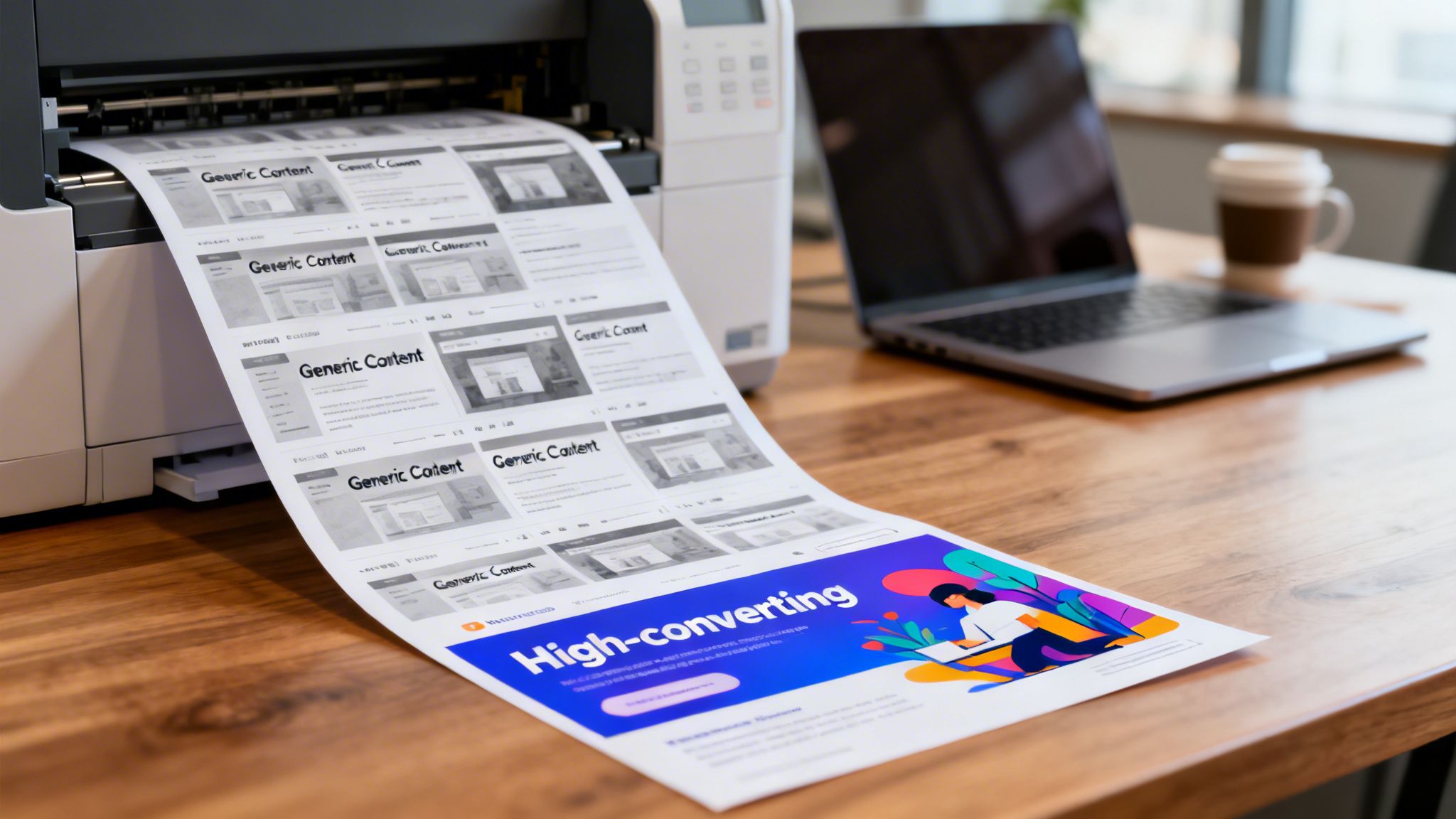
Let's get straight to it. Your competitors are probably using powerful tools like ChatGPT as glorified interns. They're asking for "a blog post about X" and getting exactly what they deserve: soulless, forgettable filler.
Used well, it gives you a competitive edge that goes far past productivity.
The real power of generative AI is velocity and precision. Producing more misses the point. You want to out-think and out-maneuver the competition, and out-publishing them won't do that.
Beyond Basic Prompts
To gain a real advantage, you have to move beyond one-shot prompts. The game is won by building what I call a "bionic" content system. This is an integrated workflow where AI works as a market intelligence engine as well as a writer.
Think about it this way. While your competition asks AI to "write a blog post," you'll command it to "analyze the top 10 search results for our primary keyword, identify content gaps and unanswered customer questions, and draft three unique article angles that exploit those gaps using our proprietary data."
That's the shift. From content generation to strategic action.
Building Your Decisive Edge
In this guide, you and I are going to cut right through the hype. I’ll show you exactly how to build this system, step-by-step. The goal is to make you and your small team far more productive, with nobody replaced.
I’m going to show you how to use these tools to:
- Generate market intelligence and uncover deep insights about your customers, competitors, and market at high speed.
- Automate workflows and systemize the repetitive, low-value tasks draining your team’s time and energy.
- Turn data into action by converting raw insights into high-performing content faster than anyone else in your space.
This is how you move from creating content to generating revenue.
The Business Case for AI in Content
Let's get past the hype. I’m not here to sell you on vague promises of “productivity.” You need the hard numbers that matter to a business owner: revenue, market share, and staying ahead of the competition.
When I talk about generative AI for content creation, I treat it as a serious business case.
The reason for this tectonic shift is simple: the economics are undeniable. This is about rewriting the entire cost structure and output of your marketing. Building a system that ties content directly to profit.
The numbers don't lie. The market is projected to climb from USD 14.8 billion in 2024 to USD 80.12 billion by 2030. That’s a 32.5% compound annual growth rate. Expect a land grab. If you want to see the global trends, you can explore the full breakdown of this market expansion.
Out-Maneuvering Your Competitors
This technology is your ticket to out-pace, out-personalize, and out-perform everyone in your field. While your competitors are stuck on a slow, manual assembly line, you can operate a nimble, intelligent system.
You can slash content production costs by 50-70% while simultaneously cranking up the volume of high-quality assets. Beyond writing blog posts faster, you can create hyper-targeted email sequences for a dozen customer segments in an afternoon, a task that used to take a month.
The bigger competitive advantage is the speed of iteration, more than the cost savings. You can test ten ad headlines and five landing page variations in the time it takes your competitor to get one version approved. That speed of learning is how you pull ahead in your market.
Redefining Your Marketing Budget
Think of generative AI as a force multiplier for your team and budget. Every dollar you invest in content suddenly goes further. Every person on your team becomes far more effective.
Instead of hiring five more writers to scale, you empower your current team of two to deliver the output of ten.
Let’s look at a side-by-side comparison.
Generative AI vs Traditional Content Production
| Metric | Traditional Content Creation | Generative AI-Powered Creation |
|---|---|---|
| Speed to First Draft | Days or Weeks | Minutes or Hours |
| Cost Per Asset | High (human hours, research, writing, editing) | Low (tool subscription, prompt engineering, human refinement) |
| Scalability | Linear (more content requires more people) | Exponential (scale output with minimal resource increase) |
| Personalization at Scale | Extremely difficult and cost-prohibitive | Effortless (generate thousands of variations automatically) |
| Iteration & Testing | Slow and expensive, limiting the number of tests | Fast and cheap, enabling rapid A/B/n testing cycles |
The table is a snapshot of the operational reality I build for businesses every day. It shows exactly how you break free from the old, linear relationship between your budget and your output.
This is how you win.
Building Your Content Machine: A Practical Framework
Alright, let's get down to business. I’ve covered the theory. Now it’s time to roll up your sleeves and build something.
Creating an AI-powered content machine means architecting an intelligent workflow, a system built for one purpose: driving business results. No single magical tool does that.
Most people stumble right out of the gate. They ask an AI to "write a blog post," get a bland draft, and walk away disappointed. A real content machine starts with the basics and builds toward strategic work. Let's map it out.
The Foundational Tier: Your First-Draft Engine
Your first goal is simple: use generative AI for content creation to do the heavy lifting on first drafts. Ad copy, long-form articles, daily marketing emails. The objective is to get from a blank page to a solid, 80% complete draft in minutes.
I give my clients specific prompt frameworks for this. Each one is a business command designed to get a specific output.
For instance, a weak prompt is: Write an ad for our new software.
A strong, results-focused prompt looks like this: Act as an expert direct-response copywriter. Using the AIDA framework, write three Facebook ad variations for our new SaaS product, [Product Name]. Our target audience is [describe persona], their primary pain point is [pain point], and our unique solution is [solution]. Each ad must include a strong hook, agitate the pain point, present our solution, and end with a clear call to action to sign up for a free trial. Use our brand voice guide attached.
See the difference? One is a lazy request. The other is a precise instruction that generates assets you can actually deploy. The goal is to have your human experts shift from being writers to becoming editors and strategists.
Engineering Your Brand Context
That brings up a critical piece: context engineering. This is how you stop the AI from sounding like a generic chatbot and start making it sound like you. A better prompt helps, but the real fix is giving the AI the right knowledge every single time.
To do this right, you need to build a "Brand Bible" for the AI. It goes further than a style guide and serves as a core operational document. It must include:
- Your Ideal Customer Persona (ICP), covering who you are talking to and what their fears, desires, and objections are.
- Your core messaging, stating your unique value proposition and the one big idea you own in your market.
- Your brand voice and tone, whether authoritative, witty, or empathetic, with excerpts from your best-performing content.
You feed this document (or a summary) to the AI with every request. This grounds its output in the reality of your business. This is how you achieve brand consistency at scale.
Advanced Applications: Conquering Entire Campaigns
Once your first-draft engine is humming, you can move to advanced applications. This is where you build a real competitive moat. Instead of one-off content pieces, you use AI to brainstorm, structure, and draft entire marketing campaigns.
I worked with an e-commerce client who now uses AI to generate their entire social media calendar. I built a system that analyzes past sales data, pulls seasonal trends, and proposes a 30-day content plan. It comes with post concepts, draft copy, and image suggestions.
The result? Their social media manager's job shifted from the daily grind to high-level strategic review. This freed up an estimated 20 hours per week for her to focus on what actually moves the needle.
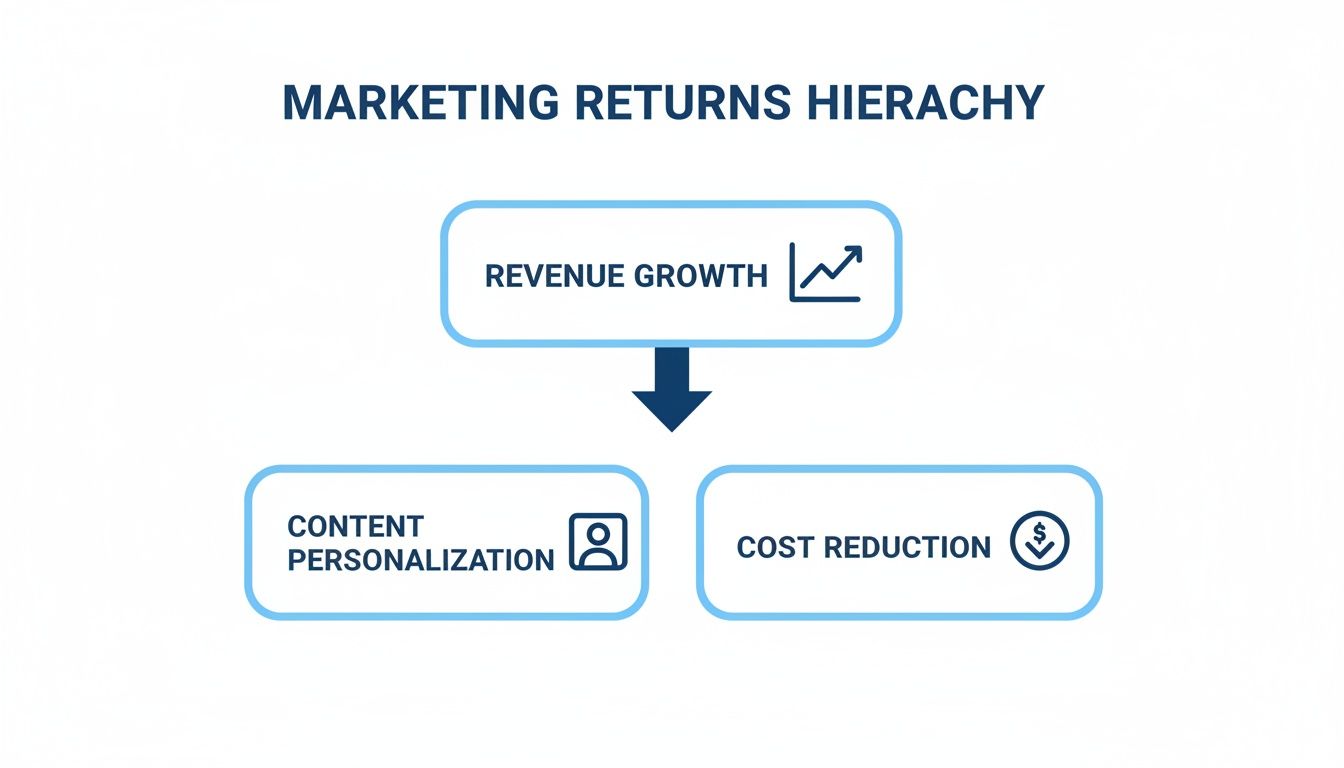
The visual makes it clear: using AI for personalization and cost savings is the engine that drives top-line revenue growth.
The end goal is a system where AI handles 80% of the initial, repetitive work. This frees up your human experts for the final 20%: the high-level strategy and creative nuance that no machine can replicate. This is how you scale creative output without selling your brand's soul.
To get started building your own machine, you can explore the capabilities of the best AI content generators and see which tools fit your workflow.
From Prompts to Profits: The ROI of AI Content
Productivity is a nice side effect. I care about profit.
Let’s connect the dots between using generative AI for content creation and watching your revenue climb. The aim is a real economic engine for your business, well beyond shaving a few hours off your week.
Early adopters are seeing strong results because AI gives them a level of speed and iteration their competitors simply can't match with manual processes. This is your chance to lap them. Repeatedly.
Imagine A/B testing ten landing page headlines in the time it used to take you to write two. Or creating personalized email campaigns for a dozen customer segments almost instantly. For my clients, this is daily operational reality.
Measuring What Matters
Your bank balance doesn't care how many blog posts you published. What moves it is customer acquisition cost, conversion rates, and lifetime value. To prove your AI initiatives are worth it, you have to track the metrics that tie directly to revenue.
Stop seeing content as a cost center and start treating it as a profit center. Every piece of content your AI system helps create needs a job. A click. A lead. A sale. If you can't measure its financial impact, you're just playing with expensive toys.
Focus on these metrics:
- Content velocity to conversion measures how fast you can get from an idea to a live piece of content that’s actually converting.
- Cost Per Lead (CPL) and Cost Per Acquisition (CPA) show whether automating a huge chunk of creation paid off. You should see a direct, measurable drop in how much it costs to get each new customer.
- Conversion rate by content variation matters because AI lets you test at massive scale. Track which AI-generated angles, hooks, and calls-to-action drive results, then feed that data back into the system to get even smarter.
Real-World Returns Are Here
The money is real because the results are real. One report showed early adopters in financial services seeing a 4.2x ROI on their generative AI investments.
These wins aren't limited to massive enterprises. I've implemented these same principles for startups, helping them achieve dramatic growth by applying this "test and iterate" mindset at a smaller, faster scale.
For a software-as-a-service client of mine, I used AI to generate 50 unique ad creatives in one week. I tested them all, found the top three performers, and tripled their ad budget on just those winners. Their lead cost dropped by 60% in 30 days.
That’s what I mean by prompts to profits. It's a direct, measurable line.
Your Path from Cost to Profit
So how do you make this happen for your business? You stop talking about "creating content" and start talking about "deploying assets." Every article, email, and social post becomes a strategic asset with an expected return.
Pick the single point in your marketing funnel where a lift would pay off most. Is it your landing page headline? Your welcome email sequence? Your top-of-funnel blog posts? Pick one.
Then, unleash the AI to create dozens of variations built on proven frameworks. For some concrete examples, check out my guide on AI prompts for marketing that are designed for exactly this purpose.
You test relentlessly. Find what works. Double down. That is how you turn AI from a buzzword into a line item on your profit and loss statement.
The Unspoken Risks and How to Mitigate Them
Anyone who tells you using generative AI for content creation is all upside is either naive or selling something. In my role, I can’t afford to be either. My job is to see the whole picture.
The truth is, this power comes with serious risks. I mean embarrassing brand missteps and serious reputational damage. Ignoring them is how you end up explaining why an AI-generated social media post offended half your customer base.
Let's tackle this head-on. The risks are real, but they are also manageable.
The Dangers You Can't Ignore
Three major risks keep me up at night when building these systems for clients: hallucinations, brand voice dilution, and the ethical minefield everyone using these tools is navigating.
Hallucinations are when the AI confidently states something that's plain wrong. This is a massive liability, especially in regulated industries like finance or healthcare.
Brand voice dilution is more subtle but just as corrosive. If you aren't careful, your content will slowly morph into a generic drone that sounds like every other company using the same tools.
Then there's the ethical side. Incidents involving AI-generated media have surged tenfold since early 2020. This explosion of deepfakes and synthetic content is a serious issue. As you can find in OECD data on AI incidents, the risk is documented and growing.
A Governance Framework That Enables Speed
Governance means building guardrails so you can go faster, safely. A practical governance framework is a competitive advantage. While your competitors are dealing with AI-driven PR disasters, you'll keep shipping.
Your framework needs three core components:
- Clear usage guidelines, meaning a written policy that explicitly states what AI can and cannot be used for. Define which tasks require mandatory human review and which data is off-limits.
- A human-in-the-loop process. No critical or public-facing content should go live without a human expert reviewing it. This person checks for typos and also validates facts, brand alignment, and strategic intent.
- Grounding AI outputs in factual data. This is where context engineering becomes your most powerful risk mitigation tool. By grounding the AI's responses in your own approved, fact-checked documents (case studies, product specs, and internal knowledge bases), you dramatically reduce hallucinations. You can learn more in my breakdown of context engineering versus prompt engineering.
The goal is a "safe-to-fail" environment for experimentation. You and your team should feel free to try new things within clear boundaries.
Your 90-Day Roadmap to AI Content That Pays

A plan without a timeline is just a wish. This is the exact, actionable blueprint I use with clients to build a profitable, AI-powered content engine in just 90 days.
Treat it as a phased battle plan. Let's get to work.
Month 1: Foundation and Experimentation
The first 30 days are about laying a solid foundation and scoring quick, undeniable wins. You need to prove the value fast. Forget boiling the ocean.
Your mission is to pinpoint low-risk, high-impact use cases. First drafts of blog posts. Ad copy variations. Internal documentation. You're aiming for 80% good, and you're aiming for it fast.
Pick a small, hungry "AI vanguard" team. Two or three people. Train them on advanced prompt and context engineering, then set them loose on initial tasks. Their success is the proof you'll need to scale.
Your deliverable for Month 1 is simple: a documented win. Show a 30% reduction in content draft time or a 20% bump in ad variations you can test. That data is your currency for Month 2.
Month 2: Workflow Integration and Scaling
In the second month, you shift from isolated experiments to integrated workflows. You physically connect your AI tools into your marketing stack: your CMS, your CRM, your project management software. The goal is a system where AI is a natural part of the process.
This is also when you formalize your governance framework. Using the principles I covered earlier, you'll establish your "human-in-the-loop" review process and lock down your brand voice guidelines. Consistency is critical as more of your team starts using these tools.
I always recommend starting with your highest-volume content channel. Is it email? Your blog? Focus integration efforts there first. By the end of this phase, you should have at least one major content workflow that is measurably faster and more efficient because of AI.
Month 3: Automation and Agentic Systems
This is where you truly pull away from the pack. In the final month, you'll move beyond just generating content and into building simple AI agents. Think of these as focused automations that handle multi-step tasks without a human babysitting them.
For instance, you could build an agent that:
- Monitors competitors' blogs for new articles.
- Summarizes their key points and flags content gaps.
- Drafts a response post or a counter-argument brief for your team to review.
You can build this with tools available right now.
By building these small, dedicated agentic systems, you stop using AI as a tool and start deploying it as a tireless digital team member. Your business goes beyond making content and builds an intelligent system that senses and responds to the market in real time.
Frequently Asked Questions About AI Content Creation
Let's dig into the common questions I hear from founders and small business owners once they start using generative AI for content creation. These are the practical, in-the-weeds concerns that pop up when you move past the initial excitement.
How do I ensure AI content matches my brand voice?
The answer is context engineering. You have to build a detailed 'Brand Voice Bible' specifically for the AI. It goes well beyond a mission statement. It needs your values, detailed target audience personas, your specific tone, and, most importantly, examples of your best-performing content.
You then feed this document into the AI's context window for every single request. It becomes an iterative process. You constantly refine the AI's output and update your voice guide based on its performance. It takes work, but it's the only way to get quality output at scale.
Which AI tool is best for content creation?
There is no single 'best' tool. Searching for one is a trap. The winning strategy is using the right tool for the right job. As of today, my personal stack for content looks something like this:
- Claude 3 Opus is my go-to for tasks that need a deep understanding of brand voice and for drafting long-form content. Its massive context window is key.
- ChatGPT-4 is the best I've found for creative brainstorming, complex problem-solving, and generating code for automations.
- Gemini Advanced excels at real-time research, synthesizing data, and pulling in current information from the web.
The goal is to build a toolbox, not find a single hammer. Your competitors are looking for one perfect tool. You pull ahead by building a system that combines the best features of several.
For those wondering about other practical applications, you might be interested in understanding what a webinar clip generator is and how it uses AI to automate video repurposing.
Can generative AI replace my content team?
No. And that’s the wrong goal entirely.
Generative AI is a force multiplier, not a replacement. It elevates your team from manual producers to strategic editors and creative directors. The companies that fire their writers will fail.
The companies that give their writers AI will outperform them. Period.