
Most advice on AI agents is backwards. People tell you to start by picking a framework, wiring up a chatbot, and celebrating a few task automations. That's tinkering.
I'm Samuel Woods. I've been working with ML since 2016 and Generative AI since 2019, and I'll give you the blunt version. Multi-agent systems for business matter because they let you build digital teams that work across revenue, operations, and decision-making at machine speed. Cleverness has nothing to do with it.
If you're still treating AI like a better prompt box, you're underbuilding. Your competitors are assembling agent teams that research, route, qualify, analyze, draft, escalate, and update systems without waiting on humans to stitch the workflow together.
Table of Contents
- Your Competitors Are Building Autonomous AI Teams
- What Are Multi-Agent Systems Really
- Choosing Your Orchestration and Architecture Pattern
- A Practical Roadmap for Implementation
- Real-World Business Playbooks
- Integrating Agents with Your Business Stack
- Where the Real Advantage Comes From
Your Competitors Are Building Autonomous AI Teams
Your competitors don't need a larger headcount to outmaneuver you. They need a faster operating system.
That's why I push founders to think about AI as an autonomous labor layer rather than a tool. One well-configured agent can help. A coordinated team of agents can qualify leads, monitor accounts, summarize market shifts, update records, and tee up next actions while you sleep.
The market signal is already loud. The global multi-agent systems market is projected to grow from USD 7.2 billion in 2024 to USD 375.4 billion by 2034, according to Nevermined's market analysis. That projection says more than hype does: operators and product teams are moving these systems into core infrastructure.
The hard truth: if a rival company can sense changes in pipeline, customer behavior, and operational risk faster than you can, they don't need a better brand to beat you.
Founders often fall into a common trap. They assume the advantage comes from one brilliant prompt engineer. In practice it comes from orchestrating specialist systems around your actual bottlenecks.
For some businesses, that starts with in-house capability. If you need to build the technical bench behind these systems, a practical route is hiring data scientists from Latin America, especially when you want strong AI talent without bloated enterprise overhead.
For others, the first move is org design. If you want to understand how responsibilities shift when AI agents become part of the operating model, I've broken that down in what an agent-first org chart looks like.
What this changes competitively
Multi-agent systems for business give you an advantage in three places your competitors care about most:
- Revenue generation, because agents can keep prospecting, enriching, drafting, and routing opportunities continuously.
- Decision speed, because you get processed signals instead of raw dashboard noise.
- Operational throughput, because repetitive handoffs stop eating your own hours.
If you ignore this shift, the risk is that another company builds a better machine for acting on information than you do.
What Are Multi-Agent Systems Really
Forget the academic definition. In business terms, a single AI agent is a strong intern. A multi-agent system is a department.
One agent can do one job reasonably well if the task is contained. A multi-agent system splits the work across specialists. One agent researches. Another analyzes. Another drafts. Another checks rules, formats output, or pushes updates into tools. Then an orchestrator keeps the whole thing moving.
That structure matters because business work is rarely one step. It's a chain of dependencies, approvals, data pulls, judgment calls, and follow-ups. Single agents struggle when the task spans too many contexts. Multi-agent systems for business win because they separate responsibilities instead of forcing one model to juggle everything.
Industry leaders stopped treating agents like side experiments in 2024. They described them as becoming as critical inside enterprise architecture as databases and cloud computing, as noted in Galileo's overview of multi-agent AI systems. That's the right frame. You don't ask whether cloud belongs in the business anymore. You decide how to use it well.
The simplest way to think about it
Here's the practical model I use with clients:
| Business analogy | Single agent | Multi-agent system |
|---|---|---|
| Team structure | One capable generalist | Manager plus specialists |
| Best for | Narrow, sequential tasks | Cross-functional workflows |
| Main weakness | Context overload | Coordination overhead |
| Business value | Fast wins | Scalable automation across functions |
The orchestrator is the manager. It decides which specialist should act, what context they need, and what happens next. That's the difference between “AI helped me draft this” and “AI ran the process.”
Why the model is getting stronger
LLM-based multi-agent systems outperform single-agent setups on complex work because they allow dynamic task decomposition and specialization while preserving proprietary data boundaries, as described in this LaMAS paper on arXiv. In plain English, that means you stop forcing one model to know and do everything.
That's also why the GTM teams moving fastest are changing their architecture as well as their prompts. If you want a good framing for that shift, what AI native GTM engineering means is useful because it translates agentic design into revenue operations instead of lab theory.
The companies that get the biggest gains ask, “Which business process should become autonomous?” instead of “How do we use ChatGPT more?”
Once you see the model clearly, the next decision gets more important: how to organize agents so they don't create chaos.
Choosing Your Orchestration and Architecture Pattern
An agent team without orchestration is just software confusion. You need a control model.
The architecture decides who delegates, who remembers context, who checks outputs, and how work moves when something fails. It sounds like technical trivia, but it changes your cost structure, your speed, and your risk.
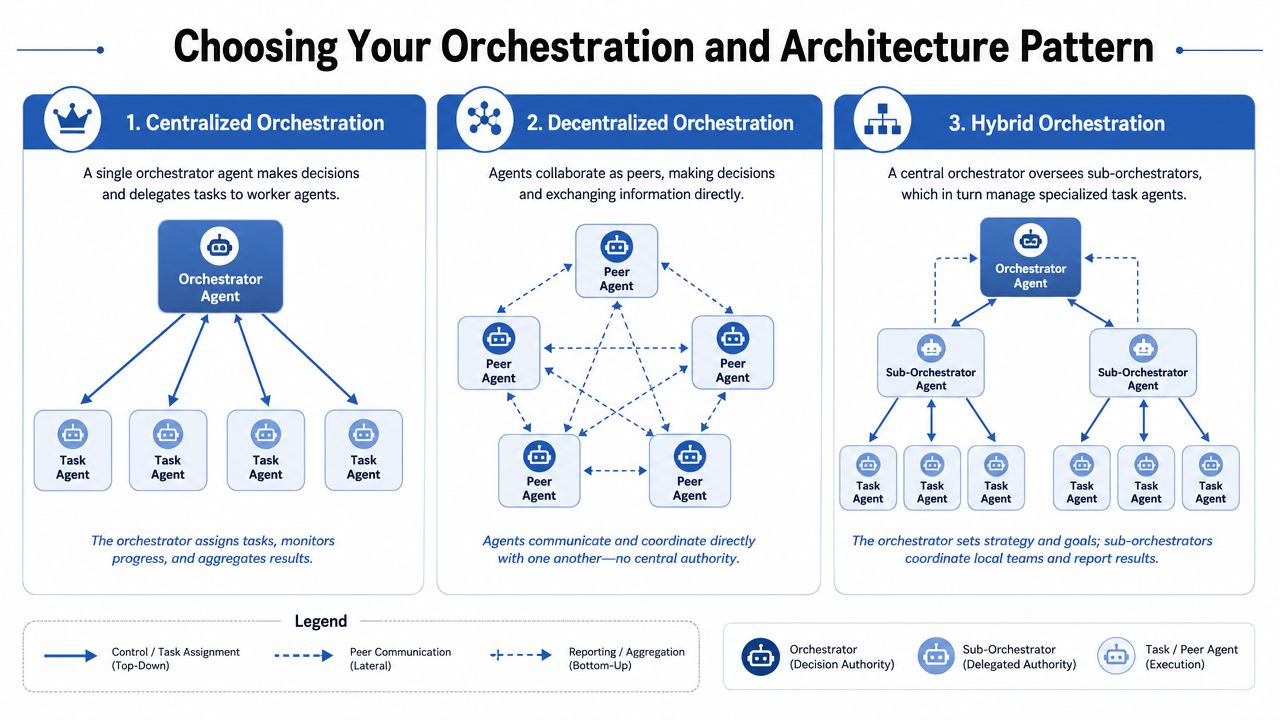
At enterprise scale, three coordination patterns keep showing up: Hierarchical Supervision, Parallel Execution with Synchronization, and Progressive Refinement, as outlined in this enterprise scaling discussion on multi-agent coordination. You do not need all three on day one. You need the one that matches the economics of the workflow.
If you want the technical layer underneath these patterns, I've written more about agentic context engineering, because orchestration fails when context is sloppy.
The three patterns that actually matter
Hierarchical Supervision
This is the manager-and-specialists model. One orchestrator holds the big picture and delegates to focused agents.
Use it when the work has a clear owner, a clear output, and several specialist substeps. Sales qualification, onboarding workflows, renewal prep, or account research all fit here. The upside is control. The downside is that the orchestrator can become a bottleneck if you stuff too much into it.
Parallel Execution with Synchronization
This pattern sends multiple agents to work at the same time, then syncs their outputs.
Use it when speed matters and the work can be divided cleanly. Competitive analysis, account intelligence, document review, and cross-source research fit well. The business gain is throughput. The risk is inconsistency if the agents return mismatched formats or conflicting conclusions.
Progressive Refinement
This starts broad and narrows. One pass explores the territory, later passes sharpen the answer.
Use it when brute force would be expensive or noisy. It's especially useful for research, targeting, forecasting, and pattern detection where you don't want every agent hitting every tool at full depth immediately. It usually gives better cost discipline than uncontrolled parallel swarms.
My advice: most small businesses should start with hierarchical supervision, then add parallel execution only after the workflow is stable.
How to choose without overengineering
Use this decision filter:
- Choose hierarchical when accountability matters more than raw speed.
- Choose parallel when delay costs more than coordination.
- Choose progressive refinement when search space is large and tool usage can get expensive fast.
The worst move is copying a flashy architecture from a demo video. Your orchestration pattern should match the workflow's economics, not the internet's enthusiasm.
A Practical Roadmap for Implementation
Most multi-agent projects fail before the first line of code, usually because the business picked the wrong use case. Weak models are rarely the problem.
That's where I start. I use a hard screening rule: multi-agent systems are only cost-effective when a single agent system fails more than 45% of the time. If the single-agent setup succeeds above that threshold, the coordination costs usually outweigh the benefit, based on the cost-effectiveness benchmark cited here.
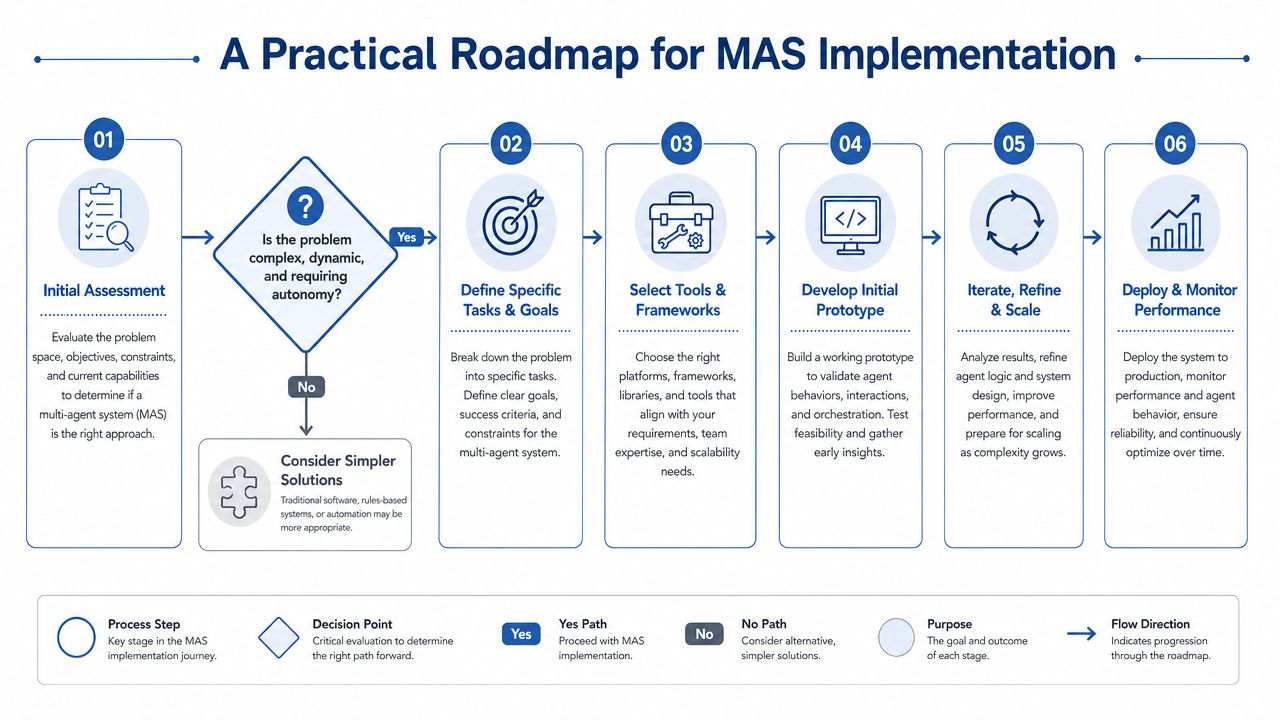
That rule alone can save you months of wasted effort. Don't build a digital department for a task that one good agent can already handle.
Start with a kill test
Before you architect anything, test the simplest version.
Give one strong agent the full job with the right tools, context, and guardrails. If it handles the workflow consistently, stop there. If it breaks across handoffs, loses context, or produces uneven quality, that's your signal to split the job into specialist roles.
I'd rather kill a bad multi-agent idea in three days than rescue it for three months.
Build the workflow before you build the stack
Whiteboard the work first. Who does what. What input starts the process. What each agent needs to know. What output each one produces. Where approval happens. What system gets updated.
Then choose tooling that fits your operating reality:
- Take the framework route with LangGraph when you need structured orchestration, state, and debugging.
- Take the low-code route for lighter internal automations, where low-code builders can be enough for a pilot.
- Take the hybrid route, as some teams do, with a mix of direct API workflows and orchestration layers.
If you're exploring options, I help businesses implement orchestrator-led agent systems inside their workflows. That's one route, alongside frameworks, internal builds, and platform-led deployments.
Measure business impact, not demo quality
Most businesses measure the wrong thing. They watch whether the agent “looks smart.” You should care whether it moves the P&L.
For multi-agent business systems, the ROI signals that matter include error rate reduction, compliance adherence, CSAT, and ESAT, as described in Automation Anywhere's MAS ROI discussion. Those metrics connect directly to resilience and speed of adaptation, which is what changes margin and growth.
Use a scorecard like this:
| Metric | Why it matters |
|---|---|
| Error rate | Bad outputs destroy trust and create rework |
| Compliance adherence | Critical when agents touch regulated workflows |
| CSAT | Measures whether automation improves customer experience |
| ESAT | Shows whether your team is being freed or frustrated |
Security is not a later problem
Treat each agent like an employee. Give it only the access needed to do the job.
That means role-based permissions, logged actions, and strict tool boundaries. An agent that can read a Salesforce field does not automatically need permission to edit every account record. A scheduling agent does not need access to financial data. These practices separate serious operators from people shipping risky automations that nobody wants to audit later.
Real-World Business Playbooks
Theory is cheap. What matters is where multi-agent systems for business create direct advantage.
The strongest use cases usually sit in the cracks between teams. Places where data lives in one system, action happens in another, and a human currently plays middleman all day. That's where agent teams earn their keep.
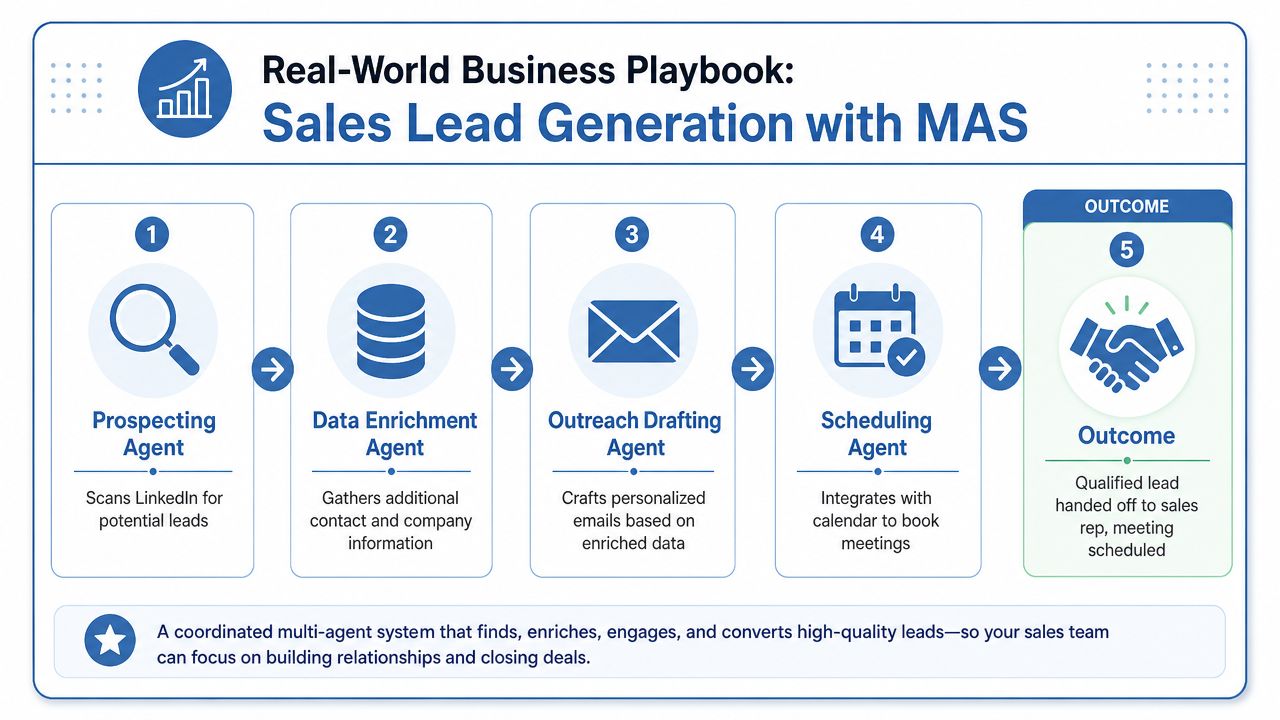
This section starts with a visual sales example because it's the easiest place for owners to see the mechanics.
Sales and customer success
A sales workflow is rarely one job. It's a chain.
One agent identifies likely accounts. Another enriches contact and company data. Another drafts outreach based on that context. Another proposes meeting slots and updates the CRM. Then a human rep gets a warm, qualified thread instead of a cold spreadsheet.
An enterprise example provides context. In a ServiceNow implementation, a multi-agent system built with LangGraph for orchestration reduced agent fragmentation across sales and customer success operations, according to this ServiceNow case summary. It's a useful example because it names a real business problem. Fragmentation kills handoffs, and bad handoffs kill revenue.
If you're thinking about adjacent service workflows, this practical guide to service automation is useful because it connects automation design to real support operations instead of abstract AI talk.
Here's a walkthrough of the broader model in action:
A strong sales agent system takes the low-value coordination work off whoever does your selling, so they can sell.
Operations and service delivery
Operations is where agent systems stop feeling optional.
In enterprise operations, multi-agent systems can reduce incident resolution times by up to 40% and improve IT reliability through collaborative anomaly detection, according to LeewayHertz's breakdown of MAS in operations. That matters because incident drag hurts uptime and also pulls expensive humans into reactive work and slows every downstream team.
Use cases I'd prioritize:
- For incident triage, one agent detects anomalies, another pulls system context, another proposes likely causes, and another drafts the response trail.
- For order and logistics exceptions, agents monitor status changes, identify risk conditions, and escalate only the exceptions humans should handle.
- For internal support routing, agents gather context and route to the right owner first instead of bouncing tickets between teams.
Marketing intelligence
Marketers often waste their sharpest hours on surveillance work. Watching competitor moves, scanning messaging shifts, checking content gaps, and summarizing patterns.
This is an ideal multi-agent setup because the work is continuous, cross-source, and repetitive. One agent monitors competitors. One clusters themes. One compares your positioning. One drafts briefs or campaign recommendations for human review.
That gives you something most companies still don't have: a living intelligence layer attached to execution, which senses and acts while the window is still open instead of reporting after the quarter is over.
Integrating Agents with Your Business Stack
A powerful agent system that can't touch your real systems is a toy. Business value appears when agents can read, write, trigger, and verify work inside the stack you already run.
That's why integration is where small teams usually stumble. Connecting the API is the easy part. The hard part is doing it without creating security holes, broken records, or a reporting mess nobody trusts.
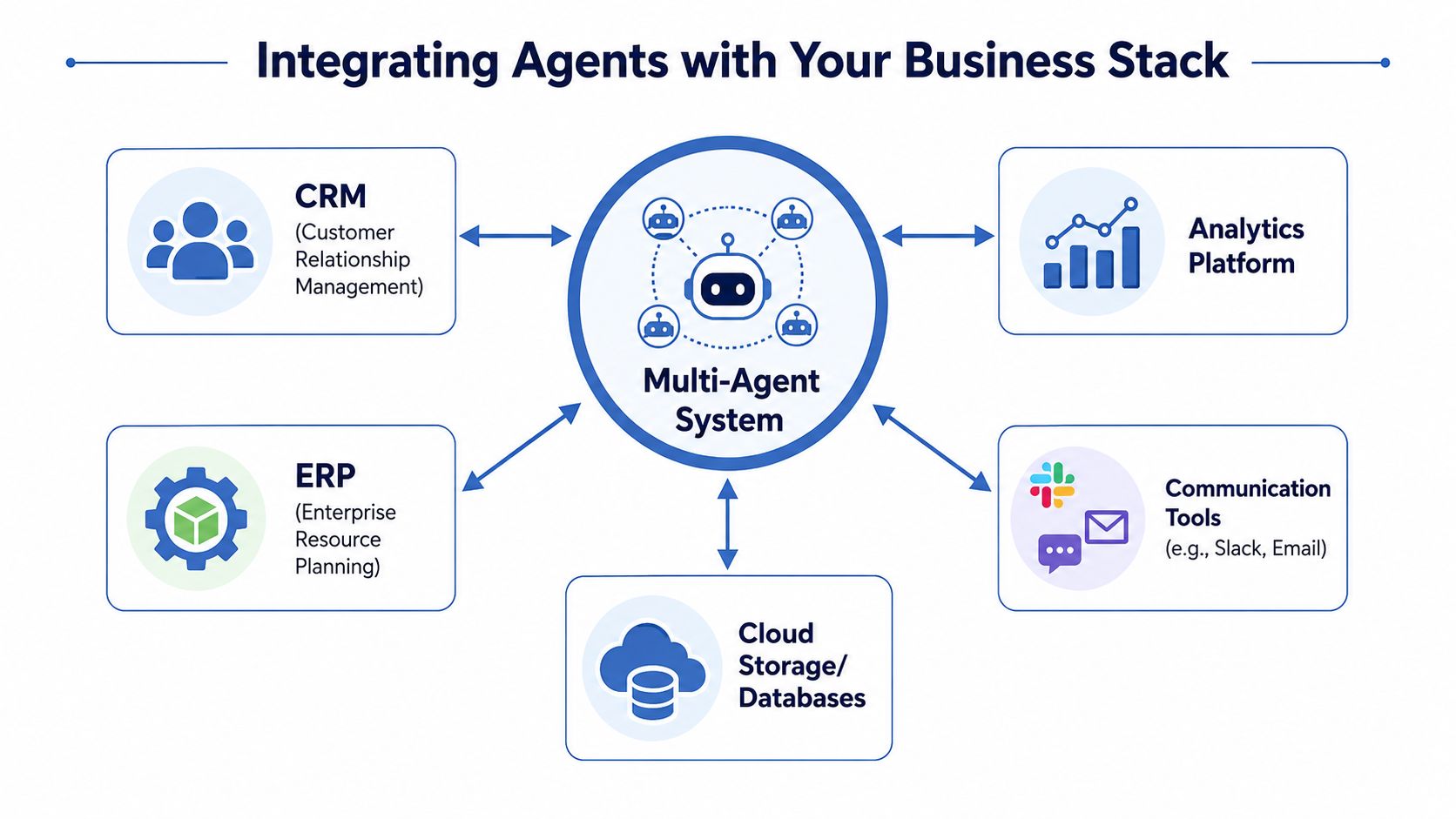
A major underserved issue for SMBs is exactly this governance and integration friction, especially when plugging agent systems into legacy CRM or ERP platforms like Salesforce or Workday without breaking security, as discussed in BizTech Magazine's piece on small-business adoption.
Why most small teams get stuck
The pattern is familiar. A founder builds a promising workflow. It drafts emails, summarizes calls, maybe even updates a spreadsheet. Then the team tries to connect it to the CRM, billing system, support inbox, and analytics stack. That's when the project gets dangerous.
The common failure points are:
- Too much access, when an agent gets broad permissions because it's faster to set up.
- No source of truth, so different agents read from different systems and return conflicting outputs.
- Weak auditability, where nobody can reconstruct why a change happened.
- Unclear identity, where actions happen but the system can't clearly attribute which agent did what.
Your agents should have narrower permissions than your average employee, not broader ones.
What a clean integration model looks like
You want agents interacting through tightly scoped tools instead of raw, unrestricted system access.
A practical pattern looks like this:
| System | Good agent permission | Bad agent permission |
|---|---|---|
| CRM | Read lead status, create contact, add note | Full delete and admin rights |
| ERP | Pull order status, flag exception | Unrestricted financial edits |
| Analytics | Read dashboards and source metrics | Rewrite source data |
| Communication tools | Draft messages, queue approval | Send anything to anyone automatically |
That's how you preserve control while still getting useful automation. Start with read-heavy permissions. Add write actions only when outputs are reliable and logged.
If you're grounding agents on internal knowledge, I've laid out a practical approach in how to train an AI agent on my company data. The core point is simple. If the data layer is weak, the agent layer amplifies the weakness.
For many companies, low-code bridges like Zapier or Workato are acceptable at the pilot stage. For higher-stakes workflows, direct API connections with scoped credentials and clear observability are usually the better long-term move.
Where the Real Advantage Comes From
I see multi-agent systems for business as a control point more than an automation trend.
The company that builds reliable agent teams first gets efficiency plus a better sensing system, a faster response loop, and a larger effective workforce without matching headcount growth. That changes how fast you can pursue opportunities, how quickly you can correct mistakes, and how much operational drag your competitors still carry.
On this topic, be opinionated. Don't start “AI experiments” with vague goals. Build agent systems where speed, coordination, and throughput directly affect revenue or margin.
Use them where you currently lose time to:
- Cross-functional handoffs
- Manual research and enrichment
- Repeated triage and routing
- Slow updates across disconnected tools
The moat comes from integration and repetition. Once your agents are grounded in your systems, tuned to your workflows, and measured against business outcomes, they turn from generic AI into operating infrastructure that reflects how your company wins.
The real advantage is that your business can act before slower competitors even understand what changed.
That's the opportunity in front of you: a machine for execution, instead of more content about agents or another internal demo.
And the companies that build that machine early will be harder to catch than most people realize.