
Most agencies are buying the wrong thing.
They say they want ai agents for agencies, but what they really buy is a prettier chatbot, a few automations, and a stack of disconnected prompts. That won't protect your margins. It won't deepen client retention. It won't make you faster than the agencies you compete with.
I'm Samuel Woods. I've been working with ML since 2016 and generative AI since 2019. My view is simple. If you use agents only to shave a few hours off production, you're aiming far too low. You should be using them to build a bionic agency system that senses, reasons, executes, and learns faster than the firms you're competing against.
Why Most Agencies Get AI Agents Wrong
The bad advice is everywhere. Start with a chatbot. Add a content prompt library. Automate reporting. Nice. Helpful. Also incomplete.
The problem is that most agency owners frame AI as labor reduction. That mindset pushes you toward replacing junior tasks instead of building strategic advantage. You end up with a cheaper workflow, not a stronger business.
The market is moving much faster than that. The AI agents market was valued at USD 7.84 billion in 2025 and is projected to reach USD 52.62 billion by 2030, growing at a CAGR of 46.3%, according to MarketsandMarkets research on the AI agents market. If you run an agency, treat that as a direct signal that buyers, platforms, and competitors are reorganizing around autonomous execution.

The chatbot trap
A chatbot is a surface layer. An agent is an operating layer.
A chatbot answers questions. A real agency agent should pull client context, inspect campaign data, compare current performance to historical patterns, draft assets, trigger reviews, and hand off approved outputs into live systems. Different game.
If you're still thinking in terms of "how do I add AI to customer support," start there if you must, but don't stop there. If you need a practical baseline for interfaces and handoff logic, Mava has a useful guide on best practices for AI chatbots. Then move past the interface and into orchestration.
Most agencies don't lose to better creativity. They lose to slower sensing, slower decision-making, and slower execution.
What actually matters
You need to ask better questions:
- Can your system spot opportunity early? Can it monitor competitor moves, performance shifts, and client account changes without waiting for a strategist to notice?
- Can it turn insight into output? Can it move from signal to brief to draft to deployment with human review in the right places?
- Can it preserve agency quality? Can it operate inside brand voice, account history, and channel-specific standards?
That's the frame. Revenue expansion. Faster delivery without quality collapse. More client capacity without linear headcount growth.
Most agencies still treat AI like a tool belt. The winners will treat it like infrastructure.
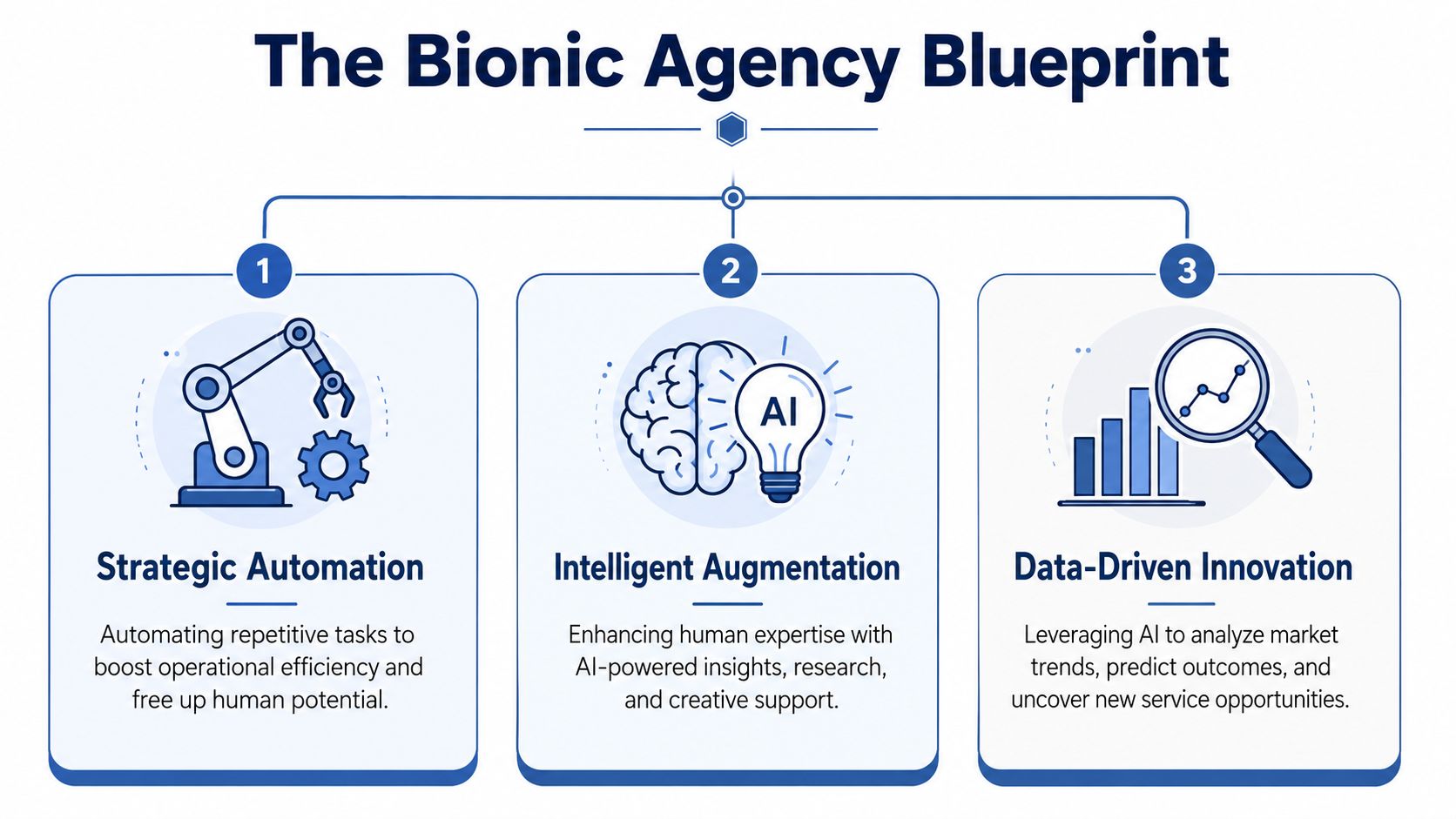
The Bionic Agency Blueprint
I don't recommend a random list of automations. I recommend a system.
My blueprint has three parts: market intelligence, campaign execution and client operations. If one of those is missing, your stack stays fragmented and your team keeps doing manual glue work.
As of 2025, 79% of senior executives report active implementation of AI agents in their companies, and 64% are focusing on business process automation in areas like marketing and sales, based on PwC's AI agent survey. That tells you the market has already moved past curiosity.
Market Intelligence
This is the pillar most agencies ignore, and it's the one I value most.
A market intelligence agent watches the environment continuously. It tracks competitor offers, messaging shifts, search movement, customer objections, creative patterns, and account-level anomalies. Then it turns that into something usable. A brief, a warning, a recommendation, a test idea.
Proprietary advantage is born from a focused strategy. Off-the-shelf tools can summarize the internet. Your system should summarize your market, your client base, and your past wins.
Campaign Execution
Execution is where most agency owners want to start because the payoff is visible.
A strong execution layer uses specialized agents, not one giant "do everything" assistant. One agent researches. Another drafts. Another checks against brand guidance. Another prepares channel-specific variations. Another packages for approval or publishing.
That structure matters because it mirrors how good operators already work. If you want a deeper view of how that looks in practice, I break down the operating model in my guide to marketing AI agents.
As a practical rule, build one system that supports your agency's service delivery. Don't build ten disconnected bots that each save a few minutes.
Client Operations
This is the boring part. It's also where margins steadily improve.
Client ops agents can support onboarding, asset collection, reporting prep, QA checklists, renewal triggers, and meeting summaries. Not glamorous. Very valuable. Every repetitive handoff you remove gives you and your senior people more room for strategy and selling.
For agencies working with regulated clients or European data requirements, governance isn't optional. If compliance is part of your buying criteria, review practical examples of reruptionchat's DSGVO-konforme KI Lösungen and then adapt the principles to your own workflow design.
The bionic agency is a coordinated system that helps you detect, decide, and deliver faster than agencies still running on meetings and manual updates.
Evaluating and Designing Your First Agent
Your first build should be your cleanest win, even if it is a modest idea.
Most failed AI projects start with too much ambition and too little structure. Agency owners try to automate strategy, full-funnel content, or client communication all at once. Then quality slips, trust disappears, and the team resumes doing everything by hand.
The hidden issue is brand nuance. Emerging 2025 data shows that 60% to 70% of AI agent deployments in agencies require heavy human oversight to preserve brand consistency, according to LangChain's State of AI Agents perspective. That means your first agent should live in a workflow where judgment can be bounded.
Pick the right first use case
Don't choose the task you hate most. Choose the task with the best mix of repeatability, visibility, and controllable risk.
Good starting points usually have four traits:
- It happens often. The team does it constantly.
- It has clear inputs. The agent doesn't have to guess what "good" looks like.
- It has a defined output format, so you can review success quickly.
- It carries low client risk. A mistake is annoying, not catastrophic.
Here's a simple selector I use.
| Use Case | Business Impact (1-5) | Complexity (1-5) | Recommended Starting Tool |
|---|---|---|---|
| Weekly client reporting draft | 4 | 2 | Zapier |
| Content brief generation | 4 | 2 | MindStudio |
| Ad variation drafting | 3 | 3 | Claude |
| Competitor monitoring summary | 5 | 3 | Perplexity |
| Client email first draft | 3 | 4 | Claude |
| Full campaign strategy generation | 5 | 5 | Not your first build |
Design the agent before you touch tools
It's common to open a builder too early. Wrong move.
First define the job in plain language. What triggers the task. What context the agent receives. What tools it can call. What output format it must return. What a human must approve before anything leaves the system.
I go deeper on this in my piece on agentic context engineering, because context quality usually decides whether an agent feels useful or unreliable.
The minimum design spec
Use this checklist before you build:
- The objective is one job only, such as "Produce a first-draft weekly performance summary for account managers."
- The inputs are source documents, analytics exports, brand guidance and prior examples.
- The tools are web search, sheet access, CRM lookup, a document writer and a messaging app.
- The rules cover banned claims, tone guidance, approval requirements and escalation conditions.
- The output follows a fixed structure that makes review fast.
- The fallbacks say what happens when the agent lacks data or confidence.
If you can't describe the task as a repeatable operating procedure, you shouldn't automate it yet.
Where agency owners overbuild
I see the same mistakes repeatedly:
- They attach too many tools too early. The agent gets access to everything, then chooses badly.
- They give it no approved examples, then expect brand consistency without giving the system brand memory.
- They skip the human checkpoint, so client-facing content goes out before anyone verifies it.
- They set vague success criteria. The team says it "kind of helps," which means nobody knows if it works.
Your first agent should feel almost boring. That's good. Boring systems get adopted. Flashy systems get demoed and abandoned.
Building Your Agent the Lean Way
You don't need a research lab. You need a tight build loop.
Most agency owners should start with low-code unless they already have technical capacity in-house. The goal is speed to proof, not architectural purity. Build the first useful agent fast, then decide what deserves a more custom stack.

Two build paths
Low-code works well when you need to validate workflow value quickly. Tools like MindStudio, Zapier, Make, Airtable, and Notion can get an internal agent live without much engineering friction.
Framework-based builds make sense when you need more control. crewAI, LangGraph, Python, custom APIs, vector databases, and internal review layers are better when your service model depends on proprietary orchestration.
A simple way to choose:
- Use low-code if the workflow is narrow, internal, and easy to review.
- Use code if the workflow touches multiple systems, requires memory, or will become a core agency asset.
A lean market research agent
A practical first build is a market research agent for account strategists.
The workflow can be simple. It checks a defined set of competitor sources, collects recent positioning changes, summarizes relevant campaign themes, and outputs a brief for a strategist to review. No publishing. No direct client contact. Clear upside.
A basic Observe-Plan-Act loop can look like this:
- Observe by gathering the client name, market, competitor list, and current campaign focus.
- Plan by deciding which sources to inspect and what changes matter.
- Act by pulling findings, summarizing them, ranking opportunities, and drafting next actions.
You can adapt this directly inside a low-code builder:
You are a market intelligence agent for a marketing agency.
Observe the target account, named competitors, and campaign goal.
Plan a research path using only approved sources.
Act by returning a structured brief with competitor shifts, messaging patterns, offer angles, and recommended tests.
If evidence is weak or contradictory, flag uncertainty and request human review.
One reason this matters for search teams is operational throughput. If your agency handles SEO or content operations, Agency Platform has a useful breakdown of AI for greater SEO efficiency that complements this kind of execution design.
What to test on day one
Don't test on live client work first.
Run the agent on past campaigns, old reports, or archived briefs where your team already knows what good output looks like. Compare the agent's draft to what your team produced manually. Then fix one thing at a time. Prompt wording. Input structure. Tool permissions. Review logic.
Here's a walkthrough worth watching before you build more complex flows:
Keep the build lean
I tell agency owners to follow three rules.
- Ship ugly, because your first internal version does not need a polished interface.
- Constrain the scope to one agent, one job and one review owner.
- Learn from failures quickly. Every bad output is design feedback, not a reason to scrap the whole effort.
If you can't get a narrow workflow running in a day, the problem is probably scope, not technology.
Measuring Agent KPIs and Business ROI
If you measure "time saved," you'll fool yourself.
That metric sounds useful because it's easy to say in meetings. It's weak because it doesn't tell you whether the agent created profit, protected quality, or expanded capacity. Agencies need operating metrics that map to delivery and commercial performance.
A stronger approach is to instrument the workflow directly. A proven methodology involves logging all agent actions and benchmarking task completion, with target success rates of 85% to 95% for structured tasks and 60% to 75% for ambiguous work like creative ideation, based on MindStudio's guidance on AI agent success metrics.

What to log
At minimum, log the following for every run:
- Task identifier so you can trace outcomes later
- Inputs used including prompt version, source files, and selected tools
- Output status such as approved, revised, rejected, or escalated
- Latency so you know where the workflow drags
- Reviewer notes so the team sees recurring failure patterns
This turns your agent from a magic trick into an operational asset.
The KPIs that actually matter
For a content or campaign workflow, I care about business-facing KPIs first.
| Workflow Type | KPI That Matters | Why It Matters |
|---|---|---|
| Content drafting | Cost per approved asset | Shows whether output is profitable after review |
| Reporting | Time to client-ready report | Measures delivery speed, not just internal effort |
| Lead qualification | Qualification accuracy | Protects sales team's time |
| Research | Insight-to-brief speed | Shows whether intelligence becomes action |
| Creative ideation | Approval rate after first pass | Reveals whether the system is learning your standards |
You should also track review burden. An agent that produces fast drafts but forces heavy rewrites may still be net negative.
My rule is simple. If you can't connect the agent to capacity, margin, or client performance, it's still a demo.
Build a simple ROI model
You don't need an elaborate finance workbook to start. You need a repeatable decision method.
Use this logic:
- Define the workflow cost before the agent.
- Define the workflow cost after the agent, including review time and tool spend.
- Measure whether output volume, turnaround speed, or client capacity improved.
- Check whether quality stayed acceptable.
If the agent lowers cost but increases revisions, be honest about that. If it improves throughput and keeps quality stable, you have a system worth expanding.
For agencies that want sharper marketing performance measurement overall, I recommend aligning agent KPIs with the same commercial lens you use elsewhere. My framework for how to measure marketing effectiveness is built for that kind of alignment.
Don't let your dashboard become a pile of vanity metrics. You are not measuring whether the AI is interesting. You are measuring whether the business got stronger.
Scaling From One Agent to an Agency-Wide System
One useful agent is a win. A fleet of unmanaged agents is a mess.
Agencies often create their next problem when different people build different assistants, nobody owns standards, prompts get copied across clients, and sensitive workflows start depending on undocumented logic. You don't have a system at that point. You have drift.
Build an agent registry
Create a simple internal registry before you scale further.
It should list the agent name, owner, purpose, inputs, tools, approval requirements, and current status. That's enough to stop duplicate builds and mystery workflows. It also forces someone to own maintenance.
Your registry doesn't need to be fancy. Airtable, Notion, or even a well-structured spreadsheet is fine. The point is governance.
Assign a human operator
Your agency needs an AI Orchestrator, even if that is you wearing one more hat. Maybe that title changes. The job doesn't.
That person manages prompts, reviews outputs, tracks failures, updates context, and decides when a workflow is ready for broader use. Without an owner, agents decay fast because no one notices the quality drift until a client does.
Agencies don't scale agents by buying more software. They scale by assigning clear operational ownership.
Set guardrails before rollout
I recommend three basic controls:
- Approval gates for anything client-facing or performance-critical
- Access limits so agents only touch the systems they need
- Escalation rules when context is missing, confidence is low, or outputs conflict with source data
These controls protect quality without adding bureaucracy.
Budget like an adult
Agency-specific ROI is often murky. Tooling can cost $500 to $5K per month, and real-world early efficiency gains are usually around 2x to 3x rather than the hyped 10x, according to Aalpha's discussion of AI agents for small businesses. That's the right budgeting frame.
If you build around fantasy gains, you'll overspend, overload your team, and declare the initiative a failure too early. If you budget for realistic early wins, you give the system room to mature.
The moat comes from memory
The strongest agency-wide system is the one with the richest operating memory, whatever its tool count.
Store approved examples. Capture account-specific nuance. Save review comments. Preserve what was accepted by clients and what drove results. Over time, your agents stop acting like generic assistants and start acting like trained operators inside your agency.
That's where the moat appears. Everyone has access to AI. The moat sits in the way your agency structures context, judgment, and execution.
Your First 90 Days: An Agent Rollout Plan
You do not need a transformation committee. You need a clock and a decision.
Days 1 to 30
Audit recurring workflows. Pick one high-frequency, low-risk task. Define the objective, inputs, tools, output format, and approval gate.
Interview the people already doing the work. Collect their best examples, edge cases, and review criteria. That material becomes the starting context for the agent.
Days 31 to 60
Build the first version in a sandbox. Use a low-code stack unless you already know the workflow deserves custom engineering.
Run historical tests first. Compare outputs against known good work. Tighten prompts, trim tool access, and fix failure patterns before the workflow touches live delivery.
Days 61 to 90
Start limited production use. Log every run, every revision, and every rejection.
Review performance weekly. If the agent reduces effort while keeping quality acceptable, expand its scope carefully. If it creates noise, redesign the workflow instead of forcing adoption.
Start with one workflow your team already understands deeply. The clearer the human process, the better the agent will perform.
By day 90, you should have one agent producing real output, one owner accountable for it, and one measurement framework that tells you whether to scale or stop. That's enough to move from AI talk to AI operations.
If you want help designing a bionic agency system instead of another disconnected automation stack, you can work with me on it.