Most consulting firms are using AI like a faster intern. That's the wrong game.
You're under pressure to deliver sharper thinking, faster proposals, and more client-ready analysis without hiring your way out of the problem. Meanwhile, buyers still expect bespoke insight, not generic summaries pasted from ChatGPT. So firms end up in a bad middle ground. More tools, same bottlenecks, very little defensibility.
I've seen this pattern enough times to be blunt about it. ai agents for consulting firms only matter when they become part of your operating system. Not a novelty. Not a side experiment. A system tied to your data, your methodology, your CRM, and the specific workflows that generate revenue.
If you just buy the same off-the-shelf agent stack as everyone else, you'll move faster for a while. Then you'll look exactly like everyone else.
Stop Competing on Speed and Start Dominating on Intelligence
A lot of firms think they're losing because they're too slow. Usually, they're losing because their work feels interchangeable.
You've probably seen it firsthand. A prospect asks for a proposal with market context, a point of view, and a practical roadmap. Your team spends days collecting company background, stitching together slides from old decks, and writing something polished but thin. Then another firm wins because they showed up with sharper intelligence and a stronger angle.
That isn't a writing problem. It's a system problem.
The real bottleneck
Most consulting workflows still depend on humans doing low-yield collection work. Searching, copying, checking old project files, pulling market notes, scanning call transcripts, digging through SharePoint, hunting for relevant case studies. Smart people doing mechanical work.
That model breaks when clients expect both speed and depth.
The firms that win won't be the ones that generate content fastest. They'll be the ones that turn fragmented information into proprietary insight faster than competitors can.
When I advise managing partners, I push them to stop framing AI as content generation. The better framing is institutional intelligence infrastructure. Your agents should function like a research layer, a synthesis layer, and a delivery layer that support consultants instead of replacing them.
What changes when you think in systems
Once you stop treating AI as a chatbot and start treating it as an operating layer, different priorities become obvious:
- Your proposal process changes because agents can pull relevant past work, reusable frameworks, and industry context without making your team start from zero.
- Your discovery process improves because agents can prepare account intelligence before the first meeting.
- Your delivery gets stronger because consultants spend more time interpreting and less time gathering.
- Your moat gets clearer because your value starts coming from how your firm structures knowledge, not just how fast one person can prompt.
Short version. If your people are still acting as manual routers between documents, websites, CRM records, and project artifacts, you don't have an AI strategy. You have labor arbitrage with nicer software.
Your First Move Beyond Basic ChatGPT
Your first move shouldn't be “let's give everyone ChatGPT.” That creates scattered usage, inconsistent quality, and almost no measurable business case.
Start with one workflow that touches revenue directly. For most firms, that's proposal generation or initial client discovery research.

Why proposal workflow is the right first target
Here is a starting point, because the pain is obvious and the payoff is immediate.
A partner wants a customized proposal by tomorrow. Someone on the team gathers the client brief, finds related case studies, pulls boilerplate, updates old slides, rewrites the value proposition, and tries to make it all sound specific. The output is often good enough. It's rarely as precise as it should be.
That's where a simple agent can prove its value.
Instead of asking a model to “write a proposal,” build an agent that does four bounded things:
- Reads the client brief.
- Searches a curated internal library of past work, frameworks, and vertical expertise.
- Pulls the most relevant examples and patterns.
- Drafts a proposal structure with clear assumptions for human review.
That's a real business workflow. Not a parlor trick.
Why this matters right now
AI agents aren't fringe anymore. In PwC's May 2025 survey of 300 senior executives, 79% said AI agents are already being adopted in their companies, and 66% of those adopters said the agents are delivering measurable value through increased productivity, according to PwC's AI agent survey.
For consulting firms, I take that as a strategic signal. The question isn't whether this category is real. It's whether you'll implement it in a workflow that changes revenue generation.
What your first agent should and shouldn't do
Use a narrow scope first.
| Agent task | Good first use | Bad first use |
|---|---|---|
| Intake | Parse RFPs, notes, and discovery briefs | Make pricing decisions autonomously |
| Retrieval | Pull relevant internal examples and frameworks | Search all company data without permission controls |
| Drafting | Build proposal outlines and first-pass narratives | Send final proposals to clients without review |
| QA support | Flag missing assumptions and unsupported claims | Fact-check itself with no human verification |
Practical rule: If the workflow affects revenue and repeats often, automate the preparation and synthesis first. Keep final judgment with your consultants.
Don't start with end-to-end autonomy. Start with a bounded agent that helps your team produce stronger work, faster, and more consistently.
That first win gives you proof. Then you expand.
Designing Your Firm's Agent Architecture for a Defensible Edge
Most firms falter at this stage. They purchase generic tools, connect a few prompts, and assume they have established a genuine capability.
They haven't. They've rented one.
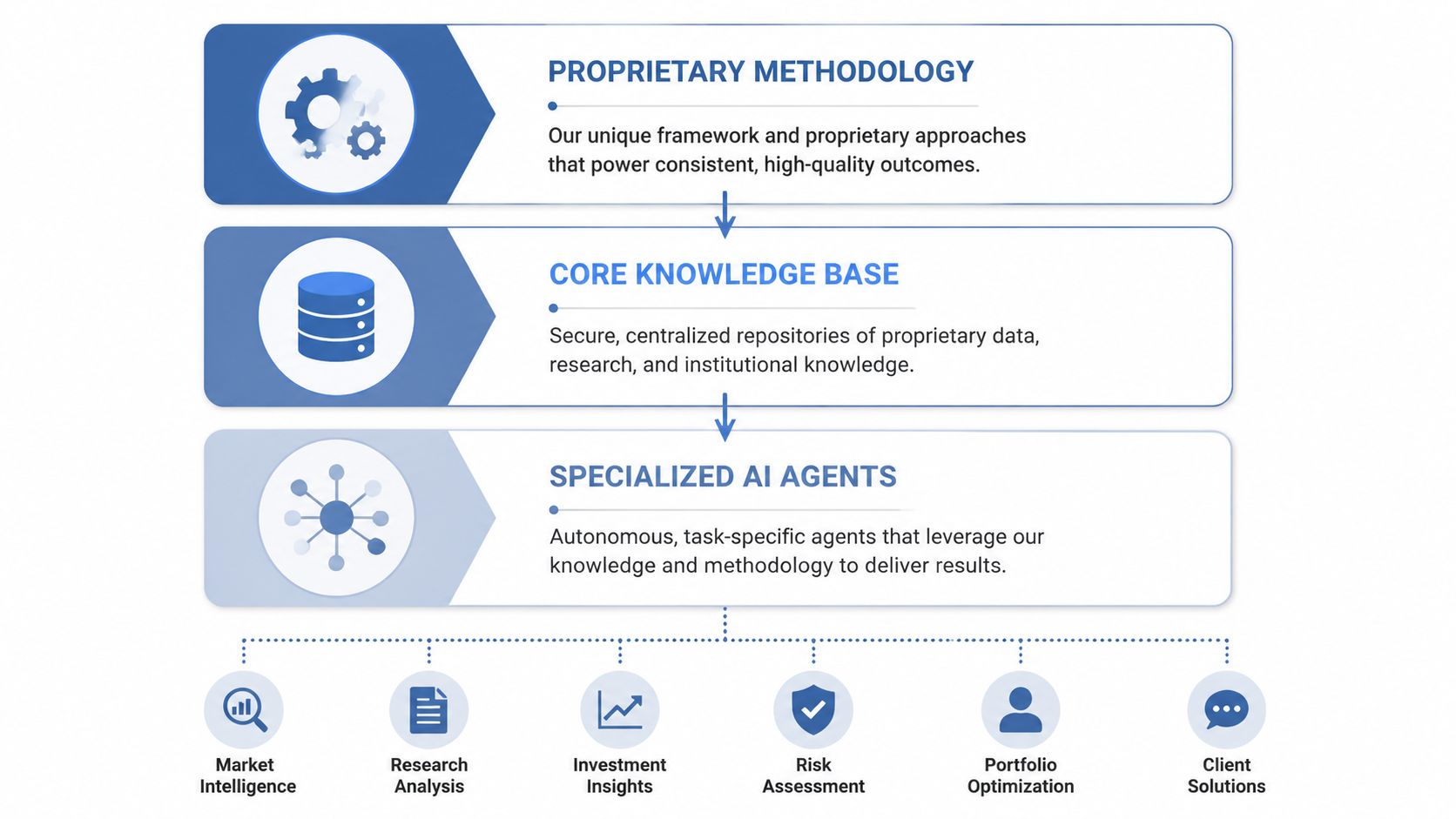
The strategic battleground is shifting to stack ownership and data differentiation. Firms using off-the-shelf agents risk commoditization, while those embedding agents into proprietary data and methodologies gain a defensible advantage. That's the core point in this analysis of AI agents in consulting and professional services.
The architecture I recommend
I usually advise a hub-and-spoke model.
The hub is your private knowledge core. The spokes are specialized agents that access that core under controlled rules. If you want a deeper view of what that looks like in practice, I've broken down the model in my guide on AI agents.
Here's the structure in plain English:
The hub
Your hub should contain the assets your competitors can't easily copy:
- Past project artifacts such as proposals, deliverables, playbooks, and interview summaries
- Firm methodology including diagnostic frameworks, industry lenses, and engagement templates
- Internal expertise from partners, SMEs, and researchers
- Approved external sources your team trusts and references repeatedly
This isn't a dumping ground. Curate it. Tag it. Control access. Remove junk.
The spokes
Then you create agents with very specific jobs.
One agent handles public research. Another finds internal analogs. Another compares the current opportunity against prior engagements. Another drafts the narrative. Another checks whether the draft aligns with firm standards.
That matters because consulting quality usually breaks in the handoffs. One person researches. Another writes. Another edits. Another partner rewrites from memory. Agents reduce that friction when each one has a narrow job and a controlled context window.
What actually creates the moat
The moat doesn't come from using GPT, Claude, Gemini, or any one model. Those are replaceable components.
The moat comes from combinations your competitors can't replicate quickly:
- Proprietary context
- Workflow design
- Feedback loops
- Access controls
- Method-specific prompting
- Accumulated institutional memory
Off-the-shelf AI gives you temporary efficiency. Proprietary agent architecture gives you cumulative advantage.
If you want ai agents for consulting firms to create margin and market position, build the system around your intellectual property. Otherwise you're speeding up commoditized output.
Crafting Agentic Workflows That Win Engagements
Architecture alone won't save you. You need workflows that fit how consulting work gets done.
The mistake I see most often is giving one agent a giant instruction like “analyze the client's market and tell me what to do.” That's where quality falls apart.
Use bounded roles, not magical thinking
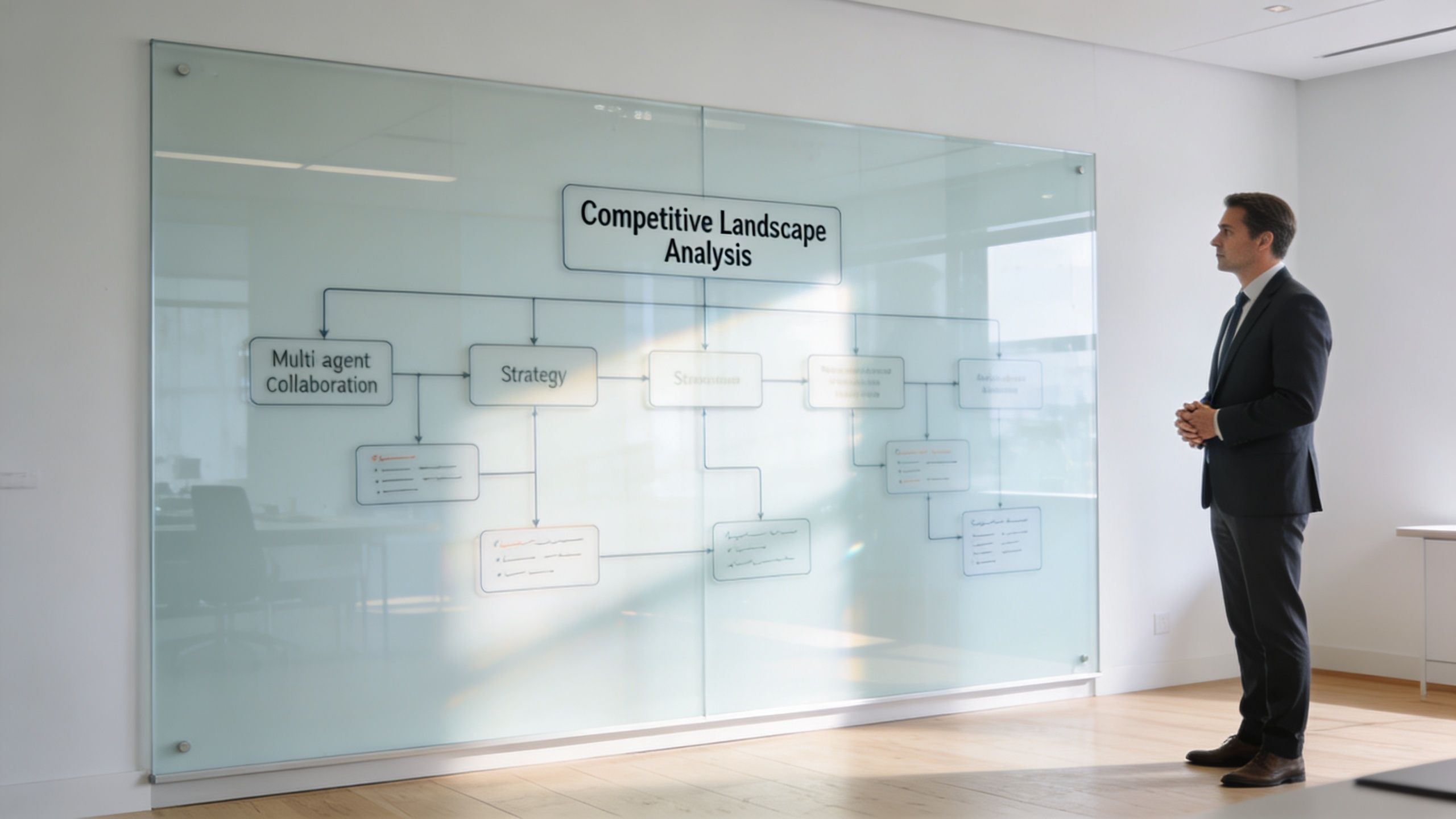
Benchmarks show that AI agents perform best in structured environments, and performance declines as task complexity rises. They also found that consultants should split work into checkpoints such as retrieval, synthesis, draft generation, and human approval. That's especially important given the execution gap BCG identified between the 30% to 40% productivity improvements enterprises expect and the 6% to 15% providers commit to, as summarized in AIMultiple's agent performance benchmark.
That aligns with what I see in the field. The best agentic workflows are checkpoint-driven.
Here's a practical example for market analysis.
A workflow that works
Agent one, the researcher
Its job is evidence collection.
Prompt it to identify key competitors, gather public materials, collect product and positioning data, and return results in a strict schema. No recommendations. No strategic flourishes. Just a clean evidence pack.
Agent two, the synthesizer
This agent gets only the researcher's structured output plus your firm's preferred analysis template.
Ask it to compare competitors across dimensions you care about, including messaging, product lines, pricing posture, distribution model, strategic moves, and likely pressure points. Internal context starts to matter at this stage.
Human review
A consultant checks for obvious misses, nuance, and client-specific context. This is where judgment belongs.
Agent three, the drafter
Now the drafting agent can turn reviewed synthesis into a client-ready first pass. Not final advice. A draft that reflects both evidence and your method.
If you're building these systems with engineering support, teams that specialize in AI product engineering can help connect the orchestration layer, data pipelines, and model logic so the workflow is reliable instead of fragile.
The hidden lever is context design
Most firms obsess over prompts. I care more about context.
If the wrong documents, stale assumptions, or irrelevant examples enter the workflow, your agent will produce polished nonsense. That's why I put so much emphasis on retrieval rules, source priority, and role-specific memory. I've written in more detail about this in my breakdown of agentic context engineering.
A simple operating model looks like this:
- Checkpoint one retrieves only approved sources
- Checkpoint two synthesizes in a fixed structure
- Checkpoint three requires consultant review
- Checkpoint four drafts for client delivery
That sequencing is what makes ai agents for consulting firms usable in real engagements.
A quick walkthrough helps here:
You do not need an autonomous super-agent. You need a disciplined production line for insight.
Integrating Agents With Your Analytics and CRM Stack
An agent that produces a document but never touches your systems is still a side tool.
If you want business impact, connect your agent outputs to the platforms your firm already uses to sell, deliver, and measure work.

Where most firms stop too early
They build a proposal assistant or research bot, the team likes it, and that's the end of the implementation.
That's wasted opportunity.
If your proposal agent drafts a response, it should also create or update the relevant CRM record in Salesforce or HubSpot, assign an owner, tag the opportunity as AI-assisted, and log what materials it used. If your research agent prepares an account brief, that brief should be attached to the opportunity and visible before the first sales call.
That's how you create a measurable feedback loop.
What to connect first
I'd prioritize four integrations.
- CRM integration so you can tie agent use to opportunities, stage progression, and closed-won analysis
- Knowledge systems like SharePoint, Notion, Confluence, or a vector database so retrieval uses actual firm memory
- Project delivery tools such as Asana, Monday, or Jira so outputs trigger next actions
- Analytics environments where client data can be reviewed safely and translated into recommendations
If you're comparing options, my overview of AI workflow automation tools covers the kinds of systems firms typically stitch together for this layer.
The operating loop you want
A mature loop looks like this:
| Trigger | Agent action | System update | Business value |
|---|---|---|---|
| New opportunity enters CRM | Build account brief and proposal draft | Opportunity tagged and enriched | Faster response with stronger relevance |
| Discovery call completed | Summarize notes and identify gaps | Tasks created for follow-up | Better pursuit discipline |
| Engagement starts | Compile client context and prior analogs | Project workspace populated | Faster ramp-up for delivery teams |
| Client data changes | Flag anomalies or opportunities | Alert sent to account owner | Proactive advisory instead of reactive reporting |
What matters: Don't just automate output. Automate traceability.
That traceability is what lets you answer the only question partners eventually care about. Did this system help us win more work, serve clients better, or improve delivery economics?
Measuring True ROI and Governing Your Agent Fleet
If your ROI story is “our analysts save time,” you don't have a board-level case. You have an efficiency anecdote.
Major firms are now measuring whether saved time is converted into higher-value work, not just lower effort. That's the key issue highlighted in this reporting on AI agents in the consulting industry. I agree with that completely. Time savings only matter if they change revenue, margins, quality, or client retention.
Measure commercial outcomes first
I tell firms to separate activity metrics from economic metrics.
Activity metrics are useful, but they're not enough. Prompt counts, agent runs, document drafts, and analyst hours saved won't convince anyone serious.
Track commercial outcomes instead:
- Proposal throughput by team and by service line
- Win quality for AI-assisted bids versus non-assisted bids
- Cycle time from inquiry to proposal submission
- Delivery margin on engagements using agentic support
- Consultant utilization mix, especially whether senior people spend more time on client-facing work
- Client-perceived quality, captured in account reviews and post-project feedback
Governance is where trust gets built
This is the part firms love to postpone. Bad idea.
If agents touch client work, you need hard rules on source validation, approval paths, data boundaries, and logging. Not because compliance teams like paperwork. Because consulting trust is fragile, and one fabricated claim in a board deck can damage a relationship fast.
Here's the baseline I push for:
| Governance area | Minimum standard |
|---|---|
| Source validation | Every factual claim in client-facing work gets checked against original sources |
| Access control | Agents only reach data relevant to the user and engagement |
| Human approval | No external-facing deliverable goes out without named reviewer sign-off |
| Audit trail | Prompts, retrieved sources, outputs, and edits are logged |
| Model policy | Approved models are assigned by use case, not left to ad hoc preference |
Good governance doesn't slow adoption. It keeps one bad output from poisoning the whole initiative.
Don't govern everything the same way
A meeting-summary agent and a strategy-recommendation agent do not carry the same risk. Treat them differently.
Low-risk internal workflow agents can move quickly. High-risk client-facing analytical agents need tighter review, narrower permissions, and stricter QA. That's how you avoid killing momentum while still protecting the firm.
Leading the Change Without Breaking Your Firm
Technology is rarely the main failure point. Culture is.
Partners worry that AI will dilute quality or undermine the traditional staffing ratio. Junior consultants worry they're automating away the work they were hired to do. Operations teams worry they'll inherit a messy stack no one owns. All reasonable concerns.
The wrong response is a top-down mandate with a handful of licenses and a town hall full of slogans.
Build a small proving ground
Start with a volunteer team. Not the loudest AI enthusiasts. Not the most skeptical holdouts. Pick respected operators from delivery, sales, and operations who understand how work really moves.
Give them one workflow each. Proposal support. Account research. Internal knowledge retrieval. Meeting prep. Tight scope. Clear ownership. Fast review cycles.
That creates internal proof people can trust because it comes from colleagues, not vendor decks.
Change the story people tell themselves
Junior consultants need to hear a different message from leadership.
Their future value won't come from being the fastest person at collecting fragments across the internet and old slide libraries. It will come from asking better questions, spotting weak assumptions, improving synthesis, and handling clients with confidence. Agents can remove low-value grunt work, but they also force your people to level up.
I'd formalize that shift with new responsibilities:
- Agent trainer for refining instructions, feedback loops, and evaluation criteria
- Workflow architect for mapping multi-step delivery processes
- Knowledge curator for maintaining internal sources and retrieval quality
- AI QA lead for validating claims, outputs, and model behavior in sensitive use cases
Those roles make the transformation real.
Why the timing matters
This market is moving fast, but most firms still haven't operationalized it at scale. The AI agents market is projected to grow from USD 7.84 billion in 2025 to USD 52.62 billion by 2030, a CAGR of 46.3%, while nearly two-thirds of organizations have not yet begun scaling AI across the enterprise, according to MarketsandMarkets' AI agents market outlook.
That gap matters.
It means you still have room to build capability before adoption becomes table stakes. Not forever. But right now, yes.
What I'd do in your seat
If I were advising your managing partner directly, I'd push for this sequence:
- Choose one revenue-linked workflow and improve it with a bounded agent.
- Build a private knowledge core before expanding automation broadly.
- Create specialist agents instead of relying on one all-purpose assistant.
- Connect outputs to CRM and delivery systems so impact is measurable.
- Put governance in place early for source validation and client-facing review.
- Train consultants to supervise and shape agent work, not just consume it.
Firms that treat agents as infrastructure will outlearn firms that treat them as software.
That's the whole game.
You don't need the flashiest demos. You need a system that compounds. One that gets better every quarter because it captures your firm's judgment, sharpens your delivery process, and makes each engagement feed the next one.
That's how ai agents for consulting firms stop being a novelty and start becoming a moat.
If you're evaluating where to start, I'd focus on one workflow where speed, quality, and repeatability all matter at once. In most firms, that's proposals, discovery research, or competitive intelligence. Get that system right first. Then expand with discipline.