
You're probably feeling the squeeze right now.
Your company works because you're in the middle of it. You catch the nuance on sales calls. You know which customers deserve white-glove attention. You can spot a weak marketing angle in seconds. That instinct is your edge. It's also your bottleneck.
Most founders try to solve that by hiring more people. Sometimes that works. Often it just creates a slower version of the same company, with more meetings, more handoffs, and less clarity. You don't need a bloated org chart. You need a force multiplier that preserves your judgment.
I'm Samuel Woods. I've been working with machine learning since 2016 and generative AI since 2019. My view is simple. AI agents for founder led companies are not a side experiment. They're a control system. If you build them properly, they extend your standards, your voice, and your operating logic across the business.
That matters now because this shift is no longer theoretical. The AI agents market was valued at about $3.7 billion in 2023 and is projected to reach $103.6 billion by 2032, according to industry statistics summarized by Tenet. Founders who move early get an advantage small teams rarely get. They can scale capability before they scale headcount.
The Founder's Dilemma Scaling Your Magic
A founder-led company usually has one hidden dependency. You.
You're the one who knows how to qualify a strange inbound lead. You know how to calm an upset customer without discounting away margin. You know which opportunities fit the vision and which ones are distractions dressed up as growth. The business runs on your pattern recognition.
That works for a while. Then growth turns your strengths into operational debt. Every decision waits for you. Every exception gets escalated to you. Every important message gets rewritten by you because nobody quite sounds like you or sees the board the way you do.
Why hiring alone won't solve it
Hiring helps with capacity. It does not automatically preserve intent.
New people need training, examples, context, and oversight. Even strong hires interpret your standards through their own lens. That's normal. But if your company's edge comes from a founder's judgment, every layer you add can water that edge down.
Your real scaling problem isn't labor. It's replication of judgment.
That's why I see ai agents for founder led companies as a founder's control playbook. Not a replacement for human talent. A mechanism for encoding how your business thinks and acts.
What agents actually change
A good agent doesn't just “do tasks.” It applies rules, context, memory, and tools inside a narrow operating lane.
That means you can build systems that draft outreach in your tone, triage support by your escalation rules, monitor competitors through your strategic lens, and surface decisions in the format you prefer. The founder's magic stops being trapped in your head.
Here's the practical shift:
- From reactive to repeatable: Your team stops waiting on you for every routine judgment call.
- From headcount first to software first: You use software to absorb operational load before adding salary burden.
- From inconsistent execution to encoded standards: The company acts with more consistency, even when you're not in the room.
The founders who win with agents won't be the ones chasing novelty. They'll be the ones who use agents to make their operating model harder to copy.
Find Your First Leverage Point Not Your Coolest Idea
Most founders pick the wrong first agent.
They go after something flashy. A fully autonomous closer. A brand strategist. A company-wide operating brain. It sounds exciting, but it usually collapses under complexity. Your first win should be boring enough to work.

The best first target is repetitive and painful
I tell founders to look for the work that causes daily friction, not the work that sounds impressive on a podcast.
Good first-agent candidates usually share three traits:
They happen often
If a task shows up every day, small improvements compound fast.They follow recognizable rules
The agent doesn't need genius. It needs a lane.They touch revenue or speed
If the output doesn't affect pipeline, response time, conversion flow, or team capacity, it's probably too low-value to start with.
A few strong examples:
- Support triage: Sort tickets by urgency, topic, sentiment, and likely next action before a human responds.
- Sales prep: Turn CRM notes, website data, and call transcripts into first-draft outreach and account briefs.
- Competitive monitoring: Digest alerts, product updates, reviews, and messaging changes into a tight founder-ready summary.
- Lead routing: Classify inbound leads based on fit, urgency, and likely offer path.
If you want more practical patterns, I've broken out a set of AI agent use cases for real business workflows.
Use the founder audit
Don't brainstorm. Audit.
Open a doc and answer these questions:
| Question | What you're looking for |
|---|---|
| Where do I repeat myself every week? | Hidden process candidates |
| What decisions do I make that someone else could make with enough context? | Judgment patterns worth encoding |
| Where does my team wait on me? | Bottlenecks with leverage potential |
| Which routine work slows revenue down? | First ROI targets |
This exercise exposes where your company is dependent on your presence instead of your logic.
Practical rule: If an intern with your SOPs, examples, and system access could do the first draft, an agent can probably handle a meaningful chunk of it.
What not to automate first
Skip these early on:
- Core brand strategy: Too much ambiguity. Too much downside if it drifts.
- High-stakes negotiations: You want a human reading the room.
- Messy multi-department workflows: Too many moving parts for a first deployment.
- Anything without a clear owner: If nobody owns the process today, the agent will inherit chaos.
Your first agent should feel more like a disciplined operator than a visionary executive. That's how you get a fast win and keep control.
Drafting Your First AI Agent's Job Description
Most agent projects fail before a single prompt is written.
The founder says, “I want an agent that helps sales,” and the team runs off building a half-defined system that produces half-useful output. That's not an AI problem. That's a hiring problem. You gave a vague role to a worker and expected precision.
Treat your first agent like a new hire. Give it a job description sharp enough that a competent operator could step in and perform.
Start with role clarity
Here's a simple example.
Let's say you want an agent to handle inbound lead qualification for your SaaS company. Don't describe it as “an SDR agent.” That title is too broad. Instead, define the actual job:
- Review inbound form submissions
- Pull context from CRM and website activity
- Score likely fit based on your criteria
- Draft a personalized response
- Route to calendar, nurture, or human review
That's a role. It has boundaries. It produces outputs. It can be measured.
For a broader view of how these systems are structured, I've written more on AI agents and how they operate inside businesses.
Write the agent brief like this
I use five parts.
Primary objective
One sentence.
Example: “Qualify inbound demo requests and produce the next best action in under five minutes.”
If you can't state the job in one sentence, it's too broad.
Required context
Most founders get sloppy by obsessing over prompts and ignoring context.
Your agent may need:
- CRM fields and pipeline stage definitions
- Customer segments and ICP notes
- Past winning sales emails
- Offer rules
- Product limitations
- Competitor comparison docs
Without context, the model guesses. Guessing is expensive.
Allowed tools
An agent without tools is a smart draft engine. Useful, but limited.
Depending on the role, you might allow:
- HubSpot or Salesforce access
- Google Sheets
- Slack notifications
- Internal knowledge base lookup
- Website enrichment APIs
- Email drafting systems
Be explicit. What can it read? What can it write? What can it trigger?
The constraint section matters most
This is the founder-control section. It's the part too many teams skip because it feels less exciting than workflows and model choices.
Write down what the agent must never do.
For example:
| Constraint type | Example |
|---|---|
| Financial authority | Cannot approve refunds above a set threshold without human review |
| Brand risk | Cannot publish public-facing content without approval |
| Data access | Cannot expose private customer data in summaries |
| Escalation rules | Must hand off complaints involving legal, safety, or contract issues |
Those boundaries protect your business and preserve trust.
A strong agent is not the one with the most autonomy. It's the one with the cleanest operating boundaries.
Build a scorecard before you build the system
Before you implement anything, decide how you'll judge output.
For a lead qualification agent, I'd review:
- Did it classify the lead correctly?
- Did it use the right context?
- Was the recommended action appropriate?
- Did the response sound like the company?
- Did it escalate when it should have?
This is what founders miss. You are not outsourcing judgment. You are codifying it.
That's the whole game. The agent becomes useful when it starts behaving like a trained operator inside your rules, not a clever chatbot improvising on your brand.
Your No-Hype Tech Stack for Building Agents
The AI stack is noisy because vendors benefit when you feel behind.
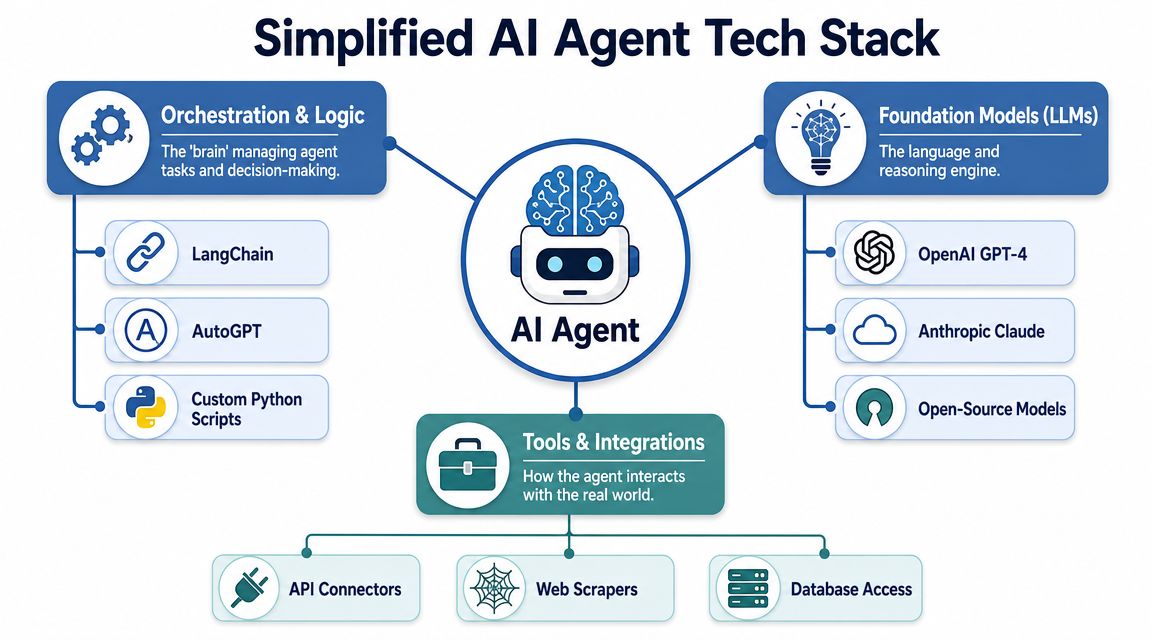
You're not behind. You just need a stack that matches the job. For most founder-led companies, I break it into three layers. The brain, the conductor, and the hands. If you keep those roles clear, tool selection gets a lot easier.
Start with the map.
The brain
This is the model. OpenAI, Anthropic, Gemini, or an open-source option.
My opinion is straightforward. Use stronger models for tasks that require nuance, judgment, tone control, or synthesis. Use smaller, cheaper models for classification, extraction, routing, and formatting.
Don't choose a model based on hype. Choose it based on failure cost.
If the agent is customer-facing and touches revenue, I'd rather pay more for reliability. If it's tagging support tickets or reformatting notes, cheaper and faster usually wins.
The conductor
This is the logic layer that decides what happens next.
Sometimes you need an orchestration framework like LangChain or CrewAI. Sometimes you need a clean Python script with a few conditionals, API calls, and logging. Founders overcomplicate this constantly.
If your first agent has one job, one model call, and a few tool actions, skip the heavy framework. Complexity does not make the system more intelligent. It just gives you more places to debug.
Here's the decision guide I use.
| Framework | Best For | Key Trade-off |
|---|---|---|
| Custom Python scripts | Simple single-agent workflows with clear logic | Less abstraction, more manual setup |
| LangChain | Complex chains, retrieval patterns, and multi-step orchestration | More moving parts to maintain |
| CrewAI | Multi-agent collaboration and role-based task separation | Can be overkill for early-stage use cases |
| No-code automation tools | Fast deployment for operational workflows | Less flexibility when logic gets complex |
If you're evaluating tooling for automation around the agent layer, this roundup of AI workflow automation tools is a useful place to compare options.
A quick visual walkthrough can help if you're sorting this out with a team:
The hands
This layer matters more than most model debates.
The hands are the systems your agent can use. CRM APIs. Google Workspace. Slack. Databases. Internal docs. Web browsing tools. Ticketing systems.
A weak model with the right tools often outperforms a strong model with no access to real business context. That's because useful business work isn't just language generation. It's reading, checking, writing, updating, and handing off inside actual systems.
My opinionated stack advice
For a first agent, I'd usually recommend something like this:
- Model choice: One reliable commercial model for production
- Logic layer: Lightweight orchestration or custom scripting
- Knowledge layer: Internal docs or a clean retrieval setup
- Integrations: Start with the systems that already hold the truth
- Observability: Basic logs, output review, and failure tracking from day one
What I would not do:
- Build a complex multi-agent system before one agent proves value
- Fine-tune a model before you've fixed your context and workflow design
- Add six tools when the agent only needs two
- Assume “autonomous” means “safe without oversight”
One more practical point
A lot of founder-led companies don't need a giant enterprise platform. They need a working operator stitched into their current stack.
That might mean OpenAI or Claude as the brain, Python or n8n as the conductor, and HubSpot, Notion, Slack, and Google Sheets as the hands. It might also mean a more custom implementation through an advisory partner. Samuel Woods offers strategy and deployment guidance for AI agents and autonomous workflows, which is one option if you need help designing the system architecture around your business processes.
Keep it plain. Keep it observable. Keep it tied to a job description.
That's how you build something useful instead of expensive.
The Pilot Phase That Proves ROI
A founder does not need another demo. A founder needs proof.
The only reason to run a pilot is to answer one question. Did this agent move a business metric enough to deserve expansion? If your pilot ends with “the team liked it,” you ran the wrong pilot.
In PwC's May 2025 survey, 66% of executives who had adopted AI agents said they were delivering measurable value through increased productivity, and 35% said AI agents were being adopted broadly across their business. That matters because it shows the path is not pilot forever. It's pilot, evidence, then rollout, as summarized in PwC's AI agent survey.
Pick one metric and make it painful
The metric should be tied to money, speed, or capacity.
Good pilot targets include:
- Lead handling speed: Faster follow-up on inbound demand
- Qualified pipeline support: Better filtering before reps spend time
- Support response time: Faster first touch on common requests
- Founder time recovered: Less executive time spent on repeatable decisions
Bad pilot targets include “quality felt better” or “the team used it a lot.” Usage without impact is noise.
If the pilot can't win budget with one slide, it's too vague.
Run the pilot in a controlled lane
Don't drop the agent into the whole company. Put it in a narrow lane with supervision.
A smart pilot setup usually looks like this:
Choose one workflow
Example: inbound lead triage for one segment.Define the baseline
What happens now, manually?Set the success threshold
What result would justify expansion?Limit access and scope
Keep the blast radius small.Review outputs daily
Catch drift fast.Summarize results in plain business language
Not model language. Business language.
Score the pilot like an operator, not a fan
Use a simple review table.
| Pilot area | What to check |
|---|---|
| Accuracy | Did the agent make the right call? |
| Speed | Did it shorten the workflow? |
| Escalation quality | Did it hand off edge cases correctly? |
| Business impact | Did the workflow improve where it matters? |
If the agent saves time but creates cleanup work, the pilot is not a success. If it drafts quickly but requires constant founder editing, the pilot is not a success. The output has to survive contact with reality.
What founders should present after the test
When the pilot ends, summarize it in three lines:
- What the agent was responsible for
- What changed in the business workflow
- Whether the impact justified broader deployment
That's enough.
You're not trying to impress investors with technical architecture. You're showing that a controlled AI system can amplify results without introducing chaos. Once you have that proof, expansion stops being a speculative project. It becomes an operating decision.
Scaling Without Losing Your Company's Soul
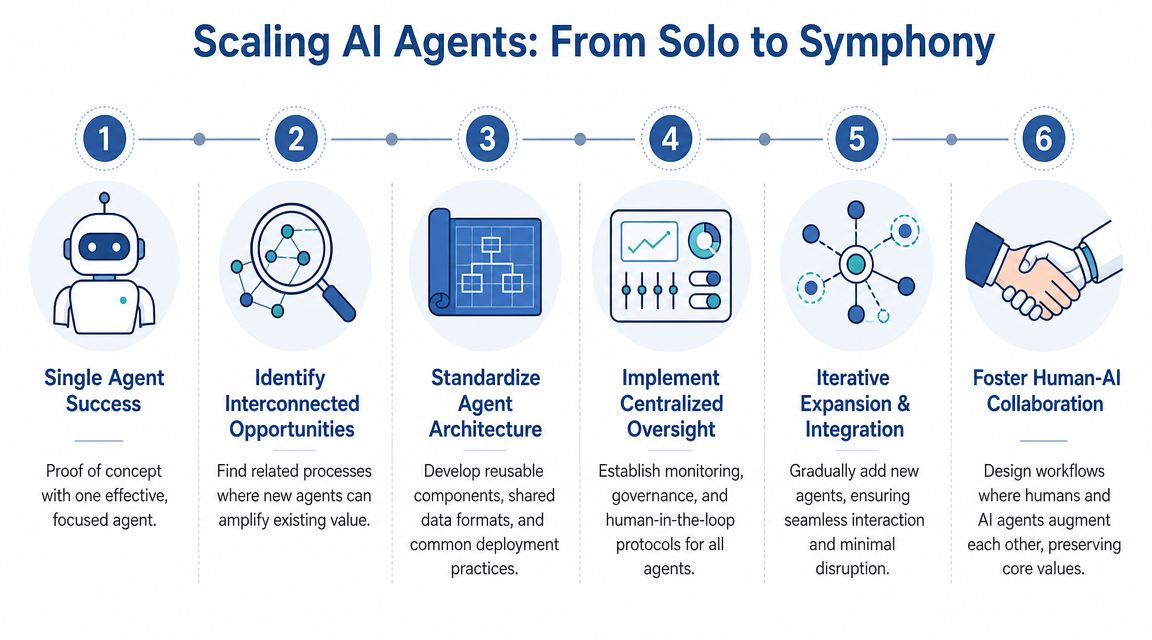
One agent gives you relief. A system of agents gives you a moat.
This is the part founders get wrong when they move too fast. They add agents to marketing, support, ops, and sales without creating shared standards. The result is weird tone drift, conflicting decisions, duplicate logic, and quiet brand erosion.
Keep one source of truth
If multiple agents operate across your business, they should pull from the same core materials.
That means a centralized knowledge layer for things like:
- Brand voice rules: What you sound like, what you never sound like
- Offer logic: Pricing, packaging, qualification, exclusions
- Escalation rules: When humans step in
- Company memory: FAQs, objections, competitor notes, product updates
Without that layer, every agent becomes its own mini-interpretation of the business. That is how founder-led companies lose their edge while thinking they're becoming more efficient.
Use human review where trust is fragile
Not every workflow deserves full autonomy.
I recommend human-in-the-loop review for:
| Workflow type | Review stance |
|---|---|
| Public brand content | Human approval before publish |
| Refunds, credits, exceptions | Human approval on defined edge cases |
| Legal or compliance-sensitive communication | Mandatory human review |
| Strategic outbound to high-value accounts | Human final pass |
This is not a lack of confidence in the tech. It's operational maturity. Some actions are too sensitive to hand over completely.
Scale the machine where consistency wins. Keep humans where trust, taste, or liability matter.
Build feedback loops on purpose
Agents don't improve because you hope they will. They improve because someone reviews output, corrects mistakes, and updates the system.
Your company needs a rhythm for this:
- Weekly output review
- Error tagging
- Prompt and context updates
- Tool permission adjustments
- Knowledge base cleanup
Most long-term advantage arises not from the first build. From the compounding refinement.
A lot of founders are also looking at how agent-driven operating models affect recurring revenue and product expansion. If you're thinking beyond internal efficiency and into monetization design, this piece on Replit Agent ARR growth strategies is worth reading because it shows how agent capabilities can shape the revenue model itself.
Protect the founder voice
If your agents write emails, proposals, content, or support messages, brand voice can drift fast unless you lock it down.
I'd document:
- Preferred sentence style
- Words and phrases you use often
- Words you never use
- Tone by context
- Examples of strong and weak outputs
- Rules for confidence, humility, and escalation
Founder-led companies often underestimate how much trust is carried in tone. Customers feel the difference between “helpful and sharp” versus “generic and synthetic” even if they can't articulate it.
The real control playbook
If you want to scale without losing the company's magic, do these four things:
Standardize agent architecture
Shared prompts, shared schemas, shared logic patterns.Centralize knowledge
One source of truth beats five clever workarounds.Review high-risk outputs
Put humans where consequences are highest.Train the system continuously
Your moat is not the model. It's the accumulated business context and the operating discipline around it.
That's the founder's advantage. You already know what great looks like. Your job isn't to hand that over. Your job is to encode it so the company can act with your judgment at a larger scale.
If your company still depends on you to make every meaningful call, you don't have a scale problem. You have a replication problem.
AI agents for founder led companies solve that when they're built with discipline. Start with one high-friction workflow. Give the agent a real job description. Keep the stack simple. Pilot it against a business metric. Then scale with governance, shared memory, and hard boundaries.
That's how you grow without diluting what made the business work in the first place.