Let's be blunt. AI for business automation is a land grab happening right now, and your competitors are already staking their claims. You can't just "keep an eye on" it. They’re using AI to run leaner, move faster, and make smarter decisions.
While you're debating, they're building moats around their market share.
Your Competitors Are Already Weaponizing AI
I’ve been in the trenches building with machine learning since 2016 and generative AI since 2019. Long before the hype. What I'm seeing now is a sprint. Companies that operationalize AI get more efficient, and they also rewrite the rules of the game.
The core idea is simple: use intelligent systems to execute repetitive work at a scale humans can't match. This frees up your best people for strategy, innovation, and relationships that actually grow your business. Anything less is leaving money on the table.
Think of this guide as your playbook. I'm skipping the buzzwords and going straight into revenue-focused applications. You'll move from tinkering with ChatGPT to building systems that give you and your team a decisive edge.
From Manual Work To Market Share
The gap between the AI-enabled and the AI-laggard widens daily. Right now, your competition is using AI to:
- Automate lead qualification, so their sales team only talks to prospects ready to buy.
- Generate personalized marketing content at scale, hitting thousands of customer segments with surgical messaging.
- Resolve over 50% of customer support tickets without any human touching them, cutting costs and boosting satisfaction.
Saving a few hours is the small part. The bigger part is seeing opportunities your manual processes are blind to. For a clear example, see how companies are turning cost centers into strategic weapons through AI in accounting.
The question is no longer "should we use AI?" The only question that matters now is "how fast can we deploy it and pull ahead?" Inaction is the single greatest risk to your business.

Where AI Is Being Deployed Right Now
Smart companies don't sprinkle AI around randomly. They focus their firepower where it delivers the biggest punch. The latest data reveals a clear pattern of weaponizing AI in core operational areas to gain a decisive edge.
Here’s a snapshot of where the smart money is going. A clear focus on functions that directly impact customer experience and operational efficiency.
Where AI Is Being Deployed In 2026
A snapshot of current AI adoption rates across business functions, revealing the aggressive focus on core operational areas.
| Business Function | Adoption Rate | Primary Use Case |
|---|---|---|
| Customer Support | 78% | Automated ticket resolution & routing |
| Marketing & Sales | 71% | Content personalization & lead scoring |
| Operations | 65% | Supply chain optimization & forecasting |
| Finance & HR | 59% | Invoice processing & talent screening |
| IT & Security | 52% | Threat detection & network monitoring |
Here is a real case. For one B2B SaaS company I worked with, I built a "content engine" that took one webinar and automatically turned it into 10 social posts, two blog articles, and three email newsletters. Their content output increased by 400% with the same team.
Another e-commerce brand deployed an AI agent to monitor competitor pricing in real-time. The agent reported the data and also automatically adjusted their store’s ad spend and promotions. The result: a 17% lift in gross margin in a single quarter.
Your goal is to build these kinds of systems.
Where to Deploy AI First for Maximum ROI
The biggest mistake I see is spreading an AI budget too thin. This "peanut butter" approach guarantees high costs and zero meaningful return. To win, you and I need to be surgical. Forget vanity projects. Focus on impact.
Your goal is to find the points in your business where automation pays off most. The bottlenecks where AI for business automation can deliver the quickest, most substantial returns. The repetitive, data-heavy tasks eating up your team's time.
The High-Value Target Framework
To find these opportunities, you need a simple framework. Analyze your core business functions through the lens of pain and potential. Where does the most friction exist?
In marketing, how much time do you spend on manual content repurposing, A/B tests, or segmenting email lists? An AI agent can turn a webinar into a dozen assets in minutes. This is market saturation.
In sales, your best closers should be talking to qualified prospects, not digging through a CRM. An autonomous agent can score inbound leads, enrich their profiles, and tee up only the hottest prospects for your team.
In customer support, look at your support tickets. How many are simple, repetitive questions? An AI agent trained on your knowledge base can resolve over 50% of these instantly, 24/7. This frees your human experts for complex issues.
In operations, are you drowning in manual data entry from invoices or contracts? Intelligent Document Processing (IDP) can pull and validate this information, wiping out errors and saving hundreds of hours.
This exercise gives you a shortlist of high-value targets. Then you can prioritize.
The rule is simple: start with the problem that has the highest business value and the lowest implementation complexity. Get a quick win, prove the ROI, and reinvest your gains into the next target.
From Tactical Wins to Strategic Advantage
This surgical approach creates momentum. Each automated process becomes a "bionic" system, augmenting your team's ability to execute. While competitors are stuck in meetings debating AI, your bionic teams are already executing faster.
The shift is happening now. A full 92% of large businesses now treat AI as a top priority. You can explore more on how this is changing the game in Redwood's latest AI trends forecast.
The key is to move from automating tasks to orchestrating outcomes. Go past automating email sends. Build a system where an AI agent analyzes campaign performance, identifies the best-performing copy, and automatically generates new variants. To see platforms that can help, check my breakdown of the top AI workflow automation tools.
Your first successful deployment is your proof of concept. It shows that this tech builds a leaner, faster, more formidable business.
The Architecture of an AI Automation Engine
Let's get technical, but only in a way that matters to your bottom line. An effective AI automation system is an architecture you build to sense the market, make decisions, and act faster than everyone else. You can't buy it off the shelf.
Connecting a few apps gets you a toy. You and I are going to build something that runs part of your business.
The framework I use for prioritizing AI projects looks like this. It’s a deliberate process that moves from identifying high-impact opportunities to building teams that are part human, part machine: bionic teams.
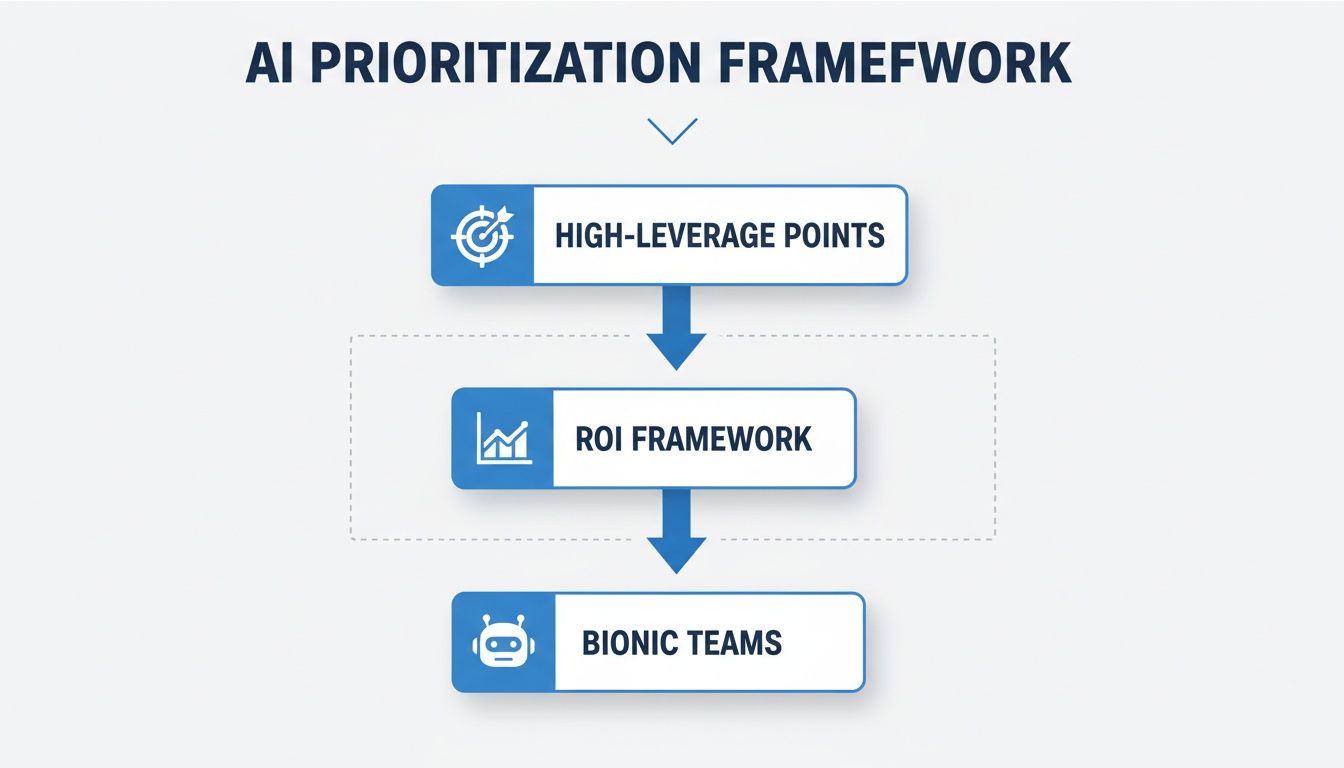
This structure ensures every piece you build is tied to a measurable business outcome rather than a cool feature.
The Three Core Layers
A powerful AI for business automation engine has three distinct layers. When they work in concert, they create a flywheel of autonomous execution. Get these three right, and you've built something your competitors will struggle to copy.
First comes the data ingestion layer.
Think of this as your engine's sensory system. Its job is to feed the machine a constant stream of fresh, relevant data. Real-time market signals, customer behavior, support tickets, CRM updates. Your engine is only as smart as the data it eats.Second comes the reasoning and orchestration layer.
This is the brain. It takes all that raw data and decides what to do. At the core, you’ll use a powerful Large Language Model (LLM) as the central orchestrator. Its purpose is to understand context and delegate tasks. It doesn't do the work itself.Third comes the action layer.
This is where the rubber meets the road. The action layer is your digital workforce of specialized AI agents. Small, autonomous programs that execute specific tasks. They execute the orchestrator’s commands with precision, 24/7.
An AI automation engine is an integrated system where data flows in, a central brain reasons, and a team of AI agents executes tasks to achieve a business goal.
Platform vs. Custom Stack: The Critical Trade-Off
Now for the million-dollar question: pre-made platforms or a custom stack? There’s a critical trade-off here.
No-code platforms like Zapier and Make are fantastic for getting started. You can get a valuable automation running in an afternoon. Their limitation is control and depth. You're working within their constraints.
A custom stack gives you ultimate power. You can create highly specialized agents and design workflows that perfectly match your business. The trade-off is complexity and cost. You need skilled engineers.
My advice? Start with platforms. Prove the value, measure the ROI. Once you hit the ceiling of those tools, you'll have the business case to justify building a custom stack.
Real-World Examples of AI Agents Driving Growth
Theory is cheap. Results are what matter. Let's look at how AI for business automation translates into cold, hard numbers: revenue, margin, and market share.
These are real results from companies I've worked with, stripped of identifying details but with the numbers intact. This is the impact you should aim for.

E-commerce Margin Expansion
A direct-to-consumer brand was locked in a price war. Their team spent hours manually tracking competitor sites, always a step behind. A losing battle that was eating their margins.
I deployed a "Competitor Intelligence Agent." It monitored competitor websites in real-time (prices, promotions, shipping thresholds). When a competitor changed a key offer, my agent automatically adjusted my client's Google Ads spend to launch a counter-offer within minutes.
The result was a 17% lift in gross margin in one quarter. They captured sales they would have lost and avoided costly, panicked discounting. While competitors were in meetings, this brand's AI agent was winning the war. See more on how AI Sales Agents can transform stores by increasing conversions 24/7.
B2B Content at Scale
A B2B SaaS company had a brilliant marketing team, but they were also a bottleneck. They produced one great webinar a month but struggled to repurpose it. Manual effort limited their content's shelf life.
I built a "Content Engine Agent." The webinar video and transcript were fed to the agent. It autonomously generated a 1,500-word blog post, five short-form video scripts, ten LinkedIn posts, and three distinct email newsletter angles.
As a result, the marketing team’s content output increased by 400% with the same headcount. They led their niche on social and search. Lead velocity from organic channels tripled in six months.
This shows the power of AI as a force multiplier. It made the marketing team far more productive, and nobody was replaced. It freed them to focus on strategy instead of repetitive tasks.
Service Business Onboarding Automation
A professional services firm struggled with client onboarding. The manual process took an average of five business days and involved endless back-and-forth emails. Slow, error-prone, and a poor first impression.
I implemented an "Onboarding Concierge Agent." This AI system guided new clients through a conversational interface. It collected information, validated documents, answered common questions, and scheduled the kickoff call without human intervention.
As a result, client onboarding time was slashed from five days to just four hours. Administrative errors were cut by 95%. This saved hours and dramatically improved client satisfaction scores from day one. To learn more, check my overview of key AI agent use cases.
How to Measure ROI and Govern Your AI Systems
If you can’t measure it, you can’t manage it. Deploying AI for business automation without a rock-solid ROI and governance framework is like flying a jetliner blind. It’s reckless.
Too many owners get seduced by vanity metrics like "tasks automated" or "hours saved." Amateur hour. Hours saved matter far less than margin improvement and market share captured.
Moving Beyond Vanity Metrics
You and I need to establish KPIs that directly connect to the financial health and competitive posture of your business. Hard numbers.
Instead of tracking "tasks automated," measure things like:
- Cost per lead reduction, meaning how much your AI-powered lead qualification system cut your CPL.
- Sales cycle velocity, meaning how many days your automated follow-up agent cut from the time between contact and close.
- Customer lifetime value increase, meaning how your personalized onboarding agent changed the LTV of new customers.
These metrics speak the language of business growth. You have to measure them correctly. Learn more in my guide on how to measure marketing effectiveness.
Before you build anything, articulate this sentence: "We are investing $X into this automation to achieve Y measurable business outcome, and we will know we are successful when we see Z change in this specific KPI."
Simple ROI Calculation Before You Build
Here's a simple framework I use to calculate potential ROI before you commit resources.
First, calculate the "cost of inaction" by quantifying the annual cost of the manual process. Include fully loaded salaries, software costs, and the cost of errors. For example: 2 team members * 10 hours/week * $50/hr * 52 weeks = $52,000/year.
Next, estimate the automation investment by tallying the one-time build cost and ongoing operational costs. For example: $5,000 build + $200/month * 12 = $7,400/year.
Then project the return, which is the cost of inaction minus your investment. In this case, the net return is $44,600 in the first year. A clear business case.
Governance: The Non-Negotiable Guardrails
Now for the part that separates the pros from the cowboys: governance. As your AI agents become more autonomous, you need guardrails. Without them, you're building a powerful engine with no brakes.
AI adoption keeps rising. Zapier's latest data shows 88% of companies now use AI in some capacity. With that power comes responsibility.
Your governance framework must include these three non-negotiables:
- Data privacy and security come first. Where is your customer data going? Who has access? You need ironclad policies for how AI systems handle sensitive information. Period.
- Ethics come next. Are your agents programmed to operate within your company's ethical boundaries? Explicitly define what they can and cannot do.
- Keep a human in the loop. For critical decisions, like spending large amounts of money, you must maintain a "human in the loop" for final approval. Treat it as a critical safety mechanism.
Your Questions About AI Business Automation Answered
Let's tackle the tough questions head-on. Committing to AI for business automation is a serious decision. These are the most common concerns I hear from founders and small business owners, answered with no-hype insights from the trenches.
How Much Does AI Automation Cost to Implement?
Frankly, you're asking the wrong first question. The right question is, "What's the cost of inaction?" When your competitors are getting faster and smarter, standing still is the most expensive move you can make.
That said, the investment varies. You can start for a few hundred dollars a month using platforms like Zapier or Make. Hook up an API key from OpenAI or Anthropic, and you can build simple, high-impact automations.
A custom AI agent system might be an initial investment in the low five figures. But the focus must always be on ROI. A $10,000 investment that saves $100,000 in labor or generates $200,000 in new revenue is an undeniable win. Start with one high-value project, prove the ROI, and reinvest your gains.
Will AI Automation Replace My Team Members?
No. It will make your best people better, and it will get rid of the parts of their jobs they hate anyway. This is the biggest fear I run into, and it comes from a deep misunderstanding of this technology.
AI is terrible at strategy, creative thinking, and building human relationships. It’s brilliant at executing repetitive, data-heavy tasks at a speed humans can't touch.
The goal is to create "bionic" teams. The AI handles the grunt work (sifting data, generating reports), which frees up your talented people to focus on strategy, closing deals, and delighting customers.
Companies that use AI only to cut headcount will be outmaneuvered by those who use it to augment their team’s capabilities. Your best people get much more done.
What Is the Biggest Risk in AI Automation?
The biggest practical risk is building a "black box": an automation you don't understand and can't control. Forget the robot uprising. This happens when you automate without clear monitoring and strong guardrails.
Imagine an AI agent emailing your entire customer base with the wrong discount. Or a pricing agent getting caught in a downward spiral with a competitor's bot. These are real risks, but they are completely manageable.
You avoid this disaster in two ways:
- Start with low-risk processes. Don't automate your payroll on day one. Start with internal reporting or drafting social media content, where a mistake is minimal.
- Implement rigorous logging and monitoring. You absolutely need to see what the AI did, why it did it, and have an immediate "off-switch." Every autonomous system I build comes with a manual override.
Do I Need a Team of Data Scientists to Get Started?
Not anymore. Five years ago, the answer was a hard yes. Today, that barrier has almost completely disappeared.
That changed thanks to powerful APIs from companies like OpenAI and Anthropic. You have world-class reasoning on tap. Orchestration platforms allow a skilled engineer to build powerful automations without training a custom model from scratch.
Today the key skill is context engineering, more than machine learning: the art of feeding the right data to the right model at the right time to get the business outcome you want. If you can clearly map out a business process, you have the most important skills needed to start winning with AI automation today.