Most advice on sales funnel optimization is too shallow to be useful. It tells you to tweak landing pages, test CTA colors, and “nurture leads” harder. That's maintenance dressed up as strategy.
I've been building ML systems since 2016 and working with generative AI since 2019. The companies that win treat the funnel like an operating system for revenue rather than a marketing diagram. Measurement, routing, scoring, content, handoffs, attribution. All connected. All accountable.
If your funnel feels unpredictable, traffic is rarely the cause. Usually your model of how buyers move is wrong, your instrumentation is weak, and you're making decisions from partial data. In a privacy-restricted environment, that gets expensive fast.
Table of Contents
- Your Funnel Is Broken Because Your Model Is Wrong
- How to Build Your Funnel Diagnostic Toolkit
- Designing CRO Experiments That Actually Work
- Winning When You Cannot Track Everything
- From One-Off Wins to a Scalable Growth Engine
Your Funnel Is Broken Because Your Model Is Wrong
The classic funnel graphic is neat, simple, and dangerous. It makes people think buyers move in a straight line from awareness to purchase. They don't. They loop, stall, compare, disappear, re-enter, and drag colleagues into the process halfway through.
That old picture creates bad decisions. Teams obsess over top-of-funnel volume, stare at blended conversion numbers, and miss the actual leak. Sales funnel optimization became a real growth discipline because teams started measuring stage by stage, looking at conversion rates, timestamps, and prospect attributes across each transition instead of treating revenue as a black box, as outlined in this explanation of sales funnel analysis.
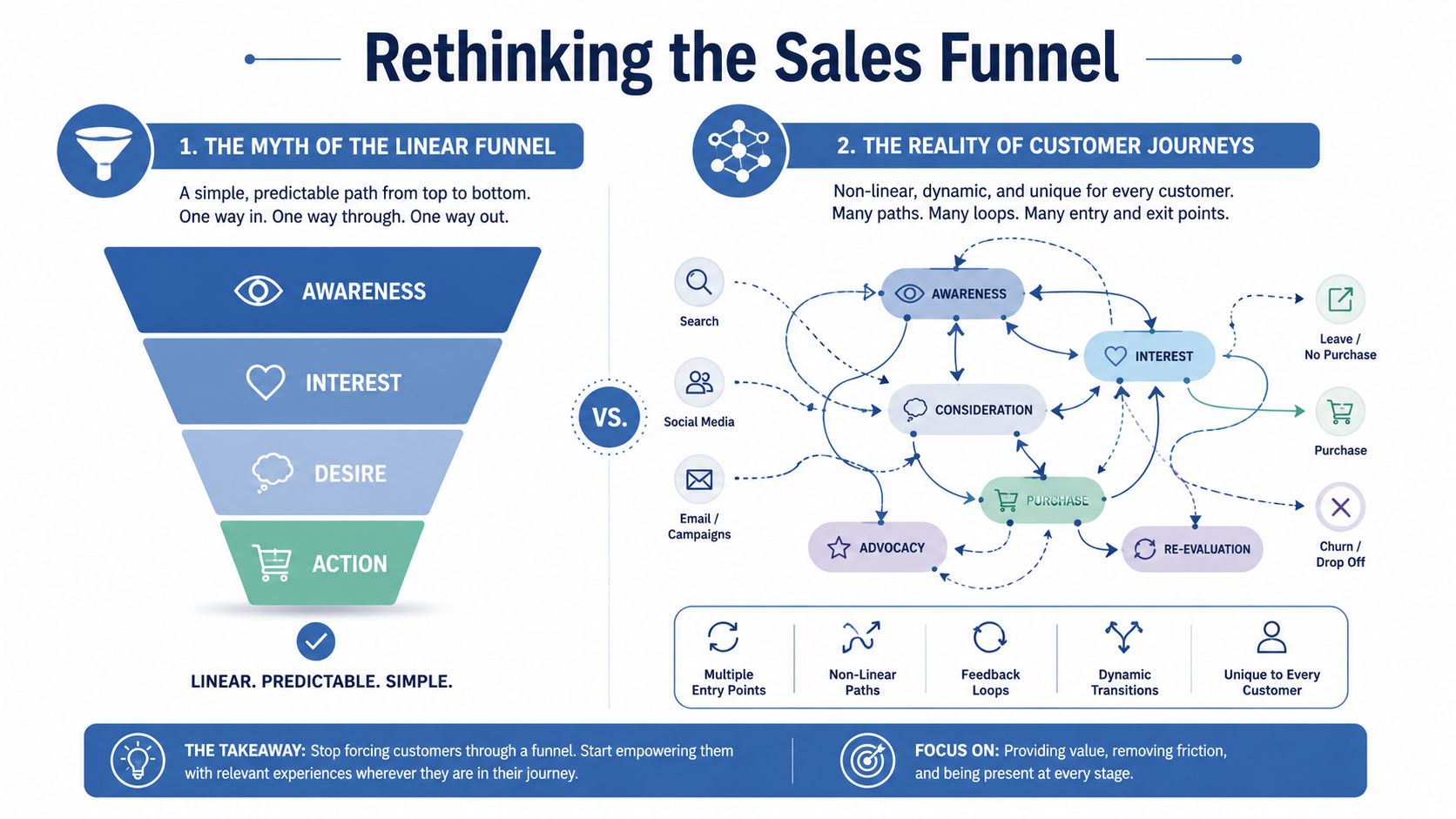
The diagram is lying to you
I model funnels as state transitions. A prospect moves from one state to another, and each move has a probability. That's a machine-learning way to think about growth, and it's more useful than a poster on the wall.
Your job is to improve the probability of the next valuable transition. “Improve the funnel” in the abstract means nothing.
If you can't name the transition that failed, you're guessing.
That means you stop watching only total leads and total revenue. You start watching traffic volume at each stage, conversion rates between stages, and the revenue conversion rate. Then you can isolate bottlenecks and test fixes like better messaging, lower friction, and faster handoffs.
If you run ecommerce, the mechanics are different but the principle is identical. A practical ecommerce conversion funnel guide is useful because it forces you to inspect the path step by step instead of admiring aggregate numbers.
The five states that matter
I prefer five operational states because they map cleanly to both SaaS and service businesses.
Awareness
Ask one question. Are the right people entering the system, or are you buying noise? Bad awareness creates fake pipeline and wastes sales capacity later.Acquisition
In this stage, a stranger becomes a known lead. The question is whether your capture mechanism attracts intent or just curiosity. Qualified entry is the point. Form fills alone prove little.Activation
This is the overlooked stage. Has the prospect experienced enough value to take a meaningful next step? Demo completion, trial setup, pricing engagement, or a booked call can all serve here depending on the model.Retention
Often, organizations exclude this from the funnel and then wonder why growth feels fragile. If customers stall, churn, or never expand, your acquisition engine is carrying too much weight.Revenue
Closed revenue is the output, not the diagnostic. By the time a deal is won or lost, the causal problems usually happened much earlier.
Here's the shift I want you to make. Stop asking, “How's our funnel doing?” Start asking, “Which transition is weakest, why, and what intervention changes that probability?”
If you want a cleaner way to think about attribution across those transitions, I've written about multi-touch attribution models in the context of real buyer journeys, not fantasy diagrams.
How to Build Your Funnel Diagnostic Toolkit
Dashboards do not fix funnels. Systems do.
If your reporting stack cannot answer three questions fast, it is dead weight. Where are buyers stalling? Which inputs create qualified progression? What should the team change this week to raise revenue? Build your toolkit to answer those questions, not to satisfy a Monday meeting.
Start with instrumentation. In a cookieless market, you will not get perfect attribution, so stop designing for perfection. Design for decision-making. That means clean event tracking, shared stage definitions, CRM discipline, and a clear record of transition points across marketing, sales, and customer success.
Track transitions, time, and friction
A useful funnel diagnostic setup measures movement between stages, the time spent in each stage, and the friction that blocks the next action. Traffic alone will not tell you why pipeline quality is weak. Lead volume will not tell you why sales is chasing junk. You need a system view.
For process mapping, I like pairing behavioral data with a visual path review. If your team struggles to document how users and leads move, Uxia's user flow diagram insights help expose dead ends, loops, and unnecessary steps before you waste time optimizing the wrong page, form, or handoff.
Here is the table I'd keep open if I were running the funnel myself.
| Funnel Stage | Key Metric | Diagnostic Focus | AI Optimization Angle |
|---|---|---|---|
| Awareness | Qualified traffic entering target pages, campaigns, or outbound sequences | Whether the right accounts and roles are entering the system | Use AI clustering to separate high-intent queries, audiences, and placements from noise |
| Acquisition | Visitor-to-lead and lead qualification rate | Whether capture points attract intent or casual interest | Use AI enrichment, routing, and intent tagging before SDR review |
| Activation | Lead-to-meeting, trial-start, demo-complete, or pricing-engaged rate | Whether prospects reach a meaningful value moment fast enough | Use AI assistants to tailor follow-up by role, behavior, and objection pattern |
| Retention | Product usage, renewal risk, expansion signals, support friction | Whether customer value is strong enough to protect and grow revenue | Use AI summaries across CRM, support, and product data to flag stall risk early |
| Revenue | Opportunity progression, deal velocity, stage aging, win-loss patterns | Whether pipeline is advancing with the right urgency and deal quality | Use AI deal inspection to spot missing stakeholders, weak next steps, and recurring objections |
The missing metrics matter as much as the included ones. Raw impressions, click spikes, and social screenshots do not belong on the core diagnostic view unless they explain a downstream change in progression.
Optimize the earliest weak transition with enough volume to matter. Improvements there compound across the rest of the system.
Build one operating dashboard
I want one shared view with five blocks, one for each funnel state. Every block should show stage volume, transition rate to the next stage, average time in stage, top entry sources, and the common traits of records that progress.
Then add an exceptions panel. That panel should surface stalled leads, slow sales follow-up, campaigns producing poor-fit traffic, broken automations, and segments with abnormal drop-off. Operators make money in the exceptions, not in the averages.
A few hard rules:
- Use one stage taxonomy, because if marketing and sales define qualification differently, your reporting is fiction.
- Capture timestamps on every key event, because delay kills conversion, and you cannot find delay without clean event timing.
- Show attribution with confidence levels. In a cookieless environment, directional truth beats false precision.
- Segment by source, role, offer, and sales owner, since averages hide the leaks that matter.
- Log handoffs between systems so that form fills, CRM creation, routing, meeting booking, and pipeline updates all leave a trace.
If you need a practical model for the reporting layer, I break it down in this guide to marketing analytics dashboards for revenue teams. Build the dashboard to trigger action. If it does not change prioritization, routing, or follow-up, it is reporting theater.
One more rule. Your toolkit should expose irrelevance early. Generic outreach, weak qualification, and slow response poison conversion long before a quarter shows the damage. The point of the system is to catch that failure while you still have time to fix it.
Designing CRO Experiments That Actually Work
Most CRO work is cosmetic. Teams test button labels while the underlying issue is that the offer is weak, the response is slow, or sales is chasing the wrong accounts.
I care about experiments that change buyer behavior, not page aesthetics. Strong sales funnel optimization means testing the mechanics of progression. Message fit. Response speed. Prioritization. Those are key areas.
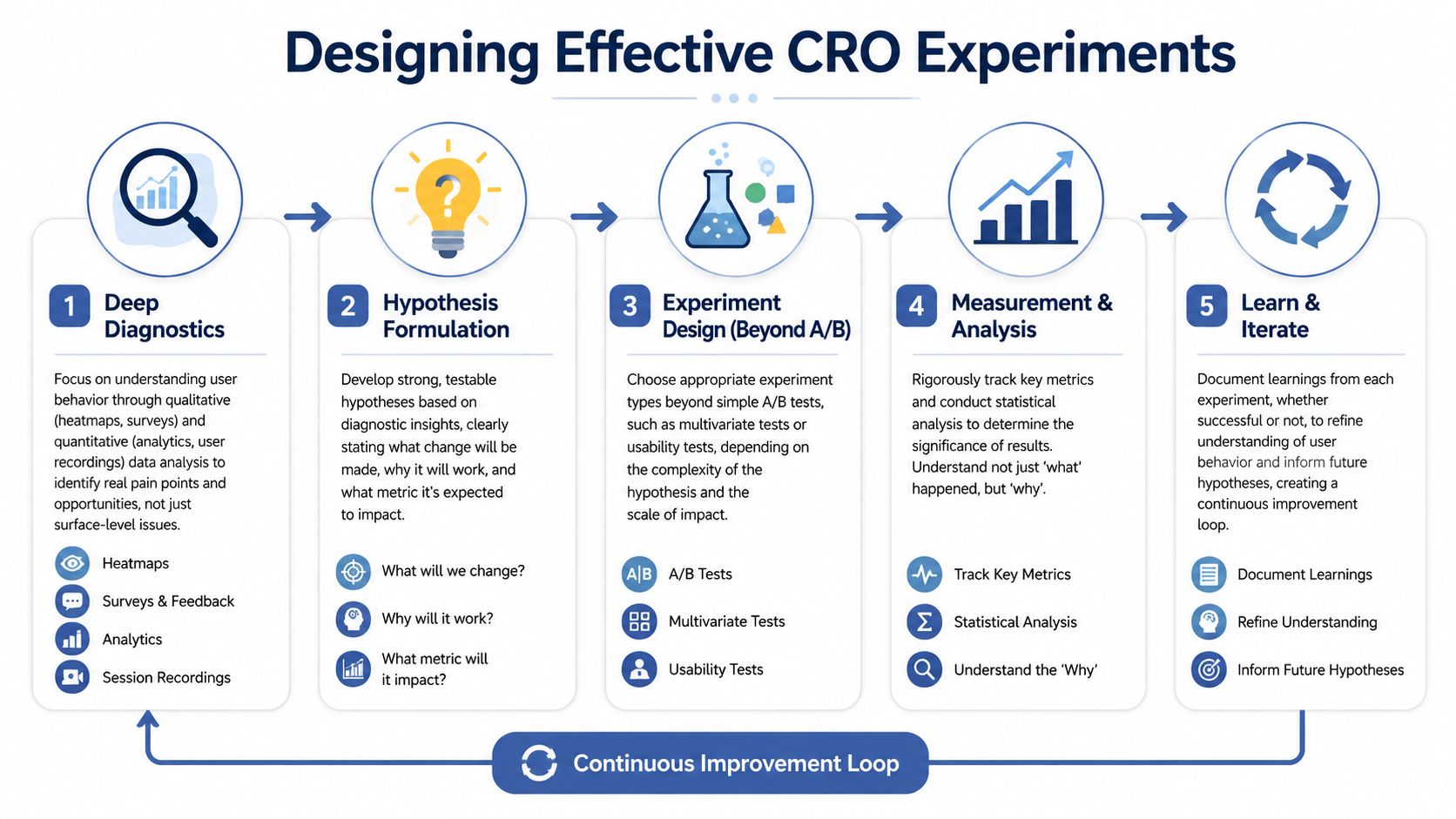
If your team needs a sanity check on test design, A/B testing best practices are worth reviewing because they push you toward clean hypotheses and meaningful variables instead of random tweaks.
Experiment one with AI messaging variation
Start at the landing page or high-intent email that feeds your pipeline. Don't ask AI to write “better copy.” Give it a job.
I'd create three message families based on distinct buyer motives. Pain reduction. Speed to outcome. Risk reduction. Then I'd use a prompt framework that forces the model to reflect the prospect's role, industry language, and stage-specific objections.
This is where AI earns its place. It can generate structured variants fast, but you still need a human operator to reject generic fluff. If you test only surface phrasing, you'll learn very little. If you test message angle against a meaningful transition, you'll learn what value proposition moves buyers.
Use this sequence:
- Pull objections from real calls by mining Gong, HubSpot notes, support tickets, or sales emails.
- Generate constrained variants with a different angle but the same audience and offer.
- Test on one stage event, such as a demo request, pricing click, or qualified form completion.
- Feed results back into CRM routing, so winning messages also shape ad copy, SDR outreach, and nurture content.
Experiment two with response-time automation
This one is brutally underused. A major shift in modern funnel operations is the move from generic follow-up to fast, data-driven intervention. Guidance now recommends internal SLAs for first-touch response, with an acknowledgment in as little as 5–15 minutes according to this sales funnel optimization guidance.
That doesn't mean your rep needs to write a custom essay in five minutes. It means the system acknowledges intent immediately, routes context to the right owner, and serves the next best asset while the human steps in.
Slow response is a systems problem as much as a sales problem.
A simple implementation looks like this:
- Trigger instantly, so a form submission, pricing visit, or demo completion fires a workflow in HubSpot, Salesforce, or ActiveCampaign.
- Send a context-aware first touch that references the page, asset, or use case that triggered the inquiry.
- Assign based on fit, such as territory, account size, product line, or industry.
- Escalate if idle. If no human follow-up lands inside the SLA, the workflow re-routes.
I've seen teams obsess over persuasion when the actual bottleneck was delay. Fix the lag first.
For operators building this into a broader experimentation program, my conversion rate optimization checklist covers the operational side.
Experiment three with lead scoring that sales will actually use
Most lead scoring dies because it's either too simple or too academic. “Visited the blog” gets points. “Downloaded a PDF” gets points. Sales ignores it because none of it reflects buying reality.
Build a pragmatic model instead. Mix firmographic fit with behavior that signals movement toward decision. Not all engagement is equal. Rewatching product content, sharing assets internally, returning to pricing, and replying to outreach matter more than random content consumption.
Keep it lightweight at first:
- Fit signals such as industry, company profile, and role relevance.
- Behavior signals such as high-intent pages, repeat visits, and asset consumption tied to solution evaluation.
- Decay logic, so older signals matter less than fresh ones.
- A rep feedback loop, so that when sales says “these leads are junk,” you update the model.
You can use a spreadsheet, a CRM score field, or a simple model layer. The key is adoption. If the output doesn't change rep behavior, what you have is decoration.
One practical option in this category is to work with me directly. My work focuses on AI-assisted prompt systems, automation, and market-intelligence workflows that can feed better scoring and routing decisions. The broader point stands whether you use custom workflows, HubSpot AI, Salesforce, or your own stack.
Winning When You Cannot Track Everything
A lot of marketers are still acting offended that tracking got harder. That reaction is useless. The environment changed. Your competitors who built lazy funnels on top of easy third-party data are exposed.
Google has confirmed the phaseout of third-party cookies in Chrome and the shift toward more privacy-preserving measurement. That matters because traditional last-click style attribution loses signal quality in this environment, which is why optimizing with sparse first-party data, offline conversions, and experiments has become a core skill, as explained in Adobe's sales funnel overview.

The cookieless shift is an opening not a disaster
If you can't track every touch, stop pretending you can. Build a system that respects partial visibility and still gets smarter.
That starts with first-party data. Forms. CRM events. Product usage. Email engagement. Sales notes. Call outcomes. Support conversations. Renewal activity. These are messy, but they're yours.
Then clean up the collection layer:
- Use server-side event capture where appropriate to reduce dependence on brittle browser-side scripts.
- Collect zero-party data intentionally. Ask buyers what they care about instead of inferring everything from pageviews.
- Unify offline and online events, because closed-won notes, calls, meetings, and pipeline changes belong in the same operating view.
- Tag experiments clearly. If you can't identify who saw which treatment, don't run the test.
You do not need perfect attribution to make strong decisions. You need a system that combines enough evidence to act with confidence.
What to do when the path is incomplete
In this context, AI helps, but not in the magical way vendors pitch it. AI is useful for pattern detection across fragmented records. It can summarize conversations, classify intent, detect objections, and surface combinations of behaviors that correlate with progression.
What it can't do is create truth from missing data. You still need operating discipline.
I use a simple hierarchy for proof:
- Direct evidence from first-party events and CRM changes
- Correlated evidence from grouped behaviors and source patterns
- Experimental evidence from holdouts, geo tests, offer tests, or timing changes
- Qualitative evidence from calls, demos, and lost-deal review
That stack is stronger than overconfident last-click reporting.
A good quick primer on how to rethink the problem is below. Watch it with one question in mind. What can your team prove well enough to budget confidently, even if the full path stays hidden?
The companies that win here don't chase omniscience. They build resilient measurement. That gives them an edge because competitors keep making spend decisions from weaker assumptions.
From One-Off Wins to a Scalable Growth Engine
Random wins do not scale. Systems do.
Sales funnel optimization starts paying real money when you stop treating it like a string of isolated tests and start treating it like revenue infrastructure. One headline that lifts conversion for a month is a small prize. The real goal is a machine that captures cleaner signals, routes leads better, learns faster, and makes the next decision easier than the last one.
That requires operating cadence.
Build a review cadence
Run weekly reviews for execution issues, monthly reviews for funnel design issues, and quarterly reviews for resource allocation and channel mix. Keep those meetings disciplined. If every review turns into storytelling, the funnel stays stuck.
Use the same sequence every time. Check data quality first. Then inspect stage movement. Then review active experiments. Then decide what gets standardized in automation, what gets cut, and what needs another test.
Start upstream. A weak early-stage conversion point usually deserves attention before a late-stage tweak because every gain at the top improves the math for the rest of the system. Teams that skip this and obsess over bottom-of-funnel cosmetics end up polishing a broken intake process.
I keep the agenda tight:
- Stage health, meaning which transition rate dropped and in which segment.
- Sales velocity, meaning where time-in-stage is increasing.
- Pipeline quality, meaning whether more leads are entering the funnel but fewer are reaching qualified pipeline.
- Experiment outcomes, meaning what changed, what held, and what should become standard process.
- System updates, meaning which win gets turned into CRM logic, AI prompts, scoring rules, or routing automation this week.
Turn experiments into institutional memory
A team without documentation repeats expensive mistakes. A team with documentation compounds knowledge.
Store every experiment in one place. Include the hypothesis, audience, stage, offer, creative or script, routing logic, result, and rollout decision. Add the ugly details too. What broke in ops. Which segment misfired. Which dependency slowed launch. Those notes save more money than the result summary.
I also recommend a separate log for automation changes. If AI is scoring leads, summarizing calls, drafting follow-up, or triggering nurture paths, track those changes with the same rigor as campaign tests. Otherwise you end up with hidden logic shaping pipeline quality, and nobody remembers why it was put there.
A few rules I enforce with clients:
- Standardize what wins. If a message, qualification path, or handoff pattern works, build it into the CRM and sales process immediately.
- Audit handoffs every month. Marketing-to-sales and sales-to-success gaps kill revenue because accountability gets blurry.
- Track decision rules as well as outputs. Knowing that conversion improved is useful. Knowing which trigger, threshold, or prompt caused it is what makes the improvement repeatable.
- Use AI as part of the operating system. Let it classify calls, flag stalled deals, route leads, and summarize objections. Do not bolt it on as a novelty tool.
- Judge the funnel by revenue efficiency. More leads mean nothing if acquisition cost rises, close rates fall, or cycle time stretches.
This matters even more in a cookieless market. You will not see every touchpoint. Fine. Build a growth engine that can still act on first-party signals, sales feedback, controlled tests, and workflow data inside your CRM. That is how serious operators get through attribution chaos. They stop asking for perfect visibility and start building a system that improves despite incomplete tracking.
Build the funnel like an operating system for revenue. Then every test, automation, and sales interaction makes the whole machine smarter.
That is the shift I push hard. Funnel as system, not campaign. Once you build it that way, AI stops looking like extra software and starts doing its real job. It helps your team detect patterns, make faster decisions, and scale what works before competitors catch up.