
Sales pipeline management means keeping only qualified opportunities and moving each one forward only when the buyer commits to a next step. For a solopreneur, that means six stages with clear exit criteria, a qualification note built from buyer evidence, automated checks for stale deals, and a weekly review of coverage, conversion, stage age, next-action rate and response time.
The popular advice is to keep filling your sales pipeline until it looks too large to fail. I've built systems that followed that advice. They produced impressive dashboards, long opportunity lists, and very little dependable revenue.
For a solopreneur, pipeline bloat has a direct cost. Every stale opportunity competes with a real buyer for your attention, every vague stage makes your forecast less useful, and every forgotten follow-up turns paid acquisition into wasted effort. My approach to sales pipeline management is tighter: qualify hard, define every stage as a decision gate, automate the maintenance, and review only the signals that can change what you do this week.
The systems below are designed for an owner-operator using a CRM, an automation tool, and an AI model. You don't need a sales department. You need a pipeline that tells the truth.
Table of Contents
- Why More Pipeline Does Not Mean More Revenue
- Building Stage Definitions That Actually Work
- The Metrics That Predict Revenue
- Automating Pipeline Hygiene with AI Agents
- Where Pipeline Systems Break and How to Fix Them
- Weekly Reviews That Compound Into Predictable Revenue
Why More Pipeline Does Not Mean More Revenue
The assumption that more opportunities create more revenue fails when the opportunities aren't qualified. RAIN Group's 2026 research found that 47.2% of respondents said qualified opportunities had increased over the previous 12 months, while organizations still struggled to turn that increase into wins, quota attainment, and revenue growth. The useful conclusion is uncomfortable: qualification and conversion efficiency matter more than the number of records in your CRM. (RAIN Group research coverage)
A bloated pipeline gives you the feeling of safety without giving you usable capacity. You spend your morning checking deals that have no confirmed problem, no agreed next step, or no credible buying timeline. By the time you reach the opportunity that could close, your best working hours are gone.
I've made this mistake with my own systems. I treated every positive reply as an opportunity, then treated every opportunity as something worth nurturing. The CRM looked active. The calendar filled up. The revenue did not follow.
The practical test: if an opportunity doesn't have a buyer-confirmed next action, it isn't helping your forecast.
The difference between volume and usable pipeline
A pipeline that converts contains evidence. The buyer has described a problem you can solve, the relevant person is involved, the timing is concrete enough to plan around, and the next interaction has a purpose. A pipeline that only looks healthy contains activity without commitment.
The distinction matters even more as buying cycles stretch and win rates fall. Ebsta and Pavilion's 2025 go-to-market benchmarks, cited in this pipeline coverage analysis, reported that the average win rate fell from 29% in 2024 to 19% in 2025, while the average B2B sales cycle grew from 4.9 months in 2019 to 6.5 months in 2025. The benchmark analyzed more than 4,000 SaaS opportunities, according to the same source.
You don't need to copy SaaS sales mechanics into a small online business. You do need to respect the implication. A deal that sits without movement can consume attention for months, and a lower probability of closing means you need better selection before you invest more time.
For a practical review, compare each opportunity against these questions:
- Problem: Has the buyer stated a problem in their own words?
- Fit: Does the buyer match the customer you can serve profitably?
- Authority: Do you know who can approve the purchase?
- Timing: Has the buyer agreed to a decision window?
- Next action: Is a specific next step scheduled or explicitly accepted?
If two or more answers are missing, move the record back to qualification or close it as unqualified. That decision may make the dashboard look worse. It makes your working day better.
A formal sales process has been associated with a meaningful performance gap. Harvard Business Review reporting cited in this sales pipeline management statistics overview found roughly a 28% revenue-growth gap between companies with a defined formal sales process and those without one. The TAS Group found that 70% of companies following a structured sales process are high performers, according to the same overview.
The lesson for a small business isn't to install enterprise ceremony. It's to create enough structure that you can tell a real deal from an interesting conversation. My sales funnel optimization guide starts with that separation because every later metric depends on it.
Building Stage Definitions That Actually Work
Your stages should answer one question: what has the buyer committed to doing next? If a stage only describes what you did, such as “sent proposal” or “had call,” it measures seller activity rather than deal reality.
Start with six stages. You can rename them for your offer, but keep the gates observable.
A six-stage pipeline you can copy
Prospecting. The person has entered your attention through a referral, form, outbound reply, or another source. The exit condition is a positive response and agreement to a conversation.
Qualification. You confirm fit, need, authority, and timing. Don't require a budget number if your buyers rarely disclose one early. Require evidence that the problem matters and that the person can move the decision forward.
Discovery. You document the current situation, desired outcome, stakeholders, and buying process. The deal advances only when the buyer agrees that your proposed next step is relevant.
Proposal. You send a recommendation or offer that reflects the buyer's stated need. The buyer confirms that it addresses the requirement, and a follow-up date is agreed.
Negotiation. The buyer is reviewing terms, price, scope, or paperwork. The stage requires an identified blocker and a next decision date.
Closed-won or closed-lost. A signed agreement or completed purchase moves the deal to won. A clear rejection, lost timing, poor fit, or disappearance after a defined follow-up process moves it to lost.
The exact stage names matter less than the exit criteria. You should borrow the discipline, not the headcount assumptions.
Use these conversion ranges as diagnostic references, not promises. One published benchmark table lists 40% to 60% from Prospecting to Qualification, 60% to 75% from Qualification to Discovery, and 50% to 70% from Proposal to Negotiation. (Stage conversion benchmark guide)
| Stage Transition | Conversion Rate | Time Limit |
|---|---|---|
| Prospecting to Qualification | 40% to 60% | Your normal response window |
| Qualification to Discovery | 60% to 75% | Before interest becomes vague |
| Discovery to Proposal | Define from your own records | Before the agreed next step expires |
| Proposal to Negotiation | 50% to 70% | Before the proposal loses context |
| Negotiation to Closed-won | Define from your own records | Before the decision date passes |
The time limits shouldn't be copied from another business. Set them from your observed cycle, then make exceptions visible. A deal that exceeds its limit needs a reason in the record, such as a procurement delay or a buyer-approved later date.
The qualification prompt
Create one required CRM note called qualification evidence. Use this prompt after each meaningful interaction:
Extract only evidence stated by the buyer. Return five fields: problem, desired outcome, decision-maker, decision timing, and agreed next action. If a field isn't present, write “unknown”. Do not infer intent from positive language.
That final instruction matters. AI will happily convert “sounds interesting” into a warm opportunity if you let it. Your rule should prevent an optimistic summary from advancing a deal.
The Metrics That Predict Revenue
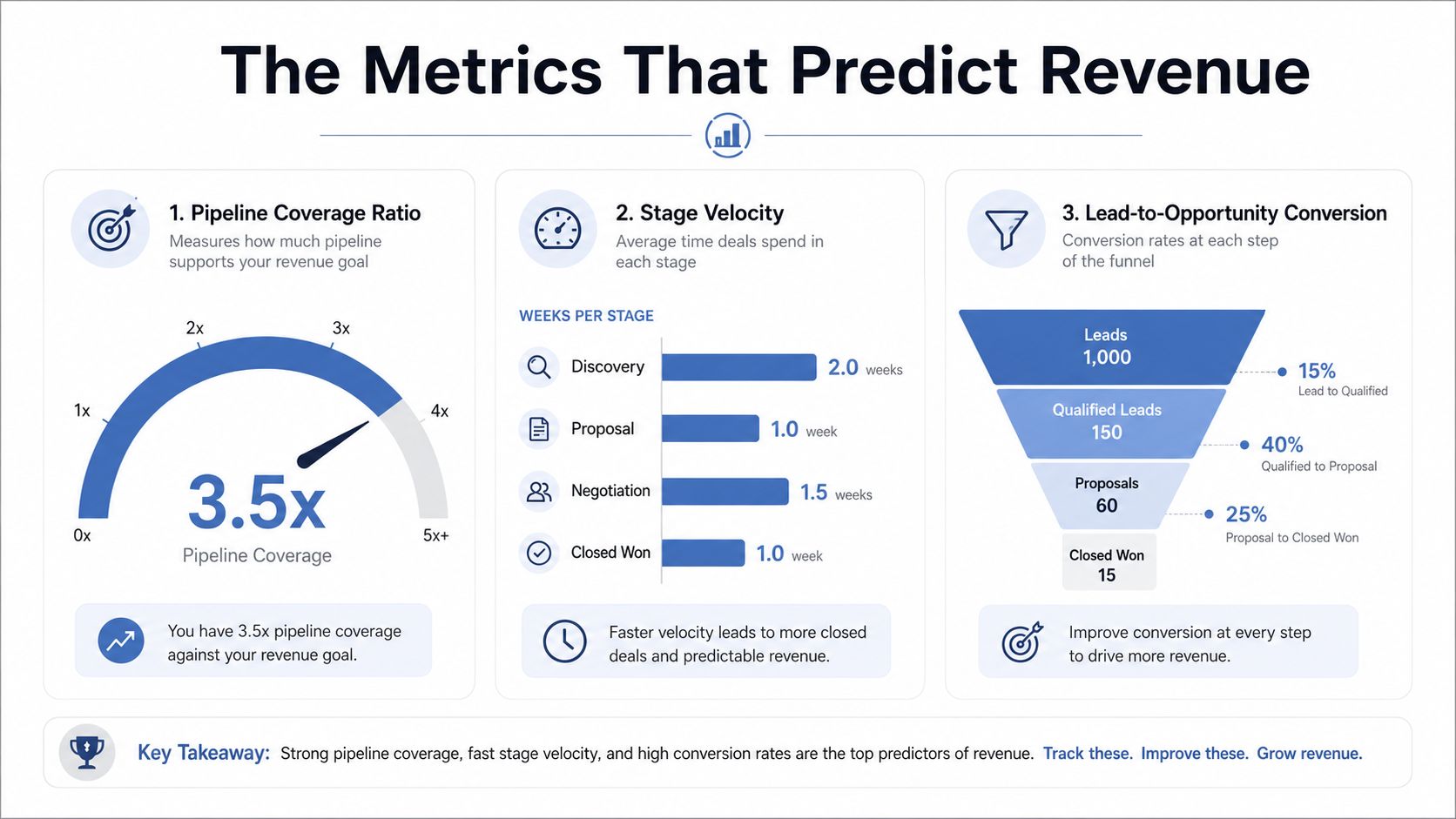
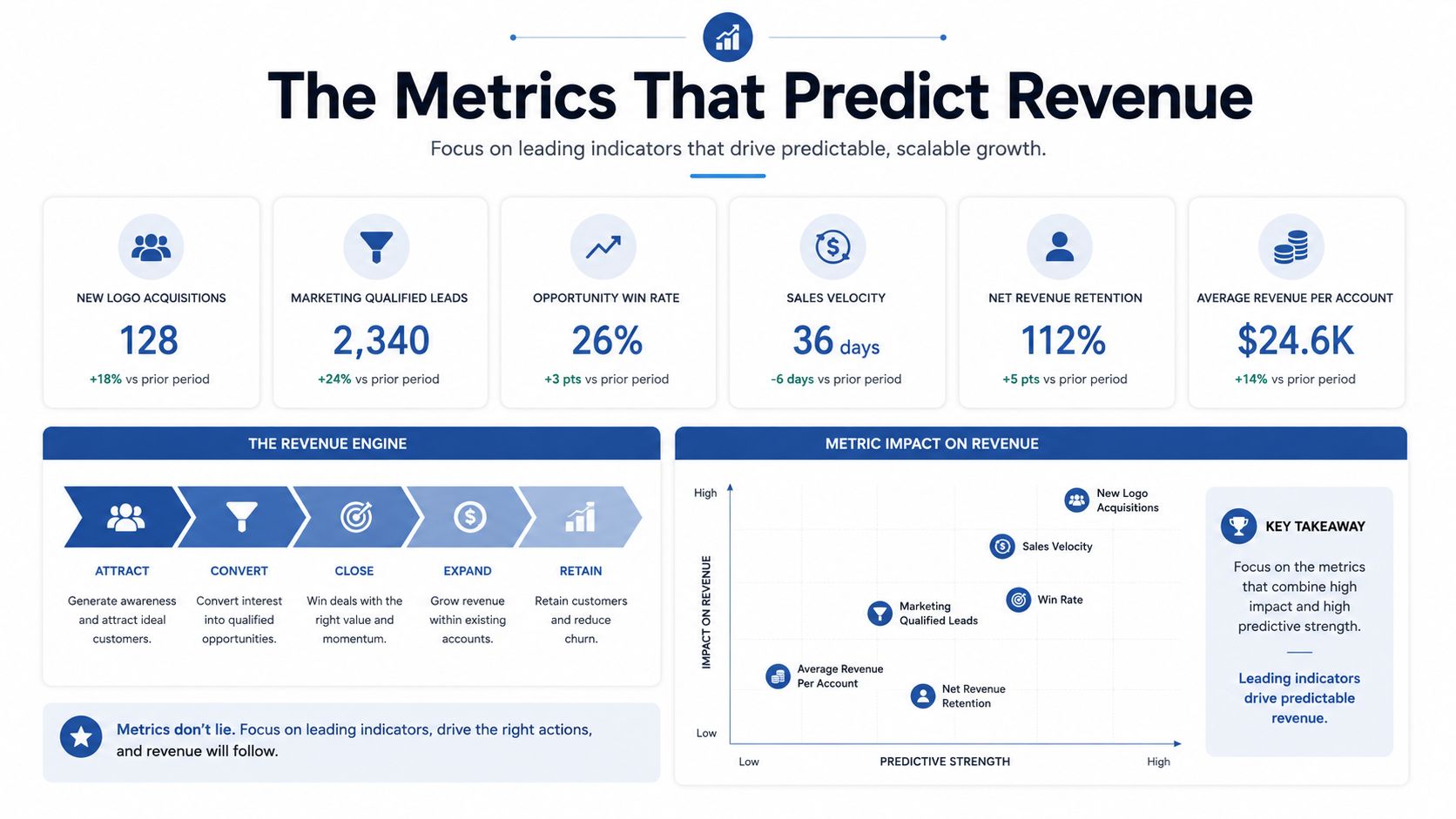
A dashboard with fifty fields can still leave you guessing. I use a small operating view built around coverage, conversion, speed, aging, and economics. Each number should answer a decision question, such as whether to create demand, disqualify deals, follow up faster, or change the offer.
Start with coverage, then work backward
The basic coverage formula is:
Pipeline coverage ratio = total pipeline value ÷ revenue target
Industry sources commonly cite a target of roughly 3:1 to 5:1 over quota, according to this sales pipeline conversion guide. The right point inside that range depends on your actual win rate, deal size, and cycle length.
Say your target is £10,000 and your average qualified opportunity is £1,000. You need to know how many opportunities are required, how many qualified conversations produce those opportunities, and how many initial leads create those conversations. Use your own historical conversion rates where you have them. Where you don't, mark the assumptions clearly rather than presenting them as a forecast.
For well-qualified inbound leads, commonly cited reference ranges include 10% to 15% lead-to-opportunity conversion and 20% to 30% opportunity-to-close win rates in mid-market deals. Those benchmarks come from the same pipeline conversion reference. They can help you build a first model, but they aren't a reason to accept weak-fit leads or force your business into mid-market definitions.
Track stage movement, not total inventory
Stage conversion rate measures the share of deals that move forward:
Deals that exited to the next stage ÷ total deals that entered the stage × 100
A pipeline can have enough monetary value and still fail at one transition. For example, if proposals regularly fail to become negotiations, the problem may be unclear scope, poor timing, missing authority, or a proposal sent before the buyer had agreed on the problem. SaaSGrid's stage conversion explanation provides the useful operating principle: inspect each transition, such as Qualified to Proposal and Proposal to Negotiation, rather than relying on a single close rate.
Next, measure stage velocity, the time an opportunity spends in each stage. Outreach reported that opportunities closed within 50 days had a 47% win rate, compared with 20% or lower after that threshold. (Gartner's sales analytics resource) Treat that as a warning about dwell time, not a universal cutoff. Your own offer may close faster or slower.
My weekly dashboard has five visible numbers:
- Qualified pipeline value, excluding records without qualification evidence.
- Coverage ratio, compared with the target built from your records.
- Stage conversion, especially at the weakest transition.
- Median days in current stage, so one old deal doesn't hide inside an average.
- Next-action rate, the share of open opportunities with a dated next step.
You can reproduce the core idea with a spreadsheet and an automation rather than buying a large platform.
One metric deserves special treatment: response time. Leads contacted within 5 minutes of an inquiry were reported as 21 times more likely to qualify than leads contacted 30 minutes later. (Follow-up timing research) If you receive an inbound form submission, an immediate useful acknowledgment can protect the opportunity while you decide whether to respond personally.
Automating Pipeline Hygiene with AI Agents
Manual CRM updates fail because they happen after the work, when your attention has already moved elsewhere. I keep the system small: one source of truth for contacts and deals, one automation layer such as Zapier or Make, an email and calendar connection, and an AI model that extracts evidence without making decisions on my behalf.
The opportunity exists now because an AI model can read a form response, email thread, or call note and turn unstructured text into fields. The agent can prepare the update. I still approve movement into a serious stage.
Workflow one for a new inquiry
Capture the inquiry. A Tally or Typeform submission creates a contact and preserves the original answers.
Score the evidence. Send the answers to an AI step with this prompt:
Score this inquiry using only the supplied text. Return fit, stated problem, urgency, likely authority, missing information, and recommended next action. Use high, medium, or low confidence. Never invent a budget, timeline, or company detail.
Route the record. High-confidence, relevant inquiries receive a personal response task. Low-confidence inquiries receive a clarification email. Unknown fields remain unknown.
Create the follow-up. The automation drafts a reply, but you approve the message before it sends. Store the draft beside the contact so the next interaction has context.
Set a deadline. Add a task with a due date. If it remains incomplete, send yourself an alert rather than another buyer-facing message.
This replaces copying form data into a CRM, scanning every new inquiry manually, and remembering who needs a reply. It doesn't replace judgment about fit, pricing, or whether the buyer's problem is worth solving.
Workflow two for a stale opportunity
Run the automation each morning against open deals. It should inspect the last activity date, current stage, next-action field, close date, and latest message. For a call transcript or note, use this prompt:
Review this opportunity record. Identify the last buyer-confirmed commitment, the unresolved blocker, whether the current stage meets its exit criteria, and one reasonable next action. If evidence is missing, say so. Do not change the stage.
If there has been no movement, create a review task. If the buyer has supplied a new commitment, draft a stage update for approval. If the close date has passed, ask you to requalify or close the record instead of pushing the date forward without comment.
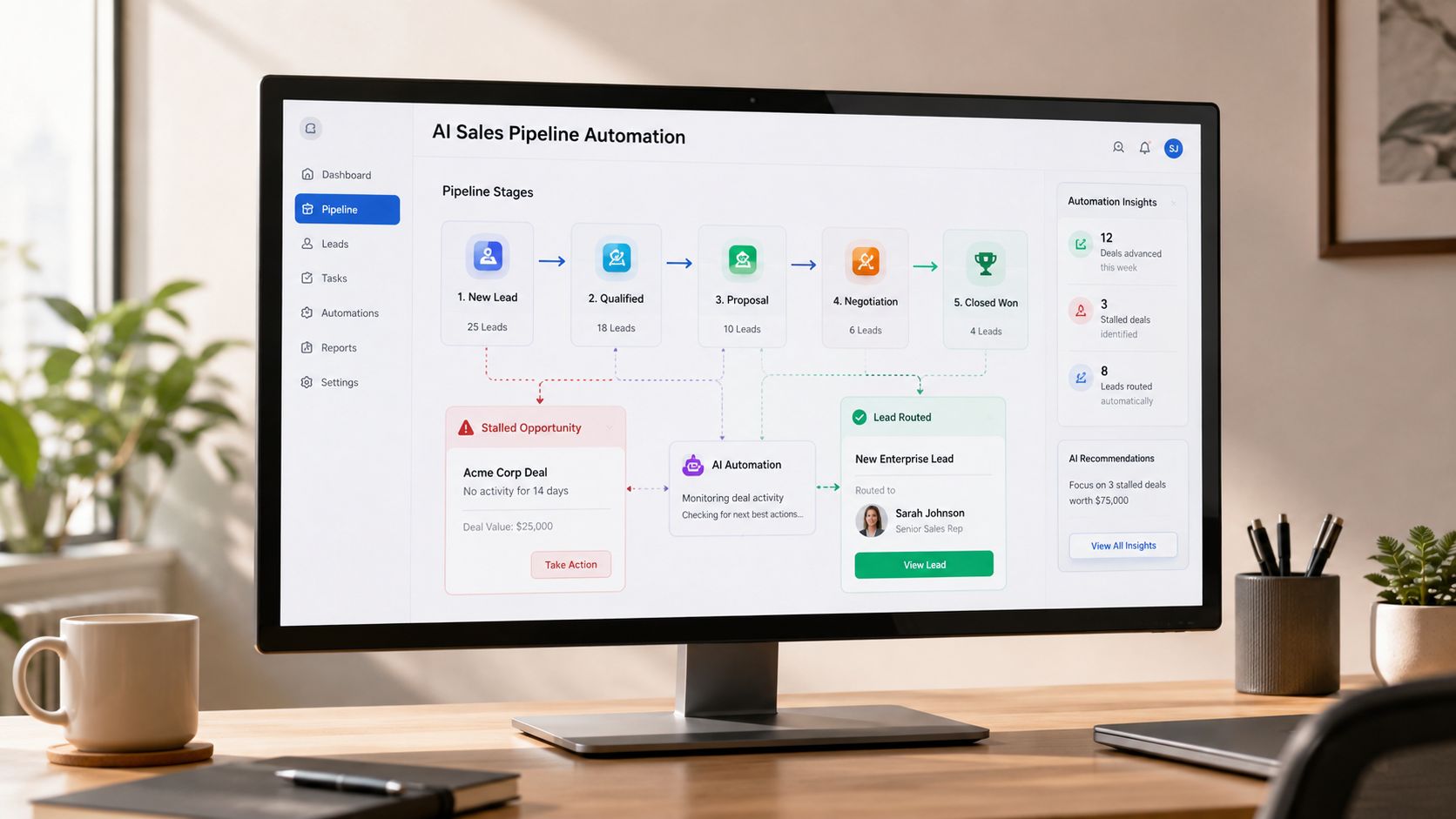
My own AI agent for lead qualification follows the same boundary: automate evidence collection and prioritization, keep consequential decisions visible.
The data requirements are simple but strict. The agent needs a stable record ID, stage, timestamps, contact details, conversation text, next action, and an explicit instruction about what it may change. Remove any of those and the workflow starts guessing.
Measure three outcomes: response time, the share of open deals with a valid next action, and the number of stale records you review each week. If those numbers don't improve, the automation is producing theatre. Add fewer steps, fix the data mapping, or remove the agent.
Where Pipeline Systems Break and How to Fix Them
My first pipeline failed because I confused movement with progress. Every completed activity allowed a deal to advance, so a booked call became discovery, a sent proposal became negotiation, and an unanswered email kept the opportunity alive. The system rewarded me for updating fields rather than proving buyer commitment.
I fixed it by making buyer evidence mandatory. A proposal couldn't advance because I had sent it. It advanced only when the buyer confirmed relevance and accepted a next decision step.
The trade-off between strictness and speed
Strict qualification can reduce the number of conversations you pursue. That's useful when your calendar is full, but it can hide an emerging buyer whose timing or authority isn't clear yet. Loose qualification keeps discovery open, but it fills your week with people who are curious rather than ready.
Use different rules for different stages. Early records can carry unknown fields. Late-stage records cannot.
A stage is a promise about evidence. If the evidence isn't there, the stage is wrong.
My second system broke after I added too many automated alerts. Every missing field generated a notification, and every old deal generated a reminder. I began ignoring the alerts, which meant the automation had created another inbox instead of reducing work.
The fix was to alert only on an action I could take today: a qualified deal without a next step, a buyer reply awaiting response, or a deal past its time limit. Everything else went into a weekly review queue.
Conventional advice that fails for small operators
“Never close a deal too early” sounds cautious, but it creates expensive clutter. If a buyer has no confirmed problem, no response after your defined follow-up process, and no agreed timing, closing the record protects your attention. You can reopen it if new evidence appears.
“Automate every follow-up” fails for a different reason. A sequence can remind you to send a message, but it can't reliably decide whether the buyer's situation changed or whether your offer is now irrelevant. Automate reminders and drafts first. Keep tone, exceptions, pricing, and final send approval human.
I also got the first qualification prompt wrong. It assigned confidence from sentiment, so polite replies looked stronger than direct objections. I replaced sentiment with evidence fields and made “unknown” an acceptable result.
The warning signs are easy to spot: close dates move without buyer confirmation, late-stage records lack decision-maker information, the same opportunity appears in several lists, and you can't explain the next step without opening three tools. Fix the smallest broken field before adding another integration.
Weekly Reviews That Compound Into Predictable Revenue
A weekly review should change your actions. If you finish it with the same stages, dates, and priorities, you held a status meeting with yourself.
I run the review from a filtered view of open opportunities. I inspect the records with near-term close dates, missing next actions, weak stage evidence, and unusual dwell time. I don't read every email. I read the latest buyer interaction and the note that justifies the current stage.
The solo review
Use this order:
Inspect stage integrity. Open each late-stage deal and check the exit criteria. Move unsupported deals backward or close them.
Rescue stalled deals. Identify the buyer-confirmed commitment that expired. Send one useful re-engagement message or remove the deal from the active forecast.
Validate the forecast. Separate committed revenue from possible revenue. A deal belongs in a confident forecast only when the evidence supports its stage and timing.
Choose next actions. Assign yourself one action per qualified opportunity. If the action can't be stated in a sentence, the deal probably needs requalification.
Update the dashboard. Record coverage, stage conversion, median stage age, next-action rate, and response time. Compare the current numbers with your prior review.
A short AI summary can help, provided it points to records rather than replacing inspection. Ask it to list deals with missing exit evidence, expired next steps, and buyer replies that have no response. Then open the records yourself.
The discipline has measurable support. One independent analysis reported 78% to 84% forecast accuracy for companies using structured stage exit criteria and weekly pipeline reviews, with a stated 16-percentage-point improvement associated with tighter pipeline discipline. (Forecast accuracy analysis)
That doesn't mean your forecast will reach the same result. It does show why cadence matters. Marketing analytics dashboards can help you connect acquisition data to pipeline outcomes, but the review still has to produce a decision.
On Monday, delete or close every opportunity that lacks a buyer-confirmed next step. Then create the six stages, add the exit criteria, and set one automation that flags stale records without changing stages. Track the five dashboard numbers for the next review, and let the evidence decide what deserves your time.
If your pipeline is full of deals you can't explain, start with a cleanup rather than another lead source. Build the stage gates, install the two simple AI workflows, and review the records every week. For more practical systems that turn AI-generated opportunities into working processes, I document the experiments in Bionic Business as I build them, including what breaks.
Frequently Asked Questions
What are the stages of a sales pipeline for a solopreneur?
Six stages cover most small offers: prospecting, qualification, discovery, proposal, negotiation, and closed-won or closed-lost. The names matter less than the exit criteria. Each stage should record what the buyer has committed to doing next, such as agreeing to a conversation, confirming a proposal fits their need, or setting a decision date, instead of what you did.
What is a good pipeline coverage ratio?
Pipeline coverage ratio is total pipeline value divided by your revenue target. Industry sources commonly cite roughly 3:1 to 5:1 over quota, but the right point in that range depends on your own win rate, deal size and cycle length. Count only qualified pipeline value, and mark your assumptions clearly where you lack historical conversion rates.
How do you qualify an opportunity in your sales pipeline?
Check five things: whether the buyer has stated a problem in their own words, whether they match the customer you can serve profitably, who can approve the purchase, whether a decision window is agreed, and whether a specific next step is scheduled. If two or more answers are missing, move the record back to qualification or close it as unqualified.
How can AI help with sales pipeline management?
An AI model can read a form response, email thread or call note and turn it into fields such as problem, desired outcome, decision-maker, timing and agreed next action. It can score new inquiries, draft replies and flag stale deals each morning. Keep stage changes and final send approval with a person, and tell the model never to infer intent from positive language.
Which sales pipeline metrics should you track?
Track five numbers each week: qualified pipeline value, coverage ratio, stage conversion at your weakest transition, median days in current stage, and next-action rate, meaning the share of open deals with a dated next step. Response time deserves its own attention, because leads contacted within five minutes were reported as 21 times more likely to qualify than leads contacted 30 minutes later.
How often should you review your sales pipeline?
Every week. Start with late-stage deals and check their exit criteria, then rescue stalled deals, separate committed revenue from possible revenue, assign one next action per qualified opportunity and update the dashboard. Read the latest buyer interaction and the note that justifies each stage instead of every email. If nothing changes after the review, you held a status meeting with yourself.