
The lead generation strategies that work judge every channel by sales-accepted opportunities and pipeline value per dollar spent. For a small team, that means one primary channel, one supporting channel, a trigger-based AI workflow that researches, scores and drafts a first message you review, a landing page that converts, and a weekly dashboard of stage conversions.
Most lead generation advice tells you to get more leads. That advice is backward when your sales calendar is full of people who downloaded something, ignored follow-up, and never had a reason to buy.
I've watched teams celebrate a falling cost per lead while accepted opportunities and closed revenue deteriorated. In 2026, the median B2B cost per lead was reported at $213, up from $198 in 2025, while average lead-to-customer conversion was estimated at 0.94%, or roughly one closed-won customer for every 106 captured leads, according to Digital Applied's 2026 lead generation data.
That gap changes how you should build lead generation strategies. Your job this week isn't to fill a spreadsheet. It's to find people with a credible reason to move, give them a useful next step, and measure whether that step creates pipeline.
Table of Contents
- Why Most Lead Generation Advice Optimizes the Wrong Number
- Inbound vs Outbound and When Each One Pays
- The Five Channels Worth Running in 2026
- An AI Workflow You Can Build This Week
- Landing Pages and Funnels That Stop Leaking Leads
- Measuring Lead Gen by Pipeline, Not MQL Volume
- What to Change on Monday
Why Most Lead Generation Advice Optimizes the Wrong Number
The standard MQL-volume playbook rewards activity before commercial value gets checked. A campaign produces more form fills, cost per lead falls, and the dashboard turns green. Sales then rejects the names, response rates drop, and the operator spends time chasing contacts who never fit the offer.
That trade is painful for a founder supporting a 10-person sales team. Every weak lead takes attention away from improving the offer, speaking with a serious buyer, or following up with someone who already showed intent.
Website visitor-to-lead conversion typically benchmarks at 2% to 5%, while MQL-to-SQL conversion commonly sits around 15% to 30%, according to eLearning Industry's B2B funnel benchmarks. Copying those figures as targets misses the point. Each stage needs its own quality check. A strong top-of-funnel rate can still produce a weak sales pipeline if the leads lack fit, urgency, or buying authority.
The number I'd put above MQLs
I'd judge a channel by sales-accepted opportunities and pipeline value per dollar spent. MQLs still help diagnose a campaign, but they are a poor finish line. They do not show whether a contact fits the account profile, has a reason to act, can influence the purchase, or reached a real sales conversation.
I'd borrow that operating principle, then keep the tracking simple enough to run in a spreadsheet.
Practical rule: If a source creates attention but no sales acceptance, classify it as an audience or content signal, not a working acquisition channel.
AI makes this filter more important. Automated outreach has made inboxes noisier, generic personalization easier to spot, and low-intent contacts cheaper to create. A solo operator can now automate research, lead scoring, and follow-up checks, but those workflows only help when they remove poor-fit contacts before they reach the calendar.
I use four filters: fit, intent, reachability, and downstream conversion. Fit asks whether the person resembles a buyer. Intent asks whether something changed recently. Reachability checks whether contact is permitted and relevant. Downstream conversion shows whether the first three filters deserved trust.
Inbound vs Outbound and When Each One Pays
Inbound and outbound solve different timing problems. Inbound builds an asset that can attract demand repeatedly, but search visibility and trust take sustained work. Outbound can create conversations sooner, while each opportunity depends on fresh research and relevant follow-up.
The cost difference is stark. Organic content and SEO were reported at $98 CPL, while account-based marketing reached $487 CPL in the same dataset, according to Digital Applied's channel comparison. Organic is not automatically better. The figures show that acquisition cost varies sharply by channel, and high-touch targeting needs deal economics that can support the extra work.
| Metric | Inbound | Outbound |
|---|---|---|
| Main investment | Content production, search work, audience trust | Prospect research, messaging, follow-up |
| Time profile | Slower to establish, then reusable | Faster first activity, repeated effort per account |
| Best measurement | Qualified organic demand and pipeline contribution | Positive replies, accepted meetings, opportunities |
| Main failure | Publishing without a conversion path | Sending generic messages to weak-fit contacts |
| Small-team fit | Strong when you can publish consistently | Strong when you have a narrow ICP and clear trigger |
Inbound gives a small team more ways to create a useful value exchange. Benchmark summaries report that 90.7% of marketers use their websites to generate leads and sales, 87% of B2B marketers use content marketing successfully for lead generation, and gated-content demand has grown by over 80% since 2020, according to Email Vendor Selection's lead generation statistics. A report, calculator, template, or workshop earns an opt-in more reliably than a vague “book a demo” request.
Outbound fits when the buyer definition is narrow and the reason to contact someone is specific. Use a recent job change, hiring post, product launch, or visible operational problem. Skip mass lists. Cold calling success rates were described as falling to 2.3% in 2025 in Dux-Soup's B2B lead generation report, so phone-first prospecting needs an unusually strong reason to interrupt someone.
For a founder with little pipeline coverage, pair targeted outbound with one useful inbound asset. A team building a longer-term acquisition base can publish around high-intent problems and capture demand consistently. Smaller deals and shorter sales cycles generally favour repeatable inbound and product-led capture. Larger customer values can justify carefully researched outbound and account-level targeting, provided sales acceptance and pipeline value support the added cost.
The Five Channels Worth Running in 2026
You don't need five active channels at once. You need one primary channel, one supporting channel, and a clear reason to add the next.
| Channel | Cost to Launch | Time to First Lead | Best Fit |
|---|---|---|---|
| Content and SEO | Low cash, high personal effort | Slow | Operators with a repeatable point of view |
| Paid search and social | Direct budget required | Fast | Clear offers with measurable conversion |
| Customer referrals | Low cash, requires trust | Variable | Products with visible customer outcomes |
| Partner and reseller programs | Low to moderate, relationship-heavy | Moderate | Narrow markets with complementary providers |
| Product-led growth | High product effort | Variable | Software with a quick path to value |
Content and SEO is my default starting point when the operator can publish from real customer problems. It compounds because a useful page can keep attracting qualified searches, but it fails when the content targets broad curiosity and gives readers no next action.
Paid search and social buys speed. Search works best when the query signals a problem close to purchase. Social can create demand and retarget interest, but paid traffic exposes weak offers quickly. The median B2B website conversion rate was reported at 2.9%, with organic search at 2.6%, email at 2.4%, paid search at 1.5%, and paid social at 0.9%, based on Callbox's analysis of more than 100 million data points across 14 industries. Treat those as directional benchmarks, not promises.
Referrals are cheap to launch and often arrive with trust attached. The failure mode is rewarding introductions instead of useful customer matches. Ask for referrals after a clear outcome, and describe the type of problem you can solve.
Partners can open an audience you can't reach alone. They also take patience. A reseller who doesn't understand your qualification rules may send volume that creates support work rather than revenue.
Product-led growth only fits when a user can experience value without a long implementation. A free tier can leak high-intent users if the upgrade path is vague or the product attracts people who will never pay. Don't build PLG because it sounds efficient. Build it when usage itself reveals buying intent.
Start with content and SEO if you can wait for demand to build. Add paid search or targeted social at month three only after the offer and conversion path are clear. Defer partnerships and PLG until you can support the operational work they create.
An AI Workflow You Can Build This Week
The opportunity exists because AI can inspect a buying signal, assemble context, and draft a relevant first touch before you manually open a research tab. The workflow still needs your judgement. Automation can speed selection and preparation, but it can't turn a weak signal into real intent.
I'd build this in five working days, using Clay with Apollo where available. A free fallback is Google Alerts, LinkedIn search, a spreadsheet, and manual company research.
Step 1, choose the trigger
Pick one signal. A new hiring post is usually easier to interpret than a vague funding announcement because the role often reveals the operational problem. Define the company size, market, buyer role, and excluded industries before collecting names.
Prompt:
“Given this hiring post, identify the operational problem it implies, the likely owner of that problem, and one reason the company may act now. Separate evidence from inference.”
This replaces broad prospect-list building.
Step 2, collect the account
Put the company URL, signal URL, role, date found, and source text into Clay. Use Apollo to find a possible contact, then retain the source for every important field. If the data can't be verified, leave it blank.
Step 3, enrich the context
Add the company description, recent hiring language, relevant product page, and public evidence of the problem. Don't collect personal trivia. The context should explain why your offer might matter.
Step 4, score the account
Use a simple score based on fit and timing. Add points for the right company type, relevant role, explicit pain signal, and a plausible use case. Subtract for missing evidence, unclear ownership, or a mismatch between the offer and the trigger.
Step 5, draft the message
Prompt:
“Write a short first-touch email to [role] at [company]. Use the hiring signal and company context below. State the observed change, explain the likely operational issue, and offer one useful next step. Don't praise the company, invent facts, use fake familiarity, or include more than one question. Keep the message direct and easy to ignore.”
Step 6, review the draft
You check every claim. Remove anything the source doesn't support. Rewrite the opening if it could apply to ten other companies.
Step 7, send a small batch
Send only the contacts you can personally defend. Track positive replies, negative replies, unsubscribes, meetings, and accepted opportunities. A reply isn't revenue.
Step 8, follow up with context
If there's no response, send one useful addition tied to the same trigger. Don't recycle “just checking in.” Stop when the signal no longer supports a relevant reason to write.
Step 9, log the outcome
Record the stage reached, the reason for rejection, and whether the signal was valid. That feedback improves the scoring rules more than another prompt will.
| Step | Traditional SDR Process | AI Workflow | Time Saved |
|---|---|---|---|
| Signal discovery | Manual searches and list building | Trigger-based collection | Research time |
| Enrichment | Tabs, copy-paste, CRM entry | Structured enrichment | Data entry |
| Qualification | Individual judgement without a shared rubric | Explicit scoring rules | Review time |
| Drafting | Write each message from scratch | Contextual draft | Writing time |
| Quality control | Informal editing | Source and claim check | Rework |
| Follow-up | Calendar reminders and memory | Triggered task list | Admin |
| Reporting | Manual spreadsheet updates | Outcome fields | Reporting time |
The initial build should take roughly five working days, with about 20 minutes daily to run and review. Those are my operating estimates, not a benchmark. Keep the volume low enough that you can inspect every message. Once the workflow produces more conversations than you can qualify personally, the constraint is no longer automation. It's human review.
I keep the implementation notes for AI workflows for entrepreneurs close by because the useful part is always the trigger, input, decision rule, and failure log. The prompt is the least important component.
Landing Pages and Funnels That Stop Leaking Leads
A landing page can waste good demand before your lead scoring ever sees it. I once reviewed a B2B SaaS page converting at 1.8% and rebuilt the path until it reached 4.1%, without increasing paid traffic. The lesson wasn't that one layout works everywhere. It was that every change had to answer a measured question.
I started with four checks: a heatmap review, form-field audit, mobile rendering check, and message-match comparison between the ad and the hero headline. The page asked for too much information, the mobile form was awkward, and the headline described the product rather than the problem in the ad.
The changes that mattered
The first test placed one CTA above the fold and moved a proof block above the form. The second reduced the form from four fields to two. The third added an exit-intent offer for visitors who weren't ready to submit.
| Change Tested | Before CVR | After CVR | Incremental Lift |
|---|---|---|---|
| Single CTA above the fold, proof block above the form | 1.8% | 2.9% | 1.1 percentage points |
| Four-field form cut to two | 2.9% | 3.6% | 0.7 percentage points |
| Exit-intent offer | 3.6% | 4.1% | 0.5 percentage points |
The exit-intent offer was the weakest idea operationally. It lifted captured contacts, but some visitors selected the lower-commitment offer even when they might have booked a conversation. I kept it only because the downstream quality remained acceptable. If those contacts had produced no accepted opportunities, I'd have removed it.
I also keep a more detailed checklist in my landing page optimization best practices guide.
The benchmark context matters. Across industries, average landing page conversion has been reported at 5.9%, while the top 10% of pages reached above 11.4%, according to SearchLab's 2026 lead generation statistics. Don't chase a benchmark before checking lead quality. A higher conversion rate can be a failure if the offer attracts people who can't buy.
Measuring Lead Gen by Pipeline, Not MQL Volume
Your dashboard should show where value disappears. I'd track five transitions: lead to ME, ME to SQL, SQL to opportunity, opportunity to close, and pipeline value per dollar spent. ME means marketing engaged, which gives you a cleaner intermediate stage than treating every download as sales-ready.
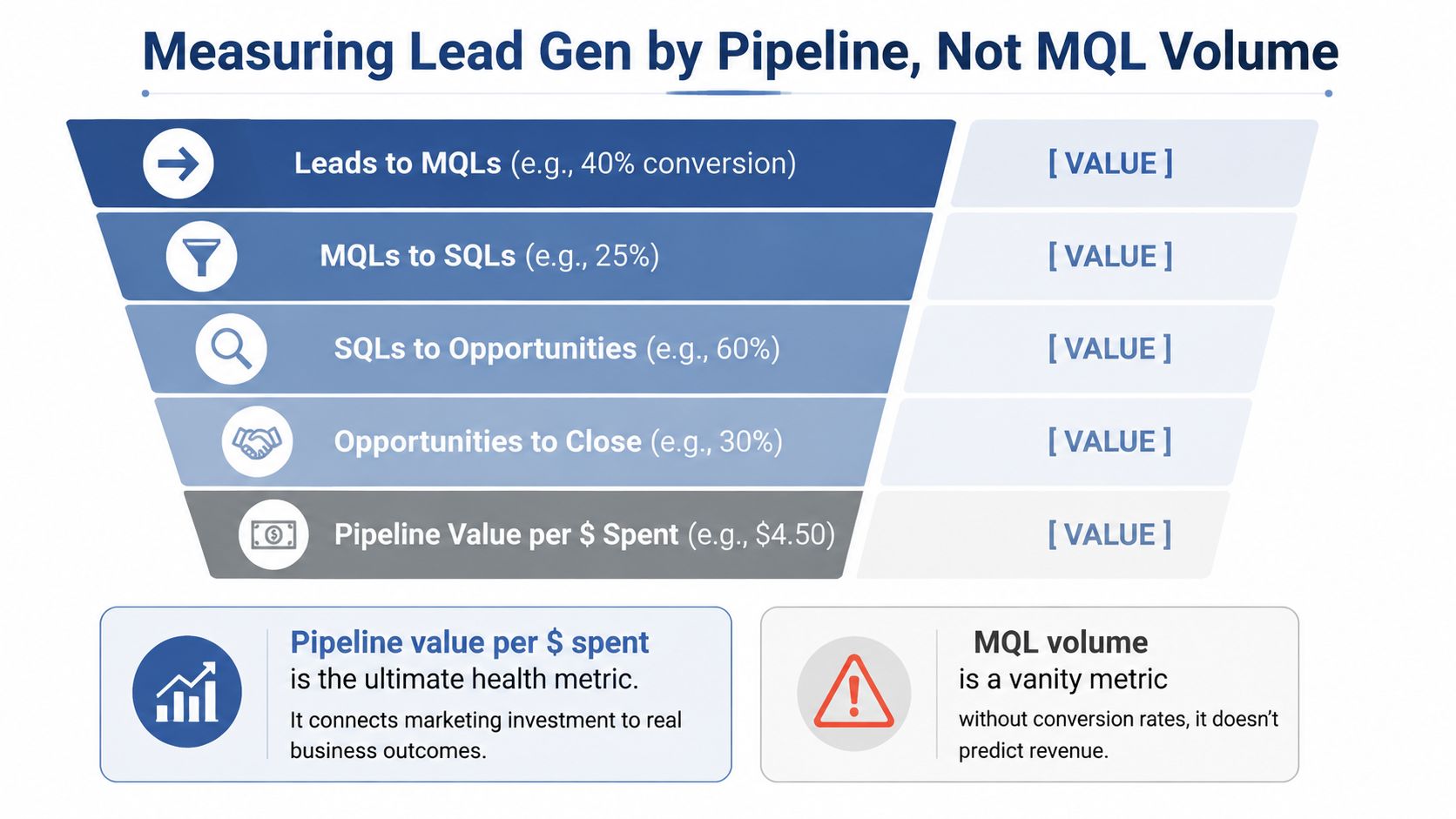
Each stage needs a definition, an owner, and a response time. You don't need a large revenue-operations system. A spreadsheet can work if the fields are consistent and you record rejection reasons instead of hiding them.
The five numbers
- Lead to ME rate: Shows whether the source creates any meaningful engagement.
- ME to SQL rate: Shows whether the engagement meets your sales qualification rules.
- SQL to opportunity rate: Shows whether accepted conversations uncover a real project.
- Opportunity to close rate: Shows whether the opportunity and offer fit the buying process.
- Pipeline value per dollar spent: Shows whether acquisition creates economic value.
A useful qualified-lead reference frames healthy lead-to-customer conversion at 10% to 20% when leads are well qualified, while B2B website lead generation commonly sits around 2% to 5%, according to Martal's lead generation statistics. The spread is where your diagnostic work lives.
Suppose MQL volume doubles while pipeline stays flat. I'd inspect ME-to-SQL first. If that rate collapsed, the campaign probably widened capture without producing stronger engagement. If ME-to-SQL held but SQL-to-opportunity fell, the issue may be qualification, offer fit, or the sales conversation.
Dashboard rule: Every volume metric needs its next-stage conversion beside it.
I review the dashboard once a week for 30 minutes. I check new opportunities, rejected leads, stage conversion by source, spend, and the next experiment. I don't debate attribution for every contact. I look for a broken transition and make one change that could repair it.
My guide to measuring marketing effectiveness covers the same discipline across broader marketing activity. For lead generation, the key is keeping the review close to pipeline rather than turning it into a reporting exercise.
What to Change on Monday
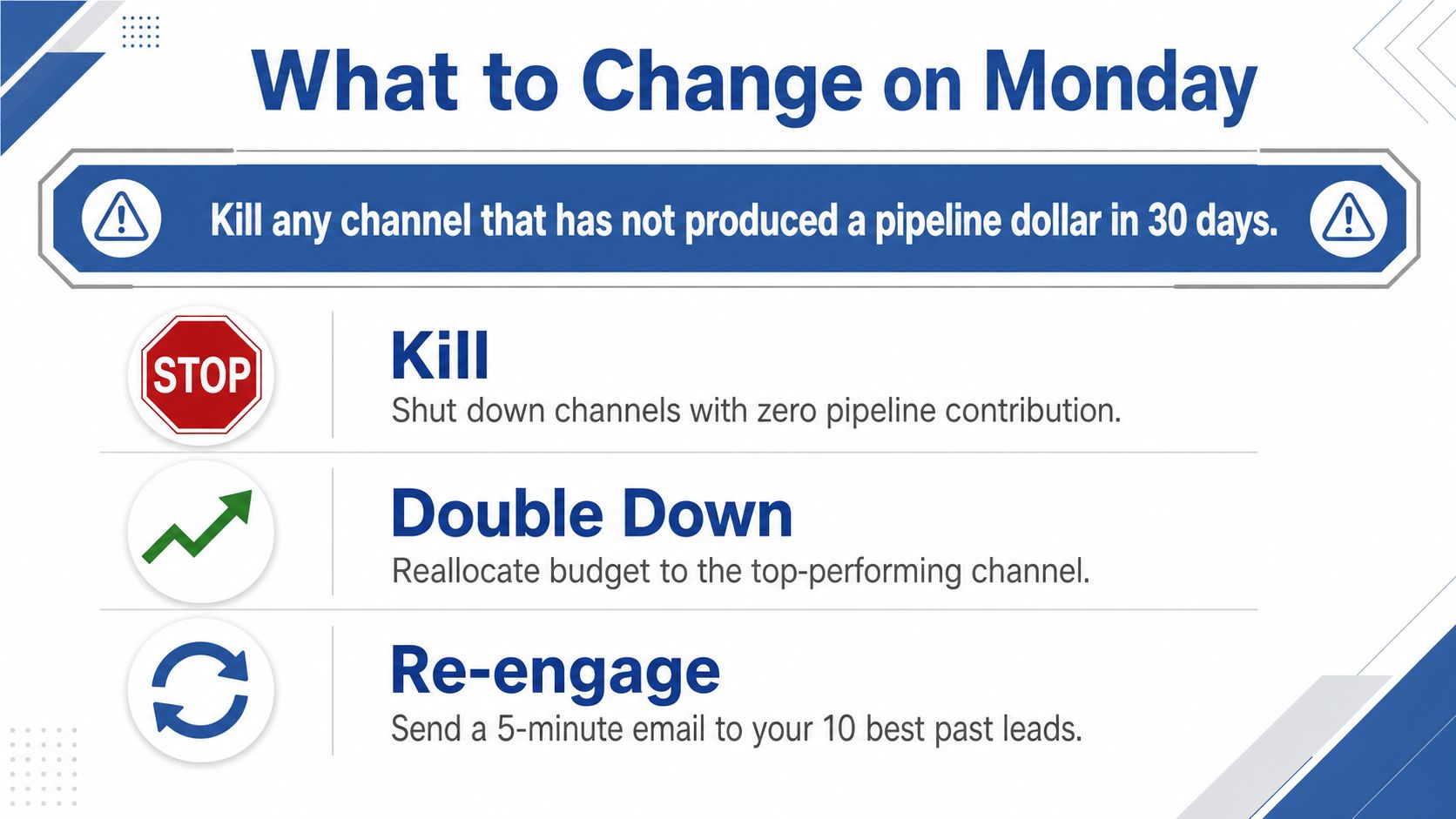
Start with a blunt triage rule: kill any channel that hasn't produced a sales-accepted opportunity in 90 days, and double down on the one that has. Keep an exception only when the channel has a documented later-stage signal and you can afford to wait. Attention is your scarce resource.
Morning, inspect the last quarter
Pull the stage conversion report. Tag every MQL by its downstream outcome, including accepted opportunity, rejected fit, no response, duplicate, and unknown. If you can't trace a lead to a later stage, mark the gap instead of assuming success.
Midday, choose one channel
Use the five-channel table to match the channel to your economics. Pick one trigger and ship the AI workflow inside that channel. The first version should collect evidence, score fit, draft a message, and create an outcome field.
Afternoon, repair the highest-traffic page
Check the hero against the source message, reduce unnecessary form fields, inspect mobile rendering, and move credible proof closer to the decision point. Change one thing at a time where possible, and write down the metric that would justify keeping it.
Before you spend more money, stand up the pipeline dashboard. Track the five transitions from the previous section and make the source field mandatory. You need to know whether a new contact becomes a useful conversation before adding volume.
Skip mass cold email, generic lead magnets, daily social posting without a capture path, contests that attract people who can't buy, and free tiers that hide serious product intent. Also skip automation that sends messages you haven't read. A defended calendar beats a longer one.
On Monday, export the data, pick the channel, build the trigger, repair the page, and create the dashboard. Then give the system enough time to produce a downstream signal before you add another tactic.
If you want the complete build notes, failed experiments, and practical AI workflows I'm testing each week, read Bionic Business at bionicbusiness.com. Choose one lead generation workflow from this article, ship it this week, and record the first downstream stage it reaches.
Frequently Asked Questions
What is the best metric for judging a lead generation channel?
Judge each channel by sales-accepted opportunities and pipeline value per dollar spent. MQLs still help you diagnose a campaign, but they don’t show whether a contact fits your account profile, has a reason to act, can influence the purchase, or reached a real sales conversation. If a source creates attention but no sales acceptance, treat it as an audience or content signal.
Should a small business use inbound or outbound lead generation?
Inbound builds an asset that attracts demand repeatedly but takes sustained work. Outbound creates conversations sooner and fits when your buyer definition is narrow and you have a specific trigger, such as a job change or hiring post. With little pipeline, pair targeted outbound with one useful inbound asset. Smaller deals and short sales cycles generally favor inbound; larger customer values can justify researched outbound.
Which lead generation channels should I start with?
Run one primary channel and one supporting channel. Start with content and SEO if you can wait for demand to build. Add paid search or targeted social around month three, once the offer and conversion path are clear. Customer referrals are cheap and arrive with trust. Defer partner programs and product-led growth until you can support the operational work they create.
How can AI help with lead generation?
Build a trigger-based workflow in nine steps. Choose one signal, such as a hiring post. Collect the account in Clay, using Apollo for a contact. Enrich it with public evidence of the problem. Score fit and timing. Draft a short first-touch email. Check every claim yourself. Send a small batch. Follow up once with context. Log the outcome and rejection reason to improve your scoring rules.
What conversion rates are normal for lead generation?
Reported benchmarks put website visitor-to-lead conversion at 2% to 5% and MQL-to-SQL at 15% to 30%. One dataset puts the median B2B website conversion rate at 2.9%, from 2.6% for organic search down to 0.9% for paid social. Average landing page conversion has been reported at 5.9%. Treat these as directional, and check lead quality before chasing a higher rate.
When should you cut a lead generation channel?
Kill any channel that hasn’t produced a sales-accepted opportunity in 90 days, and put that attention into the one that has. Keep an exception only when the channel shows a documented later-stage signal and you can afford to wait. Review a stage-conversion dashboard weekly, look for the broken transition, and make one change that could repair it before adding volume.