
Your consultants are expensive. Yet too much of their week disappears into research, proposal assembly, CRM digging, meeting prep, and recycling old thinking into new decks.
That's the core problem.
Most firms don't need “more AI.” They need an ai agent for a consulting business that takes over the operational sludge and turns it into revenue growth. I've been building AI systems since 2016 and GenAI systems since 2019, and I can tell you the firms winning with agents are not treating them like novelty tools. They're rebuilding the core engine of the firm.
You can keep selling hours. Or you can build a bionic consulting operation that responds faster, scopes smarter, and extracts more value from every consultant on payroll.
Your Competitors Are Building Bionic Consultants
You already know the pattern.
A promising lead comes in. Someone has to pull CRM notes, review old proposals, research the market, scan competitors, draft a customized response, and package the whole thing into something that looks senior and strategic. Your best people get dragged into non-billable work because the stakes are too high to delegate badly.
That's where firms bleed margin.
The firms moving ahead aren't just using ChatGPT in random tabs. They're building internal agents that act like a bionic layer across sales, delivery, and account growth. One agent gathers intelligence. Another drafts a proposal from CRM context and past project data. Another flags expansion opportunities inside active accounts before the client even asks.

If you're still thinking in terms of “an AI chatbot,” you're already behind. What matters is building an operational system that helps your firm collect, process, and act on information faster than competitors. I've written more broadly about that shift in my guide to AI agents for business.
What bionic consulting actually looks like
A serious consulting agent system usually handles work in four lanes:
- Sales acceleration by turning raw opportunity data into customized proposals and sharper pursuit strategy
- Research compression by gathering market and competitor context before a human ever opens a blank document
- Delivery augmentation by helping consultants synthesize findings, structure deliverables, and reuse firm knowledge
- Account expansion by surfacing cross-sell, upsell, and retention signals from client interactions and project history
Practical rule: If the work repeats, depends on scattered information, and influences revenue, it belongs on your AI roadmap.
Where most firms get this wrong
They start with admin automation.
Expense coding. Calendar summaries. Internal note cleanup. Nice to have. Low impact. Those tasks might save some time, but they won't change how buyers perceive your firm or how fast your team can convert opportunities into revenue.
The strongest move is to aim agents at places where speed, context, and quality create a visible commercial edge. That's how you stop chasing hours and start engineering dominance.
Identify Your Highest-ROI Agent Use Cases First
Your first agent should not be a back-office toy. It should hit revenue.
I'd start with work that influences win rate, deal velocity, client expansion, or premium pricing. That means proposal generation, competitive intelligence, and proactive opportunity analysis inside current accounts. Those are the use cases that alter how the market experiences your firm.
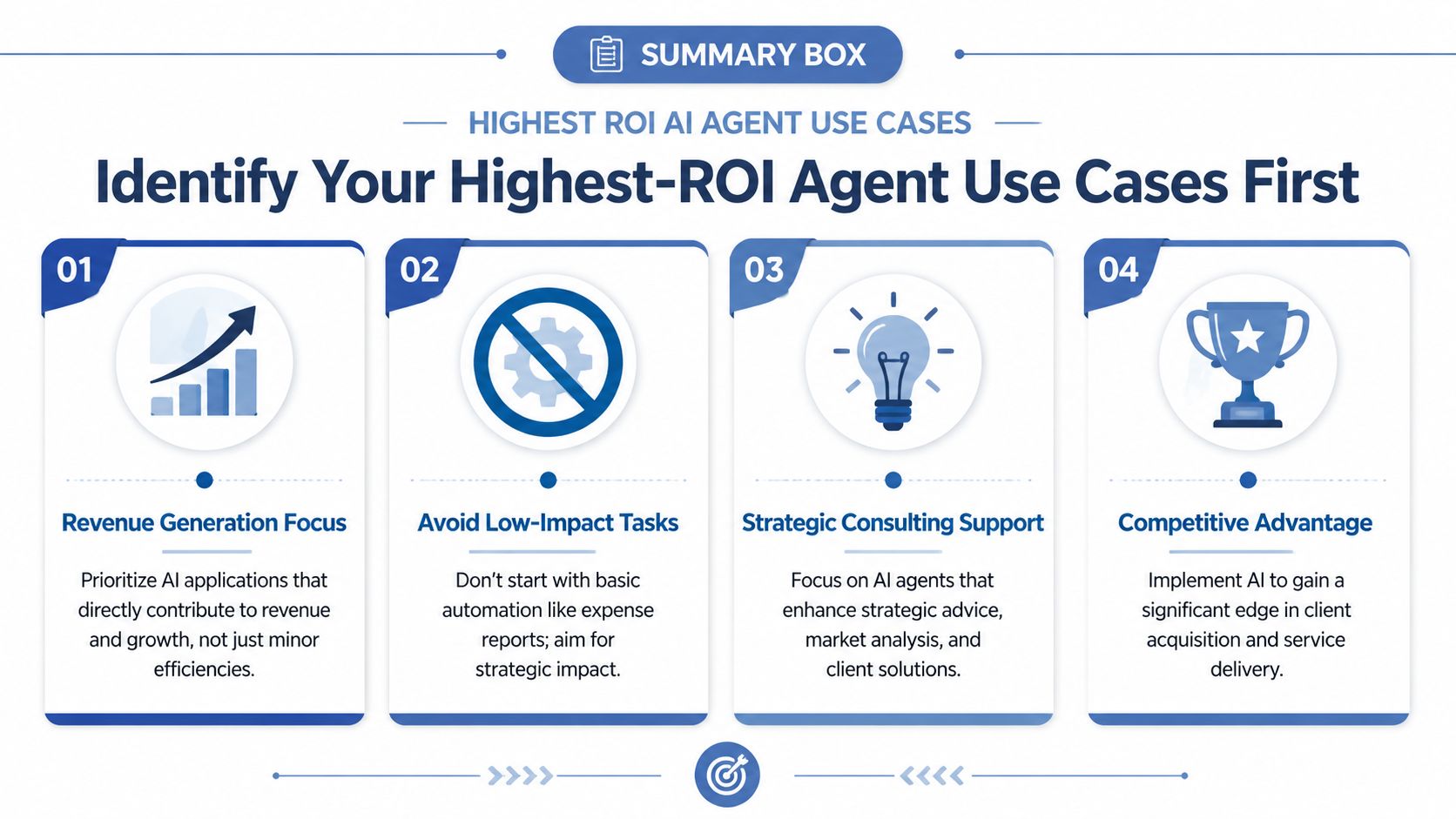
One example matters here. A mid-market strategy consulting firm grew revenue by 54%, moving from $12M to $18.5M annually after implementing AI agents, and for a larger firm, a $60,000 annual platform investment produced $3.2M to $4.8M in additional revenue, which translated to over 5,000% ROI, according to this consulting AI agent analysis.
The three use cases I'd prioritize
- Proposal agent
This is usually the fastest commercial win.
Give the agent access to your CRM, your past proposals, your positioning, and your delivery templates. Then let it produce a first draft that reflects the prospect's industry, pains, likely objections, and recommended scope. Your consultants stop starting from zero and start editing from strength.
- Competitive intelligence agent
Consulting firms love saying they're strategic. Few act like it operationally.
A competitive intelligence agent watches competitors, market shifts, client announcements, and new service launches. It feeds your team short, decision-ready briefs instead of forcing someone to spend hours gathering fragments from the web and internal notes.
- Client opportunity agent
This one is underrated and highly profitable.
It scans account history, prior recommendations, new stakeholder activity, changing market conditions, and open issues across clients. Then it flags expansion plays. New workshop. New analytics package. New advisory retainer. This is how you stop waiting for clients to define the next project.
What to skip at the start
Don't build your first agent around low-stakes admin work if you're trying to change the economics of the business.
Use this filter:
- High impact: touches pipeline, proposals, client retention, account growth, or delivery quality
- High repetition: happens often enough to justify system design
- High context density: requires pulling information from multiple places
- Clear human review: a consultant can approve, refine, or reject the output quickly
That's the bar.
If you want a broader menu of patterns, I've mapped more examples in this guide to AI agent use cases.
A quick side note. If your consultants record sales calls, workshops, or client reviews and want to repurpose those moments into short content for authority building, learn how ProdShort simplifies social clip creation. It fits well beside an agent-driven thought leadership workflow.
Here's a good walkthrough to pair with this section before you build anything more complex:
The right first agent doesn't save your team a bit of time. It changes how fast your firm can pursue and close business.
Design Your First Consulting Agent Architecture
An agent isn't magic. It's a stack.
I think about it in three parts. Reasoning, tools, and context. Get those three right and you have something useful. Get one wrong and the agent becomes a polished way to generate mediocre work.
The three components that matter
Reasoning model
This is the brain. It plans, decides, interprets inputs, and drafts outputs.
Use stronger reasoning models for diagnosis, proposal strategy, and synthesis. Use cheaper models for formatting, extraction, or rewriting. Don't burn premium model cost on tasks that are basically structured clerical work.
Tools
This is how the agent takes action.
Typical consulting tools include CRM access, document search, spreadsheet parsing, web research, meeting transcript access, project management data, and template retrieval. If the model can think but can't touch the systems where your firm lives, it stays ornamental.
Context
This is the memory layer.
Your tone of voice, service lines, ideal client profiles, case examples, pricing logic, proposal structures, delivery playbooks, and domain rules belong here. Without context, the agent writes like a generic intern. With context, it starts sounding like your firm.
A practical component map
| Agent Type | Primary Model | Essential Tools | Data Sources |
|---|---|---|---|
| Proposal agent | Strong reasoning model | CRM retrieval, document search, template generator | Past proposals, service pages, client notes, pricing logic |
| Research agent | Search-capable model | Web search, page extraction, source summarizer | Competitor sites, industry news, analyst-style internal notes |
| Account growth agent | Strong reasoning model | CRM access, meeting transcript search, task history lookup | Client history, call notes, project outcomes, stakeholder records |
| Knowledge agent | Balanced model | Internal search, tagging, summarization | Confluence, Notion, SharePoint, decks, SOPs |
Platform or custom build
Founders waste months here.
If your firm needs a result quickly, use a platform. If your firm has unusual compliance, proprietary workflows, or deep internal engineering capability, go more custom. Most consulting firms should not start by building every layer from scratch.
My bias is simple:
- Use platforms when you need speed, lower implementation risk, and easier iteration
- Use custom architecture when the agent is becoming core infrastructure and must fit tightly into your stack
- Avoid all-in-one lock-in if the platform makes it hard to swap models or export logic later
MindStudio is one option for fast visual workflows. LangChain is useful if your team wants more engineering control. If you need outside help designing the architecture itself, my Fractional CAIO advisory work covers agent systems, context design, and revenue-focused implementation.
Match the architecture to the job
Don't ask one general-purpose agent to do everything.
A proposal agent should not also handle raw web scraping, pricing governance, legal review, and deck design in one pass. That's how quality drops. Split the workflow into specialist actions. Research first. Then synthesis. Then draft generation. Then human review.
That structure matters because agent performance improves when you narrow the scope of each action. Shorter tasks. Clear inputs. Defined outputs. Better reliability.
Build Your Firm's Central Intelligence Engine
Most consulting agents fail for a boring reason. They don't know anything specific about your firm.
If your agent can't access your CRM, past project materials, delivery methods, and internal knowledge base, it can only produce polished generic work. That won't help you win serious deals.

Connect the systems that already hold your edge
The first two integrations I care about are your CRM and your internal knowledge base.
CRM data gives the agent commercial context. Who the buyer is. What's been discussed. What proposals were sent. Which stakeholders matter. What service lines they've already bought. That's where good pursuit strategy starts.
Your knowledge base gives the agent proof and pattern recognition. Past deliverables. Methodologies. Frameworks. Meeting notes. Industry-specific observations. Reusable examples. Your actual advantage sits in these resources.
According to a 2025 PwC survey, 79% of companies have already adopted AI agents, 66% report measurable value through productivity gains, and industry benchmarks show 3x to 6x first-year ROI when agents are properly integrated with core business systems, as summarized in this AI agent statistics roundup.
What the intelligence engine should include
A useful central intelligence layer usually has these ingredients:
- Read-only CRM access so the agent can pull account history without risking bad writes
- Retrieval over internal documents so it can ground responses in your firm's actual work
- Structured metadata like industry, service line, project type, client size, and outcome category
- Permission controls so partners don't accidentally expose sensitive client information to the wrong people
- Prompt and context rules that tell the agent what to cite, what to avoid, and when to ask for human review
I've gone much deeper on this operating model in my guide to agentic context engineering.
If your agent isn't grounded in your CRM and your internal knowledge, it isn't a consulting asset. It's a writing assistant.
Use retrieval, not blind generation
RAG, or retrieval-augmented generation, becomes practical instead of theoretical in this context.
The agent receives a task. It searches your approved internal sources. It retrieves the most relevant chunks. Then it drafts from those materials instead of improvising from generic model memory. That alone reduces fluff and raises trust.
Keep the write path narrow. Approved sources in. Clear answer format out. Consultant review before anything client-facing leaves the building.
Orchestrate and Measure Agent Performance
One good agent helps. A coordinated system changes the business.
I rarely deploy a single monolithic consulting agent anymore. I deploy specialists. A research agent. A synthesis agent. A proposal agent. A CRM update agent. A meeting-prep agent. They pass work between each other in sequence.
Orchestration beats one-agent chaos
A simple consulting workflow might work like this:
- A new opportunity lands in Salesforce.
- A research agent gathers company, market, and competitor context.
- An analyst agent turns that into a structured brief.
- A proposal agent drafts the response, scope outline, and specific messaging.
- A human reviewer edits and approves.
- A follow-up agent logs the output and next-step recommendations back into the CRM.
That's not overengineering. That's how you remove friction from a revenue process without trusting one model to do too much.
Measure the system like an operator
Most firms track vague adoption metrics. That's weak management.
Track performance at the task level. Successful deployments achieve 85% to 95% autonomous completion on well-defined subtasks, while end-to-end complex processes can fall to 24% to 43% success, according to this AI agent success metrics breakdown. That's why task decomposition matters so much.
Use a scorecard like this:
- Autonomous completion rate for each subtask
- Human correction rate on client-facing outputs
- Proposal turnaround time from opportunity creation to first draft
- Agent-influenced revenue tied to proposals, renewals, or expansions the system supported
- Failure mode tracking so you can see whether the issue came from model reasoning, bad retrieval, missing data, or broken tool use
What to optimize first
Don't optimize elegance. Optimize bottlenecks.
If the proposal agent drafts well but uses weak inputs, fix retrieval. If the research agent finds good material but takes too long, tighten the source list and output schema. If consultants are rewriting everything, narrow the task and improve context instead of adding more prompt instructions on top of a broken workflow.
Key takeaway: Agents are strongest on short, well-scoped actions. Build the workflow from dependable subtasks upward.
A simple internal dashboard is enough in the beginning. You don't need a giant BI project. You need visibility into where the system is helping, where it's stalling, and where human review catches mistakes.
Navigate the Real-World Risks and Team Adoption
Vendors love to sell upside and skip the ugly parts. Don't make that mistake.
Agents can fail because the data is weak, the retrieval layer is messy, the task is too broad, or the team doesn't trust the output. All four happen in practice. That's normal. What matters is whether you design around those risks from the start.
Data quality is the first battlefield
Gartner's 2025 reporting found that 30% to 40% of AI projects fail due to poor data quality, and a 2026 McKinsey survey found that successful AI adoption in consulting can improve client win-rates by 15% to 25%, according to this summary on AI agent implementation risks. The implication is straightforward. Sloppy implementation is expensive. Good implementation pays.
Your first protections should be operational, not philosophical:
- Human review on critical outputs such as proposals, pricing recommendations, and client reports
- Read-only access first so agents can't damage records while you validate performance
- Approved source boundaries to stop the system from pulling in junk context
- Pilot on one team before rolling it across the whole firm
Your senior team may resist this
That resistance doesn't mean they're wrong. It usually means they can see the risk.
Consultants don't want to be replaced by low-trust automation. They want help eliminating repetitive work so they can spend more time on diagnosis, client relationships, and high-value judgment. Clearly position the system. It's a co-pilot for the grunt work and a force multiplier for the thinking work.
A lot of AI rollouts fail for the same reason ordinary strategy rollouts fail. The plan looks good. Execution breaks. If you want a useful lens on that pattern, read why strategy execution fails.
What I'd do in your shoes
Start with one painful, revenue-linked workflow. Build a narrow agent. Ground it in internal data. Require human approval. Measure output quality every week. Expand only after the team trusts it.
That approach is less glamorous than “AI transformation.” It also works.
If you want to build an ai agent for a consulting business that drives revenue, start with proposal flow, competitive intelligence, or account expansion. Tie the system into your CRM and knowledge base. Decompose tasks. Measure completion and correction. Keep humans on final approval until the workflow proves itself.
That's how you build a consulting firm that moves faster than competitors without lowering standards.