
Most ecommerce teams are still deploying AI like it's a nicer FAQ box. That's already outdated.
The companies that win with ai agents for ecommerce brands build systems that guide discovery, execute workflows, resolve service issues, and increasingly sit closer to the transaction itself. The commercial stakes are already obvious. The AI-enabled ecommerce market reached $8.65 billion in 2025 and is projected to grow to $22.60 billion by 2032, while 93% of ecommerce businesses now view AI agents as essential for staying competitive, according to SellersCommerce's ecommerce AI statistics roundup.
I'm Samuel Woods. I've been working with machine learning since 2016 and generative AI since 2019. My view is simple. If your agent can't influence revenue, reduce operating load, or improve your competitive position, it's a toy.
That's why I care less about chatbot polish and more about system design, tool access, policy boundaries, and commercial outcomes. If you want a broader read on how AI builders are changing e-commerce this year, start there. Then come back and build the thing that actually matters.
The Hype Is Over AI Agents Are Here to Win
The old framing was wrong. Ecommerce teams kept asking whether AI could help write product descriptions, summarize reviews, or deflect a few support tickets. Useful, sure. Strategic, not really.
Autonomy is the real shift. An agent retrieves live data, follows decision rules, uses tools, and completes work across your stack. That is the difference between a branded widget and an operating layer.
What changed in practice
Customers now expect immediate answers, personalized guidance, and frictionless resolution. Operators need lower service load, better conversion, and tighter response loops. AI agents sit in the middle and do both if you wire them correctly.
Your competitors are past the testing stage and are training customers to interact with software that responds instantly and acts on intent. Once buyers get used to that speed, static storefronts start feeling broken.
My rule is simple: if an agent can't read context and take an approved action, call it what it is, a script with better language.
Where teams still waste time
I see three bad patterns over and over:
- Vanity deployments, where a business launches a chat layer that answers generic policy questions but can't check order status, modify a cart, or route a customer to the next best action.
- Prompt-first thinking, where people obsess over wording while ignoring the data layer, APIs, and operational permissions that make the system useful.
- No economic model, where conversations get tracked instead of outcomes. That makes the spend impossible to justify later.
A real ecommerce agent should either help you sell, help you retain, or help you serve at lower operational cost. Ideally all three. Anything else belongs in the experiment bucket, not the core roadmap.
Four AI Agent Playbooks That Earn Their Keep
No single use case wins. A handful of high-impact playbooks do, and most brands should run more than one. The key is sequencing them properly.

Agentic commerce is projected to capture 10% to 20% of $190 billion to $385 billion in U.S. ecommerce spending by 2030, and traffic from AI-powered search converts nine times more frequently than social media referrals, based on Morgan Stanley's outlook on agentic commerce. That should change how you prioritize.
If you want a broader catalog of deployment patterns, I've outlined additional AI agent use cases for growth teams. For ecommerce, these four matter most.
1. Product discovery and curation
This is the frontline revenue play.
A strong discovery agent acts like your best in-store associate. It narrows choices, compares options, handles objections, and moves the customer toward a purchase without forcing them through your site navigation maze. This becomes even more important when shoppers arrive from AI interfaces with high commercial intent.
What you need under the hood:
- Clean product metadata covering attributes, compatibility, use-case tags, ingredients or specs, pricing, and availability.
- Decision logic with rules for substitution, bundles, inventory-aware recommendations, and margin-safe upsells.
- Channel awareness across on-site chat, embedded product pages, and APIs for agent-first discovery environments.
If your catalog is broad or technical, start here. You'll reduce choice paralysis and capture more high-intent demand before a marketplace or aggregator does.
2. Hyper-personalization at scale
Most “personalization” in ecommerce is still segment-level. That's too blunt.
An agent can personalize in-session. It can use browsing behavior, cart state, prior purchases, loyalty context, and customer questions to steer the interaction in real time. That means better recommendations, better timing, and fewer irrelevant prompts.
Here's the trade-off. Hyper-personalization only works when your customer data is accessible and permissioned correctly. If your CRM, ecommerce platform, loyalty system, and analytics stack don't talk to each other, the agent will sound smart and act dumb.
The best personalization system in ecommerce knows what the shopper is trying to get done right now. The number of copy variants matters far less.
3. Autonomous customer service
Most brands begin here, and that's fine. It's a practical starting point because support tickets are repetitive, structured, and measurable.
But don't stop at FAQ automation. A useful service agent should handle WISMO, returns eligibility, order edits within policy, shipping questions, and escalation routing. The goal is containment with quality. Engagement is beside the point.
A service agent also creates operational efficiency. Every repetitive question handled cleanly by software frees your team to deal with exceptions, fraud flags, damaged orders, and VIP situations that require human judgment.
4. Proactive churn prevention
Retention agents are underused.
You already know the signals. Repeat customers slow down. Loyalty members stop redeeming. A high-value buyer hits friction after a delayed shipment or refund dispute. An agent can watch for those patterns and trigger retention actions before the customer disappears.
This doesn't need to be flashy. It needs to be timely. A reminder, a loyalty clarification, a support intervention, or a customized recommendation can preserve revenue that many brands just leak.
Here's the strategic point. Your competitors are mostly using AI reactively. The moment you shift to proactive intervention, you start operating with a speed advantage they can feel but can't easily copy.
Architecting Your AI Agent for Action
An agent is a system with reasoning, memory, permissions, and tool access. A prompt with a logo on it doesn't qualify.
I explain this using a simple model. The brain decides. The body acts. If either side is weak, the whole thing breaks.
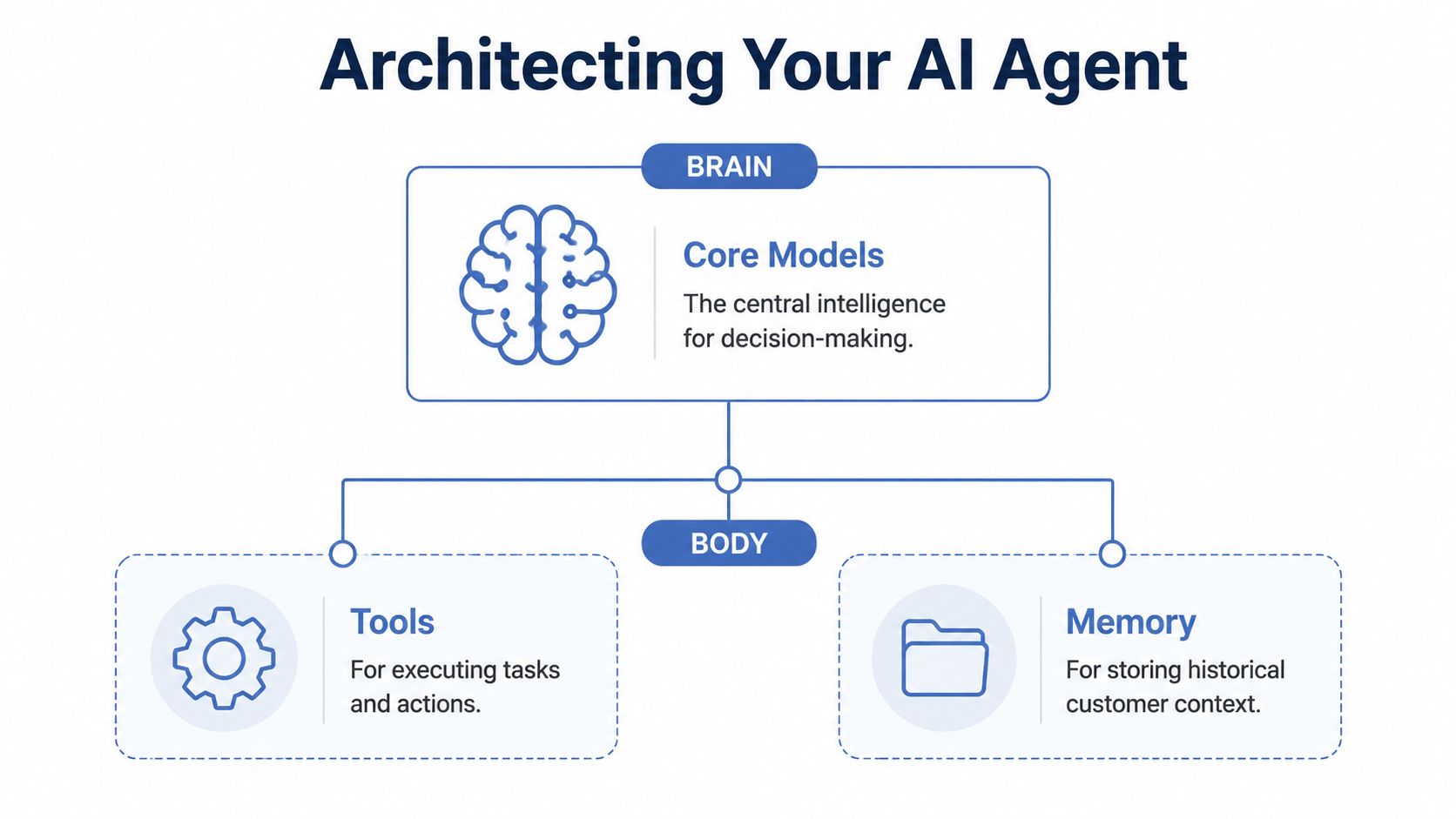
A critical gap in AI readiness is the discovery layer. Brands need semantic metadata in product catalogs, plus APIs that expose loyalty and eligibility so agents can discover products and transact securely, as outlined in Parallel's breakdown of what AI agents need to work. Most ecommerce teams are behind here.
The brain
The brain is your reasoning layer. Usually that means one or more large language models, sometimes paired with smaller models for speed or classification work.
You don't always need the biggest model. Use stronger models for ambiguous, high-judgment tasks like product comparison, policy interpretation, or complex service reasoning. Use smaller or narrower models for intent classification, extraction, or straightforward routing.
What matters more than model brand is context discipline. The agent needs the right inputs at the right moment. Catalog facts, order data, customer history, policy rules, and current session behavior all need to be assembled cleanly. That's why I spend so much time on agentic context engineering. Context is what turns raw model capability into operational reliability.
The body
The body is the action layer.
That means Shopify, BigCommerce, your CRM, your help desk, order management, inventory feeds, shipping systems, loyalty platform, and any internal tooling the agent needs to complete a workflow. If the brain can reason but the body can't do anything, the customer still ends up waiting for a human.
The body also needs limits. Just because an agent can call an API doesn't mean it should. Some actions should be read-only. Some should require customer verification. Some should route to approval.
Orchestration and memory
One agent can handle many tasks, but specialized agents often deliver superior results. A discovery agent, a service agent, and a retention agent do not require the same prompt stack, tools, or success criteria. If you are serious about scaling, you need orchestration. This guide on coordinating specialized AI workflows is worth reading because many businesses underestimate how quickly single-agent designs become brittle.
A clean architecture usually looks like this:
| Layer | What it handles | What to watch |
|---|---|---|
| Reasoning | Intent understanding, decisioning, response generation | Hallucinations, overreach, inconsistent policy application |
| Memory | Session context, customer history, prior actions | Privacy boundaries, stale context, missing resets |
| Tools | Orders, inventory, shipping, loyalty, returns, CRM | Permissions, latency, broken integrations |
| Governance | Approval rules, logging, exception paths | Fraud risk, margin leakage, lack of auditability |
Build for traceability from day one. If you can't explain why the agent took an action, you shouldn't let it take that action.
The Step-by-Step Implementation Roadmap
Starting with a scope that is too broad causes failure for many organizations. Avoid launching a “customer service agent” as if it were a single entity. Instead, begin with one workflow that features clear boundaries, repeatable data, and obvious business value.
A WISMO agent is the classic example. It's high-volume, repetitive, and heavily dependent on structured order and shipping data. That makes it a good training ground for your operating model.

Brands usually start around 30% to 40% resolution in weeks 1 to 2, then improve to 70% to 84% resolution after 4 to 6+ months by adding structured procedures, integrations, and continuous knowledge-base updates, according to Fin's guide to scaling ecommerce AI resolution rates. That progression is normal. Don't expect maturity on day one.
Phase 1 builds the operating surface
First, define the exact job.
Not “handle support.” More like: check order status, explain current shipment stage, surface expected delivery windows if available, clarify delays, and escalate exceptions. Narrow scope gives you cleaner prompts, cleaner testing, and fewer edge-case failures.
Then map the required data:
- Order data such as status, timestamps, items, and shipping method.
- Carrier or logistics data with tracking events and delivery state.
- Policy content covering shipping windows, escalation conditions, and compensation rules.
- Customer context for identity checks, contact info, and account linkage.
If a human agent needs a piece of information to answer correctly, your AI agent needs controlled access to it too.
Phase 2 defines behavior
Now write the behavioral contract.
I don't mean one giant prompt. I mean a system of instructions that covers role, goals, hard constraints, action rules, escalation triggers, and tone. You want the agent to know what it can do, what it must not do, and when uncertainty should trigger a handoff.
A practical instruction stack usually includes:
- A role definition that says what the agent is responsible for.
- Decision rules that set the order of checks to run and how to interpret them.
- Tool rules that name which APIs to call and in what sequence.
- Policy boundaries on refund, return, edit, and escalation limits.
- A response style that is short, direct, brand-aligned, and grounded in retrieved data.
I also recommend tagging every conversation by ticket type from day one. WISMO, returns, shipping ETA, damaged item, cancellation request. That segmentation is where your optimization roadmap comes from. If you want a broader implementation lens, I've published more on building AI agents inside businesses.
Instrument the workflow before you optimize the copy. You can't improve what you didn't classify.
Phase 3 adds tool use and exception handling
Most "smart" demos fail during production.
You need deterministic checks around identity, permissions, and exception categories. If the package is delayed, that's one branch. If tracking hasn't updated in a long window, that's another. If the order contains restricted items or split shipments, the agent may need to explain limitations rather than improvise.
Don't let the model invent process. Give it procedures. The best ecommerce agents are constrained where the business needs consistency and flexible where customer communication needs nuance.
Phase 4 closes the feedback loop
Launch is the beginning, not the finish line.
The agent will surface gaps in your content, tooling, and policy logic almost immediately. That's valuable. Every failed resolution should feed one of three queues: knowledge gap, workflow gap, or integration gap.
Use a short review cycle. Pull transcripts. Audit failure clusters. Update policy snippets. Refine API responses. Add escalation logic where needed. This is how brands move from basic automation to reliable containment over time.
The common mistake is assuming setup is a one-time project. It isn't. The agent becomes one of your sharpest diagnostic tools for operational friction if you treat it that way.
Measuring Agent Performance for Real Business Impact
Most analytics setups for AI are terrible. They focus on conversation count, engagement depth, or satisfaction prompts without tying any of it to the P&L.
That's a mistake. For commerce, the benchmark metrics are conversion, speed to purchase, containment, first-contact resolution, and support load reduction.

AI-assisted sessions have been reported to convert at 12.3% versus 3.1% without AI, and purchases are completed 47% faster. On the service side, one published retailer case automated 90% of inquiries and cut average response time from 24 hours to 3 minutes, based on Envive's benchmark summary for commerce agents. Those are the outcomes worth paying attention to.
What to measure for sales agents
For revenue-facing agents, I care about three numbers first:
| KPI | Why it matters | Good question to ask |
|---|---|---|
| Conversion rate | Shows whether the agent helps high-intent shoppers buy | Are assisted sessions buying more often than similar unassisted sessions? |
| Purchase speed | Reflects friction reduction | Are customers reaching checkout faster after agent interaction? |
| Average order pattern | Indicates upsell or bundle quality | Are assisted carts improving commercially, without hurting trust? |
You don't need a huge dashboard on day one. You need clean comparison logic. Compare assisted versus non-assisted sessions by traffic source, device, product type, and customer type wherever possible.
What to measure for service agents
Support agents need a different scorecard.
Track containment, first-contact resolution, transfer rate, and repeat-contact rate. Then tie those operational outcomes to labor load and backlog pressure. If the AI answers a lot of questions but still creates duplicate tickets, it isn't helping much.
I also look closely at failure shape. Did the agent fail because the policy was unclear, because the integration timed out, or because the model chose the wrong procedure? Those aren't the same problem, so they shouldn't be solved the same way.
If your AI dashboard doesn't connect to conversion or workload reduction, you built a reporting toy.
What to ignore
Don't obsess over raw engagement volume.
More conversations can mean more friction. A great shopping agent may need fewer turns because it resolves the issue quickly. A strong service agent may reduce chat length by pulling the right live data immediately.
Good AI performance often looks boring in the transcript and excellent in the business numbers. That's what you want.
From First Agent to an Autonomous Fleet
Most advice in this space still dodges the hard question. When should you let the agent act on its own?
That is the primary issue. As agents move from assistive behavior into transactional behavior, governance becomes the dividing line between scalable automation and expensive chaos. Burke calls this out directly in its discussion of shopping agents and the risks around refunds, order edits, and autonomous actions in this analysis of AI agents for shopping.
Where autonomy should start
Start autonomy where the data is structured, the policy is clear, and the downside is low.
Good early candidates include order status explanations, return eligibility checks, product comparison, basic loyalty lookups, and approved cart guidance. These workflows are bounded and auditable. They teach your team how the system behaves under load.
Bad early candidates are anything with fraud exposure, subjective exception handling, or margin-sensitive judgment unless you've built strong approval logic around them.
A simple governance checklist
Use this before expanding any agent's permissions:
- Approval thresholds decide which actions the agent can complete directly and which require a human review step.
- Identity verification confirms the customer is authorized before the system discusses or changes an order.
- Exception handling defines what happens when policy rules conflict, data is missing, or the customer request falls outside known flows.
- An audit trail lets you review what the agent saw, what it decided, and which tools it used.
- A rollback path lets you reverse a bad call quickly and learn from it.
What scaling actually looks like
An autonomous fleet is a portfolio of agents, never one giant super-agent.
You'll usually end up with separate agents for discovery, service, retention, internal ops, and maybe merchant intelligence. Each one gets its own tools, memory scope, KPIs, and permission model. Shared governance sits above them.
That's how you scale safely: specialized workers with clear operating boundaries, and no single model with unrestricted access to everything.
The payoff is simple. Your company responds faster than competitors, learns faster than competitors, and serves customers with less friction than competitors. In ecommerce, that compounds.
If you want help designing ai agents for ecommerce brands that transact, integrate, and stay under control, I work with owners and small teams on the architecture and rollout. Here's how to work with me.