
Competitors are already building AI into real work, and the gap isn't theoretical. The International Labour Organization reported in 2025 that one in four workers worldwide are in occupations with some degree of generative-AI exposure, and most of those jobs are expected to be transformed rather than eliminated because human judgment still matters (ILO 2025 update). If you're still treating AI like a side experiment, you're already behind leaders who are turning it into a bionic workforce.
I'm Samuel Woods, a Fractional Chief AI Officer. I've worked with ML since 2016 and Generative AI since 2019, and I'm going to be blunt, the companies that win this decade won't be the ones that “use AI.” They'll be the ones that design AI employees to do specific jobs faster, cheaper, and more consistently than their competitors can.
Table of Contents
- Your Competitors Are Building Their AI Workforce Now
- What AI Employees Really Are
- The Strategic Business Case for Bionic Workers
- High-Impact Use Cases in Marketing and Growth
- A Framework for Deploying Your First AI Employee
- Managing Risks and Building Governance
- Your Next Move in the Age of AI Labor
Your Competitors Are Building Their AI Workforce Now
Simple. Your competitors don't need to replace their whole team to beat you, they only need to automate the work that slows them down. That's why AI employees matter, they turn routine throughput into an advantage your sales team, marketing team, and support team can feel every day.
The market signal is already loud. In the U.S., Gallup found that 19% of employees said they use AI at work a few times a week or more, 8% use it daily, and that daily figure was up from 4% a year earlier. Gallup also found that 40% of employees had used AI in their role at least a few times a year, nearly double the 21% recorded two years earlier (Gallup workplace tracking, via ILO briefing context). That's not hype. That's behavior changing inside real companies.
The strategic mistake most leaders make
Too many CEOs still frame AI as software procurement. That's the wrong lens. You're not buying a tool, you're building a labor layer that can take over chunks of work that used to require human attention, then hand off only the edge cases.
Practical rule: if a task has clear inputs, clear outputs, and repeatable logic, it should be on the shortlist for an AI employee.
The companies moving fastest are treating this as a labor strategy, not a tech novelty. In Q1 2025, there were 35,445 AI-related positions in the U.S., up 25.2% year over year, and the median salary reached $156,998 (Veritone labor-market analysis). That tells you where the market is putting value. AI-capable labor is now strategic labor.
The broader message is even more important. Brookings says generative AI could disrupt at least 50% of tasks for more than 30% of workers, and at least 10% of tasks for about 85% of workers (Brookings). If you're a CEO, that's not a distant labor-market curiosity. It's a direct warning that speed, capacity, and execution are about to separate winners from laggards.
What AI Employees Really Are
An AI employee is not a chatbot with a nicer title. It's an autonomous software agent built around a defined job, scoped access, and explicit performance targets. That distinction matters because a generic assistant talks, while an AI employee does work.
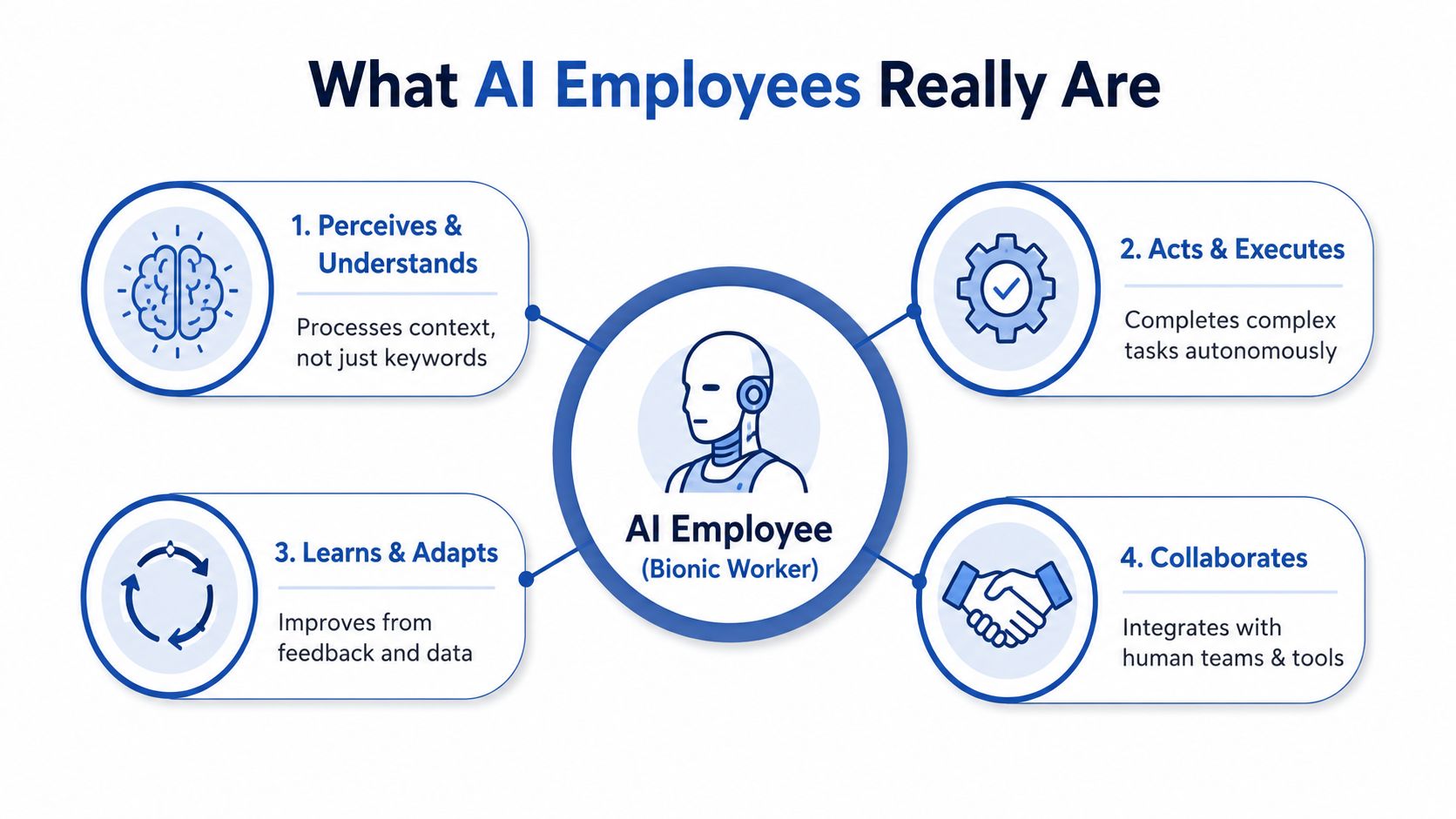
The job description comes first
Think like an operator, not a prompt hobbyist. If you want an AI employee to be useful, assign it a role with a measurable outcome. For example, a marketing operations agent might enrich leads, tag campaign responses, and route qualified prospects, while an SDR follow-up agent might send first-touch replies and escalate only the replies that need human judgment.
The highest-fit work is usually high-volume and structured. That includes marketing operations, SDR follow-up, and L1 support, because these functions have stable inputs, predictable handoffs, and success metrics you can track, like leads moved, responses generated, or content units produced (practical definition of AI employee).
Autonomy without control is how companies get burned
A real AI employee has scoped system access, not open-ended freedom. It should know what systems it can read, what it can write, what it must escalate, and where human review is mandatory. That's how you get execution without turning your stack into a compliance nightmare.
I'd frame it this way.
An AI employee should be able to finish the full workflow, but it should never be trusted to improvise in areas that affect money, privacy, or legal exposure.
That's also why I push business leaders to think in workflow terms. If the agent has to bounce between disconnected tools, it will fail under real load. If you give it clean inputs, a narrow mission, and a decision boundary, it can operate like a reliable digital teammate.
The smartest companies are not asking, “Can AI talk like a person?” They're asking, “Can AI carry a business process from start to finish without dragging a human through every step?” That's the bar.
The Strategic Business Case for Bionic Workers
The upside of AI employees is not a smaller bill. It is faster execution, tighter consistency, and broader reach. Used correctly, they stop your company from depending on human bandwidth for every repetitive action, and that changes how quickly you can take ground in the market.
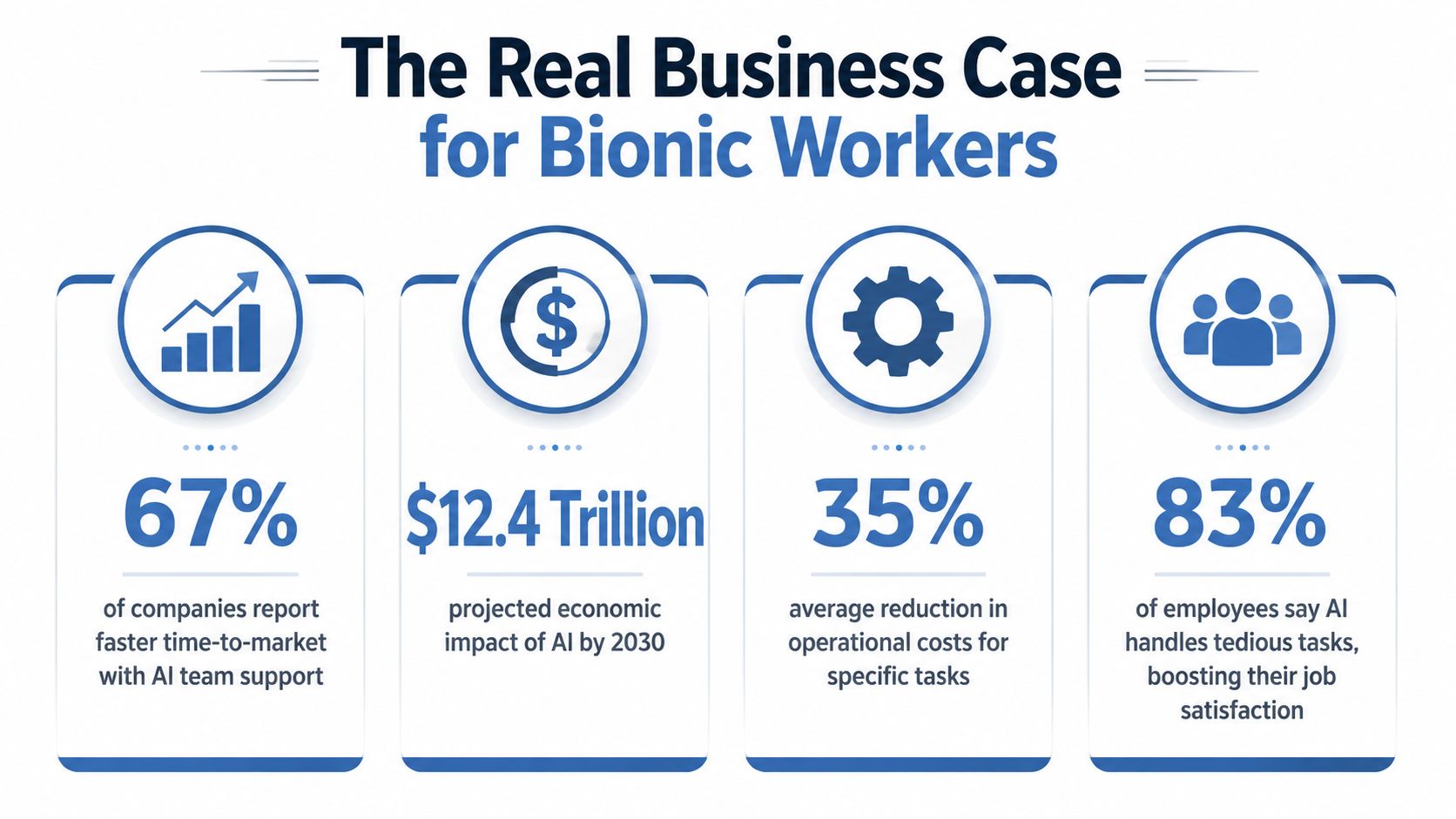
Why this becomes a moat
A strong AI workforce helps you see and respond faster than slower teams. It also lets you collect more signals from the market, process them sooner, and turn them into action while competitors are still stuck in manual loops. The moat starts in that operating rhythm, not in the model itself.
The business case gets stronger when you compare assisted work with redesigned work. SHRM's 2026 workplace report says AI users are saving up to six hours each week, while Glean's 2026 Work AI Index says workers report about 11 hours per week saved through automation alone (SHRM 2026). The spread matters. It shows the gain depends on how much of the workflow you automate, not just whether you let people use AI.
Gallup's Q4 2025 workplace tracking found that 38% of U.S. employees said their organization had already integrated AI technology to improve productivity, efficiency, and quality, while 49% said they never use AI at work (Gallup Q4 2025 workplace tracking). That is a classic transition pattern. Some teams are already building advantage, while others are still waiting for permission.
The win comes from redesign, not decoration
If you want compounding value, redesign the process so the AI employee owns the repetitive middle. A human should set direction, review exceptions, and make strategic calls. The agent should handle the grunt work that slows your best people down.
A practical planning lens comes from AI social media content creation from ShortsNinja. It pushes teams toward repeatable output systems instead of one-off prompts. That same principle applies across the company, not just in content.
For a broader operating model, I'd also point you to my own business automation with AI framework. Build systems that remove repeated work at the process level, then measure the business outcome, not the novelty of the tool.
Bottom line: if the AI does not change throughput, response time, or decision velocity, you have bought software theater.
High-Impact Use Cases in Marketing and Growth
Marketing is where AI employees become obvious fast because the work is already fragmented, deadline-driven, and full of repeatable patterns. That makes it ideal for a bionic workforce. You don't need to imagine the use case, you can map it to revenue work you're already paying humans to do.

The 24/7 SDR who never forgets the follow-up
A real AI SDR should qualify leads, respond to inbound intent, and push meetings into the calendar without waiting for a human to catch up. It doesn't need charm. It needs discipline, speed, and a clean escalation path for edge cases.
That matters because buyers don't wait. If your competitor replies first, your rep is already behind. An AI employee can handle the first wave of intake and make sure no lead sits in a queue because someone's inbox is full.
The market intelligence analyst who never sleeps
AI gets dangerous in a good way. A market intelligence agent can monitor competitors, track messaging shifts, summarize customer complaints, and surface changes before your team would normally notice them. Used well, it becomes an always-on scanning layer for your growth team.
I like this role because it compounds. The agent doesn't just save time, it improves what your team decides to do next. That's how you build an informational edge.
The content strategist who works from signals, not guesses
An AI content strategist should not just draft posts. It should synthesize keyword themes, customer language, objection patterns, and campaign history into briefs your writers can use. That means fewer random content bets and more output tied to demand.
For a marketing-specific operating model, I'd look at AI agents for marketing and think in terms of ownership. Which work can the agent own end to end, and which work needs a human voice or approval? That's the line that separates a useful system from a messy toy.
If you want the cleanest mental model, assign the AI employee one of three jobs:
- Lead response: capture intent fast, route it correctly, and prevent drop-off.
- Signal synthesis: turn scattered data into priorities your team can act on.
- Draft production: generate the first version so humans spend time improving, not starting from zero.
That's the marketing edge. Faster reaction, higher consistency, and less wasted human effort. Your competitors can copy your ad copy. They can't easily copy a system that sees sooner, reacts sooner, and ships sooner.
A Framework for Deploying Your First AI Employee
Start small, but start like an operator. The biggest mistake I see is teams picking a flashy use case before they've defined the workflow, the access rules, and the success metric. That turns AI into an experiment instead of a system.
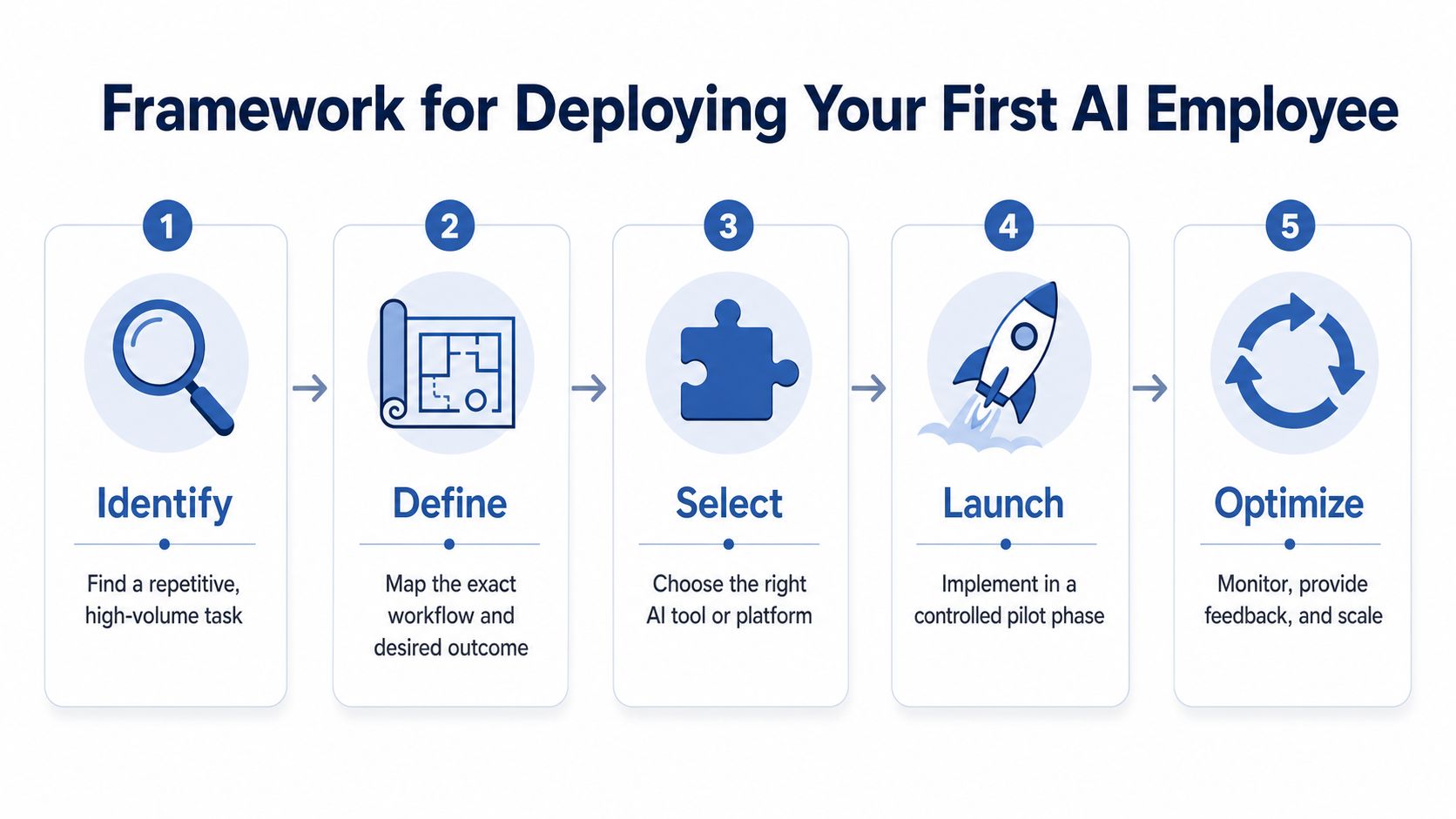
1. Pick a narrow role with repetitive output
Choose a job with volume, structure, and a clear definition of done. Don't start with “strategy.” Start with something like first-response routing, content brief drafting, or CRM enrichment.
2. Map the workflow before you pick the tool
You need to know the exact handoffs. What comes in, what gets checked, what gets written back, and where humans intervene. If you skip this, the agent will just automate confusion.
3. Keep the tech stack boring
Use the simplest stack that can do the job reliably. The best implementation is rarely the most complex one. Your goal is control, not elegance.
4. Define KPIs that matter to the business
Measure throughput, turnaround time, accuracy, and escalation quality. If you can't connect the AI employee's output to a business result, you're not running a business system, you're running a demo.
5. Pilot, then expand
I prefer a controlled pilot because it exposes the weak points fast. Once the workflow is stable, scale it sideways into adjacent tasks.
My rule: if you can't describe the workflow on one page, you're not ready to automate it.
The reason this matters is simple. AI value comes from process redesign, not from sprinkling a model over a broken operation. That's also why a small team can move faster than a large one, because fewer handoffs means fewer failure points.
For a step-by-step implementation mindset, my guide on deploying AI agents in a small team is the right reference point. Watch the workflow, not the buzzword count.
If you want the first pilot to land, assign one owner, one system, one outcome. That discipline keeps the project from turning into a committee-driven science fair.
Managing Risks and Building Governance
Governance isn't red tape. It's how you keep AI useful after the first quarter of enthusiasm fades. The companies that scale AI safely are the ones that put guardrails in place before the first serious mistake.
Security, accuracy, and compliance are all part of the job
Production AI needs scoped permissions, human review for high-risk actions, and output checks for accuracy, confidentiality, compliance, security, and bias. Security guidance from Zscaler also warns that AI-generated code should never be treated as production-ready without review, and that sensitive data like credentials, API keys, and proprietary information shouldn't be entered into unsanctioned AI tools (Zscaler security guidance). If you ignore that, you're not being forward-thinking, you're being careless.
Regulation matters too. The EU AI Act already imposes hard requirements on high-risk systems, including technical documentation, automatic record-keeping, human oversight, minimum standards for accuracy, resilience, cybersecurity, and a quality management system (EU AI Act summary). It also bans certain exploitative practices tied to vulnerabilities such as age, disability, or socio-economic circumstances. If your AI touches hiring, credit, or other regulated workflows, governance is part of product design.
Shadow AI is a usability problem, not just a policy problem
A lot of companies try to stop unauthorized AI use with policy memos. That usually fails. Employees route around tools that are clunky, slow, or obviously worse than public alternatives. The solution is a sanctioned system that is easier to use than the shadow option.
BCG's 2025 research also points to a leadership gap. Only about one-quarter of frontline employees feel strong leadership support for AI, while positive sentiment jumps from 15% to 55% when support is strong (BCG 2025). That tells me this is as much a change-management problem as a technical one.
Governance should make AI easier to trust, not harder to use.
You also can't ignore inclusion. The OECD's 2024 analysis argues that AI impacts should be monitored through a gender lens and that targeted efforts are needed to bridge divides in AI-linked opportunities (OECD 2024). That's not a side issue. If your AI rollout amplifies access gaps, you'll scale the wrong culture.
The CEO-level answer is straightforward. Build the guardrails, assign accountability, and make the tool usable enough that people use the approved path. That's how you turn risk control into a competitive advantage.
Your Next Move in the Age of AI Labor
AI employees are already changing how work gets done. The labor market data says the shift is broad, the workflow evidence says the gains are real when you redesign the process, and the governance evidence says reckless deployment is a dead end. That leaves one conclusion. This is a strategic operating decision, not a software trend.
The companies that dominate will not be the ones with the most AI experiments. They'll be the ones that build a bionic workforce around clear roles, hard guardrails, and measurable outcomes. That's how you create speed that competitors can't copy quickly enough.
Start with one question. Which repetitive task in your business is high-volume, easy to define, and expensive to do manually? That's your first AI employee. Pick the workflow, define the handoffs, and make one leader responsible for the result.
Then run a small pilot and measure what changes. If throughput improves and quality holds, expand the role. If the workflow breaks, fix the process before you scale the agent.
If you want to turn this into a serious operating advantage, start mapping your first deployment today and use Samuel Woods' frameworks as a practical guide for building the kind of AI workforce your competitors will struggle to match.