
Lead generation is broken. Most sales and marketing teams are still stuck in the past, manually chasing cold leads with dismal success rates. Your competitors are wasting time and money on a broken model. It’s a grind.
Finding more leads is the easy part. The real job is building a machine that brings the right leads directly to you. A machine that identifies high-intent prospects, engages them with hyper-personalized messages, and delivers sales-ready opportunities to you. Without the manual labor.

I'm Samuel Woods. I've been building machine learning systems since 2016 and working with generative AI since 2019, long before it was a buzzword. I don't care about AI hype. I care about revenue and a competitive advantage you can measure.
In this guide, I'll walk you through the exact frameworks I use to build these 'bionic' growth engines using a new breed of AI lead generators.
Every workflow here is one you can start small and test.
The work here is redesigning how leads are found, scored and contacted in your business. By the end, you'll know exactly how to use AI for lead generation to build a lead machine that keeps running while you do other work.
Start with the data.
The Foundation: Fueling Your AI Engine with Quality Data
Get one thing straight first: AI is not a magic wand. Most AI lead generation efforts I see fail. The reason is almost always the same.
They try to apply powerful models to garbage data.
Before you even think about deploying an AI agent, you need to get its fuel source right. That fuel is clean, relevant, and actionable data. Your competitors are likely running AI on messy, incomplete information. They get sputtering, unpredictable performance and, eventually, a total breakdown.
You’re going to build a proper fuel supply chain.
1. Identify Your High-Value Data Sources
Your most valuable data isn't locked away in some third-party platform. It’s already inside your business. Start by identifying and unifying these core sources. This is the bedrock of your entire system.
Your CRM history is a goldmine. It contains every past interaction, closed-won deal, and lost opportunity. AI can analyze it to find patterns you would never spot by hand, identifying the true characteristics of your best customers.
Your website analytics show more than traffic. Dig into what your best customers actually do on your site. Which pages do they visit before converting? What content do they download? This behavioral data is a powerful predictor of intent.
Third-party intent data is where you look outside your own walls. Platforms can show you which companies are actively researching solutions like yours right now. This is the signal that separates a cold prospect from a warm lead.
Combining these sources creates a multi-dimensional view of your market. This is how you move from basic targeting to predictive intelligence.
2. Turn Static Lists into Dynamic Intelligence Streams
A static list of leads is a depreciating asset. The moment you acquire it, it starts going stale. This is where AI agents give you a clear edge over competitors.
Instead of manually updating records, you deploy autonomous agents to do it for you. 24/7. I've built systems for clients using no-code tools like Clay that perform tasks like:
- Scraping LinkedIn to detect when a key contact at a target account changes jobs.
- Monitoring company press releases for trigger events like new funding rounds.
- Automatically finding and appending missing email addresses or phone numbers.
This transforms your CRM from a dead database into a live intelligence stream. While your competitors are working with outdated information, you're acting on real-time signals. That's a big head start.
To build this foundation, you need the right platforms. Researching the best AI tools for sales prospecting is a sensible first step.
3. Create a Machine-Readable Ideal Customer Profile
Your Ideal Customer Profile (ICP) can't be a pretty document in a Google Drive folder. For an AI to use it, it needs to be a structured, machine-readable set of attributes.
This machine-readable ICP goes beyond firmographics like company size. It includes nuanced behavioral and technographic data. For one SaaS client, I found their best customers consistently used a specific marketing tool and had recently hired a "Director of Growth." I encoded these attributes into their AI's ICP.
This level of detail is a core part of what I call context engineering. It's about structuring information so an AI can reason with it effectively. You can learn more about my approach to context engineering for business AI in my dedicated guide.
With a precise, machine-readable ICP, your AI can instantly score and prioritize incoming leads far more consistently than you can by hand. You stop wasting time on bad-fit leads.
Building Your AI Lead Generation Workflows
Enough theory. This is where you get your hands dirty and build the systems that drive revenue. Your competitors are probably tinkering with a few standalone AI tools. You’re going to build integrated workflows that become a permanent part of your growth engine.
These are frameworks I’ve rolled out with clients, and each one produces measurable results. My advice? Pick one, get it running, and then move to the next.
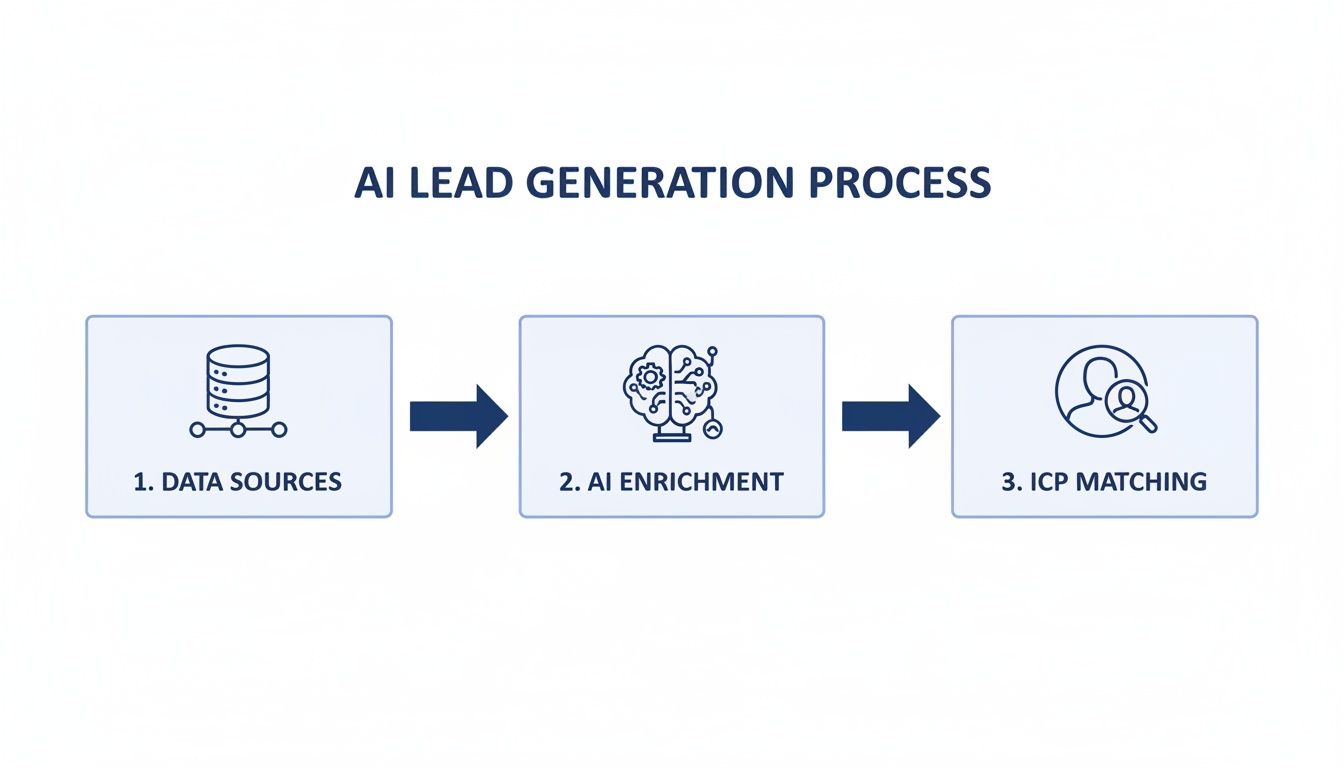
Think of it as a sequence: start with raw data, use AI to enrich it, and then filter it all through your machine-readable ICP to strike gold.
Workflow 1: The Signal-Based Outreach Agent
This is your automated scout, constantly scanning the market for buying signals. While your competitors wait for forms, your agent is already in motion.
A classic example I set up for clients is monitoring job boards. If you sell HR software, a company hiring its first “Head of People” is a five-star prospect. The agent spots this, finds the likely decision-maker (the CEO or COO), and feeds this to a model like Claude 3 Opus with a highly specific prompt I've engineered.
The resulting outreach feels like it was written by a thoughtful human advisor, not a robot. I’ve seen these signal-based emails hit reply rates of over 35%. That’s 5x to 7x higher than your competitors' generic cold outreach.
Workflow 2: The Predictive Lead Scorer
It's time to throw out your simplistic MQL model. Awarding points for email opens is a relic. A predictive lead scorer is your AI brain, analyzing hundreds of signals to figure out which leads will actually become customers.
This workflow plugs into your CRM and builds a model based on your historical closed-won deals. It quickly learns that a VP from a fintech company who downloads a specific whitepaper and whose company just got Series B funding is 90% likely to close.
Whoever handles sales sees a simple grade (A, B, C, D) and knows exactly where to focus. That can mean a 30-40% jump in sales productivity. For a deeper look at what these automated systems can do, check out these marketing automation workflow examples.
Workflow 3: The 24/7 Qualification Bot
Finally, build your front-line qualifier: an AI agent trained on your company’s entire knowledge base, far from the dumb "How can I help you?" chatbot everyone hates.
For the step-by-step build, including the scoring, the routes and the number to watch, see my AI lead qualification workflow.
Its jobs are simple:
- It qualifies visitors by asking the same discovery questions your best SDR would.
- If a visitor qualifies, it connects to your calendar and books a meeting instantly.
- If they're not ready, it captures their info for a relevant nurture sequence.
The impact is large. Businesses that deploy AI chatbots see a 64% increase in qualified leads. This one workflow can grow your pipeline without adding headcount.
AI Workflow Impact Comparison
Implementing these workflows changes your business outcomes, and efficiency is the smaller part of it. The table below breaks down the real-world difference between sticking with traditional methods and upgrading to an AI-powered approach.
| Workflow | Traditional Method Outcome | AI-Powered Outcome | Key AI Advantage |
|---|---|---|---|
| Signal-Based Outreach | Low reply rates (<5%); manual, slow prospecting. | High reply rates (>20%); proactive, real-time engagement. | Precision Targeting: Acts on intent signals, not just lists. |
| Predictive Lead Scoring | Reps waste ~50% of time on unqualified leads. | Sales productivity increases 30-40%; focus on A-tier leads. | Revenue Focus: Scores based on closed-won deals, not vanity metrics. |
| 24/7 Qualification Bot | Lost leads after-hours; high friction to book meetings. | 64% more qualified leads; instant meeting booking. | Scalability: Qualifies leads 24/7 without human overhead. |
The shift is a step-change in how you identify, qualify, and engage potential customers, freeing up your time for the high-value activities that actually close deals.
Automating Outreach That Actually Converts
Cold outreach is broken. Your competitors are still buying stale lists and blasting out generic templates for a 1% reply rate. They call that a strategy. I call it a waste of time.
You're going to use AI to connect with prospects at the exact moment they have a problem you can solve. That's signal-based selling, and it runs on precision rather than volume.
You'll set up AI agents to find high-intent buying signals using platforms like Autobound or custom scrapers. These agents are your eyes and ears, working 24/7. They monitor social media, job boards, and press releases. Every signal is a green light to start a genuinely relevant conversation.
Crafting One-to-One Messages at Scale
Once an agent flags a signal, the real work begins. You're going to build hyper-personalized outreach sequences that feel handwritten.
To pull this off, you need a solid prompt engineering framework. You give the AI the what (the signal) and the who (the prospect data), and then you teach it how to connect the dots.
Here’s a simplified version of a prompt structure I use:
Role: You are a helpful expert in [Your Industry].
Context: Your goal is to start a conversation, not to sell. You've identified a buying signal: [Company Name] just posted a job for a [Job Title]. This indicates they are facing [Specific Pain Point].
Task: Write a brief, 3-sentence email to [Prospect Name], the [Prospect Title]. Reference the job posting and connect it to the value of solving [Specific Pain Point]. End with a simple, low-friction question.
This structured prompt forces the AI to move beyond generic flattery. It creates an opening that is immediately relevant to the prospect's world.
The Human-in-the-Loop Trade-Off
Now you have a real decision to make: full automation versus a human-in-the-loop approach. When does an agent run free, and when does a person need to review its work?
For lower-value or high-volume campaigns, full automation can work very well. The efficiency gains are large.
However, for your high-value targets (the whale accounts), I never recommend full automation. The risk of an AI making a small, tone-deaf error is too high. In these cases, the AI acts as a co-pilot. It does 90% of the work, and a human provides that final 10% of polish.
This hybrid model gives you the best of both worlds: the speed of AI and the irreplaceable judgment of a human. Your competitors are either slow or robotic. You get to be both fast and human.
The results aren't subtle. AI-driven outreach consistently delivers reply rates that are 5x higher than traditional methods. You can move from the 3% industry average toward 15-25%.
The industry is already shifting. 81% of sales teams now use AI, and it's projected to handle over 30% of initial outreach by year-end. To see the data, explore the full State of AI Sales Prospecting report from Autobound. The goal is booking 2-3x more qualified meetings per rep. That’s the only metric that matters.
Optimizing Your System for Unbeatable Speed and Precision
Getting your first AI workflows live is the starting line. The lasting advantage comes from continuous optimization. Your competitors might stand up a basic system and let it run. You're going to build one that gets smarter every day.
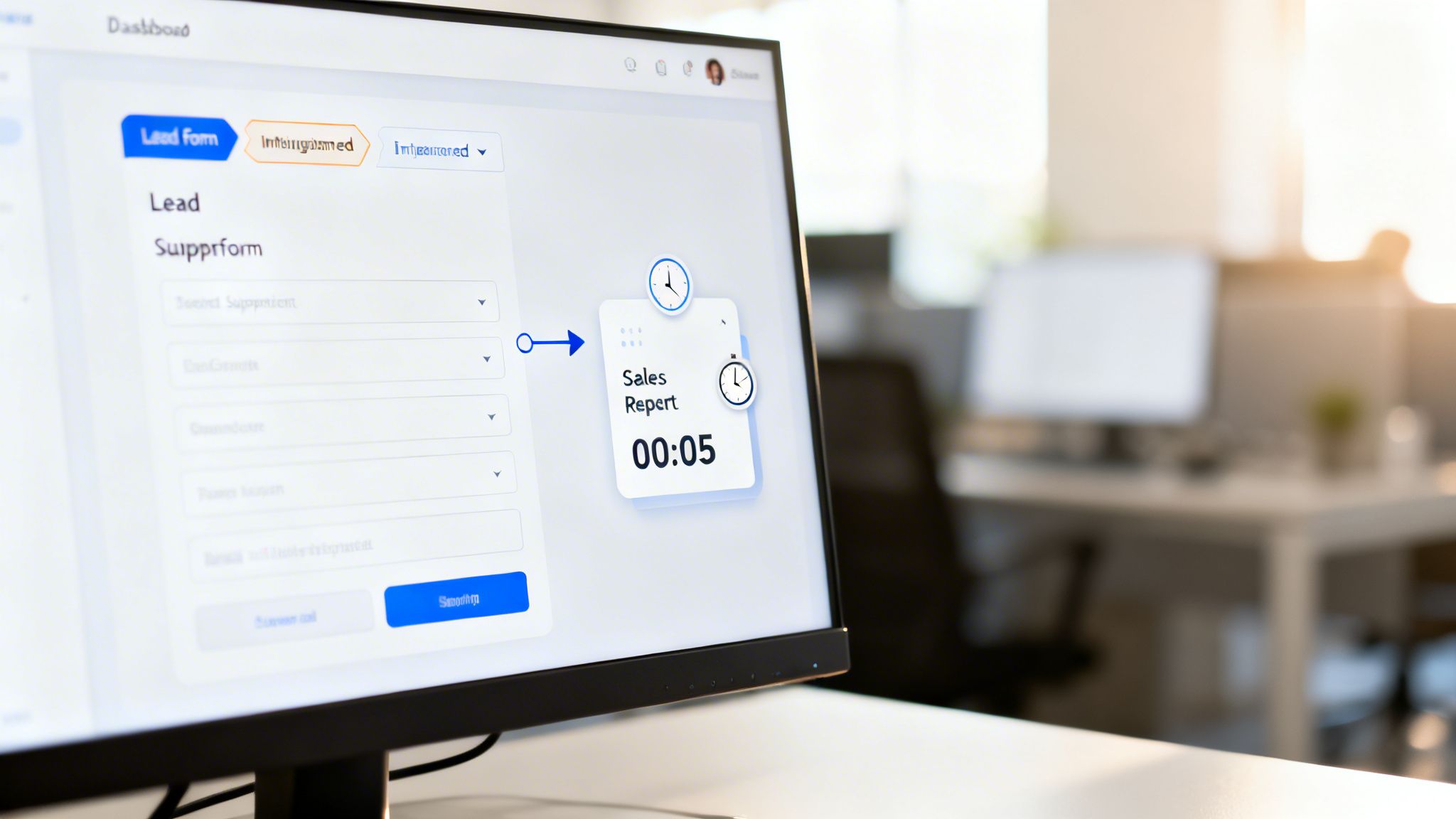
When it comes to lead conversion, the variable that matters most is speed. If you can get back to an inbound lead within five minutes, your odds of qualifying them rise sharply.
Eliminate Human Bottlenecks with Autonomous Agents
That five-minute window is impossible for a human team to hit consistently. People take breaks, go to meetings, and sleep. AI agents don’t.
This is why I set up autonomous agents to handle every new lead the second it arrives. This is how you use AI for lead generation to create a real operational edge. These agents instantly run a sequence of tasks that would take a human 15-20 minutes.
Here’s the workflow:
- Enrichment happens instantly. A lead fills out a form, and the agent immediately takes the email, searches the web, and pulls back company data, title, and LinkedIn profile.
- The agent routes the lead. Using the predictive scoring model, it scores the lead and sends it to the right person.
- The agent confirms right away. It fires off a personalized confirmation email, acknowledging their inquiry.
This process happens in seconds. It removes the human bottlenecks from your funnel, and every hour you spend on sales goes further.
The point is to be faster than is humanly possible. While your competitor’s lead is still gathering dust in an inbox, you're preparing for the first call with a complete dossier.
Research shows slashing your speed-to-lead can make you 100 times more likely to connect with a lead. That is where AI agents earn their keep. If you want to dig deeper into the data, you can find additional insights on AI lead generation at WebFX.
Create a Tight Feedback Loop with AI A/B Testing
Once your system is operating at speed, you need to dial in its precision. This is where you A/B test your AI models. It’s how a good system becomes a very good one.
Most people only A/B test landing pages. You can apply the same logic to your AI workflows, creating a tight feedback loop where real-world performance data constantly refines the AI's behavior.
Start by testing these three core areas:
- Test prompt variations for outreach. Is a casual tone getting more replies than a formal one? Run two prompt versions in your outreach agent and let the data decide.
- Test scoring models for prioritization. Does adding a company’s funding announcement make your lead scores more accurate? Run two models in parallel and track which one produces more closed-won deals.
- Test conversational flows for chatbots. Does asking for an email right away kill the conversation? Test different question sequences in your qualification bot to see which path books more meetings.
The goal is a system that self-improves. Every email sent, every lead scored, and every conversation had becomes another data point that makes the AI smarter. This is how you build a machine that delivers sustained, compounding gains.
Common Questions (and Real Answers) on AI Lead Gen
When I talk with founders and small business owners about putting these AI systems into practice, the same questions always come up. Forget the theory for a minute. These are the practical, in-the-trenches conversations I have every week, and here are the straight answers.
Can a Small Business Really Afford This?
Yes. The old idea that AI requires a big budget and a team of data scientists is dead. Today the tools are cheap and easy to reach.
You can start with low-cost, no-code platforms like Clay or Zapier connected to very capable models. The trick is to start small. Don't try to build a fully autonomous, end-to-end system on day one. That’s a recipe for disaster.
Pick one, high-impact workflow. A perfect example is enriching a small list of 50 target accounts. Prove the ROI on that single task (it almost always costs less than a single B2B software subscription), and then expand. It costs far, far less than hiring another SDR.
How Do I Avoid Sounding Robotic or Creepy?
This is the most important question, and it's where most companies stumble. The answer is a combination of expert prompt engineering and always keeping a human-in-the-loop for anything high-stakes.
First, your prompts have to be crafted with real care. They need to be engineered to adopt a specific, human tone, reference buying signals in a natural way, and focus on starting a real conversation instead of blasting a sales pitch.
Second, for your most valuable targets, you never go fully automated. The AI becomes a co-pilot. It does the heavy lifting (the research, the data gathering, the first draft), and then a human reviews it, adds that final touch of personalization, and hits send.
This hybrid approach gives you the scale of automation without losing the human touch that actually builds relationships and closes deals. Your competitors are either slow and manual or fast and robotic. You get to be fast and human.
What AI Skill Should My Team Learn First?
Start with data enrichment and signal identification. This is the foundation.
Before you can even think about automating outreach or scoring leads, your team has to understand how to feed the AI high-quality, relevant data. It’s the "garbage in, garbage out" principle, amplified.
Teach them how to use tools to find real-time buying signals and enrich contact records with meaningful context. This one foundational skill makes every other AI initiative you launch, from predictive scoring to automated email campaigns, far more effective. Get the fuel right, and the engine will run like a dream.
What's the Single Biggest Mistake to Avoid?
The biggest mistake I see, time and time again, is trying to boil the ocean. Founders and marketers get swept up in the excitement of the technology and immediately try to build a huge, complex, end-to-end autonomous system right out of the gate.
This approach fails. Almost every single time. It's too much, too soon, and it collapses under its own weight before it ever delivers value.
The right way to do this is to be surgical. Pick one specific, painful bottleneck in your current process. Maybe it's the agonizingly slow speed of lead routing. Or perhaps it's the hours wasted personalizing outreach for your top 25 target accounts.
Apply AI to solve just that one problem. Get a win. Build momentum. Then, and only then, do you expand to the next problem.