
Most advice on market differentiation is soft, expensive, and wrong.
You don't win because your homepage sounds sharper than your competitor's. You win because you build a business that buyers perceive as meaningfully different, and that difference shows up in conversion, retention, pricing power, and sales velocity. Anything else is decoration.
I'm Samuel Woods. I've worked with machine learning since 2016 and generative AI since 2019. My view is simple. If your differentiation strategy can't be observed in market data and operational behavior, it's branding theater.
A lot of founders still treat differentiation like a workshop exercise. Pick some adjectives. Rewrite the value proposition. Update the visual identity. Then wonder why nothing changes. Michael E. Porter formalized differentiation in his 1980 generic strategies framework as creating a product or service perceived industrywide as unique, alongside cost leadership and focus in the core paths to competitive advantage, which is why this idea belongs to strategy as much as marketing in Porter's framework overview.
What matters now is execution. You need a system that detects buyer shifts, competitor moves, unmet demand, pricing tolerance, and delivery constraints faster than everyone else. That's where AI helps: it lets you build a market sensory system your competitors don't have.
Table of Contents
- Why Most Market Differentiation Is a Waste of Money
- The Five Levers of Defensible Differentiation
- How to Find the Opening Others Avoid
- The AI-Powered Market Intelligence Playbook
- Differentiation Frameworks in Action
- Measuring What Matters How You Know It Is Working
- Conclusion Building Your Defensible Moat
Why Most Market Differentiation Is a Waste of Money
Most companies spend on the wrong layer.
They pour budget into visual identity, generic content, paid campaigns, and clever positioning statements before they've proven that buyers care about the distinction. Then they call it differentiation because the language sounds premium. What they have is a message wrapped around an unchanged business.
The Small Business Administration doesn't frame market entry as a creativity exercise. It advises businesses to use market research and competitive analysis to assess demand, market size, pricing, market saturation, competitors, market share, strengths and weaknesses, and indirect competitors before entering a market in its market research guidance. That's the right frame. Differentiation only matters relative to actual market structure.
The expensive mistake
I've seen teams confuse visibility with distinctiveness.
Those are not the same thing. You can buy attention for a while. You cannot buy a durable market position if your offer, pricing model, service design, and delivery mechanics look interchangeable with every alternative on the shortlist.
Three things usually go wrong:
- They copy category language. Buyers hear the same promises from everyone. Better service. Trusted partner. End-to-end solution. None of that changes selection behavior.
- They differentiate where buyers don't care. They obsess over messaging details that never come up in sales calls, reviews, demos, or renewal conversations.
- They ignore competitor comparability. A claim only matters if it stands up next to the options a customer is considering.
Your competitor doesn't need to beat your slogan. They only need to make your offer feel familiar.
What real market differentiation looks like
Real market differentiation changes buyer behavior.
It makes you easier to choose, easier to justify internally, harder to compare on price, or more aligned to a specific segment's real constraints. That's why I push business owners to stop asking, "How do we stand out?" and start asking better questions.
- What do your best buyers value enough to notice quickly?
- What can you deliver repeatedly that competitors won't match without breaking their model?
- Where does your difference appear in win rates, retention, or pricing acceptance?
If you can't answer those questions with operational clarity, your differentiation budget is probably funding noise.
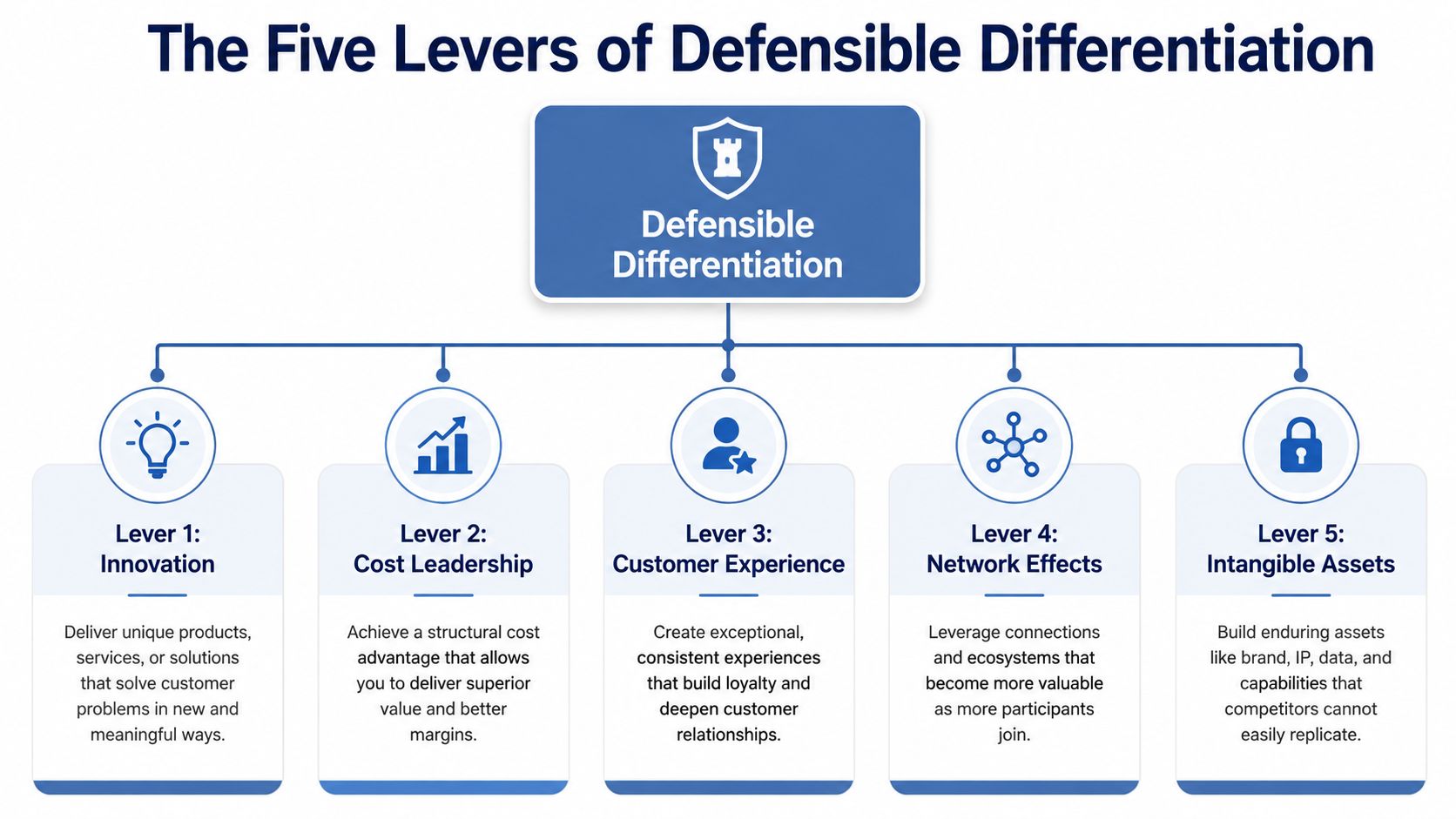
The Five Levers of Defensible Differentiation
I don't recommend trying to be different everywhere. That's how companies get diluted.
You need a few levers, pushed hard enough that buyers and competitors both feel the effect. The practical map I use has five levers: product, pricing, distribution, customer experience, and brand positioning. They're old ideas, but they become much more powerful when you instrument them with AI and real market feedback.
Pick fewer levers and go deeper
Most small businesses spread effort across all five and end up average at each.
That's a losing move. If you don't already lead your category, pick one primary lever and one support lever. Then align product roadmap, go-to-market, pricing logic, onboarding, and measurement around those choices.
A practical rule: if your chosen differentiator doesn't force a resource trade-off, you probably haven't chosen anything meaningful.
What each lever actually means
1. Product
This is the obvious one, and often the most overrated. A feature is not a moat by itself. A product differentiator matters when it solves a painful job better for a specific segment, and when the segment recognizes the value quickly enough to affect purchase behavior.
In AI-enabled businesses, this often means faster analysis, lower manual effort, stronger personalization, or better decision support. But don't pile on features. Sharp products win. Bloated products create demos that impress and implementations that stall.
2. Pricing
A lot of companies still price from cost or copy competitor tiers. Weak move.
In B2B and SaaS, differentiation becomes more defensible when it's tied to measurable segments and willingness-to-pay, because segmentation lets firms tailor product, service, and pricing by demographic, geographic, psychographic, or behavioral differences, turning differentiation into a revenue design problem as outlined by Simon-Kucher on differentiation strategy. If one segment values speed, compliance support, or white-glove service more than others, your pricing model should reflect that instead of flattening value across the whole market.
3. Distribution
This lever gets ignored because it doesn't feel glamorous.
But if you reach buyers where competitors are absent, slow, or structurally weak, you can win without having the most advanced product. Partnerships, channel relationships, community-led growth, embedded workflows, and marketplace placement all matter here. Distribution can become a moat when it consistently lowers friction for the right buyers.
4. Customer experience
A lot of markets are crowded because products are close enough. Experience breaks the tie.
Faster onboarding, clearer implementation, better support, proactive insight delivery, and account structures that fit the buyer's operating reality can all create a durable edge. Especially in categories where switching feels risky, the company that reduces anxiety wins.
5. Brand positioning
Brand isn't fluff when it's anchored to a real operational truth.
Positioning works when it compresses your value into something buyers can remember, repeat, and defend internally. It fails when it's disconnected from what your team can deliver. Strong positioning clarifies a difference that already exists.
How to Find the Opening Others Avoid
The phrase "underserved market" has misled a generation of founders.
A segment can be underserved because no one has noticed it. More often, it's underserved because serving it well is annoying, expensive, low-margin, operationally messy, or hard to scale. If you miss that reality, you'll chase a gap that exists for very rational reasons.
Stop chasing every underserved segment
Bain's analysis of small-business markets makes the important point that companies need to evaluate the economics to serve each segment, including gross margins and operating expense, because a market may be underserved because it's economically hard to serve in Bain's analysis of underserved small-business segments. That's one of the most important realities in market differentiation, and most advice skips it.
So when you evaluate an opening, don't just ask whether customers want it. Ask whether you can deliver it in a way that leaves room for profit and repeatability.
Use this decision lens:
- Check demand first. Are buyers actively trying to solve the problem now?
- Estimate the cost to serve. Does the segment require heavy customization, support, education, or compliance work?
- Test the sales fit. Can you reach them efficiently through digital, inside sales, partnerships, or product-led adoption?
- Look for operational friction. Will this segment create exceptions that break your delivery system?
- Ask why competitors stay away. Are larger players avoiding it because it's unattractive to their model?
That last point matters. Your best opportunity is often the segment that looks too small, too fragmented, or too awkward for a bigger competitor, but fits your structure cleanly.
Use AI to find operationally awkward opportunities
This is where AI earns its keep.
Instead of relying on one-off interviews and a few competitor screenshots, use AI systems to analyze reviews, support transcripts, community threads, search patterns, and sales objections for recurring pain points tied to segment-specific constraints. That's how you spot what buyers want and why current vendors fail to serve them economically.
If you're thinking specifically about discoverability inside AI-driven search environments, I also recommend reviewing these AI search differentiation strategies. Read them to understand how category visibility and competitive framing are shifting when buyers use AI interfaces to evaluate options.
The cleanest niche is rarely the most profitable one. The profitable niche is the one you can serve better without inheriting a broken cost structure.
If you want an edge competitors can't copy quickly, stop looking for open space. Start looking for mismatch. Where buyer demand exists, incumbent economics are weak, and your operating model can fit.
The AI-Powered Market Intelligence Playbook
Your competitors are still running static surveys, reading a few review pages, and calling it insight.
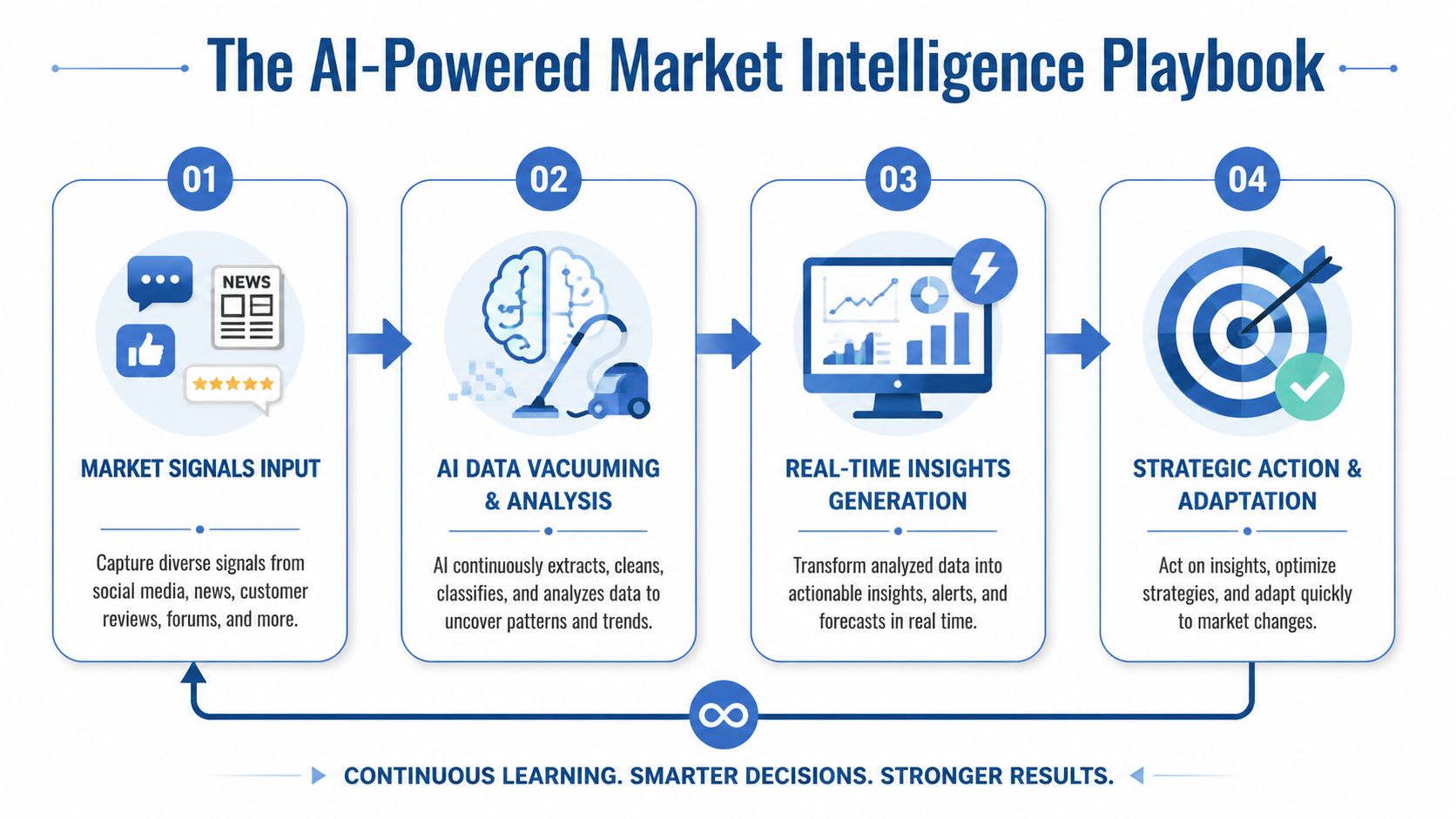
I want you to build a living intelligence loop. One that monitors what buyers are buying, searching, complaining about, comparing, and abandoning. Recent market-intelligence guidance recommends starting from what the market is buying and searching for, using search validation and trade data to identify high-growth categories and knowledge gaps rather than relying on intuition in this market-intelligence guidance. That's the right starting point.
A visual model helps here.
Build the signal pipeline
I typically structure this as a layered system.
Start by collecting external signals. Pull from competitor websites, pricing pages, changelogs, app reviews, Reddit, LinkedIn, support forums, G2-style review platforms, niche communities, search query themes, and relevant trade or category data.
Then collect internal signals. Feed in call transcripts from Gong or Zoom, CRM notes from HubSpot or Salesforce, support tickets from Intercom or Zendesk, and lost-deal reasons from your sales notes.
Normalize and classify everything. Use LLMs to tag themes like feature requests, onboarding friction, pricing objections, implementation blockers, compliance concerns, and competitor mentions. I prefer giving models a strict taxonomy so outputs stay usable.
Score each signal by strategic relevance. Not every signal matters equally. Weight signals by segment value, frequency, recency, and revenue impact. A complaint from your best-fit segment matters more than a random comment from a bad-fit buyer.
Turn raw signals into action
Data hoarding won't help you. Synthesis will.
Here's the workflow I push people to implement:
- Set up competitor monitoring agents. Have them track changes to pricing, messaging, product pages, and hiring posts. Hiring trends often reveal strategic direction before launch.
- Run voice-of-customer analyzers. They summarize patterns from reviews, transcripts, surveys, and ticket logs into structured themes you can act on.
- Write gap detection prompts. Ask the model to identify repeated unmet needs, compare those against competitor capabilities, and draft hypotheses for positioning, offer design, or new service layers.
- Get a decision brief. Have the system produce a weekly memo for you with three things only. What changed, why it matters, and what action to test now.
If you want a deeper operating model for this, I've written about how AI market intelligence gives a small business its edge.
Where most teams fail
They build a listening system and stop there.
That's not enough. Insight has to hit product planning, sales enablement, pricing, content strategy, and customer success. If the information dies in a dashboard, all you built was a report.
I've used systems like ChatGPT, Claude, Gemini, Perplexity, Zapier, Make, Airtable, Notion, and custom agents to run this loop. If you want help designing agentic workflows around market intelligence, I do that as a fractional Chief AI Officer, but the principle matters more than the vendor. The winning pattern is consistent: collect signals continuously, synthesize them fast, and force action across teams.
Differentiation Frameworks in Action
Here is how it looks in practice.
Below are two scenarios I see constantly. One is a B2B SaaS company trapped in a crowded market. The other is a DTC e-commerce brand selling something buyers can get almost anywhere. Different business models. Same requirement. Pick a clear angle and make it operational.
Example one B2B SaaS in a crowded category
A SaaS company selling workflow software usually starts by claiming ease of use, automation, and visibility. That's table stakes.
The smarter move is to narrow the battlefield. In B2B and SaaS, the strongest differentiation is tied to measurable segments and willingness-to-pay. So I would pick one customer group with a distinct operational pain point, then shape product packaging, onboarding, service level, and pricing around that group.
For example, instead of serving "mid-market operations teams," target distributed compliance-heavy teams that need audit clarity, structured approvals, and faster cross-functional handoffs. Then design the offer around those needs. Templates, reporting structures, implementation support, and sales narrative all become segment-specific.
If you're also adapting content and discoverability for AI-driven discovery, this guide to LLM search for marketers is worth reviewing because buyer research behavior is changing. The firms that get summarized well inside LLM interfaces will earn more qualified consideration.
You can also connect this to content production and positioning systems through generative AI for marketing, especially if you need to align messaging with a sharper segment strategy.
Example two DTC e-commerce with a commodity product
Now take a brand selling a common product. Supplements, accessories, home goods, skincare, pick your category.
You probably won't win by claiming superior quality alone. Every brand says that. I would look at two levers instead: distribution and positioning. Find a partnership channel, niche community, creator ecosystem, or retail context that competitors underuse. Then pair that with a psychographic angle so specific that the product feels designed for a lifestyle or identity.
This doesn't require a magical product breakthrough. It requires sharper customer selection and tighter go-to-market design.
| Lever | B2B SaaS Example | DTC E-commerce Example |
|---|---|---|
| Product | Workflow features built for compliance-heavy teams | Bundles tuned for a niche use case or routine |
| Pricing | Premium service tier matched to segment urgency | Value packs or subscriptions matched to purchase habits |
| Distribution | Direct sales plus partner referrals in a narrow vertical | Creator partnerships or community-led placements |
| Customer experience | White-glove onboarding and faster implementation clarity | Frictionless post-purchase support and repeat-order flow |
| Brand positioning | Category language built around auditability and control | Identity-driven messaging for a specific lifestyle profile |
The goal is to become easier to choose in a real buying situation, whatever looked different in a brainstorm.
The trade-off is focus. When you choose a sharper segment, some buyers will care less. Good. Broad appeal is usually the tax you pay for weak differentiation.
Measuring What Matters How You Know It Is Working
If you can't measure whether your differentiation changes behavior, you're guessing.
An effective differentiation program should be instrumented with win/loss analysis, customer perception surveys, retention rates, market-share growth, revenue per customer, and pricing-premium tracking, because those metrics show whether the differentiator is affecting buyer behavior rather than messaging alone as explained in this product differentiation measurement guide. That's the dashboard logic I trust.
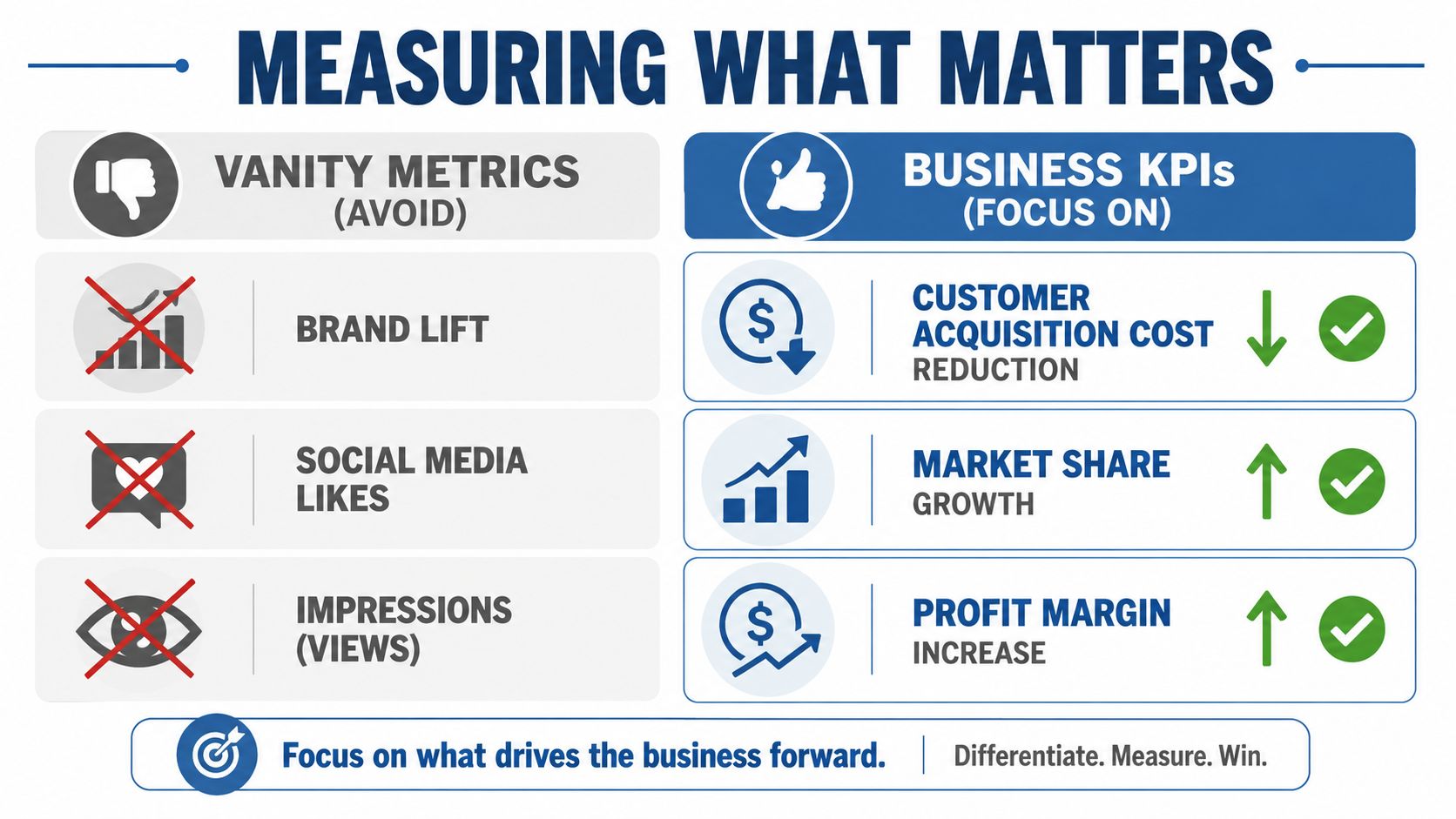
The dashboard I would actually check
I don't care much about vanity metrics in this context. I care about commercial proof.
Track these:
- Track why you win and lose. Did buyers cite your differentiator without prompting? Did you beat a named competitor because of it?
- Track retention by segment. Are the customers attracted by your differentiated promise staying longer and expanding faster?
- Watch price acceptance. Can you hold pricing with less discount pressure in the target segment?
- Watch for perception shifts. Do customer surveys show that buyers now associate your brand with the attribute you intended to own?
- Check revenue quality. Is revenue per customer improving in the segment your strategy targets?
- Watch share movement. Are you capturing more of the market slice you chose to win?
How to capture the right customer input
Most feedback systems are too loose.
You need structured questions tied to strategic hypotheses. If you're testing customer experience as a differentiator, ask buyers what reduced risk, what created friction, and what nearly blocked purchase. If you're testing pricing, ask what they believed was worth paying more for and what felt interchangeable.
If you're building those feedback loops, these customer feedback templates are useful because they give you a starting structure you can adapt to post-demo, post-purchase, onboarding, and churn analysis. Pair that with an internal reporting layer such as AI business intelligence software so signals don't stay scattered across forms, calls, and support logs.
If customers can't describe your difference clearly, they probably didn't feel it clearly.
That line is harsh, but it's accurate.
Conclusion Building Your Defensible Moat
Market differentiation is a business design decision.
You are deciding where to be meaningfully different, for whom, and in a way that competitors can't easily copy without changing their own economics, operations, or product direction. That's a much harder game than writing better copy. It's also the game that actually pays.
The companies that win build distinctions buyers notice, value, and reward. Then they reinforce those distinctions through pricing, product choices, service design, distribution, and measurement. AI makes this stronger because it gives you a faster sensing system. You stop relying on intuition and start operating from live market evidence.
Here's my opinion. If you're still treating market differentiation as branding polish, you're leaving revenue on the table and giving faster competitors room to box you in. Build the sensing layer. Pick your levers. Test your assumptions against buyer behavior. Drop whatever doesn't move conversion, retention, or price acceptance.
Forget sounding different.
Become more difficult to replace.