
Most founders think product launch marketing fails because the ads were weak or the timing was off. That's the comforting story. The truth, however, is harsher. Around 30,000 new consumer products are launched globally each year, yet only about 10 to 15% achieve meaningful long-term success, and a widely cited estimate notes that about 90% fail to meet projections or survive beyond an initial period according to Ciradar's product launch statistics roundup.
I'm Samuel Woods. I've been working with machine learning since 2016 and generative AI since 2019. I've watched teams waste months on launch plans that looked polished in slides and collapsed in the market because they treated launch as a campaign instead of a revenue system.
You don't need more fluff. You need a tighter operating model, sharper positioning, owned demand before paid demand, and AI agents that help your team move faster without turning your brand into a creepy automation machine.
Table of Contents
- Your Launch Will Probably Fail
- Phase 1 The Pre-Launch Foundation
- Phase 2 Your Go-to-Market Offensive
- Phase 3 Creative Assets and AI Agents
- Phase 4 Launch Day Execution
- Phase 5 Post-Launch Measurement and Iteration
Your Launch Will Probably Fail
Your launch is walking into a hostile market, crowded feeds, skeptical buyers, distracted sales teams, and competitors who can copy your messaging faster than ever.
Most launches don't lose because the team didn't work hard enough. They lose because nobody made the hard choices early. Weak positioning. Generic targeting. Too much spend on channels that create noise instead of demand. A launch plan built around internal excitement instead of buyer behavior.
That failure rate should change how you think about product launch marketing. This isn't a branding side project. It's a capital allocation decision. It pulls product, sales, support, ops, and marketing into one short window where mistakes get amplified.
Practical rule: If your team can't explain why a buyer should choose your product over the next-best option in one tight sentence, you're not ready to launch.
I see the same pattern constantly. Teams obsess over logos, teaser posts, and launch-day announcements while ignoring the harder questions. Who is this for right now? What pain is urgent enough to trigger action? What competitor weakness are you exploiting? Which proof will make buyers trust you?
Use a real planning system. Not a recycled spreadsheet. A proper marketing campaign planning template forces you to tie audience, messaging, channels, owners, and metrics together before money starts leaking.
Why the old playbook breaks
The pre-AI launch model assumed slow feedback loops. You'd ship, buy media, wait, then learn. That rhythm is dead.
Now your competitors can generate landing pages in an afternoon, spin up ad variants overnight, and flood channels with synthetic content. Speed alone isn't an advantage anymore. Coordinated intelligence is.
What wins instead
You need a launch system that does three things well:
- Finds market truth fast through buyer signals, review mining, sales call notes, and competitive analysis.
- Turns that truth into sharp messaging that sounds like your brand, not like a prompt template.
- Builds feedback loops immediately so your team can adjust channels, onboarding, and outreach before spend compounds the wrong bet.
Launches don't fail quietly. Teams feel it in pipeline quality, support volume, conversion friction, and wasted budget within days.
That's the frame you should use. Not "did we publish everything on time?" but "did we create an advantage competitors can't easily copy?"
Phase 1 The Pre-Launch Foundation
The strongest launches feel aggressive in public because they were disciplined in private. Before any campaign goes live, I want the foundation locked.
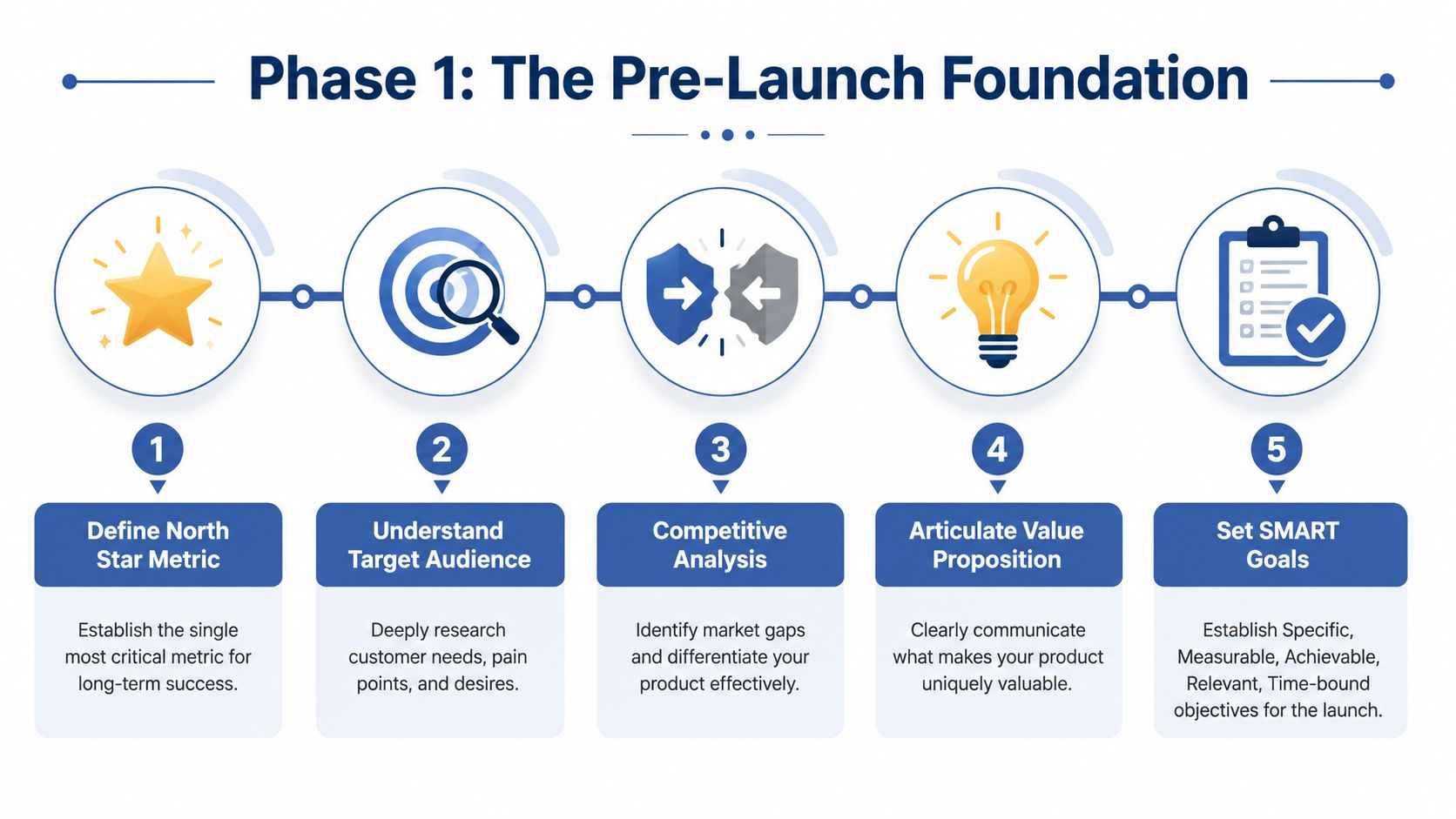
More than 25% of total revenue and profits across industries comes from the launch of new products, according to McKinsey's analysis of launch-driven growth. If you treat launch prep like admin work, you're mishandling a revenue lever.
Pick one commercial outcome
Teams often sabotage themselves with too many goals. They want awareness, signups, PR coverage, partnerships, retention, social buzz, and sales pipeline all at once.
Pick one metric that governs the launch. Revenue is fine. Trial activation is fine. Qualified pipeline is fine. Pick one.
If you don't, every team optimizes for its own comfort. Marketing chases clicks. Product ships features. Sales asks for new decks. Nobody owns the commercial result.
A simple decision table helps.
| Situation | Best primary metric |
|---|---|
| New SaaS product with self-serve motion | Trial activation rate |
| High-ticket B2B launch | Qualified pipeline |
| Ecommerce product with established demand | Revenue |
Position against a real enemy
Positioning isn't writing a nice statement in a doc. It's choosing the competitor, substitute, or bad habit you're taking customers from.
I use AI heavily here, but not lazily. Pull competitor homepage copy, pricing pages, feature pages, G2 reviews, Reddit complaints, support comments, and demo call transcripts into a research stack. Then force the model to surface patterns. Repeated frustrations. Missing promises. Overused claims. Language buyers already use.
Your output should be concrete:
- Who they're disappointed with
- What job they need done now
- Why your product is the better bet
- What proof you can show immediately
For teams refining their buyer flow before launch, customer journey mapping is one of the fastest ways to spot where interest turns into hesitation.
Use AI for research, not for strategy
People tend to get sloppy. They ask ChatGPT or Claude to "define our ICP" and then paste the output into a launch brief. That's not strategy. That's autocomplete.
I want AI doing the heavy lifting on synthesis while humans make the decisions. Let the model cluster objections, summarize call notes, compare competitor claims, and draft hypothesis trees. Then your team decides what matters commercially.
Good AI use shrinks research time. It doesn't remove strategic judgment.
If you want a useful outside perspective on channel behavior and creator-led distribution, I like these marketing insights for creators. Not because creators are your market by default, but because creator-style distribution teaches teams to think in audience trust, not just paid reach.
Your pre-launch foundation should answer five hard questions before anyone touches ad spend:
- Who buys first: Not everyone. The first segment with urgent pain.
- What do they replace: A competitor, a spreadsheet, an agency, a manual workflow.
- Why now: What's changed enough that action makes sense today.
- What proof exists: Demo, testimonial, use case, benchmark, or workflow clarity.
- What must happen after signup: Activation path, onboarding, and support readiness.
Weak answers here don't get fixed by prettier creative. They get exposed by the market.
Phase 2 Your Go-to-Market Offensive
Most go-to-market plans are channel lists pretending to be strategy. Real GTM work is distribution design. It decides where trust is built, where demand is captured, and where paid spend earns the right to scale.
Start with the architecture.
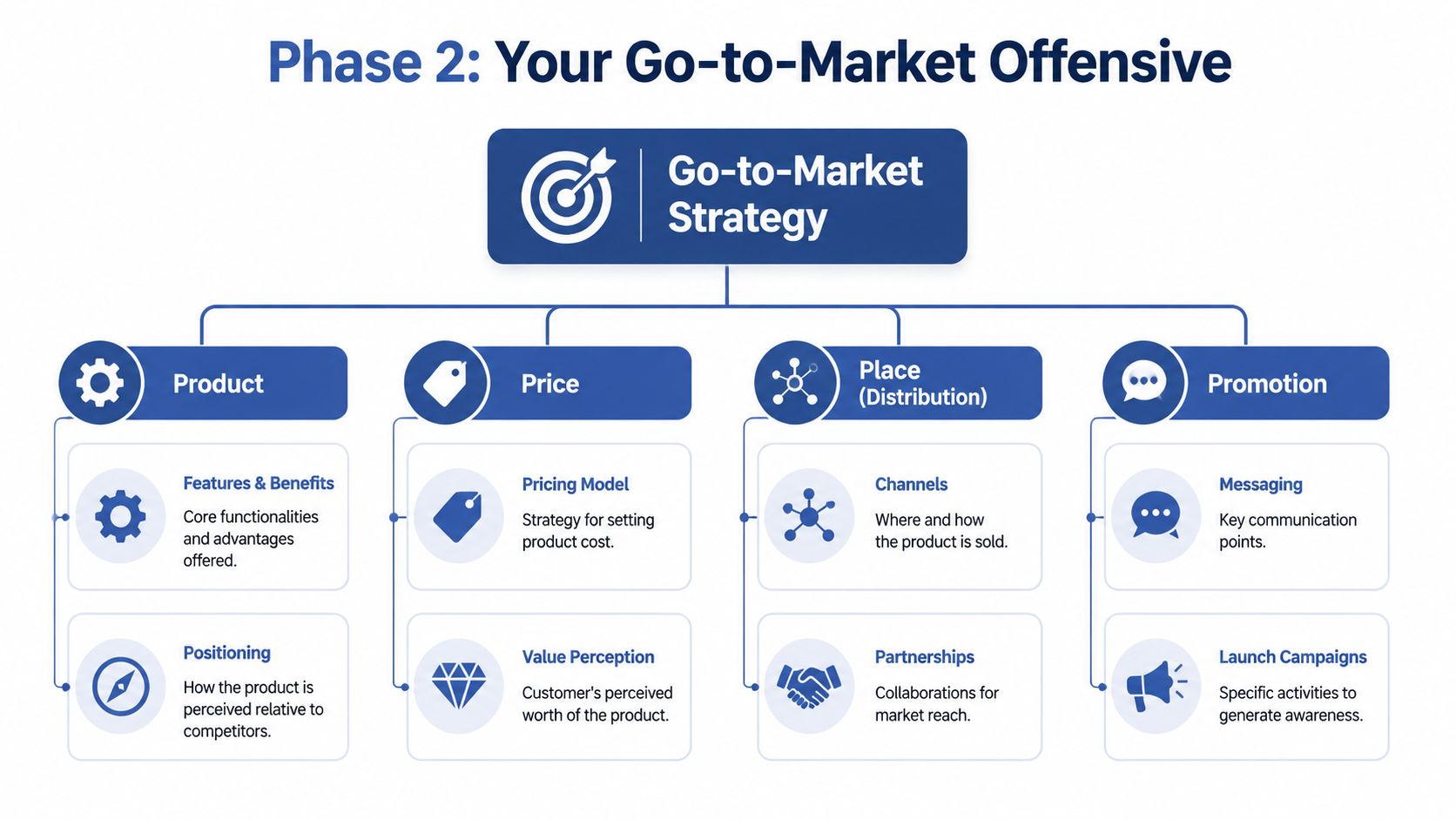
Owned channels first
One launch playbook I agree with recommends building an email list before launch through a landing page with an email collection form, then promoting content to capture interest before the product is live, as outlined by OpenView's launch guidance. That's smart because owned attention compounds. Paid attention rents reach.
I push teams toward an owned-media-first structure:
- Email list for waitlist nurturing, offer sequencing, and launch reminders
- Website and SEO landing pages for intent capture
- Blog and educational content for problem framing
- Community spaces for early feedback and social proof
- Sales enablement assets like FAQs, one-pagers, support macros, and demos
For teams building this system intentionally, strong demand generation strategies matter more than flashy launch-day stunts.
Build trust before you buy reach
Here's the behavioral reality. Roughly 56% of customers learn about new products from friends or family, while only a fraction first hear about them via paid advertising, according to G2's roundup of product launch statistics. So if your launch depends mainly on paid ads, you're fighting the market's trust pattern instead of using it.
That changes channel priorities. Referral loops, customer communities, partner intros, affiliate relationships, founder-led content, and user advocacy aren't optional extras. They're central.
A lot of founders underuse PR here. Not old-school vanity PR. Strategic credibility distribution. If your launch has a strong point of view or category angle, a solid press release service can help syndicate the announcement into places your direct channels can't reach on day one.
This walkthrough is worth watching if you're tightening the operational side of launch planning:
Sequence your channel attack
I don't launch all channels at once unless the company already has strong operational maturity. Sequencing is generally advisable.
Use this model:
Trust channels first
Founder posts, customer previews, partner outreach, waitlist invites, community drops, early-access users.Proof channels next
Testimonials, user-generated comments, review collection, webinar replays, product walkthroughs, comparison pages.Performance channels last
Paid social, paid search, retargeting, affiliate boosts, sponsored placements.
The competitive advantage is simple. Your paid traffic lands in an environment where trust already exists. Competitors often invert this. They buy attention before they earn credibility, then wonder why conversion is weak.
A useful way to segment launch audiences with AI is by intent signals, not demographic labels. Group people by what they've done. Visited pricing. Joined a webinar. Replied to a founder email. Clicked a comparison page. Asked support pre-sale questions. Shared a waitlist link. Those signals tell you what message to send and what friction to remove.
If your GTM plan starts with ads, your market education is probably unfinished.
Product launch marketing works best when each channel does a distinct job. Email converts demand. Community creates proof. PR adds legitimacy. Paid search captures existing intent. Paid social tests hooks. Don't ask one channel to do everything.
Phase 3 Creative Assets and AI Agents
Many marketers say they're using AI in launch marketing when what they really mean is they asked ChatGPT for ad copy. That's entry-level usage, and it often makes the brand worse.
Significant advantage arises from combining creative systems with AI agents that handle repetitive execution. Follow-ups. Lead triage. Social listening summaries. First-draft replies. Message routing. Internal alerting. That work adds speed without forcing your team to hire a bigger launch squad.
AI content without a brand model is a liability
Before you generate anything at scale, define a brand voice model. Not a vague style guide. A real operating spec.
Mine usually includes:
- Approved vocabulary the brand uses often
- Banned phrases that sound generic, overhyped, or off-brand
- Tone rules by channel, such as tighter for landing pages and more conversational for email
- Proof rules about what claims require human verification
- Offer framing rules so the AI doesn't invent urgency or benefits
If you're producing product visuals fast, this guide on creating AI product photos is useful because it shows where synthetic assets can help and where they can start looking fake enough to hurt trust.
Where AI agents actually help
My firm belief is this: Don't deploy AI agents where trust is most fragile unless a human can intervene quickly.
Good launch uses for agents include:
| AI agent use | Best use case | Human oversight needed |
|---|---|---|
| Lead qualification | Sorting inbound interest by fit and urgency | Review high-value leads |
| Follow-up sequencing | Reminders and next-step nudges | Approve sensitive messages |
| Social monitoring | Summarizing mentions and flagging spikes | Human replies for edge cases |
| Internal routing | Sending bugs, objections, and requests to the right team | Minimal |
Bad launch uses for agents include autonomous DMs to cold prospects, fake founder replies, synthetic testimonials, and unreviewed pricing explanations. Those shortcuts save labor and burn trust.
The guardrails I insist on
This is not optional. A 2024 Pew Research Center survey found that 73% of U.S. adults feel it's a bad thing when companies use AI to make decisions about them, as cited in 8base's discussion of AI and launch trust. If you use AI agents in product launch marketing without transparency and restraint, people will notice, and many of them will dislike it.
My baseline guardrails are simple:
Disclosure where the interaction matters
If an AI assistant is handling outreach, support triage, or recommendations, don't hide it.Rate limits on outbound behavior
A launch agent should not flood inboxes, comments, or DMs just because the workflow allows it.Human review thresholds
Messages involving pricing, legal language, edge-case objections, or upset users need approval.Bias and consistency checks
Review generated copy across segments to catch tone drift, exclusionary language, or claims that don't align with policy.Escalation logic
If sentiment turns negative, the agent routes to a human immediately.
Use AI agents to increase relevance and response speed. Don't use them to impersonate care.
A practical workflow looks like this: Claude or ChatGPT drafts five launch email variants from your voice model. An internal agent matches variants to intent-based segments. Another agent watches replies and tags objection themes. A human reviews the high-risk messages, updates the positioning doc, and kills weak variants fast.
That's a bionic system. It scales execution while keeping judgment where it belongs.
Phase 4 Launch Day Execution
Launch day isn't a celebration. It's an operational stress test. The teams that win treat it like mission control.
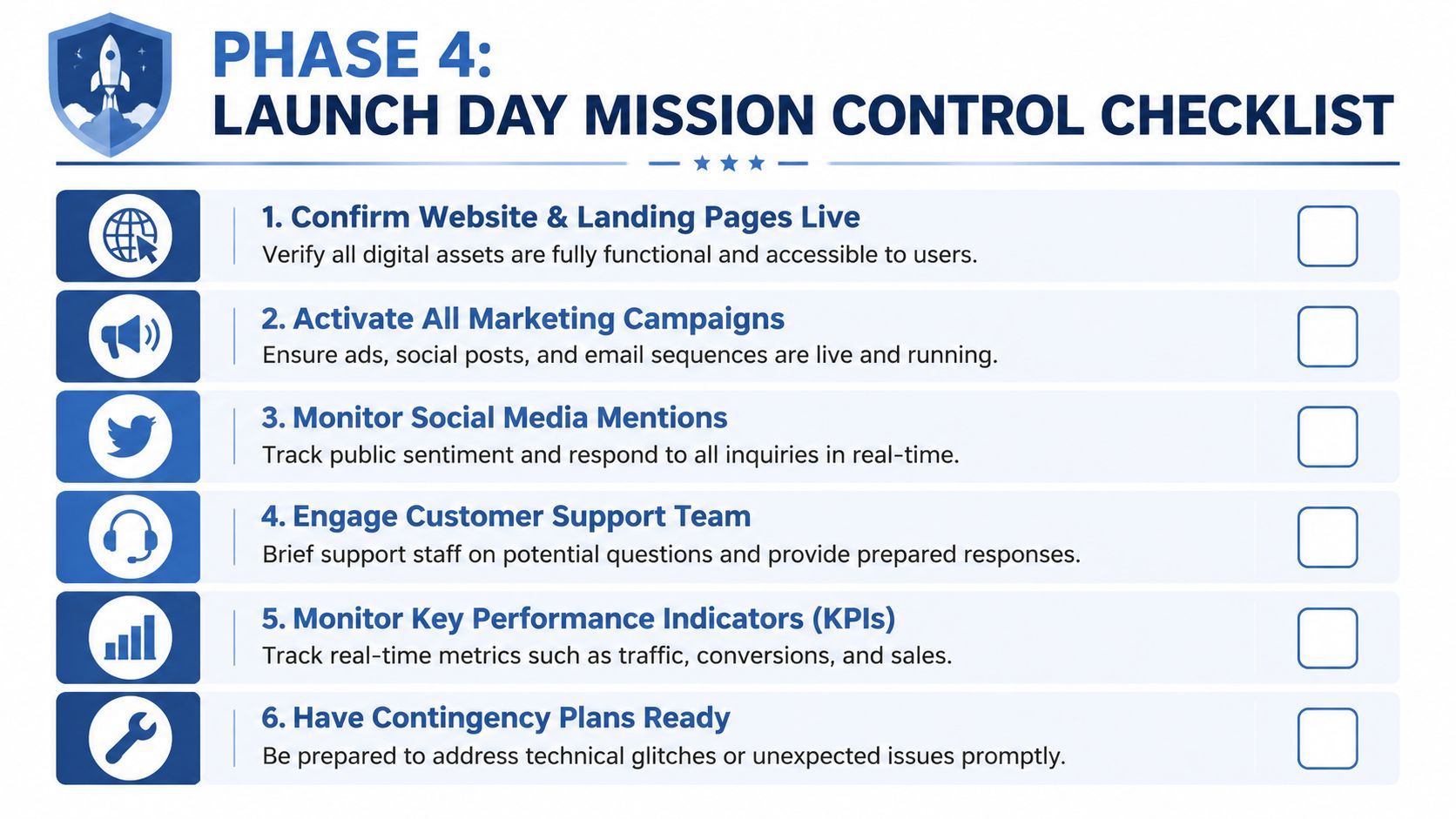
Run launch day like mission control
I want one dashboard, one comms channel, one decision chain. Not five people checking different tools and assuming someone else is watching conversions.
Your launch room should monitor:
- Landing page performance
- Email sends and click behavior
- Trial or purchase flow completion
- Support ticket themes
- Social mentions and reply backlog
- Bug reports and escalation status
Assign owners before launch day starts. One person owns web issues. One owns paid channels. One owns CRM and email. One owns support routing. One owns executive decisions. If no one owns the problem, the customer owns the bad experience.
The first response matters more than the first announcement
A bug on the checkout page, a signup loop, a broken email sequence, or a confused support queue can wreck momentum faster than weak creative. Buyers judge your product by the first friction they hit.
So write response protocols in advance. If a payment issue appears, who pauses traffic? If onboarding breaks, who updates the status page and support copy? If a prospect posts a negative thread, who responds and with what tone?
I also want a simple triage framework:
- Revenue blockers get immediate attention
- Trust blockers get public clarification fast
- Noise gets monitored, not overreacted to
Slow response is expensive because it turns fixable friction into public doubt.
Organizations often overfocus on publishing assets and underfocus on handling reality. Product launch marketing gets stronger when your launch team is prepared to adapt in minutes, not defend the original plan for hours.
Phase 5 Post-Launch Measurement and Iteration
Post-launch is where serious teams separate from busy teams. Vanity metrics look good in recap decks. Revenue systems need better questions.
My priority is less about "how much traffic did we get?" and more about whether the right people moved through the funnel, activated, stayed, and justified more spend.
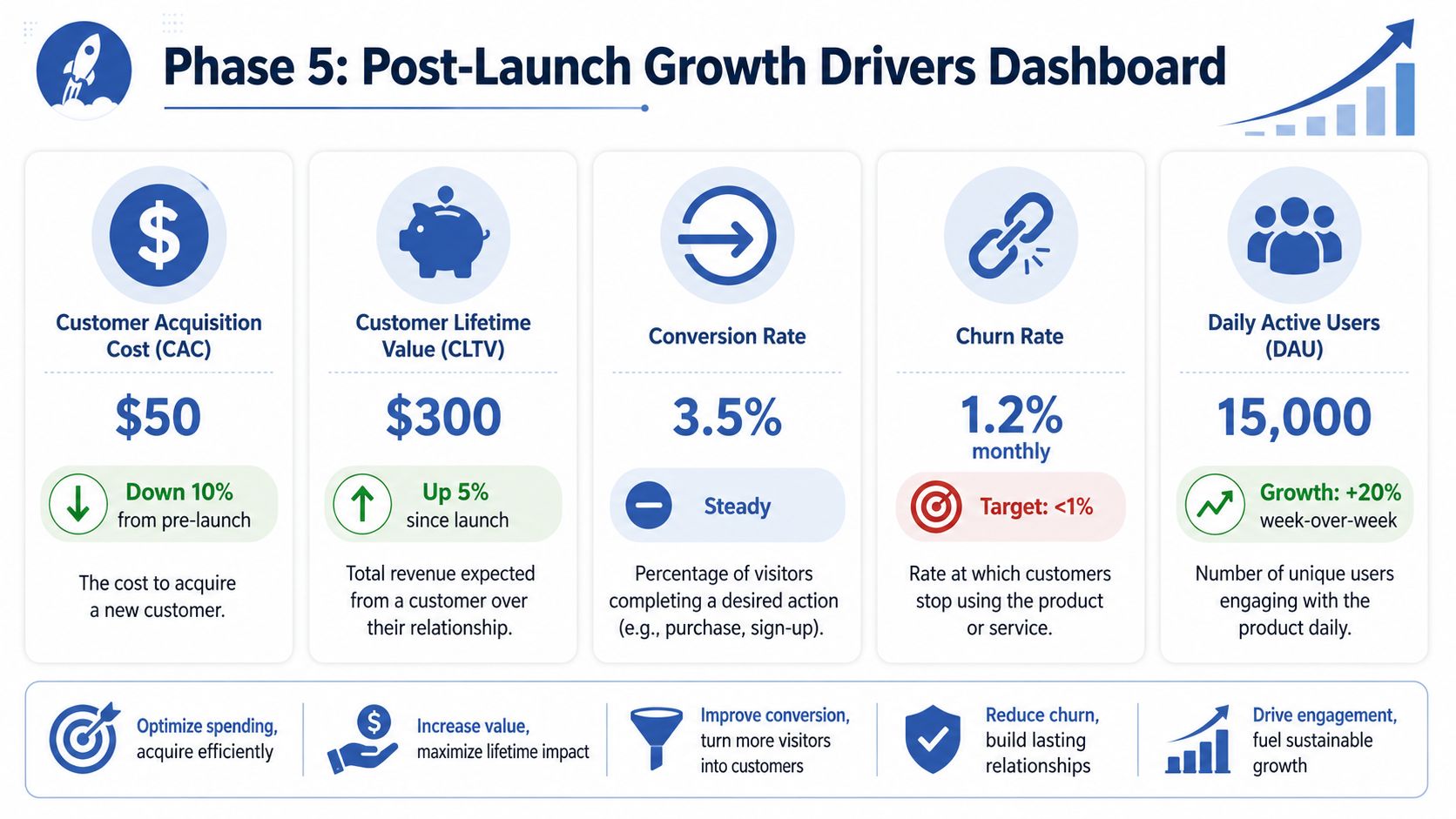
Track the six metrics that expose reality
Successful launches track at least six core metrics: teaser email CTR, landing-page conversion rate, cost per qualified lead, trial activation rate, 7-day retention, and ROAS by channel. According to Productboard's launch strategy guide, campaigns tracking these achieve 25 to 35% higher efficiency because teams can optimize creative and channel allocation with more precision.
These six are important:
| Metric | What it tells you |
|---|---|
| Teaser email CTR | Whether your promise creates curiosity |
| Landing-page conversion rate | Whether the offer and page structure persuade |
| Cost per qualified lead | Whether acquisition is commercially viable |
| Trial activation rate | Whether signups turn into real product use |
| 7-day retention | Whether the initial experience has value |
| ROAS by channel | Whether a channel deserves more budget |
If one of these breaks, your launch story changes. A strong CTR with weak activation means your messaging is ahead of your onboarding. Strong activation with poor retention means the product promise and product reality aren't aligned yet.
Last-click attribution will lie to you
A lot of teams still let last-click reporting drive budget. That's how awareness channels get underfunded and bottom-funnel channels get too much credit.
Use UTMs consistently. Tie campaign data into your CRM. Track first touch, assisting touches, and conversion touch. You don't need an enterprise measurement stack to do this better. You need discipline.
I prefer a simple multi-touch view after launch because it answers practical questions:
- Which channel introduced the buyer?
- Which asset built confidence?
- Which touch converted demand?
That changes spending decisions fast. A founder LinkedIn post may spark awareness, an email sequence may do the education, and branded search may close. Last click only sees the end.
Turn reporting into decisions
Post-launch review should happen in weekly growth sprints. Short meeting. Hard evidence. Clear actions.
Use a format like this:
- Keep what's producing qualified movement
- Cut what burns budget without downstream value
- Fix the biggest friction inside onboarding, pricing explanation, or follow-up
- Test one new message or offer angle based on real objections
The report matters only if it changes what the team does next week.
Product launch marketing becomes a competitive weapon. Not because you launched once, but because you learn faster than the companies shipping beside you. They celebrate traffic spikes. You tighten the funnel, improve retention, and reallocate budget based on actual buying behavior.
That discipline is what turns a launch from a noisy event into durable revenue.