
You want to increase customer lifetime value. Good. That means you're ready to stop chasing an endless stream of new customers and start maximizing the revenue from the ones you already have.
It's a fundamental shift. You're going to get to know your best customers on a deeper level, automate your retention and upsell playbooks, and tweak your product to build rock-solid, long-term loyalty. This is how you build a business that grows with your customers, not just from them.
Why Your Competitors Are Wrong About Customer Acquisition

Most businesses are stuck on a treadmill. They burn cash chasing new leads, celebrating top-line growth while their profit margins get paper-thin. I've been in the machine learning game since 2016, and I've seen this movie play out a hundred times. It’s a fast track to mediocrity.
Your competitors are obsessed with the wrong metric. They live and die by Customer Acquisition Cost (CAC), but that’s just the price of admission. The real game—the one that leads to market domination—is maximizing Customer Lifetime Value (CLV).
The Only Metric That Truly Matters
I'm Samuel Woods. My job is to embed AI into businesses to drive growth and scale. Let's cut through the hype. We're here to build a more profitable, defensible company. For real.
Focusing on how to increase customer lifetime value is your primary strategic weapon. A mere 10% increase in CLV can boost your company's valuation by over 30%. That’s a direct reflection of how investors value resilient, recurring revenue over costly one-off sales. You can dig into the impact of CLV statistics on business growth to see the numbers for yourself.
This is real leverage. The kind that separates market leaders from the rest.
The goldmine isn't out there in the untamed wilderness of new leads. It’s right inside your CRM, sitting in your existing customer base, waiting to be unlocked.
While your competitors fight over scraps at the top of the funnel, you and I are going to build a system that turns your current customers into your most powerful growth engine. This is a fundamental shift in how you operate.
We’ll build a framework that zeroes in on the three core pillars of CLV growth:
- Measurement: You can't improve what you don't measure. We'll establish a simple, bulletproof way to calculate and track CLV.
- Segmentation: We’ll find your "champion" customers—the ones who drive a disproportionate amount of your profit.
- Automation: We’ll deploy AI-powered playbooks to retain, upsell, and deepen your relationships with these segments at scale.
This is your strategic imperative. It's how you stop renting customers and start building a fortress of loyal, high-value relationships your competition can't touch.
The CLV Blueprint: How to Measure What Matters
Before you can grow your customer lifetime value, you have to measure it. Simple enough. But if you've ever Googled "how to calculate CLV," you've probably seen formulas that look like they belong on a physics blackboard.
Forget them. Seriously. They're academic and impractical for most businesses. I've been working with ML models since 2016, and the best metrics are always the simplest ones—the ones you can actually act on.
This is the one that works:
Simple CLV = Average Purchase Value × Purchase Frequency × Customer Lifespan
That’s it. No calculus, no Greek letters. Let's break down what this looks like, because the details shift based on your business model.
Making the Formula Real
For an ecommerce brand, it's straightforward. If your average customer spends $75 per order (Average Purchase Value), buys four times a year (Purchase Frequency), and sticks around for three years (Customer Lifespan), their CLV is $900.
With a SaaS business, it gets even simpler. Your average customer pays $99 per month (Average Purchase Value) and your churn rate suggests an average customer lifespan of 36 months. Their CLV is $3,564. To get a handle on this, you must track key subscription metrics like MRR and churn with obsessive detail.
For a service business, like a marketing agency I advised, their model was a $5,000 monthly retainer (Average Purchase Value). Their average client engagement lasted 18 months, making their CLV a cool $90,000.
The point isn't a perfect, down-to-the-penny number. The goal is a reliable benchmark. A North Star that tells you if your efforts are actually working.
But a simple average only gets you so far. It tells you what is happening, not why. The real magic happens when you start comparing different groups of customers. This is cohort analysis.
Cohort Analysis: Your Secret Weapon for Growth
A cohort is a group of customers who share a common trait, usually when they made their first purchase. When you calculate CLV for each cohort, you uncover incredibly powerful insights that a single, blended average would completely mask.
Let’s imagine you and I look at two cohorts:
- The January Cohort: Acquired through a flashy New Year's discount campaign.
- The March Cohort: Found us through organic content and word-of-mouth.
The January group might have a lower initial purchase value and a much higher churn rate. They came for the deal and left. The March cohort, though smaller, might stick around for years, buying more over time.
Your main dashboard might show a "stable" average CLV. But the cohort data tells the real story: your organic channels attract far more valuable customers. That’s an insight you can take straight to the bank. It tells you where to double down on marketing and what kind of customer to find more of. You can get even sharper insights by layering in marketing intelligence tools to enrich this data.
Practical CLV Models For Your Business
While the simple formula is the perfect place to start, it's not the only way to look at CLV. As your business and data mature, you can adopt more sophisticated models. The right one for you depends on where you are today.
Here’s a quick rundown of the most practical models.
| CLV Model | Best For | Key Inputs | Implementation Complexity |
|---|---|---|---|
| Historical CLV | All businesses starting out; establishing a baseline. | Past purchase data (revenue, orders). | Low |
| Predictive CLV | Mature SaaS & ecommerce; forecasting future value. | Behavioral data, purchase history, ML models. | High |
| Cohort-Based CLV | Subscription businesses; understanding retention trends. | Acquisition date, churn rate per cohort. | Medium |
My advice? Start with Historical CLV. Get it on a dashboard you look at every week. Once that's solid, graduate to cohort analysis.
This progression gives you a clear path from just measuring numbers to truly understanding what drives long-term revenue. That's how you build a business that thrives.
Segment and Conquer: Uncovering Your Most Valuable Customers
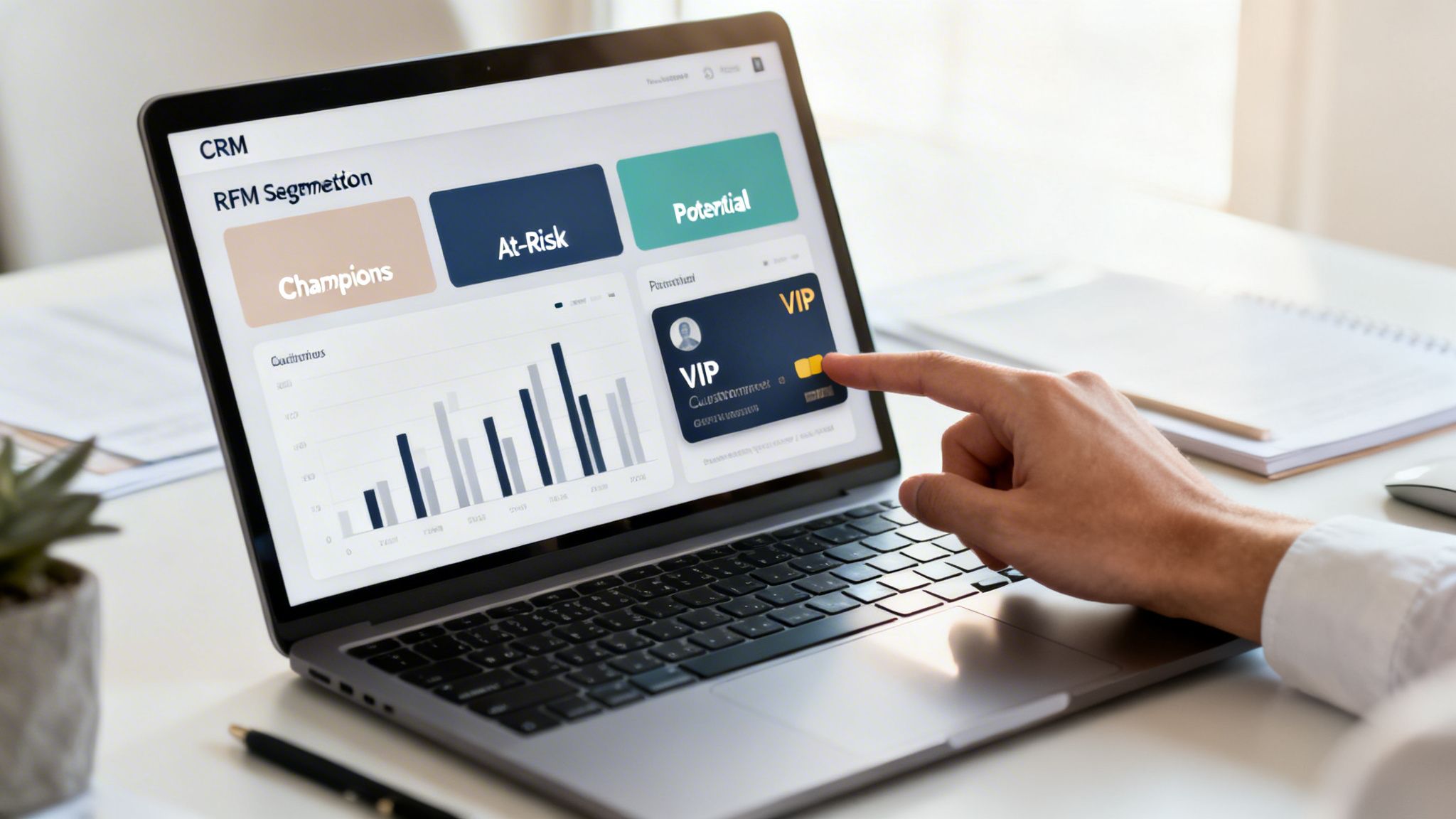
Treating all your customers the same is a recipe for wasted effort and missed revenue. A costly mistake. The reality is that a small fraction of your customers—your true fans—drive a massive portion of your profit. Your top 1% of customers can be worth 18 times more than the average.
So, how do we find them? You and I are going to pull real data from your business—your Shopify or Stripe account, your HubSpot CRM—and turn it into a strategic weapon. We’ll find your champions, identify those at risk, and build specific playbooks for each.
Forget guesswork. Get surgical.
RFM: The Foundation of Smart Segmentation
Let's start with a classic framework that survives because it works: RFM Analysis. It’s the fastest way to get a real sense of customer value without needing complex machine learning models out of the gate.
It stands for Recency, Frequency, and Monetary value.
- Recency: When was their last purchase? Someone who bought last week is a world apart from someone who bought a year ago.
- Frequency: How often do they buy? A one-and-done buyer needs a different approach than a monthly regular.
- Monetary: How much have they spent in total? This immediately flags your big spenders.
You score each customer on a simple 1-to-5 scale for each dimension. A customer who bought yesterday (Recency=5), has made 10 purchases (Frequency=5), and is a top spender (Monetary=5) gets a score of 555. That's a Champion.
A customer who hasn't bought in a year (Recency=1), only bought once (Frequency=1), and spent little (Monetary=1) gets a score of 111. They're at risk.
This simple scoring system shatters the illusion that all your customers are the same. It gives you a data-backed way to prioritize your resources, the first step toward increasing customer lifetime value.
From RFM Scores to Actionable Segments
Once you have these scores, you group customers into meaningful segments. These aren't just labels; they're the foundation for targeted marketing and service actions. I always start with these core groups.
Common Customer Segments Based on RFM
| Segment Name | RFM Score Profile | Description | Strategic Action |
|---|---|---|---|
| Champions | High R, F, M (e.g., 555) | Your absolute best. They buy recently, frequently, and spend the most. | Treat them like gold. Reward them with VIP perks, early access, and personalized thank-yous. |
| Loyalists | High F, M (e.g., X55) | They spend a lot and buy often but might not have purchased very recently. | Re-engage them. A new product announcement or a personal "we're thinking of you" email works wonders. |
| Potential Loyalists | High R, M (e.g., 5X5) | Recent, high-value purchasers who haven't yet become frequent buyers. | Your goal is to build a habit. Nail the post-purchase follow-up and onboarding experience. |
| At-Risk | Low R (e.g., 1XX, 2XX) | Good customers (high frequency or spend) who haven't bought in a while. | Launch a "we miss you" campaign with a compelling, personalized offer to win them back. |
These segments give you a playbook. Your Champions shouldn't get the same generic newsletter as your At-Risk customers. They've earned a different relationship with your brand.
Layering on Behavioral Data for an Unfair Advantage
RFM is your baseline. To really get ahead, go deeper by layering in behavioral data. This is where most competitors stop, leaving a massive opportunity on the table. It's also where AI creates a serious competitive moat.
Think about data points like:
- Product Usage: Which features do they actually use? Which product categories do they browse?
- Support Tickets: Have they submitted multiple support tickets recently? A huge churn indicator.
- Email Engagement: Are they opening your emails? Or have they gone radio silent?
- Website Activity: How often do they log in or visit, even if they don't buy?
When you combine RFM with this behavioral layer, your segments become supercharged. A "Champion" who stopped opening your emails is a high-value customer silently slipping away. A "Potential Loyalist" using every feature of your software is primed for an upsell.
This isn’t about creating manual work. It's about setting up automated triggers. An AI agent can monitor for a Champion who submits a negative support ticket and instantly flag it for a senior team member to handle personally. That's how you use data to build a business that feels personal, even at scale.
Deploying AI Automation Playbooks for CLV Growth

Alright, you’ve done the hard work of measuring CLV and segmenting your customers. Now for the fun part. This is where we deploy AI to turn all that insight into actual revenue.
This isn't about blasting out more generic emails. It's about precision. We’re using AI to deliver the right message to the right person at the exact moment it’ll have the biggest impact. I’ve used these plays to generate millions in new revenue for clients, and they don't require a team of data scientists.
1. The AI-Powered Onboarding Sequence
Your first few interactions with a new customer are everything. Most onboarding is a rigid, one-size-fits-all drip that ignores what the user is actually doing. We're building something smarter.
Here’s a simple setup for a SaaS company:
- The Trigger: A new user signs up.
- The AI Task: An AI agent analyzes the user's first few actions. Did they invite teammates? Go straight to an advanced feature? Or just click around and log out?
- The Personalized Response: Based on that analysis, the AI drafts and sends a hyper-relevant welcome email.
A user who invites their team gets an email focused on collaboration features. The user who dove into advanced settings gets a "pro-tip" email. The user who did nothing? They get a gentle nudge highlighting a "quick win" feature.
This makes the customer feel understood from day one. It's the difference between a generic "Welcome!" and a "Hey, we noticed you're digging into X, here's how to master it." This single shift can cut your 30-day churn by 20-30%.
2. A Predictive Churn Model with Simple Tools
Waiting for a customer to cancel is like waiting for a house fire to buy a smoke detector. Too late. You need an early warning system. You can build an effective version without a Ph.D. in machine learning.
Your system can monitor signals like:
- A sudden drop in logins or feature usage.
- An increase in support tickets, especially about billing.
- Removal of team members from an account.
- A high-value customer suddenly going silent on email.
When your system flags a "high-risk" combination for a valuable customer, it automatically triggers a 'save campaign'. This isn't just a discount. It could be a personal email from customer success or an invitation to a one-on-one feedback session.
For one e-commerce client, we set up a trigger for "Champions" who hadn't purchased in 90 days (their usual was 45). The system sent a personalized email with the subject "Is everything okay?" and a small, unprompted store credit. This simple automation recovered 15% of at-risk Champions, adding over $250,000 in annual revenue.
3. AI-Driven Cross-Sell and Upsell Engines
"You might also like…" is lazy. Your competitors are using simple rules-based recommendations. We can do better by using AI to analyze a customer's entire history to make genuinely helpful recommendations.
For an e-commerce brand, an AI can analyze patterns like, "Customers who buy this running shoe, browse hydration packs, and live in a warm climate are 70% more likely to buy our sweat-wicking socks within 30 days." That feels like a helpful suggestion, not a clumsy sales pitch. Implementing sophisticated Shopify cross sell and upsell strategies with this intelligence ensures customers see things they actually want.
For SaaS, it’s about identifying the perfect moment for an upsell. An AI agent can monitor a team bumping against their plan's limits. Instead of a generic "Upgrade Now!" banner, it alerts a salesperson to say, "I saw your team is scaling up project reporting. Our Pro plan has advanced analytics that could save you hours. Want a quick demo?"
The difference is context. You're not just selling; you're solving a problem you know they have, right when they have it. Exploring how to use AI agents for marketing can open up a whole new playbook of automated growth.
Fine-Tuning Your Product for Maximum CLV
Your marketing can be world-class and your automation can run like a Swiss watch, but if your core product isn’t designed to grow with your customers, you’re pouring water into a leaky bucket.
The biggest, most sustainable gains in CLV don't come from your funnels—they come from your offer itself. This is about turning your product and pricing into an engine for expansion revenue. It means listening to your customers by analyzing what they do, not just what they say.
The Land-and-Expand Playbook
In SaaS, the "land-and-expand" model reigns for a reason. You start a customer on an accessible plan (the "land"). Then, you give them a clear, compelling path to upgrade as their needs evolve (the "expand"). This is the engine behind companies like Slack and HubSpot.
The secret is to anchor your pricing tiers to value metrics that scale naturally with your customer's success.
- Per-User Pricing: As a client’s team grows, your revenue grows. Simple.
- Usage-Based Pricing: This ties your price directly to the value a customer gets—data storage, API calls, contacts. Your bill becomes a direct reflection of their ROI.
- Feature-Gated Tiers: This is the classic approach. You reserve advanced, high-value features for premium plans, creating an incentive for customers to upgrade as their business matures.
The same logic applies to e-commerce. You "land" with a great first purchase. The "expand" happens through a well-designed loyalty program with escalating rewards, exclusive products, or subscription options.
Your pricing shouldn't be a static menu. It should be a dynamic journey. The goal is to make the next step—the upgrade, the add-on—feel like the most logical and valuable decision.
Don't just guess which features belong in which tier. Dig into your analytics. If 80% of customers who use a specific feature have a 2x higher CLV, that’s your signal. That feature is a perfect candidate for a premium tier or paid add-on.
Your Best Feedback Comes from Customers Who Leave
This sounds counterintuitive, but one of the most effective ways to reduce long-term churn is to make canceling incredibly easy.
Seriously. Stop hiding the cancellation button. All that does is create frustration and burn any bridge for a potential return. Instead, build a clean off-boarding process focused on one thing: data collection. When a customer clicks "cancel," show them a one-question survey: "What's the main reason you're leaving?"
Make the options clear:
- "The price is too high."
- "I'm missing a specific feature." (Always include a text box here.)
- "I didn't get the results I expected."
- "I'm switching to a competitor." (Ask which one!)
This feedback is pure gold. If 30% of churning customers leave for a competitor with one specific feature, that’s not a churn problem—it’s a flashing red light on your product roadmap. By understanding the real elements of value your customers want, you can better sell what people actually want to buy.
Treating departing customers with respect leaves the door open for them to come back. I've seen it happen. A customer leaves for a cheaper rival, realizes the product is terrible, and comes back six months later—more loyal than ever. That only happens if you make the exit professional and painless.
Your 90-Day CLV Acceleration Plan
We've covered the blueprint—measurement, segmentation, AI automation, and product strategy. But ideas are useless without action. It’s time to execute. This isn’t a theoretical exercise; it’s a tactical roadmap to see a material lift in CLV in a single quarter.
The biggest mistake is trying to boil the ocean. Getting fired up, drafting a massive to-do list, and accomplishing nothing. Not us. We're going to be disciplined and sequential.
Here’s the 90-day plan I walk my clients through. It's built for focus and momentum.
Month 1: Get Your House in Order
The first month is about building a solid foundation. You can’t build a CLV growth engine on messy data. This part is non-negotiable.
- Weeks 1-2: Data & Measurement. Your only job is to get your CLV calculation right. Use the simple formula: Average Purchase Value × Purchase Frequency × Customer Lifespan. Put this number on a dashboard you look at daily. This is your new North Star.
- Weeks 3-4: Segmentation. Now, apply that same formula to different customer groups. Your main task here is to run a basic RFM analysis (Recency, Frequency, Monetary). By the end of Week 4, you must have clear, data-backed definitions for your "Champions," "Loyalists," and "At-Risk" customers.
That’s it. No shiny objects for 30 days. Just data, measurement, and segmentation. This groundwork dictates the success of everything that follows.
Month 2: Deploy Your First AI Plays
With your segments defined, it's time to act. We’ll focus on the highest-impact automations first. Your priority depends entirely on your business model.
The goal here is not perfection. It’s to get one or two automated campaigns live that target your most important segments. You’ll learn more from a real-world deployment in one week than from three months of planning.
- For SaaS companies: Your world is onboarding and churn prevention. Use Weeks 5-8 to build a dynamic onboarding sequence for new "Potential Loyalists" and a predictive churn alert for your "Champions." A simple alert when a Champion's product usage drops for 7 consecutive days is a powerful start.
- For e-commerce brands: Your focus is on boosting purchase frequency and average order value. Use Weeks 5-8 to launch an AI-powered cross-sell campaign for recent buyers and a win-back automation for your "At-Risk" segment.
You're building the first gears of your CLV machine. They might be clunky at first, but they will be running.
Month 3: Optimize and Expand
By now, your system is live and collecting data. The third month is all about learning and iterating. This is where you pull away from the competition, who are still stuck in planning meetings.
This is where you fine-tune your core offer, creating a tight feedback loop between your customers and your product.

As the visual shows, continuous improvement is a cycle, not a one-time project. By Week 12, you're not just running campaigns; you’re running an intelligent system. You should be analyzing the results of your Month 2 plays, tweaking your AI prompts, and identifying your next big opportunity.
Is your win-back campaign working? Is your onboarding sequence improving 30-day retention? The data will give you the real answers. This plan provides the framework to build a durable, long-term competitive advantage—one customer relationship at a time.