
Most advice on AI for customer retention is backwards. It tells you to build a churn model, admire the dashboard, and call that strategy.
I don't buy that. I'm Samuel Woods, a Fractional Chief AI Officer. I've been working with ML since 2016 and Generative AI since 2019, and I've watched too many teams confuse prediction with execution. They get a score. Nobody acts on it. Revenue still leaks.
The main problem isn't whether AI can identify risk. It can. The problem is the last mile between a churn signal and a customer-saving action. That's where competitors stall, especially smaller teams without a data science department. That's also where you can win.
Table of Contents
- Don't Just Predict Churn Prevent It
- First Define What Winning Looks Like
- Build Your Customer Intelligence Engine
- Turn Churn Scores Into Actionable Segments
- Deploy Automated Re-Engagement Plays
- Prove Your ROI and Iterate Relentlessly
Don't Just Predict Churn Prevent It
Your competitors love saying they use AI to predict churn. That sounds impressive. It also misses the point.
If prediction doesn't trigger an intervention, you've built a reporting layer, not a retention system. That's why so many AI retention projects die inside slide decks and dashboards. The strategy sounds good in a board meeting, then disappears inside disconnected tools and manual follow-up.
The gap is real. While 78% of marketers cite AI for retention as a priority, only 24% report it is fully integrated into their workflow, which is why many organizations still don't know how to move from a churn score to an actual campaign launch. That's the execution gap I care about.
Practical rule: If your AI output doesn't change what happens to a customer in the next hour, it isn't operational yet.
For CEOs, this matters because retention isn't a model accuracy game. It's a speed game. The company that detects risk and acts first keeps the account. The company that waits for a weekly review loses it.
Small teams usually assume they need a giant platform rebuild to close this gap. They don't. They need a practical chain: signal, score, segment, trigger, response, measurement. If you're already modernizing adjacent workflows, resources like optimizing Shopify customer support with AI are useful because support interactions often contain the earliest retention signals.
I've written separately about the modeling side in my guide to predicting customer churn, but the bigger issue is what happens after the score appears. That's where market share gets protected.
Here's the operating lens I use with leadership teams:
- Don't fund prediction alone. Fund intervention.
- Don't hand raw scores to marketers. Hand them clear segments and automated plays.
- Don't wait for perfect infrastructure. Build a low-code version first, then harden it.
Most companies stop at insight. You need a machine that changes outcomes.
First Define What Winning Looks Like
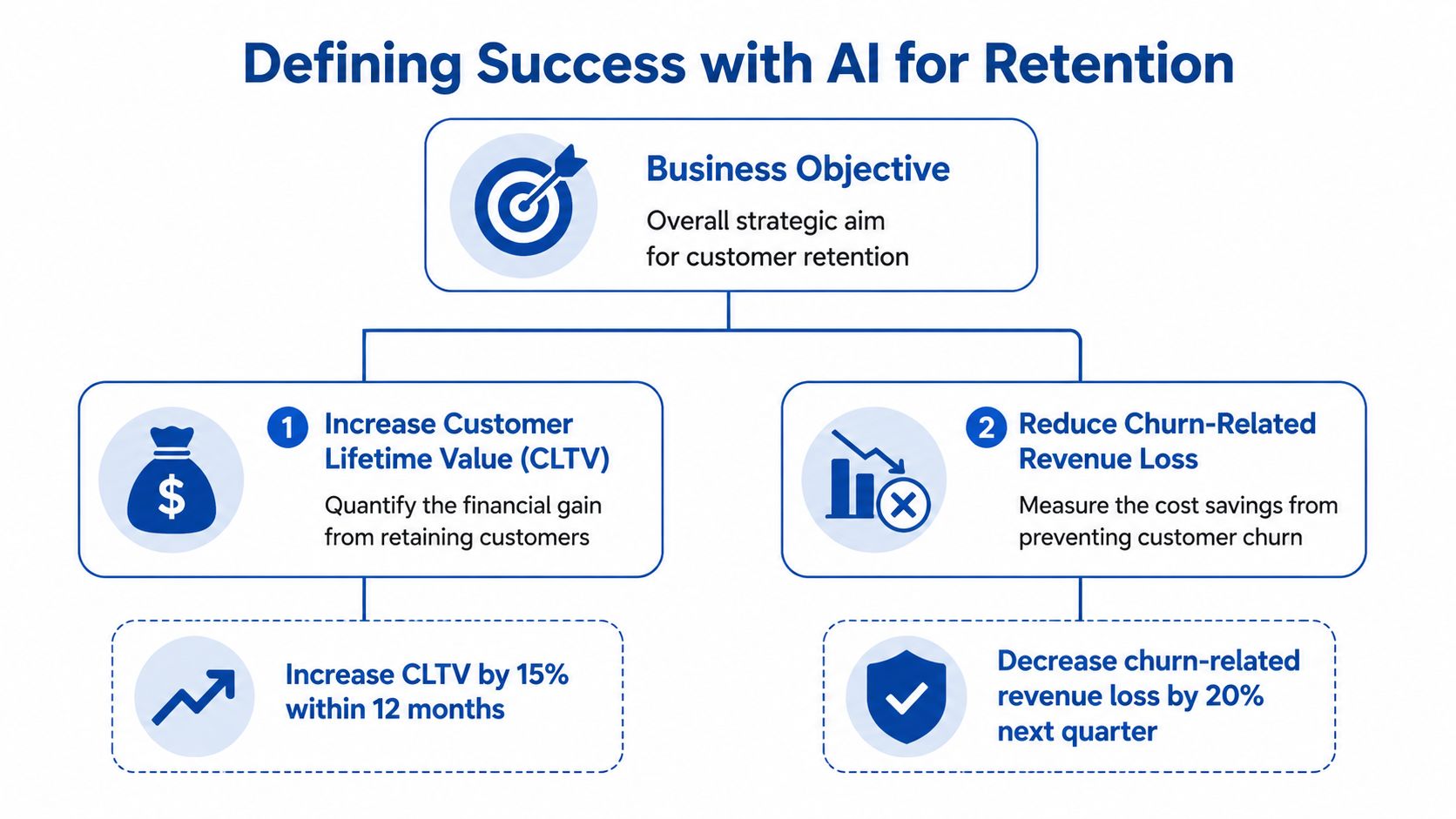
Technology is irrelevant if you can't tie it to money. If your retention goal is "reduce churn," you're still thinking too vaguely.
I want a target that finance cares about. Better customer lifetime value. Lower churn-related revenue loss. Faster second purchase. Higher renewal stability in your most valuable accounts. AI can optimize behavior, but only if you define the behavior in commercial terms.
Start with financial outcomes
Two facts should shape your thinking immediately. Retaining an existing customer is 5 to 7 times cheaper than acquiring a new one, and a 5% increase in customer retention driven by AI strategies can boost profits by 25–95%. Those economics are why retention deserves executive attention, not just lifecycle marketing attention.
That changes how you set the agenda. Don't ask, "Which AI tool should we buy?" Ask, "Where does customer leakage hurt margin the most, and what signal tells us it's coming?"
A simple way to frame it:
| Business priority | What it means in practice | Why AI helps |
|---|---|---|
| Protect existing revenue | Save accounts showing early decline | AI catches behavior shifts faster than manual review |
| Increase customer lifetime value | Get customers to repeat, renew, or expand | AI personalizes timing, content, and next steps |
| Reduce wasted retention effort | Stop blasting every customer with the same save campaign | AI helps focus intervention where action is justified |
If you're running SaaS, this usually starts with renewal risk and product usage decline. If you're in ecommerce, it often starts with repeat purchase windows, support friction, and category-level drop-off.
Choose KPIs your team can actually influence
I don't recommend setting success around abstract "engagement improvement." That's how teams hide weak execution.
Use KPIs tied to actions your retention system can directly affect:
- Revenue protection: Revenue preserved from at-risk segments that re-engage before churn.
- Customer value: Change in repeat purchase behavior, renewal behavior, or account expansion among targeted cohorts.
- Operational speed: Time from risk detection to first intervention.
- Efficiency: Whether your team is spending human attention on high-value risk instead of low-value noise.
The best retention KPI is one your CFO would recognize without translation.
There's also a strategic benefit to getting this right early. AI adoption has become mainstream in retention. A 2025 benchmark cited by Envive AI reports that 92% of businesses now use AI-driven personalization for customer retention strategies, and 83% of AI-enabled sales teams report revenue growth compared with 66% of teams without AI integration in Envive AI's customer retention statistics. If you're still treating retention AI as experimental, you're not being cautious. You're lagging.
My recommendation is blunt. Pick one financial objective, one customer behavior objective, and one operational objective. Tie all three together. That gives your AI system a job, your team a scoreboard, and your board a reason to keep funding the work.
Build Your Customer Intelligence Engine
AI for customer retention is only as good as the data you feed it. Most companies don't have a modeling problem. They have a visibility problem.
Customer behavior is scattered across your CRM, email platform, product analytics, billing system, and support desk. Then leadership wonders why the model keeps missing obvious churn risk. It missed it because the evidence lived in five places.

Unify the signals that actually matter
The data points I care about first are behavioral, not decorative. Login frequency. Feature usage. Message engagement. Support ticket patterns. Renewal proximity. Purchase history if you're in commerce. Those signals tell you whether the customer is moving toward value or away from it.
Often, teams get sloppy. They rely on historical transactions alone because that data is clean and easy to access. That's a rookie move. Transaction history tells you what happened. Retention systems need signals that tell you what's changing right now.
According to the AWS guidance on AI retention systems, data siloing across email, app, and support systems can reduce model predictive power by 30-40%, and unifying those signals is what enables models to reach 85-90% accuracy in flagging risk in AWS's overview of enhancing customer retention strategies with AI.
If your stack is fragmented, fix that before you obsess over model sophistication.
A practical data stack for SMBs often looks like this:
- Source systems: HubSpot, Klaviyo, Intercom, Stripe, Shopify, app analytics, and support data.
- Unification layer: A customer data platform, warehouse, or even a well-structured operational database.
- Action layer: Marketing automation, customer success workflows, and AI agents that can trigger the next step.
If you need a roadmap for the plumbing, my guide to marketing data integration covers the mechanics of getting those systems to talk to each other.
Use models your team can operationalize
You do not need a moonshot model to start. I prefer models that your operators can understand and your systems can use. Logistic regression and random forest are often enough when the signal design is solid.
What matters more is feature quality than model theater. I want to know things like:
- Has usage declined?
- Has support friction increased?
- Has message engagement collapsed?
- Has the account stopped reaching key success milestones?
- Is the customer approaching a renewal or repeat-buy window?
Your first win doesn't come from a more exotic model. It comes from a cleaner customer record.
One more hard truth. Real-time context matters. If your system only refreshes occasionally, your interventions arrive late and feel generic. The point of a customer intelligence engine is to create a living profile that updates as customer behavior changes.
This is also where you decide what not to do. Don't force full AI personalization if your first-party data is thin, stale, or inconsistent. Bad personalization doesn't feel helpful. It feels intrusive and clumsy. In that scenario, use simpler rule-driven journeys until your data quality catches up.
Turn Churn Scores Into Actionable Segments
A churn score doesn't tell your team what to do. "Customer 1847 has an 82% churn probability" is not a strategy. It's an alert without a playbook.
What operators need is a segment they can understand in one glance. Who is this customer? What changed? Why does this matter commercially? That's the difference between analytics and action.

A score is not a strategy
In my experience, predictive churn models catch warning signs like dropping login frequency and rising support tickets weeks before renewal. AI spots these signals early when engagement drops 20% or support tickets hit 3+, which gives your team enough lead time to trigger a personalized journey before the customer departs.
That signal is useful. The raw score alone isn't.
Your marketing lead, CX lead, or account manager needs a label that carries context. I usually translate scores into commercially meaningful groups such as:
| Segment | What happened | What your team should assume |
|---|---|---|
| High-value slipping accounts | Strong historical value, recent usage drop, support friction rising | Save fast and involve a human if needed |
| Onboarding stallers | New customer never reached activation behavior | Education is more important than discounting |
| Quiet loyalists fading | Longtime customer, engagement softening without complaint | Reintroduce value before they mentally check out |
| Promotion-only buyers | Response appears only when incentives appear | Retain selectively and protect margin |
These segments help you decide whether to educate, incentivize, escalate, or leave the customer alone.
Build segments your team can recognize immediately
I like a simple segmentation formula. Combine three layers:
- Value layer: High, medium, low commercial importance.
- Risk layer: Early warning, active decline, severe disengagement.
- Context layer: Onboarding, renewal, repeat-purchase, support recovery, expansion candidate.
That gives you practical labels your team can act on. High-value plus active decline plus renewal window is a completely different intervention from low-value plus onboarding stall.
Don't ask your team to interpret probabilities in the middle of a busy week. Hand them a category and a next move.
There's another advantage here. Segments let you enforce discipline across channels. Email, in-app messaging, support outreach, and sales follow-up stop competing with each other because they work from the same customer state.
I've also observed AI beginning to outperform rule-only systems. It can look across combinations of weak signals that humans would miss in isolation. A small drop in usage might not matter. A small drop in usage plus multiple support tickets plus poor message engagement often does. The segment captures the pattern, not just the score.
One caution. Don't create ten layers of segmentation on day one. Your team won't use them. Start with a handful of high-consequence segments tied to clear interventions and expand only when your operating rhythm is stable.
Deploy Automated Re-Engagement Plays
This is the part that saves revenue. Once a customer enters an at-risk segment, human delay becomes expensive.
I've seen too many teams detect a problem on Monday, discuss it on Wednesday, and reach out on Friday. By then, the customer has already disengaged. Automation fixes that speed problem when it's connected to the right trigger.
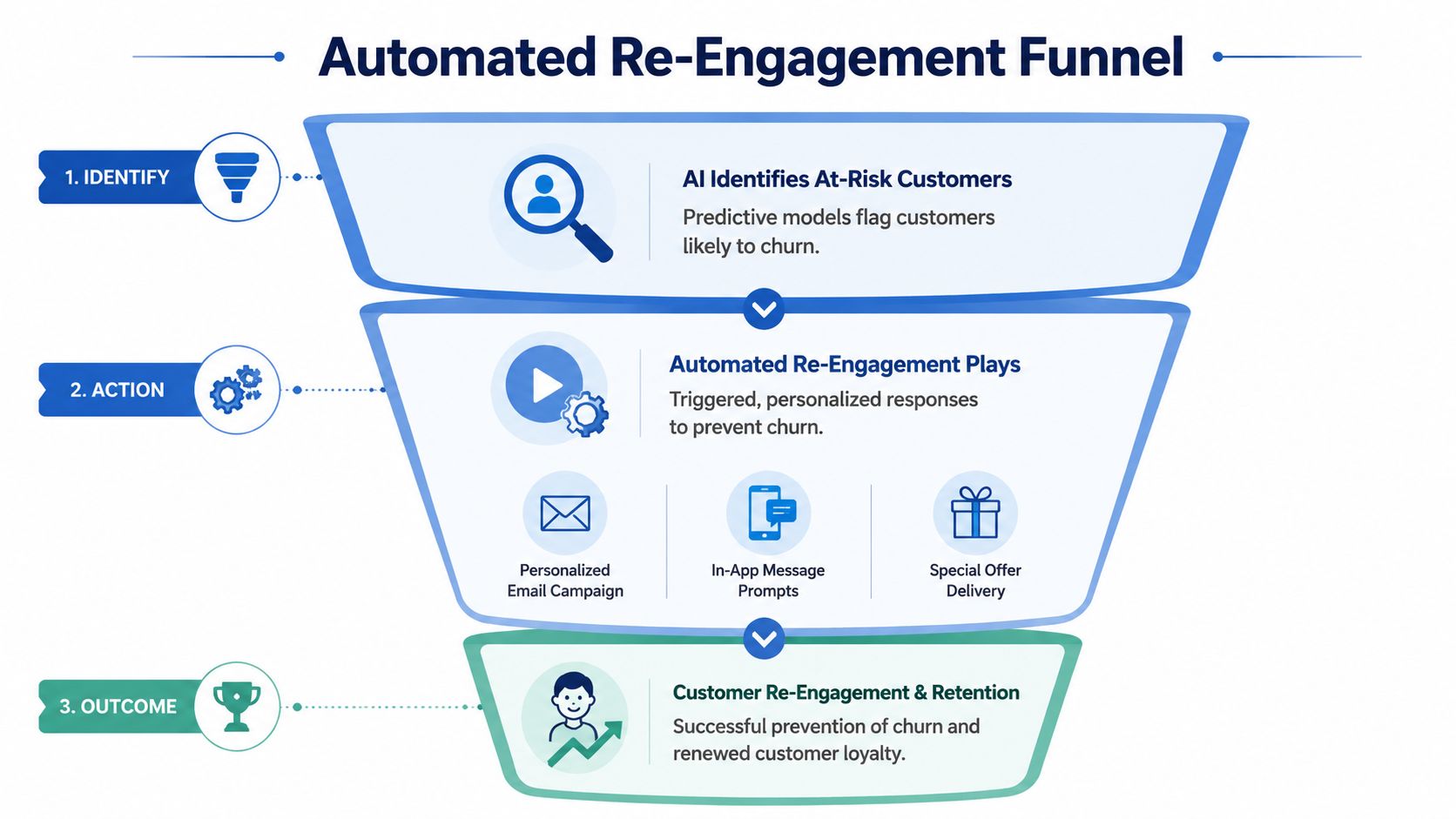
A useful visual for this operating model is below.
What an actual save play looks like
When a customer's health score dips or usage drops 20%, AI can immediately initiate a retention play like in-product help or a tiered win-back incentive. That removes the 2-3 day lag in human response and lets the team act within hours of detecting risk.
Here's a play I'd deploy for a SaaS company:
- Trigger fires: Usage drops, health score weakens, and the account enters a high-value risk segment.
- Immediate in-app intervention: Show contextual guidance tied to the feature they stopped using.
- Follow-up email: Send a personalized email based on behavior, not a generic "we miss you" template.
- Escalation rule: If there's no response, create a task for a customer success manager or founder outreach.
- Suppression logic: Stop the sequence if the customer re-engages, upgrades, or opens a support conversation.
The same logic works in ecommerce, just with different moments. Instead of renewal decline, you watch repeat-purchase windows, category drop-off, or support friction after delivery. If your team uses push and loyalty messaging, tactics around engaging customers with news alerts can fit well inside these save flows when they're tied to actual customer state.
A short walkthrough helps:
For the action layer, I usually evaluate tools based on orchestration first, not AI branding. Braze, HubSpot, Klaviyo, Intercom, and Customer.io can all work if they can receive a segment, personalize the message, and trigger a next step. Samuel Woods' AI-powered playbooks are another option in this category for businesses that want agents analyzing behavior and launching save campaigns without building everything from scratch.
Where automation should stop
Automation is powerful, but over-automation is sloppy. Not every customer deserves the same sequence, and not every moment should be handled by a machine.
Use automation when:
- Speed matters: The risk signal is fresh and delay reduces your odds.
- The intervention is repeatable: Educational prompts, value reminders, usage nudges, or standard win-back offers.
- The segment is clear: The customer state supports a predictable response.
Keep humans involved when:
- The account is strategically important: Enterprise, high-LTV, or politically sensitive accounts.
- The issue is emotional or complex: Pricing conflict, service failure, legal concerns, or multi-threaded dissatisfaction.
- Your data confidence is weak: If the trigger quality is poor, human review prevents embarrassing outreach.
If you want real examples of how these sequences are structured, my library of marketing automation workflow examples shows the mechanics behind this kind of operational setup.
The competitive edge here is simple. Your rivals still rely on meetings, handoffs, and inbox lag. You respond while the customer is still persuadable.
Prove Your ROI and Iterate Relentlessly
Most AI retention programs get underfunded for one reason. Leadership can't prove what's working.
They look at opens, clicks, replies, and campaign activity. None of that answers the hard question. Did the AI intervention preserve revenue that would've otherwise disappeared?
According to a 2025 McKinsey study, 65% of companies cannot isolate the specific revenue impact of AI-driven retention campaigns from baseline human performance. That measurement gap creates strategic paralysis because teams can't show incremental lift with confidence.
Stop measuring vanity metrics
Open rates are not retention. Click rates are not retention. Even conversions can mislead if you can't separate AI impact from what would've happened anyway.
The fix is controlled testing with real holdouts. Not vague before-and-after reporting.
I recommend this structure:
| Group | What happens | What you measure |
|---|---|---|
| Control group | Receives your normal human-led or existing retention treatment | Baseline retention behavior |
| AI treatment group | Receives AI-triggered segmentation and intervention | Incremental lift over baseline |
| Optional hybrid group | Receives AI detection with human-crafted outreach | Whether augmentation beats automation alone |
Run the test on a well-defined at-risk segment. Use revenue-preservation outcomes, renewal outcomes, repeat purchase outcomes, or reactivation outcomes. Then compare the groups over the same time window.
If you don't use control groups, you don't know whether AI created value or simply took credit for existing momentum.
This also protects you from internal politics. Marketing won't claim all the lift. Success won't claim all the lift. The test design decides.
Feed outcomes back into the system
A retention engine that doesn't learn gets stale fast. Every intervention should produce feedback. Did the customer click? Re-engage? Renew? Ignore? Churn anyway?
I treat that feedback as training fuel for the next round of decisioning. The model should get smarter about who to target, what to send, when to escalate, and when to stop. That's how you move from one-off automation to a compounding system.
My advice to CEOs is straightforward:
- Budget for measurement from day one. Don't bolt it on later.
- Demand holdout testing. Without it, ROI claims are mostly storytelling.
- Review learning loops monthly. Ask which segments respond, which interventions fail, and where human override is improving outcomes.
AI for customer retention isn't hard because the technology is mysterious. It's hard because most companies stop before the system becomes operational, measurable, and self-improving. The ones that fix that last mile don't just reduce churn. They build a response capability that competitors can't match.