
Most advice on marketing spend optimization is weak because it starts with cost control. That's finance hygiene. Competitive strategy starts somewhere else.
I don't optimize spend to make reports look cleaner. I optimize spend to move capital faster than competitors, fund what's compounding, and starve what's pretending to work. If you treat optimization like a trimming exercise, you'll get incremental savings. If you treat it like an operating system, you'll buy speed, signal quality, and market share.
The blunt truth is that many marketing departments are still steering with delayed dashboards, broken attribution, and channel managers defending their own budgets. That's why they keep overfunding demand capture, underfunding demand creation, and congratulating themselves for “efficient” performance while growth stalls.
Table of Contents
- Your Competitors Think Optimization Means Cutting Costs
- Build Your Data Foundation Before You Touch a Dollar
- Choose Your Measurement Model Wisely
- The Art and Science of Dynamic Budget Allocation
- Accelerate Your Advantage with AI Agents
- Your Optimization Playbook and Reporting Template
- Common Questions About Spend Optimization
Your Competitors Think Optimization Means Cutting Costs
Most firms aren't operating with endlessly expanding marketing budgets. A widely cited benchmark says marketing budgets remained at 7.7% of company revenue, which means the key is allocation, not asking for more money. The same source also points to about 23% of online ad spend, roughly $20 billion, as waste that can be reallocated toward revenue-producing activity, not defended out of habit (Stape on marketing spend optimization).
That changes the conversation immediately.
If your budget envelope is relatively fixed, then your edge comes from redeploying capital faster than everyone else. Shaving a few line items or demanding lower agency fees won't do it. Moving money out of weak campaigns and into channels, audiences, offers, and creative combinations that are still producing marginal return will.
A practical rule: don't ask, “Where can we cut?” Ask, “Which dollars are trapped in low-return work?”
I see too many business owners treat marketing spend optimization as a defensive audit. They pull reports, question spend, and push for everyone to “be efficient.” Fine. But efficiency without reallocation discipline just locks in mediocrity.
The stronger posture is offensive. You identify waste, recover it, and use it to attack.
That might mean owning a high-intent keyword cluster your competitors can't hold. It might mean funding better creative testing while they recycle stale ads. It might mean extending into a new segment while they're still arguing about attribution models. If you need a broader operating view of that kind of discipline, this B2B guide on improving GTM efficiency is a useful companion read.
Here's my opinion after building these systems for years. Marketing spend optimization is a capital deployment system. The businesses that understand that stop managing channels like separate kingdoms and start managing spend like a portfolio.
Build Your Data Foundation Before You Touch a Dollar
Everyone wants the smart model first. Wrong order.
If your event tracking is broken, your CRM isn't mapped cleanly, and your ad platforms are all grading their own homework, then every budget decision you make is contaminated. What you have is prettier guessing.
Stop trusting platform reporting
Meta says Meta drove the result. Google says Google did. Your email platform wants credit too. None of that is a usable source of truth for capital allocation.
I start by forcing one unified view of revenue and conversion events across the stack. That means ad spend data, web analytics, CRM stages, closed revenue, refunds if relevant, and offline sales inputs if you have them. If those systems don't reconcile, I don't touch allocation logic yet.
A solid dashboard helps, but only if the plumbing behind it is clean. I've written separately about marketing analytics dashboards because the dashboard is only the visual layer sitting on top of instrumentation quality.
What I put in the foundation
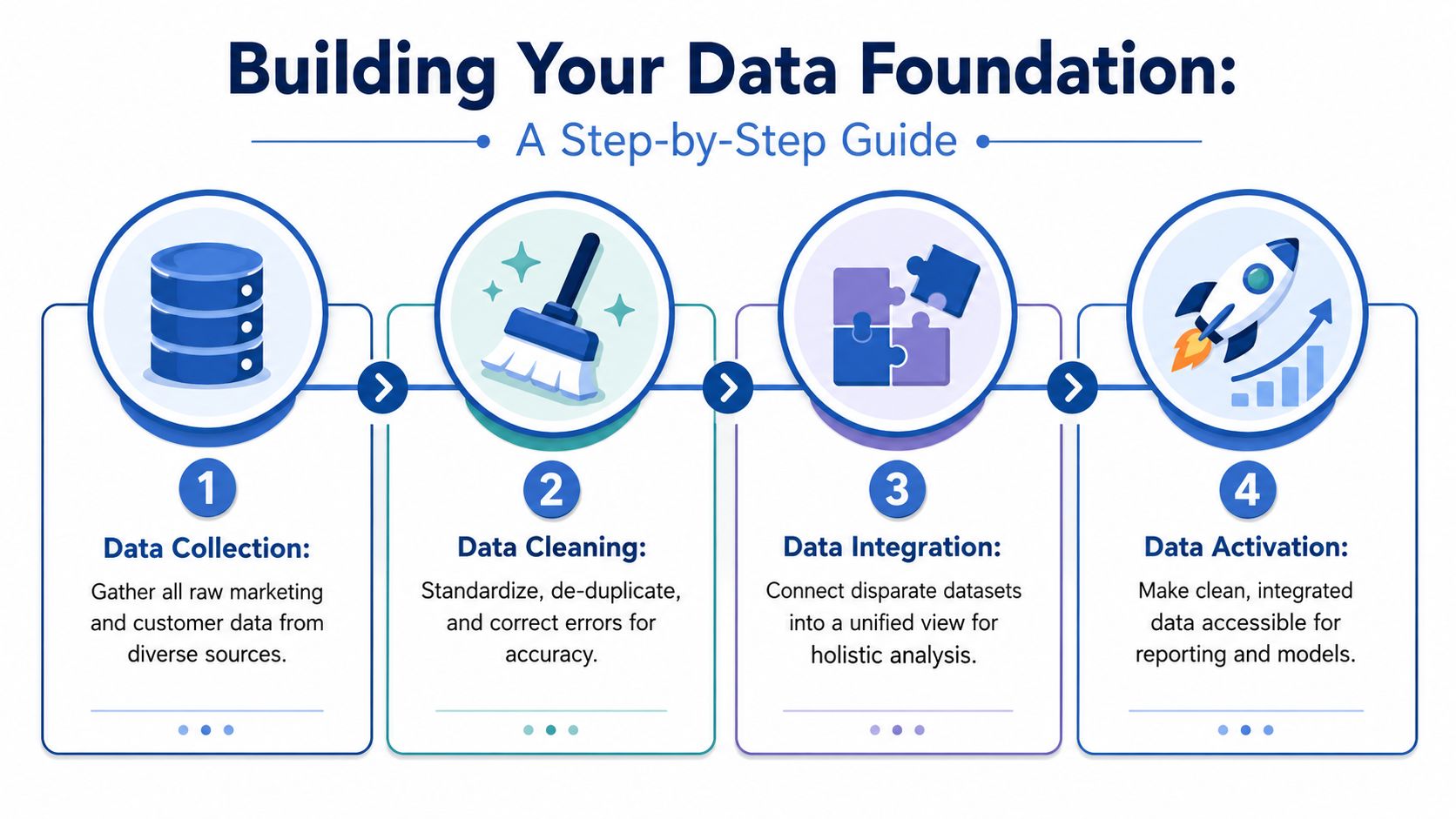
I keep this simple and hard-edged. Your foundation needs four things.
Reliable collection.
Capture conversion and revenue events consistently across your site, product, CRM, and paid channels. If lead stages change names across systems or purchases land in the wrong bucket, stop and fix that first.Cleaning discipline.
Standardize naming conventions, remove duplicates, and map campaign taxonomy before analysis. If one person labels campaigns by region and another by offer, your model will fragment fast.Integrated reporting.
Join spend, pipeline, and revenue into one view. I want you and whoever runs your ads looking at the same business reality, not two dashboards telling two different stories.Activation paths.
Make the cleaned data usable. That means feeding reporting, testing frameworks, forecasting, and automations without manual spreadsheet surgery every week.
Clean data isn't glamorous. It does, however, decide whether your next budget move is intelligent or expensive.
I also track the business metrics that survive a hard look at the numbers. CPA, ROAS, conversions, and revenue are common optimization metrics in disciplined reallocation workflows, because they tie spend to financial output rather than vanity noise, as noted in the earlier benchmark source.
A short audit usually exposes the same failure points:
- Missing conversion definitions because different people count different actions as success
- Broken handoff logic between marketing-qualified activity and revenue systems
- Overlapping reporting layers that produce conflicting totals
- Manual exports that delay decisions until the opportunity has already passed
If you're missing this layer, don't compensate with more AI. AI sitting on bad data just automates your confusion.
Choose Your Measurement Model Wisely
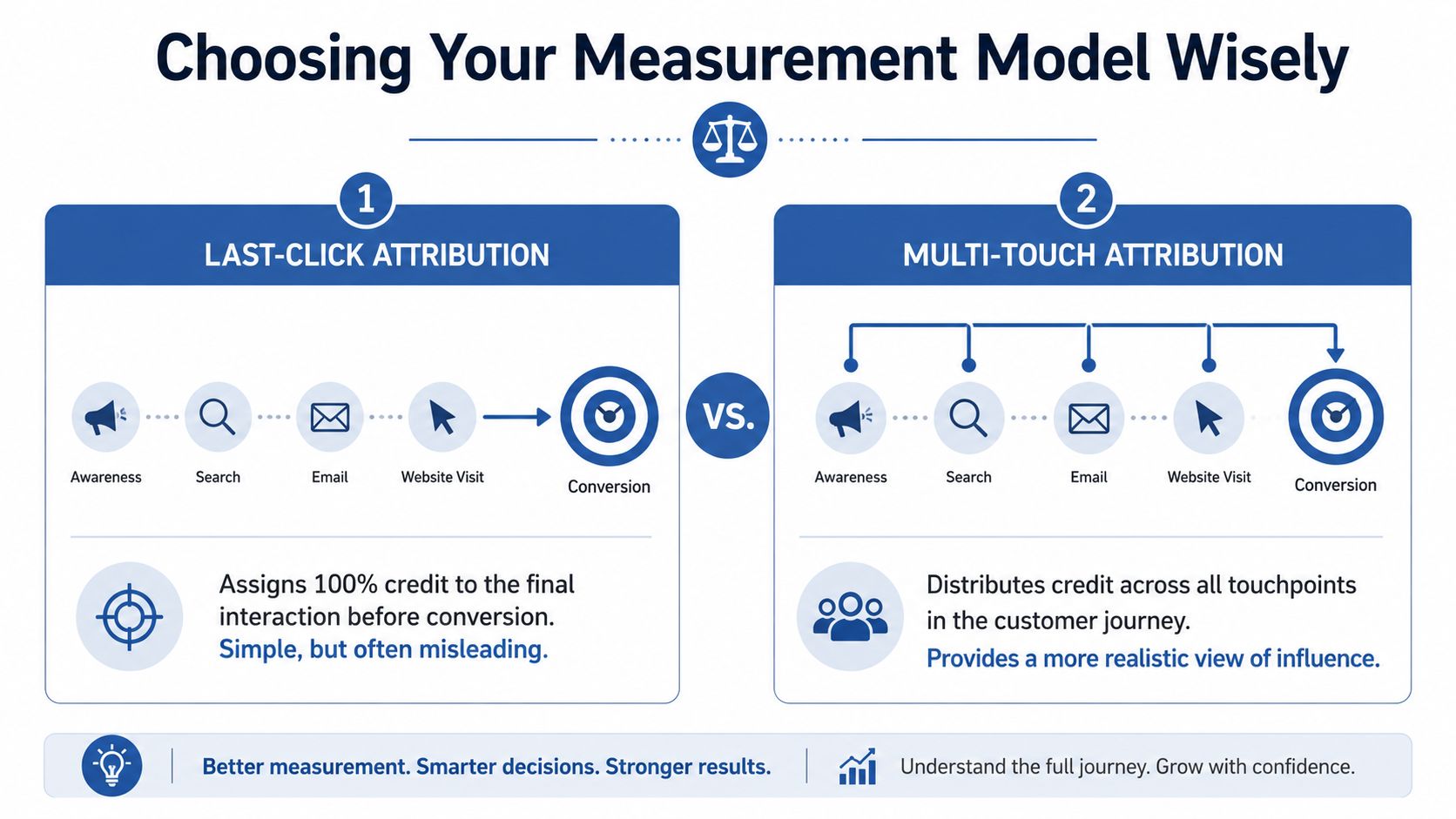
Last-click attribution is one of the most expensive lies in modern marketing.
It flatters demand capture, undervalues upstream influence, and trains teams to keep spending where conversion gets claimed, not where demand gets created. If you've ever seen branded search or retargeting absorb more and more budget while net-new growth stays weak, you've seen the result.
Why last click keeps fooling teams
Last click is operationally convenient. That's why people keep using it. It gives a clean story, fast.
It also distorts budget decisions. The final touch often captures intent that other channels helped create. So the channel nearest the sale gets over-credited, while the channels that shaped awareness, consideration, and repeated engagement get starved.
Multi-touch reporting has flaws, but it's directionally more useful than pretending the last interaction did all the work. If you want a practical breakdown of alternatives, I've covered that in my piece on multi-touch attribution models.
The sequence I trust
The order matters more than commonly understood. An effective optimization workflow starts with a unified revenue baseline, then measures incremental lift with experiments such as holdout tests, and only then uses MMM to model cross-channel effects and scenario planning. That sequence separates demand creation from demand capture and prevents poor allocation decisions (Fusepoint Insights on marketing spend optimization workflows).
That's the part often skipped. They jump straight to attribution software or a model deck and never establish causality.
Here's how I think about the main options:
| Model | Best use | Main weakness |
|---|---|---|
| Last click | Fast directional reporting | Over-credits the final touch |
| Multi-touch attribution | Tactical journey analysis in digital environments | Sensitive to tracking quality |
| Incrementality testing | Causal validation of channel impact | Requires planning and control design |
| MMM | Cross-channel budgeting and diminishing return analysis | Less useful for day-to-day creative decisions |
Use the wrong tool and you'll get false confidence. Use the right combination and you'll finally be able to answer the budget question that matters: if you move money from one channel to another, what changes in revenue, beyond reported conversions?
The measurement model should help you make a better allocation decision. If it only produces prettier channel reports, it's not doing its job.
A few practical calls from experience:
- Use incrementality testing when a channel gets too much self-attributed credit, especially branded search, retargeting, affiliate activity, or heavily optimized paid social.
- Use MMM when you need to make big budget decisions across channels, especially where lag effects and saturation matter.
- Use multi-touch reporting for tactical tuning, path analysis, and creative sequencing. Just don't let it become your only truth source.
- Avoid over-modeling early if your instrumentation still has holes. Causal logic on shaky inputs is still shaky.
The people who win here don't obsess over one “perfect” model. They build a measurement stack with clear roles, then use each method for the decision it's good at.
The Art and Science of Dynamic Budget Allocation
Static budgets age badly.
That's not theory. One PPC analysis reports that over the past five years, CPCs rose by 40 to 50% while conversion rates slipped from 7.04% to 6.96%. The same source recommends keeping 10 to 15% of total budget flexible for experimentation because static allocation under those conditions drives declining ROI (WhatConverts on PPC marketing spend optimization).
If acquisition costs rise and efficiency doesn't improve with them, you can't keep funding channels with last quarter's assumptions. You need a living allocation model.
Exploit what works and explore what could work
Most businesses overcorrect in one direction.
Some cling to proven channels for too long and slowly decay. Others chase novelty, scatter budget, and call it innovation when it's really lack of discipline. You need both exploitation and exploration, on purpose.
I keep a split in mind. The majority of spend should feed the channels and campaigns with verified return. A controlled slice should remain flexible so you can test new audience segments, fresh offers, alternate creatives, landing page angles, and adjacent channels before your competitors do.
That flexible pool matters because channel efficiency decays. Audiences fatigue. Auction pressure rises. Creative loses force. If you don't maintain an experimentation budget, your future pipeline gets held hostage by your current winners.
Build allocation rules before you need them
I like simple scenario models before fancy ones. Start with a spreadsheet if you must. Put each channel in rows, then track current spend, observed efficiency, confidence level, saturation signal, and likely next-best use of incremental dollars.
Then force decisions with rules.
Reallocate from weak return, not weak volume.
A channel can look busy and still be a bad place for the next dollar.Separate signal quality from spend size.
A large channel isn't automatically your best channel. It may just be your oldest habit.Tag each budget move by thesis.
Was the increase based on incrementality, creative improvement, audience expansion, or simple spend pacing? If you don't tag the reason, you can't learn.Review marginal efficiency ahead of blended performance.
The next dollar matters more than the average dollar when you're deciding where to move budget.
I also recommend deciding in advance what triggers a shift. Don't wait until the weekly meeting turns into a political debate between channel owners.
Budget allocation should operate like a portfolio review, not a turf war between platforms.
One more hard truth. Not every channel deserves dynamic management at the same tempo. Brand channels often need longer observation windows. Performance channels can usually tolerate faster adjustments. Treating both with identical decision cadence leads to bad cuts.
And yes, there's a trade-off. The more aggressively you reallocate, the more operational discipline you need. If your creative pipeline is slow, your landing pages are weak, or approvals take forever, then dynamic budgeting will expose those bottlenecks quickly. Good. Better to see them than hide behind an annual plan.
Accelerate Your Advantage with AI Agents
Many businesses are using AI at the surface layer. Bid automation. Ad copy generation. Maybe some audience suggestions.
That's fine, but the moat comes when AI compresses the distance between signal, diagnosis, and action.

Where AI agents actually help
I've been building with ML since 2016 and generative AI since 2019, and I can tell you the biggest mistake people make is asking AI to “optimize marketing” in the abstract. That's lazy framing. AI works when you give it a bounded operating context, access to the right data, and explicit rules for what actions it can recommend or execute.
In a strong marketing spend optimization system, AI agents can do useful work like this:
- Monitor anomalies across spend, CPA, conversion quality, lead velocity, and pacing
- Surface likely causes by checking creative changes, audience shifts, landing page issues, tracking failures, or auction pressure
- Recommend budget moves based on your approved rules and current confidence thresholds
- Open tasks automatically for whoever handles media, analysis, design, or CRO when the issue isn't solved by spend changes alone
That's how you turn AI into an operational advantage: by plugging it into the machinery of decision-making instead of asking it for generic “insights.” If you want to explore this design pattern in more detail, I've detailed practical use cases for AI agents for marketing.
I also think this pairs well with broader thinking around ad spend efficacy strategies, especially if you're trying to connect automation with actual capital efficiency rather than just workflow convenience.
Give agents guardrails or they'll create chaos
People often get reckless. They hear “autonomous” and assume the model should just move money.
No. Not at first.
An AI agent should start as an analyst with teeth, not a rogue trader. Let it watch. Let it explain. Let it recommend. Then allow narrow execution rights only where the rules are explicit and the downside is controlled.
Useful guardrails include:
Threshold-based permissions.
Let the agent act only when predefined thresholds are hit and data quality checks pass.Channel-specific authority.
Maybe it can adjust retargeting budgets inside a band, but not cut awareness media without human approval.Mandatory reasoning logs.
Every recommendation should document the input signals and the rule path that produced the action.Human override paths.
You need a clear way to reject or reverse actions when context changes faster than the model can interpret.
Here's a good mental model for what this looks like in practice:
One more point. AI agents enforce your strategy at machine speed. If your strategy is vague, your agent will scale vagueness. If your rules are sharp, your agent becomes a force multiplier.
Your Optimization Playbook and Reporting Template
Dashboards don't fix anything by themselves. Playbooks do.
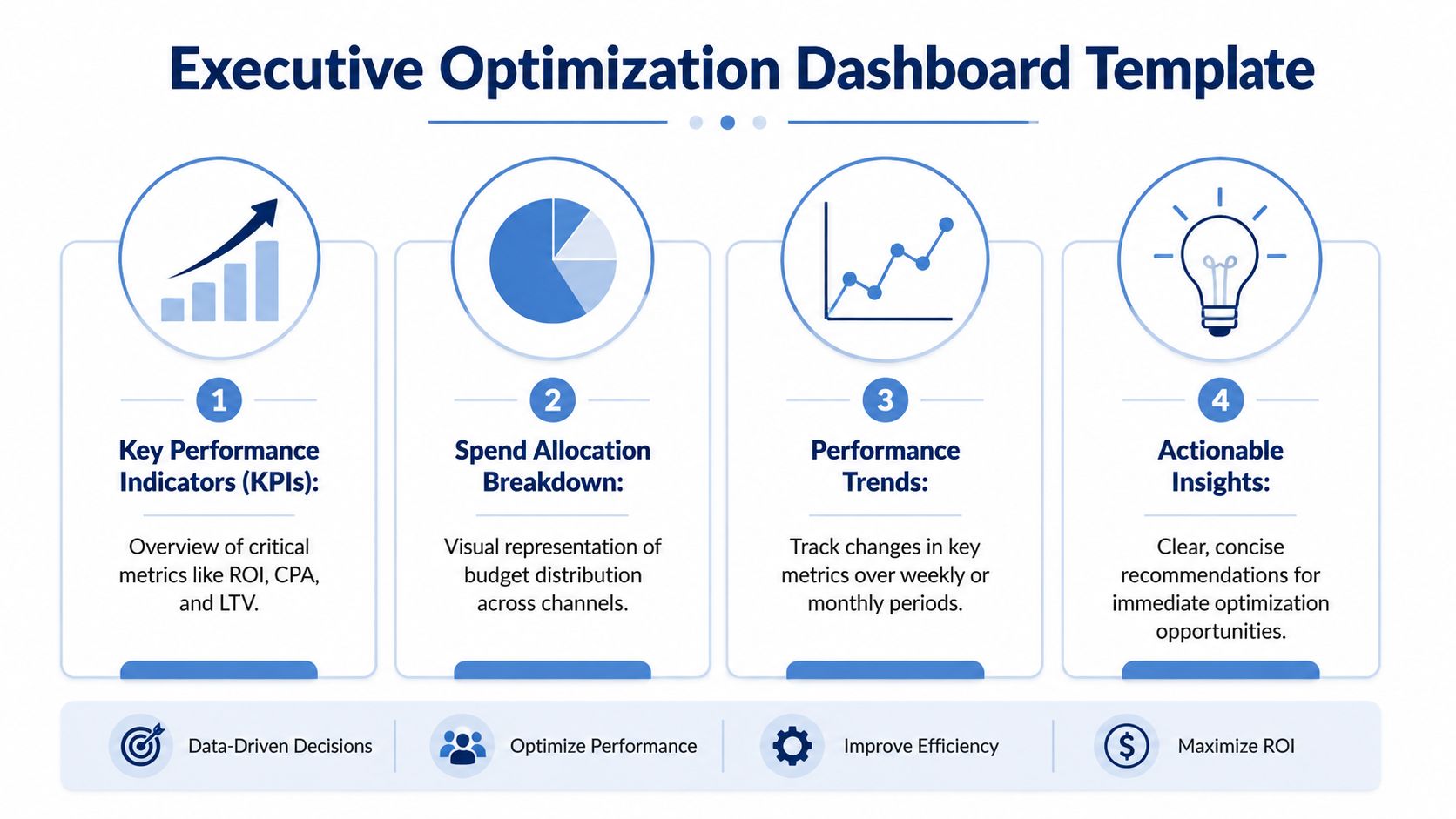
A serious optimization system needs two assets. First, a compact one-page dashboard that shows business reality. Second, an operating playbook with explicit decision logic that humans and machines can both follow.
What the one-page dashboard should show
Keep it to one page. If you need ten tabs to understand spend performance, your reporting is already failing.
I want four blocks on that page:
- Business outcomes with revenue, conversions, CPA, and ROAS
- Allocation view showing where spend is currently concentrated
- Trend lines that expose movement, not just snapshots
- Decision notes that explain what changed, why, and what happens next
The biggest reporting mistake I see is channel detail crowding out judgment. You don't need a sea of platform metrics. You need to know whether money is moving toward higher-return work and whether that movement is defensible.
The playbook needs if then logic
At this point, discipline becomes repeatable.
Your playbook should contain simple operating rules written in plain language. If a condition happens, then a response follows. That removes drama from budget decisions and makes automation possible later.
A useful playbook includes rules like these:
| If | Then |
|---|---|
| Tracking quality degrades | Freeze major reallocation until data integrity is restored |
| A campaign shows strong early efficiency and clean conversion quality | Increase budget within approved limits |
| A channel keeps reporting conversions without revenue contribution | Flag for incrementality review |
| A landing page weakens post-click performance | Route issue to CRO before increasing media spend |
Good reporting tells you what happened. A good playbook tells you what to do next.
You don't need a giant operations manual. You need enough clear logic that budget moves become consistent, reviewable, and trainable.
Common Questions About Spend Optimization
The biggest objection I hear is some version of, “This sounds right, but we're not a huge company.”
Fair. You don't need a giant team to act like an intelligent one. You need a cleaner decision process than your competitors.
Do I need a large team or a data scientist
No. You need one person who owns truth, one person who owns spend, and one shared definition of success.
In smaller businesses, the same person may wear multiple hats. That's fine. The prerequisite is clarity, not scale.
I've seen lean teams outperform larger ones because they centralize data, keep reporting tight, and refuse to let platforms self-attribute unchecked. They build a usable operating cadence instead of a huge analytics bureaucracy.
What if my data is messy and my budget is tight
That's normal. Start narrower.
Pick one revenue event. Clean one dashboard. Audit one major paid channel. Set a small experimentation reserve. Write a few decision rules. Then tighten the loop every month.
If you're thinking beyond marketing mechanics and into broader commercial impact, I'd also recommend reviewing Tagada's insights on revenue optimization. It's a useful reminder that spend decisions only matter when they connect to revenue quality.
When should I not automate budget decisions
Don't automate when your tracking is unstable, when your offer is changing constantly, or when you keep overriding the strategy every few days.
Also don't automate major cross-channel moves until you've built confidence in your measurement stack. Let people stay in the loop longer when the downside of a bad decision is high.
That's the trade-off nobody likes to admit. Automation amplifies competence, but it also amplifies sloppiness. If your business hasn't earned speed yet, forcing autonomy will create noise, not advantage.
My view is simple. Marketing spend optimization works best when you treat it as a system for reallocating capital with better evidence and faster execution. That's how you stop chasing efficiency theater and start building a machine your competitors can't match.